So many Tai Chi books look the same.
I write about technology, specifically AI, for my day job, so I’d consider myself as somebody who is fairly knowledgeable about the subject. And that’s why I think I know what I’m talking about when I say that right now, Tai Chi has got an AI problem.
I got an email recently asking me to review a book about “Seated Tai Chi”. The ‘author’ advised me that the book had been created using AI, so I responded by saying that I didn’t think I’d be able to review it in that case.
They didn’t reply, but I’m glad they were upfront about how the book had been created; really, I only had to look at the front cover to see that it had clearly been made with AI. It was obvious because they’d gone for the most generic “AI Slop” version of an image possible.
It’s that same “AI slop” style that you see everywhere these days – an uncanny-valley sheen to the images, usually a marker-felt style font, and a cover design where there’s no real hierarchy to the different elements. There’s been no real thought into where the eye is supposed to travel around the page. AI Slop designs tend to be like that — overwhelming to look at — they throw everything at you all at once, with an equal emphasis everywhere all the time. It’s exactly the sort of thing human designers are trained not to do.
I went to Amazon and looked up Tai Chi books and immediately saw how large the problem is. There’s an absolute deluge of AI slop-style Tai Chi books on there, and curiously, a lot of them seem to be aimed at the seated Tai Chi market. Why, I don’t know, apart from the fact that seniors have always been the most profitable part of the Tai Chi demographic. You’ll also find a bevy of “Tai Chi for seniors” and “Tai Chi over 60” books on Amazon.
Here’s an image I took of the first results shown when you search for “Seated Tai Chi” on Amazon so you can see what I mean:
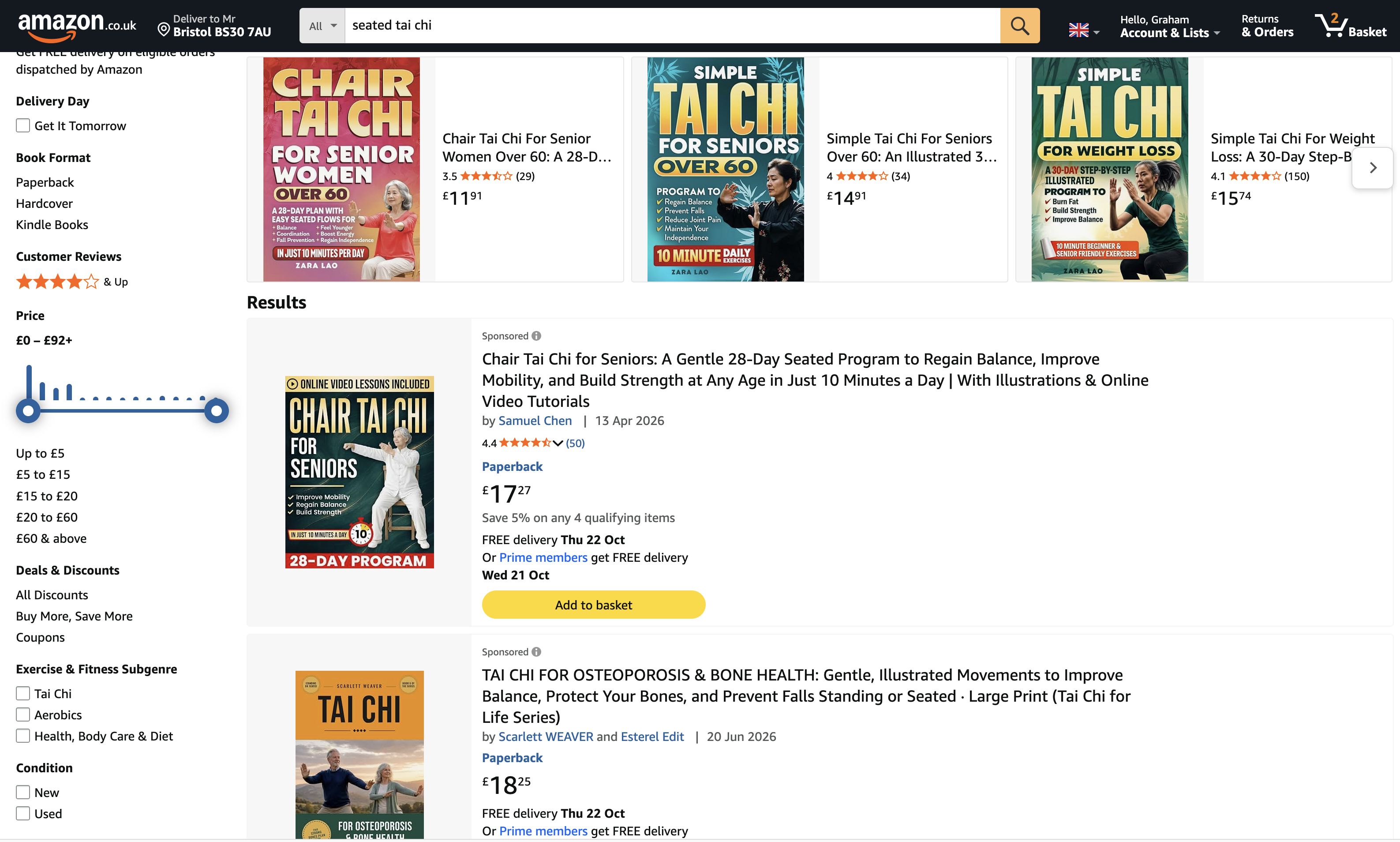
Can you see how the covers all have that horrible “slop” style to them?
Look.
I think AI is a tool that can be used for good or evil, just like any other tool. I just don’t understand why people are using it so badly. As an example of a positive use of AI, I wrote an article recently about how AI was being used to get Conn Iggulden’s books about Genghis Khan turned into a TV series, a series that would simply remain unmade forever without using AI.
But equally, I absolutely hate the way AI slop has taken over so many event posters I see either online or in real life — especially posters for Tai Chi events — and even made its way into posters in cafes or barbers that all have the same generic AI slop look to them. Walking down the street in my city on my lunch break, I can see that AI slop is everywhere and I find it very depressing. A simple poster made in Canva, with two fonts, a photograph and some carefully arranged text, could look far better than 99% of AI-generated posters.
Seeing AI slop designs actively puts me off your brand. I’ll actively avoid you, and I bet I’m not the only one.
In the Conn Iggulden example, AI is potentially enabling something that couldn’t otherwise exist. With the posters, it’s replacing something that people have been perfectly capable of making for decades, often with better results.
I’m not a knee-jerk anti-AI person. I’ve used AI images on this blog (which I write for free) in the past – just scroll down and I’m sure you’ll find some. I’ve used them when I couldn’t find a suitable image to use from a free photo library. But I’ve tried to make them look as good as possible. It’s been an experiment, but I’ll probably stop doing that in the future and stick to non-AI images simply because AI slop is starting to take over everything.
I get why people do it. It’s very easy to make a poster for something in AI in seconds. I just typed in:
“make me a poster for a tai chi seminar, October 9th at West Hampton Village Hall, 2.00pm, no experience necessary, wear loose clothing, see you there!”
And it made this:

I told it that this looked like a generic AI-generated poster, and asked it to make one that looked like it was designed by a human, and it produced this:
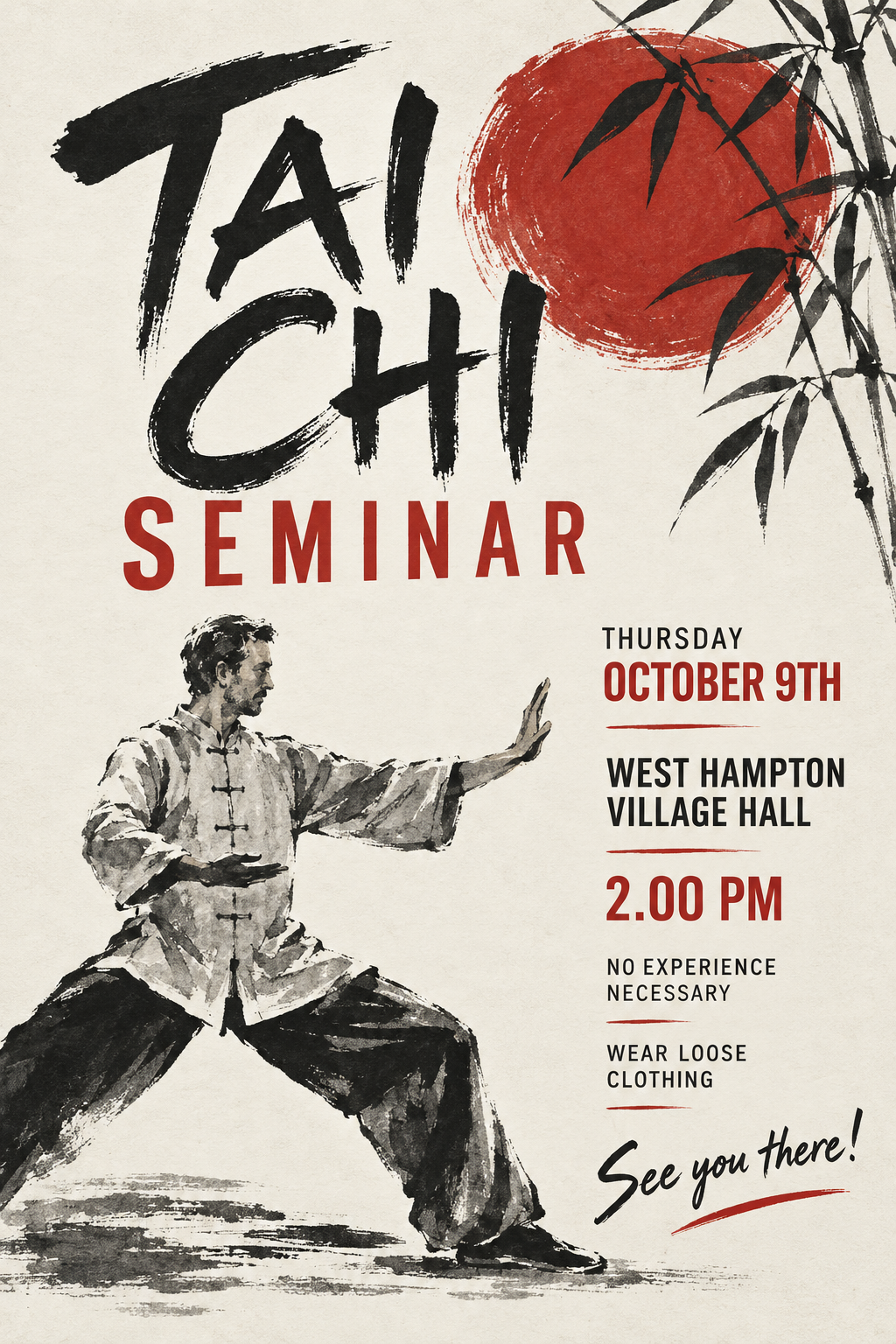
Ok, you could argue that there’s a better hierarchy on this one, with your eye starting on the main heading now, but there’s no real improvement to the AI aesthetic. It just changed one set of visual conventions it was imitating for another, and the legs on the man look completely out of proportion.
And things get worse if you ask to put too much information in. A designer would probably stop you and say you’re putting too much into the poster, but sycophantic AI just accommodates your request:
“make me a poster for a tai chi seminar, October 9th at West Hampton Village Hall, 2.00pm, no experience necessary, wear loose clothing, say “see you there!” – talk about the benefits of tai chi and why you might want to attend.”make me a poster for a tai chi seminar, October 9th at West Hampton Village Hall, 2.00pm, no experience necessary, wear loose clothing, say “see you there!” – talk about the benefits of tai chi and why you might want to attend. Tell them they can sign up to the website for membership at www.taichiwesthamptom.com and say there’s a 15% discount for your first 3 classes.”

You can see it just lets you overcrowd the poster with information. There’s WAY too much on here now for it to function effectively as a poster.
But despite design considerations, what I don’t get is why people don’t see that it all looks like AI slop?
There’s a parallel here with the martial art itself: somebody who doesn’t understand Tai Chi can imitate the external movements and produce something that looks superficially convincing. But the underlying principles are missing. AI-generated Tai Chi imagery can suffer the same fate – it looks like Tai Chi without actually being Tai Chi.


Richard J: I was going to drop it (because we’ve covered the topic), but I’ll venture a remark about “Chinese texts” and AI, just to add to the general comments about AI.
First of all, the early writings about Taiji (and other Chinese arts) tend to be so idiomatic and contextual that most knowledgeable Chinese will avoid them, unless they’re specifically trained in that area. The very few Chinese who make good translations of early texts must know the idioms of the time, the cultural cross-references, and so on. That’s why it’s almost always fruitless or even misleading to take some westerner’s translation of old texts as viable. Can AI accurately translate those same texts? Only if it is trained in the old meanings and idioms, etc.
I remember asking a woman who was born and raised in Chen Village to translate an old Chen Village document about the spear form. She did not practice Taijiquan and immediately refused, saying that she would not have enough background knowledge to accurately understand the old references. I found a semi-knowledgeable Chinese Chen-style practitioner who said he would try and translate it, but he said that while it looked like a straight-forward article to translate, there were a lot of references that if you didn’t understand them, the meaning was abstruse.
However, the worst thing about old texts is that they never say anything really useful. The old authors were never going to write down any usable “secrets” in books, etc. That’s why almost all Asian martial arts tend to have oral transmissions with only a few useful items being put in writing.
LikeLike
I thought those were “how to take steroids naturally” videos.
What would really freak me out is if AIs started making the books and videos on their own initiative, without anyone prompting them to.
LikeLike
How about those muscle bound tai chi as strength training videos? Now that’s entertainment!
LikeLike
Thanks, Mike. Yes, I think we’re largely in agreement.
My post was about using AI critically, not treating it as a teacher.
Most of the AI-generated books and videos on Tai Chi are filled with “slop” and inaccuracies. Many aren’t really about Tai Chi at all. They are marketing devices targeting curious people who don’t know enough to judge the material. I recommend avoiding them, whether they concern Tai Chi or other subjects.
On the other hand, I’ve used AI to translate Chinese texts that would otherwise take me a lot of time and effort to access. Being able to include Chinese texts in my searches and work with draft translations has opened up a much wider and deeper knowledge base.
AI can be a useful research assistant, but as you say, it can’t teach physical skills like Taijiquan or even throwing a curveball. You still need physical transmission for many things.
LikeLike
Richard J: I don’t think we particularly disagree. I don’t encourage anyone to use AI to learn Taijiquan (BTW, my interest is more in the body mechanics than the art): you don’t hold AI out as a shining light to learn from, parsing your words and reducing them. So we’re basically in agreement.
Taijiquan is more complicated than most people realize: it involves an entirely different way of movement that has been developed and polished over a very long period of time, not just some slight alteration of the way we normally move. I would be willing to bet the family homestead that there are no non-Chinese people (particularly westerners) who understand Taijiquan fully. Chen Village is very careful, in fact, about how much they will show native Chinese people, in terms of the full depth of knowledge.
If there are, as I surmise, few westerners who really have adequate information, then there is little chance that much viable information has been made available to Large Language Models. I.e., I don’t think AI’s are a decent source of information at this point in time. Obvious gimmicks like “learn seated Tai Chi” are probably just a waste of time, in my opinion.
I should add that I only made my original comment as a sort of warning: I don’t really care what people choose to do with their time. I’m simply offering a well-intentioned warning because a very large number of our western “Tai Chi” experts are ending up with no real qi or jin skills, and it’s unfortunate. Time runs out.
LikeLike
Graham, you’ve brought up some interesting issues. I agree that “AI is a tool that can be used for good or evil, just like any other tool.” Like any tool, you have to learn how to use it, and some tools are better suited to particular tasks than others.
I can’t really speak to the graphic design examples, since I have never used AI that way.
What about language AI? Anyone can request a 250-page book on Taijiquan for Seniors. AI will write it, but much of it will be slop. I suspect many of the people doing this are simply looking for a quick buck.
Fortunately, that isn’t the only way to use AI. We need to learn how to ask better questions. I tried a quick query: “What does Mike Sigman teach about taijiquan?” I don’t mean to pick on you, Mike; you were a convenient subject for my question.
I got a five-part answer. That question is much more specific than “What is Taijiquan?”, but it’s still fairly general. My next prompt was: “How consistent would the answers be if everyone asked that question?”
ChatGPT replied:
“The answers would be similar in broad outline, but not necessarily consistent in detail, emphasis, or accuracy.”
It identified three reasons: differences in interpretation, differences in source selection, and differences in personalization. My background in Chen Taijiquan and biomechanics, for example, influenced the comparison it made with Chen-style training. Someone without that background might receive a more general introduction.
I think this answer is telling, both in terms of the prompts we write and the answers we can expect.
First, if you want specific topics or approaches emphasized, ask for them. Second, read the sources. AI sometimes fills gaps in the available information, and those additions can be mistaken or speculative. Question where the information came from, and hold the AI accountable. Third, AI responses can be shaped by the conversational context and the kinds of answers you ask for. That can reinforce your existing biases.
If you want to avoid that, tell the AI to challenge your assumptions, look for contrary evidence, and distinguish established facts from interpretation and speculation.
There is a difference between using AI to produce something and using AI to learn something. The former can be done with very little expertise; the latter requires judgment, source criticism, and a willingness to question the output. It also requires effort on your part.
LikeLike
Graham, I think we’re talking about two different books by different authors. I’ll p.m. you.
LikeLike
Mike – I don’t want to name names, but I think I know what book you are referring to – the qi section was in the sample on Amazon…
LikeLike
Tai Chi (Taiji) is about how the body is moved and utilized. The general claim of real Chinese experts tends to be that they can control their bodies in ways that the layperson cannot. When you talk about pictures, postures, forms, etc., you’re generally talking about visuals … and far too many uninformed people think that Tai Chi is about the visual appearance of a magical “form” or “posture” that will imbue them with unexpected powers. In other words, they don’t really know what Tai Chi really is, even if an appreciable number of westerners claim to know it well enough to teach it.
The problem with AI representations of Tai Chi is that Ai (Large Language Models) are dependent upon the available information … and like most Chinese martial arts, the good information about Tai Chi is simply reserved for the top-level experts. People who think they can learn Tai Chi from a book, an AI representation, pictures, online courses, etc., are almost always wasting their time.
Which reminds me. I just purchased a book yesterday, written by someone who purports to be really well-versed in Taijiquan. As usual, I jumped first to the section on qi, jin, etc., (basics) to see what he knew. He obviously knew almost nothing, OR … he had some degree of knowledge but was not telling anyone. Either way, a person buying his book has nothing to gain. Doing Taijiquan without having a working knowledge of qi, jin, dantian-control, breathing, etc., is the same thing as being a novelist who has never bothered to learn the full alphabet. It does not compute.
LikeLike