So many Tai Chi books look the same.
I write about technology, specifically AI, for my day job, so I’d consider myself as somebody who is fairly knowledgeable about the subject. And that’s why I think I know what I’m talking about when I say that right now, Tai Chi has got an AI problem.
I got an email recently asking me to review a book about “Seated Tai Chi”. The ‘author’ advised me that the book had been created using AI, so I responded by saying that I didn’t think I’d be able to review it in that case.
They didn’t reply, but I’m glad they were upfront about how the book had been created; really, I only had to look at the front cover to see that it had clearly been made with AI. It was obvious because they’d gone for the most generic “AI Slop” version of an image possible.
It’s that same “AI slop” style that you see everywhere these days – an uncanny-valley sheen to the images, usually a marker-felt style font, and a cover design where there’s no real hierarchy to the different elements. There’s been no real thought into where the eye is supposed to travel around the page. AI Slop designs tend to be like that — overwhelming to look at — they throw everything at you all at once, with an equal emphasis everywhere all the time. It’s exactly the sort of thing human designers are trained not to do.
I went to Amazon and looked up Tai Chi books and immediately saw how large the problem is. There’s an absolute deluge of AI slop-style Tai Chi books on there, and curiously, a lot of them seem to be aimed at the seated Tai Chi market. Why, I don’t know, apart from the fact that seniors have always been the most profitable part of the Tai Chi demographic. You’ll also find a bevy of “Tai Chi for seniors” and “Tai Chi over 60” books on Amazon.
Here’s an image I took of the first results shown when you search for “Seated Tai Chi” on Amazon so you can see what I mean:
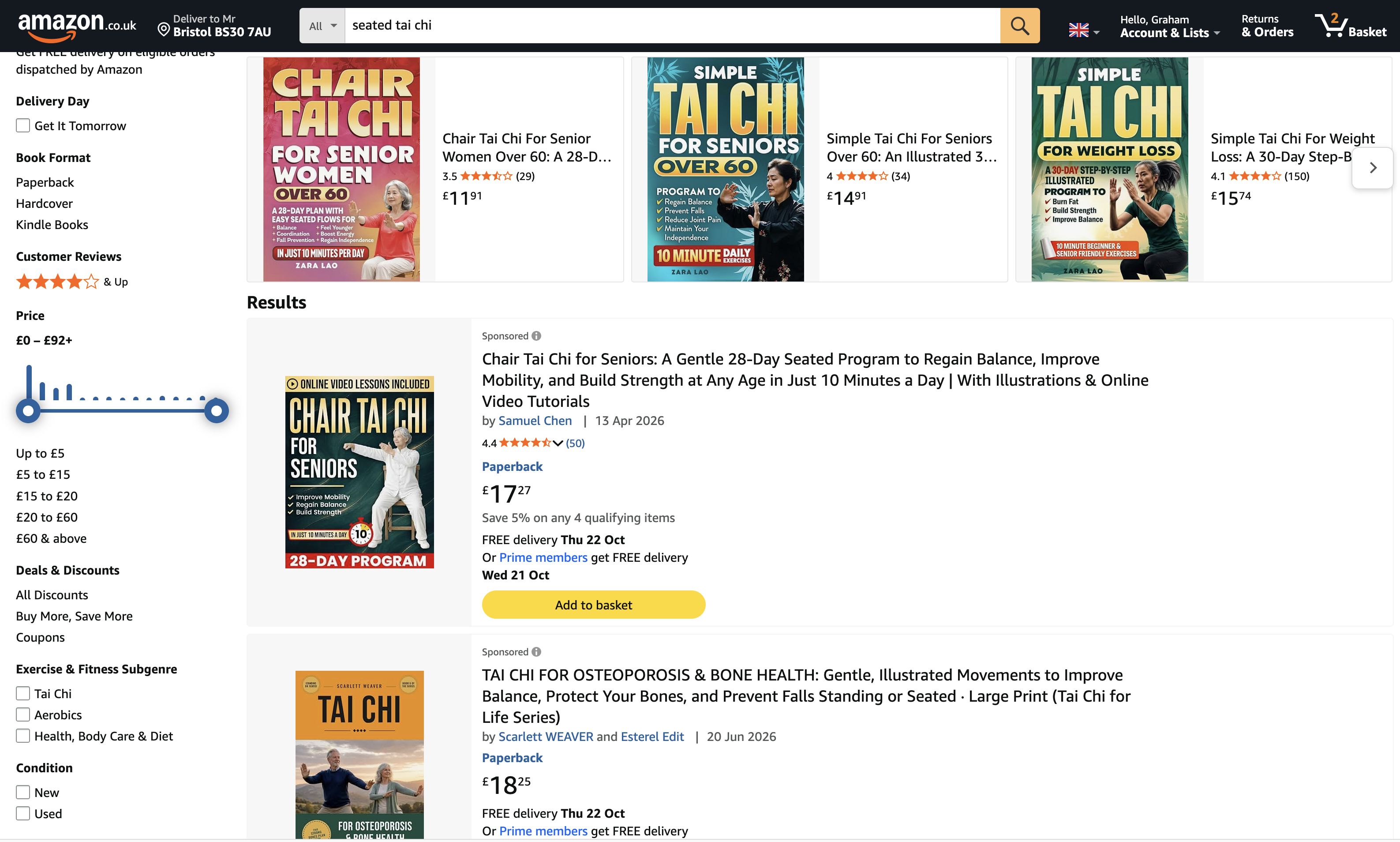
Can you see how the covers all have that horrible “slop” style to them?
Look.
I think AI is a tool that can be used for good or evil, just like any other tool. I just don’t understand why people are using it so badly. As an example of a positive use of AI, I wrote an article recently about how AI was being used to get Conn Iggulden’s books about Genghis Khan turned into a TV series, a series that would simply remain unmade forever without using AI.
But equally, I absolutely hate the way AI slop has taken over so many event posters I see either online or in real life — especially posters for Tai Chi events — and even made its way into posters in cafes or barbers that all have the same generic AI slop look to them. Walking down the street in my city on my lunch break, I can see that AI slop is everywhere and I find it very depressing. A simple poster made in Canva, with two fonts, a photograph and some carefully arranged text, could look far better than 99% of AI-generated posters.
Seeing AI slop designs actively puts me off your brand. I’ll actively avoid you, and I bet I’m not the only one.
In the Conn Iggulden example, AI is potentially enabling something that couldn’t otherwise exist. With the posters, it’s replacing something that people have been perfectly capable of making for decades, often with better results.
I’m not a knee-jerk anti-AI person. I’ve used AI images on this blog (which I write for free) in the past – just scroll down and I’m sure you’ll find some. I’ve used them when I couldn’t find a suitable image to use from a free photo library. But I’ve tried to make them look as good as possible. It’s been an experiment, but I’ll probably stop doing that in the future and stick to non-AI images simply because AI slop is starting to take over everything.
I get why people do it. It’s very easy to make a poster for something in AI in seconds. I just typed in:
“make me a poster for a tai chi seminar, October 9th at West Hampton Village Hall, 2.00pm, no experience necessary, wear loose clothing, see you there!”
And it made this:
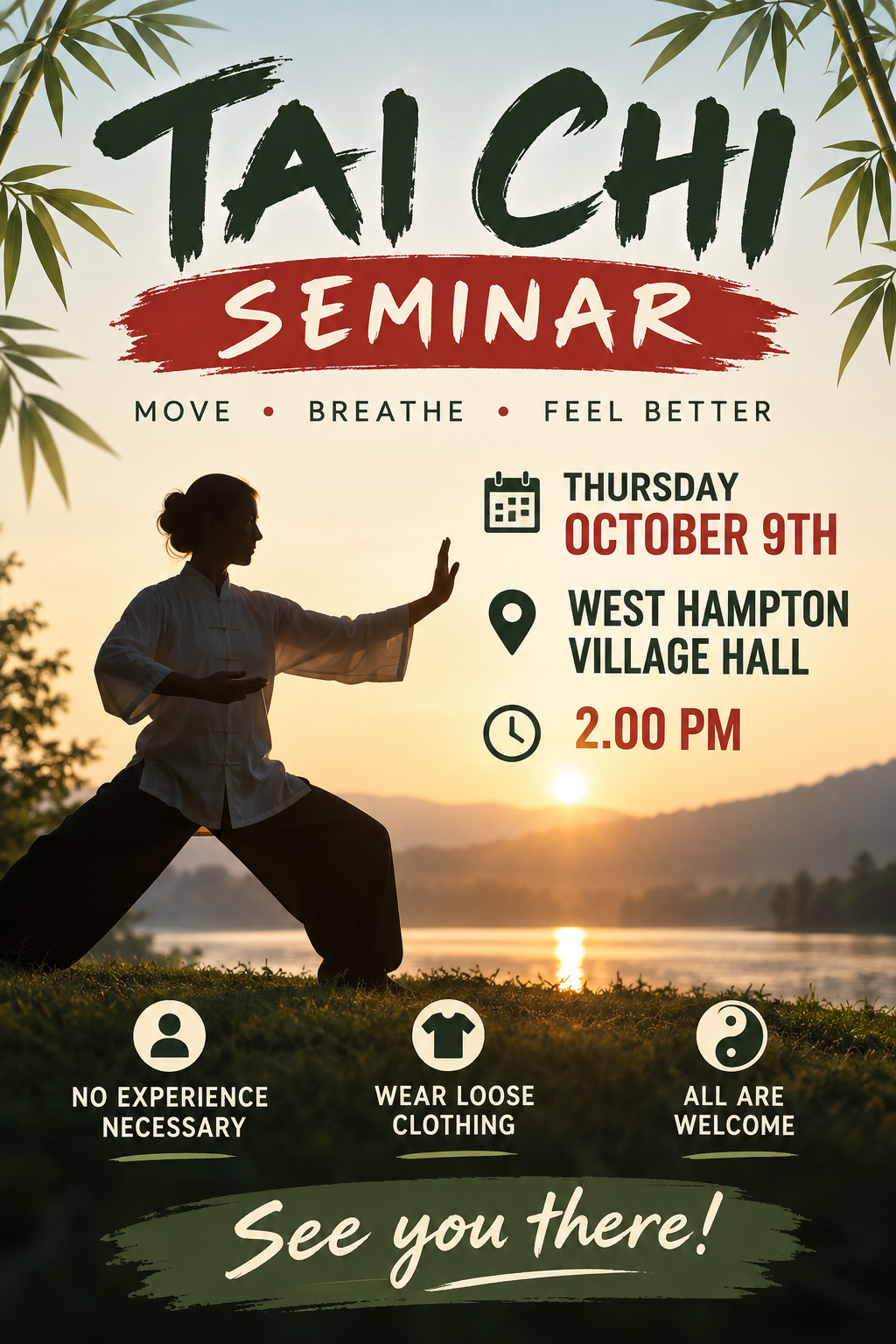
I told it that this looked like a generic AI-generated poster, and asked it to make one that looked like it was designed by a human, and it produced this:
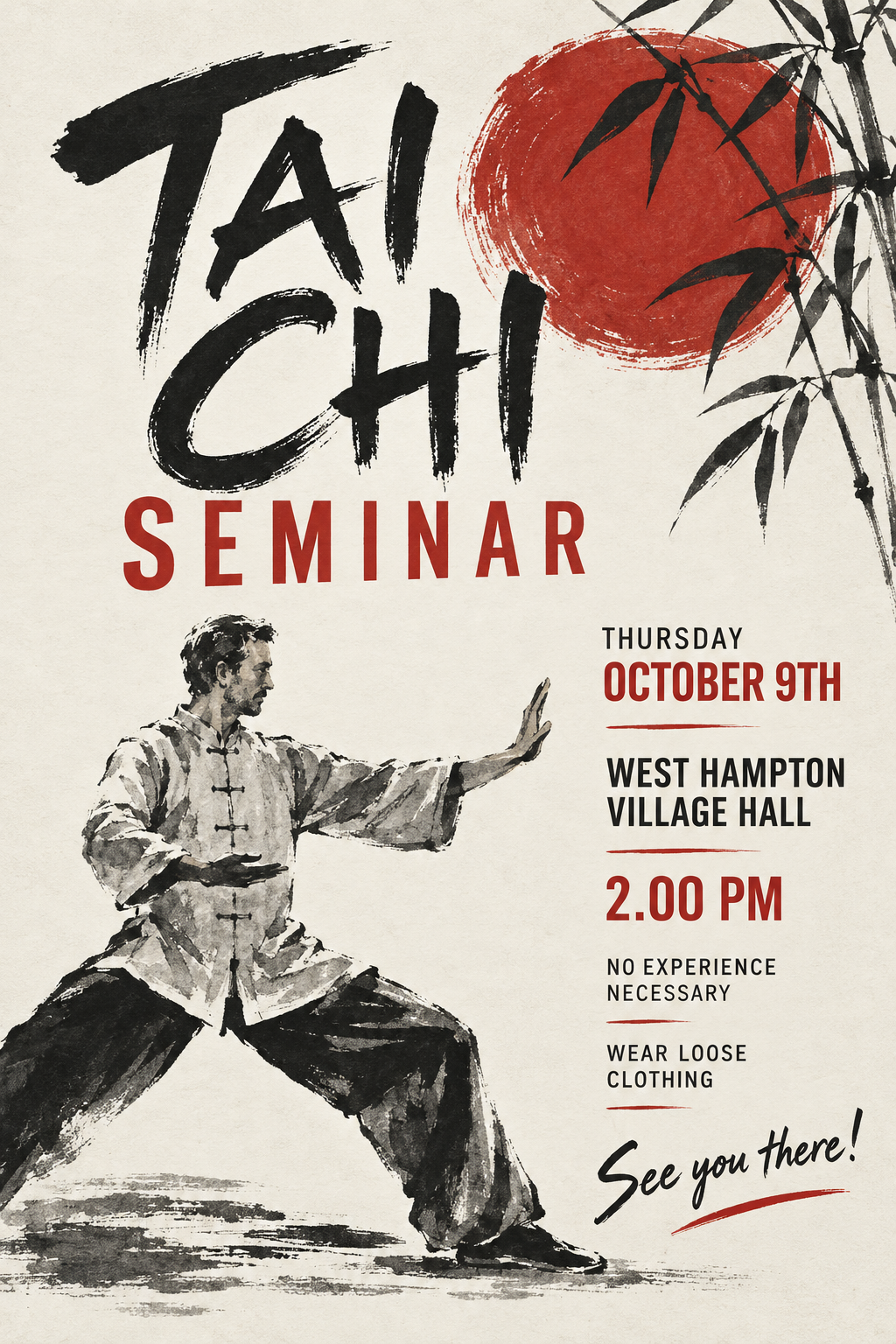
Ok, you could argue that there’s a better hierarchy on this one, with your eye starting on the main heading now, but there’s no real improvement to the AI aesthetic. It just changed one set of visual conventions it was imitating for another, and the legs on the man look completely out of proportion.
And things get worse if you ask to put too much information in. A designer would probably stop you and say you’re putting too much into the poster, but sycophantic AI just accommodates your request:
“make me a poster for a tai chi seminar, October 9th at West Hampton Village Hall, 2.00pm, no experience necessary, wear loose clothing, say “see you there!” – talk about the benefits of tai chi and why you might want to attend.”make me a poster for a tai chi seminar, October 9th at West Hampton Village Hall, 2.00pm, no experience necessary, wear loose clothing, say “see you there!” – talk about the benefits of tai chi and why you might want to attend. Tell them they can sign up to the website for membership at www.taichiwesthamptom.com and say there’s a 15% discount for your first 3 classes.”

You can see it just lets you overcrowd the poster with information. There’s WAY too much on here now for it to function effectively as a poster.
But despite design considerations, what I don’t get is why people don’t see that it all looks like AI slop?
There’s a parallel here with the martial art itself: somebody who doesn’t understand Tai Chi can imitate the external movements and produce something that looks superficially convincing. But the underlying principles are missing. AI-generated Tai Chi imagery can suffer the same fate – it looks like Tai Chi without actually being Tai Chi.