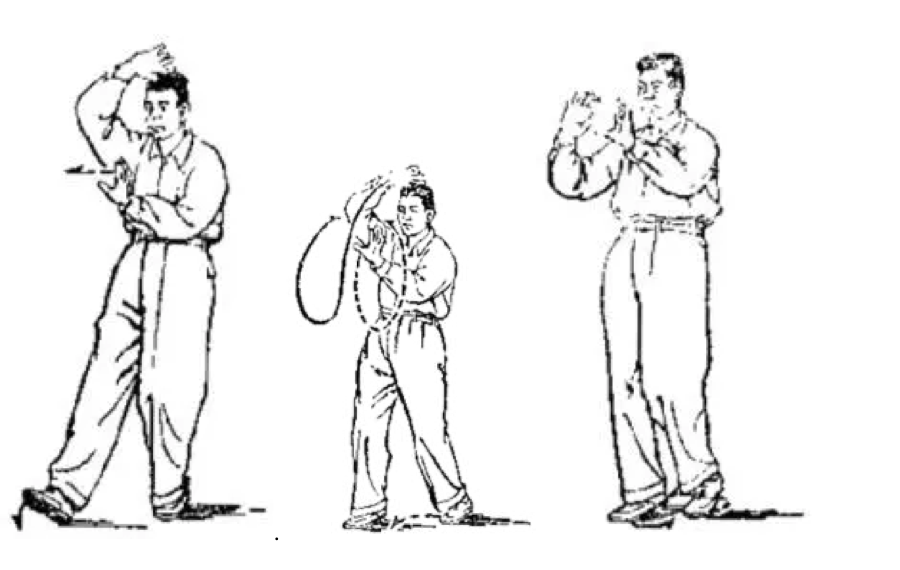
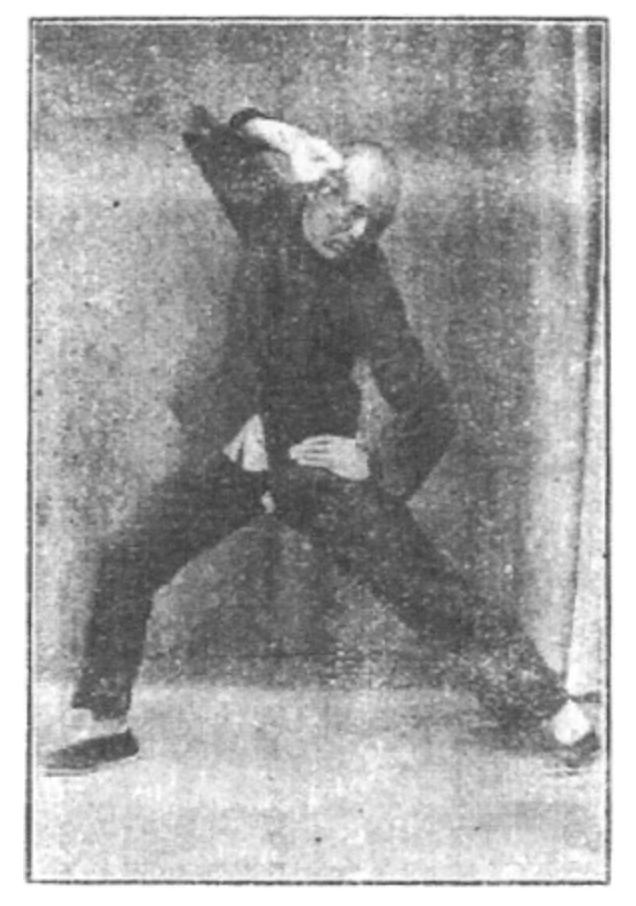
It’s no secret that Tai Chi is a series of circles. The body opening and closing using circulation motions, like a yin/yang symbol in action. But when you look at a Tai Chi form, you’ve got to wonder, what came first, the techniques or the philosophy? Was Tai Chi created in a moment of philosophical purity and clarity, or was the philosophy simply bolted on to existing military or self-defence techniques (or popular movements from theatrical or religious rituals) that were already as old as the hills?
What I’m wondering is, was there at some point a founder of the art who decided, as a starting point, that he was going to purposely create a martial art based entirely on a philosophy based on the Tai Chi symbol, which would be both the overarching principle and the raw material, out of which martial applications would be fashioned?
Or did the idea of doing things in circles come later, and get added to existing martial techniques, and in so doing, alter them forever?
Well, let’s look at what we know as fact.
Fact 1: Tai Chi does indeed contain nothing but circular movements. I’m sure somebody somewhere can point out a movement in a form that looks linear, but it’s quite possible that the movement is actually being created in a circular way, or it has degraded over time into something else. All we can do here is talk in broad brush strokes. If you look at a Karate form, or a Tae Kwan Do form you see lots of examples of linear movements, that are usually lacking from Tai Chi forms. From this we can conclude that some sort of philosophical idea must have been involved in its creation.
Fact 2: The techniques in Tai Chi forms look a lot like other techniques in other Chinese martial arts forms, so are not in any way unique. If you look at a lot of forms from the Shaolin Temple, or village styles from all over China, you see postures and movements that are very similar to the techniques found in Tai Chi. In a way, there is nothing new under the sun.
When solving a murder, detectives look for two things first – opportunity and motive.
When Tai Chi first appeared in Beijing in the late 19th century it was promoted along with the idea that it had a founder, an immortal Taoist called Chan Sang Feng who had created the art based on his observation (or a dream) of a fight between a crane (or possibly stork) and a snake. And while certain groups (see my last interview with George Thompson) on Wudang mountain still take this story very seriously, and possibly literally, modern scholarship has tended towards the idea that it was a fighting art from the rural countryside (Chen village being the most popular choice for origin) that found its way to Beijing via a young Yang LuChan, who taught it to those at the highest level of influence inside the Forbidden City.
Of course, the shadowy figure of Yang LuChan is never adequately explained, and since he was an uneducated nobody – a rural rube – nobody really made a record of his existence. The story everybody, including all the heads of the various Tai Chi families, follows, (because it’s the story the Chinese government approves of), is that he learned the art in Chen village. But I always wonder about that time in the 1860s when Yang and the very well educated and important Wu brothers were in Beijing, as being a time when Tai Chi could have been invented. The Wu brothers would have known the philosophy on which to hang it, and Yang would have had the martial skills to make it work and turn it into something that could bring the fractured court of the late Ching Dynasty together, bonding over something that was essentially Chinese in the face of constant threat from foreign powers. Yang and the Wu brothers together had both opportunity and motive, and regardless of whether you accept that interpretation of history or not, Tai Chi has been used as a political football ever since, especially by the current government to whom Tai Chi (the world’s most practiced marital art!) represents the ultimate form of soft power, spreading Chinese culture and influence the world over.
So, as a kind of counterpoint to my previous post questioning whether all Chinese martial arts come from military methods, I’d like to focus on one that definitely does – Xing Yi. Although, this really just emphasises my previous point because Xing Yi looks very different to most other Chinese martial arts and the reason it looks different is because it comes from weapons-based military methods and is therefore more concerened with military engagements than civilian. As our podcast series is showing, there is a verifiable historical connection between Xing Yi and soldiers – for example, the oldest historically verifiable practitioner linked to Xing Yi – Ji Long Feng, was a real life soldier in the Ming Dynasty army.
But the real reason you can tell Xing Yi descends from military methods is that you can simply look at it. The arms and legs are generally close together and close to the body, the posture is narrow and the direction of techniques is straight in front of you. Everything is done within the profile of the body. There are two main reasons for this 1) you were wearing armor and had to accommodate for the weight of it, and 2) you were using weapons, which were probably quite heavy, since they had to penetrate armor.
The Xing Yi we have today is what military arts would look like if you did them without wearing armor and using hand techniques instead of weapons. Of course, many people still do Xing Yi with a spear, but it’s rare to see anybody wearing armor doing it these days, which I think leads people to get the wrong idea about it.
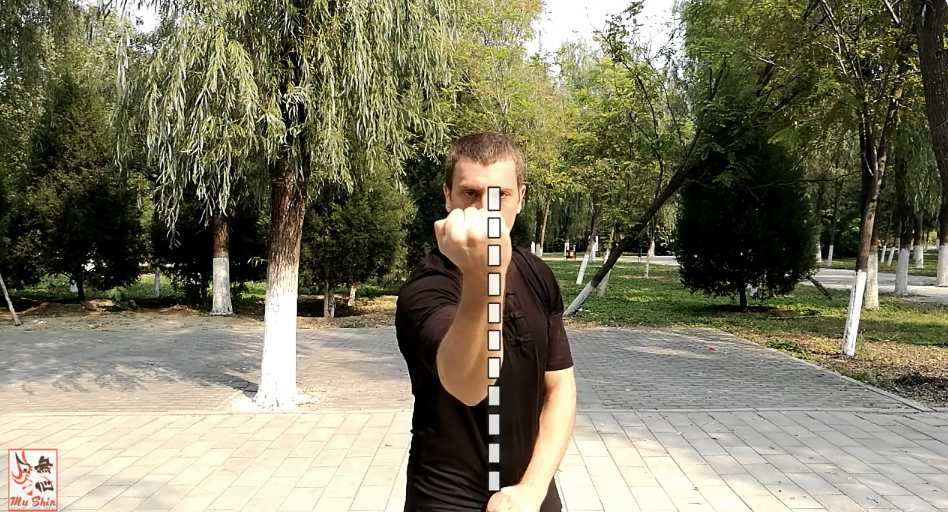
Take a look at this video of my friend Byron Jacobs from Beijing doing Xing Yi Zuan Quan (Drilling fist). Look how tight everything is to the body and how the hands are kept within the profile of the body:
Here’s an example:
All this leads me to this excellent new video by Karate Nerd, Jessie Enkamp called “I trained like a Samurai for a day”. Here he gets Dr. Kacem Zoughari, a Japanese martial arts expert to take him around the Samurai Museum Berlin. It’s pretty interesting then half way through, it gets super interesting because he gets to wear old Samurai armor and have a go with a few authentic weapons. Now this is really valuable because he tries to do Karate movements in the armor and very quickly realises that it’s completely inefficient and exposes all the vital parts of the body to strikes from the opponent. The expert, Dr. Kacem Zoughari, gets him to change his movements so that everything happens within the profile of the body and makes him use the footwork, momentum and body to power the arm movements. The strikes become hidden, and tight to the body rather than telegraphed and open… and bingo! It starts to look just like Xing Yi! He suggests a cross step at one point and it looks a lot like Xing Yi Dragon step. The strikes he has to do start to look like parts of the 5 Elements – Pi, Beng, Tzuan.
Take a look:
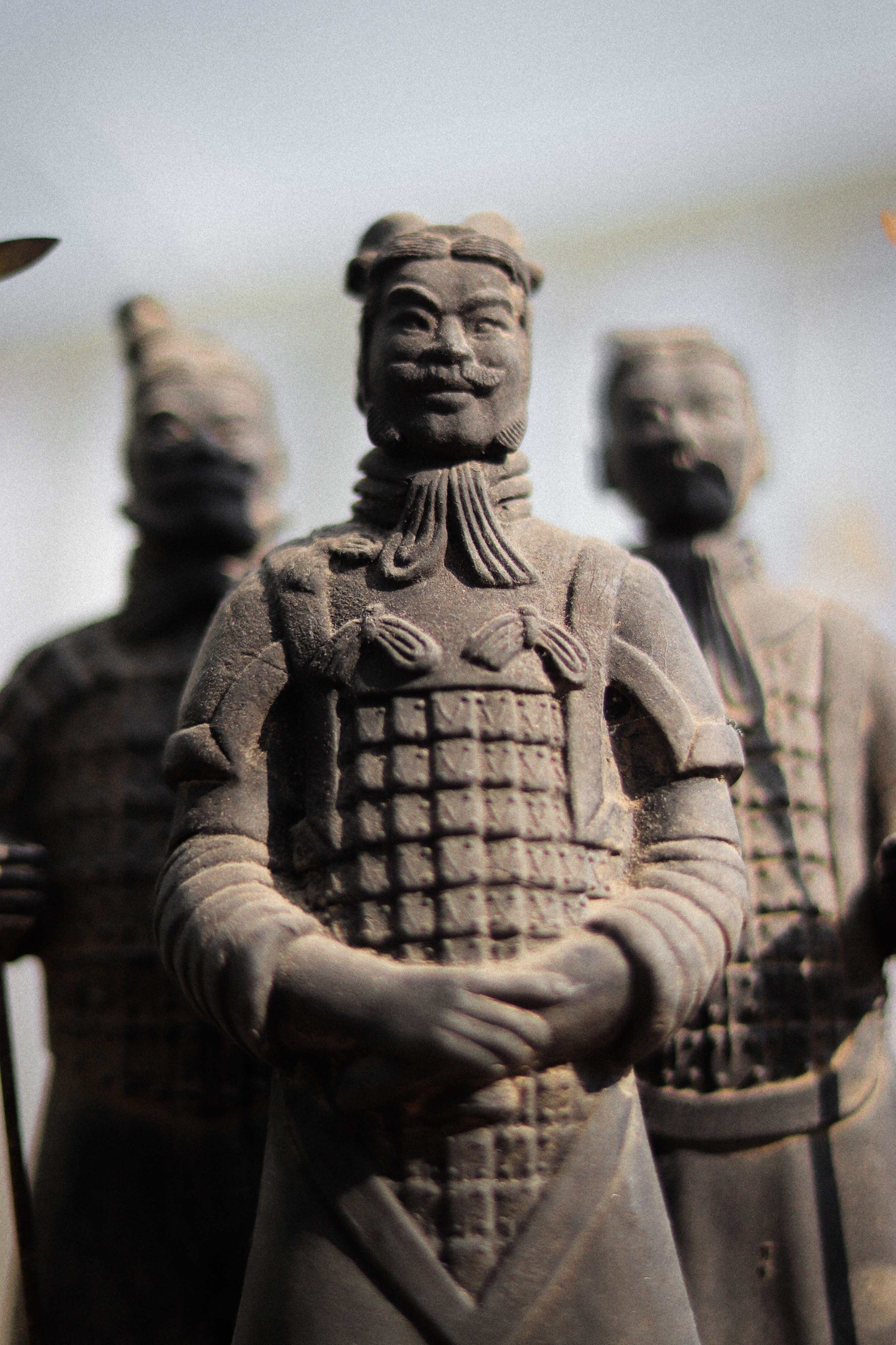
Now you may be thinking Japanese armor isn’t the same as Chinese armor and therefore none of this is relevant, but you would be wrong. That armor at the top of this post is not Samurai armor, (although I bet if you took the average person off the street and asked them what it was they would think it was Samurai armor). It’s based on Chinese armor from the Song Dynasty. This would have been officer armor, not what your average soldier was wearing, but the same principles would apply – you want your movements to protect your vulnerable areas – the neck and joints in particular.
Xing Yi is based on these principles – minimal movement, a tight profile, using the body, momentum and the step to power the arms, strikes based on timing rather than speed, etc. And that’s why it looks so different to something like Karate or Norther Shaolin or Long Fist, etc.
I think this post is perhaps a little half formed, but I want to get on to writing up my last lesson with Bear, so I’m going to put it out as is. Let the pieces fall where they may…
An interesting new video has been released by Will (a recent guest on my Tai Chi Notebook podcast) about his recent visit to Taiwan where he got to talk to various Taiwanese martial arts masters. It’s the start of a series and it looks like it’s going to be great – Will gets to walk down the smokey back alleys of Taiwan to find the martial artists and martial arts schools in Taiwan you wish you could. What’s not to like? Watch it here:
The blurb reads: “In the first episode, I meet up with my friend John Eusebio @longfistmantis to visit the bookstore of Liu Kang Yi. Mr Liu’s bookstore, Wuxue Shuguan has a huge collection of martial arts books, in both Chinese and English, and he has also spent decades collecting old and rare manuscripts. In this video he shares his insights on the development of martial arts from a military combat art, to an integrated system of both combat and health practice, as we see it today. He also shows us a copy of the Bubishi, the foundational manual of Okinawan Karate.”
Mr Liu talks about internal training, and how it relates to strengthening the tendons and fascia of the body, so that it can toughen and that can lead to more strength “qi” in the body. This all seems fairly accurate to me. (There’s discussion to be had about whether these methods were always a part of Chinese marital arts, or added in later from a different tradition, but that’s by the by). Then he talks about the 3 phases of development of Chinese martial arts, which is the part I wanted to pick up on.
To paraphrase, he says, the first is only martial training and not cultivating: it’s pure combat. No focus on health. This is the military period. The second is once it entered the civilian population. They train both combat and cultivate health, but separately, developing things like Yijinjing and Baduanjing. The third evolution was to combine combat and health, to bring both aspects together. Taijiquan is a good example of this.
Now, this is not a bad way of looking at the evolution of Chinese martial arts, but I think it’s a bit reductive, and crucially, it misses out a lot of other influences.
It’s a view that is not dissimilar to Peter Lorge’s in the book Chinese Martial Arts: From Antiquity to the Twenty-First Century which is that marital arts were all originally military arts and over time were simply dispersed from the army into civilian life.
Lorge’s position is laid out clearly in the introduction to his book starts with this:

I actually really enjoyed Peter’s lecture about the history of Chinese martial arts at the Martial Arts Studies conference 2017, but it seems that both Mr Lorge and Mr Liu both view Chinese martial arts as a kind of offshoot of military training, and nothing more, and in both cases the subject doesn’t even seem to be up for debate, it’s just presented as self obvious. The parallel between both of them is that they are relying only on written sources as their research into the matter. In fact, a lot of the cultural traditions of ‘common folk’ were not recorded, since writing belonged to the upper classes.
Now, I’ll admit, there can be no doubt that the intermingling of civilian and military life had a massive influence on martial arts practiced by people in villages, particularly after the Ming Dynasty army was disbanded and returned to civilian life after its defeat by the invading Manchu’s, who seized control of Beijing in 1644. Xing Yi in particular is one of the martial arts that traces its origins to that event, to military methods kept alive by ex soldiers who were now civilians who had had their weapons taken away. A review of Xing Yi’s existing methods and techniques today reveals a clear bias towards methods that work with a spear, which would have been the dominant weapon in the military for soldiers, and also a concern for facing an attacker who is in front of you, not to the side, which is another feature of military arts. However, most other Chinese marital arts are more biased towards barehand actions than weapons, contain sometimes elaborate sequences that would appear to be more at home on a stage than in a street fight, or involve making specific hand gestures or actions that hint at a ritual quality, that it’s clear, to me at least, that something more is going on here. Rather than just military methods being translated into personal self-protection methods, we are seeing other influences.
In China, there is a long history of martial arts being used in religious ritual, festival culture, spirit possession, street entertainment, Xiqu (Chinese theatre) and Wuxia (which literally means “martial heroes”, a genre of Chinese fiction concerning the adventures of martial artists in ancient China). I think those traditions have as much influence on the martial arts passed down to us today as the military does, and in a lot of cases, more. But, if you mention this to proponents of the “pure pugilism” brand of martial artist, they usually try and explain to you that all these things came out of marital arts. i.e. martial arts came first, and the dance/performance/theatre/ritual, etc came second. In fact, Lorge argues exactly this at 43.00 minutes in his lecture (which I still enjoyed!), despite cataloging wrestling going back centuries as pure entertainment for the Royal Court. This attempt to explain away the obvious flaw reminds me of when people present funky martial applications to form movements that clearly don’t look like marital movements. There are some frankly ridiculous martial application out there from well know teachers who, rather than just admitting that there’s no real martial application of this move that makes any sense, come up with something that just looks silly.
I’ve talked to a lot of martial artists on my podcast (20 episodes so far!) and I quite often broach this subject to see what kind of reaction I get, and I’ve found that the martial artists who live in Asia, or have lived there for some time, tend to have no problem with the idea that Chinese martial arts is a broad church of methods derived from various traditions. It tends to be the people outside of that culture who have a problem with what they’re learning not being a super-deadly killing art created for one purpose only – to be the best fighter! I suppose it’s because so many of these cultural traditions are still alive and well in Asia today that it’s hard to deny their existence. Just look around you. Martial arts training halls tend to have shrines in them where incense is burned as part of a religious ritual. Or the martial arts school participates in local religious festivals by enacting Lion and Dragon Dance routines, or giving a demonstration of martial arts. Or there is a semi-religious ceremony involved in becoming an indoor disciple, etc.
I think two things are going on here. First there’s a reaction against the modern Chinese trend of turning marital arts into a gymnastic demonstrations instead of fighting arts, and secondly there’s a reaction against the modern trend for making Chinese martial arts appear as spiritual and mystical in the same way Yoga is.
As Charles Holcomb wrote in 1990 , “Everywhere in China the martial arts either present themselves in the guise of simple exercises or are shrouded in arcane religious mysteries. Western enthusiasts often feel impelled to strip away these religious trappings and construct a version of the martial arts that is neither simple gymnastics nor religion, but emphasizes true hand-to-hand combat skills. The question remains, is this an authentic understanding of the martial arts?” [1]
I think that process of trying to present the martial arts as true hand-to-hand combat skills is very much alive and well today, I mean, its probably what most people are looking for when they start Kung Fu. I certainly was. But I think it’s also something of a reaction to the introduction of Chinese martial arts to the West, which came off the back of the Kung Fu TV series (which presented martial arts as mystical from Shaolin monks) and followed off the back of mystics like Alan Watts who presented a very counter culture sort of take on Eastern religion.
While there’s nothing wrong with that, my feeling is that it misses out on the wider, and weirder, historical context of the arts we practice today. They’re a rich blend of various traditions, and we should treat them as such.
[1] Theater of combat: A critical look at the Chinese martial arts by Charles Holcombe, Historian. Vol. 52 No. 3 May.1990. Pp. 411-431 Copyright by Michigan State University Press
The latest edition 13 of the Martial Arts Studies journal is out! Of particular interest to practitioners of Taijiquan this issue is Douglas Wile’s article on The Many Lives of Yang Luchan: Mythopoesis, Media, and the Martial Imagination. Yang Luchan is, of course, the patriarch of the Yang style, yet very little is actually known about him for sure, although that hasn’t stopped people filling the void with many colourful stories.
Yang Lu Chan
Here’s the abstract:
“The life of Yang Luchan, patriarch of the Yang lineage and founder of taijiquan’s most popular style, is a biographical blank slate upon which conservative, progressive, orientalist, and just plain rice bowl interests have inscribed wildly divergent narratives. Conservative scholar-disciples sought to link him with the invented Wudang-Daoist lineage, while progressives emphasized his humble origins and health benefits of the practice. His life (c.1799-1872) straddled the height of the Manchu empire and decline into semi-colonial spheres of foreign influence, while successive generations of Yang descendants propagated his ‘intangible cultural heritage’ through Republican, Communist, ‘open’ and global eras. Practiced world-wide by hundreds of millions, taijiquan’s name recognition made it ripe for media appropriation, and Yang Luchan has been remythologized in countless novels, cartoons, television series, and full-length feature films. The case of Yang Luchan offers an unusual opportunity to witness an ongoing process of mythopoesis against a background of historical antecedents and to compare these narratives with traditional Chinese warrior heroes and Western models of mythology and heroology. If the lack of facts has not constrained the fabrication of invented biographies, neither should it discourage the quest for historical context as we sift and winnow truth from trope in examining the patterns of motivated reasoning that characterize the many reconstructions of Yang’s biography.”
We’ve recorded a new episode on our long running ‘history of Xing Yi’ series. There’s no actual Xing Yi in this episode – it’s more about a period of Chinese history that little is written about – the middle to end of the Yuan dynasty.
Horse and Groom, handscroll after Li Gonglin by Zhao Yong, China, Yuan dynasty, 1347, Freer Gallery
In the middle to late part of the Yuan Dynasty the former Confucian ruling class came back with a vengeance and started a downward spiral that would ultimately lead to the fall of the dynasty. In this episode we examine how and why this happened, which will set the context for the important events at the end of the dynasty in the next episode.
If you like Chinese history, then you’ll enjoy it.
What has this got to do with fighting? Photo by Vladislav Vasnetsov on Pexels.com
Thinking about my last post with the discussion from Tim Cartmell. Everything Tim says is great advice for people interested in learning to fight and applies to what we know as “martial arts” today, but I do wonder about the very starting point of their discussion, which is the assumption that underlies it all – “martial arts were created to teach people how to fight”.
It sounds so obvious that it’s not even worth mentioning. I mean, it’s almost farcical to think otherwise… but is it true? Were they all “created” for that purpose? How can we be sure?
Martial arts as practiced in Western countries today are obviously about teaching people to fight, but it seems to me that once you trace “martial arts” back further and further it becomes harder to separate them out from cultural practices that included “fighting”, but also encompassed a whole lot more – a whole world view that is no longer with us.
It seems to me that most people today see “martial arts” as the original, stripped-down, very concentrated pure combat practice, that over time has become waylaid with cultural and religious baggage that has been added after the fact.
I think they’ve got it backwards. I think it “martial arts” starts off as part of a really rich and deep, varied practice incorporating all sorts of aspects of the complex array of cultural activities… and in modern times we have stripped out the combat elements and separated them off from the other elements – to pursue in our leisure time, or by governments for political means. That was certainly what happened in China in the early 20th century, for example, with the Kuo Shu movement.
Does this matter? Does it make any difference to what we practice today. Probably not, but I think it’s a more honest view of the subject, and explains why we still have a lot of these cultural practices associated with marital arts, like the picture of Lion Dance above.
This period of Yang LuChan in Beijing (around 1860) is really the time we see the arrival of “martial arts” as a separate subject in Beijing, taught in its own right and not as part of something else, like a village ritual or festival rite, or as an entertainment performance, and different to what soldiers learned. Yang was teaching soldiers, yes, but he wasn’t teaching them how to fight on a battlefield. He was also teaching rich people. This was the newly created niche that “martial arts” fitted into – the serious leisure practice. After the Empress Dowager takes control and the Wu brothers are “out”, Yang loses his patronage and has to open a commercial school in Beijing, and it becomes a family business with his sons teaching too.
The “martial arts” as we know them, and as they were created, are a civilian occupation – the serious leisure practice of already tough men (think Yang LuChan’s banner men that he taught in Beijing), or the rich middle/upper class idlers with too much time on their hands (hello the Wu brothers).
The martial arts, as we know them, have very minimal connection to actual military arts. Those were for killing people, and required weapons. As General Qi Jiguang wrote in his 1560 Boxing Classic,
“(Boxing arts do not seem to be useful skills for the battlefield, but they exercise the hands and feet, and accustom the limbs and body to hard work. Thus they serve as basic training. Therefore I have included this discussion of them as the final chapter, in order to complete this study [of military theory].”
As you can see – boxing arts were being practiced in Ming Dynasty China, but they were not considered part of regular military training. They were part of something else.
After battling hard through various technical challenges I’ve finally managed to create a Tai Chi Notebook podcast with humans on! (Previous episodes of my podcast have been a robot voice reading my blogs). I’m pleased to have my good friend Daniel Mroz on board for my first real episode where we have a conversation about what Chinese martial arts might be.
You can find it on all the usual places you find podcasts – search for The Tai Chi Notebook on Apple podcasts, Spotify, etc.. or here’s a link:
What is the relationship between Chinese martial arts and Chinese theatre, religion, mime, serious leisure activities and military tactics? How do all these factors intermingle and produce the arts we have today? In this wide ranging discussion between Graham Barlow of the Tai Chi Notebook Podcast and Daniel Mroz, Professor of Theatre at the University of Ottawa we tackle all these subjects and more. As well as being a professor of theatre, Daniel is also a Choy Li Fut and Taijiquan practitioner and has spoken at the Martial Arts Studies conference and contributes articles to various journals including the Martial Arts Studies journal.
Podcast Notes
1) That Daniel Mroz quote in full:
“By ‘Chinese martial arts’, I refer to folkways that began to assume their present forms from the mid 19th to the early 20th centuries, at the end of the Imperial, and the beginning of the Republican periods of Chinese history. These arts train credible fighting abilities through exacting physical conditioning; through partnered, combative drills and games; and through the practice of prearranged movement patterns called tàolù 套路 (Mroz, 2017 & 2020). For millennia, up end of the Imperial period in 1912, China explicitly understood itself as a religious state (Lagerwey 2010). Communities across China not only used their martial arts to defend themselves, they performed them as theatrical acts of religious self-consecration, communal blessing, and entertainment in an annual calendar of sacred festivals (Ward, 1978; Sutton, 2003; Boretz, 2010; Amos, 2021). Modernization, and secularization at the end of the Imperial period removed the original context of these practices. The Chinese martial arts were transformed over the course of the 20th century by both their worldwide spread, and by their ideological appropriation by the Chinese Republic of 1912, and the Communist state that succeeded it in 1949 (Morris, 2004). Their religious heritage forgotten in many social, and cultural contexts within greater China, and internationally, the arts we practice today combine a legacy of pragmatic combat skill, religious enaction, participatory recreation, competitive athleticism, and performed entertainment.”
This episode explores the connection between the martial arts of the great Song generals’ tradition and Chinese theatre, which emerged during the height of the Yuan Dynasty.
Xing Yi Part 13, The Water Chestnut Mirror
I would also recommend this short, funny and smart crash course on Chinese Theatre as background ‘reading’:
A lot of the “x number of shoes, y number of hairdos” regulatory stuff was added later by the Confucians from the Ming onwards. In the Yuan it was much more Vale Tudo in spirit 🙂
To see some Yuan Dynasty plays we talk about in action I’d recommend this page, which also gives some more background on Yuan Zaju plays.
A mural from a temple in the Shanxi province, dated 1324. It shows zaju actors and musicians. Image source: The Archives of Finland–China Society.
A friend pointed me to this great video “A brief history of China”, by Kristofer Schipper. I really like his down to earth views on the subject and the many misconceptions about China that can arise (and have happened historically) from trying to view it through a Western lense.
He has a few more videos too, which offer great insights, like this one:
Jack Slack was the first person to draw my attention to the parallel between rioters storming government buildings that happened in China’s Boxer Rebellion around 1900, and the storming of the Capitol Building by Trump Supporters in 2021. Both involve a kind of “spirit possession”.
Of course, America, along with many European nations, was involved in the Boxer Rebellion:
“In 1898 the Yellow River burst its banks and destroyed the harvest in much of Northern China, but this misfortune was followed by an agonizing drought which dried out the land and hardened the dirt. As young men went hungry and without work, some Chinese noted the connection between the anger of nature and the construction of train tracks, telegraph lines and churches since the arrival of foreigners in the Qing Empire. Anti-foreign sentiment brought together groups of peasants practicing martial artists and calling themselves the Righteous Society of the Harmonious Fists—though the West came to know them as “The Boxers”. The Boxers attacked and murdered missionaries across the Empire and in the summer of 1900, Tianjin and Beijing were plunged into chaos as the Boxers received the blessing of Empress Dowager Cixi and the Imperial army. 400 foreigners and 3000 Chinese Christians endured a two month siege in Beijing’s legation quarter—a stone’s throw from the Imperial Palace but completely helpless. The Boxer Rebellion is a story about agriculture and diplomacy, magic and court intrigue, and it stands as both the last great event of the Victorian Era and the beginning of the end for the Qing Dynasty. ” – Jack Slack
Of course, I’d contest that the events that lead to the end of the Qing Dynasty had started much earlier, back in 1860s. It was these conflicts with foreign powers and internal rebellions which lead directly to the creation of Tai Chi Chuan, as we discussed on our History of Tai Chi podcast series. Yes, I’m sorry, the myth of a Taoist inventing Taijiquan after a dream about a snake and a crane, is just a fairytale. The real reason is much more pragmatic.
Jack has done an excellent podcast episode on the Boxer Rebellion, which he’s just released to the public, instead of being behind his Patreon paywall. If you want to find out more, have a listen:





 The Tai Chi Notebook