We may be reaching the end of the ‘Tai Chi Master vs MMA guy’ phenomena that has lit up the martial arts world in the last couple of years. I mean, how many more old guys do we need to see knocked out to make the point?
In light of the most recent fight, Will of Monkey Steals Peach has interviewed Byron Jacobs, who is deeply embedded in the martial arts world of Beijing, to get a fuller picture of events. I think it gives the most all-encompassing overview of the phenomena, and why it is happening, I’ve heard yet. See what you think:
A new video in the long line running ‘Tai Chi master vs MMA guy’ series got posted the other day. Rather than talk about it here straight away I wanted to see what the reaction was from the martial arts community, and boy, it didn’t disappoint!
This whole MMA vs Tai Chi genre was started by the now-infamous Xu Xiaodong who posted the first video showing what happens when a delusional Tai Chi “master” gets in a fight with an MMA guy.
The qualifications for being a “Tai Chi master” these days seem to be that you have:
1) The backing of Chinese state TV, who will post lots of faked videos of you performing magical martial skills.
2) You have a sufficient number of minions and followers to do you bidding.
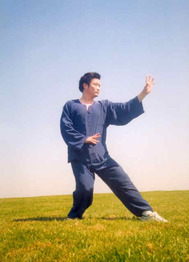
3) You look the part (silk pyjamas) and have can talk a good talk about your abilities.
Of course, none of these martial abilities are grounded in reality, so when you get in a challenge match with an MMA guy it usually ends quickly and badly for you. Chinese martial arts, particularly Tai Chi, is the focus of the soft power emanated by Beijing and the hyper-nationalistic Chinese government on the global stage. Therefore, publicly humiliating a Tai Chi “master” doesn’t make the MMA guy very popular in China, and Xu Xiaodong has been badly persecuted – his social credit score is now so low that he can’t even travel on trains and his social media accounts keep being deleted.
After the initial video of Xu Xiaodong surfaced he didn’t let the persecution put him off and he kept calling out the masters boasting of their skills on state TV. Challenge after challenge followed. One involved self-proclaimed Tai Chi/Xing Yi Master Ma Bao Guo who had previously paid a retired cage fighter Peter Irving in the UK to perform in a demo video that made him look good, and was boasting that this video was proof he was the real thing.
In this excellent article, Peter recounts the story behind the video.
Here’s the video:
To anybody that knows anything about fighting it’s obvious that Peter is just feeding attacks to Ma who reacts with some twitching responses. The fact that some people thought this was real says a lot about the mentality of minions and followers.
Xu and Ma’s challenge match was all set to go ahead (and would have ended the same way as all the others) but Ma actually called the police on his own challenge match and it was called off!
But Ma Bao Guo wasn’t giving up. At 69 he recently got in a challenge match with a San Da (Chinese kickboxing) guy who was 20 years younger than him. Here’s the video of Ma Bao Guo vs the San Da guy
As expected, it was a shocking display of ineptitude, and as I said, the reactions of the martial arts community have been interesting. Here are a few of the common responses I noticed:
The rebranding of this as MMA vs Tai Chi to fit the narrative.
The fight is actually between two practitioners of Chinese styles – one is Tai Chi/Xing Yi and the other is San Da, which is a homegrown Chinese kickboxing style. But it instantly becomes “MMA” because it fits the story created so far.
“The Chinese have absolutely ruined kungfu.” Hard to argue with this really.
Concern for Ma’s safety.
This was my first thought – getting knocked out like that at 69 could have been fatal, and will likely have long-term effects.
He needs to be sued for fraud.
I wonder how many minions and followers he convinced of his nonsense over the years? I wonder what they think of his teachings now? If they gained health benefits are they now invalid?
Why don’t those Kungfu guys that angrily complain about the fraudulent masters’ performance themselves step up to make Kungfu great again?
It seems like a bit of false reasoning to me. I think the point is that if you are going to claim abilities then you need somebody to test them. Perhaps you need to be more realistic about what you claim? The reason Xu is not challenging 20-year-old kickboxers, is that they’re not claiming magical abilities on state-run TV. And also, it’s usually the old masters doing the challenging!
“I look at someone getting beaten and it has little to do with me or my training.”
True – exposing the delusional Tai Chi masters doesn’t mean that Tai Chi itself is delusional. If you are honest about what you can and can’t do, then that’s a good thing.
But then we get to number 7, and this is the one that really gets my goat…..
7. “It says a lot about those that post these clips.”
What???
Aiming your ire at the guy lifting the curtain to show a little old man, not a wizard, behind it is something you’d attribute more to the mad emperor Nero, (who had a habit of shooting dead the bearers of bad news) than the sane and balanced mind of Marcus Aurelius, one of the last ‘good’ emperors of Rome.
The event was done publicly. There were press there with cameras. Ma had clearly arranged for this to be broadcast. And I can bet if (by some miracle) Ma had actually defeated the San Da guy, then heralds of his victory would be celebrated far and wide by everybody who purports to be a Chinese martial artist.
Stop trying to shame people for exposing the bullshit.
You can’t have it both ways. If you do something sportive and public then it remains pubic, regardless of whether you like the outcome. The point of challenge matches is to see what works. Part of the appeal of MMA for me is that it’s on one hand sport, but on the other a long-running public education project about what works in fighting.
I can already feel the voices of those “MMA is not for the street!” guys building as I write this, but you know – screw them. A good answer to that is that if you can’t make your art work with a limited rule set that simulates a real fight as closely as we can make it, how are you supposed to make it work when the other guy isn’t even restricted by those few rules?
San Da, boxing or MMA is a young man’s game. Old masters of whatever martial art it is should really stop trying to engage in it altogether. Putting yourself in a position where you can get knocked out cold at 69 years old is just a terribly bad idea. The implications for what remains of your life are serious. There’s a reason that Muay Thai fighters’ careers usually end in the 20s.
The whole thing was folly.
Ma was delusional for
Thinking that whatever martial skills he had gained from a lifetime of pushing minions, followers, and paid performers, around while wearing silk pyjamas could actually translate into real fighting skills.
Thinking that you could do this at 69 years old.
But human beings are delusional. And in normal life, we can get away with it up to a point because there are no serious consequences. I talked about this in my recent interview on the Martial Arts Studies podcast. My point was that nature is not delusional, which is why the Song Dynasty had such success economically and military thanks to the Li Movement, which aimed to get back to looking at nature for what it is, not what we think it is. That was the point I was making about studying animal methods (that I don’t think my interviewer quite picked up on) that a snake does what a snake does regardless of what human beings think about it, or even better, with no human beings around at all.
Similarly, MMA or San Da or challenge matches bring martial artists into direct contact with nature, or reality, if you like. And sometimes that can be a painful act of recognition.
It should be celebrated, not turned away from. Look it full in the face and learn. As the old martial arts saying goes:
“In martial arts you either win or you learn.”
It’s probably not a good idea to wait until you’re 69 to start learning.
Prof. Paul Bowman of the Martial Arts Studies podcast interviewed me yesterday about various things like this blog, martial arts, the intersection between Xing Yi and BJJ. It was a fun chat because I have known Paul for years and used to be his Tai Chi teacher.
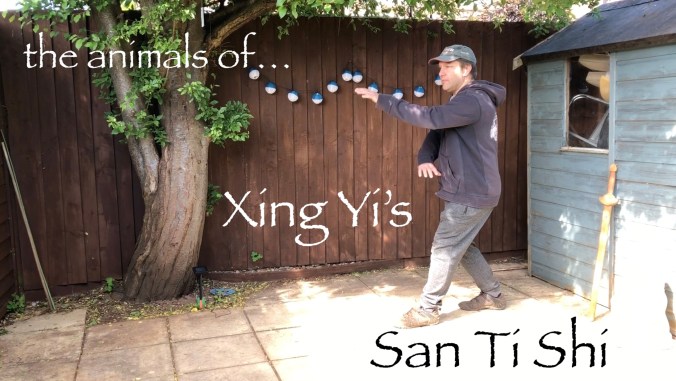
The San Ti Shi posture is the fundamental standing posture of Xing Yi Quan. You could describe it in terms of angles, vectors and structures, but my interest lies more in reviving the animals of Xing Yi, and trying to move conversations in Xing Yi circles back towards nature and animals.
So, with that in mind, I thought I’d take a look at the 5 animals that make up San Ti Shi in more detail through a few videos that present simple animal routines (linking sequences) that can be easily learned and followed.
The animals of San Ti Shi are (in no particular order):
Dragon (Long)
Eagle (Ying)
Bear (Xiong)
Tiger (Hu)
Chicken (Ji)
…and the final element is Thunder Sound.
Let’s look at each one in more detail and what it contributes to the San Ti Shi. Because we’re currently on lockdown I can’t show applications on somebody but I talk about how they would work and show how the moves would work with a sword.
1. Dragon
From the Dragon comes the concept of Dragon Body – the counter-rotation in the spine that means you are always ready to produce power. The dragon emphasises loose, relaxed coiling movements.
2. Eagle
Eagle is a powerful predator and has the most exaggerated postures of all the Xing Yi animals. Eagle provides the Eagle Claw to San Ti Shi. Eagle and Bear are always practiced together, but this sequence has more emphasis on Eagle than Bear.
3. Bear
Bear provides the concept of Bear Shoulders – a very round structure to the shoulders. Bear is heavy, relaxed and rounded.
4. Tiger Embrace
The Tiger lends Tiger Embrace to the San Ti Shi posture. This is the feeling of always embracing something. The tiger is a powerful animal, and the linking sequence is fast-paced and full of energy.
5. Chicken Leg and Thunder Sound
The last animal we’ll look at is Ji – Chicken. The chicken provides the Chicken leg quality to San Ti Shi. The ability to keep almost all your weight on one leg and the fast-paced stepping. We combine this with a look at Thunder Sound, since it’s related to the stepping.
A new comment on one of my older YouTube videos called simply “Tai Chi Throws”, made me realise that it’s now got 13,000+ views on YouTube. It was nice to watch it back and remember those times 🙂
There are applications for many popular Tai Chi moves here: Single Whip, Diagonal Flying, Needle at Sea Bottom, etc.
I dropped a theory-heavy post about Xing Yi Dragon recently, so I thought it might be nice to do a more practical post about Dragon, and here it is – it’s a nice little routine I do for 5 minutes solidly, it essentially like doing five minutes of squats, so it’s quite hard work!
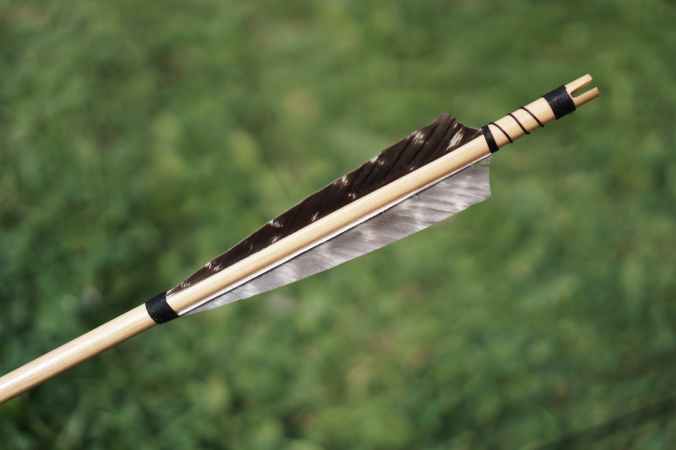
“If you asked someone in Beijing what the most important martial arts were in the year 1770 they would likely have said (in the following order) 1) archery 2) riding 3) strength training. Why? These were the specific skills that were tested on the imperial military service exams. It is often forgotten now, but many working martial artists actually made their living coaching students to pass this exam. Wrestling, fencing, boxing and spear work were also widely taught and had their own specialists. But archery was clearly at the apex of martial culture during much of imperial China’s long history. Many more books seem to have been published about archery than fencing or boxing.”
The Dragon is unique amongst Xing Yi animals because it is the only mythical one. Yes, I’m aware that some lineages of Xing Yi include a Phoenix as one of their 12 animals, but I think this is simply a mistranslation of Tai, a kind of flycatcher bird native to China. You sometimes also see it mistranslated as Ostrich, which is even stranger. You occasionally see Tuo translated as “water lizard”, or “water strider”, but it’s clearly a crocodile, another animal that is (or effectively was) native to China.
The question of why Xing Yi, whose animal methods are based on real, observable native animals, should include a Dragon we’ll leave until the end of this post, but for now, let’s look at its characteristics.
Dragon in San Ti Shi
The Dragon is one of the important animals in Xing Yi Quan because, together with Bear Shoulders, Eagle Claw, Chicken Leg, Tiger Embrace and Thunder sound, Dragon Body forms the famous San Ti Shi posture, (different lineages have slight variations on those, but they’re fundamentally the same).
San Ti Shi demonstrated by master Zhu Guang, credit Hsing Yi Leeds
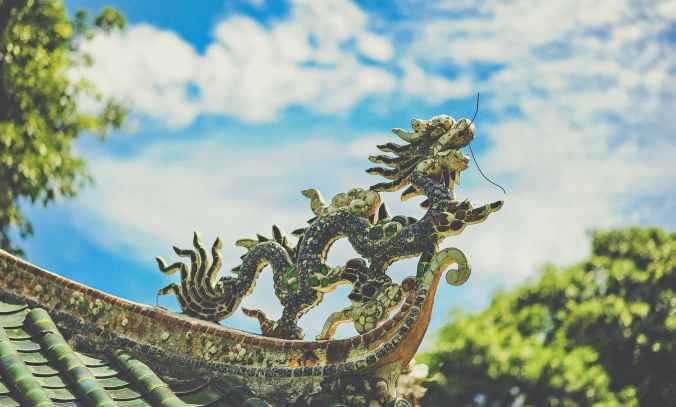
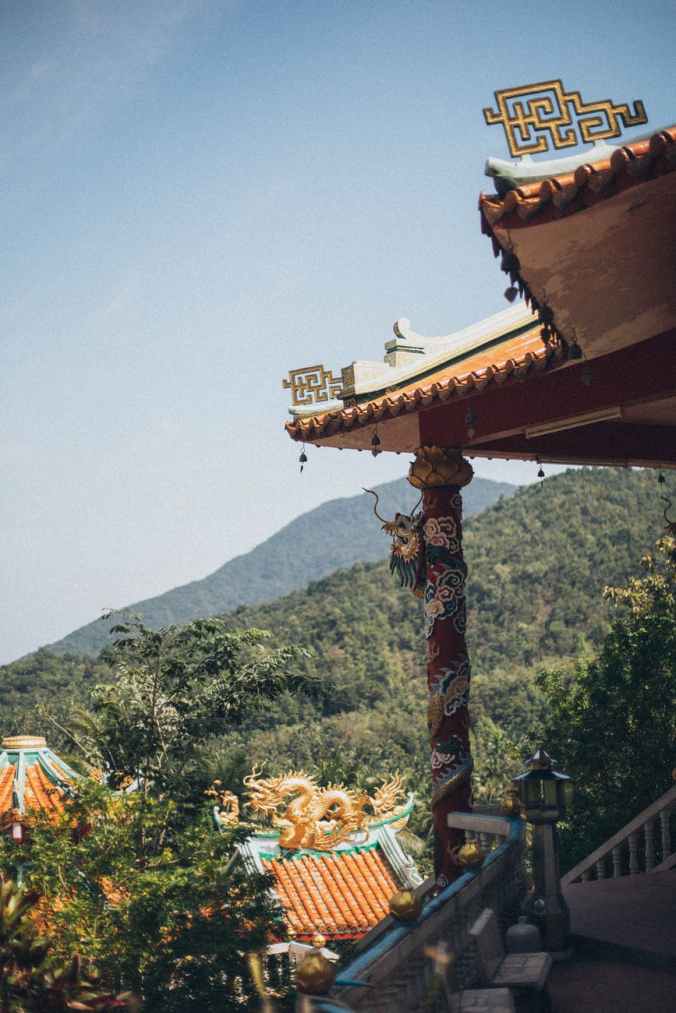
Dragons in Chinese mythology have very flexible spines – they fall and rise through clouds with a long, flexible body that coils and rotates, twists and turns. You often seem them decorating Asian temple roofs, or spiralling around a pillar:
It’s the flexible nature of the spine that is the characteristic we seek to emulate in Xing Yi Quan. In Xing Yi the spine is characterised by a coiling action, a counter-rotation between hips and shoulders, that means the practitioner can easily generate power, or, always has the potential for generating power from all positions.
The typical Dragon Shape example you see demonstrated looks something like this one:
Dragon, demonstrated by master Zhu Guang, credit Hsing Yi Leeds
Notice how his posture is placing a lot of torque on the spine, and creating potential energy. The right shoulder pushes back, but the right hip pushes forward. That is what is meant by “dragon body” in our style.
(And just to counter some things I’ve read a few times: It is not about creating a ‘spinal wave’ that moves vertically up the spine – that’s not how spines are designed to express power in human beings if longevity is one of your goals. Force (jin) itself can move up the spine to the hands, but there’s no actual physical ripple or wave that should move up your spine, like a whip cracking. I have seen some styles of Chinese martial arts that do this – they crack their spines like a whip. Good luck with that when you’re 70 I’d say, but each to their own.)
Xing Yi and Xin Yi Liu He Dragon comparison
A question came up recently (which inspired this post) about how Dragon in Xing Yi can possibly be the same as Dragon in its sister art Xin Yi Liu He, since they look different.
My first response to that is, of course, they are the same. Not identical in outward expression, but the same root.
These two arts developed in different geographic locations, but they share a common root. Take monkeys as an example: In biological terms, all modern-day monkeys look different, but they share a common ancestor. You can tell they are related. While their colourings, their sizes and their behaviours may have evolved along different lines, they’re still belong to the same species. It’s the same with Xing Yi dragon and Xin Yi Liu He dragon.
One phrase my Xing Yi teacher liked was “one root, 10,000 endings”, so there can be infinite variations on a dragon posture, or sequence, but the root, the essence of what is being expressed, is the same.
Every lineage of Xing Yi has its own slight variation, but in Hebei Xing Yi you usually see Dragon expressed in that rising and falling squatting posture shown above.
Here’s a video of Mike Patterson showing some applications:
This is the posture that is not found in Xin Yi Liu He? Really?
First, I’d dispute that. Here are two videos I found quickly online that are very similar to the standard Hebei Xing Yi version. This one looks like a prototype for the standard Hebei move, ending in a similar squat:
And then there’s this one called “Dragon wags tail” from http://www.xinyiliuhe.net , which has a different stance, but the movement is virtually identical:
Perhaps the confusion happens because the most common “dragon” movement you see in Xin Yi Liu He is this one (that you see translated as variations of “dragon shakes its shoulders” or “dragon shoulder” or “dragon carries the shoulder pole”.)
It’s one of the “3 old steps”. I like that name. Again, it implies that the dragon is a fundamental quality to the art, which is what we say in Xing Yi. I’m speculating here, but perhaps in Xing Yi’s San Ti Shi we see the bringing together of these “old steps” into a single posture that is held and practiced without movement, but with the same internal feeling?
If you look at what is being practiced in the Xin Yi steps above you see the same qualities of dragon that we look for in Xing Yi – the flexible, rotating spine. On the inside, it’s the same thing. Also notice that his arms are being held in a way that resembles wings, like dragon wings?
Let’s look at some more dragon movements you find in other lines of Xing Yi beyond the usual rise/fall squat movement you see:
This is Zhang Xi Gui is the director of the Shan Xi Xing Yi Research School. Notice the same ‘wing’ shape to his arms?
Notice the different flavours of the dragon are there – the strategic leg placement to set traps and trip, the coiling body motion and the ‘wings’ and ‘claws’ feel in the arms.
It’s already clear there is more to the ‘dragon’ than just a single move. I’m trying to get to the point where I can convince you that dragon is a quality, not a move, that can be expressed in various different ways.
Dragon principles in Xin Yi Liu He
In terms of Dragon principles being expressed in Xin Yi Liu He the best video I’ve found is this one below.
Dragon is expressed all through this video and the teacher really goes into detail about the body actions. And again, it all matches with Xing Yi – the rotation of the spine, the actions of the hips and shoulders to create power that I talked about earlier.
I really like this video (despite whatever that young German man is doing to that tree 🙂 )
I hope that’s been enough to get you thinking. We need to stop thinking about Xing Yi animals as ‘this move’ or ‘that move’. It does this massive, practical, ancient and subtle art a huge disservice.
And going back to what I mentioned earlier – the other reason for the dragon being the only mythical creature in Xing Yi/Xin Yi’s animal styles?
Well, the dragon is the emblem of Yue Fei’s family and he is often illustrated with a dragon emblem on his robe:
Was Yue Fei practicing what we call “Xing Yi” today in his back yard? Of course not, but the ideas that underpin it? Then yes, he was. His army used these strategies very successfully in battles against the Jin army, but for (much) more of that story, see my podcast.




 The Tai Chi Notebook