Interview series with Jarek Szymanski

Screen Shot 2018-08-29 at 10.04.34 AM.png

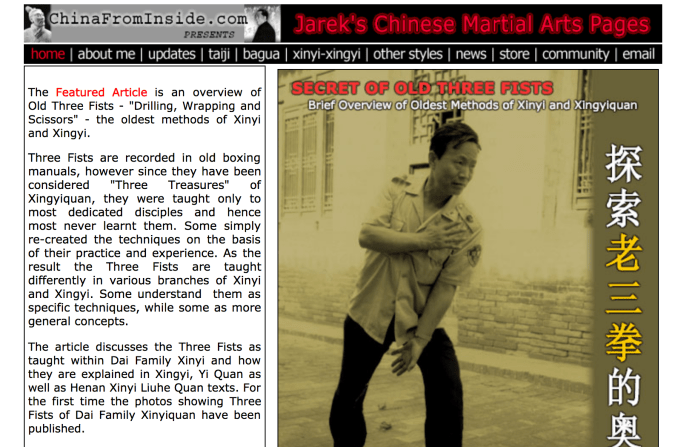
Jarek Szymanski’s website, China from Inside was one of the first and best resources on the web for the history and practice of Chinese Martial Arts, written by a European living and working inside China. It was particularly good for finding out how internal martial arts, like XinYi, XingYi, Bagua and Taijiquan were actually practiced in their native environement.

I remember reading his website back in the 1990s, and it’s still there!

Nick at Masters of the IMA has been working together with Jarek over the last few months on recording some of his experiences in China back in the 90s – how he came to end up living in China, his experiences investigating the history of various CMA, etc.

He’s posted the first parts of the interviews on his website, and it’s well worth a read. You can find out all about his experiences on Mount Wudang and Beijing, and get his opinions on how modern Chinese martial arts related to the older traditions, and how they differ. I really liked his insights into places like the Shaolin temple and Mount Wudang (see part 5) and how they’ve changed over the years compared to his visits there in the 90s.

It’s well worth a read.

Jarek Szymansk interview part 1

Jarek Szymansk interview part 2

Jarek Szymansk interview part 3

Jarek Szymansk interview part 4

Jarek Szymansk interview part 5

Jarek Szymansk interview part 6

Fun quote:

“When we got there, we saw some Shaolin monks (wuseng) giving performances not in a stadium, but just in an open space outside the temple. As far as I can tell they were demonstrating some forms and hard qigong, iron shirt (tie bu shan), etc. My Polish friend and I had great fun ‘testing out’ the iron shirt guy – when he invited members of the audience out to test his iron shirt, I don’t think he was expecting to be punched full force in the stomach by two 6-foot Polish guys (laughter). It was at that point that I realised so-called iron shirt is not that special, most demonstrations of iron shirt are just a combination of timed breathing and muscle contraction, similar to what I had practiced in my early karate years.”

Podcast: Byron Jacobs on what martial arts in China are really like


byron_jacobs

I’ve blogged about my friend Byron Jacobs before – he’s a Westerner deeply immersed in Chinese culture and martial arts and living in China at an interesting time.

We’re currently in the era where Chinese martial arts are opening up to the West in a way they’ve been prevented for doing for a long time. MMA and Jiujitsu (BJJ) is finally making an impact and people are starting to realise that modern training methods offer something that traditional methods are lacking. It will be interesting to see how the future plays out for Chinese martial arts, and what happens to traditional arts and skills.

Byron has just recorded an episode of the Real Fake Swords podcast where he addresses these issue and tells you what it’s actually like in China when it comes to martial arts. It’s fascinating (and probably different to the way you think it is) and well worth a listen. (If you are pushed for time start listening at around 15 minutes in.)

I hadn’t heard of Real Fake Swords before, but it looks like a good podcast series. I notice they’ve got episodes with other interesting martial arts personalities.


Buddhism vs Shamanism, in China.

leshan-giant-buddhaf7eae265aaf0_300x400

My friend Damon is back with another Woven Energy podcast after a long break.

Listen to “Episode 28 – Buddhism vs. Shamanism: Similarities, Differences and what we can learn” on Spreaker.

This time he tackles an interesting subject – Buddhism. I imagine this will upset a lot of Buddhists (if that’s possible!) because he classifies Buddhism as an exoteric religion, basically designed to help control the populace under the Han Dynasty (206BC – 220AD). In fact, to get them to self-regulate. You can agree with this view, or not, but there are some interesting facts in here about the rise of Buddhism in China that I didn’t know.

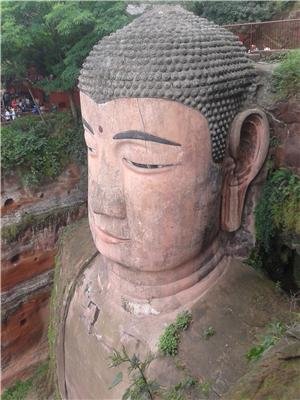
For instance, China used to be the main country for Buddhism during the Han Dynasty – it is where it got its foothold, and in fact, was the main reason for the expansion of the Chinese empire (as they sought out Buddhist teachers, inadvertently creating the Silk Route and facilitating trade). This was particularly unusual since China has traditionally been a very inward-looking country. That a foreign religion could become so widespread is really worth noting and looking into.

It’s hard to believe that now, since people associate Buddhism more with Japan or Tibet, but it makes sense – the ‘old masters’ quoted in Japanese Buddhist writing, like the Blue Cliff Record, were often Chinese.

There’s also a lot of stuff about Chinese history, and the Warring States period in the podcast. Fascinating stuff.

Henan Village Chang family Xiao Luohan

I was reading through this excellent interview with Matthew Polly, author of American Shaolin, (a book which has somehow has escaped my bookshelf – a situation I should rectify promptly), when I came across this video of a man performing Chang family Xiao Luohan in a rural village in Henan.

It’s a great little video for a number of reasons. The first is that this is something old and precious that is in danger of dying out as people lose interest in WuShu in modern life. The second is the authenticity of the presentation – it really does look like a rural villiage where he has lived all his life. The third is – it’s a really good performance!

These are the sorts of “old school” martial arts skills that are in danger of dying out in China. To quote from the Matthew Polly interview above:

“As I mentioned in American Shaolin, the idea of chī kǔ (吃苦 ), eating bitterness, is central to the Chinese understanding of learning martial arts, and the value of suffering. And the way in which that contrasts with the western idea of trying to avoid pain in any way. We have an entire society built around the idea of alleviation of pain. We have an opioid crisis because we’re trying to avoid all sorts of pain. I admire progress and evolution in the way mixed martial artists do, but I have a nostalgia and sentimentality for tradition and the way that old man practised the same form for 60 years. There’s something beautiful about that and a sadness in seeing that wiped away as MMA goes like a bulldozer through the traditional kung fu and karate world.”

Chang family boxing is one of the precursors to Taijiquan, at least in terms of martial arts theory, although there are several similar postures to Chen Taijiquan found in its boxing sets, so the connection may be more literal than just in terms of theory.

I think research into Chang family boxing would reveal more about the origins of Taijiquan than wondering if it was Taoist. Luckily this research has already been done by Marnix Wells in his book ‘Scholar Boxer: Cháng Nâizhou’s Theory of Internal Martial Arts and the Evolution of Taijiquan‘. Again, another shocking omission from my bookshelf, but by all accounts, this is a very deep piece of research. According to Jess O’Brian (author of Nei Jia Quan: Internal Martial Arts) – “For those interested in the theory, history and practice of the internal martial arts, this book is going to blow your mind.”

51bn6f9hnwl-_sx334_bo1204203200_

Byron Jacobs: incovenient truths in “Da Dao Taiji” documentary

My Facebook friend Byron Jacobs is the Technical & Events Manager and Technical Committee Member at International Wushu Federation in China. That’s a pretty high up in Chinese Martial Arts for a guy from South Africa 🙂

This is a YouTube video about him:

As you can see from the video, he’s fluent in Chinese and lives in China. He trains Xingyiquan under his Sifu, Di Guoyong.

Recently Byron appeared in an episode of the Chinese TV documentary “Da Dao Taiji” in which he was interviewed about traditional Chinese martial arts, its utility in the modern age and the problems it is facing both in the mentality of practitioners and their methods today.  I don’t think they were quite expecting such a frank interview!

Unsurprisingly, it was edited quite heavily, and they only kept some of these “inconvenient truths” in the documentary.

The good news is that here on Tai Chi Notebook you can view his whole interview, complete with subtitles. It may have been too hot for Chinese TV, but nothing is too hot for you, my dear readers!

(As an interesting sidenote, the new laws in China were passed last year prohibiting people with tattoos from being shown on TV, so they had to smudge out his tattoo for the aired version of this!)

Enjoy the inconvenient truths video:


And here is the entire episode 2, as it appeared on Chinese TV:

Wing Chun (Ding Hao) vs MMA (Xu Xiao Dong), in China

After his fight with the “Tai Chi master” Wei Lei, which rocked the contemporary martial arts scene in China, Xu Xiao Dong, the MMA fighter on a mission to expose “fake masters” is back on the scene this time showing his skills against a Wing Chun fighter.

China doesn’t have the sort of government regime which tolerates people who rock the boat, so I’m pleased to see that Xu is no longer under detention, as I feared we may never have seen him again after what happened last time.

Here’s the fight:


It’s a pretty ugly fight. Here are my takeaways:

  • Ding Hao clearly lacks realistic sparring experience, as he falls apart pretty quickly. His grappling was non-existent.
  • Xu Xiao Dong is pretty much a ‘stand and bang’ type fighter. Or maybe he felt so unthreatened by Ding that he didn’t feel the need to do much of anything else.
  • The ref makes some daring saves!
  • Why are they wearing such different clothing? Ding has shoes on! Only Xu is wearing gloves. Xu is grabbing Ding’s clothing to throw and control him. It’s a mess.
  • Why are they fighting on what looks like a red carpet used for movie premieres or award shows?
  • If you watch Ding throughout the fight you can see him try to adapt as he realises what he is doing isn’t working. He starts off looking very much like classical Wing Chun and ends up looking more like Jeet Kune Do. It’s like watching the evolution of Bruce Lee in microcosm!

Here’s some background about Xu Xiao Dong and his fights and detention by police in China:


Fight against Wei Lei:


Asian Boss: What do Chinese people think of Blackface?

As China makes more entries onto the world stage elements of an isolated culture are clashing full on with a global culture that has, how shall we say? Moved on a bit… There was a recent incident of Blackface appearing on a popular Chinese show, the Lunar New Year TV gala, where Chinese people dressed up as African people for laughs. The show was watched by 800 million people. 800 MILLION PEOPLE! Those numbers are staggering.

The following video about the show is interesting, especially if you watch past around the 10-minute mark where a black lady living in China gives her view on daily life in China and the sort of casual racism she encounters.

My general impression from watching the video is that it’s coming from a position of ignorance, not of hate. I can’t help but see the parallels to how the UK used to be when my grandparent’s generation were running things. Blackface used to happen regularly on British TV, most famously the Black and White Minstrel Show in the 1960s. Things will move on.


Also: Reviews of Black Panther from China.

The problem with push hands challenges

black-and-white-people-bar-men.jpg

This is a really interesting article from Practical Method Tai Chi about the passive-aggressive world of Tai Chi push hands challenges in China – I really try to avoid pushing hands with people I don’t know for many of the reasons described here.

I think the best use of push hands is as a teaching tool, where it is invaluable. Used as a method to compare skills it inevitably turns into ‘Wrestling Lite’, and the best wrestler wins.

Check out the article here.

You might also like: Thoughts on Push hands by Mike Sigman