Why you can’t learn Tai Chi from a book

woman holding newspaper while burning

Photo by Bruno Moretti on Pexels.com

I’ve been talking a lot about how to move from the dantien recently, and you might be wondering how easy this is to teach or do.

As it happens, I was trying to get a friend to understand how to do it today. I’ve been trying to get him to do this for a while actually (more than 2 years), but despite practicing diligently, he’s never really got it before. He’s got better at parts of it, but never the most important bit – moving from the dantien. It’s a very difficult thing to teach. You can describe it in words, but they’re open to misinterpretation. You can show them what you mean by doing it yourself, but its very hard to see unless you know what you’re looking for. You can even try and move their body for them in the right sort of way, but again, it’s not really the same thing as them doing it for themselves.

For some reason, today the penny dropped and he got it! You could almost see a light bulb appear above his head. The key seemed to be a combination of using the phrase “the arms trail behind the dantien” and trying a double-handed silk reeling exercise for the first time and watching me do it. For some reason, this time, it worked. It was a real Eureka! moment.

Of course, he can’t do it perfectly yet, but at least now I know he’s on the right track. He’s letting the pull of his dantien guide his arms. It sounds so simple, but it’s very hard to actually do. You can lead somebody to the gate as best you can, but they need to go through it themselves.

What was interesting was that with this new way of moving, he instantly felt muscles in his abdomen and lower back moving in ways they hadn’t done before. They were being worked. Instead of this area being ‘dead’ it was now full of movement. So much so that doing a Tai Chi form in this way was suddenly physically demanding. What had once been empty, floating movement was now full, rich and damned hard work. It was also mentally demanding. If he stopped paying attention, he stopped doing it.

His immediate observation was, “You can’t learn this from a book”.

Yes, he’s right. You can’t.

To learn Tai Chi you need to practice, under the guidance of somebody who has gone through that ‘move from the dantien’ gate. Once you’ve got through the gate it’s much easier to practice on your own, as that is the basis of everything that follows.

What you can find in books, like the Tai Chi Classic, which I recently produced a commentary on, only really makes sense once you’ve gone through the gate.

A lot of the requirements of Taijiquan that you find in writings are really external rules to encourage you to go through that gate. For instance, the rules about feet matching the hands, and knees the elbows, etc. These are all external requirements for dantien-driven movement. If you truly are moving from the dantien then your feet and hands will already be co-ordinated. Your knees and elbows will already be in harmony. All these rules will make sense. Before then there are still too many possibilities of going down blind alleys or faulty understanding.

In that sense, books and rules are useful in that they can help you stay on course, but they’re also a trap that you can get stuck in.

Tai Chi is also not an intellectual process. It’s a feeling. As human beings we tend to want to define everything and label it so we can think we understand it that way. Tai Chi isn’t like that. You need to do it, not think it.

I heard about a teacher once that used to confiscate any Tai Chi book that he saw on sight for the benefit of the student attempting to read it. He was probably right.

The Tai Chi Classic [Part 2] – a new interpretation

The Tai Chi Classic [Part 2]

Attributed to Chang Sanfeng (est. 1279 -1386),
interpretation and commentary by Graham Barlow.
girl thumbs through the old book

Photo by Kaboompics .com on Pexels.com

6.

“All movements are motivated by Yi,
not external form.”

[Yi is usually translated as “intent” and refers to the mind. It doesn’t mean ‘your intent to do something’ – a closer English translation of that would be “will”, and it definitely doesn’t mean what a lot of people end up thinking it means, which is your intent to be violent. People talk about having this kind of killer, or predator, mindset. Maybe that’s useful for self defence, but no, that’s not what Yi means.

What these lines are saying is that the guiding action for a movement comes from your mind leading the body. It’s your internal self leading your external self. In Taijiquan your dantien leads the physical movement, with your body kind of trailing behind, but here we are told that before that happens, the intuitive part of your mind starts the movement.

It’s important to note that we’re not talking about the thinking, intellectual, part of your mind here. I quite often liken Yi to thinking in directions. You want to raise your arm up, you think in that direction and let the body follow. What this does is dispense with the intellectual, thinking, part of the brain, and just gets you in touch with the physical body directly, with no barrier in between.]

7.

“If there is up, there is down;
when advancing, have regard for withdrawing;
when striking left, pay attention to the right.

If the yi wants to move upward,
it must simultaneously have intent downward.”

[I think there are two, related, ideas going on here. The first is that (paradoxically) if you want to push somebody up and away, you first let your dantien area sink downwards and connect to the ground, then the power comes up from the feet.

Previously we talked about power coming up from the ground. Now we get into the nitty-gritty of how we make that actually work without just using brute strength from the legs. If you sink the dantien area – think “drop” – then there is an instant ground force reaction that comes back in the opposite direction. Provided the body is ‘threaded together’ and relaxed enough, where this force goes is guided by the part of your brain the Chinese called Yi. Here are two photos attempting to illustrate this, but remember, it’s all happening simultaneously, rather than in two separate steps.

drop 1

Sink down from the dantien.

drop 2

Issuing force with jin.

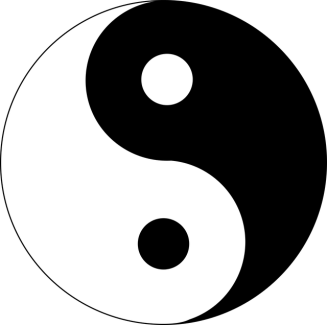
The other idea presented here is that of being aware of the left and right, and when advancing, being aware of withdrawing. On a simple level, it’s saying don’t over commit, but I connect this idea to a phrase in one of the other classics which says “if you empty the left, you must fill the right”. Just like the Taiji symbol, everything in Tai Chi is circular and in harmony. So, if you move something left, then another part of you must move to the right simultaneously, as you rotate around a central point, otherwise, you will be out of balance. You want to create the effect of a sphere, perfectly balanced on all sides.

The Taiji symbol is perfectly balanced, and you need to achieve the same state in your body.]

yin-yang-2024615_640

8.

“Alternating the force of pulling and pushing
severs an opponent’s root
so that he can be defeated
quickly and certainly.

Full and empty
should be clearly differentiated.
At any place where there is emptiness,
there must be fullness;
Every place has both emptiness and fullness.”

[Here we are getting towards the fault of double-weighting, in Taijiquan. You need to have your weight more on one leg than the other at all times. If your weight settles in an equal position then your Taiji symbol has stopped ‘moving’ and is now inert – it has become two separate halves, not a spiraling mix of energy. There’s more to double-weighting than that, but see the link above for that.

As your weight shifts from one leg to the other in push hands, for example, you are ‘alternating the forces of pushing and pulling’. If you can do this while staying in balance then your opponent will become disrupted. But again, you must stay in balance. So, if you advance something – here represented by fullness – then you must withdraw something else – here represented by emptiness – at the same time.]

9.

“The whole body should be threaded together through every joint
without the slightest break.”

[This is a return to the theme at the start of the classic of threading the body together, making it connected and keeping everything balanced. After reading the words between the start and these lines you should have a better idea of what that means. The emphasis on keeping the joints open and relaxed in particular is that these are usually the problem points where we lose connection.]

10. 

“Long Boxing is like a great river
rolling on unceasingly.”

[It’s interesting that the classic calls the art “Long boxing”. These days there are different martial arts in China called Long Boxing (Chang Quan) that aren’t Taijiquan.  I think in older times any long form routine was called long boxing, and I think that’s what is being referred to here.]

11.

“Peng, Lu, Ji, An,
Tsai, Lieh, Zhou, and Kao
are equated to the Eight Trigrams.
The first four are the cardinal directions;
Ch’ien [South; Heaven],
K’un [North; Earth],
K’an [West; Water], and
Li [East; Fire].
The second four are the four corners:
Sun [Southwest; Wind],
Chen [Northeast; Thunder],
Tui [Southeast; Lake], and
Ken [Northwest; Mountain].
Advance (Chin), Withdraw (T’ui),
Look Left (Tso Ku), Look Right (Yu Pan), and
Central Equilibrium (Chung Ting)
are equated to the five elements:
Metal,
Wood,
Water,
Fire, and
Earth
Taken together, these are termed the Thirteen Postures”

[This last section is almost a bit of admin. It lays out the fundamentals that define Taijiquan – the 8 energies and the 5 directions].

The Tai Chi Classic [Part 1] – a new interpretation

The Tai Chi Classic [Part 1]

Attributed to Chang Sanfeng (est. 1279 -1386),
 interpretation and commentary by Graham Barlow.
brown book page

Photo by Wendy van Zyl on Pexels.com

1. “In motion, the whole body should be light and agile,
with all parts linked as if threaded together.”

[Here the Classic is connecting together the ideas of being ‘light and agile’ with ‘threading the body together’. It is referring to being relaxed and without stiffness or excess local muscle tension in your movement. If you can be relaxed then your movement can flow and be connected together via the muscle-tendon channels. Any stiffness you possess will prevent you from moving in this unique way, which is key to Taijiquan. Particular problem areas to look out for that can prevent your body being ‘threaded together’ are the shoulders and lower back where we tend to store tension. If we are tense in our shoulders then the movements of the body cannot reach the hands, and if we are tense in our lower back then we cannot connect the upper and lower parts of the body. Everything in Taijiquan needs to be driven by the legs, waist and dantien area.]

2. “The chi should be activated,
The mind should be internally gathered.”

[In the first line I’ve chosen the word ‘activated’ when referring to the chi, rather than the usual ‘aroused’ or ‘excited’. This is to give more of a sense that you are switching to dantien-driven movement, using the muscle-tendon channels, rather than using normal movement, which is unconnected to the waist.

The second line originally says Shen, which refers to the spirit, rather than mind, but I think that this line is really referring to ‘paying attention to what you’re doing’ in a calm yet focused way, rather than letting the mind wander or become distracted.

Taken together these two lines are a way of saying, ‘in Taijiquan we move the body in an internal way, and to do that we need to use the mind and keep it on what we are doing, rather than letting it wander’.]

3. “The postures should be rounded and without defect,
without deviations from the proper alignment;
in motion, your form should be continuous, without stops and starts.”

[These lines start by addressing the physical posture considerations of Taijiquan. I’ve added ‘rounded’ here, because you need to physically round your posture to make it properly relaxed. That means no awkwardness or straight lines in the physical posture, just nice smooth curves.

The second part talks about the movement itself. Developing the skill of being able to move without ‘stops and starts’ takes a while and is one of the fundamental reasons for practicing the Tai Chi form every day. Of course, we are talking about moving from the dantien without stops and starts here, not just normal movement.

The phrase ‘drawing silk’ is often used to describe this quality of continuous movement you find in Taijiquan. If you were drawing silk from a cocoon then you need to do it at a constant rate – if you speed up and you risk the thread breaking. If you slow down you risk it collapsing. Just keep it at a constant rate and it should go well.

By linking these two ideas in the same section the author is drawing a parallel here between having no breaks in the physical posture (keeping it rounded) and having no breaks in the actual movement either (keeping it continuous).]

4. “The jin should be
rooted in the feet,
generated from the legs,
controlled by the waist, and
expressed through the fingers.”

[These are the lines most often used to describe how power should be expressed in Taijiquan. So, when issuing a punch, or a push, you should be going through this sequence, which starts at the ground and goes up to the fingertips. Taijiquan uses the ground force (jin), so the first part of the body mentioned is that which is closest to the ground – the feet. Next it links together the legs and waist as the parts of the body most associated with delivering that force to the hands – or fingers as it says here.

Obviously, this part is not talking about kicking. Notice that the palms are not mentioned, either. In Tai Chi your hand technique is usually a punch or a push. Occasionally a back fist or hammer fist is used, but it’s mainly pushing or punching to the torso or head, both of which use the fingers to make contact with the opponent.

When you push (to the chest) in Tai Chi you shouldn’t use your palm. Instead, you push with your fingertips. If you try pushing hard on a heavy bag with your palm you’ll soon discover why – pushing hard with your palm risks serious injury to your wrist. Of course, pushing on an arm, as we do in push hands is different, and you can use your palm without risk.

Taijiquan goes beyond simply using the raw power of your legs to augment the power of punches and kicks – it’s not talking about just doing this physically and externally. Instead, it’s talking about making use of the power of the ground through a relaxed body that is used as a coordinated whole. This passage also makes it clear that the ground force and the force of the legs are the only power inputs required to create jin, so, don’t try and punch or push from the shoulder.]

5. “The feet, legs, and waist should act together
as an integrated whole,
so that while advancing or withdrawing
one can take the opportunity for favorable timing
and good position.

If correct timing and position are not achieved,
the body will become disordered
and will not move as an integrated whole;
the correction for this defect
must be sought in the legs and waist.

The principle of adjusting the legs and waist
applies for moving in all directions;
upward or downward,
advancing or withdrawing,
left or right.”

[I’ve grouped these lines together as I think they are all talking about the same subject. Following on from the previous point about the role of the feet, legs and waist in producing power from the ground, the Classic now makes it explicitly clear that these three need to act together even when moving. This emphasises the supreme importance of the trinity of the feet, legs and waist (dantien area) in powering movement. If you can power your movement like this then you can produce Jin (power from the ground). Once you break this trinity, say by using local muscle in your shoulder, then your power has become disordered, and lacks the connection to the ground which is required by Taijiquan.]

Part 2 is now available.

Tai Chi: What moving from the dantien actually means

white ferris wheel under cloudy sky

“Stand like a perfectly balanced scale 
move like a turning wheel.” Photo by Paweu0142 L. on Pexels.com

Uber-malcontent Oliver Gerets, is back in my comments section, this time complaining that my statements are still oversimplified and misleading.” Which I think probably just means that he hasn’t bothered to read much of my blog before, as everything I said in the post he’s referring to on whole-body movement is pretty well explained in previous posts, if you want to look for it.

His issue is that I said the following were the 3 movement principles of Tai Chi, without further explanation:

1) moving from the dantien

2) power up from the ground (jin) – rooted in the feet, expressed by the fingers.

3) coiling and spiraling actions from the dantien out to the extremities and back.

He’s right – I did exactly that and moved on because I didn’t want to get sidetracked on them and get onto the main point I was discussing.  You see, I’ve gone over those points before, but we might as well use this as a springboard to discuss these ideas again and un-simplify everything. Just like Al Pacino in the Godfather – just when I thought I’d got out, but he pulled me right back in.

Let’s deal with Oliver’s first complaint.

1. There is no generally accepted definition what the dantien is amongst Taijiquan practitioners. Not even in Chen style. “Moving from the dantien” is a hollow phrase with very little practical meaning.”

I don’t know what he means with the “not even in Chen style” comment, so let’s ignore that.

I’d agree that there are no accepted definitions of anything amongst Taijiquan practitioners of what the dantien is, but there are no accepted definitions of anything amongst the practitioners. They’re a strange bunch of people ranging from weekend dabblers to full-on fanatics who have very differing views on everything under the sun, but the people at the top of the family trees tend to disagree much less. They all know what they mean.

I also think most Tai Chi people do know what the dantien is. For clarity, let me add my own definition:

The dantien I’m referring to is simply the lower abdomen area of the body. It encompasses the front, sides and back of the body. It’s a general area, rather than a specific point. When I’m talking about “moving from the dantien” I’m talking about movement originating in this area of the body. You could call this area the waist, if you like, so long as you understand that it’s not a line, like a waistline is. 

out of order text on persons belly

I’ve got no idea why she’s written “out of order”, but there’s a photo of the dantien area for you. Photo by Kat Jayne on Pexels.com

I’m not sure what more explanation I can give of that – it’s fairly simple.

The how of the matter is not so simple. Anybody can move that area of their body without any connection to the rest of their body – the limbs and head, for example. Dancers do it all the time. What’s hard is making it connect to everything else.

In Tai Chi you need a tangible connection between the dantien area and the extremities so that once you move the dantien area, the extremities are also moved as a consequence. This connection is formed by what the Chinese called the muscle/tendon channels in antiquity. These then formed the basis of the meridian system over time.

Mammals usually have muscle/tendon channels on the front and back of the body.  Yin channels on the front and yang channels on the back. They consist of muscle, tendon, ligaments, fascia and skin and can be affected by abdominal breathing (which is also centered on the dantien area).

If you can hold the body in a neutral position (the classic Zhan Zhuang posture “hold the ball” is good for this) then you can keep an equal tension on the front and back muscle-tendon channels. You can then use your breath to create a small pull on these channels when you breathe in and out. The connection starts off as very weak, but grows stronger over time.

So, Zhan Zhuang, Tao Yin and Qigong exercises strengthen this connection over time. Eventually, the connections get strong enough that you can affect the movement of the limbs with small changes in the dantien area, like rotating it left and right, or up and down, all in coordination with the breathing.

tiger stretching over brown trunk during daytime

A Tiger showing a stretch along the yin channels on the belly and a corresponding contraction on the yang channels along the back. Photo by Flickr on Pexels.com

In Taijiquan, (which deals with humans standing upright, not tigers), the dantien, legs and feet must form a connection and drive the power of the rest of the body:

From the Tai Chi classics:

“The feet, legs, and waist should act together
as an integrated whole,
so that while advancing or withdrawing
one can grasp the opportunity of favorable timing
and advantageous position.”

“The principle of adjusting the legs and waist
applies for moving in all directions;
upward or downward,
advancing or withdrawing,
left or right.”

Movement originating in the dantien, therefore, becomes a real, physical phenomina, rather than an abstract idea.

This is what I mean, Oliver.

The best exercise I’ve seen to help you develop this skill is a single-arm wave from Chen style silk reeling. In my original post I linked to a video showing the basic single arm wave. I’ll link to it again here.

In future posts I’ll address Oliver’s next 2 complaints.


Stop thinking of internal arts as special

Internal Chinese martial arts are often presented in the West as this special spiritual thing deserving of seated lectures about the meaning of Tao, complex esoteric meanderings on the nature of Chi or Shen and expensive seminars involving “masters” “lineage holders” and “internal fighters”. There are a lot of snake oil salesmen out there.

I say to hell with all that. It’s a trap you need to avoid or break out of if you’re currently in it.

Internal arts are martial arts and they should be trained like martial arts.

When you see videos of people in China training, it’s small groups with a very informal structure. Watch this video as a good example:

What they’re saying doesn’t matter so much (although that is interesting too) as what they’re actually doing. Watch the people in the background training. That’s how I think these arts should be trained: small groups, informal structure and preferably outside. No whiteboards, lectures, seats or marketing.

Nobody is trying to sell you anything or upsell you anything. Just people being shown something and trying to practice it, Making mistakes, getting better and just training.

Is there really only one style of Tai Chi?

Time to address some more comments generated by my Whole body movement post. Oliver Gerets writes:

“The body can move/coordinate in an almost unlimited number of ways. These kind of oversimplified comparisons are useless and misleading. There is no general/right way of “whole body movement” in Taijiquan. Every school/lineage is at least slightly different. “

This is an interesting point. Are all the different styles of Tai Chi actually different martial art styles, or are they all one? The generally accepted wisdom on the matter (Chinese government-backed) is that (in theory) there is only one style of Tai Chi. But when you get on the ground, in amongst the weeds, then it’s really hard to see how somebody doing Sun style Tai Chi is doing the same thing as somebody doing Chen style, and how either of them are doing the same thing as somebody doing Yang style. Sure, if you follow the sequence of their long forms, they follow roughly the same order, but the stances are all different and the type of body movement looks different. They might have had the same starting point, but over the years, they seem to have diverged significantly.

Or have they? Let’s return again to the three principles I listed as the essence of Tai Chi whole body movement in my last post.

1) moving from the dantien
2) power up from the ground (jin) – rooted in the feet, expressed by the fingers.
3) coiling and spiraling actions from the dantien out to the extremities and back.

You can argue that these 3 things are happening in all Tai Chi styles. 

giphy-3

Sun style.

giphy-4

Yang style

giphy-5

Chen style


But, the hard truth is that number 1 is not always observed in most practitioners, and number 3, is most often dropped entirely in the styles that don’t start with a letter C in their name.

Is that a bad thing? It’s point 2 that is the most important. Point 2 can be done without point 1 and 3 and you still have a functional martial art. Point 2 is also the thing I see that ties together all the “internal” arts in the most obvious way – Bagua, XingYi and Tai Chi Chuan.

We only have so many hours to train a week. I think you could make an argument that if you want to get anywhere in Tai Chi, then you’re better off spending most of your time working on point 2 anyway.

If you add in points 1 and 3 then you get even better movement. It’s a different type of movement. I think it’s worth investing time in learning points 1 and 3 as well, but make no mistake – it’s a significant investment of time. A good place to start is a simple single arm-waving silk reeling exercise:

Oliver’s final point is:

“There is no sense in moving like a cheetah, only if you want to run in a similar way. Which is not useful as a human being.”

It’s peculiar that he’s written this in a Facebook group (Ancestral Movement) which seems to enjoy looking at the way animals move and what we can learn from them. As mammals, our bodies really aren’t that different. Generally, we all have a spine, 4 limbs and a head.

64b8f401376e3cf8eb012c9de816b3c4

I’m not suggesting that we should pretend to be a horse or a cheetah, but the principles of movement in mammals are shared amongst all species. Even us.

Here’s a review of an Ancestral Movement seminar, if you want to find out more about it.

Tai Chi whole-body movement revisited

gray dragon statue

Photo by Pixabay on Pexels.com

So, my last post on what ‘whole body movement’ means in Tai Chi Chuan got some interesting reactions on the interwebs. I thought answering the comments might make a good subject for a few more articles. So let’s get going with the first of them.

On the Ancestral Movement group, Andrew Kushner writes:

“Whole body motion” is a lousy coaching cue. It neither helps people move more correctly nor is it an accurate description of what’s going on. It is possible to have “whole body motion” with only one limb moving apparently, and it is also possible to have the entire body involved but still ‘disconnected’ from an IMA perspective.

In fact this is the case with most athletic movements. Do you really think boxers and judoka don’t involve their whole body when they go to express power?

Firstly, yes, I’d agree that ‘whole body motion’ is a bad coaching cue, since it is so undefined. That’s really what my post was about – how there are different possible interpretations of what whole-body motion could mean, and what it actually means in the context of Tai Chi Chuan. Like most of the writings in ‘the classics‘, Yang Cheng Fu’s 10 important points is only useful if you already know what he’s talking about. Which makes them good as reminders, but rubbish as coaching cues.

The second point about boxers and judokas is interesting. Yes, I agree that boxers and judoka involve their whole body when they go to express power. But they do it in a different way to Tai Chi Chuan practitioners. Or at least they generally do. Sure, you could do both boxing and judo with a Tai Chi Chuan type of whole-body power, if you wanted to. But in Tai Chi you want to use as little physical effort as possible to get the job done. It’s difficult to even understand what that means and even hard to actually do it. Tai Chi movement is subtle and tricky and there’s no real incentive to train that way in combat sports where results matter and there are quicker, easier ways to get them.

boxers inside a ring

Photo by Sides Imagery on Pexels.com

It’s not like boxers don’t use their legs when throwing a punch. Of course, they do, but do they do it in the exact way we do in Tai Chi Chuan? I don’t think so. Let’s remind ourselves what the Tai Chi Chuan way of moving is again –

1) moving from the dantien
2) power up from the ground (jin) – rooted in the feet, expressed by the fingers.
3) coiling and spiraling actions from the dantien out to the extremities and back.

That’s difficult. A strong, athletic 20-year-old in Judo can fire his hips into a throw with more than enough speed and power to get the job done. It doesn’t need to have all come from the ground to work.

“Second, there is more in common between the “robot dance” and CIMA than Graham acknowledges. It wasn’t until I learned other ways of moving e.g. Systema and dance that I realized just how blocky and ‘robotic’ the CMA’s are at their core, even flowy and ‘natural’ looking ones like taiji. In fact I think a lot of their power derives from this similarity — simple movements done well.

Still for all the similarities there are important differences between CMA and the robot dance, so it is instructive to consider what those might be.”

That’s interesting. I don’t know what Andrew’s individual experience of Chinese Martial Arts has been, but I’m always a bit wary of using my individual experience to generalise and speak for all of Chinese Martial Art. It’s a very broad church and it contains pretty much every possible version of movement you can imagine.

Is he talking about modern Wu Shu training? The 1920s GouShu experiment that got exiled off to Taiwan? The pre-twentieth century martial arts that were forced underground? Wrestling styles?

I guess, compared to Systema any martial art could be called ‘blocky’ and ‘robotic’ since Systema has no routines or patterns and has no stance, just the four pillars: movement, breath, posture and relaxation. It also looks utterly ridiculous at times. I’m actually not adverse to Systema at all and I think there’s some great stuff in there. I’ve got a good friend who is a teacher and I do want to check out his class sometime. (But it would mean time spent not doing Jiujitsu, and that’s a serious consideration, so some tough choices will have to be made!)

On balance I think there is some merit in Andrew’s criticism of CMA here. A lot of it is just a lot of forms. But again, it depends on how you train it. Are you just training forms for forms sake? I think a lot of Chinese martial arts is like this. I’ve never been attracted to systems that had a lot of forms. A form for this, a form for that. I think that misses the point entirely.

I think of ‘forms’ as being like the raft in the parable of the Buddha crossing the river.

But then Andrew flips it around and praises “Simple movements done well” I think this references to things like XingYi, which has 5 fists as its base. These are quite often practiced over and over, for years. until you get very good at them. Personally, that approach didn’t appeal to me. I found the more varied animals much more interesting to practice and also more alive, less robotic, more spontaneous and useful for actual sparring. I think that’s where real power of Chinese Martial Art lies – not in practicing simple thing over and over, but in not getting too fixed down into any particular method or technique and keeping things fluid and “in the moment”.

But each to their own.

Tai Chi: One part moves, all parts move

pexels-photo-62376.jpeg

Photo by Snapwire on Pexels.com

I’ve been thinking of the way to describe what ‘whole body movement’ means in Tai Chi. The problem is describing a specific feeling, or body movement using words, which leaves the meaning open to interpretation and misunderstanding.

In Yang Cheng-Fu’s Ten Important Points, No. 7 says:

“7.) Coordinate the upper and lower parts of the body. The T’ai Chi Ch’uan Classics say “the motion should be rooted in the feet, released through the legs, controlled by the waist and manifested through the fingers.” Everything acts simultaneously. When the hand, waist and foot move together, the eyes follow. If one part doesn’t follow, the whole body is disordered.”

This is an expanded version of the more condensed and often heard phrase: “One part moves, all parts move”. But it’s also misleading.

If you take the line “Everything acts simultaneously” at its literal meaning you don’t have Tai Chi movement. You have robot dancing.

Now don’t get me wrong. I like robot dancing as much as the next Peter Crouch fan, but it’s not Tai Chi. When you see a performer doing the robot dance she often swivels the waist sideways, or dips the hip with the arm locked to the body. With the dip the whole torso and arms all move downwards together, simultaneously. Something like this:

giphy

It’s fairly obvious that this is not what is meant by Yang Cheng Fu when he says to move the body parts simultaneously, and yet I do see people falling into this trap quite often. They obviously had no intention to set out moving like a robot, but when the brain gets the idea that the body must move as a unit, the resultant expression can often end up far from the mark.

Instead, the way the body moves in Tai Chi should be more like ripples emanating from a stone dropped in a lake. The central point is the dantien. The waves begin there and ripple out to the extremities (feet, head and hands).

giphy-1

When you move, the dantien moves first, and the rest of the body follows in a coordinated action, almost as if dragged by the dantien. It is loose, connected, relaxed and powerful, rather than stiff, jerky and ’empty’.

The parts of the body don’t all move together at exactly the same time, otherwise you’ll end up like a robot. Instead, you want to be more like the way an animal moves. Animals demonstrate some of the best, most graceful, full-body, co-ordinated movement you’ll ever see.

The Cheetah is the classic one that’s used to illustrate open and close in the body, but also the directed head position. Just look at how the head helps with the coordination when running here:

giphy-2

While we run with a torso held in the vertical plane and the Cheetah runs with the torso in the horizontal plane, the head position remains key.

Point 1 of Yang Cheng-Fu’s 10 Important Points is:

1.) Head is held upright to let the shen rise to the top. Don’t use li, or the neck will be stiff and the chi and blood cannot flow through. It is necessary to have a natural and lively feeling. If the spirit cannot reach the headtop, it cannot raise.

In the Cheetah, the engine is the dantien area. The torso does big opening and closing movements as it sprints and the head points the way, keeping the spine flexible, but extended.

Be less robot, be more Cheetah.

Two recent stories

I’m still using this blog for posting my ideas and blog posts, but I’ve decided to start putting a few new stories onto my new Medium page.

I’m using Medium as a place to post more polished articles. They’re basically my better blog posts that I’ve tidied up a bit and made more coherent.

Here are the first two I’ve done:

Let me know what you think!


Tai Chi’s Rollback: A deep dive

photo of night sky

Photo by faaiq ackmerd on Pexels.com

Split, like Rollback, is one of Tai Chi’s 8 energies. It’s also one of the most commonly found of the 8 energies in the Tai Chi form. Almost every technique you see in Tai Chi Chuan (Taijiquan) uses Split energy to a greater or lesser degree.

I’ve seen Split described as spiral energy, a takedown or a breaking force. But all of those things miss the point – they describe its effects, not what it really is.

Split is really the energy of two things moving in opposite directions. If you move two things in a circle in opposite directions you create a spiral. When you do applications on somebody with spiral actions the result is usually a takedown. And you can’t break any joint without directing force in two different directions. For example, if you kick somebody’s leg it’s unlikely to break unless that leg is locked against something that doesn’t move, like say, the ground.

This brings us on to how Split is applied in Tai Chi Chuan.

In Tai Chi you want your hands to be clearly differentiated from each other. One hand needs to be active, the other passive. One empty, and the other solid. One Yin, one Yang. If you don’t do this then you enter a state known as being double weighted. As it says in the classics:

Sinking to one side allows movement to flow;
being double-weighted is sluggish.

Anyone who has spent years of practice and still cannot neutralize,
and is always controlled by his opponent,
has not apprehended the fault of double-weightedness.

To avoid the fault of double-weightedness, which hand is the yin one and which is the yang one must change continually and ceaselessly as you go through the movements of the Tai Chi form. Tai Chi Chuan should always be in a state of change, just like the Tai Chi symbol itself is.

yin-yang-2024615_640

Image by Pixabay.


If it’s not in a state of change then it’s stuck. Calling something double-weighted is another way of saying that it’s stuck.

Split is usually applied along with another of the 8 energies. One example I wanted to look at today is Rollback. Rollback, or Lu energy, is the most yin of all Tai Chi’s 8 energies. It’s almost the absence of energy. When being confronted with active Yang energy, Lu is the energy of retreating or yielding. Its movement is usually inwards.

The technique called Rollback in the Tai Chi form gets its name from Lu energy, but also mixes in a bit of Split energy.

If you look at this picture of Yang Cheng Fu doing Rollback you can see the differentiation in his hands.

ycf_roll_back

This left hand is withdrawing and pulling, but his right hand is pressing downwards.

In the action of Rollback your left-hand starts off as the active one with a guiding pull on the attacker’s wrist, but the right one then takes over as the active hand with a strong pressing down action onto the attacker’s elbow area.

I found a really old video of me doing rollback in push hands, so you can see what I mean:

giphy

At the start of the motion my left hand is the active one, then the right hand takes over with the pressing down movement.

Throughout the whole Tai Chi form, you should be aware of this interplay of energy between not just the palms but the other parts of the body too. If you can notice it in the palms, with one hand being the active one and the other the passive one, and then exchanging positions, you can start to notice it in the feet, the legs and so on.

Once you can do this over the whole body then you can distinguish yin and yang throughout your form and you will no longer be at the risk of exhibiting double weighting.