That sinking feeling. Photo by Jeremy Bishop on Pexels.com
I’ve been doing some work with the Tai Chi Classics lately, which has thrown up an interesting point. There’s only one time the Tai Chi Classics mention the “dantien” by name, which is the admonition to “Let the qi sink to the dantien”.
Instead, it uses the term “waist”, a lot.
I’ve been wondering why this is.
It’s not like the Tai Chi Classics don’t utilise archaic Chinese language – they do. They mention Chi, Jin, Xin, Shen and Yi all the time. But only that one line about the Dantien.
One of the most quotable lines in the classics is:
“The jin should be rooted in the feet, generated from the legs, controlled by the waist, and expressed through the fingers.”
Again, it says waist here, not dantien.
I wonder if it’s because “waist” gets across the idea that it’s the whole area of the abdomen that you need to utilise, including the front, sides and back.
The idea of sinking the qi to the dantien is another of those lines from the classics that is often stated and little understood. You’ll find a hundred different interpretations from a hundred different practitioners. So, I might as well add my own.
To me it’s not a particularly esoteric subject. It’s a practical consideration.
It simply means relaxing the upper body enough that your weight seems to settle in your lower body. Your breathing also lowers, as it relaxes, and becomes diaphragmatic breathing, so the abdomen expands and contracts as you breathe. There should be almost no expansion of the chest when you breathe like this.
With your breathing and weight settled around the dantien area you can sense a kind of fullness, or heaviness. Thus your “qi” is sunk to the your “dantien”. It should also help you feel calm. If you notice when you get stressed or anxious, your breathing quickens and raises up in the body. Sinking your qi to the dantien is the opposite of this.
In terms of martial technique, it helps you stay rooted. You’re using your mind to overcome a ‘fight or flight’ reaction. Of course, as soon as you engage with an opponent, the temptation is to react too physically with your arms and shoulders – this would be ‘letting the qi rise’ and the wrong thing to do from a Tai Chi perspective. Instead, you should maintain the sinking feeling in the lower body and try and stay calm and move from the dantien.
Sinking the qi to the dantien will always improve your technique, regardless of what it is, when dealing with an opponent.
Sink your qi to enhance your technique. Photo by Anton Belitskiy on Pexels.com
I’ve been talking a lot about how to move from the dantien recently, and you might be wondering how easy this is to teach or do.
As it happens, I was trying to get a friend to understand how to do it today. I’ve been trying to get him to do this for a while actually (more than 2 years), but despite practicing diligently, he’s never really got it before. He’s got better at parts of it, but never the most important bit – moving from the dantien. It’s a very difficult thing to teach. You can describe it in words, but they’re open to misinterpretation. You can show them what you mean by doing it yourself, but its very hard to see unless you know what you’re looking for. You can even try and move their body for them in the right sort of way, but again, it’s not really the same thing as them doing it for themselves.
For some reason, today the penny dropped and he got it! You could almost see a light bulb appear above his head. The key seemed to be a combination of using the phrase “the arms trail behind the dantien” and trying a double-handed silk reeling exercise for the first time and watching me do it. For some reason, this time, it worked. It was a real Eureka! moment.
Of course, he can’t do it perfectly yet, but at least now I know he’s on the right track. He’s letting the pull of his dantien guide his arms. It sounds so simple, but it’s very hard to actually do. You can lead somebody to the gate as best you can, but they need to go through it themselves.
What was interesting was that with this new way of moving, he instantly felt muscles in his abdomen and lower back moving in ways they hadn’t done before. They were being worked. Instead of this area being ‘dead’ it was now full of movement. So much so that doing a Tai Chi form in this way was suddenly physically demanding. What had once been empty, floating movement was now full, rich and damned hard work. It was also mentally demanding. If he stopped paying attention, he stopped doing it.
His immediate observation was, “You can’t learn this from a book”.
Yes, he’s right. You can’t.
To learn Tai Chi you need to practice, under the guidance of somebody who has gone through that ‘move from the dantien’ gate. Once you’ve got through the gate it’s much easier to practice on your own, as that is the basis of everything that follows.
What you can find in books, like the Tai Chi Classic, which I recently produced a commentary on, only really makes sense once you’ve gone through the gate.
A lot of the requirements of Taijiquan that you find in writings are really external rules to encourage you to go through that gate. For instance, the rules about feet matching the hands, and knees the elbows, etc. These are all external requirements for dantien-driven movement. If you truly are moving from the dantien then your feet and hands will already be co-ordinated. Your knees and elbows will already be in harmony. All these rules will make sense. Before then there are still too many possibilities of going down blind alleys or faulty understanding.
In that sense, books and rules are useful in that they can help you stay on course, but they’re also a trap that you can get stuck in.
Tai Chi is also not an intellectual process. It’s a feeling. As human beings we tend to want to define everything and label it so we can think we understand it that way. Tai Chi isn’t like that. You need to do it, not think it.
I heard about a teacher once that used to confiscate any Tai Chi book that he saw on sight for the benefit of the student attempting to read it. He was probably right.
“Stand like a perfectly balanced scale move like a turning wheel.” Photo by Paweu0142 L. on Pexels.com
Uber-malcontent Oliver Gerets, is back in my comments section, this time complaining that my “statements are still oversimplified and misleading.” Which I think probably just means that he hasn’t bothered to read much of my blog before, as everything I said in the post he’s referring to on whole-body movement is pretty well explained in previous posts, if you want to look for it.
His issue is that I said the following were the 3 movement principles of Tai Chi, without further explanation:
1) moving from the dantien
2) power up from the ground (jin) – rooted in the feet, expressed by the fingers.
3) coiling and spiraling actions from the dantien out to the extremities and back.
He’s right – I did exactly that and moved on because I didn’t want to get sidetracked on them and get onto the main point I was discussing. You see, I’ve gone over those points before, but we might as well use this as a springboard to discuss these ideas again and un-simplify everything. Just like Al Pacino in the Godfather – just when I thought I’d got out, but he pulled me right back in.
Let’s deal with Oliver’s first complaint.
“1. There is no generally accepted definition what the dantien is amongst Taijiquan practitioners. Not even in Chen style. “Moving from the dantien” is a hollow phrase with very little practical meaning.”
I don’t know what he means with the “not even in Chen style” comment, so let’s ignore that.
I’d agree that there are no accepted definitions of anything amongst Taijiquan practitioners of what the dantien is, but there are no accepted definitions of anything amongst the practitioners. They’re a strange bunch of people ranging from weekend dabblers to full-on fanatics who have very differing views on everything under the sun, but the people at the top of the family trees tend to disagree much less. They all know what they mean.
I also think most Tai Chi people do know what the dantien is. For clarity, let me add my own definition:
The dantien I’m referring to is simply the lower abdomen area of the body. It encompasses the front, sides and back of the body. It’s a general area, rather than a specific point. When I’m talking about “moving from the dantien” I’m talking about movement originating in this area of the body. You could call this area the waist, if you like, so long as you understand that it’s not a line, like a waistline is.
I’ve got no idea why she’s written “out of order”, but there’s a photo of the dantien area for you. Photo by Kat Jayne on Pexels.com
I’m not sure what more explanation I can give of that – it’s fairly simple.
The how of the matter is not so simple. Anybody can move that area of their body without any connection to the rest of their body – the limbs and head, for example. Dancers do it all the time. What’s hard is making it connect to everything else.
In Tai Chi you need a tangible connection between the dantien area and the extremities so that once you move the dantien area, the extremities are also moved as a consequence. This connection is formed by what the Chinese called the muscle/tendon channels in antiquity. These then formed the basis of the meridian system over time.
Mammals usually have muscle/tendon channels on the front and back of the body.Yin channels on the front and yang channels on the back. They consist of muscle, tendon, ligaments, fascia and skin and can be affected by abdominal breathing (which is also centered on the dantien area).
If you can hold the body in a neutral position (the classic Zhan Zhuang posture “hold the ball” is good for this) then you can keep an equal tension on the front and back muscle-tendon channels. You can then use your breath to create a small pull on these channels when you breathe in and out. The connection starts off as very weak, but grows stronger over time.
So, Zhan Zhuang, Tao Yin and Qigong exercises strengthen this connection over time. Eventually, the connections get strong enough that you can affect the movement of the limbs with small changes in the dantien area, like rotating it left and right, or up and down, all in coordination with the breathing.
A Tiger showing a stretch along the yin channels on the belly and a corresponding contraction on the yang channels along the back. Photo by Flickr on Pexels.com
In Taijiquan, (which deals with humans standing upright, not tigers), the dantien, legs and feet must form a connection and drive the power of the rest of the body:
From the Tai Chi classics:
“The feet, legs, and waist should act together as an integrated whole, so that while advancing or withdrawing one can grasp the opportunity of favorable timing and advantageous position.”
“The principle of adjusting the legs and waist applies for moving in all directions; upward or downward, advancing or withdrawing, left or right.”
Movement originating in the dantien, therefore, becomes a real, physical phenomina, rather than an abstract idea.
This is what I mean, Oliver.
The best exercise I’ve seen to help you develop this skill is a single-arm wave from Chen style silk reeling. In my original post I linked to a video showing the basic single arm wave. I’ll link to it again here.
In future posts I’ll address Oliver’s next 2 complaints.
Time to address some more comments generated by my Whole body movement post. Oliver Gerets writes:
“The body can move/coordinate in an almost unlimited number of ways. These kind of oversimplified comparisons are useless and misleading. There is no general/right way of “whole body movement” in Taijiquan. Every school/lineage is at least slightly different. “
This is an interesting point. Are all the different styles of Tai Chi actually different martial art styles, or are they all one? The generally accepted wisdom on the matter (Chinese government-backed) is that (in theory) there is only one style of Tai Chi. But when you get on the ground, in amongst the weeds, then it’s really hard to see how somebody doing Sun style Tai Chi is doing the same thing as somebody doing Chen style, and how either of them are doing the same thing as somebody doing Yang style. Sure, if you follow the sequence of their long forms, they follow roughly the same order, but the stances are all different and the type of body movement looks different. They might have had the same starting point, but over the years, they seem to have diverged significantly.
Or have they? Let’s return again to the three principles I listed as the essence of Tai Chi whole body movement in my last post.
1) moving from the dantien 2) power up from the ground (jin) – rooted in the feet, expressed by the fingers. 3) coiling and spiraling actions from the dantien out to the extremities and back.
You can argue that these 3 things are happening in all Tai Chi styles.
Sun style.
Yang style
Chen style
But, the hard truth is that number 1 is not always observed in most practitioners, and number 3, is most often dropped entirely in the styles that don’t start with a letter C in their name.
Is that a bad thing? It’s point 2 that is the most important. Point 2 can be done without point 1 and 3 and you still have a functional martial art. Point 2 is also the thing I see that ties together all the “internal” arts in the most obvious way – Bagua, XingYi and Tai Chi Chuan.
We only have so many hours to train a week. I think you could make an argument that if you want to get anywhere in Tai Chi, then you’re better off spending most of your time working on point 2 anyway.
If you add in points 1 and 3 then you get even better movement. It’s a different type of movement. I think it’s worth investing time in learning points 1 and 3 as well, but make no mistake – it’s a significant investment of time. A good place to start is a simple single arm-waving silk reeling exercise:
Oliver’s final point is:
“There is no sense in moving like a cheetah, only if you want to run in a similar way. Which is not useful as a human being.”
It’s peculiar that he’s written this in a Facebook group (Ancestral Movement) which seems to enjoy looking at the way animals move and what we can learn from them. As mammals, our bodies really aren’t that different. Generally, we all have a spine, 4 limbs and a head.
I’m not suggesting that we should pretend to be a horse or a cheetah, but the principles of movement in mammals are shared amongst all species. Even us.
Here’s a review of an Ancestral Movement seminar, if you want to find out more about it.
I’ve been thinking of the way to describe what ‘whole body movement’ means in Tai Chi. The problem is describing a specific feeling, or body movement using words, which leaves the meaning open to interpretation and misunderstanding.
In Yang Cheng-Fu’s Ten Important Points, No. 7 says:
“7.) Coordinate the upper and lower parts of the body. The T’ai Chi Ch’uan Classics say “the motion should be rooted in the feet, released through the legs, controlled by the waist and manifested through the fingers.” Everything acts simultaneously. When the hand, waist and foot move together, the eyes follow. If one part doesn’t follow, the whole body is disordered.”
This is an expanded version of the more condensed and often heard phrase: “One part moves, all parts move”. But it’s also misleading.
If you take the line “Everything acts simultaneously” at its literal meaning you don’t have Tai Chi movement. You have robot dancing.
Now don’t get me wrong. I like robot dancing as much as the next Peter Crouch fan, but it’s not Tai Chi. When you see a performer doing the robot dance she often swivels the waist sideways, or dips the hip with the arm locked to the body. With the dip the whole torso and arms all move downwards together, simultaneously. Something like this:
It’s fairly obvious that this is not what is meant by Yang Cheng Fu when he says to move the body parts simultaneously, and yet I do see people falling into this trap quite often. They obviously had no intention to set out moving like a robot, but when the brain gets the idea that the body must move as a unit, the resultant expression can often end up far from the mark.
Instead, the way the body moves in Tai Chi should be more like ripples emanating from a stone dropped in a lake. The central point is the dantien. The waves begin there and ripple out to the extremities (feet, head and hands).
When you move, the dantien moves first, and the rest of the body follows in a coordinated action, almost as if dragged by the dantien. It is loose, connected, relaxed and powerful, rather than stiff, jerky and ’empty’.
The parts of the body don’t all move together at exactly the same time, otherwise you’ll end up like a robot. Instead, you want to be more like the way an animal moves. Animals demonstrate some of the best, most graceful, full-body, co-ordinated movement you’ll ever see.
The Cheetah is the classic one that’s used to illustrate open and close in the body, but also the directed head position. Just look at how the head helps with the coordination when running here:
While we run with a torso held in the vertical plane and the Cheetah runs with the torso in the horizontal plane, the head position remains key.
Point 1 of Yang Cheng-Fu’s 10 Important Points is:
1.) Head is held upright to let the shen rise to the top. Don’t use li, or the neck will be stiff and the chi and blood cannot flow through. It is necessary to have a natural and lively feeling. If the spirit cannot reach the headtop, it cannot raise.
In the Cheetah, the engine is the dantien area. The torso does big opening and closing movements as it sprints and the head points the way, keeping the spine flexible, but extended.
Split, like Rollback, is one of Tai Chi’s 8 energies. It’s also one of the most commonly found of the 8 energies in the Tai Chi form. Almost every technique you see in Tai Chi Chuan (Taijiquan) uses Split energy to a greater or lesser degree.
I’ve seen Split described as spiral energy, a takedown or a breaking force. But all of those things miss the point – they describe its effects, not what it really is.
Split is really the energy of two things moving in opposite directions. If you move two things in a circle in opposite directions you create a spiral. When you do applications on somebody with spiral actions the result is usually a takedown. And you can’t break any joint without directing force in two different directions. For example, if you kick somebody’s leg it’s unlikely to break unless that leg is locked against something that doesn’t move, like say, the ground.
This brings us on to how Split is applied in Tai Chi Chuan.
In Tai Chi you want your hands to be clearly differentiated from each other. One hand needs to be active, the other passive. One empty, and the other solid. One Yin, one Yang. If you don’t do this then you enter a state known as being double weighted. As it says in the classics:
Sinking to one side allows movement to flow; being double-weighted is sluggish.
Anyone who has spent years of practice and still cannot neutralize, and is always controlled by his opponent, has not apprehended the fault of double-weightedness.
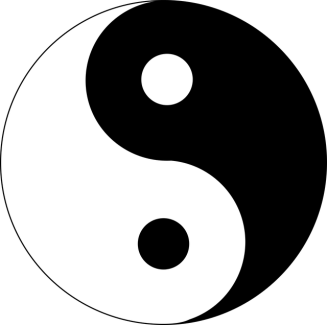
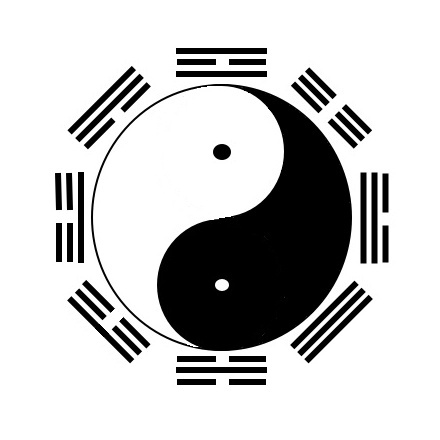
To avoid the fault of double-weightedness, which hand is the yin one and which is the yang one must change continually and ceaselessly as you go through the movements of the Tai Chi form. Tai Chi Chuan should always be in a state of change, just like the Tai Chi symbol itself is.
Image by Pixabay.
If it’s not in a state of change then it’s stuck. Calling something double-weighted is another way of saying that it’s stuck.
Split is usually applied along with another of the 8 energies. One example I wanted to look at today is Rollback. Rollback, or Lu energy, is the most yin of all Tai Chi’s 8 energies. It’s almost the absence of energy. When being confronted with active Yang energy, Lu is the energy of retreating or yielding. Its movement is usually inwards.
The technique called Rollback in the Tai Chi form gets its name from Lu energy, but also mixes in a bit of Split energy.
If you look at this picture of Yang Cheng Fu doing Rollback you can see the differentiation in his hands.
This left hand is withdrawing and pulling, but his right hand is pressing downwards.
In the action of Rollback your left-hand starts off as the active one with a guiding pull on the attacker’s wrist, but the right one then takes over as the active hand with a strong pressing down action onto the attacker’s elbow area.
I found a really old video of me doing rollback in push hands, so you can see what I mean:
At the start of the motion my left hand is the active one, then the right hand takes over with the pressing down movement.
Throughout the whole Tai Chi form, you should be aware of this interplay of energy between not just the palms but the other parts of the body too. If you can notice it in the palms, with one hand being the active one and the other the passive one, and then exchanging positions, you can start to notice it in the feet, the legs and so on.
Once you can do this over the whole body then you can distinguish yin and yang throughout your form and you will no longer be at the risk of exhibiting double weighting.
In this post I’m continuing with my current theme of the mind and Tai Chi Chuan.
Animals don’t “think” like we do most of the time. I bet you could argue that the species known for problem-solving like crows, chimpanzees, dolphins and dogs do their fair share of thinking, but in my previous post I was describing a state where you are doing Tai Chi without thinking. Just being.
You can see it in their eyes. Just look at that cat above. Cats are great examples of this, because they are around us often they’re easy to observe, but if you can observe animals in the wild you’ll see that they are in this state most, if not all, of the time.
There are various references to cats in the Tai Chi classics.
“The Form is like that of a falcon about to seize a rabbit,
and the shen is like that of a cat about to catch a rat.”
Shen, we can loosely translate as spirit, but if you just substituted the words “inner state” there instead I think it would better equate to what the author was trying to convey, but he or she did did say Shen for a reason, as we shall see.
The word “Spirit” in English is tied up with all sorts of (organised) religious connotations which get in the ways and are not helpful.
A better understanding of what is meant by Shen would perhaps be, ‘underlying spirit of nature’. The part of you that is connected to this underlying spirit of nature is known as the Xin in Chinese. If it’s aligned with nature your Xin can produce your Yi (intention), which in turn can produce the physical movement (Qi) which in turn produces action (Li) all working in harmony with nature. You and your environment are one, working and acting together.
There are various versions of this ‘working in harmony with nature’ sequence written about in old Chinese writings – the Xin harmonises with the Yi, the Yi harmonies with the Qi and the Qi harmonises with Li being the most common and also forming the 3 internal harmonies of the famous Lie He, the 6 harmonies with are written about in all sorts of Chinese martial arts.
My Xing Yi teacher, Damon Smith did a whole podcast episode about the word “spirit” and what it means in Asian traditions connected to shamanism, which I find helpful in understanding. I would listen to the whole thing, but around the 8-minute mark he talks about this sequence and how Shamans use it to act in harmony with nature in their own lives or when practicing shamanism:
Cats and the Tai Chi classics
To me, the section of the classics that says “The Form is like that of a falcon about to seize a rabbit, and the shen is like that of a cat about to catch a rat”, alludes to the idea that on the outside the victory in combat may look overwhelming and great – like that of the falcon seizing a rabbit triumphantly, but on the inside, you need to be quiet and calm and in harmony with nature – the exact qualities you can see in a cat patiently stalking a rat.
Of course, the flacon is like that on the inside when catching a rabbit, but it’s not easy to see on the outside. Human-loving cats, however, are easier to observe.
A cat crops up somewhere else in the Tai Chi classics too:
“Walk like a cat.”
That doesn’t mean get down on all fours, it means to adopt the same mental qualities as mentioned earlier to your stepping. Don’t just rush in blindly or recklessly: be calm, patient and at one with your environment.
Remember, as it says in the classics:
“All movement is motivated by Yi and not by external form”.
But perhaps Bruce Lee said it best in Enter the Dragon:
I’d like to give a quick shout out to Cook Ding’s Kitchen who reposted one of my blog posts “Don’t Try“, which gave me the chance to read it again. It was about using less effort and not forcing things. Difficult words to live up to.
This started me thinking about one of the things that can help in using less effort in Tai Chi. A good trick is to turn our normal perspective on the human body upside down. We normally think of doing things with our arms and hands and don’t think much about the legs at all. In Tai Chi we want to reverse that.
If we watch a boxing match, for example, we tend to look at what’s going on with the hands a lot, since that’s where all the action is, and generally miss the subtle changes of the legs.
Tai Chi is boxing with the legs: You use your legs like arms, and your arms like legs. When you’re doing the Tai Chi form, stop using your arms to ‘do’ things and put all your focus into using your legs to do it. It’s a bit like walking on your hands: your arms and legs swap their normal functions over.
When doing the form or applications, your toes grip the ground, your weight moves fully forward or backward on the feet (no wishy-washy stances floating about in the middle ground, please), you are sunk and slightly low in your stance so you can get fully into your legs. In contrast, the upper body should be empty. Relax. Let the arms go where they need to go, but don’t move them there deliberately. Let your legs, directed by your middle, do the work. Think them into position with a directed focus (yi).
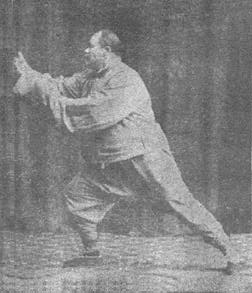
The Press posture is a good example of what I’m talking about:
Yang Cheng Fu – Press
You put your inside hand on the outside arm wrist and push towards the opponent in a linear direction. Because you’re forming a particular shape with your hands in Press, it’s tempting to do this move with your arms cut off from the body. Instead, the power needs to come from the ground via the legs. Drop down and release from the dantien area to the ground and let the power of the ground rise up to the hands. Done right, you’re hitting the opponent with the force of the planet (jin), not just the force of your body.
As it says in the classics:
“The jin should be
rooted in the feet,
generated from the legs,
controlled by the waist, and
manifested through the fingers.”
and
“The whole body should be threaded together
through every joint
without the slightest break.”
and
“All movements are motivated by yi,
not external form.”
My Xing Yi teacher invented the word “chalicity” as an English equivalent of the Mongol phrase “Bak Tam Stay Saub”, which means (very roughly) “a bit like a capacious container”. So, chalicity means, “a bit like a chalice.”
A chalice, or a cup, is a rounded structure designed to contain a fluid with no leaks, and has parallels for both the mental aspect and physical aspect of a posture in the internal arts.
In the context of his shamanism practice, chalicity is more about the mental parallel – the space inside the cup reflecting the space inside a mind that is empty of thought.
However, in the context of Taijiquan and martial arts, you can think of ‘chalice-like’ as the physical structure of the body creating the space necessary to contain “Peng” energy, that is, the ground force used in internal arts expressed through a rounded structure.
Think of Peng energy as being the fluid inside the cup and your body as being the structure of the cup. Or you can think of it as the air inside a rubber ball. If you keep your body rounded, it holds the Peng energy nicely. If you don’t, it leaks out.
The posture requirements of Taijiquan
All the posture requirements of Taijiquan create a rounded structure for the body. Here are some:
1. Head suspended from above
2. Elbows drooped.
3. Chest sheltered / back lifted
4. Shoulders rounded.
5. Chi sunk to the dantien.
6. Kua rounded
7. Knees bent.
These requirements create the structure for your ‘chalice’ within which you can hold the Peng force.
These days all internal martial arts make use of Zhan Zhuang, “standing like a tree” standing postures, which the practitioner is required to hold for extended periods, work the same way. They all maintain this same Peng shape, with gently rounded limbs and upright spines.
Xing Yi Quan uses the San Ti Shi standing posture which has 6 requirements, two of which are bear shoulders and tiger embrace. Together these two requirements mean your torso and arms take up the same chalice-like posture. You maintain the Peng shape. It’s all the same idea.
Maintaining structure while moving.
Structure isn’t something that’s meant to be achieved only in a static posture. Part of what you’re training when you perform a Tai Chi form, for example, is the ability to keep this Peng shape as you move.
If you keep the requirements you can maintain Peng. If you break the requirements then your Peng force will leak out of your body, just as water would leak from a cup with a hole in.
So, if you start to drop your head or stiffen the neck, for example, or straighten your legs or raise your elbows, you lose the natural power of the body working together all powered from the ground, and you have to start muscling it to compensate in your techniques.
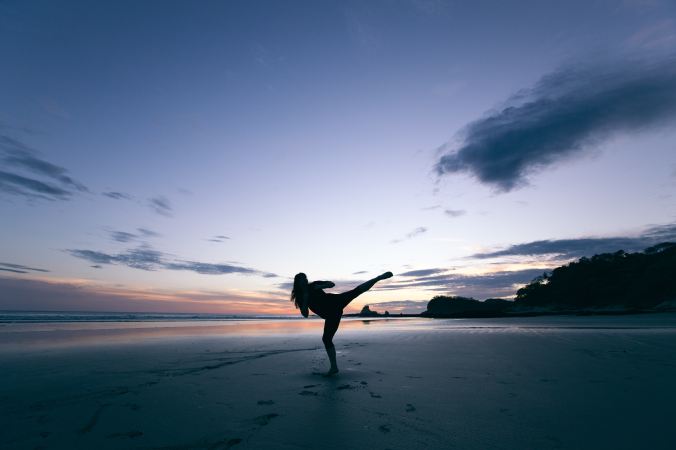
So, to work in internal arts, all the techniques need to be expressed within the framework of this structure, and some techniques in martial arts just aren’t suited to maintaining this Peng structure.
There’s nothing wrong with a side kick, but you physically can’t keep the body ‘rounded’ while performing a side kick to the opponent’s chest because of the angle you need to open your hip to. Just look at the photo.
I think that’s one reason why you don’t often see the a side kick in most Tai Chi forms or in fact in Xing Yi or Bagua. The kicks you do see in the internal arts tend to not take the hip out of alignment with the rest of the body.
Does that mean you can never do a side kick again? Of course not, but generally, you need to keep your rounded structure at all times when practicing internal arts, that way you keep your Peng energy rounded and the true power of the internal martial arts can be expressed.
Tai Chi is opening and closing happening simultaneously.
That’s one of the secrets of Tai Chi, right there. Unfortunately, as with much of the truths about Tai Chi Chuan, the statement doesn’t make any sense unless you already know what it means.
As an art, much of Tai Chi is self secret like this. In one way that’s frustrating, but in another way it’s freeing because it means teachers don’t have to hold things back. The secrets reveal themselves over time.
Look at the Tai Chi Classics, for example. They’re a collection of pithy martial arts sayings that hide deeper meanings. “5 ounces of force deflects a thousand pounds“, “Walk like a cat.“, “Store up the jin like drawing a bow.”, etc.
Many of the sayings in these documents don’t mean anything to people reading them who don’t already understand them. So, there’s no risk in losing ‘the secrets of the art’ by publishing them, which is perhaps one reason why the Tai Chi classics are in wide circulation, while other martial styles keep their writings secret, held only within families.
Perceiving opening and closing
When you’re doing your form, can you perceive movements that are obvious opening movements, and movements that are obviously closing movements?
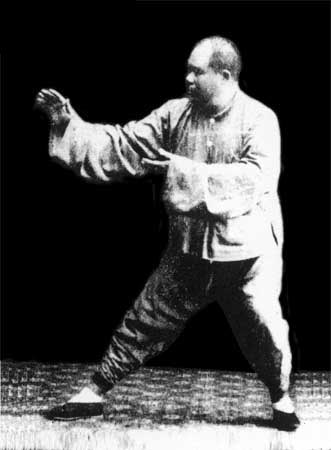
It’s good if you can. If you can’t then think about this – roll back (lu) is clearly a closing movement, and ward off (Peng) is obviously and opening movement. Look for the same actions in the other movements. On the opening movements, the body expands outwards. On the closing movements the body contracts inwards.
Yang Cheng Fu – Roll back
But that’s not the end of the story.
If you’re perceiving the form like this – a series of opening and closing movements that happen one after the other, then you’re not quite on the right track.
The key is that the opening and closing are both happening all the time simultaneously. So, as one part of the body is closing whilst another part is opening.
Look at the yin yang symbol. If you follow it around in a circle with your eye you can see that as one aspect grows stronger, the other aspect diminishes, but is also being born again and growing. It goes on in an endless cycle.
It’s these cycles you need to pay attention to in the form. It should feel like this cycle of opening and closing movements is going on with one movement giving birth to the next, rather than perceiving them two separate movements where one starts, then stops, then the other starts and stops. The movement is continuous. It goes out, it comes back, it goes out again.
Silk reeling circles
Let’s break this down into something more tangible.
A while ago I made a video course on the basic single handed silk reeling exercise. This exercise is great because it gives you a chance to work on opening and closing in a relatively simple movement.
Out of the whole course, part 1 is probably the most relevant video to explain what I mean:
Here’s what I’m doing in the video: I’m looking for a slight stretch across the front of my body and a slight stretch across the back of my body (the yin/yang aspects). As the arm goes out the front of the body gradually becomes more taught until there’s enough tension there that I can use it to pull the arm back in. As the arm comes back in, the back of the body becomes slightly more taught until there’s enough tension there to use it to expand the arm outwards. This is all integrated with reverse breathing which powers everything from the Dan Tien area. It’s a very stretchy, rubber band-like practice.
You can start with big, crude circles, but work down to smaller more subtle circles.
But ultimately you’re looking for the feeling of the cycle of yin and yang, opening and closing going on in the body.
It’s this feeling that you need to take into the Tai Chi form where opening and closing happening simultaneously through a myriad of different movements.








 The Tai Chi Notebook