Rushing is probably the cause of most of our problems. That time you didn’t notice the uneven paving stone and tripped? You were probably rushing. That time you shouted at the kids because they couldn’t get their shoes on fast enough while leaving the house? You were rushing. That time you accidentally emailed a picture of yourself drunk to everybody in the company? You were definitely rushing then.
In nature, wild animals can move a lot faster than we do, but do they ever look like they’re rushing? A rabbit sprinting for its life to avoid a fox still moves with poise, dignity and grace. Compare that to the embarrassment of the average human running for a bus, an act in which the stakes are considerably lower! Even a cat, an animal known for incredible bursts of speeds pauses for a second before it makes that leap onto a table, so it can be aware of the entirety of the situation.
But how can we learn to stop rushing all the time and regain this poise which animals seem to naturally have? One answer is Tai Chi.
If you’ve been doing Tai Chi for a while, a good number of years, then you’ll know the form inside out. It’s no longer a fresh, new and exciting thing. In fact, your mind is probably bored with it. Here we go again, this same old moves. Sigh. Stand for a moment before you do the form and you’ll notice feelings of impatience start to creep in. Part of you will want to start rushing, to get it over with as quickly as possible
This is where your slowness training is useful. Do the form slowly, at an even pace and just keep doing it. Resist the call the start speeding up and rushing sections. Treat all parts with equal importance. Even the linking moves between the classic postures. Notice your breathing. Keep your awareness on what you’re doing. Don’t let the mind wander off – keep it in the body and keep bringing it back. If you do notice that it’s wandered off completely then stop and start the form again, no matter how far you’ve got. Slowly, day after day you build a kind of mental strength, and if you’re lucky you’ll find it seeps over into the rest of your life, and you’ll be less prone to rushing than you were before.
Stop rushing and you no longer slip up,
Stay in the moment and strains are no longer felt,
When strains and no longer felt, stresses start to disappear,
Arlene Faulk is the author of Walking on Pins and Needles, her memoir of living with multiple sclerosis without a diagnosis for many years, spending two years not getting up from the couch and how she eventually found Tai Chi and how it helped her combat the disease and regain her health, eventually becoming a Tai Chi teacher herself. Make sure you listen right to the end as we have some tips from Arlene on how you can use Tai Chi principles discussed in the Tai Chi Classics to feel better right now as you listen to the podcast.
A sphere is one of the strongest shapes regardless of the direction of force. Photo by Laura Tancredi on Pexels.com
I wanted to talk today about the concept of the Tai Chi ball, or more accurately, Tai Chi sphere. While it might sound simple, I think it’s really an advanced concept because it’s taking the Tai Chi teachings out of the realm of specifics, of things like ‘relax that shoulder’, ‘move that foot’, ‘drop that elbow’, ‘align that hip’, etc…, and into the realm of concepts, which are much harder to pin down into physical details.
The Tai Chi Classics talk about Tai Chi being circular a lot. For example, it says:
“The postures should be rounded and without defect, without deviations from the proper alignment; in motion, your form should be continuous, without stops and starts.”
At a certain point the position of the hands and feet and other body parts in Tai Chi gets subsumed by the general sense of keeping your body and all your movement rounded, like a ball. (Newsflash: despite a thousand form corrections from seminar masters, the exact position off your hands isn’t what’s important.)
What’s important in Tai Chi is that your body is creating a ball-like structure, with ‘you’ at the centre. That’s what determines if you hands and arms are in the correct position, not angles and degrees. If you are making a sphere with your movement and body, then everything will be in the right place, and if you aren’t, it’s not.
The advantage of creating a sphere is that force can comes in and be rolled off without too much interference and muscular tension. A sphere is a Tai Chi symbol write large, in 3 dimensions.
The Tai Chi Classics talk about Tai Chi Chuan being circular. Photo by Sindre Stru00f8m on Pexels.com
The idea of separating empty and solid in the body goes hand in hand with creating a Tai Chi sphere. In fact, I don’t think you can do it successfully without a separation of empty and solid – or yin and yang – in the body.
But here’s the kicker. You can’t just decide one day to do this practice. You can’t go outside right now and do you form and decide to make your Tai Chi like a sphere because it will be meaningless. Instead, it’s a situation where you gradually discover, after many years of practice, that Tai Chi is like a sphere. One day you’re practicing and you suddenly notice it, and bang! Your Tai Chi will never be the same again. It’s like that famous picture that looks a bit like an old man but isn’t:
You either know or you don’t! Can you see what this is a picture of?
Most people are unable to see what that is actually a picture of at first glance, but once you get it, no amount of me trying to persuading you otherwise will prevent you from knowing exactly what it is.
It’s the same with the Tai Chi sphere. Your Tai Chi has always been a sphere, you just didn’t know it, until one day you did, and then it was suddenly obvious to you.
Referring to the Tai Chi Classics can help your practice. Photo by RODNAE Productions on Pexels.com
I’m writing this as a kind of follow up to my previous article on 3 views of qi in Tai Chi. That article contained the 3 different things I think people really meant when they talk about qi in Tai Chi. This article aims to do the same thing with yi. I don’t consider myself an authority on either matter, but I have had some skin in the Tai Chi game for a while now, and I’ve read enough of other people’s writings to come to some conclusions about what I think they’re talking about. Hopefully you’ll find these definitions helpful, and I’d be interested to hear your thoughts in the comments section.
Yi gets a few mentions in the Tai Chi Classics, and is usually translated into English as “intent”, or “mind-intent”, a translation which I think can be problematic because there are at least 3 different things that people mean when they say “intent” in Tai Chi, and while the three are obviously related, they’re also quite distinct from each other.
Before we get into the definitions, let’s have a look at what the Tai Chi Classics have to say about yi:
The most quoted line regarding Yi is in the Tai Chi Classic: “All movements are motivated by yi, not external form”, which can also be translated as “use the mind, not force”. In no.6 of Yang Cheng-Fu’s 10 important points he says:
“6.) Use the mind instead of force. The T’ai Chi Ch’uan Classics say, “all of this means use I [mind-intent] and not li.” In practicing T’ai Chi Ch’uan the whole body relaxes. Don’t let one ounce of force remain in the blood vessels, bones, and ligaments to tie yourself up. Then you can be agile and able to change. You will be able to turn freely and easily. Doubting this, how can you increase your power?”
So, here the emphasis is on relaxing and not using “force”, but why? And What does that mean? I will explain later.
Interestingly, right after that line, the Tai Chi Classic then goes on to say:
“If there is up, there is down; when advancing, have regard for withdrawing; when striking left, pay attention to the right.
If the yi wants to move upward, it must simultaneously have intent downward. “
Definition 1: Martial intent
Given the lines quoted in the Tai Chi classics above I find it strange that the most common interpretation of yi in Tai Chi is as a kind of martial intent. Here intent is “your intent to do something”, and in Tai Chi people generally mean a martial intention that needs to be contained within every particular posture or movement. So, for example, when you do the ward off movement, you need to have the intention of deflecting a blow away. If you movement lacks that intention, it is said to be empty.
Now this may all be true, and not knowing the martial applications of a movement inevitably leads to it becoming too abstract and unfocused, but this understanding of ‘intent’ is clearly not what is being talked about in the Tai Chi Classics when it admonishes us to “use the mind, not force”. If all it meant was to have a martial intention behind the movements, then it’s impossible to see how that can match up with lines from the classics like:
“If the yi wants to move upward, it must simultaneously have intent downward.”
What has that got to do with martial intent?
Clearly this is talking about something else. Yes, a martial spirit is obviously important for Tai Chi, and some Chinese teachers refer to an “eye spirit” which his making sure you are focused and looking in the right place in form performance, and you look like your actions are martially proficient, but I don’t really think this is what is specifically meant by yi in the Tai Chi classics.
Definition 2: A line of intent from the ground up
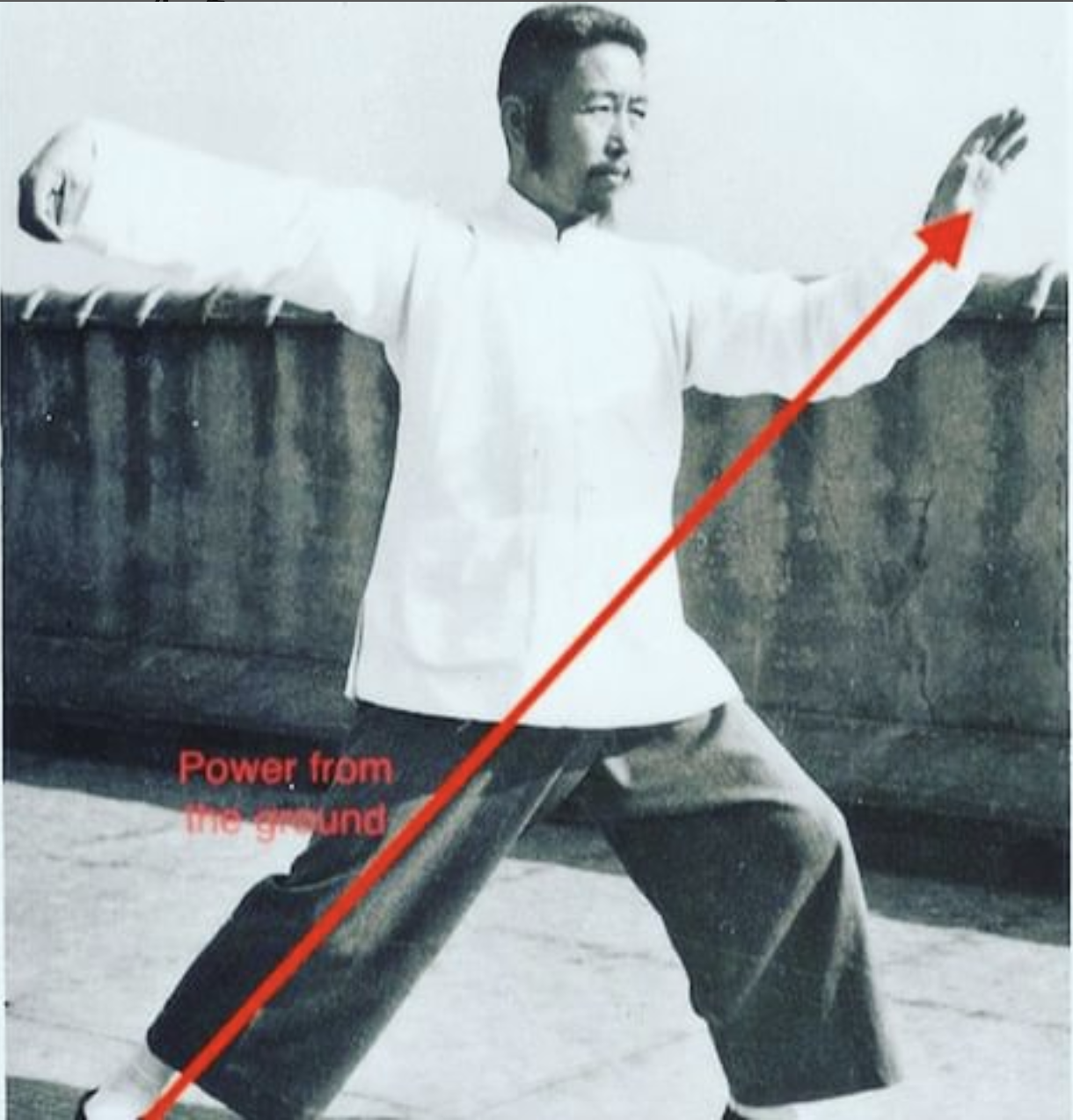
The second way that people refer to intent in Tai Chi is as a line of force, usually from the ground to the point of contact with the opponent. The idea in Tai Chi is to bring the solidity of the ground to your point of contact with the opponent. How do you do this? Well, firstly by relaxing, so that your body can function as a whole, connected, unit, and then by feeling a line of connection from the point where you contact your opponent (in push hands that would be your palm or wrist) directly to your foot (the part of you that is closest to the ground). By imagining the force of your opponent going straight down to the ground in a straight line from your palm to your foot then you can make use of jin – which is a force obtained from bringing the solidity of the ground to the point of contact with your opponent. This jin force stands in contrast to the normal force of the body produced by exerting your muscles, which the Chinese call li. Of course, muscles are involved in generating jin (otherwise you’d collapse not he ground), but they kept as neutral and relaxed as possible, so that excess force is avoided.
If you send force from the ground to your point of contact with your opponent, using jin, you can bounce them back off you.
Of course, you cannot be thinking of the ground if you want to project somebody away from you. Your work in creating the path to the ground is already done – in the bow analogy this is the drawing of the bow. All that remains now is to fix a direction and release the arrow:
As it says in the classics:
“Release the chin like releasing the arrow.
To fajin [discharge energy], sink, relax completely, and aim in one direction!”
This use of Jin fits in better with the lines in the classic that say
“If the yi wants to move upward (i.e. bounce your opponent back) it must simultaneously have intent downward. (i.e. you imagine a line of force to the ground).
(N.B. this straight line of force obviously goes through empty space, so it’s not the actual line any force from the ground will take, but it’s a case of your mind having the overall goal in mind, and your body filling in the details on a kind of subconscious level.)
Definition 3: A part of the mind
This definition is about yi being a part of your mind and the hardest to put into words. Obviously, definitions 1 and 2 also involve using the mind, so you can see how all 3 definitions are kind of wrapped up in each other.
In everyday life when you want to do something, like say pick up a pen or bring a cup of tea to your lips, the idea to do it appears in your head before the physical action takes place.
In internal arts the 6 harmonies get a lot of press. Of these 3 relate to the physical body, and 3 relate to the internal make up of the person. In the West we tend to have one word “mind” to relate to all the different and distinct parts that the Chinese have words for, like xin, shen and yi, but the three internal harmonies (san nei he) are:
1) The heart (Xin) harmonises with the intention (yi).
2) The intention (yi) harmonises with the chi.
3) The chi harmonises with the movement (li).
The heart mind (Xin) is related to our desire to do something, the yi (intent-mind) is the part of our mind that makes things happen on a subconscious level. When you pick up the cup to bring it to your lips you don’t think “hand move to cup, fingers wrap around handle”, etc.. It just happens because your intent-mind is taking over, based on what you desired to happen. The intent-mind is therefore a kind of subconscious process.
Now, going along with the idea that there are these different parts of our mind that exist as separate entities comes the idea that we can train these separate entities in isolation to gain a deeper ability with them. So, for example, by repeated practice of a Tai Chi form (or Zhan Zhuang standing practice), in which we are trying to access the subconscious intent-mind, rather than brute force, to perform action we might, in fact, get better at it and develop some ability that ‘normal’ people who lack this cultivation don’t have. It’s an interesting idea!
A good starting point for developing this intent-mind is Zhan Zhuang standing practice. One common practice is to stand in the ‘hugging a tree’ posture and try and get the mental sense that your hands are expanding outwards, yet without physically moving them. You are cultivating your intent-mind when you do this. This is starting with just one direction, but in standing practice people often talk about training 6 directions at once.
When performing a Tai Chi form it’s obvious that you are dealing with moving energy (in a physical sense) in different directions. If you can utilise your mind to “think” in these directions then you can start to train your yi, and it can start to feel like your movements are generated by yi and not by physical force.
Conclusions
It’s not easy to talk about what is meant by yi in Tai Chi, but hopefully I’ve provided you with some good starting points and ideas. I’ll repeat again my assertion that the three definitions I’ve given are all important parts of the practice that makes up Tai Chi Chuan and all inter-related. And while yi may be tricky to describe, it is of utmost importance to all the internal arts. There is a line from the Xing Yi classics that goes:
“There is nothing but structures and nothing by qi”
On hearing this line I remember my Tai Chi teacher saying “Oh, that’s good, I like that, but I’d change it to:
There is nothing but structures and nothing by yi”.
Structure and intent. When it comes right down to it, that’s all the internal arts are made up of. That’s how important yi is.
One of my poetic/literary heroes, Charles Bukowski had “Don’t try” written as an epitaph on his tombstone. To many people he was simply an alcoholic, womanising, bum who pissed way his talent, but I bet Charles Bukowski did more honest days work in his life than a lot go his critics ever did. Writing was his way out of a life of oppressive blue collar jobs that had ground him down, and he only succeeded as a writer late in life, and that gave him a unique perspective.
There’s a video that explains his seemingly paradoxical philosophy of “Don’t try”.
But if you don’t have time to watch it then Bukowski explained it himself in one of his letters:
“Somebody asked me: “What do you do? How do you write, create?” You don’t, I told them. You don’t try. That’s very important: not to try, either for Cadillacs, creation or immortality. You wait, and if nothing happens, you wait some more. It’s like a bug high on the wall. You wait for it to come to you. When it gets close enough you reach out, slap out and kill it. Or if you like its looks, you make a pet out of it.”
– Charles Bukowski
I think anybody versed in the philosophy of Tai Chi can see an instant parallel here to the Taoist ideal of Wu Wei – “not doing”. Quite often if you can wait for the mud the settle the water becomes clear all by itself, and the right action becomes obvious.
There are a number of quotes you can find in the Tao Te Ching that elucidate on this idea, right from the start of the book, where in chapter 2 Lao Tzu states: “The sage acts by doing noting”, then later in chapter 22 he says “Because he (the Sage) opposes no one, no one in the world can oppose him.” And in Chapter 48, “When nothing is done, nothing is left undone.”
Now I wouldn’t say that Lao Tzu and Bukowski have exactly the same take on this idea, but they’re not a million miles apart.
There are obvious applications of “Don’t try” in all areas of your life – from creativity, as Bukowski found, to business and your home life, but one of the most obvious I find is in martial arts.
If I find I’m engaged in too much of a struggle during sparring, rather than go harder, I have slowly learned to back off. Rather than fight through something it’s much easier to change track and go around it.
In Tai Chi push hands you can encounter this idea whenever you feel resistance from your opponent. How do you react? Do you push harder, knowing if you do, you can impose your will on them? Maybe you can, but you’re just engraining a bad habit that’s not going to lead to success when you try it on somebody bigger than you.
In Jiujitsu I often find guard passing is the best example of this idea of Don’t Try. If you try and force a guard pass, like a knee slide for example, when your partner is defending well then quite often you can make it work, but it’s a lot of effort and ultimately you’ve depleted your energy reserves more than you had to. And again, it won’t work on somebody bigger and stronger. That’s when the words “don’t try” tend to appear in my mind. If the knee slide pass is defended then change the angle, work something else, see if you can switch to a bull fighter pass instead. Or change to a back step. There are always ways around the problem instead of having to power straight through it.
People tend to do push hands at the wrong range. I think the combat benefits of training push hands disappear almost entirely when you are too far out.
I notice when I train it with people they keep wanting to edge back. You need to be a range that feels uncomfortably close, until it feels comfortable.
If you look at MMA (sorry to use that as an example, if it rubs you the wrong way, but it provides brilliant examples and feedback of the dynamics of two people in a violent encounter) one of the big, high-percentage, often fight-ending, techniques is the counter left (or right) hook; the check hook. This happens after the fighter throws a jab – you move back (or slip) and throw your hook over the top – that’s the range push hands is working in, and a good practical example of what skill at that range can do.
If you watch this video of Cheng Man Ching pushing hands you can see he tries to stay in close all the time – in fact, when he’s launching people he kind of ‘cheats’ and takes an extra half step in so he’s right inside their base, which enables him to show off a bit more on the distance he can push them – this is only possible because they are keeping their ‘front door’ open with a wide stance. The way I was taught is that your toes match the opponent’s heels, fist width apart to allow for ‘shin biting’. (Lots of people do this distance correctly, but go shoulder width apart – leaving the groin too open and letting people step in to launch them. It’s just a bad habit to get into).
Don’t mistake push hands for sparring
Chinese martial art people in general I think spend too long in these double or single ‘arm contacted’ type positions – in more martial sparring sessions these moments happen in split seconds. People don’t stay here. If you end up putting your arms out looking for that position you get punched on the nose. I think doing too much of it breeds bad habits. You’re doing that ‘safe’ training to learn skills that are hard to acquire, which then get used in freer environments, rather than try to mimic the ‘safe’ environment in freer training.
Staying in this range all the time with another person doing ‘soft’ stuff like push hands seems to lead to teachers who start showing off and generating cult-like guru behaviour. It’s a trap you can fall into if you’re not careful. If your students start treating you like a holy saint, then that’s a red flag!
I’m really not a fan of the kind of following that builds around some of the big names in Tai Chi, like this guy, Adam Mizner. He plays the guru card well, and I’ve seen lots of videos where his students really overreact to him in a way that makes me think they all fell down a rabbit hole years ago. However, the guy clearly has some good skills at push hands, as you can see in this video. This video I think is one of the least worst of his I’ve seen (in terms of over reaction from his students) – yet the group still all stop what they are doing to ‘watch the master’ and play his guru game:
Fighting
It’s always worth repeating, even though its kind of obvious, – you don’t need push hands to fight. Combat sports turn out accomplished fighters quickly without these methods.
You can practice all the applications in a Tai Chi form in push hands – it’s one step up from doing them as stand alone techniques because it requires more timing, flow and ‘listening’, but this is still not ‘fighting’.
Jin
One of the reasons for push hands is to learn to use Jin not Li. For a short answer of what that means, I mean using the ground strength in your movement (jin), not local strength (li). It’s easy to fool yourself that you’re ‘doing it’ when you perform a Tai Chi form, because there’s nobody else there. Can you ‘do it’ when somebody is providing some light resistance? Or trying to ‘do it’ back to you? Push hands enables you to find out. I wish people would view push hands more as a tool for learning that, not as a competitive sport of limited wrestling. It’s like people have been given a knife, but they insist on using it like a spoon.
And the use of Jin in directions also requires a strategy to use them, which can also be practiced in the laboratory of push hands. Listen, stick, yield, neautralise and attack.
In push hands you ‘listen’ to the push from the opponent (with your body), you stick to their limbs (so you can feel and listen) then you yield to their pressure, which leads to neutralising their attack, so that you can attack yourself.
In sparring you use the same idea, but you cannot rely on being stuck to their arm. However, you need to keep the same process going that you’ve learned in push hands, just sometimes there will be no contact – you can still neautralise, and yield, through subtle changes in body posture and position, thanks to your use of sensitivity. Once you take ‘push hands’ into a more real sparring environment, I think you’re in the same territory where Xing Yi spends most of its time training. In Xing Yi it’s just the same idea, even if it looks different – you do not attack blindly at the opponent – that won’t lead to success against somebody good, bigger or stronger. In Xing Yi we have this phrase “don’t attack when you see an opening, attack when you see the heng” – I would interpret that as you only attack once the opponent’s attack has been neautralised (heng being the point of neautralisation); depending on your level of timing, this can be before the attack has even been launched. Good opponents will leave fake ‘openings’ for you to attack. Therefore you don’t attack based on what your eyes alone see – you attack based on feeling for that moment of neautralisation. Different training methods – same results.
My guest this episode is Rob Poyton a veteran of the UK Tai Chi and martial arts scene. These days Rob is a teacher of the Russian martial art of Systema, which he has been teaching in the UK since the early 2000s and has run workshops and seminars all over Europe. Rob is also a prolific author of Systema books and videos which you can get via his website Cutting Edge Systema which is found at systemauk.com
In this wide-ranging discussion we talk about what the UK Tai Chi scene was like back in the 80s and 90s, and the similarities and differences between Tai Chi and Systema. We even get into a bit of politics, and talk about Rob’s experiences as a professional musician and his sideline as a horror fiction writer. So, sit back and enjoy as we get under the skin of Tai Chi and Systema.
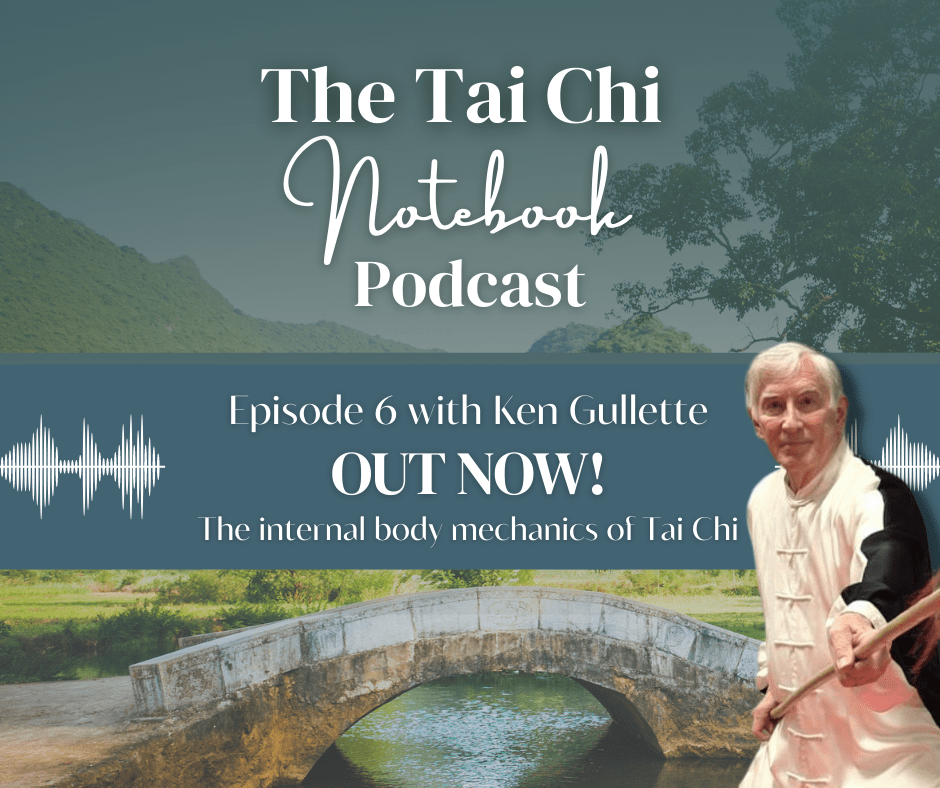
In this episode Tai Chi Notebook podcast my guest is Ken Gullette, a native of Illinois, USA, where he trains in all three of the main internal arts – Tai Chi, Bagua and Xing Yi. Ken also runs a website called internalfightingarts.com where he trains students from around the world in the three internal arts using a combination of recorded and live classes.
Ken is quite famous for his focus on body mechanics, internal power and getting to the root of these arts in a non-mystical and no-nonsense way. In fact, he’s written an excellent book that’s available on Amazon – it’s called ‘Internal body mechanics for Tai Chi, Bagua and Xing Yi’, and I’d recommend you get a copy.
In this episode we discuss the internal body mechanics of Tai Chi, training with disciples in the Chen family linage and there’s also a few stories of the times Ken has had to use his arts in real situations.
As we’re moving into Autumn, there’s bright sun and a bit of a cold bite in the morning air during Tai Chi practice. I find a change in the weather is a good time to reflect on the things I’ve learned so far and to change the focus of my practice back towards the fundamentals.
I feel like summer was a time to be more active and energetic in my practice and Autumn is a time to be more reflective, so I’m picking up the practice of fundamental single-arm silk reeling again. Refocusing my Tai Chi on the idea of 1) sinking my weight down into the lower body and 2) generating movement from the legs, hips and feet while trying to stay as relaxed in the upper body as I can. I prefer to focus on these two tangible things rather than to talk too much about dantien and qi.
So, let yourself do the movements of a Tai Chi form, but remember, you’re not allowed to move your arms at all! And by that I mean, you cannot move from your arms all. Your arms move, of course, but they move because of the lower body. And don’t just pay lip service to this idea. Really do it. Ban yourself from arm movements and see where it takes you. Movements that could be seen as superficial take on whole new layers of meaning when practiced this way.
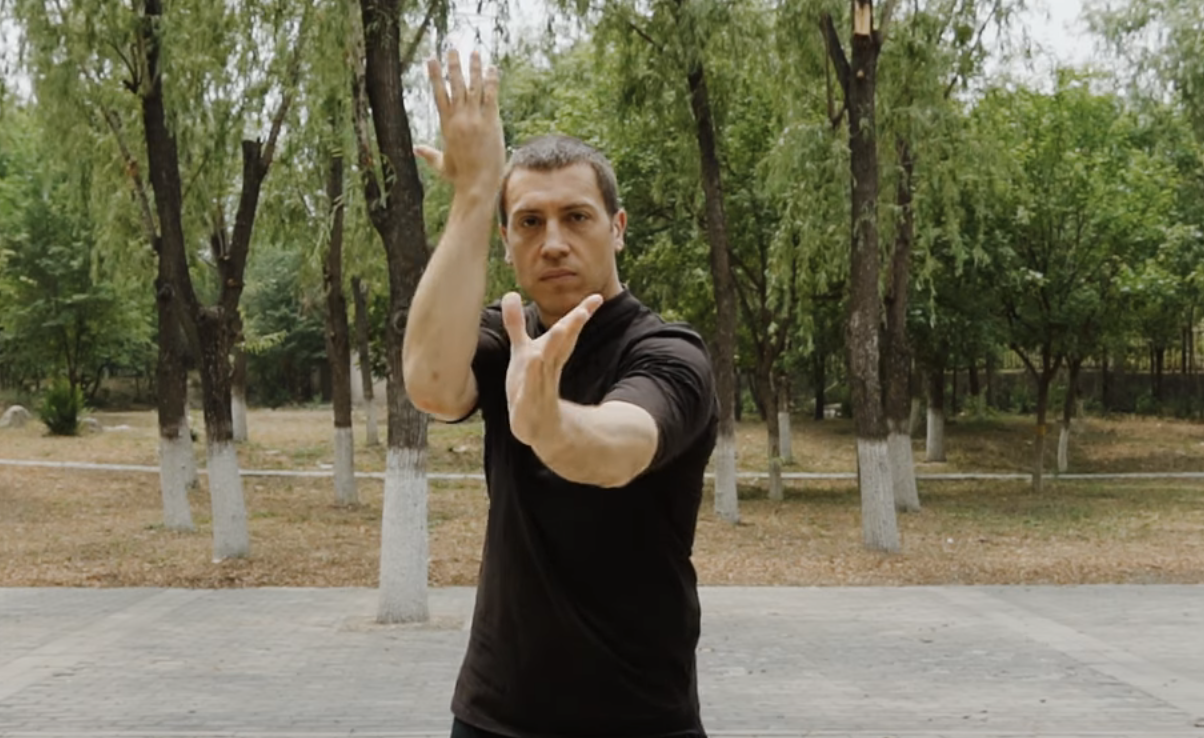
Byron Jacobs is a teacher of Xing Yi and Bagua based in Beijing, China. He’s a student of the famous Shifu Di Guoyong and is heavily involved in the martial arts scene in Beijing. As well as training traditional martial arts he’s also a BJJ practitioner and competitor.
In this wide ranging discussion we talk about training Xing Yi, Bagua and Tai Chi and whether Wu Shu will ever get into the Olympics. We also find out what it was like to train martial arts in Beijing during the Corona virus pandemic, and what the Chinese BJJ and MMA scene is like.