“Lord make my words as sweet as honey for tomorrow I may have to eat them.”– Unknown.
It’s been pointed out by a kind reader that I didn’t explain myself very well in the last post, and that I was putting “weight” onto the front leg despite saying that I wasn’t. After a long chat with the reader – (thanks Igor) – and some reflection, I think he’s right. So, thanks to Igor for pointing this out. I’ll have another go at explaining what I meant here:
What I was trying to explain was that in a general Xing Yi step I’m not going from a back stance to a front stance. Like this:
Back stance (weighted back leg):
Front stance (weighted front leg):
I desribed not doing this in my last post as “not putting my weight on the front leg“. However, I now realise that this is misleading because at the point in the video where I’m hitting the tennis ball my mass is landing on the front leg. Here’s the moment:
You can hear it as well, if you have the sound on. The rear leg then follow steps and catches up and “catches” under my body.
So, while my stance is not changing from a back stance to a front stance, my mass does go into the front leg, and the ground.
One of the reasons I write this blog is to write out my thoughts, because then I can be really clear with what I mean, and correct them if necessary. So, I think I just got a little bit clearer, thanks to one of my readers. The point of this blog is never blind adherence to a particular viewpoint, but to research and challenge what I’m doing, and keep an open mind.
The other point that I think is worth making is that the ‘mass going into the ground’ is only happening because I’m not hitting something of substantial mass. You can hear the sound of my foot hitting the ground as I hit the tennis ball. If I was hitting something heavy, like a person, I think that’s what should be making the sound. That’s the real “Thunder sound” of Xing Yi – the sound of your first hitting the person. Chinese martial art is done so much against the air that I think people have become too obsessed with putting power into the ground. It’s what happens with generations of people punching air. It seems clear to me that the power should be going into the opponent. When we have no opponent, or one of little mass (like a tennis ball) then the power ends up going down into the ground.
Here’s the video again, if you want to see what it does in motion:
Edit: I wrote a second post that added a clarification about the difference between what I meant by “weight” and “weighted leg”, because I realise that this post isn’t very clear on the subject. I’ve left the rest of this post unedited.
Here’s the good news: our recent podcast about Yi Quan seems to have upset far fewer people than our one about Baguazhang. In general, reaction to the Yi Quan podcast has been positive. It’s a good point to remind people that our Heretics podcast isn’t a history podcast, it’s a podcast about the miasma – cultural assumptions and how they have played a role in the development of various arts, religions and institutions throughout history. The episode was as much about Xing Yi as it was about Yi Quan, and also the kind of tradition of criticism that the founder, Wang Xiangzhai, baked into it.
As we discussed in the podcast, Wang Xiangzhai’s criticism can be viewed as “the spirit of the times” speaking through him. At the time it was required to talk down to “rotten old traditions”, of which Xing Yi was an example (China has never really had a free press). You can read some of Wang’s criticisms in his article “Essence of Boxing Science”, which is an interview he did, turned into an essay.
He says about Xing Yi: “ It must be noted that Xing Yi Quan in its orthodox form had no such thing as the Twelve Forms (Twelve Animals), though their should be twelve forms of the body. Nor did it have the theory of mutual promotion and restraint of the five elements.”
Actually I’d agree with him – that is the way Xing Yi should be practiced. The animals are not “forms”. That was the general theme of the podcast – there’s very little difference between Yi Quan and Xing Yi done right.
However, Yi Quan people still like to criticise 🙂
I read a post recently by a (good) practitioner of Yi Quan criticising Xing Yi’s punching method – using Beng Quan as an example.
“It still baffles me when I see xingyiquan people Beng Chuan without turning the waist and shoulders, even worse almost hopping on the rear leg as all the weight is held back.”
I’d agree with him – you need movement in your body using your spine as an axis – it’s no use being like an inflexible lump of wood. And, yes, “hopping” is another mistake. Don’t hop.
But we do hold the weight on the back leg in a lot of movements. This is the hardest thing (I think) for people new to Xing Yi to understand. How can you generate force without putting your weight into the front leg?
That’s a good question to ask a Xing Yi practitioner, because they should be able to punch you and show you 🙂
“Every punch must have 2 important components: Shift of weight. [to front leg] Transference of kinetic chain from lower to upper extremity.”
Well, yes, but with caveats. That’s certainly how you generally punch in boxing, or in other martial arts. However, let’s remember that people in these arts can still generate power while retreating – enough to knock somebody out. Anderson Silva famously knocked out Forrest Griffin, while stepping backwards to avoid his rushing attack. So the situation is clearly not as cut and dried as some would like.
I’m not really into hitting things much these days – I prefer the joys of pyjama wrestling on soft mats (with minimal brain injury), but I thought I’d make a short video to show you can generate force without putting your weight into the front leg, as Xing Yi teaches us, and that maybe we should all keep an open mind on the matter.
If you look at my front leg in the video you’ll see I never put my weight onto it. It steps out in front of the body, then the back leg catches up. Obviously, it holds some weight, but the weight is ‘held’ mainly on the back leg. This is how you’re supposed to do it in my line of Xing Yi. You can, of course, also do it with a weighted front leg, but the principle of “Chicken Leg” is that one leg holds the weight – it doesn’t matter which one – and we don’t need to transfer the weight between legs to generate force, instead, the force comes from correct stepping and body movement (Dragon body).
Yes, I know need to get a bag to hit, but instead I’ve got a tennis ball on a string to play with (we go with what we’ve got available, right?) I’ll get a bag at some point and do another video.
Why do it like this? Good question.
i) You arrive quicker to where it is you’re getting to – it’s much more “all at once” than having to transfer weight between the legs. It’s sharper and better if you’re looking to intercept the opponent (Jeet) which matters most in weapons fighting, where timing is much finer than with fists (Xing Yi comes from weapons, spear being the main one).
ii) You keep your body “back”, which is better for defence. Leaning too much into things is a great way to get knocked out, as we all know. Or with weapons, you want to keep the vital organs as far back as you can. If you look at the Xing Yi Classics it says things like “do not wither and do not be greedy” – you need to keep a reserved attitude to fighting, especially with weapons.
In other news – the blossom is coming out on the cherry tree – you might be able to see it in the video. Spring is here!
Just a short post today, but I really liked this video of Shaolin Da Hong Quan (“Big Hong Fist”) from Will at Monkey Steals Peach. He shows some applications at the end too, so keep watching. The applications look like some I learned in Tai Chi, and I can see some of the punches have a lot of similarity with Xingyiquan. More evidence that Chinese martial arts are all one big family.
Thanks to Jarek Szymanski for posting about this clip.
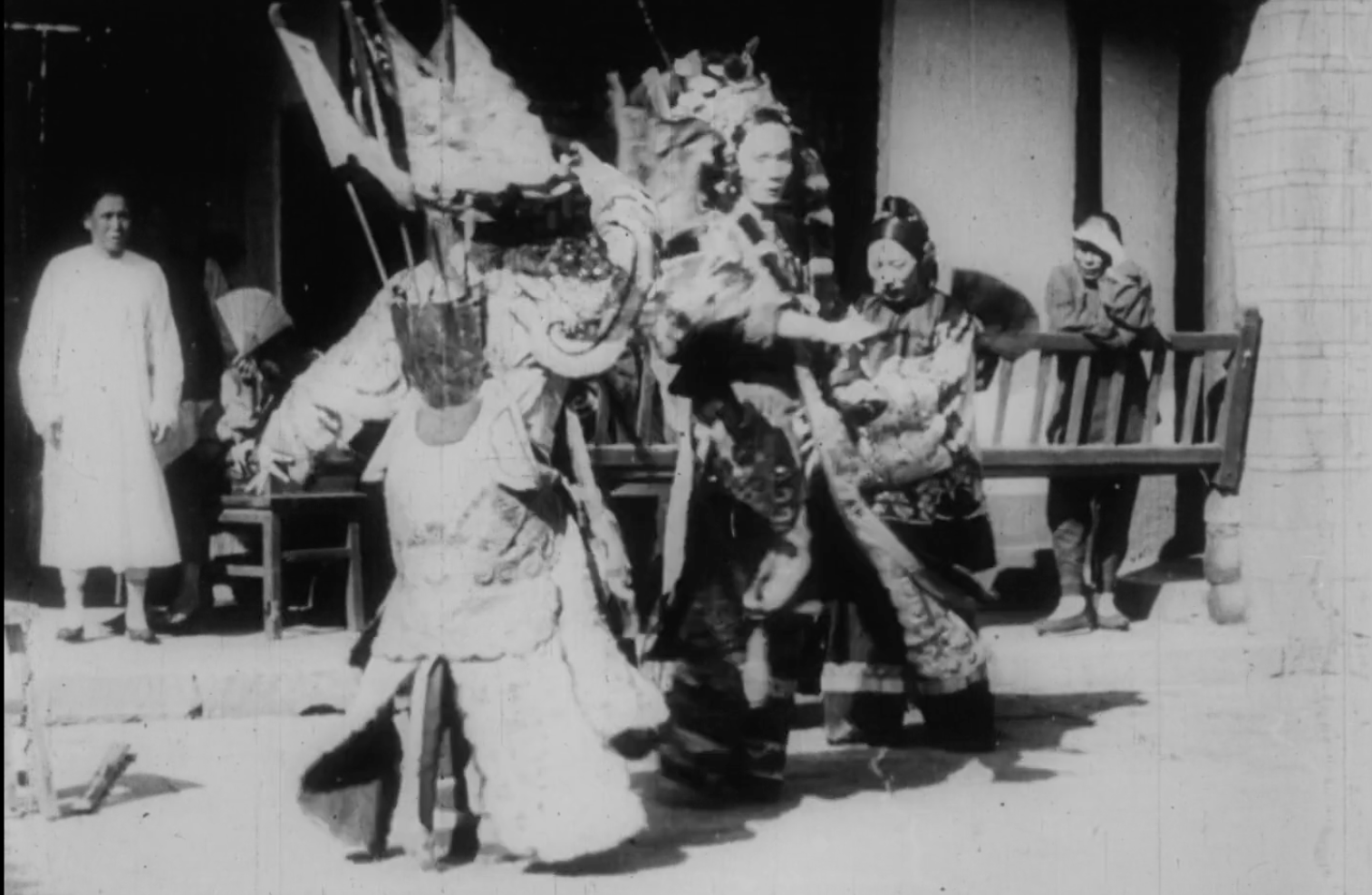
“Unique documentary footage taken between 1901 and 1904 in Yunnan in southwestern China by Auguste François (1857-1935) french consul stationed there. Street performers, barbers, funerals, official visits, leopard catching a pigeon and monkey wearing opera outfit doing somersaults, opium smoker, it’s all there – and more. Absolutely stunning over fifty minutes of footage from China that none of us has ever seen. Somewhere there were probably also martial artists, hiding in plain sight;)”
Of particular note for martial arts fans are the Dragon Dance scene at 32 minutes and the street theatre dancing at 46m which looks an aweful lot like Baguazhang….
This presentation looks at how martial arts arrived in the UK and when the concept of being a martial artist first entered into the popular consciousness. Along the way he covers Bartistu, the Avengers, James Bond, Bruce Lee, Kung Fu the TV series, Ninjas, the Wu-Tang Clan and the UFC.
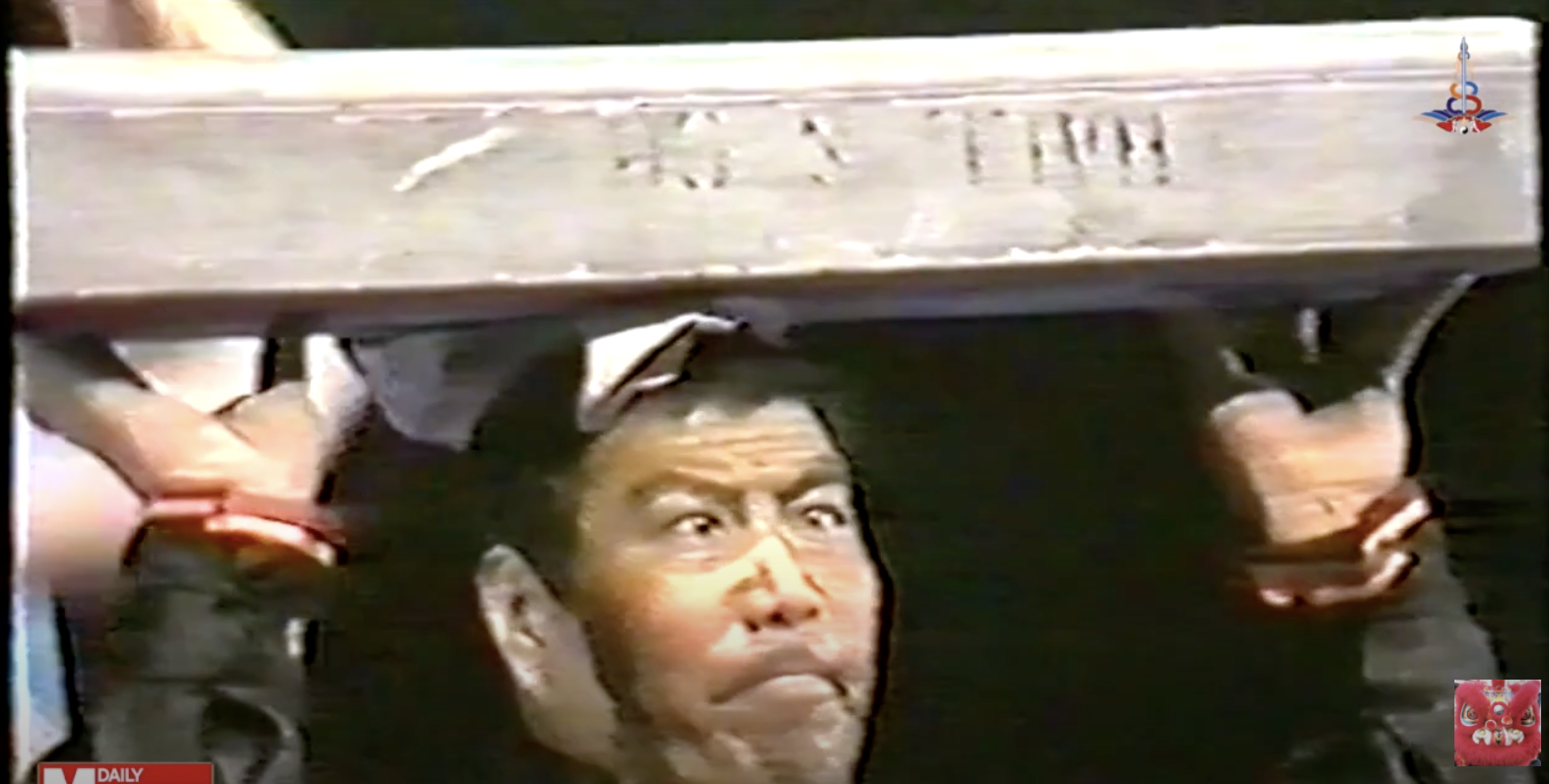
Back in 1981, the Daily Mirror sponsored the “Chinese State Wu Shu Company” to do a performance in London. It would have been completely forgotten by now except that they produced a one hour video tape of the event, sections of which have now been uploaded to YouTube. They’re worth a watch because they give a great insight into what “Wu Shu” was in 1981.
We tend to think of Wu Shu these days as being impressive martial-flavoured gymnastic type demonstrations, often with weapons. There is certainly some impressive “monkey cudgel” form and a staff form on show, but back in 1981 “Chi Kung” or “internal strength” demonstrations seemed to play a much bigger part than they do today. These days those sorts of breaking demonstrations have become more what you’d expect from the Shaolin Monks then Wu Shu athletes, who still put on those sorts of shows today (or at leat they did until C19).
The demonstrations from 1981 are serious, in that the masonry being broken over human bodies looks real. The sledgehammer that breaks it is thrown with gusto, but at the same time, there’s a comedy and performance element. Pretend shots of the sledgehammer are done by the performers to tease the audience and get a bigger reaction when the real blow lands. Traditional music is played. Here we can see the echoes of Chinese theatre (or opera), from which these traditions sprang.
Some of the preparations for the breaks are also very theatrical. As the performers do their chi kung to warm up I can see reflections of the “spirit possession” that convinced so many “boxers” in 1899 that they could become invulnerable to bullets in the Boxer Rebellion. The practitioners seem to wrap their bodies in invisible armour.
In the West we very quickly seem to dismiss these sorts of demonstrations as “circus tricks”, which implies they are fake in some way. But the masonry looks real to me. These don’t look like the deliberately weakened bricks, so often seen in these demonstrations. That looks like a regular British kerbstone being broken over his head, for example!
The 1981 demonstration stands as a great historical document of what the “Wu Shu” brand was in 1981, as China was starting to open up to the West, and before the Shaolin brand split off with the internal strength demonstrations and the Wu Shu brand took the athleticism to new gymnastic heights.
Highland survivalist Tom Langhorne shows you how to make your own martial arts staff, from selecting and harvesting the wood sustainably to crafting and refining it. If you need a little project to work on in lockdown, then this could be it!
He’s also got a great video that shows a comparrison of different staff fighting styles, which incluides: Jogo dau pau, Scottish Quarterstaff, German Quarter Staff and Japanese Bo,
And a video on the staff in general and its Scottish history:
Why is Baguazhang so strange? What does it have to do with Mongolia? In this episode of my Heretics podcast we have a chat about this very unusual martial art, often considered a sister art to Xing Yi and Tai Chi.
This is a very informative interview with Ma Yue who is a Mashi Tongbei master. He talks about (amongst other things) what it was like growing up in a traditional martial arts family when the Cultural Revolution happened in China, and he had to be taught in secret. He also talks about the making of the first Shaolin Temple film, which is father was involved in, and what he sees as the many problems with Wu Shu today.



 The Tai Chi Notebook