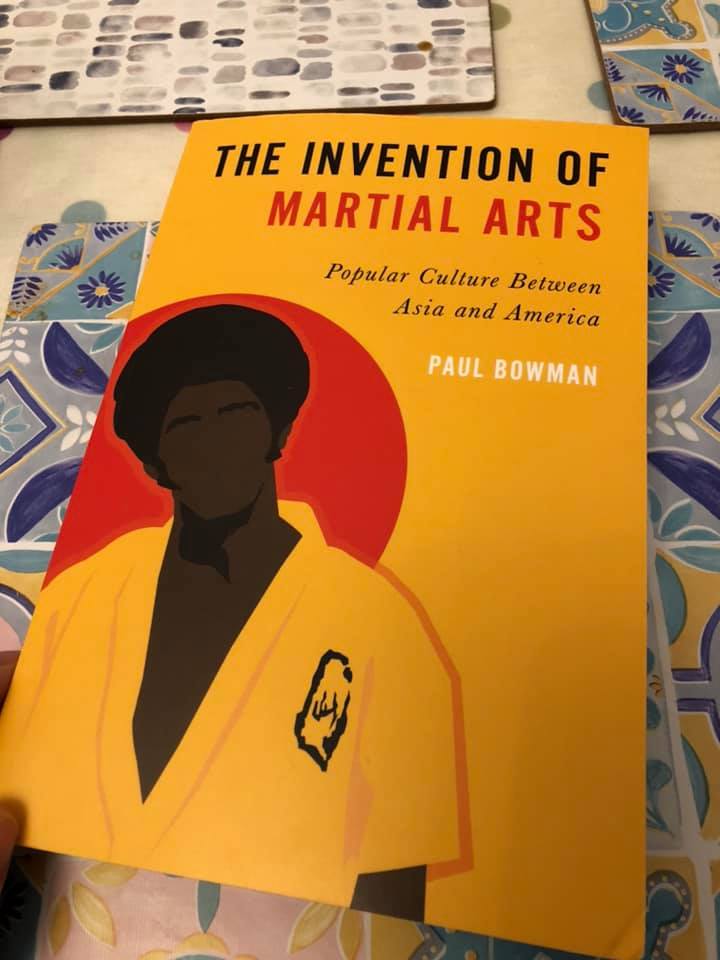
The Invention of Martial Arts, Popular Culture Between Asia and America by Paul Bowman

I’ve just got a copy of The Invention of Martial Arts, Popular Culture Between Asia and America, by Paul Bowman. (Amazon link. Non-Amazon link). Firstly, yes, that excellent cover illustration is a picture of Jim Kelly playing the iconic character Williams in Enter the Dragon, a character who speaks volumes about the international and multi-ethnic appeal of East Asian martial arts in the early 1970s. It was created by the incredible Jon Daniel, who passed away in 2017.

Some of Bowman’s work is very academic, but this one is for “normal people”, like me. I’m still on the Introduction, but feel compelled to write something about it because this book is dripping with ideas to do with the conversations we all have around martial arts.

That to me is what much of Martial Arts Studies is – it’s not about the martial arts themselves, it’s about “what we talk about, when we talk about martial arts”, which would otherwise be left unexamined.

Take his writing on theory in the introduction:

“At first glance martial arts may seem simple. But any discussion of them will involve an implicit or explicit theory about them.”

So true. If you’ve ever been involved in any sort of online discussion about martial arts you’ll find the participant are talking past each other because of an assumption of (often contradictory) theory that underlines everything they say to each other about any subject to do with marital arts. One person thinks the martial art is really all about this, and the other person thinks the martial art is really all about that, and they go on busily talking about different things.

He raises the brilliant point that no theory of martial arts (or culture) can contain all the answers and that “different theories offer variations and varieties of perspective. Looking at things from the perspective of one paradigm, or orientation, followed by another, and then another is stimulating and illuminating in many ways. The shifts in perspective caused by this can produce more well-rounded or enriched understandings of phenomena, and can also instil a prudent awareness of the limits of our own understanding. However, by the same token, such shifts can also produce contradictory, conflicting incompatible pictures of ‘the same thing’.”

It should come as no surprise that the title of the book can then be viewed in multiple ways. He’s not talking about the literal invention of the term “martial arts”, or the actual martial arts themselves, but the invention of the ideas about martial arts, ways of thinking about them, depicting them and valuing them.

I could go on, but really, I’d recommend grabbing a copy yourself.

What are we really doing when we do martial arts?

This is a fascinating talk between Drs Jared Miracle and Paul Bowman on martial arts. There’s a little section from 31.20 onwards where they get into the miasma that surrounds martial arts and how it can be manipulated for nation building and national identity. the example given is Tae Kwan Do and its need to be ancient. But they go on to talk about how, on a personal level, we often have an idea about what we are doing when we do martial arts that doesn’t necessarily match what we are actually doing or getting out of the martial art we practice.

Where Karate got its kicks from (it was the French!)

This is a very nicely made video from the Karate Nerd that shows the influence of Western military methods (created by the French from Savate) on the formation of Japanese Karate. This influence of the West on Japan was something we talked about a lot in our podcast on The origins of Kempo and Jiujitsu, but it’s nice to see a video that uses old footage so well to demonstrate the point.

Here’s some of that lovely Savate from 1924, in normal and slow motion:

A brief history of China

A friend pointed me to this great video “A brief history of China”, by Kristofer Schipper. I really like his down to earth views on the subject and the many misconceptions about China that can arise (and have happened historically) from trying to view it through a Western lense.

He has a few more videos too, which offer great insights, like this one:

What is an authentic understanding of Chinese martial arts?

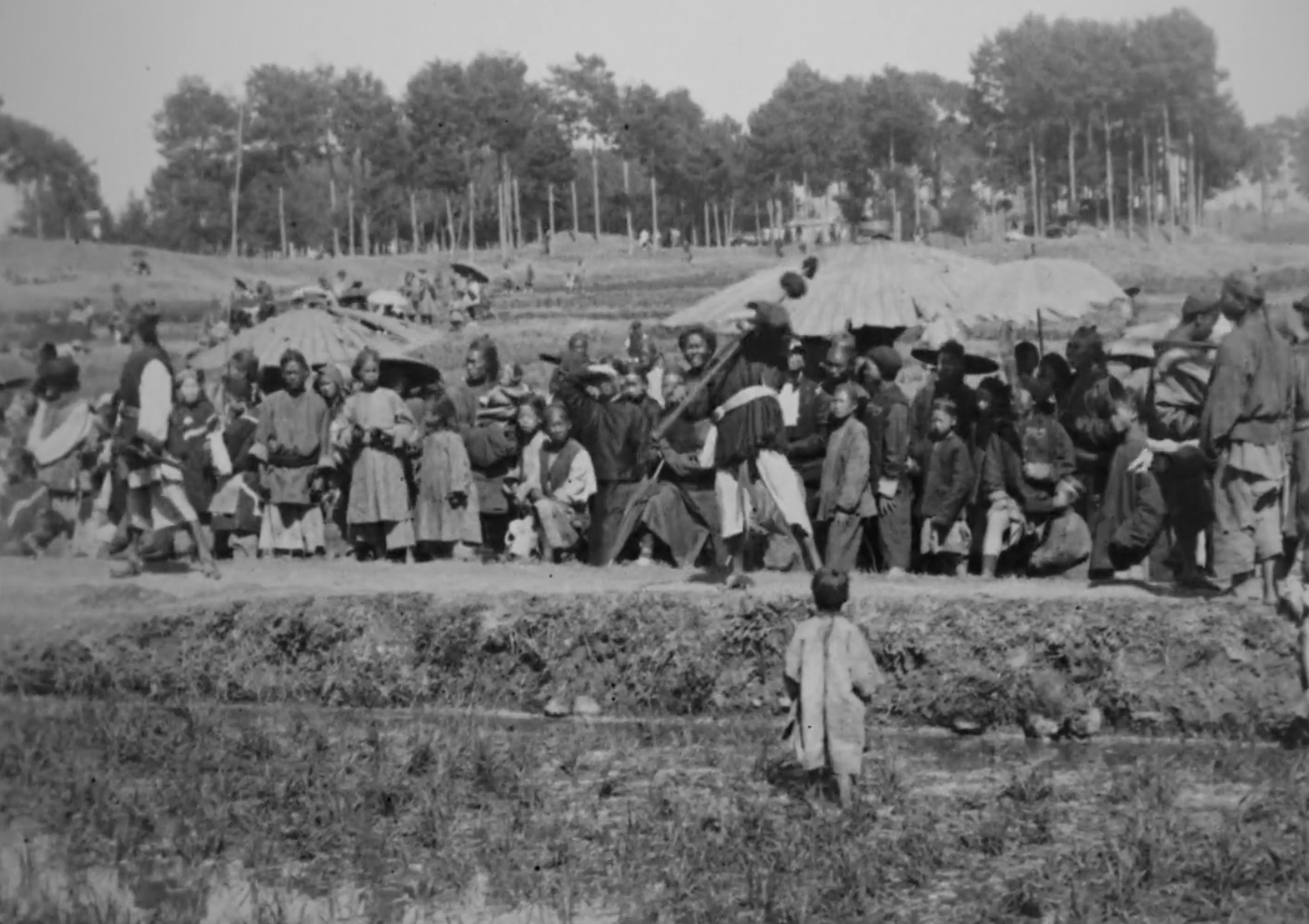
Qing Dynasty martial artists performing in a procession (between 1901-1904)

I’m still fascinated by that film I posted a little while ago of China from 1901-1904. It’s as close as we’ll get to seeing the people who were around at the time that the popular martial arts of Northern China – Taijiquan, Baguazhang and Xingyiquan were being formalised into the structures and routines we still know and recognise today.

It gives a small insight into what the martial arts of the time were like, we have an idea of what they practiced, but we don’t always know where they practiced them, and to some extent really why they practiced them. There’s a particular sequence starting at 17.10 in the film where we see a procession of sorts going along a riverbank and then entering a village or town. There are martial arts performers doing twirls and spins of their weapons as they go. The setting is informal, music is being played (we see the musicians) and it has something of an air of the Saint’s Day religious processions you still see going on between villages in rural European nations, or the May Day “Hobby Hoss” procession that can still found in Cornwall in the United Kingdom.

But back to China. The martial artists involved seem embedded into the culture of the place and time as much as the musicians or flag holders.

“There was a well established pattern of village festival culture in Northern China. The ritual was called a sai and it was based on a three-part structure: inviting, welcoming and seeing off the gods. Ritual could last anywhere from three days to a month. Wherever you happened to be, these rituals were happening nearby every two weeks. A smaller sai might have only 50 people officiating and a thousand participants, while a large one might involve hundreds of ritual experts and 100,000 participants. A large ritual could invoke as many as 500 gods, their statues escorted out of temples in massive processions with armed escorts of martial performers that snaked between villages for miles.”

“According to David Johnson, ritual festivals were so common and so old and so large that they were overwhelmingly the most important influence shaping the symbolic universe of the common people. Regionally they happen about every two weeks and could involve over a hundred villages, with processions that strung out for miles attracting thousands of spectators. “It is quite impossible to understand what villagers… in North China thought and felt about the world of politics, about Chinese history and traditions, about the world of gods and demons, or about any of the grand matters of life and death, without a close familiarity with sai [and similar rituals]. Ref: David Johnson 1997, “Temple Festivals in Southeastern Shanxi”, Overmyer 2009,8.”

From Tai Chi, Baguazhang and the Golden Elixir: Internal martial arts before the Boxer Rebellion by Scott Phillips, p173.
Qing Dynasty martial artists performing in a procession (between 1901-1904)

I don’t think we can assume, from one film. that all Chinese martial art of the period was like this, but it’s fascinating to see a glimpse of how well it was integrated with everything else.

As Charles Holcombe wrote at the start of his seminal 1990 essay on the subject, Theater of combat: A critical look at the Chinese martial arts

Everywhere in China the martial arts either present themselves in the guise of simple exercises or are shrouded in arcane religious mysteries. Western enthusiasts often feel impelled to strip away these religious trappings and construct a version of the martial arts that is neither simple gymnastics nor religion, but emphasizes true hand-to-hand combat skills. The question remains, is this an authentic understanding of the martial arts?

Charles Holcombe, Theater of combat: A critical look at the Chinese martial arts

Chasing perfection: Yang Cheng-Fu’s roll back posture

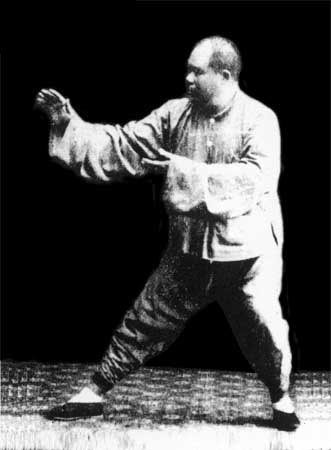
I thought I’d start a series of posts commenting on what I like about photos of famous masters of the past. I thought I’d start with this photo of Yang Cheng-Fu doing rollback from the Yang long form.

Yang Chengfu, Rollback.

Yang Cheng-Fu comes in for a lot of criticism, mainly I think because of his weight. He was a big man, but I’ve always been impressed with how precise and delicate his postures seem to be. What I like most about this picture is that you can almost feel the heaviness and sinking in what he’s doing, yet at the same time there is the precise placing of his hands and feet.

Tai Chi is a paradox in that you are supposed to feel light yet also heavy. According to the Tai Chi Classics your head needs to feel like it is being pulled up “as if suspended from above”, and yet your body needs to also have the feeling of sinking, “Make the chi sink calmly” and “The abdomen relaxes, then the chi sinks into the bones.”

You can see both these qualities in Yang Cheng-Fu performing Rollback, head upright, light and nimble, yet also firm and heavy. With the placement of his hands you also get a sense of the yin and yang being distributed throughout his body. The back hand has the intent of pulling and the front hand has the intent of pushing. He is not “double weighted” – each hand is expressing a different energy. The weight on his feet is on the back leg – again, not in no man’s land in the middle, but clearly distinguished.

You also get a sense of calm. This is not a frantic and hurried performance. It’s slow and deliberate, like a great river rolling.

There’s a lot you can learn from a photo.

Power is just one factor. Don’t obsess over it.

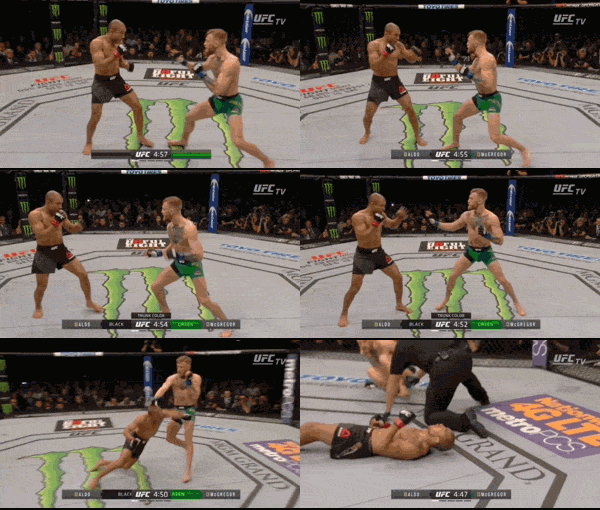
Aldo vs McGregor

When was the last time you saw MMA coaches or fans having a massive long, protracted argument about the best way to produce power? I can’t remember it happening. I don’t think that’s because they don’t care about it – they obviously do – but I think they recognise that it’s part of the whole that makes up a fighter, not the only thing to focus on. Being able to take a punch to the face or body without crumpling into the canvas is obviously a more important skill. Being able to produce a powerful stomp into the ground when you’re punching the air, leaving your fist vibrating and shaking to demonstrate the enormity of your power… is very good for show, but what about for real? Can you do that when you’re tired, you’ve already been hit twice in the body and kicked six times in the same leg?

MMA coaches and commentators talk a lot about Conor McGregor’s left. It’s one of the most famous KO weapons in MMA. He’s sent a lot of consciousnesses on a short break to Valhalla with it. I was listening to Coach Zahabi breaking down the Conor McGregor vs Dustin Poirier fight (video below). He calls McGregor the “One punch KO type guy”, with a “kill shot”, a “touch of death”. But on that night the KO didn’t happened. Coach Zahabi talks a lot about about what Poirier did to take the sting out of it – by constantly wearing McGregor down, clinching him, not playing his game.

If you look at the GIF above of Aldo vs McGregor you can see McGregor knocks Aldo out while moving backwards (Tai Chi people, feel free to yell out “Repulse Monkey!” here – it will do you no good, but it will make you feel better 🙂 ) this reveals what’s more important than power – timing. Power as the goal seems fruitless to me – what matters more is timing. If I could bottle timing and drink it I’d be drunk on it all the time!

The internal martial arts, with their emphasis on intricate, subtle and detailed body methods, qi, jin, “internal strength”, (and not much actual fighting), tend to fall prey to this obsession with power too easily. How much power do you really need? My answer is always “enough”. Once you go beyond “enough” then you start to detract from other areas of your game – timing, position, fluidity, flow, etc.. Power is part of the whole system of movement that should go with every Chinese martial art – if you extract that one aspect and look at in isolation then you can’t see the forest for the trees.

Here’s the breakdown by Coach Zahabi:

Xing Yi Quan by Tian Jinglong

Here’s a nice video of a Xing Yi Quan linking form showing some really nice Xing Yi Quan body methods.

Xing Yi Quan master Tian Jinglong (田景龙) shows Advanced and retreat linked form(Ji Tui Lianhuan(进退连环拳). Tian Jinglong is disciple of Li Jinbo(李金波), youngest student of legendary Hebei province warrior “Iron Luohan” Zhang Changfa (张长发aka Zhang Xiangzhai张祥斋) . Lineage: Li Luoneng(李洛能)—Liu Qilan(刘奇兰)—Liu Dianchen(刘殿琛)—Zhang Changfa(张长发)—Li Jinbo(李金波)—Tian Jinglong(田景龙)

Store and release in Xing Yi

So, I decided to make a short-ish video to clear up some confusing points of discussion in my previous posts, about transfer of weight between legs. This lead me on to talking about the store and release of power in the body that Xing Yi can produce and how you don’t need to “load up” because you should always be “loaded”.

N.B. This is not the same as the jin – ground power – produced by down power on the front foot (that’s going on as well, obviously) but it’s more analogous to the 5 bows concept in Tai Chi, except this is the Xing Yi version, which I think is more suited for continuous striking, not a big “one shot kill”. We call this way of producing power the Dragon body in Xing Yi.

As always, I’m not saying this is the only way to do it, or the best way, or that you suck, or I’m brainwashed, or you are brainwashed. I’m just presenting some information, feel free to reject it if you don’t like it. And all the best in your training.