Prof. Paul Bowman of the Martial Arts Studies podcast interviewed me yesterday about various things like this blog, martial arts, the intersection between Xing Yi and BJJ. It was a fun chat because I have known Paul for years and used to be his Tai Chi teacher.
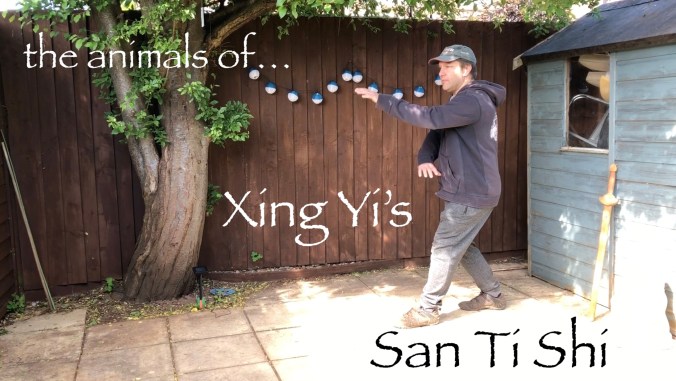
The San Ti Shi posture is the fundamental standing posture of Xing Yi Quan. You could describe it in terms of angles, vectors and structures, but my interest lies more in reviving the animals of Xing Yi, and trying to move conversations in Xing Yi circles back towards nature and animals.
So, with that in mind, I thought I’d take a look at the 5 animals that make up San Ti Shi in more detail through a few videos that present simple animal routines (linking sequences) that can be easily learned and followed.
The animals of San Ti Shi are (in no particular order):
Dragon (Long)
Eagle (Ying)
Bear (Xiong)
Tiger (Hu)
Chicken (Ji)
…and the final element is Thunder Sound.
Let’s look at each one in more detail and what it contributes to the San Ti Shi. Because we’re currently on lockdown I can’t show applications on somebody but I talk about how they would work and show how the moves would work with a sword.
1. Dragon
From the Dragon comes the concept of Dragon Body – the counter-rotation in the spine that means you are always ready to produce power. The dragon emphasises loose, relaxed coiling movements.
2. Eagle
Eagle is a powerful predator and has the most exaggerated postures of all the Xing Yi animals. Eagle provides the Eagle Claw to San Ti Shi. Eagle and Bear are always practiced together, but this sequence has more emphasis on Eagle than Bear.
3. Bear
Bear provides the concept of Bear Shoulders – a very round structure to the shoulders. Bear is heavy, relaxed and rounded.
4. Tiger Embrace
The Tiger lends Tiger Embrace to the San Ti Shi posture. This is the feeling of always embracing something. The tiger is a powerful animal, and the linking sequence is fast-paced and full of energy.
5. Chicken Leg and Thunder Sound
The last animal we’ll look at is Ji – Chicken. The chicken provides the Chicken leg quality to San Ti Shi. The ability to keep almost all your weight on one leg and the fast-paced stepping. We combine this with a look at Thunder Sound, since it’s related to the stepping.
I dropped a theory-heavy post about Xing Yi Dragon recently, so I thought it might be nice to do a more practical post about Dragon, and here it is – it’s a nice little routine I do for 5 minutes solidly, it essentially like doing five minutes of squats, so it’s quite hard work!
“If you asked someone in Beijing what the most important martial arts were in the year 1770 they would likely have said (in the following order) 1) archery 2) riding 3) strength training. Why? These were the specific skills that were tested on the imperial military service exams. It is often forgotten now, but many working martial artists actually made their living coaching students to pass this exam. Wrestling, fencing, boxing and spear work were also widely taught and had their own specialists. But archery was clearly at the apex of martial culture during much of imperial China’s long history. Many more books seem to have been published about archery than fencing or boxing.”
The Dragon is unique amongst Xing Yi animals because it is the only mythical one. Yes, I’m aware that some lineages of Xing Yi include a Phoenix as one of their 12 animals, but I think this is simply a mistranslation of Tai, a kind of flycatcher bird native to China. You sometimes also see it mistranslated as Ostrich, which is even stranger. You occasionally see Tuo translated as “water lizard”, or “water strider”, but it’s clearly a crocodile, another animal that is (or effectively was) native to China.
The question of why Xing Yi, whose animal methods are based on real, observable native animals, should include a Dragon we’ll leave until the end of this post, but for now, let’s look at its characteristics.
Dragon in San Ti Shi
The Dragon is one of the important animals in Xing Yi Quan because, together with Bear Shoulders, Eagle Claw, Chicken Leg, Tiger Embrace and Thunder sound, Dragon Body forms the famous San Ti Shi posture, (different lineages have slight variations on those, but they’re fundamentally the same).
San Ti Shi demonstrated by master Zhu Guang, credit Hsing Yi Leeds
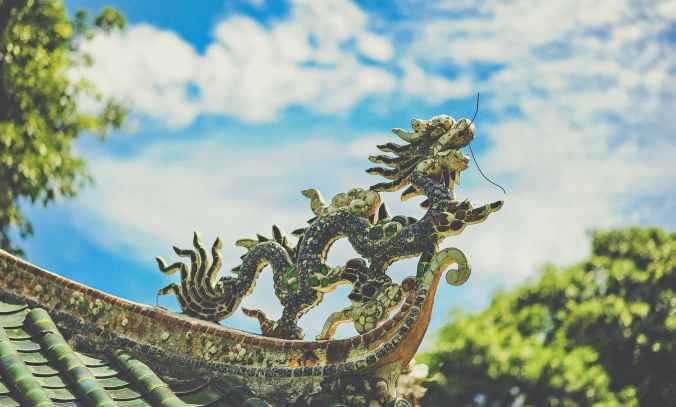
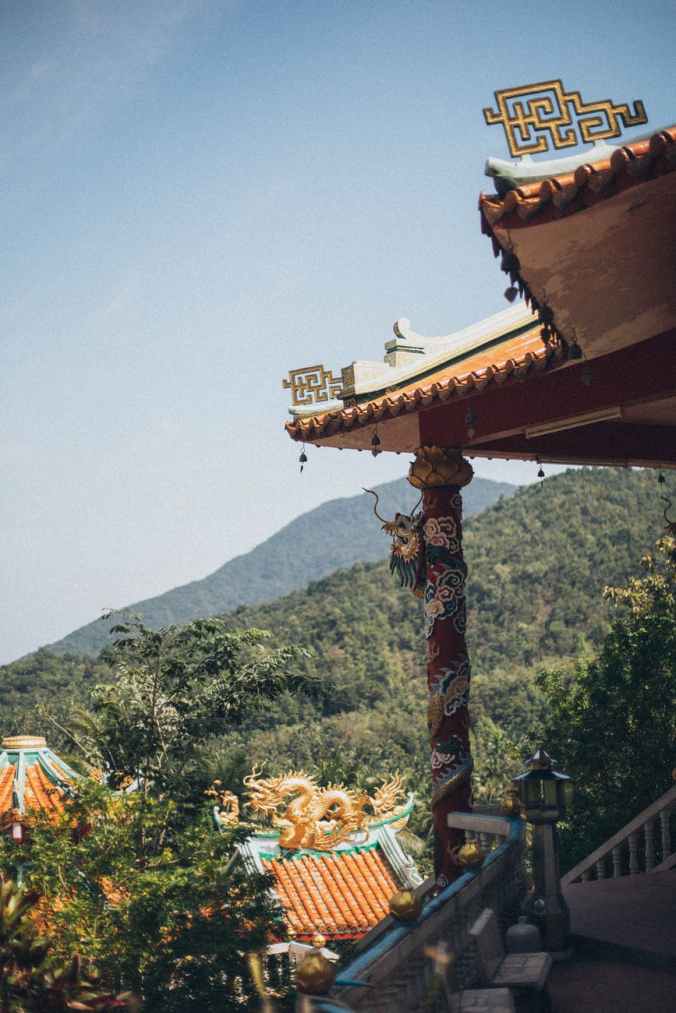
Dragons in Chinese mythology have very flexible spines – they fall and rise through clouds with a long, flexible body that coils and rotates, twists and turns. You often seem them decorating Asian temple roofs, or spiralling around a pillar:
It’s the flexible nature of the spine that is the characteristic we seek to emulate in Xing Yi Quan. In Xing Yi the spine is characterised by a coiling action, a counter-rotation between hips and shoulders, that means the practitioner can easily generate power, or, always has the potential for generating power from all positions.
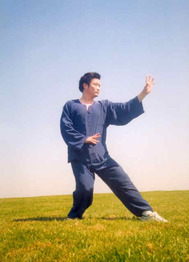
The typical Dragon Shape example you see demonstrated looks something like this one:
Dragon, demonstrated by master Zhu Guang, credit Hsing Yi Leeds
Notice how his posture is placing a lot of torque on the spine, and creating potential energy. The right shoulder pushes back, but the right hip pushes forward. That is what is meant by “dragon body” in our style.
(And just to counter some things I’ve read a few times: It is not about creating a ‘spinal wave’ that moves vertically up the spine – that’s not how spines are designed to express power in human beings if longevity is one of your goals. Force (jin) itself can move up the spine to the hands, but there’s no actual physical ripple or wave that should move up your spine, like a whip cracking. I have seen some styles of Chinese martial arts that do this – they crack their spines like a whip. Good luck with that when you’re 70 I’d say, but each to their own.)
Xing Yi and Xin Yi Liu He Dragon comparison
A question came up recently (which inspired this post) about how Dragon in Xing Yi can possibly be the same as Dragon in its sister art Xin Yi Liu He, since they look different.
My first response to that is, of course, they are the same. Not identical in outward expression, but the same root.
These two arts developed in different geographic locations, but they share a common root. Take monkeys as an example: In biological terms, all modern-day monkeys look different, but they share a common ancestor. You can tell they are related. While their colourings, their sizes and their behaviours may have evolved along different lines, they’re still belong to the same species. It’s the same with Xing Yi dragon and Xin Yi Liu He dragon.
One phrase my Xing Yi teacher liked was “one root, 10,000 endings”, so there can be infinite variations on a dragon posture, or sequence, but the root, the essence of what is being expressed, is the same.
Every lineage of Xing Yi has its own slight variation, but in Hebei Xing Yi you usually see Dragon expressed in that rising and falling squatting posture shown above.
Here’s a video of Mike Patterson showing some applications:
This is the posture that is not found in Xin Yi Liu He? Really?
First, I’d dispute that. Here are two videos I found quickly online that are very similar to the standard Hebei Xing Yi version. This one looks like a prototype for the standard Hebei move, ending in a similar squat:
And then there’s this one called “Dragon wags tail” from http://www.xinyiliuhe.net , which has a different stance, but the movement is virtually identical:
Perhaps the confusion happens because the most common “dragon” movement you see in Xin Yi Liu He is this one (that you see translated as variations of “dragon shakes its shoulders” or “dragon shoulder” or “dragon carries the shoulder pole”.)
It’s one of the “3 old steps”. I like that name. Again, it implies that the dragon is a fundamental quality to the art, which is what we say in Xing Yi. I’m speculating here, but perhaps in Xing Yi’s San Ti Shi we see the bringing together of these “old steps” into a single posture that is held and practiced without movement, but with the same internal feeling?
If you look at what is being practiced in the Xin Yi steps above you see the same qualities of dragon that we look for in Xing Yi – the flexible, rotating spine. On the inside, it’s the same thing. Also notice that his arms are being held in a way that resembles wings, like dragon wings?
Let’s look at some more dragon movements you find in other lines of Xing Yi beyond the usual rise/fall squat movement you see:
This is Zhang Xi Gui is the director of the Shan Xi Xing Yi Research School. Notice the same ‘wing’ shape to his arms?
Notice the different flavours of the dragon are there – the strategic leg placement to set traps and trip, the coiling body motion and the ‘wings’ and ‘claws’ feel in the arms.
It’s already clear there is more to the ‘dragon’ than just a single move. I’m trying to get to the point where I can convince you that dragon is a quality, not a move, that can be expressed in various different ways.
Dragon principles in Xin Yi Liu He
In terms of Dragon principles being expressed in Xin Yi Liu He the best video I’ve found is this one below.
Dragon is expressed all through this video and the teacher really goes into detail about the body actions. And again, it all matches with Xing Yi – the rotation of the spine, the actions of the hips and shoulders to create power that I talked about earlier.
I really like this video (despite whatever that young German man is doing to that tree 🙂 )
I hope that’s been enough to get you thinking. We need to stop thinking about Xing Yi animals as ‘this move’ or ‘that move’. It does this massive, practical, ancient and subtle art a huge disservice.
And going back to what I mentioned earlier – the other reason for the dragon being the only mythical creature in Xing Yi/Xin Yi’s animal styles?
Well, the dragon is the emblem of Yue Fei’s family and he is often illustrated with a dragon emblem on his robe:
Was Yue Fei practicing what we call “Xing Yi” today in his back yard? Of course not, but the ideas that underpin it? Then yes, he was. His army used these strategies very successfully in battles against the Jin army, but for (much) more of that story, see my podcast.
I grew up watching Monkey on TV. This Japanese TV series based on the ancient novel Journey to the West was dubbed into English and run by the BBC from 1979 onwards. It was hugely influential in introducing Kung Fu and Taoist/Buddhist ideas to the West via a children’s story.
It’s quite fitting that I watched it as a child, because it is a story for children, but if you look closer, you’ll find that it deals with a lot of deeper issues.
Journey to the West follows the story of a Buddhist monk and three immortal animal spirits (four if you count the horse) who follow ‘him’ (this was always confusing to me, as the actor in the TV series was clearly a woman) on a journey to ‘the west’, which was India, in search of the Buddha. Along the way, they have to endure various trials and tribulations.
Journey to the West is a classic work of Chinese literature, and can be read as an allegory for all sorts of things – is it about the taming of the ‘monkey mind’? Is it a criticism of Buddhism by Taoists? Or Taoist by the Buddhists? Or is it a religious text that acts as a guide to spiritual enlightenment?
As you’ll discover from this fascinating discussion between Chinese language and literature professors Katherine Alexander and friend of the Tai Chi Notebook, Scott Philips, all things are possible!
Katherine Alexander is a professor of Chinese Language and Literature at the University of Colorado at Boulder, and has a PhD from the University of Chicago. Her PhD dissertation, “Virtues of the Vernacular: Moral Reconstruction in late Qing Jiangnan and the Revitalization of Baojuan” addresses popular religious literature and culture in Jiangnan during and after the Taiping War. https://www.colorado.edu/alc/katherin…
Internal Chinese martial arts are often presented in the West as this special spiritual thing deserving of seated lectures about the meaning of Tao, complex esoteric meanderings on the nature of Chi or Shen and expensive seminars involving “masters” “lineage holders” and “internal fighters”. There are a lot of snake oil salesmen out there.
I say to hell with all that. It’s a trap you need to avoid or break out of if you’re currently in it.
Internal arts are martial arts and they should be trained like martial arts.
When you see videos of people in China training, it’s small groups with a very informal structure. Watch this video as a good example:
What they’re saying doesn’t matter so much (although that is interesting too) as what they’re actually doing. Watch the people in the background training. That’s how I think these arts should be trained: small groups, informal structure and preferably outside. No whiteboards, lectures, seats or marketing.
Nobody is trying to sell you anything or upsell you anything. Just people being shown something and trying to practice it, Making mistakes, getting better and just training.
Byron Jacobs just posted the latest in his excellent XingYi primers, this time on the last of the XingYi elements Heng Quan:
Byron got into a discussion on the XingYi Facebook group when asked when he was going to show “an advanced version with the “fajin” motions.”
His reply was so good I’m reposting the whole thing here, with his permission, as I feel the same way and he explained it very nicely:
A: these are Primer videos to get people to understand the basics in order to begin practice, so that’s their purpose, fundamentals. Maybe in future I’ll release some other ones with function and application etc. I would like you to clarify what your are asking for with “an advanced version with fajin motions”?
Q: the shaking motions in your strikes where penetrates internally?
A: A couple of things. Its a misunderstanding to think that Fajin means something like a specific method or something. It simply means to issue force. That is all it meant in the past, and that is all it means today. Its real meaning has been twisted and misunderstood, even more so in the west. In more recent times some strange focus on shaking has come into CMA which is not how things were and definitely this too has been twisted into something that it never was. The Xingyi classics never discuss “shaking” and in fact older generation teachers will admonish you for this telling you overtly shaking makes “power leak” from your target. An example is even quoted from Feng Zhiqiang talking about how Chen Fake taught them “While issuing power the body should be relaxed, but one should be very conscious about so-called “Shaking Power” (Dou Jin). This power has to be focused and not scattered all over the body. The more advanced one is, the smaller the shaking. When we were learning Taijiquan from Chen Fake shaking the body in Fa Li was the greatest taboo to be avoided.”
Good issuing of force is firstly dependent on the correct structure, then the correct method and finally using body mechanics to assist with generating optimal force. This is all covered in those basics, and its the long term practice of these key points I put in those videos that will enable you to develop strong issuing of force. Strong issuing of force penetrates
In this post I’m continuing with my current theme of the mind and Tai Chi Chuan.
Animals don’t “think” like we do most of the time. I bet you could argue that the species known for problem-solving like crows, chimpanzees, dolphins and dogs do their fair share of thinking, but in my previous post I was describing a state where you are doing Tai Chi without thinking. Just being.
You can see it in their eyes. Just look at that cat above. Cats are great examples of this, because they are around us often they’re easy to observe, but if you can observe animals in the wild you’ll see that they are in this state most, if not all, of the time.
There are various references to cats in the Tai Chi classics.
“The Form is like that of a falcon about to seize a rabbit,
and the shen is like that of a cat about to catch a rat.”
Shen, we can loosely translate as spirit, but if you just substituted the words “inner state” there instead I think it would better equate to what the author was trying to convey, but he or she did did say Shen for a reason, as we shall see.
The word “Spirit” in English is tied up with all sorts of (organised) religious connotations which get in the ways and are not helpful.
A better understanding of what is meant by Shen would perhaps be, ‘underlying spirit of nature’. The part of you that is connected to this underlying spirit of nature is known as the Xin in Chinese. If it’s aligned with nature your Xin can produce your Yi (intention), which in turn can produce the physical movement (Qi) which in turn produces action (Li) all working in harmony with nature. You and your environment are one, working and acting together.
There are various versions of this ‘working in harmony with nature’ sequence written about in old Chinese writings – the Xin harmonises with the Yi, the Yi harmonies with the Qi and the Qi harmonises with Li being the most common and also forming the 3 internal harmonies of the famous Lie He, the 6 harmonies with are written about in all sorts of Chinese martial arts.
My Xing Yi teacher, Damon Smith did a whole podcast episode about the word “spirit” and what it means in Asian traditions connected to shamanism, which I find helpful in understanding. I would listen to the whole thing, but around the 8-minute mark he talks about this sequence and how Shamans use it to act in harmony with nature in their own lives or when practicing shamanism:
Cats and the Tai Chi classics
To me, the section of the classics that says “The Form is like that of a falcon about to seize a rabbit, and the shen is like that of a cat about to catch a rat”, alludes to the idea that on the outside the victory in combat may look overwhelming and great – like that of the falcon seizing a rabbit triumphantly, but on the inside, you need to be quiet and calm and in harmony with nature – the exact qualities you can see in a cat patiently stalking a rat.
Of course, the flacon is like that on the inside when catching a rabbit, but it’s not easy to see on the outside. Human-loving cats, however, are easier to observe.
A cat crops up somewhere else in the Tai Chi classics too:
“Walk like a cat.”
That doesn’t mean get down on all fours, it means to adopt the same mental qualities as mentioned earlier to your stepping. Don’t just rush in blindly or recklessly: be calm, patient and at one with your environment.
Remember, as it says in the classics:
“All movement is motivated by Yi and not by external form”.
But perhaps Bruce Lee said it best in Enter the Dragon:



 The Tai Chi Notebook