Chinese martial artists “disgust” with MMA

Very interesting post over at internalmma blog about a particular view that I’ve also come across from Chinese Martial Artists. The idea that MMA is somehow disgusting.

“I know that there is a stigma amongst the Chinese who train in their martial arts that ground fighting is what dogs do, and you don’t want to be a dog (I have had Chinese friends tell me personally that they think MMA fighters are beasts/animals and not even human).”

Usually there’s also a whole load of “gay” jokes thrown in as well. Let’s be honest, there is something a little bit homoerotic about two shirtless sweaty men wrestling each other in positions usually associated with sex, but it only appears that way to an outsider who doesn’t understand the game. Grab a roll with a BJJ blue belt and you’ll be too busy worrying about staying alive to give a second though to any of that. Even rolling with a female, if you’re a straight male, (or vice versa) isn’t awkward at all, once you get used to it, which can happen in a matter of minutes – it’s all about the art, and you simply don’t think about anything else.

Anyway, Check out the full blog:

As old as I want to be 


Saw a great quote about Tai Chi today that I’d like to paraphrase.

Taijiquan, at least originally, was created as a discipline for self-perfection, long life, happiness and found its ‘application’ as a martial art – it contained teachings from previous Taoist practices.

I think that’s pretty good because it acknowledges that tai chi was never just a martial art, which explains the wacky applications you see doing the rounds, and also acknowledges that it isn’t ancient itself, but contains practices within it that might be.

Oh, Joko!


I’ll admit to being a big fan of Charlotte Joko Beck’s 1993 book Nothing Special. Her first book is good too, but the second really hits the spot for me. It’s about Zen living, but is very light on the ‘Zen’ and very heavy on the ‘living’. What I like is her approach to practice, because I think it relates to Tai Chi practice.

There are so many similarities between the two. Aside from the fact that they’re both meditative in nature, if you want to get anywhere in Tai Chi you need to practice pretty much every day, even when you don’t feel like it, in much the same was as you have to sit and meditate every day to get anywhere in Zen, even when you don’t feel like it. Not that there is anywhere to get in Zen, since you are already right here. In fact, from a Zen point of view it would be better to say that you have to meditate every day just to get back to where you are already, and nowhere else.

Some of my favourite quotes from her work (which I’m not getting just right, but hey, they are close enough):

“When nothing is special, then everything can be.”

“On the withered tree the flower blooms.”

“Stop thinking, stop dreaming and there is nothing that you cannot know”.

Anyway, I’d recommend Nothing Special, the book, and watching the following YouTube documentary about her work.

Charlotte Joko Beck – Ordinary Living-documentary:

Peng, Lu, Ji, An: Grasping the bird’s tail

Teaching using Trigrams
PakuaPostHeaven
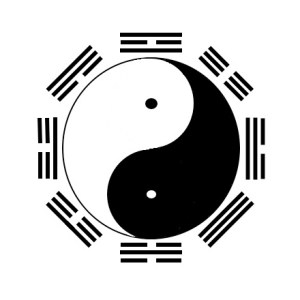
Yesterday I taught the ‘Grasp Bird’s Tail’ sequence in the form. I don’t know why, but I drifted into talking about trigrams as I was teaching it. Trigrams are the series of three broken or unbroken lines that make up the Bagua and are usually associated with the ancient book of Chinese wisdom, the I-Ching, or “classic of changes”, which contains 64 hexagrams (two trigrams on top of each other).

This diversion into ancient philosophy is somewhat unusual for me, but not unheard of, as I usually don’t like to get sidetracked into theoretical discussions too much when I teach. I think theory has its place, but I’ve seen too many Tai Chi teachers who seem to need a whiteboard and marker pen to teach you how to throw a punch. The thing is, the trigrams aren’t purely theoretical to me, and they do have relevance to teaching and practical application, as I will explain.

The four fundamental forces used in Tai Chi are Pung, Lu, Ji and An, (usually translated as Ward off, Rollback, Press and Push) and are most clearly expressed in Yang style-derived Tai Chi forms in the section known as Grasp Bird’s Tail. Each of the energies has a trigram related to it for a specific reason.

Peng is three unbroken, or yang, lines: “heaven”
Lu is three broken, or yin, lines: “earth”
Ji is one solid, yang, line surrounded by two yin lines: “water”
An is “fire”, a yin line surrounded by Yang lines.”fire”

Heaven, earth, water and fire – four fundamental elemental forces.

Because of their symbolic makeup, the trigrams can help you understand what’s ‘inside’ the postures, and what makes them different to each other – what makes a Peng a Peng, for instance, and not a Lu? And how is that different again to a Ji? And how is An different again?

It’s about the feel of each movement.

For example: Peng is represented by three yang lines – this is maximum yang at its fullness. In this posture you should feel internally inflated – a positive, outward expression of energy at its maximum. That doesn’t mean it is “hard” – it is actually more like a large rubber ball – a springy kind of energy on contact.

Lu is represented by three yin lines. This is the most empty a posture can be, but again, it’s not lacking or depleted, it’s just empty. There’s still a structure, like the way a vase is empty in the middle. You are guiding force past you, without adding in your own force, but also without losing your own stability.

Then you get Ji and An, which mix both yin and yang lines. Ji is a solid yang line between two broken yin lines – the needle in the cotton. This is how the energy should be expressed in Ji – soft, but with a hard centre. Push is the opposite – it appears to be hard, but is open and empty inside, giving the push a warmer fire-like feel.

Again, we are talking about how each posture feels here, so words will always be inadequate, which is why the trigrams can be a useful visual symbol to represent the feeling of each energy and help you distinguish them.

The use of trigrams is not limited to Grasp Bird’s Tail. (There are another four in use in Tai Chi, which are further mixtures of yin and yang balances, but I often feel like the theory is being shoehorned slightly into Tai Chi to accomodate them into a nice neat number 8, as there’s no real reason to go as far as 8, and you could also go further.).

Once you can understand the feeling of the four energies in Grasp Bird’s Tail you can see how it applies in other areas of the form. For example – what energy do you want to express at the very end of Brush Knee Twist Step? Is it a Ji or an An with the projecting hand?

Well, the interesting thing is, you could do it either way, so long as you know what you’re doing and why you’re doing it.

Addendum: One of the joys of symbols is that you can interpret them in different ways. If what I’ve written goes directly against what your teacher has told you, then that’s fine – you can interpret these things in different ways. This is just the way I do it.

More Taiji fakery

Oh, why do they do this?

Who is ready for some more depressing news about martial arts and China? I bet you are. Anyway, here’s the latest in a long line of Taiji magic tricks that don’t fool anybody:

“We’re challenging these Thais to a match in the spring, I need to show these fighters to my master in Henan,” explained Chen Jia. “It’s going to be televised all over China.”

This is the story of how a Taiji group organised a challenge match against a group of pro Thai boxers. Original article here:

http://fightland.vice.com/blog/taiji-vs-muay-thai-the-fight-i-put-a-stop-to

If you know anything about Thai Boxers then you know that this would be the equivalent of a group of school children challenging a Special Forces unit to a gun battle. The author, realising this, tries to stop it going ahead, thinks he has, but at the end of the article it says the fight went ahead anyway, and the Taiji guys won 3-2, with no further explanation. Winning 3 to 2 sounds amazingly good for the Taiji guys, especially considering who they were fighting.

But then another article appeared recently with a further explanation:

http://thelastmasters.com/taiji-vs-muay-thai/

“So I got the links and watched the fights. Sadly, this “match-up” was exactly what everyone says fights in China are like. The fights were rigged – Chinese fighters wore black pants to hide shinguards, referee saved Chinese fighters from anything more than a 3-punch combo, Thai guys were paid to take a fall.”

I’m not surprised at all, this is the way everything seems to be done in China. It’s such a continual disappointment, and another reason why the Chinese Martial Arts are in such a poor state.

“A girl atop Huashan outside of Xi’an told me once that “fakery is a part of our Chinese culture,” and she said it with a measure of pride. The trickster has always been a hero in Chinese culture, and held above the great warriors who must eventually sacrifice themselves for either cause or country, while the schemer survives. That tradition, combined with a half-century of non-stop brutal lies and another three decades of desperate money mongering, has reached its most bloated moment.

I don’t think the moment can last forever, and I believe a cleansing of the martial arts will hasten the end of a century of lying.”

I’m not so optimistic, I think it will just continue like this forever until there is a change of government in China and an explosion of democracy. Until then we’re going to get stuff like this on Chinese TV. I wonder if the Chinese people know it’s fake, or not? Sigh.

The uncarved block

Simple is effective

Know honour,
Yet keep humility!
Be the valley of the universe!
Being the valley of the universe,
Ever true and resourceful,
Return to the state of the uncarved block.

Tao Te Ching, chapter 28

Sometimes we just make it all too complicated, and we forget the wisdom of the uncarved block. This video is taken at a Dennis Jones seminar, showing how to apply martial arts to real self defence. Basically, he’s most concerned with positioning himself (movement) and then delivering all his power to the desired target in one go.

I like the way he’s taken his art (Karate) and looked at what the kata is telling you about movement, and not taking the moves as literally the only way you have to do it.

The mother of all movement

How one thing leads to another

16

Teaching today’s lesson we strayed into the martial applications of one move the student was having a hard time getting just right. It was a transition move between two recognisable postures, a kind of spiral action of both hands around a circle. In reality of course, there are no fixed postures, and no transitions between them, but when teaching beginners you have to start somewhere, so we did.

To help him get the idea of the way the hands move I showed him an application – “punch me”, I said. I deflected his punch with my left, reached through to the back of his head with my right and spiraled my hands to bend him over, ready for a knee to the temple or to be flipped right over. After we’d worked on this for a bit and he’d ‘got it’, I had to then explain that there was no one application for each move. When you break it down, the move in the form doesn’t work exactly like that application I showed (you have to reach in deeper to get your hand around the back of their head than the way you do it in the form, for example), but you can easily see how it’s the same thing really.

Each move in the form is the mother, and the applications are the children – each one subtly different. I can come up with a lot of applications for each move. For this one I had a strike, a choke, a throw, etc, all with slightly different emphasis. It’s endless, really.

After you’ve delved around in a few applications you need to come back to the mother movement, the one that gives birth to them all.

The road less traveled

What I’m actually teaching is…

The road less traveled

The road less traveled

“He stood about 20 yards away from me, and I closed my eyes and I could feel the power of his chi coming out of him, pushing me over”

So said my latest Tai Chi student, as we were talking about what styles of Tai Chi he had done before. I just sighed and said “Sorry, but I don’t do any of that. Derren Brown can do it very well though…” and carried on with the lesson, never returning to the subject of Chi again. He didn’t seem to mind. In fact, he seemed to quite enjoy the focus on correct movement – it seemed rather new to him…

I only teach on a one-to-one basis these days. It’s much easier format than teaching a whole class of people, all at different levels, and you can really drill down into what needs to be worked on right now with the student for them to improve. Most of the people I teach are complete beginners, which is fine, but occasionally I’ll get somebody who has had some previous Tai Chi experience, as was the case here. In general, this is more fun, since I can usually ramp up the amount of detail in what I’m teaching. However, it can throw up a few curve balls, like the above.

I often wonder what will happen when I refuse to go down the road of “chi tricks” with new students in conversation or teaching. Will they decide I’m not the enlightened Chi Master they were searching for, and leave disappointed? Will they think I don’t have the ‘real thing’ (whatever that is)?

In the end I’ve decided not to worry about it. I just teach what I know I can do, and leave it at that. It’s up to them if they want to say. They usually do.

Towards the end of the lesson (which went really well, actually) I remember saying “what you’re trying to do here is to learn to use your body’s natural power, through the movements of Tai Chi. The co-ordinated, natural power of the body in motion, which we call ‘sung jin’ or ‘relaxed force’. You don’t need to get too attached to the movements themselves – they’re just examples – it’s what they’re trying to teach you that’s important.”

I think that sums it up nicely.

The Tai Chi magician

Woo! Everywhere is Woo!

Tai Chi, like all other traditional martial arts, contains some aspect of performance, show or magic trick. See my previous post about meeting Scott Phillips for more on this idea, but in short, public demonstrations for entertainment have always been a part of the traditional Chinese martial arts. Martial arts street ‘buskers’ doing gymnastic performances, kung fu schools doing en masse demonstrations of their skills, the Shaolin Monks touring the world with their concrete-breaking, skull-cracking performances, etc… The list goes on.

In Tai Chi the publicly-expected demonstration of skill has turned into something more subtle and suitably ‘Taoist’ than merely breaking concrete blocks, or wooden boards. It seems to come down to a ‘master’ figure demonstrating how far he can push a student back with a very light touch, and while it may not be explicitly stated, the assumption is that the master is demonstrating his Chi Power. Sometimes touch is not even necessary and it is done through thin air by the master merely waving his hands at the student. The bigger the reaction of the student then the better the master, or so the unspoken rule seems to go.

Yes, there can be some functional use to this sort of pushing demonstration as a teaching aid. From the students point of view they get to feel what it’s like when somebody with skill puts hands on them and pushes them backwards. Ideally, from a Tai Chi perspective, it should feel different to a muscular, forceful push. It’s not much use as a self-defence technique, but it’s good for demonstrating the type of force you want to be developing in Tai Chi – using the force of the ground via the legs, controlled by the waist and channeled into the hands. It’s a smooth type of effortless power, rather than using the shoulders or back to do a muscular ‘stiff’ sort of push. The difference is subtle and getting hands-on with your teacher is essential if you’re ever going to learn what it is, because you need to feel what it is not, too.

The problem arrises when when the student’s reactions become hyped up in public. In an effort to not let their teacher lose face they can start to over-react to the push. They start to stiffen their arms, and straighten their legs, resulting in a curious type of ‘hop’. It’s not like an agreement was explicitly made before the demonstration that the student should have a big reaction, it’s more that he starts to subconsciously over-egg his response so he doesn’t make his teacher look bad. Anybody who has taught a group of people Tai Chi will be familiar with this phenomenon. Whenever my students tried to ‘fall over’ for me in a demonstration I always reprimanded them and tried to get them to stop ‘helping’ me do the demonstration, and just act like a normal attacker.

On the other side of the coin, you could decide to view these kind of demonstrations as a simple magic trick. A magician (the teacher) is showing a magic trick, and you all know it’s not real, so just enjoy it for the spectacle it is.

At The Fajin Project Facebook group a chap called Stuart Shaw, seems to have no patience for the Tai Chi magician. He’s done some brilliant breakdowns of how various ‘masters’ of Tai Chi do their tricks (he calles them “Woo Woo”). You might have to join the group to view the videos, but I’ll try and link to them below. Why watch it? Well, if your Tai Chi teacher does this stuff to you, then it’s worth being aware of what’s really going on:

>> Woo Fajin Analysis — Adam Mizner Jalapeños <<

>> Analysis of Woo-Fajin << Michael Phillips

>> Analysis of Woo-Fajin – Seated Push Trick << Chee Soo

>> Woo Fajin Analysis – Huang Shyan vs. Liao Kuangcheng <<

The old master and the young apprentice

’twas ever thus

The Karate Kid – master and apprentice.

I love this clip of Master Helio Gracie teaching a private lessons, and it follows on nicely from my previous post about martial arts as theatre.

Here we have Master Helio Gracie, a thousanth degree red belt, probably in his 80’s, teaching a private lesson to a fresh new white belt kid. (The pupil shown here later went on to become a world champion in his own right.)

It’s a dynamic as old as time – the old master and the young apprentice. The whole thing is a performance of sorts, and they both play their roles perfectly – the wise, generous old man knows all the tricks, and teaches the young, enthusiastic beginner who makes all the stupid mistakes, time after time. And again, it’s being filmed, so it’s impossible to ignore the fact they both know the camera is there and they have their roles to play.

Enjoy the show.