Ken Gullette’s new book: Internal body mechanics

Screen Shot 2018-08-08 at 12.02.27 PM.png

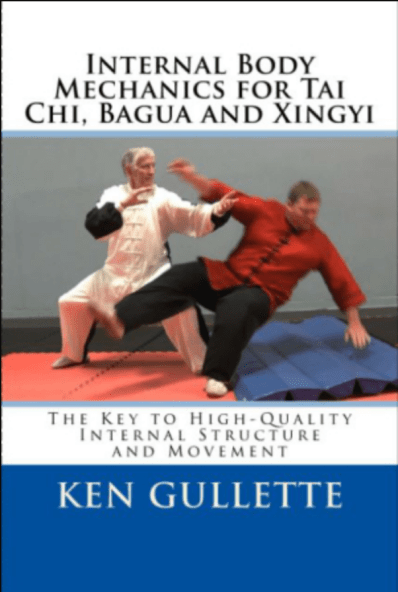
A quick heads-up for internal martial artists: Ken Gullette has a new book out that looks really interesting called, “Internal body mechanics for Tai Chi, Bagua and Xingyi”.

I haven’t read it, or even seen a copy, but I thought I’d give it a mention because it looks pretty good. It sounds like it gets straight down to the business of teaching you how to move and dispenses with the usual boring histories and form photos. Ken’s bio of how long he’s trained and who he as trained with looks pretty good too.

In Ken’s own words:

Basically, I wanted to write the book that I wish I had when I began studying the internal arts back in 1987. If I was able to read it back then, it would have saved me many years and thousands of dollars in class fees. Based on some of the martial artists I have met during the past 20-something years, I know there are millions of internal arts students who are not learning these skills.

The six fundamental body mechanics for internal power include:

** Establishing and maintaining the ground path at all times.

** Using peng jin at all times along with the ground path.

** Using whole-body movement — when one parts move, all parts move.

** Silk-Reeling “Energy” — the spiraling movement that adds power to techniques.

** Dan T’ien rotation — guiding the internal strength and power as the body moves.

** Using the kua properly — opening and closing the kua, like a buoy in the ocean, helping the body stay balanced as incoming force changes.

You can find out more details about the book here, and it’s on Amazon US and UK.

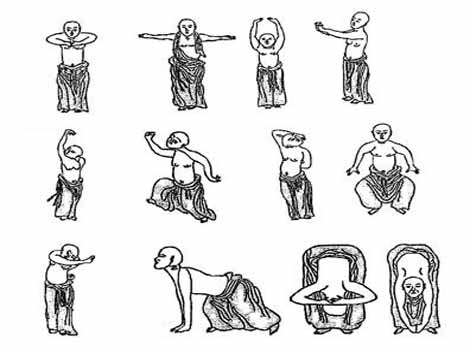
VIDEO: Yi Jin Jing – The Muscle Tendon change classic (Exercises 1-12 with full explanations)

yi-jin-jing-2

Below is a nice explanation video of the Yi Jin Jing by Shi Heng Yi of the Shaolin Temple Europe,  recorded during a Qi Gong Retreat in July 2018 at the Shaolin Temple Europe located in Otterberg / Kaiserslautern in Germany.

I don’t practice this set myself, but I tend to think of it as a kind of expanded version of the Ba Duan Jin, a set I do practice. As with the Ba Duan Jin, you need to keep in mind the ideas of muscle-tendon channels, and the suit idea, when you practice all qi gongs. In fact, that’s exactly what the monk is explaining in the video – “when you do this exercise you must feel which part of the body it affects, which muscles and tendons it is stretching”.

Without the understanding of muscle-tendon channels and the suit, these are just repetitious exercises, but the understanding of what you’re looking for can transform them.

Here’s the explanation video:

And here’s the complete routine performed by Shi Heng Yi.

The 12 Exercise / Posture Names are:

1) Wei Tuo Presenting The Pestle (Frontways)
2) Wei Tuo Presenting The Pestle (Sideways)
3) Wei Tuo Presenting The Pestle (Upwards)

4) Plucking Stars On Each Side
5) Pulling 9 Cows By Their Tails
6) Displaying Claws and Spreading Wings

7) 9 Ghosts Drawing Swords
8) Placing 3 Plates On The Floor
9) Black Dragon Shows It’s Claws

10) Tiger Jumping On It’s Prey
11) Bowing Down In Salutation
12) Swinging The Tail

Podcast: Byron Jacobs on what martial arts in China are really like


byron_jacobs

I’ve blogged about my friend Byron Jacobs before – he’s a Westerner deeply immersed in Chinese culture and martial arts and living in China at an interesting time.

We’re currently in the era where Chinese martial arts are opening up to the West in a way they’ve been prevented for doing for a long time. MMA and Jiujitsu (BJJ) is finally making an impact and people are starting to realise that modern training methods offer something that traditional methods are lacking. It will be interesting to see how the future plays out for Chinese martial arts, and what happens to traditional arts and skills.

Byron has just recorded an episode of the Real Fake Swords podcast where he addresses these issue and tells you what it’s actually like in China when it comes to martial arts. It’s fascinating (and probably different to the way you think it is) and well worth a listen. (If you are pushed for time start listening at around 15 minutes in.)

I hadn’t heard of Real Fake Swords before, but it looks like a good podcast series. I notice they’ve got episodes with other interesting martial arts personalities.


Turning qigongs into functional qi exercises

Screen Shot 2018-07-18 at 10.08.55 AM

Reconstructed Daoyin tu Drawings of Guiding and Pulling in the Mawangdui Silk Texts

The Daoyintu “Drawings of guiding and pulling” were uncovered in the Mawangdui site in ChangshaHunan, in 1973. The texts were written on silk. From Wikipedia:

“They include some of the earliest attested manuscripts of existing texts (such as the I Ching), two copies of the Tao Te Ching, a copy of Zhan Guo Ce, works by Gan De and Shi Shen and previously-unknown medical texts, such as Wushi’er Bingfang (Prescriptions for Fifty-Two Ailments).[1] Scholars arranged them into 28 types of silk books. Their approximately 120,000 words cover military strategy, mathematics, cartography and the six classical arts: ritual, music, archery, horsemanship, writing and arithmetic.[2]

The tombs date from 206 BC – 9 AD, which puts them in the Western Han Dynasty (this was mentioned in a previous post of mine on Buddhism), and contained the burial tombs of Marquis Li Cang, his wife, and a male believed to have been their son. The site was excavated from 1972 to 1974.

The scroll above was found in 1973 and dates to 168BC. Again, from Wikipedia:

A painted scroll on display at the Hunan Provincial Museum and known as the Daoyintu found in tomb three at Mawangdui in 1973 and dated to 168 BC shows coloured drawings of 44 figures in standing and sitting postures doing Tao yin exercises. It is the earliest physical exercise chart in the world so far and illustrates a medical system which does not rely on external factors such as medication, surgery or treatments but internal factors to prevent disease.

What they are doing in the scroll is clearly related to what we call Qigong today – an exercise system that has come out of China. These exercises are still found all over China, and in many cases, the theory behind them has merged with martial arts, and they tend to be practiced together.

The question still remains – what are they actually doing? How is this good for health?

I believe you need to understand “suit” theory to get a handle on what they’re doing. I first heard the “suit” theory from the writings of Mike Sigman. He just posted about it again recently:

Mike: The “suit” idea is that the connective tissues throughout the body and muscles can be developed and conditioned to the point that they wrap the body like a snug spandex/lycra “suit”. The “suit”, however, is not just a passive connection: it can be controlled, conditioned, etc., as an aid and support to strength and movement. The “suit” is just a model that can be used to illustrate the functional qi of the body. As “qi”, the suit responds to controls and actions from the subconscious mind. 

First of all, if you’re looking for an explanation of what “qi” is, when it comes to martial arts, or its functional usage, then I think this is where you should be looking. Qi is not some mysterious energy that flows through the universe and through invisible channels in the body – it’s the physical connections you can create through conditioning exercises where you stretch this “suit” and gradually learn to manipulate the body using it. This naturally leads to the idea of the body being moved by “qi” not muscle, which is a phrase we hear given lip service to in Tai Chi, but rarely explained. It sounds initially like magical qi thinking, but if you can understand the “suit” theory you’ll see that it’s actually grounded in a solid practice that builds up over time. Another of the meanings of the word “Qi” is simply breath. However, if you realise that using the breath is one of the key methods you can use to stretch the suit, that also makes sense. 

Mike also has videos where he explains the suit ideas further:


Mike: Think of the “suit”, for a moment, as the plastic coating/skin on a child’s soft, plastic-coated doll. Imagine that you can take a doll’s legs in each hand and twist and manipulate the whole doll, including the arms, by the way that you twist the legs of the doll. The connection of the arms to the legs via the plastic “skin” of the doll allows for the conveyance of the twist to the arms. That’s not a great example, but it gives you an idea about how the twisting and control of your own lower body (from waist downward) can be conveyed through the “suit”/functional-qi to effect movement in your arms and upper body.

Looking back at that picture on the silk painting from the “Drawings of Guiding and Pulling” in the Mawangdui Silk Texts, you can see that these are clearly stretching-based exercises – the arms are lifted to either shoulder height or above the heads and stances are being deliberately taken. So what are they doing? My answer would be that they are conditioning this suit.


Suit theory

A good way to think about the suit is by splitting it into yin and yang – the yin parts cover the soft, ventral,  areas of the body – the front, the insides and backs of the legs, inside of arms, and the Yang parts are the harder, dorsal, parts – the back, outside and front of legs and arms. “Breathing in the Qi” is usually done by “pulling” in on this connection on the yin parts of the suit, and expansion is usually done by releasing the pressure and stretch that this has built up using the Yang parts of the suit  – “guiding” – as you breathe out and open the body. Remember, Tao Yin was called “pulling and guiding”.

John Appleton’s Posture Release Imagery web page is a good source for seeing how this ventral/dorsal split works in both humans and other animals.

The point of qigongs is to develop the connections in the body to the point where you can feel them and move the body with them through natural cycles of open and close.

Mike: It’s a little bit difficult to feel the connections of the “suit” at first, so the first thing you have to do with qigongs is begin to develop the connections of your body by using breathing techniques to strengthen the connective tissues. Gradually, you develop your qi/”suit” all over the body and you learn to control it as an aid and support to your musculo-skeletal strength. There is an interesting thought mentioned in some Chinese thought that wild animals still have this rapport of qi and musculoskeletal strength; humans (it is opined) have evolved out of this rapport and have to be taught to control and develop their qi in this manner.

So, there’s the hint for what you’re looking for in your qigong exercises: “using breathing techniques to strengthen the connective tissues.”

At all times the body length connection  – the slight stretch on the suit – must be maintained  – “don’t break the qi”.

(Credit to Mike Sigman for the quotes, and the suit concept).
Confessions of a hobbyist Black Belt

608a6938-1-720x380

Incidentally, I heard a story from a long time black belt this weekend. He was talking about a bout he refereed at a tournament a while back. The match was between a well known world champion black belt who’s name everyone would immediately recognize if I said it. The black belt was matched up against a no name purple belt. The black belt got destroyed by the purple belt. It happens. Black belts aren’t indestructible and the cult that exists around the belt is unhealthy as it sets up unrealistic expectations. We all lose. I wouldn’t have it any other way.

Nice article that gives a fresh perspective on what it means to be a black belt in BJJ when you’re just a hobbyist, not a world champion. The comments are worth reading too.

It also inspired this podcast by Brandon MC.


Taiji Master KO’d by Xu Xiaodong now trains in kickboxing

(I think the word “Master” is being used a little bit too liberally here 😉 )

Do you remember Wei Lei, the Tai Chi dude that set the Internet alight by being starched by aging MMA coach Xu Xiaodong in about 20 seconds? Well, he’s back, but this time it looks like he’s decided that his Tai Chi skills aren’t up to the job and he’s training kickboxing.


Of course, this simply raises questions. Should he need to train kickboxing? Isn’t Tai Chi enough? Should he seek out other Tai Chi teachers to learn from? Is this the most practical way of learning to fight? If so, then what does that say about Chinese martial arts?


Buddhism vs Shamanism, in China.

leshan-giant-buddhaf7eae265aaf0_300x400

My friend Damon is back with another Woven Energy podcast after a long break.

Listen to “Episode 28 – Buddhism vs. Shamanism: Similarities, Differences and what we can learn” on Spreaker.

This time he tackles an interesting subject – Buddhism. I imagine this will upset a lot of Buddhists (if that’s possible!) because he classifies Buddhism as an exoteric religion, basically designed to help control the populace under the Han Dynasty (206BC – 220AD). In fact, to get them to self-regulate. You can agree with this view, or not, but there are some interesting facts in here about the rise of Buddhism in China that I didn’t know.

For instance, China used to be the main country for Buddhism during the Han Dynasty – it is where it got its foothold, and in fact, was the main reason for the expansion of the Chinese empire (as they sought out Buddhist teachers, inadvertently creating the Silk Route and facilitating trade). This was particularly unusual since China has traditionally been a very inward-looking country. That a foreign religion could become so widespread is really worth noting and looking into.

It’s hard to believe that now, since people associate Buddhism more with Japan or Tibet, but it makes sense – the ‘old masters’ quoted in Japanese Buddhist writing, like the Blue Cliff Record, were often Chinese.

There’s also a lot of stuff about Chinese history, and the Warring States period in the podcast. Fascinating stuff.

Your daily Tai Chi ritual – creating order out of chaos

backlit clouds dawn dusk

Photo by Pixabay on Pexels.com

Scott posted some answers to various questions he gets over at Strengthness with a Twist, his blog. I thought the first one was most interesting:

What do you mean when you say martial arts are rituals?

Rituals are ways of making order out of chaos. Martial arts are about unleashing the greatest forces of chaos and bringing them into order. It is a daily ritual that has deep, lasting, and profound effects on every aspect of our being. This is true of martial arts world wide, but it is particularly clear in the structure of Chinese martial arts as they were understood before the Boxer Uprising.

I’ve been thinking a lot about this quote since it’s pretty clear to anybody who does a daily practice of Tai Chi (or related martial/yoga/chi kung type practice) in the morning, that it soon becomes a kind of ritual, whether you like it or not. Not a ritual in the Western religious sense, but a ritual for your body (which Scott is arguing is, in fact, the true essence of religion in the Eastern sense).

I like his definition of “bringing order from chaos” even if it does sound a bit Jordan Peterson fan-boy-ish 😉

But if we can separate the phrase from the alt-right ideology it has become attached to, that phrase is what you are doing to your body when you practice Tai Chi in the morning. Having just woken up in the morning you can consider your body to be in a state of ‘chaos’ – you’re not yet functioning at 100%, your tendons will be shortened from lying down for so long and your body might ache from uncomfortable sleeping positions, and it needs to stretch. In fact, we stretch as a reflex action once we wake. Mentally you are also not yet “with it”, at least not until you’ve properly caffeinated.

A morning Tai Chi “ritual” (or “routine” if you like), can bring you back into occupying your body properly and get it ready for the demands of the day. When I think about what the main health benefit of Tai Chi is, I think it’s this. People tend to treat Tai Chi as a panacea that cures everything from a bad back to an ingrowing toenail. I take all the latest ‘scientific’ research about the miraculous healing benefits of Tai Chi with a pinch of salt. I think its best feature is simply this: it’s a way of gently ordering and strengthening the body in the morning, ready for the day.

I also like Scott’s later quote,

Martial arts are about unleashing the greatest forces of chaos and bringing them into order

This one brings to mind a whirling Baguazhang practitioner spinning in circles, taming the elements he is working with, or two sword fighters caught in the midst of a leaping blow.

two man in white shorts fighting using sword during daytime

Photo by ginu plathottam on Pexels.com

It all sounds a bit fantastical, but again, I think there’s some truth buried here.

Through techniques in martial arts, we are bringing order to the chaos of the fight. This is perfectly demonstrated in a Jiujitsu match – it’s all scrambling, spinning madness, then order is established as a joint lock or choke is put in place, as one practitioner controls the limbs and body of the other through correct position, leverage and technique, and the ‘fight’ ends.

Performing the Tai Chi form is an analogy for how the whole universe was created out of chaos, and order established. When you start the Tai Chi form, in a still, standing position you are in a state of Wu Chi – the undifferentiated primordial state of emptiness, but always with the possibility of giving birth to something. Then the big bang happens and you start to move – Yin and Yang become differentiated and you are continually moving between these two opposite poles. The body opens and closes in a continuous spiral. As one part of the body is opening, another is closing until the final movement – often known as “Carry the Tiger back to the mountain”- when you return to stillness. The mountain here represents that primordial stillness. You have brought order to chaos and returned to the mountain.

adventure alps amazing beautiful

Photo by Krivec Ales on Pexels.com


Does Cormier’s dirty boxing point the way for CMA in MMA?

I’m always looking for ways that the sticky hands-like training found in Chinese martial arts like Tai Chi Chuan, Wing Chun, Praying Mantis, White Crane and Hung Gar, where contact between the forearms or hands is maintained and the practitioner is encouraged to ‘listen’ to the movements of the opponent through this contact, can be used in MMA.

A clip of Bruce Lee showing sticky hands training

 The problem with transferring these sorts of skills to MMA is quite obvious: nobody in a ‘real’ fight is going to offer up their arm to you to stick too. Instead, they’re just going to punch you straight in the face, and not leave their fist hanging in the air afterward for you to grab.

Perhaps the most famous MMA practitioner ever, Conor McGregor, is a master of counter-attacking and timing. He waits for the opponent to commit to a strike before throwing his deadly left hand and catching him just as he comes in. He mixes this up with kicking techniques straight from a Tae Kwon Do instruction manual.

giphy


Other fighters like Nate Diaz are known for their straight-up boxing style hands and fighters like Gobrandt and Cruz have evolved the MMA striking game into a movement based style.

One of the names you don’t often hear mentioned regarding striking is the UFC light heavyweight champion, and now the new heavyweight champion, Daniel Cormier. Cormier, a former Olympic Wrestler, has a strong background in grappling but has dominated the light heavyweight division (despite two losses to Jon Jones, who keeps getting disqualified and banned for failing drug tests), achieving 10 TKO or KO victories from striking.

MMA: UFC 226-Miocic vs Cormier

Using wrestling as his base he’s developed a style of clinch-based dirty boxing that has been very successful. He doesn’t look like a typical striker, with both his hands outstretched, instead of in a typical boxing guard. When engaging an opponent on his feet Cormier seeks to smother the other guy’s hands, and feed in strikes once they are out of the way, moving into a clinch position, then looking to land a strong hook as either he or his opponent exit the clinch. And of course, once in the clinch, he can use his wrestling to get a takedown. Video here.

If he can catch his opponent with his hands down as he exits the clinch then a short hook can mean its lights out, as the ex Heavy Weight champion Stipe Miocic found out to his cost this Saturday at UFC 226 when Cormier moved up a weight division to challenge for the belt, becoming a two-division champion in the process as Miocic collapsed to the floor following a clean hook to the chin from Cormier.

Cormier’s tactics have a president in boxing. Jack Johnson and George Forman used to smother opponents hands to set up their own fence and draw loopier punches that they could cut inside of.

MMA Analyst Jack Slack has broken down the stylistic punching of Cormier in Clash of Kings: Tactical Guide to Stipe Miocic vs Daniel Cormier, ahead of the UFC 226 heavyweight clash. Slack calls it the “mummy” style of guard, presumably because it resembles a horror movie mummy approaching with outstretched arms.

Jack Slack breaks Cormier’s style down further in a subsequent article, after the event, which looks at Cormier’s use of a blocking arm, known as a barring arm. Video here.

But what peaked my interest was the idea that this style of fighting could be the ‘way in’ that Chinese Martial Arts practitioners are looking for when transitioning to MMA (or heck, just even real fighting). Cormier’s style makes extensive use of subtle angle changes and sensitivity that push hands and sticky hands training builds up.

If you’ve got a background in this style of sticky hands then read those Jack Slack articles and take a closer look at what Cormier is doing because it could be a style of fighting that would probably work for you too.

Fearing and Loving: Making Sense of the Warrior

Screen Shot 2018-07-03 at 11.50.51 AM

Why do men and women fight and go to war? This is one of the Reith Lectures by Margaret MacMillan. There is some great history on the War of the Roses, and also what it means to be a “warrior”. This will be of interest to everyone who does martial arts.

Historian Margaret MacMillan asks why both men and women go to war. “We are both fascinated and repulsed by war and those who fight,” she says. In this lecture, recorded at York University, she explores looks at the role of the warrior in history and culture and analyses how warriors are produced. And she interrogates the differences that gender plays in war. Anita Anand presents the programme recorded in front of an audience, including a question and answer session.

Link: https://www.bbc.co.uk/programmes/b0b88hl4#play