In the first episode we explore the development of the concept of heresy by two early christian teachers, Valentinus and Irenaeus. We then begin a multi-part series on the origins of Jiu Jitsu and Kempo, addressing some of the myths surrounding the samurai class in the process, as well as talking about some of the other, less famous, inhabitants of feudal Japan.
Just wanted to give my readers a quick heads-up. I’m starting a new podcast!
Since I appeared on Ken Gullette’s Internal Fighting Arts podcast a couple of weeks ago I’ve been contacted by various people about different things and one of them was my old XingYi teacher Damon Smith who runs the Woven Energy podcast. He wanted to see if I’d like to help him out with his new Heretics Podcast.
The Woven Energy podcast is about Shamanism and contains frequent calls to action, so they give ideas you might like to try out and techniques. In contrast, the Heretics podcast is going to be a place where subjects that don’t fall under the banner of Shamanism can be discussed, like, say, martial arts. There will also be no call to action.
The name is in reference to the origins of the concept of heresy, back in Gnostic Christianity, and the fact that we will probably be talking about things that are against society’s commonly held beliefs. Starting with martial arts.
In the first episode, I make the mistake of asking Damon, ‘what is the history of Jiujitsu?’
Covers: Kempo, Jiujitsu, Japan-China trade, Yakuza, Samurai, Shoguns and much more….
For a while now (10 years in fact!) there’s been a video on YouTube purporting to show a push hands challenge match that went down between Chen Xiao Wang, the recognised head of Chen style Taijiquan, and a XingYi practitioner from Taiwan called Liao Bai.
The challenge is often cited as a rare example of an uncoperative push hands exchange featuring Chen Xiao Wang, and one in which he doesn’t come off looking as proficient as he normally does. While nothing of substance happens at all in the clip, the fact that Liao Bai is able to launch a couple of strong attacks through Chen Xiao Wang’s defences, and occasionally make Chen move a foot is seen as some sort of a victory for him.
Firstly, I find the idea that this is some sort of victory slightly bizarre to begin with – I mean, he made him move his foot? Really? Is that it?
Secondly, the explanation that accompanies the YouTube video is written by only one side of the two parties involved, and heavily partisan. The clip is described as a “freestyle push hands”. However, it may turn out that what we’re seeing is nothing of the sort.
Mike Sigman posted recently:
Liao came to a workshop of CXW’s and bragged that no one can take his Tiger Fist releases. The video pretty much starts where CXW calls him on it and says, “OK, you do it”. Liao attempts a number of times to release his Tiger Fist (you can see it is the same release every time) and CXW attempts to absorb and instantaneously release back into Liao Bai, by CXW’s use of Receiving Jin. A lot of people embarrassed themselves and their reputations by publicly posting this video and saying it was “push hands”: it wasn’t even close … it was an example of CXW trying to use Receiving Jin in an open, unrehearsed setting, thus making it a good video to study.
OK, Mike is clearly a paid-up member of Team Chen Style :), but even so, I find his explanation persuasive. What they’re doing in the clip is clearly not push hands in any way, shape or form. There’s just some awkward feeling out – a touching of the arms, then Liao Bai tries to launch attacks, while CXW tries to absorb them, without attacking back. Chen is clearly not even trying to attack back. If his only aim was to show he could absorb the attacks (using Receiving Jin), then this makes sense. And for the most part he succeeds.
Either way, it’s rare to find a clip of Chen Xiao Wang that’s not cooperative, so it’s instructive. Most of the time Chen succeeds, but not always. That’s what ‘real’ looks like. It’s not going to sell seminars or generate income, and it comes with risks to both health and reputation so I can see why he does so little of it, but you know it when you see it.
I created this blog post to counteract the popular narrative that surrounds this video. If we’re going to get to the bottom of it then it’s important to hear from both sides, and so far the idea that it’s a push hands challenge has gone pretty much uncontested.
It might be time to view it again, with fresh eyes.
I keep hearing talk of current/or current interim/or previous UFC Lightweight champion (it’s such a mess in that division of the UFC at the moment that I lose track) Tony Ferguson and his use of Wing Chun in the UFC.
The following video puts all the different clips of him training on a Wing Chun wooden dummy and fighting in the UFC together, with a bit of Joe Rogan commentary over the top – it’s actually a good watch:
The exercise he’s doing with the metal ball looks a lot like the Baguazhang tea cups drill, as well.
To me his Wing Chun looks kind of self-taught. I get the impression he’s more into innovative training using the wooden dummy equipment, rather than in making a serious attempt to learn and apply actual Wing Chun in MMA.
A lot of the proof that he’s using Wing Chun in the UFC relies on that one elbow he did over the top in the clip above. But the thing is, Jon Jones has been using that for years, and nobody says he’s doing Wing Chun. Watch him doing it against Gustaffson here:
Still, it’s worth noting that Fergason is doing well with whatever unconventional training methods he’s using. If he can find some inspiration in traditional Chinese Martial Arts, then so much the better for everyone.
“I remember one time when a student was showing a qigong posture she was taught from another teacher and spoke about how qi circulated through it. He adjusted her posture slightly and said “now you have qi circulation”. “
When you read something like this I think it reinforces the incorrect idea that Qi is some type of etheric, mystical energy that rises in our bodies like steam and can be directed by the mind… (in fact, that’s what the article goes on to talk about)
Well, frankly, it isn’t. At least in the context of martial arts, it isn’t. Acupuncturists probably have a different opinion on that, but I’m not talking about acupuncture.
But at the same time, if you know what is meant by “Qi” (through your practical understanding) then that original sentence I quoted above does make sense. Let me explain.
You’ve got to remember that when a Chinese teacher talks about Qi in terms of martial arts, what they are talking about is related to your physical structure. The stuff that makes you up. Skin, bones, tissue, muscles, etc…
If you have “strong Qi” then it means you are physically strong. So, for example, a strong athletic young guy or gal would be described as somebody with “strong chi”. Usually, the posture is good, the eyes bright, the hair shiny, etc… These are all aspects of “strong Qi”.
A weak slumped, tired, or sick-looking person would be described as having “weak Qi”.
You, my friend, have “weak Qi”.
So, an old person could have either “strong chi” or “weak chi” depending on how they presented themselves. If you’re bright-eyed and bushy-tailed, you’re doing well. Your Qi is strong.
Strong Qi, or BDE as the Yooth say today…
In Tai Chi your Qi refers to your physical structure in a movement, as well as a special type of conditioning of the body’s structures that takes place through exercises like Standing Post and Silk Reeling. Through these exercises, you can strengthen the felt connection from your fingers to your toes – a kind of all-over body suit. It’s the strengthening of this ‘body suit’ that explains the circus-style feats of strength you see martial arts groups demonstrating. Things like throwing a needle through glass, bending a spear on your neck, being resistant to blades and breaking rocks with your hands.
I would not suggest trying these things at home! Sure, there are often ways to fake feats like the ones above, but there are also ways to do it correctly, utilising the conditioning of the body’s Qi.
Martial arts techniques in Tai Chi require two things – Qi and Jin. Here we’re only talking about Qi. I’ve talked about Jin before.
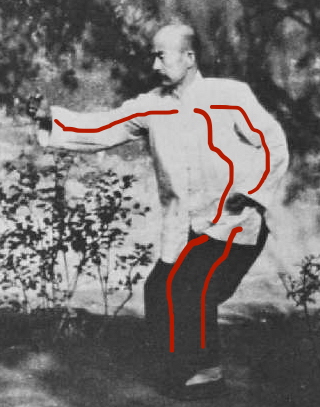
Qi (Chi) relates to structure. So, if you adopt a Tai Chi posture that’s relaxed, sunk, stable and strong (i.e. your structure is good), then you are “using your Qi well”. And it could be said the “Qi is circulating well”. (Actually, nothing is circulating in the sense of water in a pipe). If your structure is off in someway then it could be said that your “chi is not circulating well”.
So, if we read that quote again, with the new knowledge that it is to do with posture and structure:
“He adjusted her posture slightly and said, “now you have qi circulation”.
Could equally be written:
“He adjusted her posture slightly and said, “now you have better structure”.
So, to me that means, he corrected some defect in her posture (say an overly tense lower back, or tense shoulders, for example), so that her “Qi” started to circulate – i.e. the posture regained its natural strength.
Sorry guys, but none of this has anything to do with steam or heat or a mystical energy in the body. But it’s so easy to assume that this is what is meant when you read quotes like the one above.
Especially once you add to that the fact that people can feel pretty much anything they can imagine.
I was interviewed for Ken Gullette’s Internal Fighting Arts podcast recently. It was a fun show and Ken is a gracious and generous host and a new friend in martial arts. We had a really wide-ranging discussion about so many different subjects. I’m sure each topic we touched on could have been a podcast in itself, but Ken did a great job editing it to keep it on track.
We start talking about what it’s like starting BJJ later in life, then move on to Chinese martial arts like Tai Chi, Choy Lee Fut and XingYi and if they are still relevant today for self-defence. Hopefully, you find something here of interest.
Thanks to Ken for the opportunity. I’d suggest checking out his other episodes, too.
I got into a discussion about Bengquan, one of the 5 fists of Xingyiquan, a Chinese martial art I’ve written about before, recently, which prompted me to consider what really made a Bengquan different to a regular straight punch that you’d find in any number of other martial arts. I thought I’d just jot down a few of my ideas about it, because that forces me to organise my thoughts, but it has turned into quite a long post. So, apologies for that, but I’m going to post it anyway 😉
Xingyi is the oldest of the 3 big internal martial arts of China. Because it is so old and has gone through the hands of so many different practitioners and been secreted into several different secretive families, who often don’t teach outsiders, there are various different ways of doing Xingyi/Xinyi these days. They all employ different exercises and can look pretty different to each other, so it’s hard to talk generally about XingYi without somebody disagreeing with you. Still, all the different branches of the art remain one family, and you can talk about the art in general to some extent while still making sense. Which is what I’m going to attempt to do.
One thing to note is that historically Xingyi was developed as a barehand adaptation of military spear fighting methods. Ji Jike, (died 1662) also known as Ji Long Feng “God of spear”, was the oldest historically record practitioner. He was a soldier for the Ming Dynasty who found himself on the losing side and had to hand over his weapons and adapt to civilian life. He kept practicing his spear skill but adapted it for barehand work.
These days Xingyiquan is famous for having 5 fists. Each of these is a different kind of strike. Bengquan, “Crushing fist”, is one of the most famous of these fists. It’s representative of the Wood element, and consists of a very direct, forward strike, usually kept low, to the solar plexus or abdomen.
Xingyiquan has been featured in a few movies recently, and it’s its Bengquan that always gets the glory so you can consider it a kind of representative technique for the whole art.
In this scene from The Grandmaster a Xingyi master runs through the 5 fists, ending with Bengquan, then proceeds to fight Wing Chun master Yip Man, who is quite impressed with the Bengquan fist.
In the clip he then goes on to fight a second master who is doing a Shaolin art (my guess would be that it’s meant to represent Hung Gar) – it’s interesting to contrast the two styles (something I will be doing below).
What I would consider a good example of Bengquan outside of movies is this XingYi performer Yang Hai, originally from China, but now living and teaching in Canada:
I think most people I know who do XingYi, regardless of their particular style, would regard this performance “good”.
So, the question I want to answer here is what makes what he’s doing a Bengquan as opposed to a regular straight punch? In short, if you were just to punch forward in a straight line, with your body weight behind it, would it be a Bengquan?
Unsurprisingly, my answer is “no”, so let me explain.
Starting at the top of the body and working down, the first thing to look at is the arm movements. One arm is retracting in Bengquan as the other punches – that action utilises the whole body in a very relaxed way because it makes the spine rotate. Nothing is stiff. The arms are working together in harmony, the spine is rotating and the hips are also moving around it.
One hand coming back to the hip as the other strikes is also a feature of the Reverse Punch in Karate. So how is this different? Notice that in Bengquan the two fists cross over the top of each other, rather than being unconnected, and on different sides of the body. (Does the similarity point to a common ancestor? Possibly, back in the mists of time… it’s hard to say).
On a deeper level, the whole action of Bengquan is formed by the opening and closing of the body to move the arms. The section where the hands end up just in front of the body (meeting in the middle) is the ‘close’ part, the section where one hand punches out and the other retracts to the hip is the ‘open’ part. (A half-step Bengquan is where you punch on the close section as well).
The concept of opening and closing goes a bit outside the scope of this article, and involves the dantien usage and back bow, amongst other things, but I’ve talked about it before. You find this opening and closing action in Taijiquan, Baugazhang and other Chinese martial arts.
The question of why the arm retreats all the way to the hip in bengquan is also a good one. It doesn’t initially seem like something that particularly practical to do in a barehand combat situation. (Note different styles of Xingyi retract the arm to different degrees, too). However, I believe it’s there for a couple of reasons. Firstly, considering the spear origins of the art, the hip it’s a natural place to hold the butt of the spear, and where it naturally ends up when you retract after a spear thrust. Secondly, bringing the hand all the way back (an exaggerated movement) helps with the feeling of opening and closing. If you can do it big, then you can (over time) learn to do it small.
Note that if you are doing a Bengquan with a spear in your hands then your other hand cannot retract to the hip while thrusting with the spear (since you are holding the spear with two hands), but apart from this the action is identical to the barehand method. But after the thrust, you’d retract the spear back, so the hand was back at the hip again. So, doing Bengquan with a spear (correctly called Beng Qiang) is repeating the action on one side of the body over and over (until you swap sides), while doing it barehand, you are alternating sides of the body with each punch. Like this:
The next thing I’d look at is the footwork. in Bengquan you step as you punch. You don’t land your feet, then punch, or punch without stepping. The step is an integral part of the movement. It’s part of the opening and closing of the body and part of the technique. In Xingyi your feet should always be moving.
Notice that his back foot stays connected to the floor for a comparatively long time for a stepping-in punch. He’s keeping that ground connection for a long, long time. His body and head are generally kept quite upright – he’s not lunging forward. All this is down to the type of footwork that XingYi uses, where the feet are kept under the body on a comparatively small base, as opposed to a wider stand where you have a longer base.
I believe that part of the purpose of this footwork is to aid a key feature that makes a Bengquan different to a regular straight punch – that is its ability to penetrate deeply into the target.
If you track the path of the fist in this example, it is on a slightly upward but mainly forward trajectory, like an arrow being shot from a bow. It goes right through the target in a straight line. It should be doing damage to anything it contacts on its trajectory, just like an arrow would, not aimed to land at a particular spot.
This feature marks Bengquan out as being different to a lot of punching methods that aim to land in one particular place in time and space. If you look at the path of a typical punch that is ‘swung’ at a target it is mainly swinging in an arc. So you’re timing it to land on the target as you drop your weight forward onto your front leg. That produces power, sure, but I wouldn’t call that a Bengquan as it’s not going through the target like you see in the Bengquan example above. Even if the force then goes through the pad or target, the punch itself doesn’t. To me a typical punch is about “landing on the target with your weight”, like a sledgehammer hitting something. Yes, that hurts and it’s effective, but it’s not what you should be doing in Bengquan. Done correctly it should displace a pad holder significantly. This is much easier to train on a person than a pad holder to be fair, as the contact of the fist on a pad is not the same as the contact of a fist on a body – the body is softer and crumples more as you impact, making it easier to get the right feel.
A key to look for in Xingyiquan, when its applied under pressure, is that the footwork doesn’t devolve into other methods, like say, falling into a long riding horse stance to help make up ground.
Xingyi is a collection of particular body methods (Shenfa)- once you start to lose one of them, the whole thing unravels, and you have… something else.
The most recent episode of Trust Me, I’m a Doctor featured Tai Chi!
“Michael Mosley finds out whether t’ai chi can offer the same health benefits as vigorous exercise – without all the huffing and puffing. ”
They compare the same time spent doing Tai Chi to the time spent doing Zumba, which is far more vigorous. Is he really “doing Tai Chi”? Well, that’s up for debate, but the results are surprising.
If you get iPlayer then you can watch it at the link below:
I spent my lunch hour practicing Tai Chi with the leaves falling around me, which made me realise that Autumn is definitely here. Practicing under the trees also made me think about the strong parallel between the postures of Tai Chi and the structures of nature.
Take trees for example – the branches grow upwards and outwards:
The spine is always extended, the eyes engaged and the posture directed upwards and outwards.
The following is a Yang Tai Chi form video. Notice that his body structure is always opening outwards and upwards:
So why do we do this in Tai Chi? Well, natural structures are inherently strong structures. Nature has been working on trees, plants and animals for millions of years, and they have evolved into strong shapes that can take a battering from the elements and survive. In terms of postural considerations of Tai Chi we are aiming to mimic natural structures to take advantage of their inherent strength. For example, with the arms, the elbow is usually kept below the wrist in Tai Chi, when the hand is going up and outwards, this enables your arm to create the same sort of shape as a tree branch that grows outwards and upwards.
If you collapse the structure of your arms – say, close your joints like the elbows and shoulders too much, you don’t get this effect of mimicking natural structures. Instead, the structure needs to be supported by more muscle usage if it is going to withstand pressure.
Think also of stretching the ‘body suit’ of skin, fascia, tendons. If you bend the joints too sharply you lose the stretch from feet to toes. If you look at a picture of a fower, plant or tree, it looks kind of ‘stretched out’, doesn’t it?
Chang Man-Ching using the power of the ground to uproot an opponent.
I’ve talked a lot about the idea of Jin on this blog, usually in reference to using the power of the ground in martial technique. However, talking about Jin only in this context starts to create the impression that it’s a special skill that you may, or may never acquire. A hidden secret, almost. It might be more grounding (no pun intended) to consider that we all already use some aspects of Jin in every day life.
Take a look at the following photos of people carrying things/other people:
The photos of people carrying weights on top of their heads provide perhaps the clearest example of what I’m talking about, but I wanted to include the other photos too, because the same principles apply.
In all cases, the human body has the ability to manage the extra weight applied to it in a constantly shifting environment of movement, without you toppling over. The weight being carried is being sent to the ground in all cases. If you hold a heavy weight out in front of you it is much more difficult, because you have to use your arm muscles in isolation, but if you can simply add the weight to your own body and let the force pass through your body to the ground then it’s a lot easier to carry, especially over long distances. Your body/mind will automatically manage these forces as you move using your subconscious. If it wasn’t doing it then you’d simply fall over as you moved because you wouldn’t be adapting to the subtle shifts of weight.
The point about the subconscious doing it is important because it means your conscious mind is free to do other things. For example, you can carry out a conversation while carrying a weight on your head and walking, rather than having to concentrate on it with 100% of your mental effort.
This ability of the subconscious mind to manage these forces is what we call Jin in Chinese Martial Arts. So, when somebody pushes on me, say in Taijiquan Push Hands, and I send that push to the ground I am using some sort of conscious control over a normally subconscious-mind ability.
That’s the skill you need to train. These Jin skills can range from the simple to the complex, but it’s all based on using an ability we already possess and use naturally, without even thinking about it.