Aikido Heresies. The dark side of Aikido.

1282637968030010200

Morihei Ueshiba, founder of Aikido

Just remembered I didn’t post about the last Heretics podcast we did. This one was about the history of Aikido. I thought it would be quite a light-hearted one, but as Damon explains, it turns out the history of Aikido, and its parent art Daito Ryo, is largely unknown to the average martial artists (i.e. me) and also pretty dark and nasty. Very nasty.

War crimes, extreme nationalism, invasion, torture, ethnic cleansing, crimes against humanity and so on.

So, if you’d like to have your illusions about “the way of harmonious spirit” shattered, then listen on, otherwise, as they say, ignorance is bliss.


New Tim Cartmell interview

ep354-wide

Tim Cartmell (not “Tim Cartwell” as stated in the graphic above)’s name will probably be familiar to most Xingyi enthusiasts. He’s a practitioner of Chinese martial arts and a BJJ black belt. There’s a new podcast episode by him that’s worth a listen. Tim covers his training in different martial arts systems and the differences between sport and street martial arts.

The interview has also been transcribed. Get audio and text version here.

Heads-up! New Xingyi book coming soon. Tai and Tuo Xing.

book

Just a heads up that there’s a new Xingyi book on the horizon that deserves your attention. It’s called A Study of Tai and Tuo Xing and it’s by my old training partner Glen Board.

Tai and Tuo (Asian paradise flycatcher and Chinese crocodile) are two of Xingyi’s 12 animals. They’re considered advanced in the sense that the methods they use are difficult and subtle. The book is a thorough investigation of the fighting strategies and methods of both animals.

I’ve had access to a pre-final draft and I think it’s shaping up to be an excellent book. The illustrations are great, there’s plenty of historical background on Xingyi as well as technical discussion. The book also features good quality photographs showing martial applications and linking sequences for both animals. All in all, it looks great.

Look out for it soon. It should be on Amazon.

Asian-paradise-flycatcher-portrait

Asian paradise flycatcher

yang2-1024x683

Chinese alligator


The Origins of Jiu Jitsu and Kempo (part 5)

The final part of our podcast series on Jiu Jitsu and Kempo is live. In this episode we spend a long time trying not to talk about Aikido, then agree to talk about it more next time. Apart from that, we follow the developments in Japan through to modern times, with particular attention paid to the history of the yakuza.

https://www.spreaker.com/user/9404101/5-the-origins-of-jiu-jitsu-and-kempo-par


Fighting in the age of loneliness

Screen Shot 2018-12-05 at 5.03.02 PM.png

I thought I’d bring your attention to a great little video series written and directed by Felix Biederman that’s been produced by SBNation called Fighting in the age of loneliness. It’s a kind of history of MMA and the UFC, including all the influences from Japan to Brazil and elsewhere, including the Pride period, set against the social/economic backdrop the USA and Japan.

One particular quote I liked was:

‘Your home belongs to the bank, your gas tank is lining the pockets of those who had more to do with 911 than the country your brother just died fighting in and you’re told the economy is in high gear even though your paycheck is buying less and less but what you just saw in the cage was unambiguous. One person hit another and the other fell. Nothing about it lied to you.’

Here are the episodes:

Episode 1:

Episode 2:

Episode 3

Episode 4:


Episode 5

The history of Jiujitsu and Kempo. Part 4

The latest episode of the Heretics podcast is out!

https://www.spreaker.com/user/9404101/episode4final

In part 4 we examine the time period between 1960 and 1980 in Japan, and discuss topics such as martial arts marketing and the different ways in which the Japanese created and promoted a wide range of new martial arts.

Here are a few links to videos of the things we talk about this time:

Gracie vs. Kimura – October 23, 1951 (Maracanã Stadium – Rio de Janeiro, Brasil)

Gracies vs bullies on beach:

Rikidozan vs Masahiko Kimura (1954 – Part 2/2)

PRIDE 25: Kazushi Sakuraba vs Antonio “Elvis” Schembri

Muhammed Ali vs Antonio Inoki Boxer vs MMA Fighter 1976


Mas Oyama vs “bull”:

TV show about Iwama and Aikido, Ibaraki Prefecture (茨城県, Ibaraki-ken) Japan featuring the late Morihiro Saito Sensei.

Taido:

Kodo:

What makes Xingyi’s Bengquan different to a normal straight punch? Part 2: The bow draw.

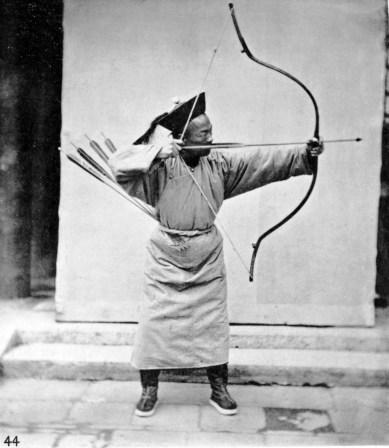
manchu_soldiers_2

Chinese archer, photographed in the 1870s

Following on from my previous post about Bengquan, one of the 5 Element fists of Xingyiquan, I want to take a closer look at some of the internal characteristics of the strike.
In learning to do a Bengquan correctly you must first learn the mechanical way to do it, then later you can tackle what should really be going on. By the ‘mechanical way to do it’ I’m talking about things like weight distribution, a slight contraction and a slight expansion as you punch, a counter rotation on the spine between hips and shoulder, and the way the fist continues straight forward like an arrow shot from a bow. Generally, these are the things I talked about in the last article. A lot of this is simply maintaining the requirements of San Ti Shi – the 6 bodies posture – while in motion.

Once you are able to do these ‘mechanical’ actions it’s time to look a little a little deeper at some of the internal aspects.

At this point, we need to introduce the concept of the leg bows, arm bows and the back bow. Together that makes 5 bows, all of which need to be coordinated together to produce a perfect bengquan. The word ‘bow’ is used here in the sense of a bow and arrow – the string can be drawn to create potential energy and released to fire that energy.

beng bows

Arms, legs and spine form the 5 bows.

By utilising the 5 bows we are able to source power from areas of the body that aren’t used in normal movement. The process that co-ordinates the 5 bows working together is known simply as opening and closing. I’m going to try and explain how it works with a bengquan, in a very basic way. Obviously, the situation is more complex than I’m trying to make out, but let’s just go with a basic explanation for now.

I’ve mentioned the muscle-tendon channels before. We try and condition them in the internal arts. They run from the fingertips to the toes on the same sides of the body. The opening, or Yang channels, run roughly along the back of the body. The closing, or Yin channels run roughly along the front of the body.

The connection along these channels start as very weak and difficult to get a sense of, but with repeated conditioning, in the correct manner it can be strengthened, so that the limbs can be manipulated using the channels, rather than by using normal muscle usage. Your muscles are still involved, of course, but you are repatterning the way you use them, so they can be controlled from the body’s centre, known as the dantien.

(Try my free Qigong video course for details on how to do this.)

Think of the channels as elastic connections. You need to be relaxed to access them. If a joint is tense then it reduces your access to the elastic force (hence the constant admonitions to Sung “relax’ in internal arts). Ultimately it is your breath, via reverse breathing that enables you to access these bows. Pulling in along the Yin channels creates the action called closing, and pulling in along the Yang channels creates the action of opening. This phenomenon is observable in most animals in nature. Similarly, in internal arts, one side of the body is always contracting as the other side is expanding, and so on. This opening and closing action enables us to use the ‘bows’ of the legs, arms and back in the same way a bow can power an arrow. There’s a storing phase, and a releasing phase.

While the bows certainly ‘add’ to the power, it’s important not to think of them as ‘additives’ that you can apply on top of the wrong sort of movement. They fundamentally are the correct way the body should move if you are using the muscle-tendon channels.

The image at the top of this post shows a Chinese archer, photographed in the 1870s using what’s known as a recursive bow – the very top and bottom actually curve away from the archer when in a neutral position and are pulled back when he draws the arrow. This type of bow was popular throughout Asia.

Here’s one being built using traditional methods:

https://www.youtube.com/watch?v=F0nEocphm-M

If you think of a recursive bow mapped over the top of a human body, then you get some idea of how the bows concept works.

beng2

Of course, this is just to get the general idea – the overal feel. There are actually 5 bows involved, as I’ve said.

In the last article we looked at how a bengquan has a storing phase of the movement, then an expansive phase of the movement. Now we can form a parallel with the action of drawing and releasing a bow.

However (and Mike Sigman needs credit for pointing this out to me) instead of thinking of the bow as firing an arrow out from your middle behind you, think of the string being pulled inwards towards the shaft of the bow, on the storing/closing cycle, and then released back to normal with a snap on the expansive punching section as you punch. That’s more like what is actually occurring within the body.

In the drawing phase the arms bend, the legs bend and the back bows and the dantien contracts.

The spine would ‘bow’ out. The bottom tip of the spine bow would be the coccyx and the top tip the head.

spinebow3

Spine in a neutral position before the ‘string’ is pulled back towards the ‘bow’.

The flexing and straightening of a leg, for example, is another bow. Same with an arm. All the bows need to be utilised as a team, lead by the dantien, and activated using the muscle tendon channels rather than just local muscle.

On release, the dantien is going down and out, which releases the back bow. The leg bows release which add a vertical component to the power. These combined forces drive and the arm bow to extend on the punching side.

The visual image of drawing a bow has long been associated with Xingyi’s Bengquan because the Bengquan ‘form’ is a perfect training vehicle to work on developing your back, leg and arm bows.  I haven’t mentioned intent (Yi) yet or Jin yet, so there’s more to the story, which I hope to mention next time, but if you’re looking for a way to practice the 5 bows in conjunction with a power release then Bengquan is a perfect mechanism to practice it with.

Heretics podcast episode 2

Episode 2 of the history of Kempo and Jiujitsu is out!

Starts in 1850. Extensive discussion of Kano Jigoro, the evolution of Judo and beyond. Plus a lot on the political-cultural situation of Japan at the time. Plenty of martial arts Heresy as always 😉

If you found the first episode too history-heavy this one, while still having a bucket-load of history in it, is more conversational and has some lighter-weight elements, talking about BJJ, Chuck Lidell and other things. We take a slightly controversial listener question at the end.

iTunes link:

https://itunes.apple.com/gb/podcast/heretics-by-woven-energy/id1442072590?mt=2#

Spreaker link: