Just finished watching series 4 of Glitch. It’s a Netflix show where dead people get reanimated in a rural Australian town (why this happens is a long story).
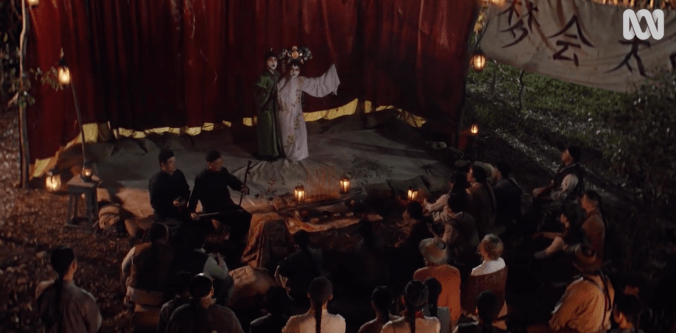
In season 4 a Chinese immigrant who died in the dust and mud of the bush in the 1850s comes back to life.
At the time, Australia was the most multi-cultural place on earth. We see flash backs from his life touring the Chinese camps of the Victorian goldfields performing Opera, which was the pop music of its day.
It’s pretty well done. Here’s some background on the history:
There are several bits in the series where the actor Harry Tseng performs Opera moves that look just like “kung fu”.
These days it’s pretty hard to imagine what life was like over 100 years ago. Some people still have the idea that “Kung Fu” has absolutely nothing to do with Chinese Opera. Clearly it was all part of the same cultural mix.
One of the most frequent things you hear in BJJ is “move your hips“.
Brazilian teachers tend to say “escape your hips“. Which is an odd-sounding translation of presumably something that sounds better in Portuguese. In American and English it usually gets turned into “hip escape“, as in, “do a hip escape here“, “it’s not working because you need to hip escape more“.
We hip escape up and down the gym as a warm up (also known as “shrimping”) because it’s a fundamental movement you need to have in your tool box that you can pull out without having to think about it.
But why? What is it? Simply put: It’s designed to create more space between you and your opponent on the ground.
You can use hip escapes for escaping bad positions like side control and mount. But it also has benefits for attacks too. Basically a good rule of thumb is that if what you’re doing isn’t working try doing a hip escape and doing it again. The change of angle and leverage will probably fix it.
Now we know what a hip escape is, let’s get to the point of all this.
When we say “move your hips” that’s not the part of the body that you need to move from. If you just moved from your hips you’d never go anywhere. You’d just spasm on the floor like a dying fly having its last buzz. What you actually need to do is push with your toes and feet on the ground so that your hips move.
Your hips moving is the result of the action, not the action itself.
Which brings me onto Tai Chi Chuan and the dantien (the lower abdomen area of the body).
All wise and knowledgeable Internet-enabled Tai Chi practitioners know that we need to “move from the dantien” in Tai Chi Chuan. (This is the supposed secret to Tai Chi that you get told by your wise master only after you have paid the required tuition fees for a number of years. 🙂 )
Cheng Man Ching, Single Whip posture.
But again, where does the action originate? I would say that, just as in JiuJitsu, you don’t actually “move from the dantien” by originating action there. Your dantien moves, but it’s your foot that provides the impetus. Your foot pushing against the ground is where the ‘power’ comes from in Tai Chi Chuan.
(A side note here for the Order of Advanced Tai Chi Wizards of the Internet: When you get this concept of the power from the ground you will find that you can actually originate the movement in the dantien as a kind of dropping force that is then rebounded from the ground, so it’s less of a push with the legs. File this under “advanced” if it makes no sense right now and come back to it later).
What Tai Chi Chuan specialises in is transmitting this power to the extremities without interfering with it as much as is humanly possible. We know that in Tai Chi we need to be relaxed (song), which seems like the last thing you’d want to be if you have to hit something hard, but there is a method in the madness.
In Tai Chi Chuan you are trying to transfer that power – the ground reaction force – from your foot all the way to your fingers as smoothly as possible and directing it with the dantien. This is called ‘threading a pearl through the 9 crooked gates‘ in the Tai Chi classics. The gates here are the joints of the body. All the breaks in connection between your foot and fingers are the points where power leaks out. Usually we cover these things up by using muscular strength to get by – you can spend years fooling yourself with this, and it’s a very hard habit to stop.
Tai Chi is infused with the concept of flow, but what does that actually mean? What does ‘flow’ mean in this context?
We are used to seeing Tai Chi practitioners in parks performing graceful, flowing movements. In fact, that’s what we expect to see whenever somebody mentions “Tai Chi”, but as usual, it’s what’s underneath the water that matters, not what we see on the surface.
“Chang Ch’uan [Long Boxing] is like a great river
rolling on unceasingly.”
This points to the continuous nature of Tai Chi boxing. Techniques don’t really start and stop, they all merge into one continuous movement.
Sun Lu Tang, Tai Chi.
Acquiring this skill in the Tai Chi form is actually quite difficult. For a start, people tend to speed up or slow down during a form performance. They speed up on the bits they like and slow down on the bits they find hard.
Another common fault is posturing – pausing serenely in postures that are being held, if only for a moment. It’s equal and opposite infraction is too much merging – movements get mushed into each other without one finishing properly before the other begins.
I’d say it takes a good few months of continual practice, focusing on just continuity, to iron these faults out of a Tai Chi form
The deeper lesson in continuous movement is that you are constantly recycling the ‘energy’ in the form. When you break a movement, or stop, you are not keeping everything flowing, and you lose the power of momentum. They fall flat.
This links back to the idea of Yin and Yang being in constant flux, with change as the only constant. These ideas are as old as the hills, but find their expression most often in Taoist thought.
In a recent TED talk Adrien Stoloff looks at what Wuwei (The Taoist concept of non-action, and flow) mean.
Adrien discusses flow and wuwei, and how recent research in cognitive neuroscience suggests what may be happening in the brain when we experience flow or wuwei. Adrien Stoloff is a doctoral candidate in Asian Religious Traditions. He is interested in Chinese religious beliefs and practices from the late Warring States period to the Early Han Dynasty (approximately 5th-2nd centuries BCE). Specifically, Adrien’s research focuses on the Classical Daoist phenomenon of wuwei. Translated as “effortless action,” wuwei is a state of being in which one acts effortlessly yet efficiently in a given situation. His dissertation project uses an approach informed by tools in the field of religious studies – textual and historical analysis – as well as by the fields of philosophy and cognitive science:
The dance/fight game
If there’s one martial art that really emphasises the concept of ‘flow’ then it’s Capoeira. The Brazilian dance/fight martial art where two participants enact a kind of spontaneous, improvised martial dance set to music.
Clearly your connection to the other person in Capoeira transcends the physical connection we find in Tai Chi push hands, and it has to be in place or you end up with a foot to the face. That’s Tai Chi’s Ting Jing (Listening energy) on steroids.
Even as an outsider to Capoeira, I can tell when the practitioners are connected to each other, and when they’re not. When the focus is more on athletic ability and directed inwards the two practitioners don’t seem to melt together into one dance – they retain their separate selves. The type of Capoeira I like to watch is where the two practitioners become one – responding and reacting in real time to each other.
And of course, with the rhythm of the music and a focus on connecting there’s all the potential for it to cross over into ‘spirit dance’, where you connect to the wider environment.
I looked for some beginner capoeira videos recently and found these which I thought presented some basic moves that I could copy. I had a go at this video below this morning and I was surprised by how difficult (but also fun) even these ‘basic’ moves are.
I mean, I can do it badly. Anybody can do it badly. But trying to do it with the smoothness and flow that the practitioner demonstrates above is a different matter.
If you wanted to get more ‘flow’ in your movement, I think this could be a good place to start.
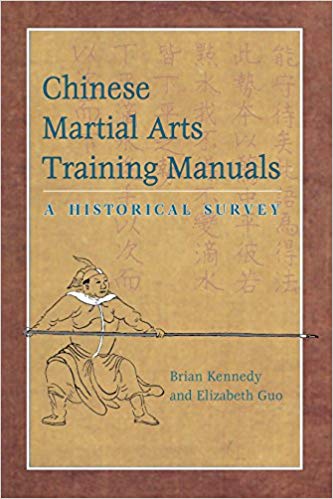
I conversed with Brian a few times and always found him to be an interesting and respectful person. Here’s an article he wrote on the Da Dao “Big Knife”, for those not familiar with his work.
“I first grew interested in martial arts history back in the ‘Bruce Lee-Kwai Chang Caine days’. My parents got me a copy of Robert Smith’s Asian Martial Arts and one of my high school history teachers let me do a semester of independent study on Chinese martial arts history. That independent study project, back in 1975, got me started on a lifelong interest in Chinese martial arts history. The field of Chinese martial arts history has progressed so much in those 40 years—but, many of the same challenges remain. “
Brain was 61 and had just got his brown belt in Briazilian Jiujitsu in January of this year and his first stripe in May. What an inspiration.
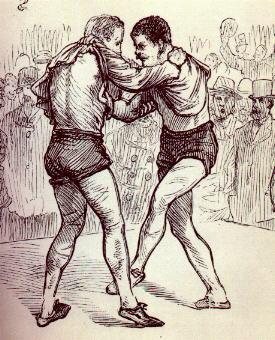
The first episode is devoted to the now lost wrestling style called simply, Irish Collar and Elbow.
What’s fascinating about this style is that it used to be huge. Thousands of people would turn up to watch a high profile match up over a century ago. It also spread to America where it became equally popular. Even George Washington was a practitioner!
However, it was superceeded by other styles of wrestling, and cultural and societal changes in its birthplace involving the industrial revolution (if I remember correctly) and the rise in popularity of boxing that resulted in its decline and eventual demise.
Ruadhán MacFadden, who runs the podcast, however, has been trying to recreate what it must have looked like based on his research into accounts of Collar and Elbow matches and his knowledge of contemporary grappling styles (he’s a brown belt in BJJ).
At a recent BJJ Globetrotters Summer Camp, he conducted a seminar showing what he’s discovered about this lost art. BJJ Globetrotters have now put the seminar online, so you can glimpse through a window into the past and see what this style of European martial art would have looked like:
In my last post on Yoga I mentioned the political situation here in the UK at the moment.
If you’re in the US, Europe or elsewhere and you can’t figure out what’s going on in the UK then welcome to the situation! Neither can we. The whole thing is madness.
I recently read something that actually put it all in context for me. I think it’s spot on. It’s about what actually happened, not what we think is has happened. It also quotes from one of my favourite books – Zen and the Art of Motorcycle Maintenance.
“What did it mean that many of the poses I was teaching were identical to those developed by a Scandinavian gymnastics teacher less than a century ago? “
I’m sharing this article again because I really like it. I like the moments where your perspective of the world is turned upside down. When your perspective suddenly shifts and what you thought was permanent is shown to be on the same shifting sands as everything else.
These moments seem to be happening on a daily basis with the political turmoil in the UK at the moment. Democracy lurches left and right. The once unthinkable becomes thinkable, normal, everyday reality.
But the thing is, we invented Yoga. Not the ancient Hindu practice. The modern-day Yoga of tight pants and sweaty mats. The Yoga you see practiced in classes all over the country on wooden floors in rooms with steamy windows. It is Western culture given an Eastern polish and exported back to us to pander to our fetish for spirituality.
Get the inside view on the recent BBC Shaolin Temple documentary from a YouTuber who lived there for 3 years training Shaolin Kung Fu. What is real and what is fake? Find out here:
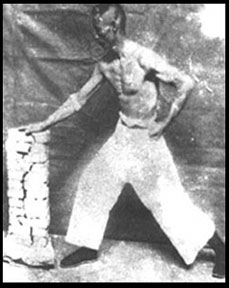
I posted this video of me doing Tai Chi in the rain back in 2012. This is a short form derived from the full long Yang form of Gu Ru Zhang (Ku Yu Chang) the famous “King of Iron Palm” from Hong Kong.
You see the famous picture of him breaking tiles without spacers quite a lot:
Gu Ru Zhang
Gu Ru Zhang’s style of Tai Chi is still quite rare. It’s from the Yang family originally, but had some input from his friend Sun Lu Tang, and you sometimes see it incorectly called Sun Style.
Gu published a book in 1936 on Tai Chi called “Tai Chi Boxing”, which you can find translated on the Brenan Translation website.
I’ve done various different styles of Tai Chi, but I always come back to this form. It’s my favourite. Anyway, here’s my video:




 The Tai Chi Notebook