The concept of ‘flow’ in martial arts

photo of man on his boat during daytime

Photo by KML on Pexels.com

Tai Chi is infused with the concept of flow, but what does that actually mean? What does ‘flow’ mean in this context?

We are used to seeing Tai Chi practitioners in parks performing graceful, flowing movements. In fact, that’s what we expect to see whenever somebody mentions “Tai Chi”, but as usual, it’s what’s underneath the water that matters, not what we see on the surface.

The Tai Chi classics state:

Chang Ch’uan [Long Boxing] is like a great river
rolling on unceasingly.”

This points to the continuous nature of Tai Chi boxing. Techniques don’t really start and stop, they all merge into one continuous movement.

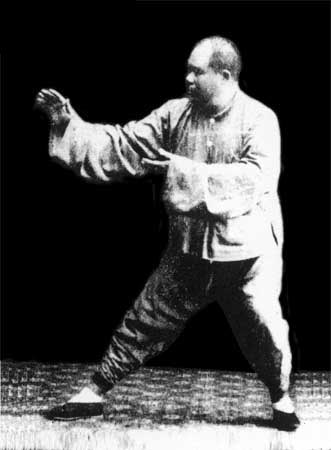
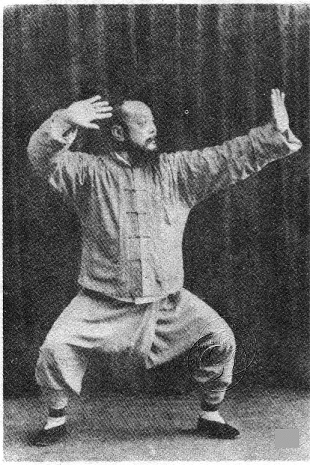
Sun Lu Tang 2014-12-11 15-54-12

Sun Lu Tang, Tai Chi.


Acquiring this skill in the Tai Chi form is actually quite difficult. For a start, people tend to speed up or slow down during a form performance. They speed up on the bits they like and slow down on the bits they find hard.

Another common fault is posturing – pausing serenely in postures that are being held, if only for a moment. It’s equal and opposite infraction is too much merging – movements get mushed into each other without one finishing properly before the other begins.

I’d say it takes a good few months of continual practice, focusing on just continuity, to iron these faults out of a Tai Chi form

The deeper lesson in continuous movement is that you are constantly recycling the ‘energy’ in the form. When you break a movement, or stop, you are not keeping everything flowing, and you lose the power of momentum. They fall flat.

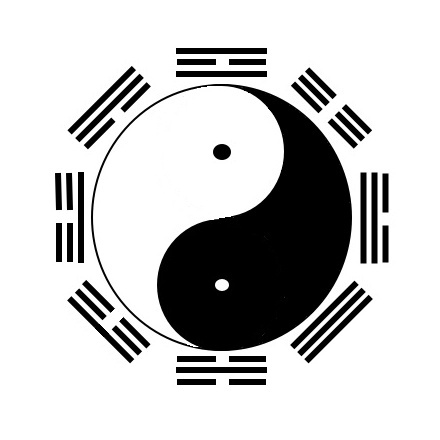
This links back to the idea of Yin and Yang being in constant flux, with change as the only constant. These ideas are as old as the hills, but find their expression most often in Taoist thought.

In a recent TED talk Adrien Stoloff looks at what Wuwei (The Taoist concept of non-action, and flow) mean.

Adrien discusses flow and wuwei, and how recent research in cognitive neuroscience suggests what may be happening in the brain when we experience flow or wuwei. Adrien Stoloff is a doctoral candidate in Asian Religious Traditions. He is interested in Chinese religious beliefs and practices from the late Warring States period to the Early Han Dynasty (approximately 5th-2nd centuries BCE). Specifically, Adrien’s research focuses on the Classical Daoist phenomenon of wuwei. Translated as “effortless action,” wuwei is a state of being in which one acts effortlessly yet efficiently in a given situation. His dissertation project uses an approach informed by tools in the field of religious studies – textual and historical analysis – as well as by the fields of philosophy and cognitive science:


The dance/fight game

If there’s one martial art that really emphasises the concept of ‘flow’ then it’s Capoeira. The Brazilian dance/fight martial art where two participants enact a kind of spontaneous, improvised martial dance set to music.

Clearly your connection to the other person in Capoeira transcends the physical connection we find in Tai Chi push hands, and it has to be in place or you end up with a foot to the face. That’s Tai Chi’s Ting Jing (Listening energy) on steroids.

Even as an outsider to Capoeira, I can tell when the practitioners are connected to each other, and when they’re not. When the focus is more on athletic ability and directed inwards the two practitioners don’t seem to melt together into one dance – they retain their separate selves. The type of Capoeira I like to watch is where the two practitioners become one – responding and reacting in real time to each other.

And of course, with the rhythm of the music and a focus on connecting there’s all the potential for it to cross over into ‘spirit dance’, where you connect to the wider environment.

I looked for some beginner capoeira videos recently and found these which I thought presented some basic moves that I could copy. I had a go at this video below this morning and I was surprised by how difficult (but also fun) even these ‘basic’ moves are.

I mean, I can do it badly. Anybody can do it badly. But trying to do it with the smoothness and flow that the practitioner demonstrates above is a different matter.

If you wanted to get more ‘flow’ in your movement, I think this could be a good place to start.

RIP Brian Kennedy

51ohpgzfmol._sx331_bo1204203200_

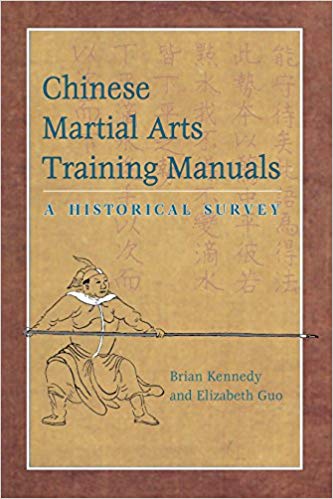
It’s sad to report that respected Chinese martial arts practitioner and author Brian Kennedy has died. He’s best remembered for his two works on Chinese martial arts history – Chinese Martial Arts Training Manuals and Jingwu: The School that Transformed Kung Fu.

I conversed with Brian a few times and always found him to be an interesting and respectful person. Here’s an article he wrote on the Da Dao “Big Knife”, for those not familiar with his work.

“I first grew interested in martial arts history back in the ‘Bruce Lee-Kwai Chang Caine days’.  My parents got me a copy of Robert Smith’s Asian Martial Arts and one of my high school history teachers let me do a semester of independent study on Chinese martial arts history. That independent study project, back in 1975, got me started on a lifelong interest in Chinese martial arts history.  The field of Chinese martial arts history has progressed so much in those 40 years—but, many of the same challenges remain. “

Brain was 61 and had just got his brown belt in Briazilian Jiujitsu in January of this year and his first stripe in May. What an inspiration.

A full write up of his contributions to the field of Martial Arts studies is available on Kung Fu Tea.

Rest in peace, Brian and condolences to your family.

Irish Collar and Elbow wrestling, (back from beyond the grave)

collarelbow

Collar and Elbow match, Dublin 1878

I’m a big fan of the Hero with a Thousand Holds podcast, which looks at relatively obscure wrestling styles around the world.

The first episode is devoted to the now lost wrestling style called simply, Irish Collar and Elbow.

What’s fascinating about this style is that it used to be huge. Thousands of people would turn up to watch a high profile match up over a century ago. It also spread to America where it became equally popular. Even George Washington was a practitioner!

However, it was superceeded by other styles of wrestling, and cultural and societal changes in its birthplace involving the industrial revolution (if I remember correctly) and the rise in popularity of boxing that resulted in its decline and eventual demise.

Ruadhán MacFadden, who runs the podcast, however, has been trying to recreate what it must have looked like based on his research into accounts of Collar and Elbow matches and his knowledge of contemporary grappling styles (he’s a brown belt in BJJ).

At a recent BJJ Globetrotters Summer Camp, he conducted a seminar showing what he’s discovered about this lost art. BJJ Globetrotters have now put the seminar online, so you can glimpse through a window into the past and see what this style of European martial art would have looked like:

Zen and the art of Brexit

blue and yellow round star print textile

Photo by freestocks.org on Pexels.com

In my last post on Yoga I mentioned the political situation here in the UK at the moment.

If you’re in the US, Europe or elsewhere and you can’t figure out what’s going on in the UK then welcome to the situation! Neither can we. The whole thing is madness.

I recently read something that actually put it all in context for me. I think it’s spot on. It’s about what actually happened, not what we think is has happened. It also quotes from one of my favourite books – Zen and the Art of Motorcycle Maintenance.


Here


Yoga came from Europe

“What did it mean that many of the poses I was teaching were identical to those developed by a Scandinavian gymnastics teacher less than a century ago? “

woman flexing her legs

Photo by theformfitness on Pexels.com

I’m sharing this article again because I really like it. I like the moments where your perspective of the world is turned upside down. When your perspective suddenly shifts and what you thought was permanent is shown to be on the same shifting sands as everything else.

These moments seem to be happening on a daily basis with the political turmoil in the UK at the moment. Democracy lurches left and right. The once unthinkable becomes thinkable, normal, everyday reality.

But the thing is, we invented Yoga. Not the ancient Hindu practice. The modern-day Yoga of tight pants and sweaty mats. The Yoga you see practiced in classes all over the country on wooden floors in rooms with steamy windows. It is Western culture given an Eastern polish and exported back to us to pander to our fetish for spirituality.

Original link removed – I think this is the same article.

Judo Jack

The title of this video is “94 Year Old Jack Has Been Practising And Teaching Judo For 67 Years”, which tells you everything you need to know.

Some humans are exceptional.


Gu Ru Zhang style Tai Chi Chuan

I posted this video of me doing Tai Chi in the rain back in 2012. This is a short form derived from the full long Yang form of Gu Ru Zhang (Ku Yu Chang) the famous “King of Iron Palm” from Hong Kong.

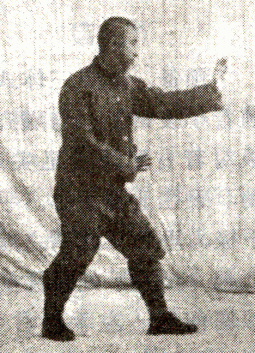
You see the famous picture of him breaking tiles without spacers quite a lot:

guruzhang3B

Gu Ru Zhang

Gu Ru Zhang’s style of Tai Chi is still quite rare. It’s from the Yang family originally, but had some input from his friend Sun Lu Tang, and you sometimes see it incorectly called Sun Style.

Gu published a book in 1936 on Tai Chi called “Tai Chi Boxing”, which you can find translated on the Brenan Translation website.

I’ve done various different styles of Tai Chi, but I always come back to this form. It’s my favourite. Anyway, here’s my video:

XingYi footwork explained

photo of walking rooster

Photo by Đàm Tướng Quân on Pexels.com

Byron Jacobs has another video out in his XingYi series, this time focussing on footwork. If you’re after the basics of XingYi then this is the best place to start. I think footwork is especially important in XingYi as much of the defending is done not by deflecting things (like you find in Tai Chi) but by moving your feet.

“Chicken leg” forms one of the requirements of San Ti Shi, and refers to the ability to keep most of your weight on one foot so the other is free to move.

Take a look:

Byron also has another episode of his Drunken Boxing podcast out, also worth a watch/listen. This podcast is about what it’s like to actually live and train martial arts in China. This time he’s talking to Michael Ashley Wix, who is a student of Beijing Shuai Jiao Master Li Baoru (李宝如).

“Originally from New Zealand, Michael has lived in Beijing for 23 years learning various Chinese martial arts, including studying for 3 years at the Beijing University of Sport, and studying Yi quan for 5 years.

Michael was involved in the early development of Brazilian Jiu Jitsu and MMA in China, and introduced Chinese wrestlers to the sport with champion Yao Honggang being one of them.

One of Michael’s missions is promoting and preserving Shuai Jiao which he used to do through the popular but now defunct website Shuaijiao.tv. Currently, he is working on publishing Master Li Baoru’s extensive body of books and articles.”


The Tai Chi Miasma, or “No, the fight is not over just because you’ve got me off balance.”

pangu2

I had an interesting chat with another Tai Chi teacher this week. Generally, Tai Chi teachers are nice people who have trained hard at something for a number of years and developed a lot of skill in it. They’re often not that into the martial side of the art, (even if they say they are), yet they’ve managed to pick up a lot of what I call “Tai Chi Miasma” along the way.

(If you want to know what a Miasma is, I do a podcast about the subject and how it reverberates through human history. Click the link above. A brief summation of Tai Chi Miasma would be, “a set of unconscious and often faulty assumptions about combat influenced by Tai Chi training”, but I’d also have to include a lot of Chinese miasma about yin and yang, qi and tao that was incorporated into Tai Chi by the influence of the Neo Confucian Zhu Xi amongst the intellectual class.)

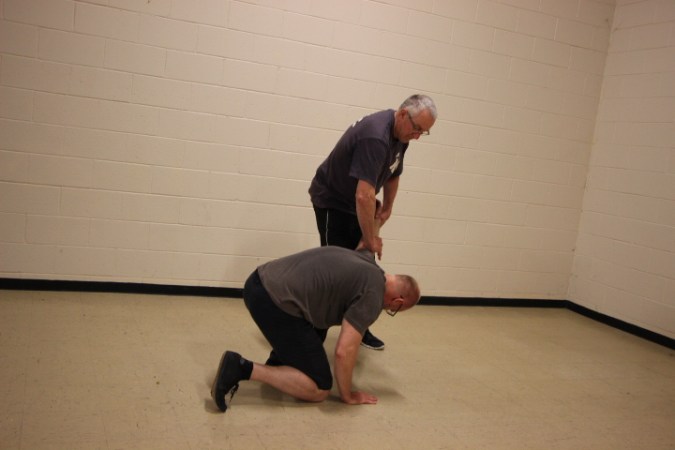
For example, I find that there’s a pervasive belief amongst Tai Chi practitioners that the fight is effectively over once they have taken your balance. They’ll say things like, “once I’ve got you off balance I can walk you around the room”.

I’m sorry to break it to you (pun intended) but no, the fight is not over just because you have broken my balance!

It’s not over even if you get me off balance and whack me in the face, unless I’m unconscious or too hurt to continue by your deadly 5 point exploding palm technique.

Yes, I’m sure you’ve seen your master controlling people with the lightest of touches and walking them around the room in a wrist lock or arm control of some kind, but that’s happening in a controlled training environment. In real life, it’s not like that.

Just watch any combat sport with live training against resistance. Say wrestling or judo. The players are in a constant state of flux. They are losing their balance and regaining it over and over. Often they willingly sacrifice their balance for a superior position.

giphy-1

Judo. It’s crazy.

They get thrown, they get taken down, they get pinned, but they fight their way back up and go again. The fight is not over just because one person takes the other’s balance, however skilfully or with the lightest of touches they did it.

“Ah!”, they say, “but once you get them off balance it’s easy to keep them off balance. ”

No, no it’s not.

Just look at MMA. MMA is an even better example than pure grappling arts because it involves strikes. Sometimes the strikes are controlled and orderly, but a lot of the time, especially after people get hurt and tired, there are wild punches being thrown looking for a KO, resulting in people falling all over the place, people slipping, kicks missing, etc.

giphy

MMA. It’s painful.

The 80/20 rule.

In grappling sports, people spend a lot of time training what to do after the balance has been taken – or “finishing moves” if you like. That’s where 80% of the training is, because they know it’s not easy and they want to secure the win.

In contrast, Tai Chi partner work seems to be 80% about balance taking and 20% about what to do afterwards… if you’re lucky.

That’s fine if you are aware of that, but not fine if you then start to make grand pronouncements about what would happen in a combat situation because you’ve been told about what should happen next in the method you are teaching, rather than your direct experience.

Yes, I’m making a huge generalisation, and I’m sure it doesn’t apply to YOUR school. [wink emoji for sarcasm] But allow me the exaggeration to make my point.

By the way, I’m sure I have my own martial arts miasma too. We all do, but what I’m saying is that we should be aware of it.

Catch yourself saying these things about what should happen next, or what would happen next, if you can. Let your actions speak, not your words.

There’s nothing wrong with focussing on balance breaking. It’s fun, and skilful, and nobody is getting hurt, but also make it a point to spend significant time sparring with resistance.

It keeps you honest.