“When the haft is gripped, this grip is done with the whole body” – Xing Yi classics
I am still trying to make sure I do some sword practice every day. Specifically I’m using Bear Eagle from Xing Yi as my main practice.
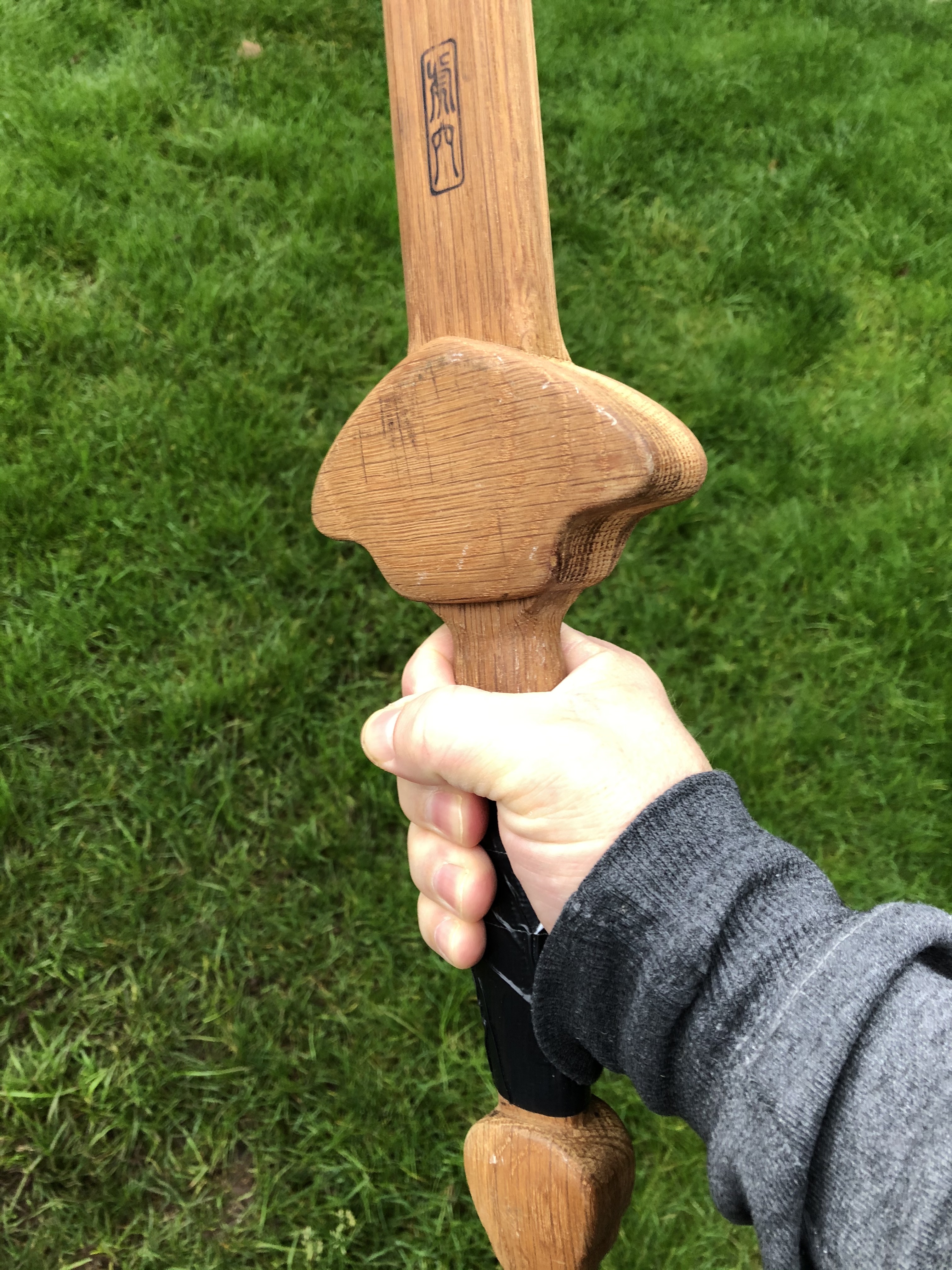
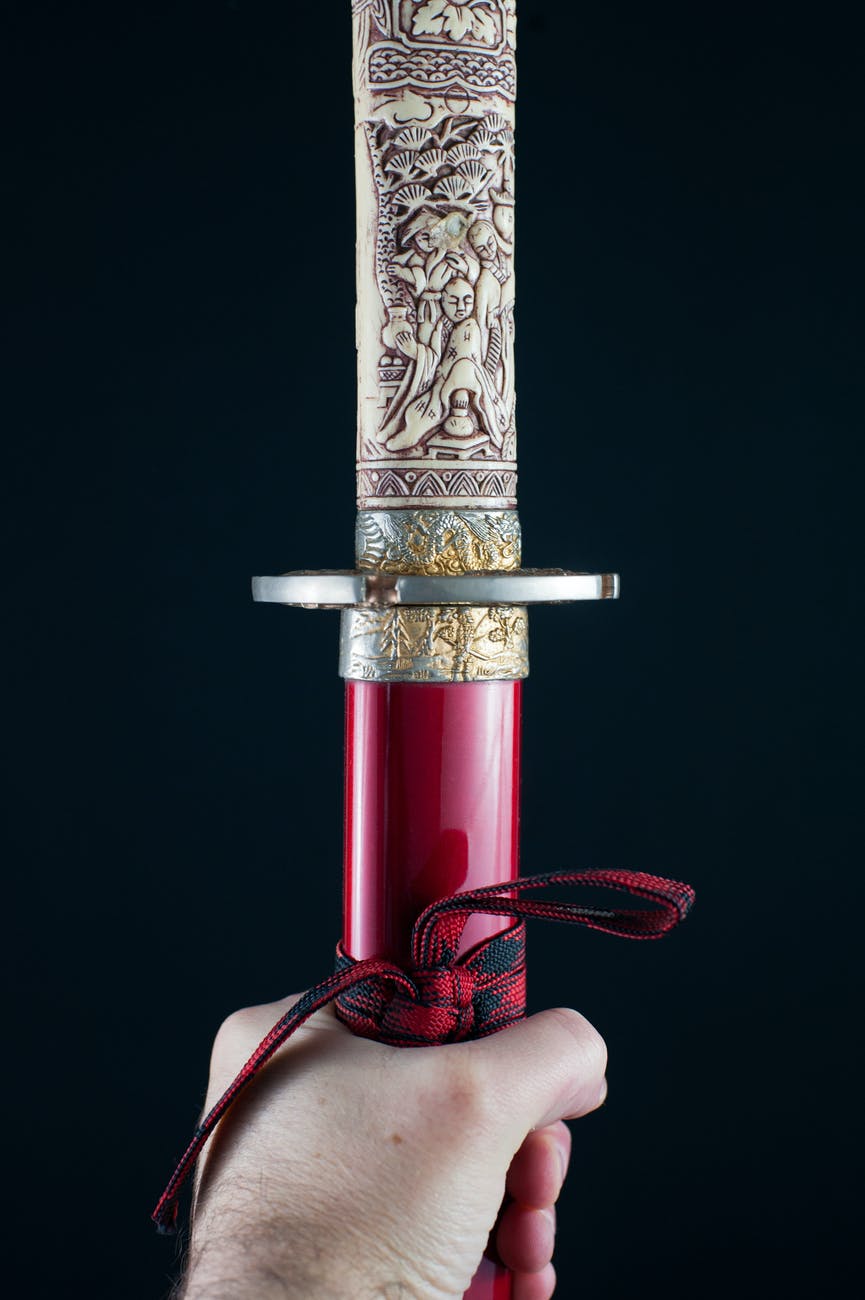
One of the big issues that becomes apparent when you do a lot of sword practice is the grip. My experience is that a solid grip means less wear and tear on your wrist.
I was therefore quite pleased to read this blog on how to grip a sword by Scott Rodell, since it confirms what I was taught and have found to be the best way to practice in terms of logevity. He recommends the same grip that I use.
The way I was taught was to grip the handle with all my fingers, not any kind of thumb/finger arrangement as you often see, and make sure all the fingers are below the guard, for obvious reasons. I think one of the keys to making your grip strong is to grip really hard with the little finger, that way you make sure it never sips off, because once it does the rest of the fingers tend to follow. As the Xing Yi classics say, “When the haft is gripped, this grip is done with the whole body“. With a strong, stable, grip you can start to connect the sword to your centre, so that movements from the torso can be reveald in the extremities – in this case, the sword.
Before the Internet, back in the early 90s, there were only a few books on the subject of Tai Chi in the West, so the authors of these books achieved a kind of fame and notoriety that wasn’t really proportional to their actual importance, or impact on the Tai Chi world. Or maybe their fame became proportional because of the books themselves, in a kind of self fulfilling prophecy. It’s hard to say.
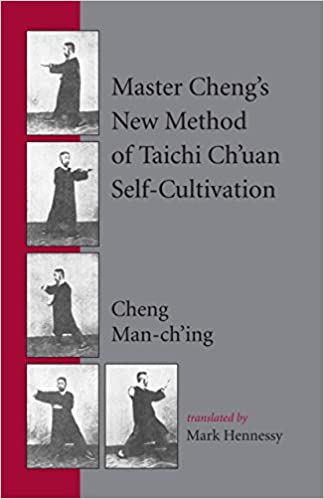
Either way, one book title that always stuck in my mind was “Master Cheng’s New Method of Taichi Ch’uan Self-cultivation”.
This idea of “self cultivation” is kind of the main reason that people practice Tai Chi in the modern world. It’s kind of like exercise, but a little deeper, involving something a little more like meditation. This idea of using eastern spirituality to go on a personal odyssey, or journey into your self is sold to us all the time in the world of Tai Chi, Yoga and health or spiritual practices.
The fact is, it’s nonsense. I hate to break to to you, but individually, we are really not that deep. Scratch our surface and there’s really not that much to us. The idea of cultivating yourself is really a huge waste of time. Our depth lies in our relationships to other people, places and non-human animals. And to find our connection to the world, to the land, the first thing you need to do is get rid of this little self that you’ve been busy cultivating with your various yoga, tai chi and martial arts practices.
Just look at what the Zen or Tao masters of old wrote. They were telling us this constantly in their writings.
When you do something, you should burn yourself up completely, like a good bonfire, leaving no trace of yourself.
– Shunryu Suzuki
One must be deeply aware of the impermanence of the world.
– Dogen
The practice of Zen is forgetting the self in the act of uniting with something.
– Koun Yamada
Those were literally the first three quite in an article I just searched up called “25 Zen Quotes“.
I feel like I could quote any chapter of the Tao Te Ching too, but let’s go with chapter 3:
The Master leads by emptying people’s minds and filling their cores, by weakening their ambition and toughening their resolve. He helps people lose everything they know, everything they desire, and creates confusion in those who think that they know.
Practice not-doing, and everything will fall into place.
“I am curious to find why Bear and Eagle are always together. Have you come across or know of any reasoning behind this?
Thank you in advance for your time!”
This is a good question – if you practice Xing Yi you’ll notice that all the animal forms are practiced as individual animals, yet Bear (Xiong) and Eagle (Ying) are often mixed together as something called a “harmonious fist” (He Quan). (Although you also find them as separate links too). There are a few reasons why this is so.
Firstly, although Xing Yi has no particular connection to Taoism, it does make use of the concept of Yin and Yang. All the animals have Yin aspects and Yang aspects – this can be most clearly seen in something like snake, where the yin aspects are represented by the pythons – crushing, choking and coiling, and the yang aspects are represented by the vipers – quick, darting and venomous.
In Bear and Eagle, each animal represents an extreme of the postures found in Xing Yi – Bear should be the most extreme Yin (softer, heavier, shorter posture) and Eagle the most extreme Yang (hard, powerful and big). Bear is only ever Yin and Eagle is only ever Yang. So, to have a balance of Yin and Yang, both are practiced together to produce the optimum fighting strategy.
Bear is used at close range, rolling on and around attacks through your structure and position the attacker should naturally lands on the end of your blows. Think of slipping a jab in boxing and landing an uppercut. In contrast, the Eagle actively goes out to strike the opponent using long piercing strikes at a longer range. So, as a strategy they work well together.
That’s the most basic reason.
Secondly, 英雄(hero) and 鷹(eagle)熊(bear) have the same pronunciation in Mandarin and Cantonese. This may just be a coincidence.
Now we can slip into the more esoteric reasons. This is something I’ve only ever heard from my teacher, but it makes no difference to the first theory, so let me present it.
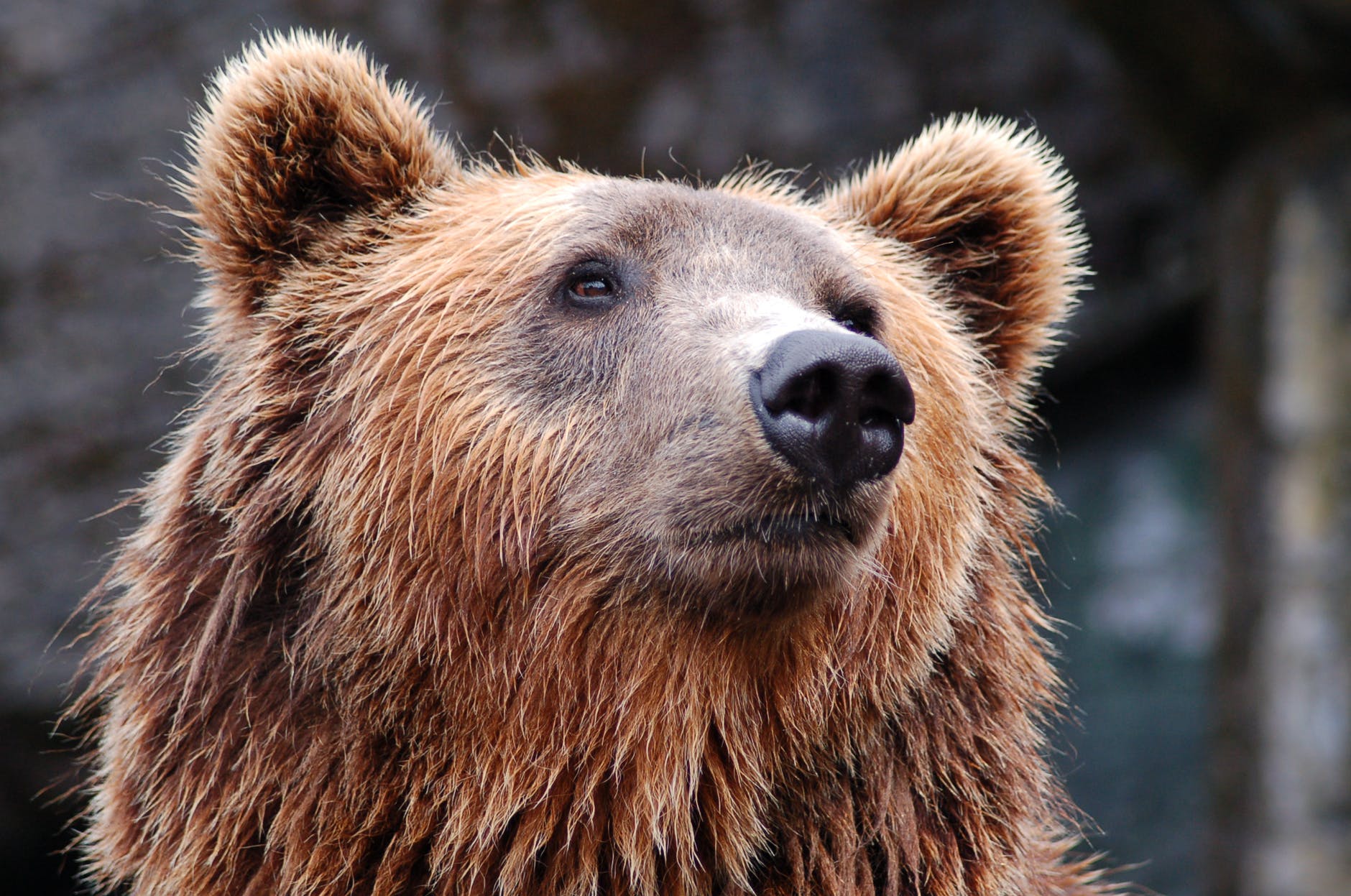
There is an animal native to China and Japan called the Bear Eagle (Xiong Ying). In the west we call it the Mountain hawk eagle. (Spizaetus nipalensis in Latin.)
From Wikiepdia: “ it is usually perceptibly bulkier and more massive than most other members of its genus. It is seemingly the largest member of the 10 currently recognized species in the genus Nisaetus, notwithstanding the recently recognized Flores hawk-eagle (Nisaetus floris) (which was separated from the changeable hawk-eagle).”
You can see its powerful legs in this picture. I always like the little tuft it has on its head.
The bear eagle gets it’s name from the way it will grapple with prey on the ground – a bit like a bear. So this single animal represents both qualities. If you believe that the Xing Yi animals were derived directly from observing nature (which was the thrust of the Li movement in the Song Dynasty) then it’s possible that the hunting and fighting tactics of the Mountain Hawk eagle were studied to produce what we have handed down to us in Xing Yi. It’s an unprovable theory, but there you have it.
Ultimately, it doesn’t matter to me if you think of the Xing Yi animal as representing a separate bear and an eagle, or a mountain hawk eagle. It’s all the same thing, and you can gain a lot of insight into the Xing Yi link by observing all 3 animals. Sadly, YouTube is probably your best bet for that these days.
An interesting article from the Atlantic about how only humans have chins. Nobody knows exactly why really, but there are competing theories. At least if you get attacked and eaten by a lion you can shout “you chinless wonder!” at it before you die.
It made me think about the use of the chin in martial arts. In many ways a chin could be considered a disadvantage, as the jaw is where you want to hit somebody “square on the jaw” if you want to knock them out, and the chin makes the jaw more accessible.
I also though about martial arts that make use the chin and the only one that comes to mind is BJJ. I find I use my chin a lot to hold people in place – a bit like a third arm – in top positions. It hooks over the shoulder nicely to stop people getting up when you’re behind them slightly. It’s not one of those techniques that is taught, it just happens naturally.
Bruce Lee would have been 80 years old today. Here’s a Bruce Lee Birthday blog from ‘friend of the notebook’ Paul Bowman:
“It was Bruce Lee who effectively introduced the term “martial arts” into the Western lexicon. This may not seem hugely significant. But what it also means is that he sowed the seeds of a new identity: people could henceforth identify as “martial artists.” Ultimately then, although it is true that before Bruce Lee people were practicing what we now call “martial arts,” it was only after Bruce Lee—and perhaps only because of him—that the very entity “martial arts” and the identity “martial artist” came into social and cultural existence.”
Thanks to Richard Johnson for commenting on my last post, which had a section of the Xing Yi classics (The 10 Thesis of Yue Fei) translated by my teacher. My teacher’s translation definitely differs from others you find online – it includes many more references to weapons that are omitted in other translations I’ve seen, specifically a haft-grip and a bow, in these sections.
It matters, because reading other translations I’ve seen you’d get the impression it was about gripping your opponent, not your spear.
I thought it interesting that Richard called it “quite interpretive rather than a strict translation“:
The first quote is quite interpretive rather than a strict translation. I found it in the manual attributed to Yue Fei. It could also be instructions to curl one’s fist tight with the same energy as gripping a handle.
Richard Johnson
I’d agree with him, but, with a rather large caveat: I think all translation is an interpretation.
There is no such thing as a “strict” translation of these Chinese classics into English, because a literal translation of characters often comes off looking like the work of Yoda. Confusing, it is!
To get at the meaning of the text you have to rejig it into English, and here you need to know the context of the work, the time period it was written in and also have some working knowledge of the subject to do it in a meaningful way.
Thanks to Paul Andrews of Xing Yi Academy who has done the following literal translation of these sections of the Jianshou Lun (Classic of Fighting), so you can see what I mean:
“I’m looking at my translation of the Jiaoshou Lun now. So the first quote is:
用拳要卷緊 Yòng quán yào juǎn jǐn,
用把把有氣 Yòng bǎ bà yǒu qì.
Literally – Use fist must roll tight. Use grip must have Qi.
So fist could be the fist or it could be “boxing”. There is no mention of a haft here, there is nothing immediately before or after, but a little bit further on we get this:
手以心把 Shǒu yǐ xīn bà,
心以手把 Xin yǐ shǒu bà.
Literally – Hand uses xin to grip. xin uses hand handle (shou ba together means handle/haft).
In my own interpretation Shou (hand) can also mean “a technique”. So my take on this is: The methods use the xin to grasp and the xin transmits through the haft. Given this later reference to a haft/handle it is legitimate to understand that the entire section is talking about weapons so D earlier use of haft is in context.
Second quote:
一握渾身皆握, Yī wò hún shēn jiē wò,
一伸渾身皆伸, Yī shēn hún shēn jiē shēn
伸要伸得進, Shēn yào shēn dé jìn
握要握得根 Wò yào wò dé gēn
如卷炮, Rú juǎn pào
卷得緊, Juǎn dé jǐn
崩得有力, Bēng dé yǒu lì
Literally:
One grasp mix body (hunshen together means “everything” or whole body) all grasps.
One extends everything all extends
Extending important to extend while entering
Grasping important grasp must root
As reeled (rolled up/coiled) cannon (explosion)
Reel must be tight
Collapse/compress must have power/strength
So:
When grasping [the haft], the whole body grasps [the haft].
When one part extends, the whole body extends.
The key is to extend while entering.
When grasping the grasp comes from the root, as if coiled ready to explode.
The coiling becomes tight, Compressing to store power.
The first two phrases could also be interpreted as: Grasp with the whole body and everything holds. Extend with the whole body and everything extends.The last phrase is tricky. Damon like the alternative 绷 – beng meaning to draw tight. But the character used in the text I have is 崩 – beng same as “Beng quan” meaning to collapse/crush/compress.This phrase could mean that the reel must be tight, like something compressing to store power (or if the alternative beng is used – like a bow at full draw).Or collapsing could refer to releasing the reel, letting go. Meaning that when released the power has to transmit. That phrase isn’t easy it could mean both.”
The Classic of Fighting is one of the more practical works in the classics, and contains some fascinating insights on martial matters. Amongst the verse is this part:
“The outstanding person boxes through freely releasing technique. It is also useful if the boxing is tightly reeled using Qi in the haft grip”.
“Haft” here refers to the bit of the spear that you hold, but the same thing applies to holding a sword by the handle.
Later on in the classic it expands on what using Qi in the haft grip means:
“When the haft is gripped, this grip is done with the whole body; when one thing extends the whole body extends. The key to extending is to gain extension in the entrance; the key to the grip is to gain the grip from the root, as if coiling explosively. The coiling should become tight, like the power that exists in the bow at full draw.”
I really like this description as it gets across the feeling that needs to develop with the sword or spear as you use it day in, day out. So when it says “the coiling should become tight” I think it means over time. When you grip, it becomes like your whole body gripping the weapon, and if you want to move the weapon you have to move your whole body in a coiling manner. In fact, the best way to manipulate a weapon with your whole body is using reeling – spiral actions that move inwards and outwards. Our bodies are built for spiral movements.
It’s also worth noting that the coiling is not done slowly, but explosively, although I’d suggest starting to find these coiling movements slowly and without using force first. If you want a simple exercise for developing coiling movements, then I’ve got one of those as well.
The other thing I wanted to mention before I go was the use of the word “boxing” here. Boxing would imply empty hand martial arts, but it instantly goes on to talk about a “haft grip”, which implies weapons. Of course, “fist” “boxing” and “martial art” are all implied by “Quan”, so it’s all open to interpretation.
Either way, it’s long been said that Xing Yi is a spear fighting art that is done mainly bare hand. The frequent references to weapons in its classics would seem to confirm this theory.
The COVID 19 pandemic has had a devastating effect on the world economy, and it’s been equally as bad on martial arts practice. Chinese martial arts have proved more resistant to complete collapse because the majority of the training can be done solo. Taolu or ‘forms’ are prevalent and can all be done outdoors and socially distanced, and on Zoom. Things like BJJ however have really suffered, since it requires close contact. A solo drill version of BJJ is really just an exercise class.
Now there is talk of a vaccine for COVID 19, and maybe before Christmas. The vaccine has the potential to return us to ‘normal’ in the martial arts. At least we’ll be able to train together safely again. You’d think that would be great news for martial artists, but now I’m noticing just how many of my martial arts associates won’t take a vaccine, because they are complete anti-vax nut cases. Sorry! I mean “vaccine hesitant”. Yes, that’s what we have to call them now.
All the conspiracy theories, stuff about Bill Gates wanting to microchip the world, COVID being made up, it all being a plan-demic, etc, it’s all, 100%, posted on my Facebook feed by martial artists, not by the other people I’m friends with.
For example, there’s one kung fu teacher I had from around 30 years ago, who I really respected, who has turned out to be a full on anti-vaxxer. He hasn’t even got his child immunised against measles because “I believe in Chinese medicine”. Well, that’s nice for you (man), but you’re putting weak, old and vulnerable people at risk from a killer disease because you have chosen to ignore science and not to get your child immunised against a potentially fatal disease. Your child might be healthy and fine, but they can pass it on to somebody who is recovering from cancer treatment and has a weakened immune system. But you don’t really give a crap about that do you? You’re too busy jabbing yourself with acupuncture needles and drinking herbs to care.
Next time you break a limb, just put some crystals on it. Job done. Photo by Alina Vilchenko on Pexels.com
As you can tell, it makes me angry. So, apologies, but I’m going to go on a bit of a rant.
There’s a reason nobody has polio anymore. We had a vaccine, and enough people took it that we achieved a herd immunity. The less people that take a vaccine the less effective it is overall, which is why measles is making a comeback in parts of the UK and the US.
“But we don’t know the long term effects!”
Hey, guess what, nobody knew the long term effects of any vaccine. It’s not like these new vaccines haven’t been tested – that’s all they’ve been doing to them. Testing them over and over to make sure they’re safe. History has told us that bad side effects happen within 2 weeks of taking a new vaccine, or generally not at all. Nothing is 100% risk free, and nobody is saying it is, but it’s all about balancing the risks.
Perhaps it’s social media, and the sorts of idiots who post links and make youtube videos packed full of conspiracy theories that are to blame. But it’s the people who think watching them counts as “research” that are the problem. And why do so many marital arts people specifically succumb to this? That, I don’t know. They seem particularly vulnerable to strange beliefs. It probably explains why martial arts cults exist and why kung fu masters in China keep getting beaten up by a middle aged MMA guy.
And before you hit the reply button with “Yeah, but what about..” Just don’t. It’s your very whataboutism that is part of the problem. You spread confusion about vaccines every time you post these things – you’re part of the problem. Please stop it!
I find talking – as in real talking, not discussion forum kind of talking – with other martial artists always inspires some great thoughts. Recently, I was having a chat about some Eagle movements in Xing Yi and my venerable discussion partner noted that they were very similar to the Eagle Dance that Mongolian wrestlers do before a match.
Eagle dance.
My friend noted that the arm positions in the eagle dance are also quite similar to a lot of the arm positions in Baguazhang’s circle walking, like this one:
Baguazhang performed by Master Zhang Hong Mei.
Obviously, the performance is not exactly the same – the eagle dance can have music or a drum beat, but often doesn’t. However, music or not, it does have a rhythm, a beat, which are all things usually lacking in performances of Baguazhang. But Baguazhang does look a bit like a dance. It’s wonderfully twisty, mobile and changeable, but the Mongolian Wrestling dance is so much freer, it’s done with a smile, it’s clearly about having a good time. In contrast, Baguazhang is much more dower and serious. You could almost say it’s as close to dance as you could get if weren’t allowed to actually dance. You’re certainly not supposed to be smiling or showing emotions. I’m going to steal my friend’s hilarious comment about Baguazhang circle walking: “It’s almost like, ‘I want to boogie, but my Confucian culture won’t let me!‘”. 🙂
(As a side note, he also told me a theory about why there is no syncopation in classical Chinese music – it’s because in ‘ancient times’ drums were used to whip up the armies of the various tribes into a kind of pre-battle fighting trance, and when they wanted to unite the Han dynasty, they had to stop the tribes fighting. So, syncopation was removed from the music. I’ve got no proof for this theory, so just take it as an interesting idea, but banning drums it does sound exactly like the sort of thing Confucians would do.)
And that brings me onto my crazy Baguazhang/Mongolian Wresting/Archery theory. Dong Haichuan, the founder of Baguazhang and Yin Fu – his main student, spent 10 years together in Mongolia collecting taxes for Prince Su. This would have been during our Victorian times, so you can get an idea of the time period. Back in China the Dowager Empress Cixi sat on the throne in the Forbidden City.
10 years is a long time, and I find it impossible to believe that, being keen martial artists, that Dong and Yin didn’t have at least some exposure to Mongolian wrestling and/or religious practices, like Eagle dance, and that it could very well be reflected in the content of Baguazhang. I also wonder what all that exposure to a different culture to their own did for them.
Mill stone posture
Let’s look at another popular motif found in Baguazhang, the Mill store posture”.
Baguazhang performed by Master Zhang Hong Mei.
The key feature of the ‘mill stone posture’ is that the upper body and lower body are twisted away from each other in opposite directions as you walk the circle. If you’ve watched a lot of videos of Mongolian martial arts then it might remind you of something…
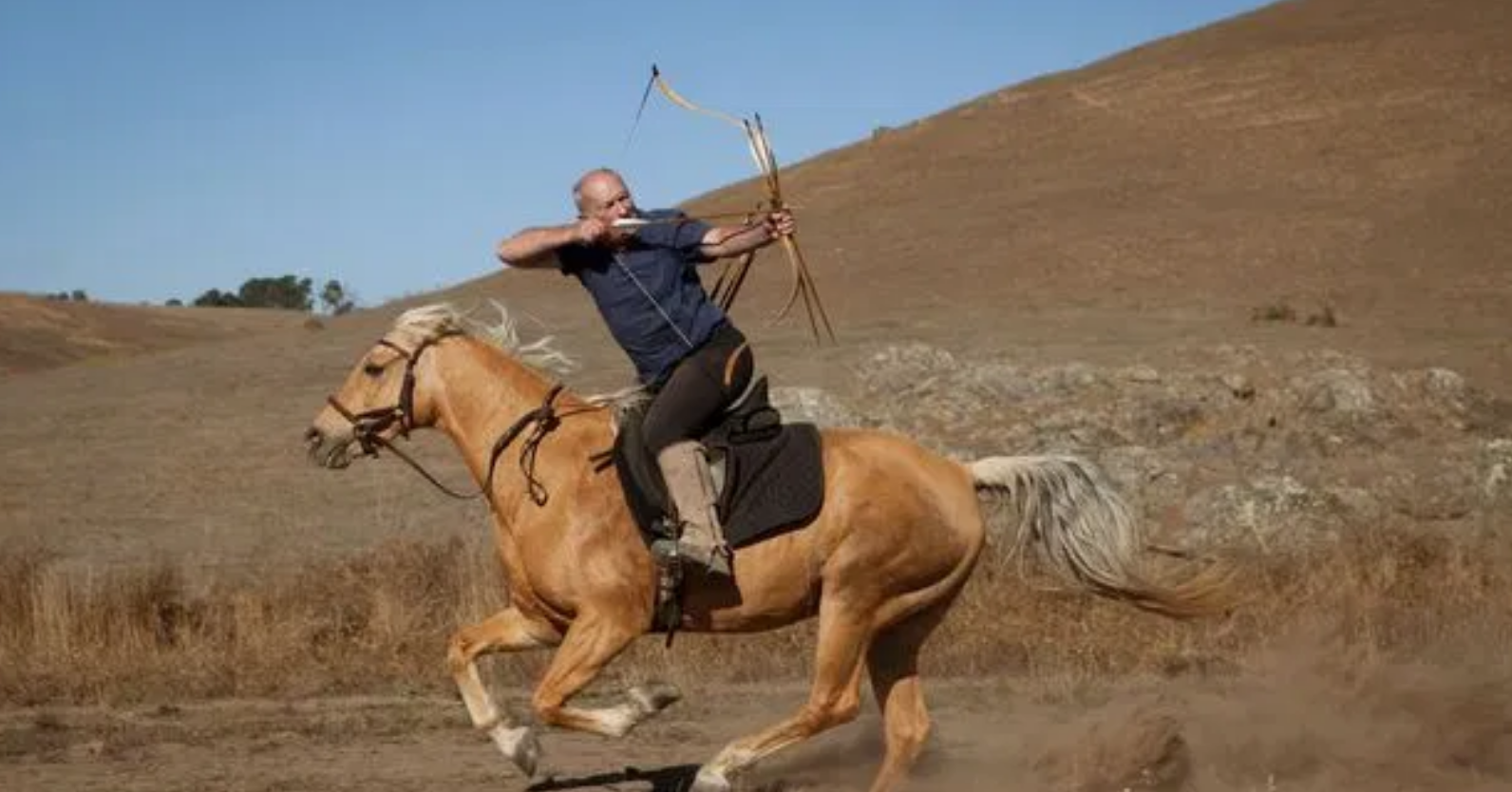
Another of the “manly arts” of Mongolian culture is horseback archery, which includes the ability to shoot an arrow behind you – the famous Parthian Shot, a horseback archery technique of feining a retreat then turning and shooting behind you 180 degrees once the enemy commit to chasing you.
Parthian Shot
The millstone standing posture of Baguazhang looks (to me) like some sort of training method for the Parthian Shot.
Here’s a video example of it being trained as a drill in Baguazhang:
Dong He Chuan was inside the imperial palace starting in 1864, the ruling Manchu’s (from the North) still had horseback archery as part of the military service exam. Is the simiarity of many Baguazhang postures to Mongolian martial arts a coincidence, or not? Who can say. The historical connection between Dong and Mongolia is there though.
And to finish things off, here’s a funny video I made with my kids when they were little. I wanted to boogie, but my kids wouldn’t let me! Ah, I miss those days, but I don’t miss the disturbed nights 🙂
Another thing that sword practice does is force you to practice outside. Practicing martial arts outside is not something that’s popular in the UK. Village halls and sports centres across the land resound to the sound of a million “Ki-ah!”s, but if you practice martial arts outside you are instantly branded a weirdo.
If people in the UK see you practicing martial arts outside they shout stuff at you, or do a Bruce Lee impression. It seems to be part of our culture. It’s not like this in other countries. Inner Mongolia is a great example – its indigenous wrestling culture stretches back to caveman times, and is still practiced to this day outside on the grass.
Sadly, today not only is Mongol language and culture under threat from the Chinese state, of which Inner Mongolia is a region, but wrestling itself is also under threat. As the Monogol language, identity and culture is destroyed, so people lose motivation to wrestle.
“Em adds their thoughts to this with, “Mongols all over, especially the Mongols in the grasslands and the smaller towns, are depressed and sad. There’s a hanging feeling of hopelessness. It’s made wrestling difficult to do. People aren’t motivated to train, nor are they mentally focused. Their thoughts are elsewhere, which distracts you from having that ‘feeling’ during a match. Yet, the show must go on and a few Naadam have happened recently and it’s allowed wrestlers to get back to competing, uniting, and sharing a common goal of keeping their culture alive. Wrestling is one way to do this. Winter Training began in October and there is an even greater push to spread the art and culture internationally too.””
But the outlook does not look good.
“There is no doubt that if the PRC continues its forced assimilation of Mongolian culture, that this wrestling art will become forever changed. In turn, it can also impact the competitive landscape of Sumo, Judo, Shuai Jiao, Freestyle, and others. Bökh is simply too intertwined within what it means to be Mongolian, for the sport to not feel massive ramifications from cultural turmoil and forced influences from outside traditions.”
But to get back to weapons. Weapons make you practice outside, so you discover your own connection to earth and sky. Just try swinging a sword around inside for 5 minutes and you realise why.
Of course, in the UK it rains a lot. I find that I’m ok with practicsing fast moving arts like Xing Yi sword outside in the rain. It doesn’t seem to bother me. Slow moving Tai Chi forms in the rain however are miserable, and as for Zhan Zhuang standing practice – forget it.







 The Tai Chi Notebook