An interesting article from the Atlantic about how only humans have chins. Nobody knows exactly why really, but there are competing theories. At least if you get attacked and eaten by a lion you can shout “you chinless wonder!” at it before you die.
It made me think about the use of the chin in martial arts. In many ways a chin could be considered a disadvantage, as the jaw is where you want to hit somebody “square on the jaw” if you want to knock them out, and the chin makes the jaw more accessible.
I also though about martial arts that make use the chin and the only one that comes to mind is BJJ. I find I use my chin a lot to hold people in place – a bit like a third arm – in top positions. It hooks over the shoulder nicely to stop people getting up when you’re behind them slightly. It’s not one of those techniques that is taught, it just happens naturally.
Bruce Lee would have been 80 years old today. Here’s a Bruce Lee Birthday blog from ‘friend of the notebook’ Paul Bowman:
“It was Bruce Lee who effectively introduced the term “martial arts” into the Western lexicon. This may not seem hugely significant. But what it also means is that he sowed the seeds of a new identity: people could henceforth identify as “martial artists.” Ultimately then, although it is true that before Bruce Lee people were practicing what we now call “martial arts,” it was only after Bruce Lee—and perhaps only because of him—that the very entity “martial arts” and the identity “martial artist” came into social and cultural existence.”
Thanks to Richard Johnson for commenting on my last post, which had a section of the Xing Yi classics (The 10 Thesis of Yue Fei) translated by my teacher. My teacher’s translation definitely differs from others you find online – it includes many more references to weapons that are omitted in other translations I’ve seen, specifically a haft-grip and a bow, in these sections.
It matters, because reading other translations I’ve seen you’d get the impression it was about gripping your opponent, not your spear.
I thought it interesting that Richard called it “quite interpretive rather than a strict translation“:
The first quote is quite interpretive rather than a strict translation. I found it in the manual attributed to Yue Fei. It could also be instructions to curl one’s fist tight with the same energy as gripping a handle.
Richard Johnson
I’d agree with him, but, with a rather large caveat: I think all translation is an interpretation.
There is no such thing as a “strict” translation of these Chinese classics into English, because a literal translation of characters often comes off looking like the work of Yoda. Confusing, it is!
To get at the meaning of the text you have to rejig it into English, and here you need to know the context of the work, the time period it was written in and also have some working knowledge of the subject to do it in a meaningful way.
Thanks to Paul Andrews of Xing Yi Academy who has done the following literal translation of these sections of the Jianshou Lun (Classic of Fighting), so you can see what I mean:
“I’m looking at my translation of the Jiaoshou Lun now. So the first quote is:
用拳要卷緊 Yòng quán yào juǎn jǐn,
用把把有氣 Yòng bǎ bà yǒu qì.
Literally – Use fist must roll tight. Use grip must have Qi.
So fist could be the fist or it could be “boxing”. There is no mention of a haft here, there is nothing immediately before or after, but a little bit further on we get this:
手以心把 Shǒu yǐ xīn bà,
心以手把 Xin yǐ shǒu bà.
Literally – Hand uses xin to grip. xin uses hand handle (shou ba together means handle/haft).
In my own interpretation Shou (hand) can also mean “a technique”. So my take on this is: The methods use the xin to grasp and the xin transmits through the haft. Given this later reference to a haft/handle it is legitimate to understand that the entire section is talking about weapons so D earlier use of haft is in context.
Second quote:
一握渾身皆握, Yī wò hún shēn jiē wò,
一伸渾身皆伸, Yī shēn hún shēn jiē shēn
伸要伸得進, Shēn yào shēn dé jìn
握要握得根 Wò yào wò dé gēn
如卷炮, Rú juǎn pào
卷得緊, Juǎn dé jǐn
崩得有力, Bēng dé yǒu lì
Literally:
One grasp mix body (hunshen together means “everything” or whole body) all grasps.
One extends everything all extends
Extending important to extend while entering
Grasping important grasp must root
As reeled (rolled up/coiled) cannon (explosion)
Reel must be tight
Collapse/compress must have power/strength
So:
When grasping [the haft], the whole body grasps [the haft].
When one part extends, the whole body extends.
The key is to extend while entering.
When grasping the grasp comes from the root, as if coiled ready to explode.
The coiling becomes tight, Compressing to store power.
The first two phrases could also be interpreted as: Grasp with the whole body and everything holds. Extend with the whole body and everything extends.The last phrase is tricky. Damon like the alternative 绷 – beng meaning to draw tight. But the character used in the text I have is 崩 – beng same as “Beng quan” meaning to collapse/crush/compress.This phrase could mean that the reel must be tight, like something compressing to store power (or if the alternative beng is used – like a bow at full draw).Or collapsing could refer to releasing the reel, letting go. Meaning that when released the power has to transmit. That phrase isn’t easy it could mean both.”
The Classic of Fighting is one of the more practical works in the classics, and contains some fascinating insights on martial matters. Amongst the verse is this part:
“The outstanding person boxes through freely releasing technique. It is also useful if the boxing is tightly reeled using Qi in the haft grip”.
“Haft” here refers to the bit of the spear that you hold, but the same thing applies to holding a sword by the handle.
Later on in the classic it expands on what using Qi in the haft grip means:
“When the haft is gripped, this grip is done with the whole body; when one thing extends the whole body extends. The key to extending is to gain extension in the entrance; the key to the grip is to gain the grip from the root, as if coiling explosively. The coiling should become tight, like the power that exists in the bow at full draw.”
I really like this description as it gets across the feeling that needs to develop with the sword or spear as you use it day in, day out. So when it says “the coiling should become tight” I think it means over time. When you grip, it becomes like your whole body gripping the weapon, and if you want to move the weapon you have to move your whole body in a coiling manner. In fact, the best way to manipulate a weapon with your whole body is using reeling – spiral actions that move inwards and outwards. Our bodies are built for spiral movements.
It’s also worth noting that the coiling is not done slowly, but explosively, although I’d suggest starting to find these coiling movements slowly and without using force first. If you want a simple exercise for developing coiling movements, then I’ve got one of those as well.
The other thing I wanted to mention before I go was the use of the word “boxing” here. Boxing would imply empty hand martial arts, but it instantly goes on to talk about a “haft grip”, which implies weapons. Of course, “fist” “boxing” and “martial art” are all implied by “Quan”, so it’s all open to interpretation.
Either way, it’s long been said that Xing Yi is a spear fighting art that is done mainly bare hand. The frequent references to weapons in its classics would seem to confirm this theory.
The COVID 19 pandemic has had a devastating effect on the world economy, and it’s been equally as bad on martial arts practice. Chinese martial arts have proved more resistant to complete collapse because the majority of the training can be done solo. Taolu or ‘forms’ are prevalent and can all be done outdoors and socially distanced, and on Zoom. Things like BJJ however have really suffered, since it requires close contact. A solo drill version of BJJ is really just an exercise class.
Now there is talk of a vaccine for COVID 19, and maybe before Christmas. The vaccine has the potential to return us to ‘normal’ in the martial arts. At least we’ll be able to train together safely again. You’d think that would be great news for martial artists, but now I’m noticing just how many of my martial arts associates won’t take a vaccine, because they are complete anti-vax nut cases. Sorry! I mean “vaccine hesitant”. Yes, that’s what we have to call them now.
All the conspiracy theories, stuff about Bill Gates wanting to microchip the world, COVID being made up, it all being a plan-demic, etc, it’s all, 100%, posted on my Facebook feed by martial artists, not by the other people I’m friends with.
For example, there’s one kung fu teacher I had from around 30 years ago, who I really respected, who has turned out to be a full on anti-vaxxer. He hasn’t even got his child immunised against measles because “I believe in Chinese medicine”. Well, that’s nice for you (man), but you’re putting weak, old and vulnerable people at risk from a killer disease because you have chosen to ignore science and not to get your child immunised against a potentially fatal disease. Your child might be healthy and fine, but they can pass it on to somebody who is recovering from cancer treatment and has a weakened immune system. But you don’t really give a crap about that do you? You’re too busy jabbing yourself with acupuncture needles and drinking herbs to care.
Next time you break a limb, just put some crystals on it. Job done. Photo by Alina Vilchenko on Pexels.com
As you can tell, it makes me angry. So, apologies, but I’m going to go on a bit of a rant.
There’s a reason nobody has polio anymore. We had a vaccine, and enough people took it that we achieved a herd immunity. The less people that take a vaccine the less effective it is overall, which is why measles is making a comeback in parts of the UK and the US.
“But we don’t know the long term effects!”
Hey, guess what, nobody knew the long term effects of any vaccine. It’s not like these new vaccines haven’t been tested – that’s all they’ve been doing to them. Testing them over and over to make sure they’re safe. History has told us that bad side effects happen within 2 weeks of taking a new vaccine, or generally not at all. Nothing is 100% risk free, and nobody is saying it is, but it’s all about balancing the risks.
Perhaps it’s social media, and the sorts of idiots who post links and make youtube videos packed full of conspiracy theories that are to blame. But it’s the people who think watching them counts as “research” that are the problem. And why do so many marital arts people specifically succumb to this? That, I don’t know. They seem particularly vulnerable to strange beliefs. It probably explains why martial arts cults exist and why kung fu masters in China keep getting beaten up by a middle aged MMA guy.
And before you hit the reply button with “Yeah, but what about..” Just don’t. It’s your very whataboutism that is part of the problem. You spread confusion about vaccines every time you post these things – you’re part of the problem. Please stop it!
I find talking – as in real talking, not discussion forum kind of talking – with other martial artists always inspires some great thoughts. Recently, I was having a chat about some Eagle movements in Xing Yi and my venerable discussion partner noted that they were very similar to the Eagle Dance that Mongolian wrestlers do before a match.
Eagle dance.
My friend noted that the arm positions in the eagle dance are also quite similar to a lot of the arm positions in Baguazhang’s circle walking, like this one:
Baguazhang performed by Master Zhang Hong Mei.
Obviously, the performance is not exactly the same – the eagle dance can have music or a drum beat, but often doesn’t. However, music or not, it does have a rhythm, a beat, which are all things usually lacking in performances of Baguazhang. But Baguazhang does look a bit like a dance. It’s wonderfully twisty, mobile and changeable, but the Mongolian Wrestling dance is so much freer, it’s done with a smile, it’s clearly about having a good time. In contrast, Baguazhang is much more dower and serious. You could almost say it’s as close to dance as you could get if weren’t allowed to actually dance. You’re certainly not supposed to be smiling or showing emotions. I’m going to steal my friend’s hilarious comment about Baguazhang circle walking: “It’s almost like, ‘I want to boogie, but my Confucian culture won’t let me!‘”. 🙂
(As a side note, he also told me a theory about why there is no syncopation in classical Chinese music – it’s because in ‘ancient times’ drums were used to whip up the armies of the various tribes into a kind of pre-battle fighting trance, and when they wanted to unite the Han dynasty, they had to stop the tribes fighting. So, syncopation was removed from the music. I’ve got no proof for this theory, so just take it as an interesting idea, but banning drums it does sound exactly like the sort of thing Confucians would do.)
And that brings me onto my crazy Baguazhang/Mongolian Wresting/Archery theory. Dong Haichuan, the founder of Baguazhang and Yin Fu – his main student, spent 10 years together in Mongolia collecting taxes for Prince Su. This would have been during our Victorian times, so you can get an idea of the time period. Back in China the Dowager Empress Cixi sat on the throne in the Forbidden City.
10 years is a long time, and I find it impossible to believe that, being keen martial artists, that Dong and Yin didn’t have at least some exposure to Mongolian wrestling and/or religious practices, like Eagle dance, and that it could very well be reflected in the content of Baguazhang. I also wonder what all that exposure to a different culture to their own did for them.
Mill stone posture
Let’s look at another popular motif found in Baguazhang, the Mill store posture”.
Baguazhang performed by Master Zhang Hong Mei.
The key feature of the ‘mill stone posture’ is that the upper body and lower body are twisted away from each other in opposite directions as you walk the circle. If you’ve watched a lot of videos of Mongolian martial arts then it might remind you of something…
Another of the “manly arts” of Mongolian culture is horseback archery, which includes the ability to shoot an arrow behind you – the famous Parthian Shot, a horseback archery technique of feining a retreat then turning and shooting behind you 180 degrees once the enemy commit to chasing you.
Parthian Shot
The millstone standing posture of Baguazhang looks (to me) like some sort of training method for the Parthian Shot.
Here’s a video example of it being trained as a drill in Baguazhang:
Dong He Chuan was inside the imperial palace starting in 1864, the ruling Manchu’s (from the North) still had horseback archery as part of the military service exam. Is the simiarity of many Baguazhang postures to Mongolian martial arts a coincidence, or not? Who can say. The historical connection between Dong and Mongolia is there though.
And to finish things off, here’s a funny video I made with my kids when they were little. I wanted to boogie, but my kids wouldn’t let me! Ah, I miss those days, but I don’t miss the disturbed nights 🙂
Another thing that sword practice does is force you to practice outside. Practicing martial arts outside is not something that’s popular in the UK. Village halls and sports centres across the land resound to the sound of a million “Ki-ah!”s, but if you practice martial arts outside you are instantly branded a weirdo.
If people in the UK see you practicing martial arts outside they shout stuff at you, or do a Bruce Lee impression. It seems to be part of our culture. It’s not like this in other countries. Inner Mongolia is a great example – its indigenous wrestling culture stretches back to caveman times, and is still practiced to this day outside on the grass.
Sadly, today not only is Mongol language and culture under threat from the Chinese state, of which Inner Mongolia is a region, but wrestling itself is also under threat. As the Monogol language, identity and culture is destroyed, so people lose motivation to wrestle.
“Em adds their thoughts to this with, “Mongols all over, especially the Mongols in the grasslands and the smaller towns, are depressed and sad. There’s a hanging feeling of hopelessness. It’s made wrestling difficult to do. People aren’t motivated to train, nor are they mentally focused. Their thoughts are elsewhere, which distracts you from having that ‘feeling’ during a match. Yet, the show must go on and a few Naadam have happened recently and it’s allowed wrestlers to get back to competing, uniting, and sharing a common goal of keeping their culture alive. Wrestling is one way to do this. Winter Training began in October and there is an even greater push to spread the art and culture internationally too.””
But the outlook does not look good.
“There is no doubt that if the PRC continues its forced assimilation of Mongolian culture, that this wrestling art will become forever changed. In turn, it can also impact the competitive landscape of Sumo, Judo, Shuai Jiao, Freestyle, and others. Bökh is simply too intertwined within what it means to be Mongolian, for the sport to not feel massive ramifications from cultural turmoil and forced influences from outside traditions.”
But to get back to weapons. Weapons make you practice outside, so you discover your own connection to earth and sky. Just try swinging a sword around inside for 5 minutes and you realise why.
Of course, in the UK it rains a lot. I find that I’m ok with practicsing fast moving arts like Xing Yi sword outside in the rain. It doesn’t seem to bother me. Slow moving Tai Chi forms in the rain however are miserable, and as for Zhan Zhuang standing practice – forget it.
Issue 10 of the (free) Martial Arts Studies journal is out now. This issue marks a 5 year anniverary for the journal. You should read it and support it, because it’s the most important journal we have for martial arts, and if, like me, you’re back in some sort of lockdown, what else are you going to do with your time? 🙂
Amongst the delights contained within is a great article by my friend/teacher/student/Professor/Sifu/Guru Paul Bowman about finding Brazilian Jiujitsu (BJJ), falling in love with it and then having to give it up because of the COVID 19 Pandemic. It contains some great insights into why we practice martial arts there.
Here’s a quote that caught my interest:
“Since every challenging BJJ roll produces the feeling of a fight for life, the end of a session is like the aftermath of a near-death experience, with all of the attendant exhaustion, elation, and camaraderie that goes along with surviving such encounters. A BJJ saying goes, ‘if you don’t roll, you don’t know’. This has a range of possible meanings, but prime among them is that those who have never trained BJJ cannot begin to grasp its appeal, its feel, and its profound psychological and emotional effects. In a very real sense, BJJ can easily be regarded as a kind of therapy. The question is one of who it is that needs BJJ as therapy, and why.”
“The contemporary condition (whether figured as modern or postmodern) has often been characterised as one permeated by sedentary media consumption, work-stress, insecurity, work/life imbalance, information overload, consumerism and indoor living. The so-called ‘developed’, ‘Western’ world of consumer societies, neoliberal policies and deregulated economies, are acknowledged to be the cradle of ‘diseases of affluence’. Part of the background noise of this environment is generalised anxiety. One biological feature of chronic anxiety has been said to involve the constant low-level ‘running’ or ‘leaking’ of aspects of the sympathetic nervous system – manifesting in the anxiety-sufferer’s inability to ‘switch off’ feelings of stress and anxiety [Nestor 2020]. Activities that directly stress the mind and body – such as intense exercise and extreme experiences – have been connected with ‘correcting’ this constant ‘leak’. The argument is that they may do so by, in a sense, giving the body a dose of ‘real’ (physical and/or psychological) stress, which thereby ‘reminds’ the body what stress actually looks and feels like. This thereby allows the organism to ‘recalibrate’ and switch off anxiety-producing chemicals in the absence of ‘real’ physical stressors [McKeown 2015; Nestor 2020]. Short-term, low-level doses of the kinds of stimulation that would cause lasting damage or even death in prolonged exposure is called hormesis, or hormetic stress [Hof 2020].”
Day 3 of my experiment with switching my training around so that weapons (specifically sword) are the mainstay of my practice, and changes are already happening.
Today I want to talk about Shen Fa, which translates as “body method”. You could call it whatever you want really, but it just means “the way you move”. Xing Yi has a very detailed Shen Fa and in bare hand practice you have to make your body do it. In contrast, using a sword almost teases it out of the body. The key to Xing Yi Shen Fa is learning to use your body as a coordinated whole. If you start “using your arm” and muscling it, then nothing seems to work as it should.
As it says in the Xing Yi Classics:
“(When) the top wishes to move, the bottom automatically follows. The bottom wishes to move, the top will automatically lead. (When) the top and the bottom move, the center section will attack. (When) the center section moves, the top and the bottom will coordinate. Internal and external are combined, the front and the rear mutually required. This is what is called “threading into one.”
You could say that the sword forces you to do this threading, by using your whole body to do each move. I mentioned before that my teacher emphasised using a heavy sword, and that is part of the reason why. (The other is that this style of sword is for going through armour, but that’s another topic).
I’m focussing on just one Xing Yi animal for my practice at the moment – Bear Eagle. It’s quite a lengthy ‘form’ by Xing Yi standards (although much shorter than a typical Chinese sword forms”), so there are lots of variation in the moves involved. In Xing Yi you’re free to do the forms fast – in fact, sometimes, the faster the better. That means you need to “flick”, “jab” and “swoosh” (I’ll spare you the technical terms!) a pretty heavy sword through lots of very quick techniques. If you are using your body in an uncoordinated way then it’s simply not possible to control a heavy sword at speed with momentum and with the accuracy required.
I noticed that an older post of mine on the Principles of XinYi seems to have generated a lot of interest lately. While Xin Yi and Xing Yi have evolved to have a different look, they are both rooted in the same idea of threading into one, which originated from spear use.
Incidentally, I’ve decided to focus on sword not spear for my weapons practice – I’ll go over why another time, but one reason is that I don’t own a long enough spear. Needs must when the Devil drives hard!
Sorry there haven’t been many blog posts lately. I just didn’t feel inspired to write anything, and when I don’t feel inspired, following the Tai Chi principle, I don’t like to force it.
Something has got me back into writing recently though. I was having a conversation with a friend about Chinese marital arts and specifically weapons, and I thought – ‘well, instead of trying to describe things in words, I can just show you this on Zoom’, and I ended up teaching part of a sword form. What a time to be alive! It’s great that we can do this. When I started martial arts there was no such thing as the Internet, and if you couldn’t make it to see your teacher all you got was the occasional crappy VHS tape to learn from. Now we can Zoom between continents in seconds. I love the spontaneity of it.
As usual, the process of having to teach something means you get as much out of it as the person learning – you have to riffle out your old memory box, and then practice it hard enough so that it’s polished back up to a decent level before you teach it. I’d definitely put my Xing Yi sword on the back burner to focus on other things since lockdown began back in March, so getting back into it was an absolute pleasure. I miss the physicality of it, and the subtlety.
What occurred to me is that we (the general corpus of Chinese martial arts practitioners) tend to practice bare hand as our main art, then tack on weapons as an afterthought. Historically (and I’m generalising here, but stick with me), it was always the other way around. Our precious bare hand forms are actually more recent things, tacked on the end of weapons systems. Wing Chun practitioners, for example, spend most of their form training time practicing Siu Lim Tao, not butterfly knives. This got me thinking… what happens if we swap it back to the way it used to be?
What if, instead of heading outdoors to do Chi Kung, Tai Chi practice and Kung Fu each morning, I instead picked up my sword and did sword routines, then tacked on a few barehand bits on at the end if I’ve got time?
I’m going to experiment with this idea for a couple of weeks and see how it feels.
What I usually find is that practicing barehand does nothing for your sword practice, but practicing with a sword doesn’t seem to knock back your bare hand practice as much as you think it would: It’s much easier to transition from weapon to bare hand, than it is to transition from bare hand to weapon.
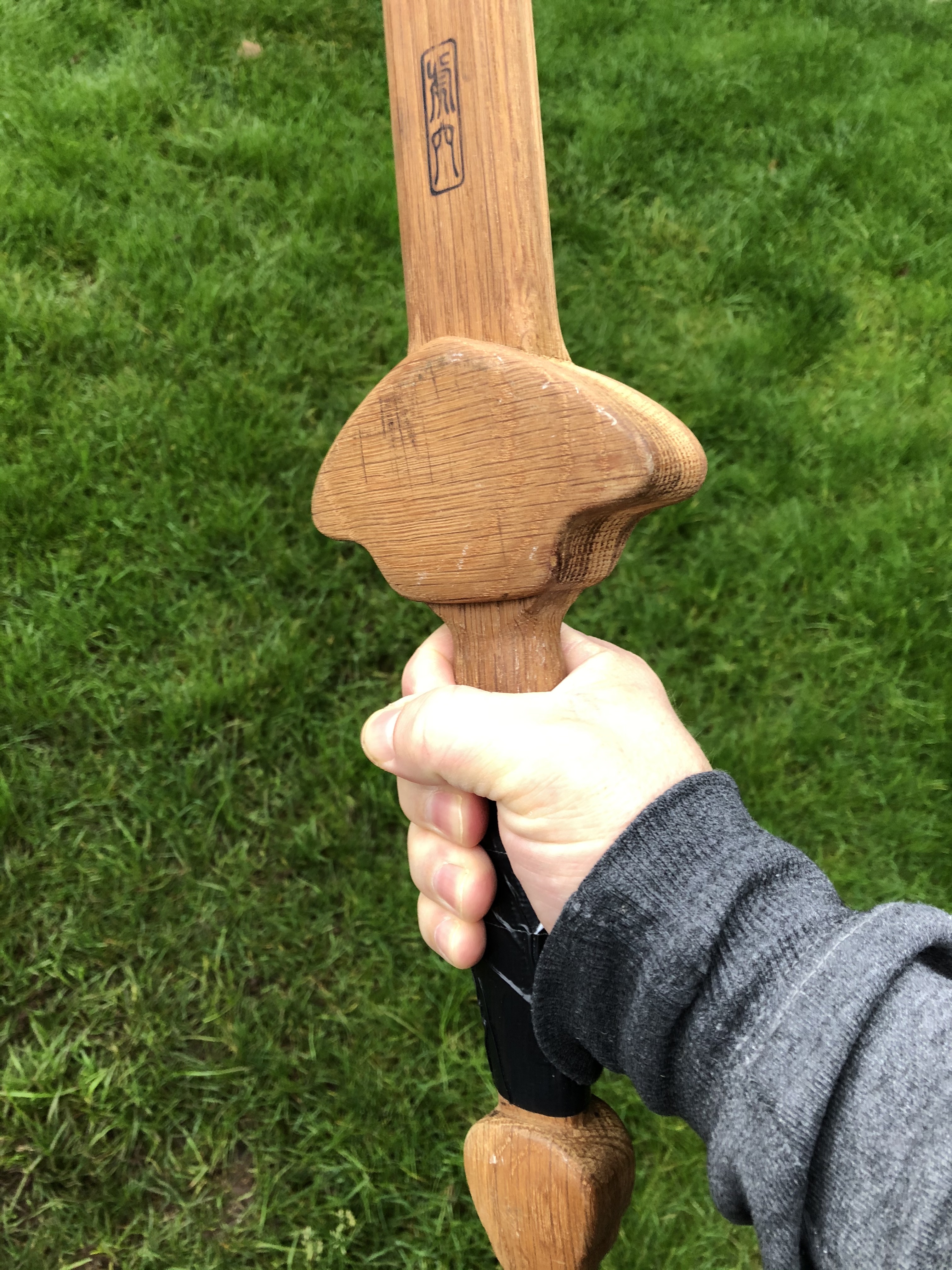
Even after a couple of days I can feel the physical difference. My forearms and wrists ache a bit from lack of conditioning. The sword I use is quite heavy – 800 grams, I think – and it’s a replica of a Ming Dynasty sword, hand made by Tigers Den in the UK. It’s great. I’ve put some tape over the handle, because it was slipping in the cold weather. That might ruin the esthetic, but at least it makes it look like a “used” weapon, rather than something that you hang on the wall.
Anyway, back to Zoom. Of course, as soon as I stepped outside to wave my sword around it started raining. This is Britain, after all. However I managed to get my laptop somewhere dry enough that it was only me getting wet, not the machine, and taught a few moves. It all went rather well I think. We’re going to do it again this week.
The whole thing brought back a lot of memories about practicing Xing Yi sword in the rain somewhere in a field back in the “naughties”, as the 2000s was called. My teacher used to be very into practicing outdoors in nature, and his mood positively lifted the worse the weather got and the further away from other people we got! There’s something to be said for not giving in to nature and working with it, no matter what it throws at you.
But, anyway, I think having the sword as your main “thing”, rather than it existing on the periphery of your practice, could lead to some interesting results. I’ll experiement and see. Let me know what you think, or if you’re doing something similar.