Chinese martial arts masters in London,1981

Back in 1981, the Daily Mirror sponsored the “Chinese State Wu Shu Company” to do a performance in London. It would have been completely forgotten by now except that they produced a one hour video tape of the event, sections of which have now been uploaded to YouTube. They’re worth a watch because they give a great insight into what “Wu Shu” was in 1981.
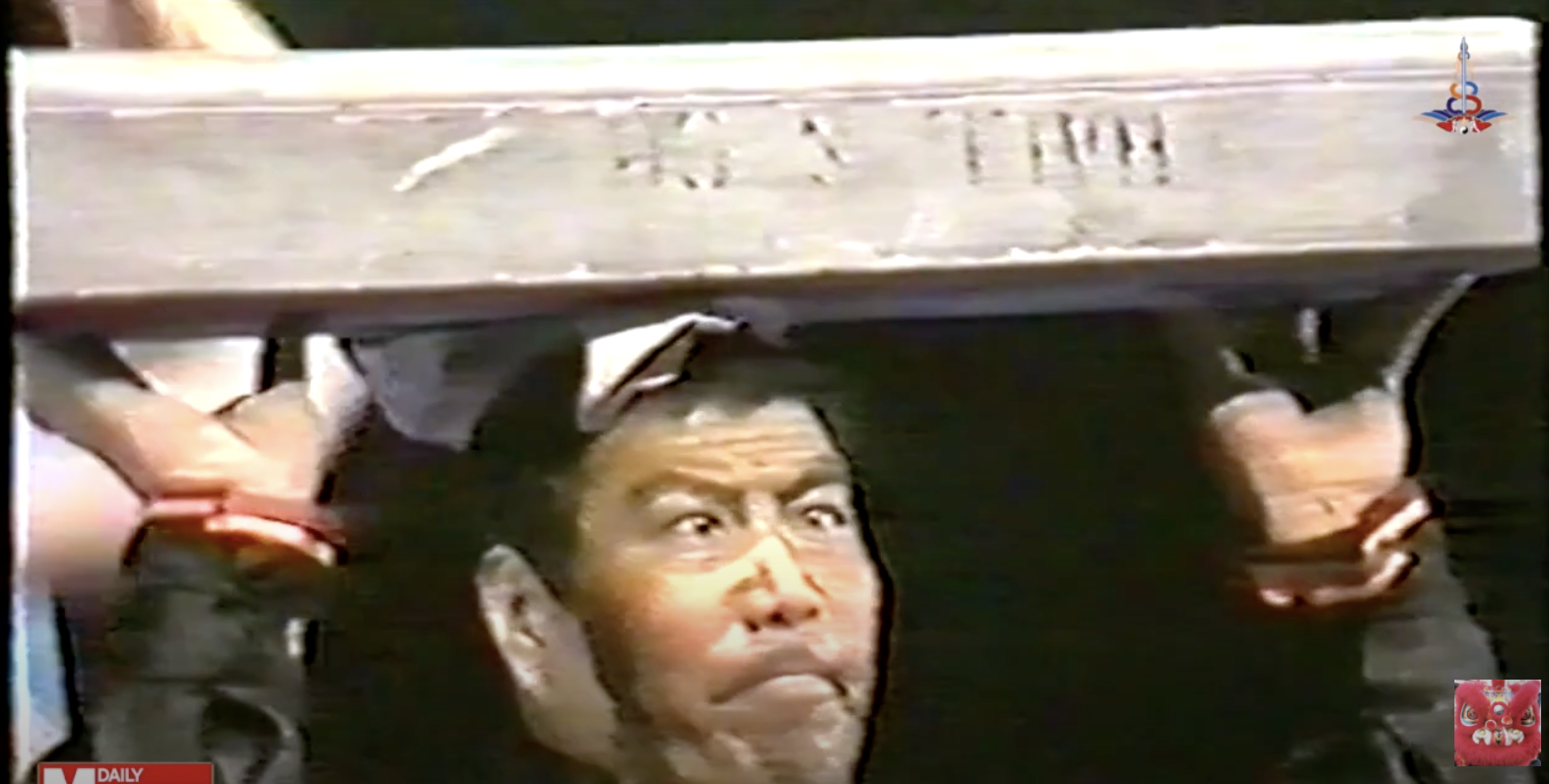
We tend to think of Wu Shu these days as being impressive martial-flavoured gymnastic type demonstrations, often with weapons. There is certainly some impressive “monkey cudgel” form and a staff form on show, but back in 1981 “Chi Kung” or “internal strength” demonstrations seemed to play a much bigger part than they do today. These days those sorts of breaking demonstrations have become more what you’d expect from the Shaolin Monks then Wu Shu athletes, who still put on those sorts of shows today (or at leat they did until C19).

The demonstrations from 1981 are serious, in that the masonry being broken over human bodies looks real. The sledgehammer that breaks it is thrown with gusto, but at the same time, there’s a comedy and performance element. Pretend shots of the sledgehammer are done by the performers to tease the audience and get a bigger reaction when the real blow lands. Traditional music is played. Here we can see the echoes of Chinese theatre (or opera), from which these traditions sprang.

Some of the preparations for the breaks are also very theatrical. As the performers do their chi kung to warm up I can see reflections of the “spirit possession” that convinced so many “boxers” in 1899 that they could become invulnerable to bullets in the Boxer Rebellion. The practitioners seem to wrap their bodies in invisible armour.

In the West we very quickly seem to dismiss these sorts of demonstrations as “circus tricks”, which implies they are fake in some way. But the masonry looks real to me. These don’t look like the deliberately weakened bricks, so often seen in these demonstrations. That looks like a regular British kerbstone being broken over his head, for example!

The 1981 demonstration stands as a great historical document of what the “Wu Shu” brand was in 1981, as China was starting to open up to the West, and before the Shaolin brand split off with the internal strength demonstrations and the Wu Shu brand took the athleticism to new gymnastic heights.
How to make your own martial arts staff

Highland survivalist Tom Langhorne shows you how to make your own martial arts staff, from selecting and harvesting the wood sustainably to crafting and refining it. If you need a little project to work on in lockdown, then this could be it!

He’s also got a great video that shows a comparrison of different staff fighting styles, which incluides: Jogo dau pau, Scottish Quarterstaff, German Quarter Staff and Japanese Bo,

And a video on the staff in general and its Scottish history:

Martial arts meme time

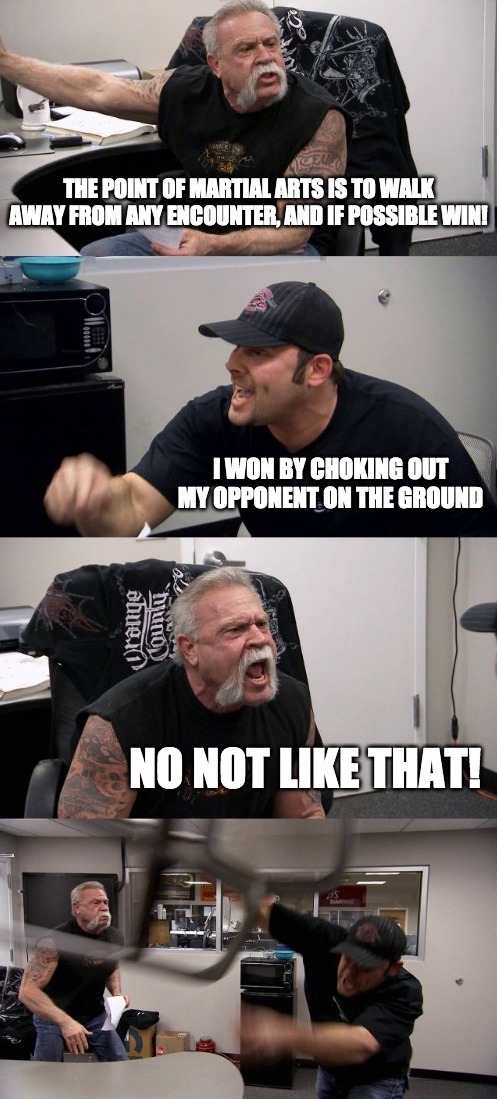
I seem to have had a lot of variations of this conversation over the years. I think it would make a good meme.

Traditional martial arts teacher: The point of martial arts is to walk away from any encounter, and if possible win!

MMA/BJJ fighter: OK! [chokes out much larger opponent in a cage match with very few rules]

Traditional martial arts teacher: No, not like that.

So here goes 🙂

What it was like learning traditional Chinese martial art in secret during the Cultural Revolution

This is a very informative interview with Ma Yue who is a Mashi Tongbei master. He talks about (amongst other things) what it was like growing up in a traditional martial arts family when the Cultural Revolution happened in China, and he had to be taught in secret. He also talks about the making of the first Shaolin Temple film, which is father was involved in, and what he sees as the many problems with Wu Shu today.

Part 1

Part 2

Baguazhang article and applications

The next episode of the Heretics podcast is going to be about the martial art of Baguazhang, so to get in the right head space here’s a classic Bagua applications video by Luo Dexiu along with a great article by Ed Hines of 21 c Bagua.

The article has some great ideas, especially about forms being memory holders for principles, rather than catalogues techniques.

“you need to use the forms, or techniques not as platonic ideals to be chased forever, but as examples from a broad set of ‘what is possible’. It is possible to hit this way, that way and another way. It is possible to unbalance this way, that way and another way. And so on. No perfect techniques, just the capacity to recognise possibilities”

Ed Hanes

Do traditional martial arts need to ‘worry’ about MMA?

With the explosion on the Internet of videos of MMA fighters knocking out traditional martial artists I think that internal martial arts are feeling (rightly) like they’ve become the undeserved butt of a joke, while at the same time the older generation of teachers is passing away without enough new students to carry on their arts to the same standards. The modern generation don’t want to practice as hard and have other things to be interested in.

Noble institutions like Xing Yi, Baguazhang and Taijiquan, which developed a reputation for being effective, fighty, martial arts during the 1920s and 1930s in China are now starting to be thought of as ‘for health’ only, or useless for fighting with, while MMA is seen as the barometer of effectiveness. Or at least that’s the narrative I see being played out. But I’m just not convinced that this narrative is actually true

Firstly, I don’t think these videos of Xu Xiaodong beating up Kung Fu masters are necessarily about saying MMA is better than internal arts – they’re more about one man’s fight against the Chinese system. One man’s “rage against the machine”, which is the government’s control over the martial arts scene in China. It’s a battle for personal freedom that Kung Fu just happens to have got caught up in. The China state Wu Shu machine is relentless in imposing the “official” version of traditional Chinese martial arts on the population, and that often it has little to do with actual fighting (which gets sidelined into Sanda – Chinese Kickboxing – , which is often divorced from traditional Wu Shu). So-called masters were encouraged to start making outrageous claims about their kung fu abilities on Chinese TV in staged demonstrations that were presented as being real. For pointing out the flaws in this heavily state-promoted view of Wu Shu with his fists, Xu Xiaodong is paying a heavy price of social restrictions and persecution. His travel is limited and his freedoms are curtailed.

Over here in the West I often hear serious Kung Fu practitioners worry that if MMA is seen as the be-all and end-all of fighting then traditional styles will eventually fade away, and the evolution of martial arts will go down a sports-based cul-de-sac, in which you “aren’t even allowed to kick somebody in the head when they’re on the ground!”

I see things differently. MMA training is really rough (or at least, it is in most places). In terms of what the vast majority of martial arts practitioners want, it’s a fringe element. Your average office worker has no interest in turning up to work on Monday with a black eye and busted nose. The vast majority of martial arts practitioners are still in traditional arts, which might be more ‘street’ orientated, but tend to be less rough in their practice. They’re filling village halls with karate and tae kwon do classes, or doing judo at university, or BJJ at their local academy and Tai Chi in the park. Or at least they used to be before COVID hit. The percentage of these people that want to push their bodies to the limit and be beaten up on a regular basis is vanishingly small.

MMA is also a form of entertainment designed for television. When the big MMA stars compete at UFC on a Saturday and the crowd goes “Whoo!”, when a spinning head kick finds its target, I bet the numbers at local Tae Kwon Do clubs go up the next week, not down. I see MMA as a great promoter of all martial arts. It’s quite possible Conor McGregor has done more to promote traditional karate than anybody else in history!

I agree there’s a real risk that if MMA is seen as the only arbiter of ‘what works’ in combat then martial arts could evolve down a sports cul-de-sac, but I’d argue that MMA is pretty damn close to ‘real’, and the gains made by seeing what works in the cage compared to what passed as ‘real’ in martial arts before the UFC is like night and day.

People are not so stupid that they can’t understand the difference between a sport with rules and a martial art for self defence. And anyway, sure it’s against the rules to kick an opponent in the head when their knee is touching the ground, but who the hell is getting kicked full power in the head when they’re on the ground in a martial arts class anyway?

What we’re actually seeing is the end of the era of the ‘death touch’ and ‘ling kong jin’ no-touch nonsense that found a fertile environment to grow in a martial arts world that had lost touch with reality. An MMA guy in China beating up fake kung fu masters could just be part of the course correction that is required in the path of martial arts needs to walk right now.

People really, really want martial arts to be ancient

It’s easy to laugh at the QAnon followers who stormed the capitol in the belief that Donald Trump would pardon them of their crimes and there was a secret revolution about to happen, but there are plenty of equally delusional beliefs in martial arts.

I found an article on the Martial History Team blog recently that quotes from a longer article by Paul Bowman about why martial arts history seems to matter so much to some people.

There are plenty of gems here, but I like this quote:

“Unsurprisingly, in much scholarship on Asian martial arts, the matter of history remains freighted and weighted down by the same popular myths; so much so that even much that passes for scholarship seems to refuse to face up to the evidence that suggests that, quite frequently, martial arts that present themselves as ancient are hardly even old.[11] 


So many massive social mutations occurred through the nineteenth and twentieth centuries that most ‘traditional’ martial arts effectively have at best little more than a century of continuous history to them, rather than the vast eons of allochronic time that so many seem to want them to have spanned.[12]


I emphasize the word ‘want’, here. This is because wanting appears to be a key issue to consider when approaching questions of martial arts history and culture. For instance, it seems that the perpetuation of fantasy histories and the fetishistic fabrication of lineages in ‘traditional’ martial arts evidently have everything to do with wanting. 

Practitioners want taiji to be ancient. Many want there to have been a Southern Shaolin Temple which was burned down, scattering the few surviving kung fu monks to the different corners of China.[13] We want Okinawan farmers to have fought samurai with rice flails. We want Yim Wing Chun to have been a real proto-feminist warrior.[14] We want the skill that wielded the weapon that killed Magellan to remain alive today.[15] And we want ancient warrior armies to have flown at each other through the air, kicking each other off horses with flying sidekicks and jumping spinning back kicks. 

Just because you want something, it doesn’t make it true.

Photo by Bakr Magrabi on Pexels.com

More lockdown listening on martial arts

As lockdown lingers around the world martial arts classes are facing a tough time, however, there are plenty of stimulating online discussions on martial arts to listen to. Here are three discussions I’ve listened to recently that have tickled my cerebral tentacles. Maybe they’ll do the same thing for yours?

Photo by Brett Jordan on Unsplash

First up – Viking martial arts!

This discussion between Paul Bowman and Qaus Stetkevych on so-called “Viking martial arts” is really interesting. It’s a world I know nothing about (although I did write an essay once on the connection between Xing Yi and old shield work )

Podcast link:

Youtube link:

It’s very interesting to listen to the criticisms that Qays makes in the above discussion then watch this clip I found of “Viking martial arts/Glima” – (which was litterally the first clip that came up when I searched for Glima). This martial art looks exactly like No Gi Brazilian Jiujitsu to me…

Xing Yi and Yi Quan

Next is Byron Jacobs excellent Drunken Boxing Podcast in which he interviews Yi Quan practitioner James Carss. What I like about this discussion is that it’s very down to earth and real about what it’s like training martial arts in China and Hong Kong. It’s not all smiles and rainbows and it was interesting hearing about the animosity between different groups of the same martial art that naturally spring up. Plus you get to find out more about the connections between Yi Quan and Xing Yi Quan, and how they are a lot closer than a lot of people think.

Podcast link:

Youtube link:

Byron recently added a new video to his series on baguazhang basics, that’s well worth a watch:

James Carss has an interesting video that introduces Zhan Zhuaung:

The Golden Elixer

Finally, here’s a bit of an older discussion, but fascinating if you are interested in the connection between Chinese theatre and martial arts. Scott Park Philips is in conversation with Daniel Mroz about all the subjects you find in his latest book. Scott never gives the same answer twice, but it’s an interesting slice into his mind. In particular he answers the question “What is the Golden Elixir?” at 41.44.

YouTube link:

The new American Boxer Rebellion of 2021

Jack Slack was the first person to draw my attention to the parallel between rioters storming government buildings that happened in China’s Boxer Rebellion around 1900, and the storming of the Capitol Building by Trump Supporters in 2021. Both involve a kind of “spirit possession”.

Of course, America, along with many European nations, was involved in the Boxer Rebellion:

“In 1898 the Yellow River burst its banks and destroyed the harvest in much of Northern China, but this misfortune was followed by an agonizing drought which dried out the land and hardened the dirt. As young men went hungry and without work, some Chinese noted the connection between the anger of nature and the construction of train tracks, telegraph lines and churches since the arrival of foreigners in the Qing Empire. Anti-foreign sentiment brought together groups of peasants practicing martial artists and calling themselves the Righteous Society of the Harmonious Fists—though the West came to know them as “The Boxers”. The Boxers attacked and murdered missionaries across the Empire and in the summer of 1900, Tianjin and Beijing were plunged into chaos as the Boxers received the blessing of Empress Dowager Cixi and the Imperial army. 400 foreigners and 3000 Chinese Christians endured a two month siege in Beijing’s legation quarter—a stone’s throw from the Imperial Palace but completely helpless. The Boxer Rebellion is a story about agriculture and diplomacy, magic and court intrigue, and it stands as both the last great event of the Victorian Era and the beginning of the end for the Qing Dynasty. ” – Jack Slack

Of course, I’d contest that the events that lead to the end of the Qing Dynasty had started much earlier, back in 1860s. It was these conflicts with foreign powers and internal rebellions which lead directly to the creation of Tai Chi Chuan, as we discussed on our History of Tai Chi podcast series. Yes, I’m sorry, the myth of a Taoist inventing Taijiquan after a dream about a snake and a crane, is just a fairytale. The real reason is much more pragmatic.

Jack has done an excellent podcast episode on the Boxer Rebellion, which he’s just released to the public, instead of being behind his Patreon paywall. If you want to find out more, have a listen: