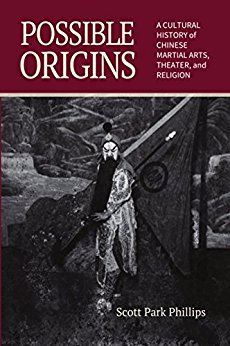
Review: Possible Origins, Scott Park Phillips – Part 1

51kkblit4ql-_sy346_

I’ve been meaning to review Scott Phillips’ book on the origins of Chinese Martial Arts for some time now, but there always seemed to be something else for me  to read, or to do… Ok, I admit it, I’m just a terribly slow reader. However, the recent uproar over the fight between Tai Chi “Master” Wei Lei and MMA coach Xu Xiaodong that has dominated the Chinese Martial Arts scene has made me pick up Possible Origins, A Cultural History of Chinese Martial Arts, Theatre and Religion, and give it the attention it deserves.

A bit of background to the current situation: Xu (who had to go into hiding after the fight once the government got involved) had started to make a name for himself as the debunker of Kung Fu masters who he claimed lacked the skills required for actually fighting while charging students large sums of money to learn these (nonexistent) skills. He wasn’t particularly respectful in his debunking either – in fact, his profanity filled rants were uncomfortable to watch and hard to follow, but his point was simple.

Wei, the subject of a documentary on Chinese television about his Tai Chi powers,  took umbrage to the implied insult and challenged Xu in an effort to defend the honour of traditional martial arts. It sounds like the plot of every kung fu movie, but it actually happened. Anybody who has seen the fight (which lasts about 10 seconds ending with Wei’s face being ruthlessly pummeled on the ground by Xu) will have realised that Wei was utterly delusional about his fighting abilities. Even after his beating, in his post fight interview, Wei still seemed to be delusional about his fighting ability, proclaiming that he was only hit after he “tripped’ and fell”. In reality he was knocked to the ground by a punch which revealed him to be a bumbling amateur in the realms of pugilism.

You can easily make the argument that Wei was never a proper Tai Chi Master anyway, so his poor performance is irrelevant, but a lot of people obviously did think he was a legit martial artists. What’s interesting to me is how we got here.  How did we end up with a generation of Kung Fu (especially Tai Chi) masters who think they can fight, but can’t? If you went to a boxing coach in Glasgow to learn how to box, he’d teach you how to box, and regardless of how good or bad you were, you’ll at least end up with some fighting skills. But if you go to a Tai Chi master in Taiwan, asking to learn to fight, he’ll teach you a lot of fancy arm-waving stuff, mystical qigong and forms, but after several years you might actually be no different from an untrained person in your fighting ability. In fact, you’ll probably be worse.

Nothing ushers in a period of self reflection like a catastrophic failure, so it’s at this point that we should turn to Possible Origins to see how we got here.

Scott’s book at least proposes some answers to this curious situation that Chinese Martial Arts finds itself in – which is to embrace it. His basic premise is that once upon a time in China, martial arts, theatre and religion were all one thing. Over time, and due to various political and cultural shifts they became separated out, but never truly lost their connection to each other, even if the arts lived on as a pale reflection. The book examines how that process happened, why it happened and what we can do about it. In a way it’s a call to arms for the reader to embrace parts of their practice that have hitherto remained untapped and to restore these connections.

I know plenty of people amongst the martial arts that I know who just laugh at Scott’s theories. (“Oh, no, not that guy…”)*. They tend to be practical people who are more interested in how something works than why it is the way it is in the first place. That’s fine, and there’s no reason to go ‘backwards’ in martial arts. I think it’s equally valid to not worry about any of this, and just focus on what you can do with what we’ve had handed down to us. But the book does open a door to a fascinating world of demons, spirits and ancestors that we’ve left behind. You’d also be surprised by how much evidence there is for his interpretations. He can’t be conclusive about anything (hence the title) but I’ll be damned if he doesn’t present a wealth of information to support his case.

Nezha

Martial arts originated so long ago that almost everything about that time is lost to us, and survives only in fragments. I think the strongest ‘evidence’ Scott has for his theories is the Boxer Rebellion of 1899, which happened relatively recently, and was a kind of a last gasp of the old world where martial arts, religion, theatre and ritual were all tied up together. There are documented cases in the Boxer Rebellion of martial arts practitioners combining martial arts techniques with spirit possession and mediumship to help overthrow foreign powers. Unfortunately it turns out that invoking the spirits of demons to give you fighting ability doesn’t, in fact, stop bullets and the Boxers were wiped out, and many of the ‘old ways’ and knowledge with them. Further cultural, political, and repressive regimes buried them deeper and deeper until today we’ve lost all concept of why we do what we do in Chinese Martial Arts.

Besides all this, Possible Origins is a damn good read, and an entertaining, book in its own right. It’s not an academic tomb, it’s an easy to devour. I’m halfway through and loving it. Even if you don’t agree with Scott’s theories, you’ll learn a lot about things you never even knew existed from Possible Origins.

Everybody who practices a Chinese Martial Art should read it.  I’ll post a ‘part 2’ follow up when I’m finished.
Links: Scott’s blog. Scott’s video. Buy the book on Amazon.

* In case you were wondering, Scott’s martial arts lineage is actually legit, and explained in the book.
Hands off! Stevie Nicks goes full Crane Kick

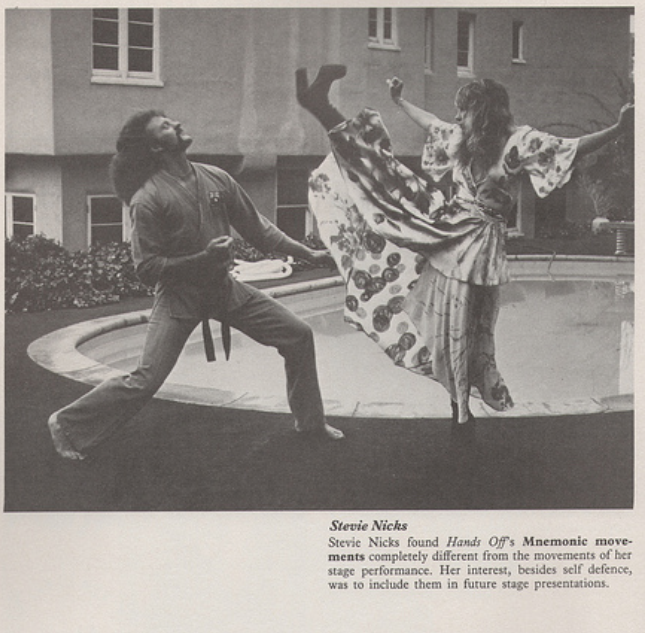
Fleetwood Mac star Stevie Nicks appeared in a women’s self defence book “Hands off!” back in the 1970s! Here she is on the cover:

Screen Shot 2017-05-14 at 08.46.27.png

From the Openculture article:

“The book itself was written by Bob Jones, an Australian martial arts instructor who doubled as a security guard for Fleetwood Mac, The Beatles, The Rolling Stones, David Bowie, Joe Cocker and other stars. And it featured what Jones called “mnemonic movements”–essentially a series of nine subconscious/reflexive self-defense moves (like a swift knee to the groin). See Jones’ website for a more complete explanation of the exercise routine that also provided, he notes, a great cardio workout.”


Check out the heels – no can defend!

Screen Shot 2017-05-14 at 08.46.48.png


Fleetwood Mac’s classic track, The Chain, was featured heavily in Guardians of the Galaxy 2, a reminder that they really don’t make ’em like they used to:


How to practice effectively for just about anything

All martial arts tend to be big on repeating movements over and over – BJJ-ers practice hip escapes and triangles, Wing Chun-ers practice Su Lim Tao, Tai Chi-ers practice form movements over and over. We intuitively recognise the benefits that repeating a sequence of movements gives us – we become more fluid and after a while it feel like these moves could be something we could actually pull-off under pressure. Well, it turns out there is a science behind repetition, and this TED video explains what it is:

Full contact Tai Chi. A painful lesson in reality.

A video clip has been doing the rounds on the Internet recently about a “Tai Chi master” called Lei Gong who accepted the challenge of a Chinese MMA fighter/coach called Xu Xiaodong to an actual fight. Here’s what happened:

As you can see the Tai Chi master had his bell rung very quickly and very convincingly. The whole video lasts 47 seconds. It’s clear from the first few seconds of the actual fight that Lei Gong is way out of his depth and shouldn’t be in there with Xu. He had no idea how to deal with an opponent who was actually attacking him, not just dancing around making strange shapes in the air, like his student presumably do for him.

(The stoppage by the ref was a bit late for me, and Lei Gong ended up taking more punishment than he should have. The effects of head trauma are all too real, but it seems that this is the price he had to pay to be woken from his dream of magic fighting ability).

Generally, I think that this fight was a good thing for Tai Chi as a whole. Let me explain.

The challenge arose after Lei Gong appeared on a Chinese Television programme called “Experiencing Real Kung Fu” claiming to have sparring and fighting ability with Tai Chi. He spared one of the hosts of the show in the programme. See below at 9.30:

Xu’s beef with the show was that people claiming these sorts of abilities better be able to back it up.

The sad truth is that most things in China are fake, including their TV shows! I’ve seen so many of these types of shows now where Tai Chi masters go up against Muay Thai or Karate people, or wrestlers. They’re all fake. Does that mean Tai Chi is fake too? I don’t think so, but I think it exposes the complete lack of realism that is prevalent in the Tai Chi culture. It’s not rocket science: if you want to be able to actually fight with any art, then you have to practice actually fighting with it.

Xu seems to have a particular problem with the big dogs of Chen village who charge a lot of money for people to become disciples to learn their special skills. I can see where he’s coming from – if you look at what you learn in a typical seminar from a big name in the Chen style, then none of this is going to prepare you for an encounter like the one Lei Gong was in.

Xu’s argument, which I think is logically valid, is that if you’re going to charge all that money for something you better be able to prove it works. He’s now challenged the son of Wang Xi’an, one of the “4 tigers of Chen village”, but Wang’s son will only send his student, who has also been trained in SanDa (Chinese kickboxing with throws as well) to fight Xu. Xu, understandably says this will not do, because he wants to test Chen style Tai Chi. This will probably rumble on a bit and lead nowhere.

I was chatting with a friend about the whole thing and he said something like “I think that all martial arts, once they actually spar end up looking like some version of MMA”.

I think he’s probably right. I’ve written before about the delusion of grace under pressure and how so many people’s idea of what Tai Chi should look like in a fight is so way off.

MMA is what martial arts look like when stripped down to pure functionality. When all the cultural trappings have been removed. Chinese Martial Arts does contain its own bad-ass martial artists, but still, those arts contain things that are not purely about fighting. And for a good reason – they perform a useful social function. MMA also performs a useful social function, but more in the same way that Western boxing does, not in the way that Chinese Martial Art does.

Perhaps we’re all missing something. There are special skills you can only get from Tai Chi, and I think people have a right to teach these things without having to fight MMA to prove it works. I also don’t believe that all the people who are paying lots of money to become indoor disciples of Chen style masters think they are being given a kind of ‘master-key’ to martial arts that will mean they will be able to fight 21-year old athletes without ever having to spar first. It’s more like they are buying into a tradition. Once they buy in they’ll (hopefully) get the skills the tradition is famous for*, and be able to set themselves up as teachers. The problem comes when they get delusional and start to see themselves as bad-ass fighters when they don’t have a right to. This situation is made worse by the acceptance of fakeness, or cheating, in Chinese culture and TV shows.

It’s a messy situation, but it is what it is. Welcome to the world of Tai Chi. What matters is you and your training. Use your own reasoning to asses what you’re doing and what skills it is actually giving you, and don’t start to claim you can do things you can’t, otherwise you might suffer a painful wake-up call, like Lei Gong did.

*Of course, whether somebody who is not Chinese and not even from Chen village would ever really be taught the real skills of the family is open for debate anyway.

Review: Notorious – The life and fights of Conor McGregor by Jack Slack

image1.JPG

I’ve been a fan of Jack Slack’s fight breakdowns on Vice.com for years now. He’s got a keen insight into the fight game and a knack of knowing exactly why, on a technical level, one fighter just beat another. I’d go as far to say that he’s totally changed my appreciation of the depth of the technicalities of Mixed Martial Arts, and even inspired me to write a few breakdowns of my own.

So, I was really looking forward to Notorious, the life and fights of Conor McGregor, his first proper foray into the book world, in which Jack (that’s his nom de plume) applies his writing sharps to tackle the MMA phenomena that is Conor McGregor. But here’s the thing – in short articles, his keen observational style shines, especially when backed up with video or GIFs of the situations he’s describing. In book format he’s limited to drawings to illustrate his points. The result is a bit like listening to a boxing match on the radio – you just end up thinking this would be so much better if I could see what was going on.

But don’t let that put you off, especially if you’re a Conor McGregor fan. The book is essentially Jack describing every single Conor fight (up to his second Nate Diaz fight in 2016) in detail – right from his humble beginnings in Cage Warriors to to his title fights in the UFC. The endless blow by blow accounts of every match become something of a battle to get through themselves, and I found myself skipping paragraphs just to get to the more interesting and high profile fights later in the book.

It’s also noticeable that Conor the man is entirely missing from this book. There are no new interviews with him, no interviews with his friends or coaches. With no access to the star of the book all we have is a few quotes from other people’s interviews and UFC press conferences. We don’t really get any insight into the mind of McGregor. I’d love to know exactly how a kid with a background in pure boxing picked up all those Taekwon Do and Capoeria kicks. Where did he get them from? What was his inspiration? And how, exactly did he get so good at them? What are his training secrets?

Perhaps I’m being too harsh because there are plenty of fun moments to be had in these pages, especially later on when he gets into MMA politics, but Jack is more of an analyst than a Booker prize-winning writer. In a longer format, and without video clips to illustrate his points, he slips too easily into cliche  – repeatedly calling blood “claret” – or churning out questionable analogies, like “with arteries closing faster than those of a Glaswegian chain smoker”.

If you want to find out exactly how the conflicting styles of Nate Diaz and Conor McGregor’s produced two of the most entertaining MMA fights in history then read on, for glimpses of what inspired the creative genius behind the techniques, we’re still waiting.

Get the book on Amazon.

I’m now a writer for Jetli.com

So, a while back I mentioned that I’d been contacted by a major martial arts website about writing some articles for its launch. Well, today that website launched!

Please check out Jetli.com

Yes, that’s the famous martial artists and film star Jet Li!

At Jetli.com we strive to bring you content that is exciting and inspiring. We are drawn to stories that highlight people all over the world that chase their dreams no matter what. From the boxing gyms of London to the favelas of Brazil, we have found heroes who live with the values of martial arts at the center of their lifestyle. You’ll see dedication, courage, humility, and generosity. Amazing stories await you at Jetli.com!

I’ve written quite a few articles for Jet already – it looks like two have been published, so here they are:

Coming Full Circle: How Movement Culture is Taking Martial Arts Back to its Roots


How to Avoid Being Attacked


Look out for more from me coming soon here:


The Judo chop

shutoFrom the ever-enlightening Urban Dictionary:

Judo Chop

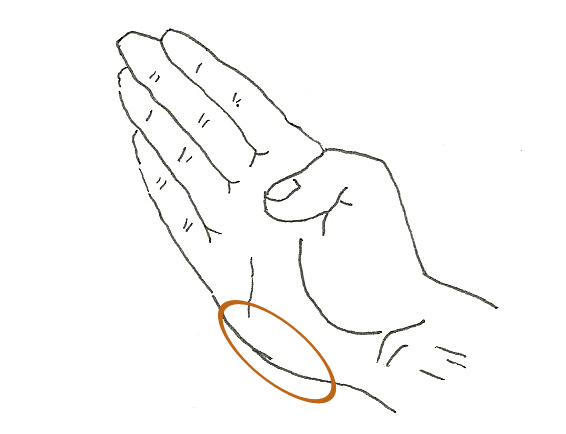
The act of taking your hand and making a chop motion on a persons shoulder near the neck area while saying in a loud manner, “Judo chop-HAI!”

1. Find a victim.
2. Creep up behind them.
3. Make sure palm/hand is flat and straight.
4 Raise your hand and chop the victim’s shoulder, making sure it is close enough to the neck.
5. Say the phrase, “Judo Chop HAI!” While doing so.
6. Walk away.

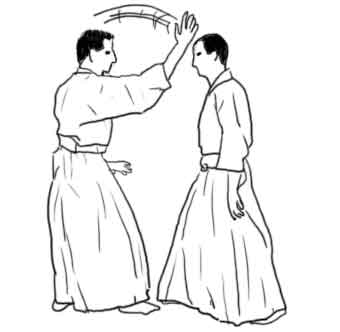
Following on from my last post about Internal Judo, I’ve been thinking about the (stupid) “knife hand” attack you commonly see in Aikido, Jiujitsu and Judo – “Shomen uchi”


angriffe7


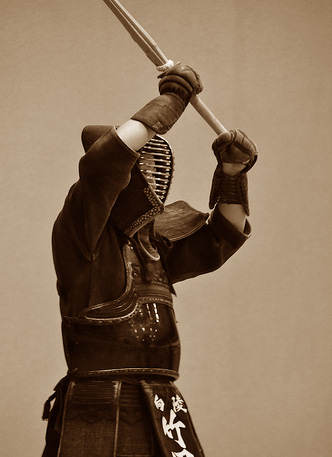
I say “stupid” because , well, it is. Nobody is ever going to attack you like this in reality. You even see it done with bottles and knives, but it’s pretty obvious that this technique is derived from a much more practical origins – an overhead strike from a katana:

shomenuchi

One of my friends does Judo. He loves it, except for the time when the teacher says they’re going to do “self defence” and the class has to learn how to defend against an overhead strike using a knife, or defend a haymaker by turning their back on the attacker and doing a hip throw. The first situation is ridiculous, the second, possible, but unlikely.

It’s hangovers like this, relics of the weapons-focus of the past that are left behind in martial arts, that provide more weight to the theory one of my old teachers used to have that what we recognise as “martial arts” didn’t used to exist a few hundred years ago when people could freely carry weapons, and soldiers were trained in how to use them. The invention and evolution of the firearm changed things a lot, and then once it was no longer considered civilised to carry a bladed weapon in normal daily life, things changed again. If it was acceptable to carry a sword nowadays, you can bet the local Tae Kwon Do class would be changing its syllabus.

If you think about it, the idea of defending yourself against somebody with a weapon, when you don’t have one, is a pretty hopeless task. Especially if they’ve got a knife. The only thing you can say about knife fighting for sure, is that they’re definitely not going to attack you with a big overhand strike to the temple. So why keep training it?


Kung Hey Fat Choy!

rooster

Kung Hei Fat Choy! Welcome to the year of the Fire Rooster. If you’re looking for some tips to survive in this alternative reality we seem to have entered, then Scott P Phillips has a Fire Rooster survival guide. In short: get organised.

I’d also like to kick off the Chinese new year by directing you to this excellent interview ‘It’s not what you think: what serious martial artists want you to know about tai chi‘,with Chen Huixian,a Chen villiage Taiji practitioner who has moved to the US and is teaching there. It’s good to see Taiji from the source reaching a wider audience.

Also make sure you take the opportunity to read the excellent talk by Paul Bowman on ‘Taoism in bits‘ about the transplanting of ideas around Taoism and martial arts from East to West.

I often wonder to myself if the concept of ‘styles’ in Taiji has reached a kind of end point. These days, with the floodgates to information wide open, thanks to the Internet, everybody has access to everything. Silk reeling exercises are no longer the secret teachings belonging to the Chen family. Zhan Zhuang standing meditation is no longer the preserve of Yi Quan practitioners. Fast stepping patterns are no longer the speciality of XingYi and Bagua, and slow movement no longer belongs to the Yang family. These days you’re as likely to see a Yang style practitioner doing silk reeling exercises as a Chen practitioner standing in Yi Quan postures for extended periods.

It’s like it has come full circle, and there is just Taijiquan again.


A Tai Chi reading list

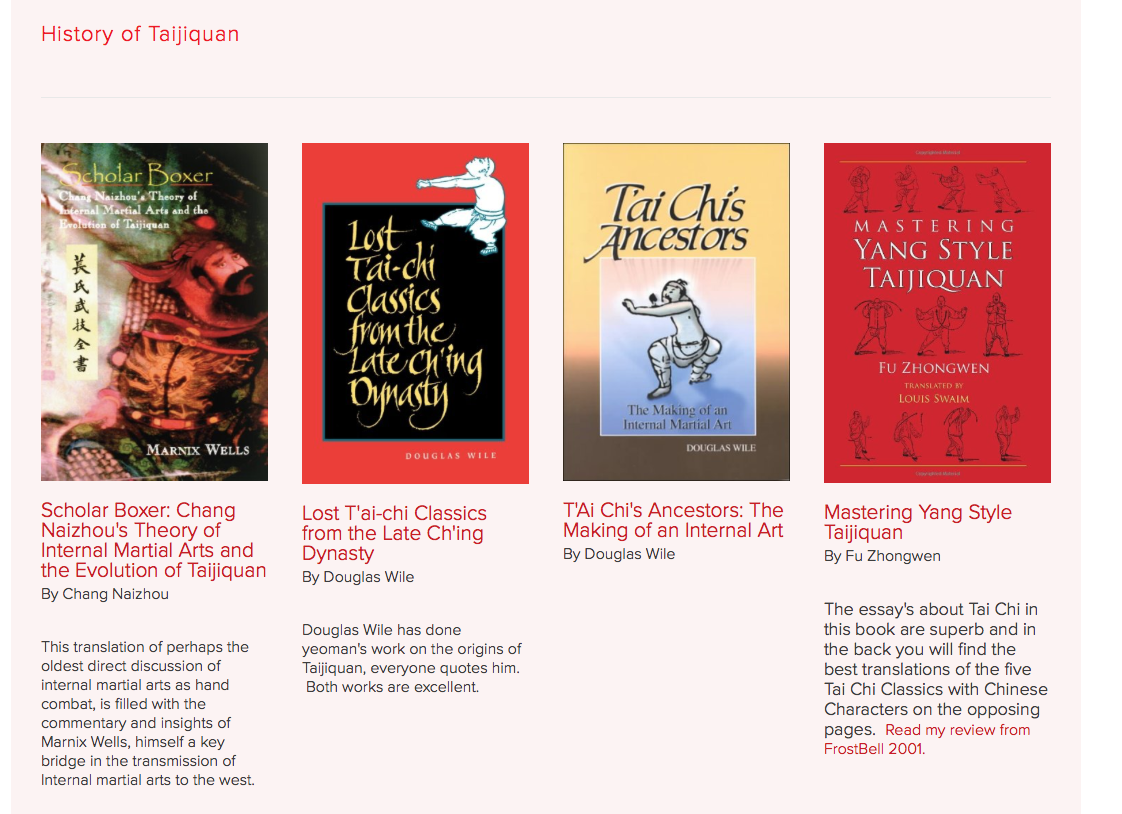
Screen Shot 2017-01-14 at 07.14.22.png

I just learned that Scott P Philips recently created a new Facebook page, and as I browsed it I ended up on his Books page, which is like leafing through the most comprehensive Tai Chi/Chinese Martial arts section of Waterstones that will ever exist, but never will.

He’s linked reviews in the descriptions of several of them, too, which is a nice touch.I’ve got a lot of these books, but there are way more here than I’ll ever have time to read.

If you’re after some reading material on Taijiquan or the martial arts culture from which is arose, then there are some great ideas here.