In his chapter on silk reeling, in the book on Chen Style Tai Chi Chuan (1963) (A snip at only 828 pounds on Amazon in the UK!), Shen Jiazhen writes:
…Tai Chi Chuan movements must be in a shape like pulling silk. Pulling silk [from a cocoon] is done by a circular motion, and because it combines pulling straight and circling, naturally it forms a spiraling shape, which is the unification of the opposites of straight and curved. Silk reeling energy or pulling silk energy both refer to this idea. Because in the process of unreeling, extending out and pulling back the four limbs likewise produce a sort of spiraling shape, therefore the boxing manuals say that whether in large, extended movements or compact, small movements, one must absolutely never depart from this type of Tai Chi energy which unites opposites. Once one has trained in this thoroughly, this silk reeling circle tends to become smaller the more one practices, until one gets to the realm where there is a circle but no circle is apparent, at which point it is known only by intent. 1 This is why the third characteristic of Tai Chi Chuan is that it is an exercise which unifies opposites with silk reeling, both forward and backward.
Thanks to Jerry K for the translation. If you’re interested he’s also translated other chapter of the book – like this one on Empty and Full.
With this in mind I thought it would be beneficial to investigate exactly how silk is pulled from a cocoon. The Chinese have cultivated silk worms for more than 5,000 years. Here’s video showing how silk is cultivated today in Shanghai:
Like any industry, silk production has been automated, but you can still see how people did it using a hand reeling machine in some parts of China:
I’m guessing that the initial spiralling action of her hand she uses to get the starter threads off the brush is where the analogy starts to happen with what you’re doing in silk reeling exercises in Tai Chi Chuan? It reminds me of the way you can play with an elastic band in your hand. With 5,000 years of silk production in China I’m pretty sure the hand reeling machines would have existed at the time Chen style was creating these exercises, some 300-odd years ago, but without a machine then you’d have to be doing it with your hands in that manner.
Either way, I don’t think the silk worm gets out of this alive 😦
I ran (ha!) across this article by Sam Wuest, thanks to the Steve Morris Facebook page. It’s a really interesting look at how Usain Bolt is the fastest man alive despite not conforming to accepted wisdom on running mechanics.
It turns out Mr Bolt makes clever use of waist rotation when he runs, in contrast to the normal admonitions to reduce rotational movement and increase forward and back movement you’ll get from a lot of running coaches. By turning his waist in coordination with the running motion Mr Bolt is creating a longer lever to the floor, and everybody knows that longer levers create more power than shorter levers over the same distance.
There’s a famous line in the Tai Chi Classics that goes “The waist is like the axle and the ch’i is like the wheel“. At one point in the article, Sam Wuest says
“The rotation of the waist/pelvic region is like the turning of a wheel on an axle. The hip joints are rotating around the imaginary centerline of your body parallel to your spine at about the elevation of the sacrum. It is not a perfect rotation, as the free leg hip will come through higher than the support leg’s hip if the lateral chain is firing correctly. Perhaps it would be better described as a rolling rotation. Which brings us to reason #2 of why this piece of technique is important.”
Sounds familiar, doesn’t it? Reason #2 is interesting too:
Reason #2: Better Muscle Sequencing/Activation
Often, those that rotate better whilst sprinting will look smooth and relaxed. Their strides won’t just look longer, they’ll look more relaxed. Think of Carl Lewis’ famously effortless stride. This is how we are designed to move – the center moves first, then the extremities follow, much like a whip.
The muscles around the pelvis have high muscle-to-tendon ratios (force producers) while the extremities have relatively much more tendon and elastic structures (force amplifiers). In a correctly aligned body, a small movement of the waist can produce large amounts of force elsewhere in the body.
This sounds awfully close to the Tai Chi idea of the dantien as a nexus of muscular and tendon power in the body.
As somebody interested in muscle tendon channels and their effect on movement and silk reeling exercises from Tai Chi I can see the correlation here. Tai Chi uses the same principle of movement coming from the centre (the dantien) and that controlling the movement of the extremities through elastic tissue. We usually think of this sort of movement as having to be learned, rather than occurring naturally, however it appears to be exhibited in high-level athletes, as we see in the article linked to above. Are they just naturally doing it? Have they tapped into the way the body is designed to move? Have they stumbled upon it, or have they had to learn to move this way on purpose?
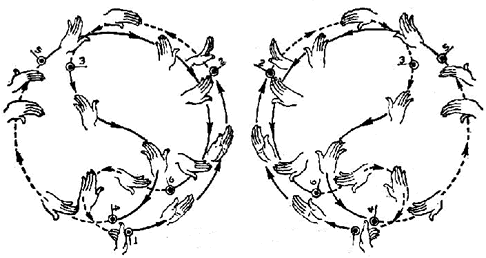
Shen Jiazhen (1891-1972) co-authored the book Chen Shi Taijiquan (1963), which contained the famous silk reeling diagram below:
Silk reeling is the essential skill of Chen style Tai Chi Chuan and involves learning how to wind the body so that all movements arise from the dantien, and that when ‘one part moves, all parts move’. Other styles of Tai Chi do pay lip service to this idea, of course, but I think only the Chen style really gets into it in the level of depth that’s required because they have a deliberate method (Silk reeling) that’s all about this concept.
When I look at family members of other Tai Chi styles perform Tai Chi I don’t see the same type of movement that you find in Chen style. It’s hard to evaluate of course since a lot of Tai Chi masters can hide the details of the movements. I’ve been told that the current head of the Chen style, Chen Xiaowang, is very good at hiding the movement so you don’t see it. But if you look at videos of Wu and Yang family members I don’t believe that the same silk reeling is really going on there. I see lots of really smooth movement (sometimes called “drawing silk”) but not the dantien control that you typically associate with Chen style.
If you understand the concept of silk reeling I see no reason why it can’t be added to these other styles of Tai Chi, of course. In fact, my own lineage started as a Yang style, but it is more of a hybrid style, as it has gone outside of the bounds of a single “family style” and added in elements from elsewhere, including silk reeling from the Chen style. It doesn’t pretend it got it from elsewhere.
When my Tai Chi teacher introduced me to silk reeling he used the pattern in the diagram above from the Shen Jiazhen book on Chen style. Looking back now I realise that this was actually a very difficult place to start with silk reeling because of the pattern’s complexity. It mimics the Tai Chi diagram… but not quite completely. If you look at the bottom of the diagram you’ll see that there’ s an extra little circle going on. The changes from open to close are also really frequent and quick, compared to a standard single arm wave silk reel.
The way my teacher taught me you stood in a forward bow stance and did one arm at a time. Then change stance for the other arm. The illustrations of the hands are pretty accurate and show the way the palm turns nicely. The numbers are important because these indicate the positions where the body changes from open to close and vice versa (with accompanying weight shifts). The diagram on the left is for the left hand and the diagram on the right is for the right hand.
A portion of Shen’s book on the subject of silk reeling has been translated into English and can be read here.
As I said, I don’t think this exercise is good for beginners. A better starting point for learning the basics of silk reeling would be a simple single arm wave. The best instruction I’ve seen on this is by Mr Mike Sigman. In this video (which I’ve posted before, I think) he explains the concept of muscle/tendon channels, open and close and goes over a basic single arm wave and what you should be doing in very clear terms:
This video is a blast from the past (for me, at least). It was filmed in 2003 and I’m in it!
It’s the film of a demonstration the Yongquan Chinese Martial Arts group did in London. There are lots of the arts I was training at the time shown off here – Choy Lee Fut, Northern Shaolin, Tai Chi, Push Hands, then some breaking demonstrations. I’m doing a broadsword form in the demo that I can’t even remember anymore! There’s some Iron palm (a granite pebble broken with a chop) from Donald and a kerb stone gets broken over Doug’s head with a sledge hammer!
Since I was actually in this demo I know that none of these materials are faked – they’re all the genuine article. Real bricks, etc..
At the end of the demonstration there are some clips of us practicing for the demo. These are more enjoyable for me to watch as they bring back some good memories of training with my teacher and the rest of the guys back in the day.
What I like most in the video is the very last clip, where Doug is practising the Press (Ji) technique from Tai Chi on a line of people. Done right it’s meant to be very minimal physical effort with a big results (using Jin not Li) – the power should penetrate through the line of people so that the people at the back of the line fly away first. He does a ‘not very good’ version of it (too much Li – physical force) so it all looks very physical. Donald comes over to tell him off and show him how it should be done, and without any set up does a perfect Ji – really minimal effort and the guy at the end of the line flies off – then Doug has another go and gets it right. I’m glad that got captured on video.
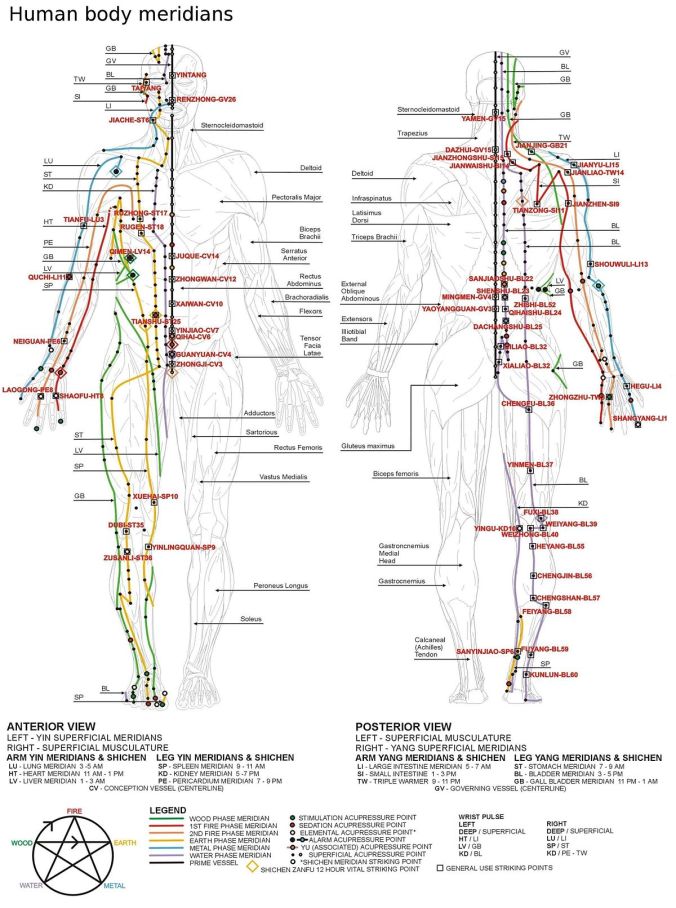
I think that somebody doing some background research into “Tai Chi” inevitably ends up looking at a picture of the “acupuncture meridians” and starts to wonder how they relate to Tai Chi Chuan.
The meridians are used in traditional Chinese medicine practices like acupuncture, massage and pulse diagnosis.
It’s very easy to jump to the conclusion that specific moves in Tai Chi Chuan must affect specific meridians (since, you know, they’re both Chinese…), and indeed a lot of Tai Chi literature will tell you things like this – for example, you’ll see it written that Wave Hands Like Clouds works on the belt meridian or Needle At Sea Bottom works on the bladder meridian.
Do they really? Who knows.
I remember asking my Tai Chi teacher about this and he just brushed it off as unimportant. He was right, too. The thing is, when you do an opening outwards movement, Qi (if there is such a thing, and if there is, then it’s probably not what you think it is) is moving through all the meridians equally in an outward direction, and when you do a closing movement it moves equally through them all in an inward direction. This sequence of opening moves turning into closing moves, which turn again into opening moves, and so on, is repeated throughout all Tai Chi Chuan forms, and is therefore the key feature of the art, and where it gets its name – you continually move from Yin to Yang to Yin to Yang, etc…
You don’t need to worry about the acupuncture meridians for practical considerations. The meridians are not exactly the same as the muscle tendon sinew channels (Jing Jin)first described in the Yellow Emperor’s Inner Classic (Huang Di Nei Jing) that Chinese experts will talk about. The meridians are more modern, and roughly drawn over the top of the old channels (so are useful for illustrating a general concept, like their same sidedness, for example) but they’re more detailed/fiddly, and not as useful for practical work because of that. You need broader brush strokes.
In internal martial arts you want to develop the connections in the muscle sinew channels so you can actually feel them. You’re starting point for developing these connections would be to use open and close movements. So (generally) the channels that go up the outside of the legs and up the back of the body are used for ‘opening’ and the ones on the front of the body are for ‘closing’ movements.
Using reverse breathing you try and feel a slight tension on the surface of the body and turn that into an opening outward, or a pulling inward, sensation, matched with the movement. (E.g. I breathe in and try and feel a pull along the ‘close’ channels of my arm, and let that lead my movement). You need to let this connection become the driver of the movement, taking over from the local muscles. Your shoulders are usually a source of problems, as is relaxing the lower back sufficiently. Remember to drive power (Jin) from the lower body (closest to the ground). Connections start gossamer thin and build up over time.
Any Tai Chi form movement would work for this, so find one you are familiar with and open up the back and close down the front. However, if I were to pick a movement to start with then a single arm silk reel would make most sense. Like this:
After months of this work you should develop a sense of how the Dantien naturally controls things.
I believe this is the basic path.
Alternatively (using the way most of us Westerners get taught) people learn lots of forms, techniques and exercises that make them feel like they know a lot, but then in 20 years they might meet an expert and realise that they didn’t start with the basics…
Here I want to discuss what a natural posture means in Tai Chi Chuan. I was working on the posture we call ‘Fist under elbow’ with a student today. The posture looks like this:
Fist under elbow – Yang Cheng-Fu
The word translated as ‘fist’ could also mean ‘punch’, so you could equally call the posture, ‘Punch under elbow’. It looks a bit like the Judo Chop I talked about recently, but it’s not done like that at all in application. Instead of a chopping, downward, movement it’s a forward and outwards,palm strike done with the left hand. You can see this immediately when you see it done in motion. Here’s Yang Jun, the grandson of Yang Cheng-Fu who is pictured above, teaching the movement in his family’s style of Tai Chi.
You might ask why your other hand is punching under the elbow. I was always taught this was a hidden technique, where you’d turn the left hand into a deflection of the opponent’s attack and punch them with your right, but in the Tai Chi form it wasn’t show explicitly, and the punch was hidden away under the elbow… In application, it looked a lot like a little bit of Wing Chun Kung Fu.
I always have doubts about the validity of these sorts of explanations though. Firstly, I don’t know why you’d want to hide a technique like this? Who are you hiding it from, and why? And it’s not an especially deadly technique, so it’s not like it is dangerous for people to see it. There are much more dangerous techniques shown openly in the form. And secondly, if you don’t actually practice it then you’ll never actually be able to do it under pressure, so hiding things away is not an ideal practice method.
I think it’s much more likely that the posture itself has special cultural significance (as say, part of a religious ritual, or maybe it relates to Chinese cosmology), so was included in the Tai Chi form sequence, or perhaps it’s something of a signature move that was handed down over the generations from an older martial art, and has lost its original meaning, but remained as a kind of nod of respect to the forefathers.
Either way, it’s in the Tai Chi form now, and shows no sign of being removed, so we might as well get on with learning it properly.
My point in writing this article was that I find students generally don’t perform this posture particularly well. Perhaps it’s something to do with the arm position being slightly uncomfortable unless you can relax sufficiently, but it seems particularly suited to making mistakes. Maybe it’s because it looks a bit like an “on guard!” posture, but if you ask a student to take up this posture they will invariably hunch the shoulders, or make their leading arm too stiff and aggressive, or get the angle of the hand and fingers all wrong.
Here’s an example of what I mean. Look at how tense this guy’s arms are:
He’s holding up his right elbow instead of letting it drop. His left arm is almost locked straight and both arms are too high: Instead of ‘sinking the chi’ he’s letting it rise up, which makes him unsteady.
In Tai Chi the shoulders should naturally round and the elbows should drop – this makes your posture softer and more relaxed – ‘sung‘, as we say in Tai Chi.
If I was to walk up to the person above practicing on the beach and at the moment they formed their Fist Under Elbow I was to slap their arm away at the elbow then the chances are that I’d severely compromise their structure and balance, possibly knocking them over, giving me ample room to attack.
In comparison, if you look at the picture of Yang Cheng-Fu above again, then you can see he is much more relaxed and comfortable in his stance. You get the feeling that if you tried to slap his arm away he’d be able to just let his arm go with your motion, and let it swing back around and slap you in the face! (This was exactly what happened to me the first time I got hands-on with my Tai Chi teacher, so I can talk from experience!)
Yang Cheng-Fu’s more natural posture means that his centre of gravity is within himself in the area of the dantien. And because mind and body are linked, it’s more likely that his mind is focussed and aware of what’s happening. Once your physical centre of gravity starts to shift out of your base, so too does your mental focus. And equally, if your mind is all over the place when you’re doing your Tai Chi form then, more than likely, your physical balance will suffer for it.
In an ‘internal’ martial art we try to harmonise what’s happening between the external and the internal parts of the body. That’s what I’m trying to do in each posture of the Tai Chi form – become more centred,both mentally and physically. I want to have a more natural body that is free from artificial posturing. Postures that look ‘held up’, as if from invisible wires from the ceiling, are not as useful for combat as natural, rooted, aware postures that can meet the demands of the moment.
(A quick tip for getting a more natural posture is to take up a posture from the Tai Chi form, put your arms in what you think is the correct position, then take a big breath in, all the way up to your shoulders then let it all out in one big gasp. Let your arms settle to where they need to be, rather than holding them up. That relaxed, sunk, posture you now have is what you should be looking for in Tai Chi Chuan.)
A Tai Chi Chuan performer dong a form, as viewed by an observer, is not in a binary right/wrong state. If it were then everyone would be ‘wrong’ because Tai Chi is that point of perfection that everybody is striving towards. I’m not talking about superficial things that form competitions are judged on, like the wrong height for an arm, or the wrong length of stance. I’m talking about maintaining a perfect state of equilibrium (yin/yang balance) throughout the movement. Constantly going from open to close in perfect harmony. Even the best experts are making little errors constantly as they perform a Tai Chi Chuan form, they’re just so much better than the average person that we can’t see or appreciate them.
But equally, all roads to not lead to Rome. Not everyone doing Tai Chi is on the right track. There are so many side roads you can wander off on, especially with so many other tempting martial arts available on the high street that are a bit like it, but not the thing itself.
There’s one particular side road I want to discuss here that is so close to Tai Chi, but also, so far from it, that you’ll never get there if you go too far down it.
“a hair’s breath and heaven and earth are set apart.”
One thing you’ll find a lot of people, particularly instructors who are into the martial side of Tai Chi, doing is putting their weight into things, rather than moving from the dantien.
So what do I mean? Well, think of it like this: if somebody is doing a Tai Chi form and each time they lift and arm they keep their body relaxed and let their body weight fall into the arm they can generate a significant amount of power, while appearing to remain relaxed – all the things Tai Chi is supposed to be.
It’s impressive, and will convince a lot of people of your awesome martial prowess, but it’s not really how Tai Chi is supposed to work. If you’re committing your weight into a technique then you get a lot of power, but you also get a lot of commitment. As an analogy, it’s rather like swinging a lead pipe to hit somebody. If you make contact then fine, you’ll do a lot of damage, but if you swing and miss then you can’t change and adapt quickly enough to deal with the opponent’s counter.
In contrast Tai Chi is supposed to work like a sharp knife – you can generate power without committing your weight into the technique, so you can change and adapt, just as if you were switching cuts with a blade. The knife is so sharp it doesn’t need a lot of weight behind it.
To get this curious mix of non-committed movement and power you need to move from the dantien. This requires a co-ordinated, relaxed body, that’s driven from the central point. This type of movement really does involve re-learning how to move and is developed in things like silk reeling exercises and form practice.
Learning to put your body weight into techniques is comparatively much easier to grasp, and may even be a useful first step, but it should never become the goal of your practice. It’s only when you come up against somebody well trained in dantien usage that you realise the inferiority of other methods.
Just browsing through the Internet on a lazy New Year day’s morning I noticed once again how my feeds tend to bring together the old and the new in one continuous stream of “Internet”, showing me videos and writing that are almost 100 years apart, yet seem to be talking the same language.
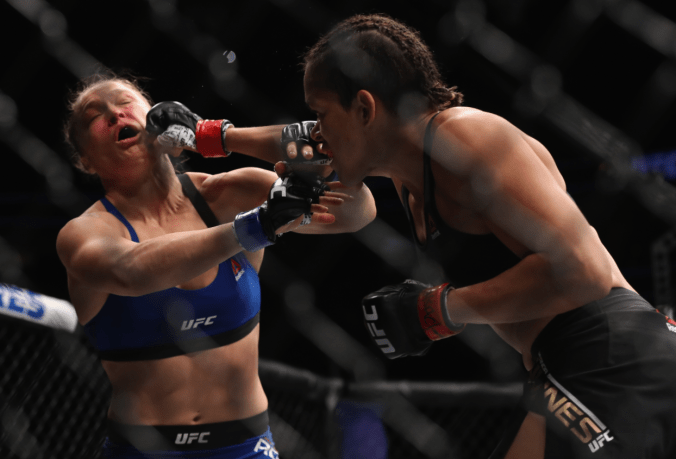
For example, we’ve just had UFC 207 in which (warning, SPOILERS) Ronda Rousey made her come back for a not-so-glorious 48 seconds, and was hit with 27 punches from Amanda Nunes (that connected) without landing a single blow back and was saved by the referee from further damage. She looked totally outclassed in the striking department. This was further highlighted by the previous championship bout between Cody Garbrant and Dominic Cruz, which was like an exhibition match, showing incredible timing, footwork and striking ability over 5 truly glorious rounds. The belt went to Cody via decision in the end, but Cruz fought like a warrior and his footwork was as outstanding as ever even if it occasionally left him open.
The two matches couldn’t have been more different; one a display of how bad footwork and poor defence meeting strong striking results in total domination, the other a display of perfect timing and offence mixed with defensive footwork on both sides resulting in a game of inches.
I don’t know how long these links will last but here are the full fights:
Brennan translations are free translations of old Tai Chi manuals. This is one from a Yang Cheng-Fu student published in the 1940s. I’ve skim read a few parts now of this new one, and I really like it, and the translation is done in a way that you can read it without being perplexed at obscure phrases.
For example, here’s a good quote:
“Every movement in Taiji Boxing is always half empty and half full, and is like a round sphere. This is not only the case for large movements, but also for the smallest movement of any part of the body. From beginning to end, movement is continuous, like the ceaseless movement of the universe through the sky. Taiji Boxing uses the abdomen as the axis of the whole body, so that whatever way your are moving – forward and back, side to side, up and down, or reversing direction – the limbs and trunk are all being moved from the abdomen, going along with its movement like the stars following the setting sun. Therefore Taiji Boxing is an exercise that conforms very much to naturalness.”
Ok, stars don’t strictly “follow” the setting sun, but I think it gives a nice poetic metaphor.
In particular, I like chapter 7, in the manual “SEVEN: METHODS OF PRACTICING EMPTINESS & FULLNESS” Personally, I think getting an understanding of empty and full, as a strategy, is key to applying all martial arts in a live situation.
In chapter 7, it says:
“Empty to defend, then fill to attack. This is the key to the art.
If you spot the moment to become full and yet do not issue, the art will be difficult to master.
There is emptiness and fullness within emptiness and fullness.
When your “fullness” is really full and your “emptiness” is really empty, you will attack without missing.”
And right away I’m reminded of the fights this weekend at UFC 207. Dominic Cruz is a master of this principle. He creates a fullness, enticing the opponent to strike him, then as the strikes come, takes that fullness away and gives them only emptiness to hit – usually thin air, but at the same time (and this is the key to making it really successful) hitting them with a ‘full’ strike from somewhere else. To be fair, Cody Garbrant displayed some equally good demonstrations of this concept, but he did it more by bobbing and weaving on the spot, while Cruz displayed his rare talent for doing it while moving in and out, which makes it even more exciting to watch.
In contrast, Ronda had none of this. Her footwork was plodding, her body movement stiff and she continually met the fullness of Amanda Nunes’ punches with the fullness of her own face, with predictable results.
As Wu’s book goes on to say:
“Practitioners of martial arts have to study the principle of emptiness and fullness. It is not only a feature of Taiji Boxing, all other martial arts have it too.”
Indeed – it’s not really a Tai Chi-specific concept I’m talking about there, but it is part of Tai Chi Chun as a martial art. Indeed, the concept of emptiness and fullness forms the title and theme of chapter 6 in the classic military text, Art of War, by Sun Tzu.
Wu goes on to explain the two key phrases:
“Empty to defend, then fill to attack. This is the key to the art.
If you spot the moment to become full and yet do not issue, the art will be difficult to master.”
As:
“These two phrases form the theory of how to apply emptiness and fullness. When it is time for emptiness, defend, and when it is time for fullness, attack. “Empty to defend. Fill to attack.” This is an unchanging rule of attack and defense in martial arts, the highest skill. If the opponent attacks with fierce power (i.e. fullness), I do not resist him directly, instead I avoid his main force to let it dissipate. Once he has missed and switches his fullness to emptiness, I immediately enter while he is empty. To “spot the moment to become full” means that when he empties, I fill. But if I do not attack at that moment, the result will be that I have let opportunity pass me by. To “not issue” in such a moment indicates that you are unable to determine emptiness and fullness, and the techniques will naturally be difficult for you to master.”
It seems to me that a lot of what has been preserved in the Tai Chi classics is a distillation of many popular martial arts sayings, and not phrases created specifically for Tai Chi Chuan. In this case they come from Sun Tzu in the 5th century BC. And, as the fights from UFC207 at the end of 2016 prove, they’re as relevant today as they were thousands of years ago.
Let’s look at how moving in a circular way can produce effortless power.
If you rotate a circle then different parts on the circumference will move in different directions relative to each other. This is crucial to the art of Tai Chi Chuan. Let me explain.
This video of rollback from Yang style is very nicely done. Although I don’t speak Chinese, so I have no idea what he’s saying, the application is nicely shown and very clear.
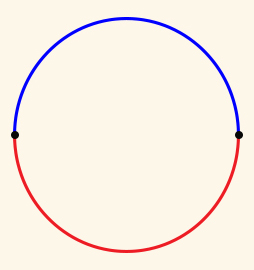
Let’s take a circle.
Notice that the two points in black on the outside that are directly opposite each other.
If you rotate the circle clockwise, or anti clockwise, then the two points will rotate relative to each other. And from the perspective of the centre of the circle, they will be moving in opposite directions.
Now, if you imagine the circle is the view of a Tai Chi practitioner in the video of rollback, but viewed from above, you can see that if they rotate around their centre then the parts of the body on the opposite sides of their circle will be moving in opposite directions.
Now, unless they are spinning constantly, they won’t keep this up for long in the same direction, but it will be happening continually throughout a Tai Chi form, just in different directions and with different parts of the body.
So, while his left hand is rotating backwards to the left, clockwise direction, his right shoulder is moving equally forward to the right, still clockwise. They are the points on opposite sides of the circle. Obviously he then hits the limit of his rotational possibilities (without stepping) and stops.
Obviously Tai Chi is more of a sphere than a flat 2D circle, but hopefully the point stands and shows how circular movement around the centre point can produce power from the whole body.
The writings in the Taiji Classics really only make sense if you understand what they’re saying already. As we’ll see…
Everybody who practices Taiji and has read the Taiji Classics is familiar with the idea of using the legs as primary generators of force, rather than the shoulders and arms.
As it says in the classics:
“The chin [intrinsic strength] should be rooted in the feet, generated from the legs, controlled by the waist, and manifested through the fingers.”
Reading that, you’d think that it’s talking about simply pushing off the ground with the legs to generate force. But that’s not the whole story. It couldn’t be – I mean, a good boxer punches from his legs in a similar manner, getting the force of the whole body into the shot. Taijiquan is supposed to be ‘internal’ and involve a different way of moving than regular athletic human movements. Isn’t it?
This mention of ‘controlled by the waist’ here is the key. It’s referring to the fundamental idea in Taijiquan that the dantien area of the body (basically, the waist, but inside, not just on the surface) is controlling the actions of the arms and hands, so they don’t move independently of the movements of the body. This should be true of any Taiji movement, regardless of the particular style of Taijiquan being practiced.
This is such an important concept to Taijiquan that in a lot of interviews (like this one) Chen Xiao Wang, the head of the Chen style branch of Taijiquan, calls it his “1 principle”:
CXW: “There is just one principle and three kinds of motion. The one principle is that the whole body moves together following the Dantien. In every movement the whole-body moves together but the Dantien leads the movement and the whole body must be supported in all directions. This is very important. One principle, three kinds of motion: the three kinds of motion are as follows…First, horizontal motion, the Dantien rotates horizontally. The second kind of motion is vertical motion, the Dantien rotates vertically. The third kind of motion is a combination of the first two. Any movement that is doesn’t follow the principle is a deviation. So when we are training every day we are trying to find and reduce our deviations from the Taiji principle.”
You could also sum up this concept using the phrase, “Hands follow body”. (Later on you get ‘body follows hands’ – but let’s not worry about that right now).
It’s important to note that this mode of movement is contrary to the way we normally move in everyday life. It’s very common for people to be able to understand it intellectually, but not be able to physically embody it. It’s also very difficult to do it consistently. In Taijiquan you need to do it all the time, and without cheating! Take your mind of it for a second and you’ll find you revert to using your ‘normal’ movement again; you’ll use your shoulder and upper body to move your arms. Throw in working with a partner who is providing resistance and it becomes even harder to always move from the dantien.
Incidentally, I think one of the reasons for the incredible amount of solo form work found in Taijiquan is that you need to practice this stuff for months and years for it to become ingrained in your body, so that it becomes the default way you move, even under pressure. Hence the need for regular form practice.
So, the dantien moves, and it moves the hands. So far, so good. The next question is ‘how?’ How, exactly, can moving your legs, hips and dantien control the actions of the arms and hands?
The answer lies in the muscle tendon channels that connect the body internally. They (generally) stretch vertically from the hands (fingers) to the feet (toes) either on the front of the body (yin channels) or on the back of the body (yang channels). It’s important to note that the channels themselves don’t really cross over the body from side to side – they generally run vertically. Credit needs to go to Mike Sigman here, for introducing me to this concept of muscle-tendon channels.
The theory is that muscle-tendon channels were the precursor to the acupuncture channels that we’re all familiar with these days, and are a roadmap of the strength flows and forces of the body. If you really want to get into it, there’s a fuller explanation of the theory on Mike’s website, but the TLDNR (too long, did not read) version is basically that if you create a stretch on the muscle tendon channels from end to end, so they are somewhat taught, then you can start to manipulate them via their central nexus – the dantien – so that a movement of the dantien can power a movement of the hand (or foot). Yes, it’s more complicated than that (there is more than one dantien, for example), but that’s the basic idea.
If you remember back at the start of this blog post, I quoted some lines from the classic that says the progression in generating movement in Taijiquan starts from the bottom and goes upwards, yet at the same time we’re being told that all movement starts in the dantien, which is definitely not in the feet. So, we have a contradiction. Or do we?
Here’s the thing: If you use your legs to push upwards off the ground to generate force you get a kind of “muscle jin”, since you’re not using the power of the dantien, as described by Chen Xiao Wang. To really get to the meat of what it means to use Jin (refined force) in Taijiquan you need to learn how to send force downwards from the dantien to the ground, and bounce it back up simultaneously. So, the originator of the upwards force is still the dantien, and the general direction of force is still upwards from the feet.
For example, when you’re loaded onto the rear leg, and ready to push forward you’d actually start by sending force from your dantien area downwards, “sink the qi”, and the bounce back force that comes up from the ground is what you use to push the opponent away. It should be noted that sending forces down to the ground from the dantien and bouncing it back into the opponent is simultaneous – there’s no time delay.
The next time you go swimming dive down to the bottom of the deep end and stand on the bottom then push off the floor and send yourself upwards to the surface. What you’ll notice is that you naturally want to drop your weight down before you push up. This is a crude kind of approximation of what’s going on in a Taiji push.