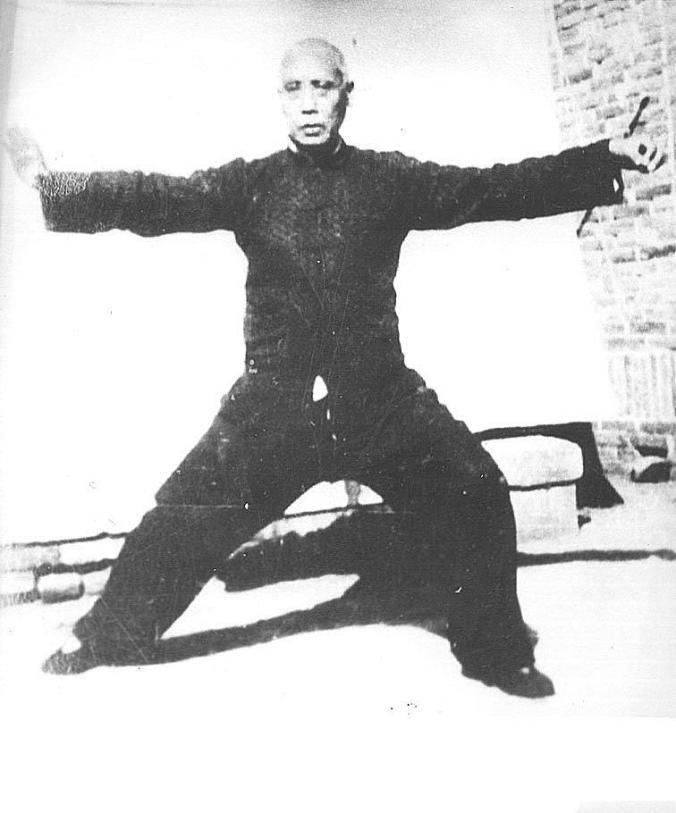
Here’s week 5 of my course Pulling Earth Pushing Heaven, on mindful Tai Chi movement.
OK, so to recap, we’ve started off looking at building the elastic connection along the channels. We’ve looked at relaxing the lower back and getting the power to come from the lower body. We’ve talked about not compromising the movement in the arms. We’ve added in reverse breathing. Now we’re going to try to keep all that and get the movement to be directed from the middle of the body – the dantien.
No, not my life. This guy’s life. He made a video about it:
Yes, I know the connection between Tai Chi and Wudang mountain is tenuous at best, and he repeats some old made-up stories about the origins of Tai Chi, but it’s a fun video to watch.
Here’s part 4 of the course. This week we focus on breathing. I cover the topics of normal and reverse breathing, then show a couple of different exercises that will get you on the right track for applying the breathing methods to the movement we are working on. Finally, we integrate the breathing into the movement, preserving all the progress we have made so far. Once you get the hang of it those breathing exercises I show are not required anymore, as you should be integrating it into your main exercise.
This week is more subtle than work showed previously. An inner focus will be required. Good luck! I’m happy to answer any questions you have.
Here’s part 3 of my 8-week course on mindful movements with Tai Chi. Last week we looked at the lower body, this week it’s the turn of the upper body and I throw in a bit of zen wisdom at the end for good measure. Enjoy!
Here’s the second episode of my Tai Chi course on mindful Tai Chi movements. This week we take a look at where you power you movements from in the body. Enjoy!
Good news! I’ve started filming a short 8-week Tai Chi Notebook course, and you can get it here, for free.
As usual things come together by chance (or maybe a it’s fate) but either way, a friend asked me to show them how to do “this internal stuff“, so I was about to shoot them a simple video on the basics, then I realised that there’s too much to cover in just one video, so I planned out 8. Then I started to get creative and made it look a little bit professional, and the end result is what you’ve got here – a short YouTube course called Pulling earth, pushing heaven.
In week 1 of the course we cover the concept of “maintain and extend”. Each week will focus on a different aspect until we get to the point where you’ve got the basic idea of “Tai Chi movement”. Of course, this is just ‘foot in the door’ stuff, but I’d like to think that after following along for 8 weeks, and doing it every day, you’d at least have the correct foot inside the correct door. Look out for part 2 next week.
The connections between Tai Chi and Taoism are at once obvious (the Tai Chi symbol is used extensively in Taoism) and also sketchy at best (there is no historical lineage connection).
You see a lot of Taoist priests (or at least Chinese people wearing Taoist priest robes) on Wudang mountain, which has traditionally been associated with Taoism, teaching people Tai Chi, Xing Yi and Bagua (the internal arts) in the lineage of Chang San Feng, the mythical Taoist who is traditionally associated with the origins of Tai Chi Chuan, but whose historical existence seems difficult to prove.
However, how long these modern days Taoists have been there teaching people martial arts I’m not sure. The fact that their ‘ancient’ martial arts look remarkably similar to the modern “wu shu” versions created in Beijing makes them seem highly suspect to me…
But while a direct connection between Taoism and Tai Chi may be difficult to prove, they clearly employ the similar ideas. Take for instance the idea of Wu Wei – the ever elusive “doing without doing” of Taoism.
If you take a look at the Tai Chi Classics you see that while they don’t mention the phrase “Wu Wei” itself the strategy of the art described fits it like a glove. Take the following quotes from the Treatise on Tai Chi Chuan:
It is not excessive or deficient;
it follows a bending, adheres to an extension.
When the opponent is hard and I am soft,
it is called tsou [yielding].
When I follow the opponent and he becomes backed up,
it is called nian [sticking].
If the opponent’s movement is quick,
then quickly respond;
if his movement is slow,
then follow slowly.
It seems Taoism is having something of a resurgence, as this article reveals, as a philosophy for dealing with the anxiety-inducing modern world. Even the rock star intellectual de jour, Jordan Peterson, is getting in on the act.
From Alan Watts back in the ’60s to Jordan Peterson in the modern age, the Western intellectual has had a recurring fascination with Taoist thought. Particularly with the concepts of Wu Wei and the Tao Te Ching. In fact, the book that first got me interested in Tai Chi years ago was The Tao of Pooh by Benjamin Hoff.
I think all this interest in Taoism again is generally a good thing. Let’s see where it leads.
If we think of ‘basic Jin’ as being the ability to direct the solidity of the ground through the body, from the feet up to the hands, then there are four basic directions we can use this power in.
Up
Down
Away from the body
Towards the body
And since you can go away from the body and towards the body on both the x and z axis (to the sides and in front and behind), that makes 6 directions in total.
Here’s Mike Sigman explaining the 6 directions and Jin:
Due to a nasty training injury, I’ve had to lay off the “rough stuff” for a while, which means I’ve got more time to spend on forms practice than usual. The latest little project I’ve been amusing myself with is learning the start of a different Taiji form than the one I know.
I’ve picked Chen style, since this is the oldest style, and pretty different to my Yang style form.
It’s often hard to see the connection between Yang and Chen style since they look so different, but as I’ve discovered, if you start to learn the beginning of one after already knowing the other it’s very easy to see how they have the same root. This has already provided lots of insights into my regular form by looking at how Chen style treats familiar movements.
To be clear, I’m just learning the first few moves of the form. Probably I’ll get up to the Crane Spreads Wings move (or whatever they call it in Chen). After that, I think the law of diminishing returns starts to kick in and the time spent working on a new form and remembering it starts to outweigh the benefits you get from practising it. I already know a long form, so I don’t think there’s much to be gained by undergoing the arduous process of learning another one.
This little project has made me think about a few side issues, which I’d like to go over below:
Learning from video
There’s this unwritten rule in martial arts that learning anything from a video is bad, or so the conventional wisdom goes. Learning from a real person is preferable, but not always practical. If you’ve got enough experience in an area then I think you can learn a lot from video. Also, let’s not forget, that there are videos on YouTube of recognised experts, like Chen Xiao Wang, doing the form, who are doing it a lot better than any local teacher you’ll find.
For instance, here’s the renowned Taijiquan expert Chen Zheng Li doing the Chen Lao Jia Yi Lu form in a nice relaxed pace that’s easy to follow:
Of course, there will be fine details I’ll miss by copying him, but I’m doing this more as an exercise in personal exploration, rather than in trying to get the Chen form perfect. In fact, I’ve already modified one move I felt would work slightly better in a way I’m more familiar with. (I’m a heretic, I know)
2. Distinguishing ‘energy’ from ‘moves’
Taiji uses the four primary directions of Jin – Peng (upwards), Ji (away from the body), Lu (towards the body) and An (downwards) in various combinations. It’s often hard for people to separate this ‘energy’ direction from the physical movements themselves. So, a “ward off” posture is one thing, but the energy that you usually use with it – Peng – is another. Confusingly, Peng is often translated as “ward off”, so the two become conflated. By doing a new form with different moves, you get to see how the same ‘energy’ is used in a different arm shape.
For instance, in Yang style the ‘ward off’ movements tend to have the palm pointing inwards towards the body, while in Chen style, they are pointed outwards, away from the body.
3. Spotting similarities
So, while a Chen form may look very different to a Yang form, once you start thinking in terms of which of the 4 energies you’re using, you start to see the similarities, even if the postures look different.
For example, both forms start with a Peng to the right, a step forward, another Peng forward, a splitting action, then another Peng to the right, then into the Peng, Lu, Ji, Lu, An sequence known in Yang style as “Grasp Birds Tail” in Yang and “Lazily tying coat” then “Six sealing four closing” in Chen style. (Apparently, the Yang naming came from a mistranslation of the original Chen name, but this matters not to me).
(Note: In some performances, of Chen style – like the one above by Chen Zengli, he misses out the “Lu then Ji” move of the sequence. In others, like this one by CXW below, it’s in there. I don’t know why. Personally, I like to put it in, because it connects me to the Yang style I know.)
Doing Peng in a different arm configuration than you’re used to is, frankly, good for your practice, because it helps you break out of the mould a bit, into a freer execution that is not dictated to by the conventions of your particular style.
The New Year Challenge! Do it yourself
I’d like to challenge you to do the same thing in January. If you’re a Chen stylist, then learn the start of the Yang form up to White Crane Spreads Wings. If you’re a Yang stylist, then give the Chen form a go. Alternatively, investigate the opening sequence of Sun, Wu or Wu(Hao) style. Give it a go!
Here’s a video of Yang and Chen forms done side by side that I’ve posted before because it helps show the similarities:
This set of eight exercises is a popular Qi Gong exercise in China, probably the most popular. There are hundreds of different variations. This one I particularly like because although the reeling movement she’s doing is hidden to the point of invisibility, the arm movements are being used very obviously to enhance the subtle tensioning from fingers to toes throughout in a way you can see. Very nice.