I think I’m going to start referring to the theme of our recent Heretics podcasts (that Taijiquan was started by the Wu’s and Yang LuChan in 1851, then continued to evolve over the following decades, getting more commercial as it went, and was finally ‘completed’ as a coherent philosophy, martial art and national art in the 20th century), the Heretical Hypothesis.
It stands in contrast to the conventional lineages for the art. Which were first:
i) Zhang SanFeng was the originator. Then it goes into Chen village via Wang ZongYue, and then to Yang LuChan.
Then when this fell out of favour you get either:
i) Various ancient lineages of Taijiquan from Wudang some of which end up in Chen village, others continue to the present day and miss out Yang LuChan.
ii) Obviously Zhang is a fiction, so we start in Chen village (via Wang ZongYue) to Chen Wanting (16th century) and onwards to Yang LuChan.
What’s in a name?
There is an absolute dearth of writing about Taijiquan until after the Ching Dynasty ends. Why there are no published works during this period is an interesting question, but we’ll leave that for another time. All we have in that period is really the group of writings know as the Tai Chi classics, also called the Salt Shop Classics, that Wu YuXiang alleges he found in a Salt Shop, but most people think he actually authored.
In the Salt Shop Classics we see two names pop up – Zhan SanFeng and Wong ZongYue representing a historical lineage. Zhan SanFeng’s name is dropped in the Li copy of the original by 1881, but that’s a good 20 years after Tai Chi entered its commercial period (1861), so a lot has happened and the fortunes of the Ching Dynasty has changed.
Douglas Wile (‘Lost Classics…’ page 111) expresses that view that Zhang SanFeng was already associated with pro-Chinese and anti-foreigner sentiment, and that was the reason for his inclusion in the original version of the Salt Shop Classics. And by the time the manuals were copied by Li (1880s) it is removed because politically it looks more likely the Ching dynasty is going to survive at that point.
It’s an interesting idea, that makes sense. But what of the name Wang ZongYue? There’s no historical evidence that Wang ZongYue existed. Again, Wile points out that using the name “Wang ZhongYue” could have a more political than factual origin. Wang ZhongYue is a euphemism for Marshal Yue Fei of the Song Dynasty, who again stood for anti-foreign sentiments and pro-Chinese nationalism.
Wang = King, Zhong = Revering. Yue = Yue Fei, either himself or his lineages (his army).
That would make sense if (following the Heretics Hypothesis) the original purpose of the Wu’s was to create an essentially Chinese martial art practice to bind the Confucian Elite together against all the threats they were facing – Taiping rebellion, Nian rebellion, Foreign powers, etc.
An important addition to the writings on Taijiquan, and Chen style in particular, that ultimately raises more questions than it answers.
I first heard about this translation of Chen Zhaopi’s 1935 book on Taijiquan by Mark Chen in an interview he did with Ken Gullette on his Internal Fighting Arts podcast. It’s well worth listening to that episode because Mark is an engaging speaker and he covers all the most interesting revelations of the book there.
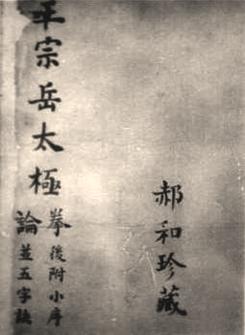
I was impressed with the podcast, so ordered the book and finally managed to finish reading it recently. As already mentioned, the book contains translations of selected texts from Chen Zhaopi’s “Chen shi taijiquan hui zong” (“Chen family taijiquan selected masterworks“), published in 1935, but contains texts that claim to originate from earlier periods, authored by Chen Chanxing (and that’s where the fun starts), but let’s first take a closer look at who Chen Zhaopi was.
Chen Zhaopi
Chen Zhaopi is a pivotal figure in Chen family history, as he was the first Chen practitioner to move to Beijing from Chen village and teach Taijiquan commercially, in 1928. When he later accepted a teaching post at the Central Guoshu Academy in Nanjing in the south, the famous Chen Fake replaced him in Beijing in the north, securing the Chen legacy. Chen Zhaopi’s life (recounted in detail here) is a remarkable story, as he went through a series of highs and lows. His toughest time was during the Cultural Revolution when he was persecuted heavily, so much so that he attempted suicide. Thankfully he survived, and once Mao had decided that Taijiquan was not a threat to the nation returned to teaching in the Chen village where he managed to tutor the next generation, who are all famous names in Chen style today. Without his efforts it’s unlikely that a martial tradition would have survived in the Chen village at all.
Collected Masterworks starts with two biographies of Chen Zhongshen, a famous fighter for hire from Chen village who lived during the tumultuous events of 19th century in China, suppressing rebels, and was renowned for his excellent martial skill. Longer versions of these biographies later appear in Chen Xin’s book. It feels somewhat like these biographies are added to the start of this volume to stake the claim of Chen fighters to being experienced fighters and serious martial artists.
Of more interest to the casual reader are the next two texts which are attributed to the famous Chen Chanxing (although the author notes they have also been attributed to Chen Wanting elsewhere), who was the teacher of Yang Luchan in most of the orthodox histories of Taijiquan. That makes them the most important texts in this collection. Mark gives excellent introductions to each text he translates, with copious notes.
The first text is “Chen Chanxing’s Verse of Taijiquan”. It’s short – just 1 page long – and although it doesn’t mention Taijiquan by name, reads like many old Chinese texts on Taijiquan. E.g.:
“Freely bending and extending, others know nothing, Always in contact, I totally rely on winding”.
The second text attributed to Chen Chanxing is a compilation of posture names from the Taijiquan form.
But the third and final text attributed to Chen Chanxing is where the mystery deepens. It is much longer and titled: “Chen Chanxing’s Discussion of Taijiquan’s 10 main points”.
Reading through the text of “10 important points”, I found the words eerily familiar, “in all matters separation must have unification”, “inside and outside are joined, front and back mutually support each other”…. then I realised that was because I was reading a modified version of the Xing Yi classics normally referred to as “The 10 thesis of Marshal Yue Fei” and sometimes attributed to the eponymous Song dynasty marshal.
While they are of unknown provenance the 10 Thesis forms the basis for most of the classic writings on Xing Yi that you’ll find in later works; so I’d say its connection to the martial art Xing Yi is unequivocal.
Except here. Here, in Chen Zhaopi’s book it is presented as Chen Chanxing’s original writings on Taijiquan. The author (either Chanxing, Zhaopi, or maybe Mark Chen?) even puts the name “Taijiquan” into the text itself to make it seem more authentically about Taijiquan. E.g. “Taijiquan is ever changing. There must be energy everywhere…”
Obviously, these references to “Taijiquan” are not found in the other available translations of Yue Fei’s classic (the version linked above appears in “Xingyiquan: Theory, Applications, Fighting Tactics and Spirit” by Yang Jwing-Ming, for example). These translations use the term “martial arts” instead.
Not reading Chinese, I don’t know if the phrase “Taijiquan” was used in the original print edition by Zhaopi (1935), at a time when it was already in common usage, or was inserted into this translation by Mark Chen in this edition. And if it was used by Zhaopi, did he insert it or was it in the original source material allegedly from Chen Chanxing?
But either way, clearly something is being done to attach Chen Chanxing’s name to the history of Taijiquan by co-opting some old martial arts writings.
In the Translator’s Preference at the start, referring to the 10 points, Mark Chen writes:
“Interspersed amidst the theoretical discourse, the text contains perhaps some of the best practical martial-arts instruction ever written. It is clearly a transitional document on the timeline of taijiquan’s evolution, composed in an era when utility was still paramount – the work of a vastly experienced fighter wielding a vigorous rhetorical facility to convey the true “look and feel” of an advanced martial art. What emerges from the text is not theoretical pablum about soft overcoming hard, but a picture of the formidable fighiting system that made the Chen clan of Wen County some of the most feared caravan guards and bandit hunters of the Qing dynasty, from Hubei to Shandong.”
I’d say he’s right about the value of the text, and the reputation of the Chen clan, he just has the wrong author, and the wrong martial art!
Whether or not Marshal Yue Fei actually wrote these 10 thesis (obviously this is unprovable) is beside the point, the point is that they are well known and in wide circulation, and Chen Chanxing certainly did not write them. And yet this book treats them as the original writings of Chen Chanxing, without question.
Maybe I’m missing something here, (and somebody please correct me if I’m wrong) but I find this error perplexing as the author has clearly put huge amounts of effort into this translation, and agonises over each character he translates. The Appendices where he talks about the details of his translation and the provenance of different Taijiquan writings, like the Salt Shop Classics, and also the Chen Wanting origin story are really fascinating and show how much work he’s put into researching this book.
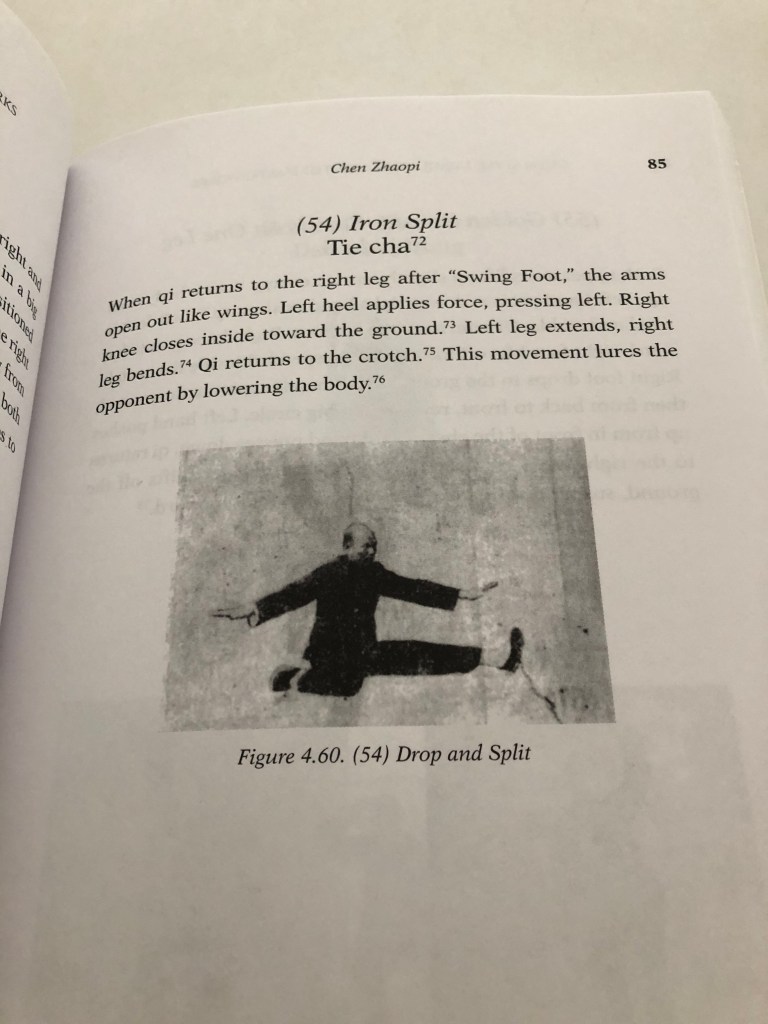
Moving on, the next chapter is by Chen Zhaopi himself and contains annotated photos of Zhaopi performing the Chen old frame first form. These photos will be of particular interest to modern day Chen practitioners as he performs many movements in quite acrobatic ways, including movement 54 called the “Iron split” where he drops to the floor in a dramatic half splits movement.
After this we have an explanation of push hands and the original texts written in Chinese. Finally, the appendices and copious notes sections are well worth reading.
Overall this book is an excellent addition to the literature on Taijiquan, and an essential purchase for all Chen stylists, although I keep coming back to the question of why Chen Zhaopi is presenting the Xing Yi classics as belonging to the Taijiquan literary canon and presenting them here as the writings of Chen Chanxing.
Chen Style Taijiquan Collected Masterworks is clearly a labour of love for the author and translator and every Taijiquan practitioner will enjoy it, but for me it ultimately throws up more questions than it answers.
Confucian Scholar Zhu Xi -(1130-1200AD. This man has a lot to answer for 🙂
Our recent Heretics Podcast series on the history of Tai Chi Chuan keeps generating interesting feedback. Here’s a particularly good one I got today:
My compliments to Damon and Graham on their podcast about the origins of Tai Chi Chuan. I particularly liked mapping martial art history to the general history of the period. From a strict reading of the available evidence the podcast cannot be faulted. Where there maybe problems is in the interpretation provided, which it could be argued commits the error of anachronism. Here is a good quote from a Wikipedia article: “In historical writing, the most common type of anachronism is the adoption of the political, social or cultural concerns and assumptions of one era to interpret or evaluate the events and actions of another”. The interpretation basically argues that Tai Chi Chuan was a bonding exercise in the Imperial Court because of the political decline in the Qing state. A lot more evidence is needed to support the claim that Yang Lu Chan, probably an illiterate low-class bonded servant, was used like an external consultant to go into a large organization and help reassert tradition Confucian values. That looks like an interpretation of Chinese History filtered through the prism of 21th century corporate culture.
Well, that’s an interesting idea. I really like well thought out criticism, especially when it’s delivered so succinctly.
Let’s explore a few of these ideas, and see where it takes us.
I see our podcast on the Myth of Tai Chi as “what Damon thinks really happened based on the available evidence”.
So, there will always be a lot of interpretation involved. History is essentially how you join the dots together. I think what Damon is doing is joining the dots together in a new way that makes a lot more sense than the stories we have been given by our teachers (in some senses the last people you should be asking about real history are martial artists), which all have parts that don’t make sense:
1. The original story we were given was about Tai Ch Chuan (Taijiquan) being created by a Taoist immortal called Chan San Feng. He’s a semi-fictional character who appears at various times throughout Chinese history. Most people who don’t believe in spirits of the ancestors walking amongst us (a common belief in China then) now dismiss this story. Li Yiyu even removed it from his hand written copy of the Tai Chi classics as early as the 1880s. I think this is one for the flat-earthers out there 🙂
2. The next story is that he learned in Chen village where Tai Chi was created by Chen Wanting in the 16th Century. This story was officially adopted by the General Administration of Sport of China who awarded Chen Village, Henan, a commemorative plaque acknowledging its status as ‘the birthplace of taijiquan’, in 2007 (See Fighting Words, Wile, 2017, Martial Arts Studies (4).) however this plaque had to be removed after just two months after a “firestorm” of new claims to the Tai Chi $ appeared, including the newly ‘discovered’ Li family documents.
But apart from that the story is full of holes. i) For a start nobody in Chen village used the name “Taijiquan” until long Yang used it. ii) There is also no actual evidence he was in Chen village at all. iii) Wu Yuxiang and Yang Luchan meet in Beijing for the first time, yet both have separate connections to an obscure village in China? iv) Then there’s the issue of why they taught an outsider like Yang, but only him – they didn’t teach anybody else, ever! v) Then there’s all the extra content (lots of other forms, weapons, etc) not found in Yang style, but found in Chen style, vi) Chen village records crediting their martial art to the earlier Chen Bu, not Chen Wanting, vii) the emphasis on silk reeling found in Chen style… the list goes on and on. It just doesn’t add up. However, it still needs explaining why the Chen old form and the Yang long form follow the same pattern (see the upcoming part 6 of Heretics podcast series for Damon’s explanation).
3. There are other theories of Tai Chi Chuan being ancient – really ancient, sometimes a thousand, or two thousand years old (that’s the White Cloud Temple claim) – and coming from Wudang mountain, via various unverifiable people, and ending up in the hands of Yang LuChan somehow – but nobody takes these claims seriously.
Of course, Damon isn’t saying that Tai Chi Chuan was created out of thin air, but rather it is the content of Northern Shaolin arts that Yang LuChan (a good martial artist) knew, adapted to fit certain traditional Confucian Court values thanks to Wu Yuxiang, and with a backstory added by Wu to make it appear ancient.
A class-based society
Chinese society was class-based, and teaching martial arts would make Yang LuChan the same class as theatre performers, i.e. the lowest of all classes.
From the Wikipedia article above: “There were many social groups that were excluded from the four broad categories in the social hierarchy. These included soldiers and guards, religious clergy and diviners, eunuchs and concubines, entertainers and courtiers, domestic servants and slaves, prostitutes, and low class laborers other than farmers and artisans. People who performed such tasks that were considered either worthless or “filthy” were placed in the category of mean people (賤人), not being registered as commoners and having some legal disabilities.[1]”
So, Yang LuChan was a Jianren, yet, there he was inside the Forbidden City, teaching (and mixing with) the most high-level people in the system.
Wu Yuxiang and Yang Luchan
I think this can be verified: The only students we know he had were all in senior positions, like Wu Yuxiang, and Wu Quan Yu, for example. Those are the facts of the matter, and viewed through our eyes that does make him something like an external consultant, but only superficially. Compared to a consultant of today the power dynamic would be very different. I imagine Yang would be doing a lot of bowing and kowtowing to these senior people he’s teaching.
But is that anachronism or just a reading of the facts? The teaching of martial arts as a hobby or binding action for the court, was indeed a unique innovation, but I don’t think somebody of the lowest class being used to entertain the court is that unusual at all – there is plenty of historical precedent: Theatre entertainers, for example, were regularly brought to the Forbidden City to entertain the Confucian court, throughout Chinese history:
“The Ming imperial court also enjoyed opera. However, most Ming emperors liked to keep their music entertainments inside the palace.[24] They performed for the court. ”
Jingxi (Peking Opera) was certainly popular in the Ching court too:
“In music, the most notable development of the dynasty probably was the development of jingxi, or Peking opera, over several decades at the end of the 18th century. The style was an amalgam of several regional music-theatre traditions that employed significantly increased instrumental accompaniment, adding to flute, plucked lute, and clappers, several drums, a double-reed wind instrument, cymbals, and gongs, one of which is designed so as to rise quickly in pitch when struck, giving a “sliding” tonal effect that became a familiar characteristic of the genre. Jingxi—whose roots are actually in many regions but not in Beijing—uses fewer melodies than do other forms but repeats them with different lyrics. It is thought to have gained stature because of patronage by the empress dowager Cixi of the late Qing, but it had long been enormously popular with commoners.” – from https://www.britannica.com/topic/Qing-dynasty
So, I think we can establish Yang in the position we say he is in (the Royal Court). But let’s get to the meat of the matter!
“A lot more evidence is needed to support the claim that Yang Lu Chan, probably an illiterate low-class bonded servant, was used like an external consultant to go into a large organization and help reassert tradition Confucian values.”
I agree, but it’s hard to know what form that evidence could take? The Smith hypothesis is that it was Wu Wuxiang who was performing some sort of re-instigation of Confucian values, and Yang LuChan was just being used as a gun for hire. We know he was there, in the royal court, but the question of what he was doing there is the key issue.
Tai Chi Chuan as Neo-Confucianist martial art
Everybody knows Tai Chi is based on Taoist principles, starting with Yin and Yang. But wouldn’t you expect the martial art Yang and Wu came up with to be more Confucian in flavour than Taoist? Why then was Yang teaching a martial art that people instinctively know is Taoist in philosophy? Tai Chi Chuan (a soft, internal martial art) is, after all, based on those great symbols of Taoism – the Yin Yang symbol, the 5 elements, the 8 Bagua, etc..
So, how do you explain that contradiction? Well, I can add one more piece of evidence. I wouldn’t call it a smoking gun, but it does add to the overall narrative:
If we look at the content of what he was teaching (Tai Chi Chuan) – then you’ll find it kind of is based on traditional Confucian values, rather than anything Taoist. I’ll explain…..
People talk about Tai Chi as being Taoist a lot, but Taoism is this shaggy, messy, nature-loving, outdoorsy, shamanic, magic, smokey, rich, spiritual, earthy thing involving things like spirit possession and exorcism – it’s not very Confucian at all. Or indeed, very like Tai Chi Chuan.
The best description of Taoism I’ve heard was by Bill Porter (Red Pine), who likened Taoism to “house-broken shamanism”.
The philosophy we find in Tai Chi Chuan – yin and yang, 5 elements, 8 powers, etc. uses the symbols of Taoism, but is all very heavy on categorisation – it’s very clean, neat and orderly. In fact, very… Confucian!
Or, rather, it’s what scholars call “Neo Confucian”. At the time that Buddhism was gaining popularity in China, as a threat to Confucianism, the Confucians needed something to combat it, because they had nothing very “spiritual” in their religion, whilst Buddhism and Taoism were both full of spiritual stuff.
The Confucians plugged the gap with what became known as Neo-Confucianism. Neo-Confucianism adopted the signs and symbols and ideas of these more spiritual religions (yin and yang, Taiji symbols, 5 elements, etc), but it was really just repackaged Confucianism 101. The scholar responsible for all this was Zhu Xi, who lived during the Song Dynasty, from 1130-1200AD. He effectively sanitised all these Taoist ideas and related it all back to the 4 classic texts of Confucianism. His impact in his lifetime was not so great, but to later periods it was absolutely huge – his ideas formed the basis of the Civil and Martial exams that people had to pass to enter government/senior positions, for example.
Zhu Xi
Damon did an excellent episode about Zhu Xi’s impact on Chinese society and martial arts as part of the Heretics Xing Yi series (the same Neo-Confucian philosophy ends up being dumped on Xing Yi during a later period).
Give that episode 5 of Xing Yi a listen. To me it makes sense.
I should add some rumour control, since I think that Tai Chi people will generally not like this Neo-Confucian angle:
1. I don’t think saying that the philosophy of Tai Chi is actually Neo-Confucian, rather than Taoist is a diss to the art – an actual Taoist martial art I imagine would not be as practical! It would be messy, unfocussed and a bit wild. A martial arts form repeated over and over in the same sequence each time would probably be a strange concept to a Taoist!
2. I also don’t want to diss the Chen family – their reputation during the Ching Dynasty was of them being practical and expert martial artists who actually used their martial skills to fight bandits and escort caravans. They were the real deal! Their family martial art is older than the appearance of Taijiquan in the 1850s by far – and as any good Confucian knows, older is always better! 🙂
What matters to me about Taijiquan is that it works, not what you call the philosophy behind it.
In this episode we look at how the effects of the Taiping Northern Expedition and the Nian Rebellion of the mid Nineteenth Century drew the confucian Wu brothers and the fighters of Chen Village towards each other for the first time.
Ok, here it is, part 2 of our history of Tai Chi Chuan. In this episode we examine the context in which the relationship between Yang Luchan, Wu Chengqing and Wu Yuxiang developed during the years of the Taiping Rebellion and the new regime of Emperor Xianfeng.
Looking back over the last few blog posts I’ve written it occurs to me that a reader might think that I don’t actually like Tai Chi Chuan. I do. I practice it pretty much every day. There’s something in it that is just very good for you. Before practice I feel a bit unfocussed, and uncoordinated. After practice I feel like I’m back “in the zone”, and that’s a rare thing for any practice to deliver as consistently as Tai Chi does. And it always does.
If I contrast that with Jiujitsu (something I also love, or at least used to before this lockdown started), after that I’m an exhausted, sweaty mess in need of water and recovery. Jiujitsu is a lot of fun, but it breaks you down. In contrast, Tai Chi builds you up. You need both together. I’ve always practiced my Tai Chi with other more physical arts anyway. More dynamic things, like Choy Lee Fut or Xing Yi are great compliments to the relaxed, slow Tai Chi movements.
One of the reasons I criticise Tai Chi a lot is that it does have the most abysmally low standards amongst its practitioners of any martial art you’ll ever see. In fact, it’s a martial art that most people don’t actually practice as a martial art!
Regular readers to the blog, or regular listeners to the Heretics Podcast, will know that we recently started a series on “The Myth of Tai Chi“. Again, it sounds like it’s a bit of a negative attack on Tai Chi, but anybody with even a cursory understanding of Tai Chi history will realise that a lot of it is vague, unknown and contradictory, especially for a period of time (1850s onwards) in which other martial arts (like Xing Yi) have no confusion over their history and lineage.
Episode 1 of the podcast takes into account all the other things that were happening in China in 1850, and there was a lot! It was a period of turmoil that was about to become even worse with the most bloody civil war in world history – the Taiping Rebellion – which left an estimate 20 million dead. (If you’d like to know more about this and the various martial arts that were created around the same time period, like Wing Chun and Choy Li Fut, then I’d recommend Benjamin Judkin’s excellent book Creation of Wing Chun, The: A Social History of the Southern Chinese Martial Arts – it’s by far the best Chinese martial arts history book I’ve read).
The best Chinese martial arts history book you’ll ever read!
Now the scene is set, episode 2 (coming soon) will offer more definite conclusions on the origins of Tai Chi Chuan, but there’s still so much left to talk about that this will soon become a mult-part story. You might want to empty your cup before you listen though: Damon’s conclusions on what Tai Chi really is are not particularly favourable for any group trying to claim ownership of the Tai Chi brand – the Chens, the Yangs, the Wus the Taoists or anybody else. You’ll have to wait until episode 2 is released in the next few days to find out what the big reveal is!
But until then, just a little reminder that I do actually like Tai Chi Chuan (honest!), despite appearances. And regardless of its origins what matters is its actual practice. Learning about history won’t make you any more or less skilful, only practice will do that.
The 98th Regiment of Foot at the attack on Chin-Kiang-Foo (Zhenjiang), 21 July 1842, effecting the defeat of the Manchu government. Watercolour by military illustrator Richard Simkin (1840–1926).
The history of Tai Chi Chuan (Taijiquan), rather than its actual practice, is one of the most controversial subjects to do with the art. Various different groups have tried to claim Tai Chi as their own, and considering the amount of money involved in the art it’s very hard to know who to trust in this matter.
In this podcast we’ve tried to look objectively at the facts, and the result is that it doesn’t look good for anybody, especially the British 🙂
The history of Tai Chi Chuan is a subject I’ve wanted to tackle on our podcast for a while, but now (thanks to one of our patreons, Gabriel) it’s finally a reality.
In this episode we begin a new series of episodes on this subject by setting the scene and historical background to the mythmaking around the origins of Tai Chi that occurred starting from the middle of the Nineteenth Century in response to social turmoil and unrest exemplified by the Taiping Rebellion and Opium Wars.
“All movements are motivated by Yi, not external form.”
[Yi is usually translated as “intent” and refers to the mind. It doesn’t mean ‘your intent to do something’ – a closer English translation of that would be “will”, and it definitely doesn’t mean what a lot of people end up thinking it means, which is your intent to be violent. People talk about having this kind of killer, or predator, mindset. Maybe that’s useful for self defence, but no, that’s not what Yi means.
What these lines are saying is that the guiding action for a movement comes from your mind leading the body. It’s your internal self leading your external self. In Taijiquan your dantien leads the physical movement, with your body kind of trailing behind, but here we are told that before that happens, the intuitive part of your mind starts the movement.
It’s important to note that we’re not talking about the thinking, intellectual, part of your mind here. I quite often liken Yi to thinking in directions. You want to raise your arm up, you think in that direction and let the body follow. What this does is dispense with the intellectual, thinking, part of the brain, and just gets you in touch with the physical body directly, with no barrier in between.]
7.
“If there is up, there is down; when advancing, have regard for withdrawing; when striking left, pay attention to the right.
If the yi wants to move upward, it must simultaneously have intent downward.”
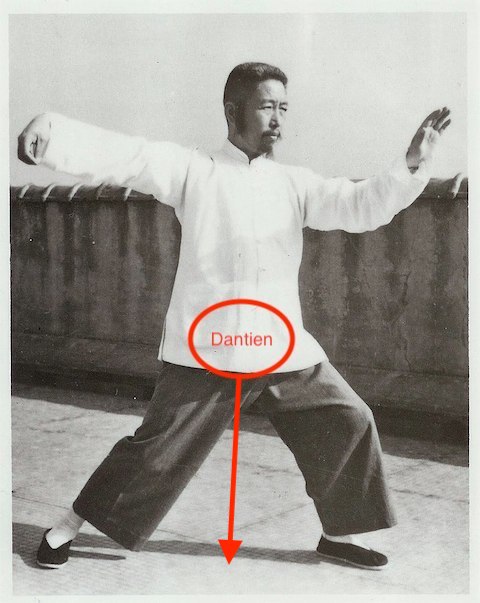
[I think there are two, related, ideas going on here. The first is that (paradoxically) if you want to push somebody up and away, you first let your dantien area sink downwards and connect to the ground, then the power comes up from the feet.
Previously we talked about power coming up from the ground. Now we get into the nitty-gritty of how we make that actually work without just using brute strength from the legs. If you sink the dantien area – think “drop” – then there is an instant ground force reaction that comes back in the opposite direction. Provided the body is ‘threaded together’ and relaxed enough, where this force goes is guided by the part of your brain the Chinese called Yi. Here are two photos attempting to illustrate this, but remember, it’s all happening simultaneously, rather than in two separate steps.
Sink down from the dantien.
Issuing force with jin.
The other idea presented here is that of being aware of the left and right, and when advancing, being aware of withdrawing. On a simple level, it’s saying don’t over commit, but I connect this idea to a phrase in one of the other classics which says “if you empty the left, you must fill the right”. Just like the Taiji symbol, everything in Tai Chi is circular and in harmony. So, if you move something left, then another part of you must move to the right simultaneously, as you rotate around a central point, otherwise, you will be out of balance. You want to create the effect of a sphere, perfectly balanced on all sides.
The Taiji symbol is perfectly balanced, and you need to achieve the same state in your body.]
8.
“Alternating the force of pulling and pushing severs an opponent’s root so that he can be defeated quickly and certainly.
Full and empty should be clearly differentiated. At any place where there is emptiness, there must be fullness; Every place has both emptiness and fullness.”
[Here we are getting towards the fault of double-weighting, in Taijiquan. You need to have your weight more on one leg than the other at all times. If your weight settles in an equal position then your Taiji symbol has stopped ‘moving’ and is now inert – it has become two separate halves, not a spiraling mix of energy. There’s more to double-weighting than that, but see the link above for that.
As your weight shifts from one leg to the other in push hands, for example, you are ‘alternating the forces of pushing and pulling’. If you can do this while staying in balance then your opponent will become disrupted. But again, you must stay in balance. So, if you advance something – here represented by fullness – then you must withdraw something else – here represented by emptiness – at the same time.]
9.
“The whole body should be threaded together through every joint without the slightest break.”
[This is a return to the theme at the start of the classic of threading the body together, making it connected and keeping everything balanced. After reading the words between the start and these lines you should have a better idea of what that means. The emphasis on keeping the joints open and relaxed in particular is that these are usually the problem points where we lose connection.]
10.
“Long Boxing is like a great river rolling on unceasingly.”
[It’s interesting that the classic calls the art “Long boxing”. These days there are different martial arts in China called Long Boxing (Chang Quan) that aren’t Taijiquan. I think in older times any long form routine was called long boxing, and I think that’s what is being referred to here.]
11.
“Peng, Lu, Ji, An, Tsai, Lieh, Zhou, and Kao are equated to the Eight Trigrams. The first four are the cardinal directions; Ch’ien [South; Heaven], K’un [North; Earth], K’an [West; Water], and Li [East; Fire]. The second four are the four corners: Sun [Southwest; Wind], Chen [Northeast; Thunder], Tui [Southeast; Lake], and Ken [Northwest; Mountain]. Advance (Chin), Withdraw (T’ui), Look Left (Tso Ku), Look Right (Yu Pan), and Central Equilibrium (Chung Ting) are equated to the five elements: Metal, Wood, Water, Fire, and Earth Taken together, these are termed the Thirteen Postures”
[This last section is almost a bit of admin. It lays out the fundamentals that define Taijiquan – the 8 energies and the 5 directions].
1. “In motion, the whole body should be light and agile, with all parts linked as if threaded together.”
[Here the Classic is connecting together the ideas of being ‘light and agile’ with ‘threading the body together’. It is referring to being relaxed and without stiffness or excess local muscle tension in your movement. If you can be relaxed then your movement can flow and be connected together via the muscle-tendon channels. Any stiffness you possess will prevent you from moving in this unique way, which is key to Taijiquan. Particular problem areas to look out for that can prevent your body being ‘threaded together’ are the shoulders and lower back where we tend to store tension. If we are tense in our shoulders then the movements of the body cannot reach the hands, and if we are tense in our lower back then we cannot connect the upper and lower parts of the body. Everything in Taijiquan needs to be driven by the legs, waist and dantien area.]
2. “The chi should be activated, The mind should be internally gathered.”
[In the first line I’ve chosen the word ‘activated’ when referring to the chi, rather than the usual ‘aroused’ or ‘excited’. This is to give more of a sense that you are switching to dantien-driven movement, using the muscle-tendon channels, rather than using normal movement, which is unconnected to the waist.
The second line originally says Shen, which refers to the spirit, rather than mind, but I think that this line is really referring to ‘paying attention to what you’re doing’ in a calm yet focused way, rather than letting the mind wander or become distracted.
Taken together these two lines are a way of saying, ‘in Taijiquan we move the body in an internal way, and to do that we need to use the mind and keep it on what we are doing, rather than letting it wander’.]
3. “The postures should be rounded and without defect, without deviations from the proper alignment; in motion, your form should be continuous, without stops and starts.”
[These lines start by addressing the physical posture considerations of Taijiquan. I’ve added ‘rounded’ here, because you need to physically round your posture to make it properly relaxed. That means no awkwardness or straight lines in the physical posture, just nice smooth curves.
The second part talks about the movement itself. Developing the skill of being able to move without ‘stops and starts’ takes a while and is one of the fundamental reasons for practicing the Tai Chi form every day. Of course, we are talking about moving from the dantien without stops and starts here, not just normal movement.
The phrase ‘drawing silk’ is often used to describe this quality of continuous movement you find in Taijiquan. If you were drawing silk from a cocoon then you need to do it at a constant rate – if you speed up and you risk the thread breaking. If you slow down you risk it collapsing. Just keep it at a constant rate and it should go well.
By linking these two ideas in the same section the author is drawing a parallel here between having no breaks in the physical posture (keeping it rounded) and having no breaks in the actual movement either (keeping it continuous).]
4. “The jin should be rooted in the feet, generated from the legs, controlled by the waist, and expressed through the fingers.”
[These are the lines most often used to describe how power should be expressed in Taijiquan. So, when issuing a punch, or a push, you should be going through this sequence, which starts at the ground and goes up to the fingertips. Taijiquan uses the ground force (jin), so the first part of the body mentioned is that which is closest to the ground – the feet. Next it links together the legs and waist as the parts of the body most associated with delivering that force to the hands – or fingers as it says here.
Obviously, this part is not talking about kicking. Notice that the palms are not mentioned, either. In Tai Chi your hand technique is usually a punch or a push. Occasionally a back fist or hammer fist is used, but it’s mainly pushing or punching to the torso or head, both of which use the fingers to make contact with the opponent.
When you push (to the chest) in Tai Chi you shouldn’t use your palm. Instead, you push with your fingertips. If you try pushing hard on a heavy bag with your palm you’ll soon discover why – pushing hard with your palm risks serious injury to your wrist. Of course, pushing on an arm, as we do in push hands is different, and you can use your palm without risk.
Taijiquan goes beyond simply using the raw power of your legs to augment the power of punches and kicks – it’s not talking about just doing this physically and externally. Instead, it’s talking about making use of the power of the ground through a relaxed body that is used as a coordinated whole. This passage also makes it clear that the ground force and the force of the legs are the only power inputs required to create jin, so, don’t try and punch or push from the shoulder.]
5. “The feet, legs, and waist should act together as an integrated whole, so that while advancing or withdrawing one can take the opportunity for favorable timing and good position.
If correct timing and position are not achieved, the body will become disordered and will not move as an integrated whole; the correction for this defect must be sought in the legs and waist.
The principle of adjusting the legs and waist applies for moving in all directions; upward or downward, advancing or withdrawing, left or right.”
[I’ve grouped these lines together as I think they are all talking about the same subject. Following on from the previous point about the role of the feet, legs and waist in producing power from the ground, the Classic now makes it explicitly clear that these three need to act together even when moving. This emphasises the supreme importance of the trinity of the feet, legs and waist (dantien area) in powering movement. If you can power your movement like this then you can produce Jin (power from the ground). Once you break this trinity, say by using local muscle in your shoulder, then your power has become disordered, and lacks the connection to the ground which is required by Taijiquan.]
In this post I’m continuing with my current theme of the mind and Tai Chi Chuan.
Animals don’t “think” like we do most of the time. I bet you could argue that the species known for problem-solving like crows, chimpanzees, dolphins and dogs do their fair share of thinking, but in my previous post I was describing a state where you are doing Tai Chi without thinking. Just being.
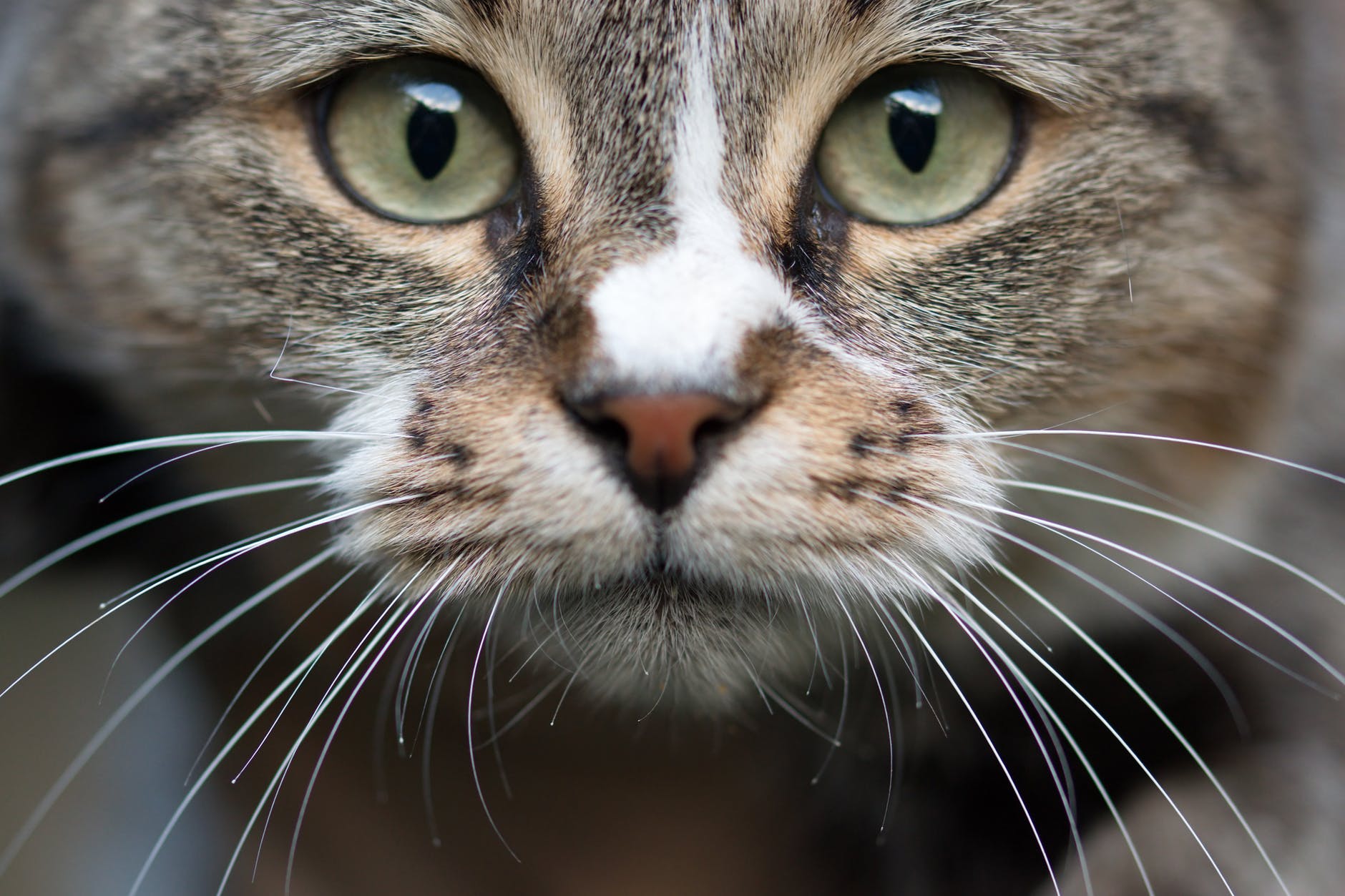
You can see it in their eyes. Just look at that cat above. Cats are great examples of this, because they are around us often they’re easy to observe, but if you can observe animals in the wild you’ll see that they are in this state most, if not all, of the time.
There are various references to cats in the Tai Chi classics.
“The Form is like that of a falcon about to seize a rabbit,
and the shen is like that of a cat about to catch a rat.”
Shen, we can loosely translate as spirit, but if you just substituted the words “inner state” there instead I think it would better equate to what the author was trying to convey, but he or she did did say Shen for a reason, as we shall see.
The word “Spirit” in English is tied up with all sorts of (organised) religious connotations which get in the ways and are not helpful.
A better understanding of what is meant by Shen would perhaps be, ‘underlying spirit of nature’. The part of you that is connected to this underlying spirit of nature is known as the Xin in Chinese. If it’s aligned with nature your Xin can produce your Yi (intention), which in turn can produce the physical movement (Qi) which in turn produces action (Li) all working in harmony with nature. You and your environment are one, working and acting together.
There are various versions of this ‘working in harmony with nature’ sequence written about in old Chinese writings – the Xin harmonises with the Yi, the Yi harmonies with the Qi and the Qi harmonises with Li being the most common and also forming the 3 internal harmonies of the famous Lie He, the 6 harmonies with are written about in all sorts of Chinese martial arts.
My Xing Yi teacher, Damon Smith did a whole podcast episode about the word “spirit” and what it means in Asian traditions connected to shamanism, which I find helpful in understanding. I would listen to the whole thing, but around the 8-minute mark he talks about this sequence and how Shamans use it to act in harmony with nature in their own lives or when practicing shamanism:
Cats and the Tai Chi classics
To me, the section of the classics that says “The Form is like that of a falcon about to seize a rabbit, and the shen is like that of a cat about to catch a rat”, alludes to the idea that on the outside the victory in combat may look overwhelming and great – like that of the falcon seizing a rabbit triumphantly, but on the inside, you need to be quiet and calm and in harmony with nature – the exact qualities you can see in a cat patiently stalking a rat.
Of course, the flacon is like that on the inside when catching a rabbit, but it’s not easy to see on the outside. Human-loving cats, however, are easier to observe.
A cat crops up somewhere else in the Tai Chi classics too:
“Walk like a cat.”
That doesn’t mean get down on all fours, it means to adopt the same mental qualities as mentioned earlier to your stepping. Don’t just rush in blindly or recklessly: be calm, patient and at one with your environment.
Remember, as it says in the classics:
“All movement is motivated by Yi and not by external form”.
But perhaps Bruce Lee said it best in Enter the Dragon:








 The Tai Chi Notebook