Just look at those two guys and tell me they aren’t having fun! Nothing says “macho martial artist” quite like standing on one leg and having a guys head wrapped under your armpit in a guillotine choke while he’s pulling your leg into his groin.
But seriously, I think every martial artist should know how to do a guillotine choke, not just grapplers. The power of the guillotine is that it’s a very versatile choke. You can do it standing, on the ground and in all the positions in between. It looks like a deceptively simple technique – you just wrap your arm around their neck and squeeze – but as you’ll discover, there’s a whole load of subtle variations, tricks and positional requirements you need to know about to make your guillotine effective.
Rob Biernacki has produced a series of video clips that form a great free online instructional on Grapplearts about how to perform this simple choke. Trust me, it’ll be a great use of 30 minutes of your life and it’s good enough for them to have charged for it, but they’ve kindly provided it for free.
Incidentally, I heard a story from a long time black belt this weekend. He was talking about a bout he refereed at a tournament a while back. The match was between a well known world champion black belt who’s name everyone would immediately recognize if I said it. The black belt was matched up against a no name purple belt. The black belt got destroyed by the purple belt. It happens. Black belts aren’t indestructible and the cult that exists around the belt is unhealthy as it sets up unrealistic expectations. We all lose. I wouldn’t have it any other way.
Nice article that gives a fresh perspective on what it means to be a black belt in BJJ when you’re just a hobbyist, not a world champion. The comments are worth reading too.
Scott posted some answers to various questions he gets over at Strengthness with a Twist, his blog. I thought the first one was most interesting:
What do you mean when you say martial arts are rituals?
Rituals are ways of making order out of chaos. Martial arts are about unleashing the greatest forces of chaos and bringing them into order. It is a daily ritual that has deep, lasting, and profound effects on every aspect of our being. This is true of martial arts world wide, but it is particularly clear in the structure of Chinese martial arts as they were understood before the Boxer Uprising.
I’ve been thinking a lot about this quote since it’s pretty clear to anybody who does a daily practice of Tai Chi (or related martial/yoga/chi kung type practice) in the morning, that it soon becomes a kind of ritual, whether you like it or not. Not a ritual in the Western religious sense, but a ritual for your body (which Scott is arguing is, in fact, the true essence of religion in the Eastern sense).
I like his definition of “bringing order from chaos” even if it does sound a bit Jordan Peterson fan-boy-ish 😉
But if we can separate the phrase from the alt-right ideology it has become attached to, that phrase is what you are doing to your body when you practice Tai Chi in the morning. Having just woken up in the morning you can consider your body to be in a state of ‘chaos’ – you’re not yet functioning at 100%, your tendons will be shortened from lying down for so long and your body might ache from uncomfortable sleeping positions, and it needs to stretch. In fact, we stretch as a reflex action once we wake. Mentally you are also not yet “with it”, at least not until you’ve properly caffeinated.
A morning Tai Chi “ritual” (or “routine” if you like), can bring you back into occupying your body properly and get it ready for the demands of the day. When I think about what the main health benefit of Tai Chi is, I think it’s this. People tend to treat Tai Chi as a panacea that cures everything from a bad back to an ingrowing toenail. I take all the latest ‘scientific’ research about the miraculous healing benefits of Tai Chi with a pinch of salt. I think its best feature is simply this: it’s a way of gently ordering and strengthening the body in the morning, ready for the day.
I also like Scott’s later quote,
“Martial arts are about unleashing the greatest forces of chaos and bringing them into order“
This one brings to mind a whirling Baguazhang practitioner spinning in circles, taming the elements he is working with, or two sword fighters caught in the midst of a leaping blow.
It all sounds a bit fantastical, but again, I think there’s some truth buried here.
Through techniques in martial arts, we are bringing order to the chaos of the fight. This is perfectly demonstrated in a Jiujitsu match – it’s all scrambling, spinning madness, then order is established as a joint lock or choke is put in place, as one practitioner controls the limbs and body of the other through correct position, leverage and technique, and the ‘fight’ ends.
Performing the Tai Chi form is an analogy for how the whole universe was created out of chaos, and order established. When you start the Tai Chi form, in a still, standing position you are in a state of Wu Chi – the undifferentiated primordial state of emptiness, but always with the possibility of giving birth to something. Then the big bang happens and you start to move – Yin and Yang become differentiated and you are continually moving between these two opposite poles. The body opens and closes in a continuous spiral. As one part of the body is opening, another is closing until the final movement – often known as “Carry the Tiger back to the mountain”- when you return to stillness. The mountain here represents that primordial stillness. You have brought order to chaos and returned to the mountain.
Although I never met him, as a fellow practitioner of “old man Jiujitsu” the loss of Anthony Bourdain hit me hard. It felt like we lost a warrior, an inspiration and friend all at the same time.
Rest in Power Anthony Bourdain (1956-2018), Renzo Gracie Blue Belt.
It’s all in Chinese, but I believe this video is a Tai Chi guy entering a BJJ competition in China… or maybe it’s a challenge match. From the way everybody is watching this one match, in particular, I get the feeling this is a special challenge.
Here’s the video. The match starts at around 8.30.
I can’t understand what is being said, but based on what I can see the “Tai Chi” guy showing a terrible lack of respect – he keeps hitting the BJJ guy, which is against the rules, then saying sorry to the audience, apologising profusely, then just doing it again. There’s lots of drama. The “Tai Chi” guy tries to walk off at one point when he realises the way things are going. Well done to the BJJ guy for keeping his cool.
When the “Tai Chi” guy inevitably gets submitted the ref separates them and then he tries to attack the BJJ guy after the match has ended, at which point the ref restrains him with a choke hold and chaos ensues.
Only in China 🙂
In a world where you can self-identify as anything, anybody can claim to be a “Tai Chi guy”, but apparently the guy is Zheng Jiakuan, known as the apprentice of Ma Baoguo, and the BJJ guy is a blue-belt player Zhang Long from Alliance.
Ma Baoguo produced this famous video which he claims showed the effectiveness of his techniques… while the MMA fighter claims otherwise.
Anyway, I think that says it all.
I don’t really know what the Tai Chi guy expected to achieve by entering a BJJ tournament, but by behaving so badly he’s ended up looking even worse than you’d expect. All the traditional Chinese values of respect are all displayed by the BJJ guy.
A better video for “Tai Chi vs BJJ” is the video of Marcelo Garcia against a Taiwanese push hands champion. Of course, lots of people don’t think these push hands champions are doing Tai Chi either, but at least respect was shown:
In terms of the matra of: takedown, pass guard, submit, Jeff Lawson’s performance at Polaris 6 is possibly the most perfect BJJ match ever. Completely flawless and so quick! We were drilling this exact Seoi Nage (shoulder throw) this week. Great to see it used exactly as we drilled it in competition against a resisting opponent.
We had BJJ world champion Victor Estima at our BJJ school recently for a seminar. There was a guy there who I think is trying to make a life for himself as a YouTube Vlogger (although he only appears to have 1 video on YouTube!)
Anyway, he made this video about the event and it’s very funny because he challenges Victor to a match. He’s just a white belt. Hilarity ensues…
At 6.28 in this BJJ promotion video from the early 1950s by Helio and Carlos Gracie, a “skinny guy” gets his girl stolen by bigger, stronger bully. But don’t worry – he signs up for jiujitsu lessons and wins her back!
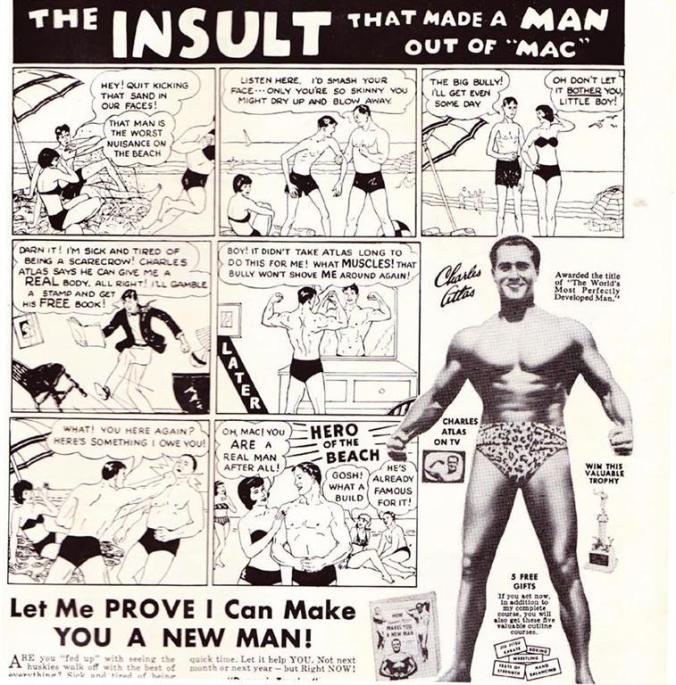
Let’s ignore the 1950’s idea of women as property and prize, which jars with modern sensibilities, and look at the marketing message. This narrative around the marketing of jiujitsu is clearly based on this classic advert for the Charles Atlas body building system “The insult that made a man out of Mac”:
Again, a skinny scrawny guy, discovers the secret information that will turn him into a strong young bull and he has the powers to repel the sand kickers (with unlawful assault this time, but let’s forget about that at for a moment – it was a different age). He goes from being called a “little boy” by his girlfriend to being a “real man”.
In both cases we can see they’ve identified the target audience as the geeks. The skinny, scrawny men who need to gain knowledge and skills to compete with their more athletic contemporaries to win the approval of women.
So many times we hear the narrative that the founder of system x,y,z of martial arts was a sickly child or young man who overcame this using the power of his martial system to defeat not only his opponents but also his own weaknesses.
Notice that in the older, more conservative, Chinese narratives, there’s very rarely a women involved, unless it is the person’s mother. Sun Lu-tang was “a small and frail seeming child… When Sun’s mother heard that he was studying Kung Fu, She at first objected, afraid that he would hurt himself. Then she saw how much healthier her formerly-sickly child looked and give her blessing to him to continue his studies. ”
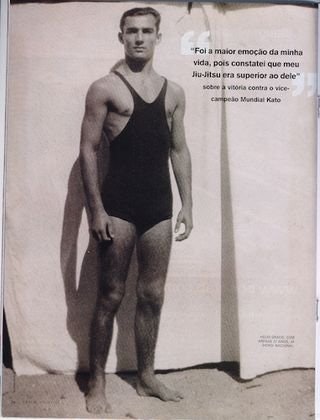
Do these stories bear much relation to reality? Sometimes, but often not. Here, for example, is a picture of the weak and sickly Helio Gracie who created Brazilian Jiujitsu by modifying the techniques of Jiujitsu to make them less physical, because he couldn’t use any strength in his techniques due to his frail condition.
There probably is a lot of truth to sickly or weak people practicing martial arts diligently to improve their health, but the narrative is so often used and so often repeated that I can’t help but think a bit of marketing has slipped in at the same time.
And what’s the modern day equivalent? I suppose that it’s become about marketing martial arts directly to women. Women today don’t need a man to protect them – they can do it themselves!
Where will it go in the next 10-20 years, I wonder? Classes for men to learn to protect themselves from women? It’s possible….
I don’t think there’s anything wrong with any of these marketing trends, but I think it’s important to see them as trends. As always with martial arts – Caveat emptor “Let the buyer beware!”.
Here’s a seminar clip I came across recently of the legendary Rickson Gracie teaching in Tokyo, Japan this year. He’s going over concepts that should be familiar to Tai Chi people, or in fact anybody who has a deep understanding of Chinese martial arts. It’s the concept called “jin” – often translated as refined force. It’s using the power of the ground, transmitted through a relaxed (“sung”) body to produce an unusual strength that isn’t reliant on excessive muscle use (“li”).
Jin is talked about all the time in the Tai Chi Classics, most notably on the issuing of force with the famous phrase:
The jin should be rooted in the feet, generated from the legs, controlled by the waist, and expressed through the fingers.
What’s interesting to me is why it’s only really Rickson Gracie (and his students) who talks about and demonstrates this stuff in BJJ? Did he find it elsewhere and integrate it, or was it always there if you had eyes to see it?
It’s quite ‘Zen’ and deconstructionist to talk about labels not mattering. But over long years I’ve come to the conclusion that labels (for martial arts) exist in the world because they do matter. If they didn’t matter (to whatever extent) then they wouldn’t exist.
I was reading recently (an idea from Mike Sigman) that the best way to view a martial art with regard to the question of “How internal is this?” is as a sliding scale of 1 through 10 from just using local muscle on the left (0-1), through to external martial arts in the middle (5) that use Jin (ground force) to some extent, on to internal martial arts at the end (10 being the highest) that use full dantien control of movement.
I’d put things like Wing Chun or Karate that go beyond just using basic movement in the middle of the scale. These things often get called the true ‘internal’ versions of the arts, but they don’t really use the dantien. The official version of Yang style Tai Chi that you see done by Yang Jun I don’t think is a full 10 either – it just doesn’t use the datien for full control all the time. I think Chen style Tai Chi would be a 10 – of course, that’s the theory. Most practitioners would be bottom to middle of the scale at best.
There was some talk recently on internal aspects in arts like BJJ. I think BJJ and Judo have the potential for being in the middle of the scale – some Jin usage. Often this is what you see termed as ‘invisible jiujitsu’. I think that’s exactly what you need for groundwork (and for fighting generally) – beyond that it’s a case of returns vs time spent. If you want to make your living as a pianist you don’t need to become a master of the very hardest pieces of classical music. It’s almost irrelevant. Of course, if you want to devote your life to it then, it’s your life and it’s a world of discovery.






 The Tai Chi Notebook