Tao Te Ching, chapters 8 and 61


51b4nahi0bl-_sx258_bo1204203200_

I was giving the Tao Te Ching the cursory glance I occasionally give it recently. I’ve got the copy shown above. I usually flick to a random chapter, read it three times and ponder it deeply. Well, as deeply as I am able to. I landed on chapter 61, and the next day I landed on chapter 8. These two seemed to be linked in theme, so I thought I’d say something about them.

Incidentally, I really like the Stephen Mitchell translation. I’ve no idea how accurate it is compared to the Chinese, but all translation seems to involve some interpretation, and I like the way he’s done it.

Here’s chapter 61:

61

When a country obtains great power,
it becomes like the sea:
all streams run downward into it.
The more powerful it grows,
the greater the need for humility.
Humility means trusting the Tao,
thus never needing to be defensive.

A great nation is like a great man:
When he makes a mistake, he realizes it.
Having realized it, he admits it.
Having admitted it, he corrects it.
He considers those who point out his faults
as his most benevolent teachers.
He thinks of his enemy
as the shadow that he himself casts.

If a nation is centered in the Tao,
if it nourishes its own people
and doesn’t meddle in the affairs of others,
it will be a light to all nations in the world.


and chapter 8:

8

The supreme good is like water,
which nourishes all things without trying to.
It is content with the low places that people disdain.
Thus it is like the Tao.

In dwelling, live close to the ground.
In thinking, keep to the simple.
In conflict, be fair and generous.
In governing, don’t try to control.
In work, do what you enjoy.
In family life, be completely present.

When you are content to be simply yourself
and don’t compare or compete,
everybody will respect you.


So, firstly let’s look at the imagery of water, one of the classic symbols of the Yin side of the Taiji diagram. Both chapters use water as a metaphor for the correct way of acting or being in the world.  It’s a theme that repeats through the Tao Te Ching, and also throughout the history of Asian martial arts, even in modern times. I’m thinking of Bruce Lee in the infamous interview where he says “Be water, my friend!”


I was reading another article about Wing Chun today by Ben Judkins, which also expanded upon this idea of softness overcoming strength, and how this idea has permeated Asian martial arts:

Early reformers in martial arts like Taijiquan (Wile 1996) and Jujitsu sought to shore up their own national identities by asserting that they brought a unique form of power to the table.  Rather than relying on strength, they would find victory through flexibility, technique, and cunning (all yin traits), just as the Chinese and Japanese nations would ultimately prevail through these same characteristics.  It is no accident that so much of the early Asian martial arts material featured images of women, or small Asian men, overcoming much larger Western opponents with the aid of mysterious “oriental” arts.  These gendered characterizations of hand combat systems were fundamentally tied to larger narratives of national competition and resistance (see Wendy Rouse’s 2015 article “Jiu-Jitsuing Uncle Sam” .

but as the author notes, the situation is often muddied

Shidachi appears to have had little actual familiarity with Western wrestling.  It is clear that his discussion was driven by nationalist considerations rather than detailed ethnographic observation.  And there is something else that is a bit odd about all of this.  While technical skill is certainly an aspect of Western wrestling, gaining physical strength and endurance is also a critical component of Judo training.  Shidachi attempted to define all of this as notbeing a part of Judo. Yet a visit to the local university Judo team will reveal a group of very strong, well developed, athletes.  Nor is that a recent development.  I was recently looking at some photos of Judo players in the Japanese Navy at the start of WWII and any one those guys could have passed as a modern weight lifter.  One suspects that the Japanese Navy noticed this as well.

But while the idea of the soft overcoming the hard has already fallen to the level of a cliché, especially when it comes to martial arts, and mixed with political ideas, should we ignore it as a way of being in the world?  I’d say not. It does point to a truth.

Anyone with any familiarity in martial arts is aware of the feeling of having to ‘muscle’ a technique to make it work, as opposed to executing a clean technique based on good leverage. This points towards what I think these chapters of the Tao Te Ching are talking about.

When it comes to Tai Chi one of the hardest things to grasp about the techniques exemplified in the forms is that they shouldn’t necessarily feel powerful to you as you do them. My teacher often uses this phrase: “…if you feel it then they don’t – you want them to feel it, not you“.

If you can give up the need to control and struggle with a situation, then you can relax and access your own inner power. See what acliché that statement sounds like already? It sounds like one to me as I wrote it, but I guess all cliches were probably based on something real, otherwise, they wouldn’t be a cliché.

In Chinese martial arts that sweet spot between doing and not doing (to bastardize some more Taoist terminology) is called Jin. I’ve written a bit about that before:

The 6 directions and Jin

Rickson Gracie using Jin

Mike Sigman on basic Jin

Jin in Chinese martial arts (and tennis)


Wing Chun (Ding Hao) vs MMA (Xu Xiao Dong), in China

After his fight with the “Tai Chi master” Wei Lei, which rocked the contemporary martial arts scene in China, Xu Xiao Dong, the MMA fighter on a mission to expose “fake masters” is back on the scene this time showing his skills against a Wing Chun fighter.

China doesn’t have the sort of government regime which tolerates people who rock the boat, so I’m pleased to see that Xu is no longer under detention, as I feared we may never have seen him again after what happened last time.

Here’s the fight:


It’s a pretty ugly fight. Here are my takeaways:

  • Ding Hao clearly lacks realistic sparring experience, as he falls apart pretty quickly. His grappling was non-existent.
  • Xu Xiao Dong is pretty much a ‘stand and bang’ type fighter. Or maybe he felt so unthreatened by Ding that he didn’t feel the need to do much of anything else.
  • The ref makes some daring saves!
  • Why are they wearing such different clothing? Ding has shoes on! Only Xu is wearing gloves. Xu is grabbing Ding’s clothing to throw and control him. It’s a mess.
  • Why are they fighting on what looks like a red carpet used for movie premieres or award shows?
  • If you watch Ding throughout the fight you can see him try to adapt as he realises what he is doing isn’t working. He starts off looking very much like classical Wing Chun and ends up looking more like Jeet Kune Do. It’s like watching the evolution of Bruce Lee in microcosm!

Here’s some background about Xu Xiao Dong and his fights and detention by police in China:


Fight against Wei Lei:


Asian Boss: What do Chinese people think of Blackface?

As China makes more entries onto the world stage elements of an isolated culture are clashing full on with a global culture that has, how shall we say? Moved on a bit… There was a recent incident of Blackface appearing on a popular Chinese show, the Lunar New Year TV gala, where Chinese people dressed up as African people for laughs. The show was watched by 800 million people. 800 MILLION PEOPLE! Those numbers are staggering.

The following video about the show is interesting, especially if you watch past around the 10-minute mark where a black lady living in China gives her view on daily life in China and the sort of casual racism she encounters.

My general impression from watching the video is that it’s coming from a position of ignorance, not of hate. I can’t help but see the parallels to how the UK used to be when my grandparent’s generation were running things. Blackface used to happen regularly on British TV, most famously the Black and White Minstrel Show in the 1960s. Things will move on.


Also: Reviews of Black Panther from China.

Heavy Dantien

This is a great clip of Chen Bing teaching a basic silk reeling circle with a lot of emphasis on relaxing and being heavy.

People often wonder how being relaxed can generate power in martial arts. If you watch the video you can see how being relaxed in the upper body leads to great power in the lower body. And once you have that power in the lower body you can start to use it to drive your movements. Of course, there’s more to it than that, but it’s a start.

The 6 directions and Jin

If we think of ‘basic Jin’ as being the ability to direct the solidity of the ground through the body, from the feet up to the hands, then there are four basic directions we can use this power in.

  • Up
  • Down
  • Away from the body
  • Towards the body

And since you can go away from the body and towards the body on both the x and z axis (to the sides and in front and behind), that makes 6 directions in total.

Here’s Mike Sigman explaining the 6 directions and Jin:

BBC self defence clip: “I was nearly raped”

An interesting clip popped up on the BBC website today about self defence for women by a woman. Here it is:

Here’s my potentially mansplaining view: She makes 3 quick points at the end – I really agree with her first two, (don’t be afraid to offend and use your voice) but her last one – “widen your stance” – I don’t get. I’d say the opposite – get ready to move! Get up on your toes (mentally, if not always physically) and get ready for movement. If you make a sitting duck of yourself against a man whose’s first move is probably going to be to try and grab you then that’s not good. Equally, if he’s going to strike you then adopting a firm, wide stance is not going to help either.

Watch my previous post about movement for self defence from Rob Poynton to see what I’m talking about.

Either way, I’m glad she made the point that despite all the martial arts techniques on show, the first two points can be done by anyone and are the most effective.

The comments section on that video is interesting too:

“I want to see that viral video of men teaching boys how to fight off the urge to be predatory.”

“But god forbid she be allowed carry a firearm to more effectively defend herself”

“Give her a gun and she’ll be unbeatble”

Learning to hate men!

“Unrealistic sweep, and sloppy arm bar. Train Jiu Jitsu, that will give you more realistic techniques that actually work. The clinch was also poorly done, with no control.”

” I remember reading somewhere that a man was jumped by 2 women. They we’re basically groping him & trying to take his trousers off. They wouldn’t stop & he slapped them. Next day, he had police at his door for common assault.”

There you have it – the great unwashed of the world live in every comments section. Never look below the line 🙂


Rickson Gracie using concepts found in Chinese martial arts – notably, jin

Here’s a seminar clip I came across recently of the legendary Rickson Gracie teaching in Tokyo, Japan this year. He’s going over concepts that should be familiar to Tai Chi people, or in fact anybody who has a deep understanding of Chinese martial arts. It’s the concept called “jin” – often translated as refined force. It’s using the power of the ground, transmitted through a relaxed (“sung”) body to produce an unusual strength that isn’t reliant on excessive muscle use (“li”).

Jin is talked about all the time in the Tai Chi Classics, most notably on the issuing of force with the famous phrase:

The jin should be
rooted in the feet,
generated from the legs,
controlled by the waist,
and expressed through the fingers. 

What’s interesting to me is why it’s only really Rickson Gracie (and his students) who talks about and demonstrates this stuff in BJJ? Did he find it elsewhere and integrate it, or was it always there if you had eyes to see it?

Anyway, here’s his workshop:

Using movement for self defence, not blocks

I really liked the above clip by Rob Poynton of Cutting Edge Systema. It’s about the idea of using movement, rather than a fixed, rooted stance or hand blocks, to defend yourself.

To break down the message:

  • Your first reaction should be to move.
  • Use the legs for defence (stepping) and not the arms to block.
  • With your arms free you can use them for other things – like takedowns or strikes.

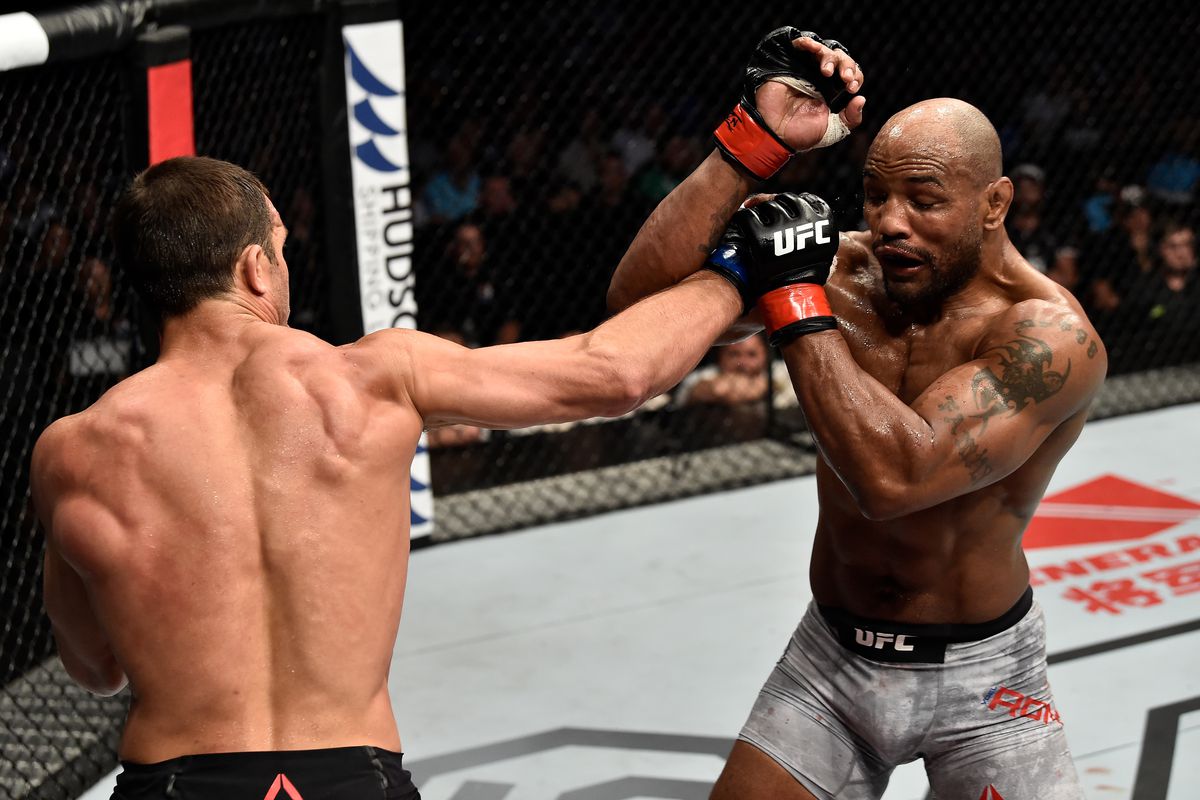
It’s simple, common sense advice when it comes to martial arts. The XingYi I learned was based around exactly the same concepts, incidentally. If you look at a lot of MMA fighters you see the same set of principles in action. If you think about it, you generally don’t see them doing a lot of blocking with their hands. Instead, they are moving and slipping punches. Obviously, there are exceptions – for example, the last MMA fight I watched was Yoel Romero vs Luke Rockhold, at UFC 221 in which Romero did a series of bizarre-looking arm blocks throughout the fight, yet came out on top.

916785142-0

To be fair though, it wasn’t getting him anywhere – he was getting him picked apart by Rockhold until Romero finally broke through and delivered a knockout blow, possibly by virtue of being one of the toughest human beings alive at the moment.

I think Rob’s right in saying that the traditional arts are slow to teach this concept of movement, though. Generally, you hear things said like “if you don’t spar you’ll never be able to use it”, which is true, of course, but how about actually breaking down and analysing what you learn in sparring, and bringing it back into training to refine it? I think that’s what Rob is showing here.

The point about a fear-based response vs a confidence-based response is also very interesting.

Of course, the counter-argument is ‘where are all the great Systema fighters, then?’ But it’s pretty clear that Systema isn’t really designed primarily for being used in a cage. It seems like a pretty useful life skill though, full of concepts you can more easily transfer to your day to day existence.

Labels like ‘internal’ do matter in martial arts

pexels-photo-312839.jpeg

It’s quite ‘Zen’ and deconstructionist to talk about labels not mattering. But over long years I’ve come to the conclusion that labels (for martial arts) exist in the world because they do matter. If they didn’t matter (to whatever extent) then they wouldn’t exist.

I was reading recently (an idea from Mike Sigman) that the best way to view a martial art with regard to the question of “How internal is this?” is as a sliding scale of 1 through 10 from just using local muscle on the left (0-1), through to external martial arts in the middle (5) that use Jin (ground force) to some extent, on to internal martial arts at the end (10 being the highest) that use full dantien control of movement.

I’d put things like Wing Chun or Karate that go beyond just using basic movement in the middle of the scale. These things often get called the true ‘internal’ versions of the arts, but they don’t really use the dantien. The official version of Yang style Tai Chi that you see done by Yang Jun I don’t think is a full 10 either – it just doesn’t use the datien for full control all the time. I think Chen style Tai Chi would be a 10 – of course, that’s the theory. Most practitioners would be bottom to middle of the scale at best.

There was some talk recently on internal aspects in arts like BJJ. I think BJJ and Judo have the potential for being in the middle of the scale – some Jin usage. Often this is what you see termed as ‘invisible jiujitsu’. I think that’s exactly what you need for groundwork (and for fighting generally) – beyond that it’s a case of returns vs time spent. If you want to make your living as a pianist you don’t need to become a master of the very hardest pieces of classical music. It’s almost irrelevant. Of course, if you want to devote your life to it then, it’s your life and it’s a world of discovery.