There’s a great article over on Kung Fu Tea about the life of one of the most influential Chinese martial artists of all time, Sun Lu Tang.
One of the persistent problems that I see in amateur discussions of “Chinese martial studies” is a lack of understanding of how broad the traditional martial arts really were, and the variety of life experiences that they encompassed. In fact, rather than discussing China’s martial culture in the singular, it would probably be better to think about these cultures in the plural. The martial arts never were just one thing, and our experience with the modern “traditional” arts tends to seriously skew our perceptions of the past.
It’s a good read, so sit down with a cup of tea and put your feet up with your laptop.
My friend Byron Jacobs has added another video to his excellent Xing Yi Ten Minute Primer series. This time it’s on the water element, Zuan Quan, known as Drilling Fist.
I love this article by Bill Fettes, a retired Australian police officer, I came across recently on Ellis Amdur’s blog. It discusses real world uses for the techniques found in the Internet Arts he has trained- Aikido, Tai Chi and XingYi. I like the mix of no nonsense description and practical demonstration.
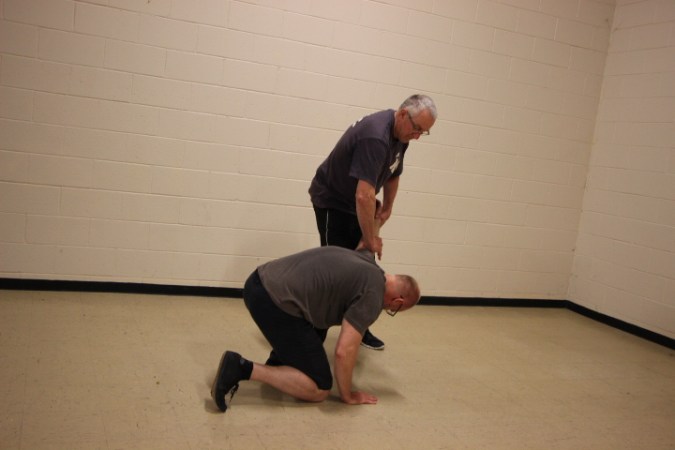
What’s great is that Bill gives clear recollections of the techniques he actually used “on the streets”, then provides demo pictures of how it played out with a partner. Take a look!
My overwhelming observation is that what he’s showing looks exactly like the kind of techniques my Tai Chi teacher does all the time in push hands/sparring. In fact, I recall being on the end of them several times!
A lot of the time I see people training Chinese Martial Arts with too much emphasis on getting a single hit in, as if that would be the end of everything. It won’t. “One strike one kill” is a nice idea in theory, but I don’t think you’re meant to take that idea litterally.
One thing my Tai Chi teacher emphasises is that he wants the fight to end with the other guy controlled at his feet, pinned to the ground in some way so he can be incapacitated or restrained. If you want to run away then why not give yourself a head start by breaking something first, or calming them down? Or if you want to hold them in place until help arrives you need to have trained that skill.
You can’t just keep hitting people – it prolongs the conflict and turns what started as a self defence situation into an assault by you on the attacker, even if you were the original victim. Just imagine how it’s going to look on CCTV, which is everywhere in the UK.
Homework time
Tai Chi people! I would suggest you incorporate these techniques into your push hand if you are not doing so already – it’s not hard to see where you could fit them in.
XingYi people! – Note, there’s also a nice reference to one of my favourite XingYi animals, the bear eagle, in the article. And also check out the quote below about the observation of wild animals – this is your homework 🙂
Everyone! One more thing to consider about this article – he’s not really talking about weapon assaults or multiple opponents. How do you think that would change outcomes and what he’s doing? Discuss.
Animal observation
Quite often in martial arts like XingYi we are encouraged to observe actual wild animals and the way they fight. I really like the part of the blog post where he describes a similar instruction from a teacher, and real world example of usage:
When living in Japan, I attended several meetings of martial minded fellas, organized by Phil Relnick. Phil was kind of a godfather to most of us non-Japanese martial artists, having lived and trained in the country since 1955. At once such meeting, a U.S. student living in Singapore, who was studying the Shaolin animal forms, was invited to speak. He told us that his teacher had him go to Singapore zoo each day and study his animal: the boar. He then had to report back with anything he had learnt. I thought that was a pretty cool idea until Master Wang Zhong Dao designated me a ‘tiger,’ and gave me the same instructions. Then it became hard work. I was not sure why he designated me a tiger, maybe my big paws or shoulders, or maybe because I was always pacing or prowling, never being able to keep still. Most masters don’t explain their reasoning to plebs, anyway, so I spent a lot of time observing my namesake behind bars. One thing I did notice about the tiger was that when attacking, it generally uses its weapons on the throat; I used this a couple of times on the street with quite unusual results.
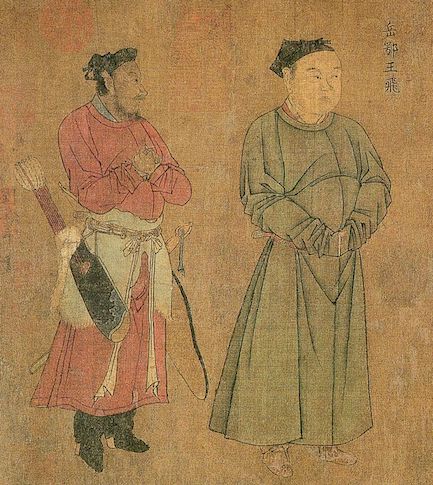
Yue Fei (right) from The “Four Generals of Zhongxing” painted by Liu Songnian during the Southern Song dynasty.
In this episode we discuss the role of General Zhang Jun in the survival of Yue Fei’s tradition, as well as in the survival of members of Yue Fei’s extended family. We also discuss how Zhang Jun managed to protect himself from the purges carried out by Qin Hui.
Previous episodes:
XingYi Part 8
This episode is about Song Dynasty arms and armour. This is a slightly shortened version of the episode from which a few of the more controversial topics have been omitted. The full uncensored version can be found inside Patreon.
XingYi Part 7
As a background to our upcoming discussion of late Song Dynasty armour and weapons, in this episode we give a brief overview of a few animal strategies applied on the battlefield at strategic and tactical levels, as well as in individual combat.
XingYi Part 6
We examine the life of Yue Fei’s best friend, General Han Shizhong, and the circumstances immediately following the death of Yue Fei. We also take a look at the the life of Han’s heroic wife, Liang Hongyu, and internal politics of the Jin Empire at that time.
XingYi Part 5
In this episode we examine the work of the Confucian Scholar Zhu Xi, who lived during the time period we have reached in the narrative (during the Song Dynasty). His philosophy did not impact Xing Yi until centuries later, but when it did, the effect was a large one, so this episode sets the scene for other episodes to come.
XingYi Part 4
We come at last to the great general Yue Fei’s greatest victories, and ultimate betrayal and death – at the hands of corrupt officials on his own side.
XingYi Part 3
In part 3 of our series on Xing Yi, we look at how the Li movement influenced Yue Fei and other Song generals in formulating effective strategies for use against the Jin, and how they managed to challenge the previously unbeatable dominance of the Jin cavalry. We also discuss the rise to power of chancellor Chin Hui in the regime of Emperor Gaozong.
XingYi Part 2
In this episode the look at the early life of Yue Fei, some of the factors that link him to the Li Movement, the meaning of some of the symbolism surrounding him, and the reasons for the transition between the Northern Song and Southern Song Dynasties.
XingYi Part 1
In this episode we discuss significant events that occur between the end of the Han Dynasty and the beginning of the Song Dynasty, in particular highlighting issues that form the background to the life of the famous Song Dynasty general, Yue Fei, who has traditionally been attributed as a progenitor of Xing Yi and other martial arts.
As you may know I co-host the Heretics podcast with my old XingYi teacher Damon Smith. (Our last episode was pretty rad, so check it out. It’s on Heraclitus, the pre-Socrates Greek philosopher who was as Taoist as Chang Tzu – but we manage to cover Mongolian metal music and martial arts amongst other things).
It’s almost impossible to explain what a high level martial artists Damon is, so I’m not even going to try. He does a particularly good job of hiding it as well, so you’d never know unless you saw him perform some sort of martial technique just how good he is.
One of Damon’s favorite sayings is “there’s no correct technique, there’s only appropriate technique”. The first time I heard this it kind of annoyed me. I mean, a technique either works or it doesn’t, right? So in a way there is a ‘correct’ technique… however, the deeper meaning is that if you apply a ‘correct’ technique at time that is inappropriate then it’s as useless as an incorrectly performed technique.
If you watch martial art competitions you see this all the time. The perfectly executed jab/cross combo gets completely nullified by the opponent changing level and going for a body lock and takedown; the beautiful double leg that goes straight into a waiting knee to the face or the perfect hook punch counter that leaves the fighter open to the straight cross. The list goes on.
Another way I’ve been thinking about this recently is to do with styles. In BJJ everybody talks about their ‘game’. My game is this, my game is that. “I’m a butterfly guard player”, “I’m a top player”, “I like half guard”.
In Chinese martial art whole styles are dedicated to a particular type of fighting. Tae Kwan Do is kicking; Wing Chun is close range and Choy Lee Fut is long range, etc..
That’s great, but what if this thinking is holding us back? Perhaps a better way of thinking about martial arts is that you need to build up a variety of skills in different situations or positions. The more skill sets you have the easier you will be able to respond to what the opponent is doing in an appropriate way.
If, for instance, you’re in a self defense situation and the attacker is grabbing you, then you need to have some grappling skills. If you lack those skills then sure, you can fall back on your striking skills, but there might be a much easier solution you are completely missing. And equally, if you are in a situation where somebody is attacking you with a knife and you have to fight back, grappling them can be quite counter productive, if not fatal. If you knew how to use a short weapon, like a stick, and one was available then that might be a much better solution.
In the end, it’s appropriate technique that is required, but (and here’s the clincher) you can only access appropriate technique if you are already skilled in a variety of different positions and situations.
If you haven’t thought about this before then now might be the time to get out there and expand the limits of your training.
Just finished watching series 4 of Glitch. It’s a Netflix show where dead people get reanimated in a rural Australian town (why this happens is a long story).
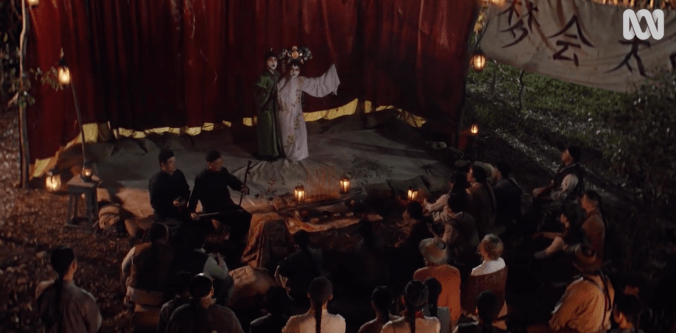
In season 4 a Chinese immigrant who died in the dust and mud of the bush in the 1850s comes back to life.
At the time, Australia was the most multi-cultural place on earth. We see flash backs from his life touring the Chinese camps of the Victorian goldfields performing Opera, which was the pop music of its day.
It’s pretty well done. Here’s some background on the history:
There are several bits in the series where the actor Harry Tseng performs Opera moves that look just like “kung fu”.
These days it’s pretty hard to imagine what life was like over 100 years ago. Some people still have the idea that “Kung Fu” has absolutely nothing to do with Chinese Opera. Clearly it was all part of the same cultural mix.
One of the most frequent things you hear in BJJ is “move your hips“.
Brazilian teachers tend to say “escape your hips“. Which is an odd-sounding translation of presumably something that sounds better in Portuguese. In American and English it usually gets turned into “hip escape“, as in, “do a hip escape here“, “it’s not working because you need to hip escape more“.
We hip escape up and down the gym as a warm up (also known as “shrimping”) because it’s a fundamental movement you need to have in your tool box that you can pull out without having to think about it.
But why? What is it? Simply put: It’s designed to create more space between you and your opponent on the ground.
You can use hip escapes for escaping bad positions like side control and mount. But it also has benefits for attacks too. Basically a good rule of thumb is that if what you’re doing isn’t working try doing a hip escape and doing it again. The change of angle and leverage will probably fix it.
Now we know what a hip escape is, let’s get to the point of all this.
When we say “move your hips” that’s not the part of the body that you need to move from. If you just moved from your hips you’d never go anywhere. You’d just spasm on the floor like a dying fly having its last buzz. What you actually need to do is push with your toes and feet on the ground so that your hips move.
Your hips moving is the result of the action, not the action itself.
Which brings me onto Tai Chi Chuan and the dantien (the lower abdomen area of the body).
All wise and knowledgeable Internet-enabled Tai Chi practitioners know that we need to “move from the dantien” in Tai Chi Chuan. (This is the supposed secret to Tai Chi that you get told by your wise master only after you have paid the required tuition fees for a number of years. 🙂 )
Cheng Man Ching, Single Whip posture.
But again, where does the action originate? I would say that, just as in JiuJitsu, you don’t actually “move from the dantien” by originating action there. Your dantien moves, but it’s your foot that provides the impetus. Your foot pushing against the ground is where the ‘power’ comes from in Tai Chi Chuan.
(A side note here for the Order of Advanced Tai Chi Wizards of the Internet: When you get this concept of the power from the ground you will find that you can actually originate the movement in the dantien as a kind of dropping force that is then rebounded from the ground, so it’s less of a push with the legs. File this under “advanced” if it makes no sense right now and come back to it later).
What Tai Chi Chuan specialises in is transmitting this power to the extremities without interfering with it as much as is humanly possible. We know that in Tai Chi we need to be relaxed (song), which seems like the last thing you’d want to be if you have to hit something hard, but there is a method in the madness.
In Tai Chi Chuan you are trying to transfer that power – the ground reaction force – from your foot all the way to your fingers as smoothly as possible and directing it with the dantien. This is called ‘threading a pearl through the 9 crooked gates‘ in the Tai Chi classics. The gates here are the joints of the body. All the breaks in connection between your foot and fingers are the points where power leaks out. Usually we cover these things up by using muscular strength to get by – you can spend years fooling yourself with this, and it’s a very hard habit to stop.
Tai Chi is infused with the concept of flow, but what does that actually mean? What does ‘flow’ mean in this context?
We are used to seeing Tai Chi practitioners in parks performing graceful, flowing movements. In fact, that’s what we expect to see whenever somebody mentions “Tai Chi”, but as usual, it’s what’s underneath the water that matters, not what we see on the surface.
“Chang Ch’uan [Long Boxing] is like a great river
rolling on unceasingly.”
This points to the continuous nature of Tai Chi boxing. Techniques don’t really start and stop, they all merge into one continuous movement.
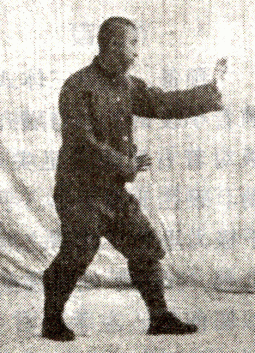
Sun Lu Tang, Tai Chi.
Acquiring this skill in the Tai Chi form is actually quite difficult. For a start, people tend to speed up or slow down during a form performance. They speed up on the bits they like and slow down on the bits they find hard.
Another common fault is posturing – pausing serenely in postures that are being held, if only for a moment. It’s equal and opposite infraction is too much merging – movements get mushed into each other without one finishing properly before the other begins.
I’d say it takes a good few months of continual practice, focusing on just continuity, to iron these faults out of a Tai Chi form
The deeper lesson in continuous movement is that you are constantly recycling the ‘energy’ in the form. When you break a movement, or stop, you are not keeping everything flowing, and you lose the power of momentum. They fall flat.
This links back to the idea of Yin and Yang being in constant flux, with change as the only constant. These ideas are as old as the hills, but find their expression most often in Taoist thought.
In a recent TED talk Adrien Stoloff looks at what Wuwei (The Taoist concept of non-action, and flow) mean.
Adrien discusses flow and wuwei, and how recent research in cognitive neuroscience suggests what may be happening in the brain when we experience flow or wuwei. Adrien Stoloff is a doctoral candidate in Asian Religious Traditions. He is interested in Chinese religious beliefs and practices from the late Warring States period to the Early Han Dynasty (approximately 5th-2nd centuries BCE). Specifically, Adrien’s research focuses on the Classical Daoist phenomenon of wuwei. Translated as “effortless action,” wuwei is a state of being in which one acts effortlessly yet efficiently in a given situation. His dissertation project uses an approach informed by tools in the field of religious studies – textual and historical analysis – as well as by the fields of philosophy and cognitive science:
The dance/fight game
If there’s one martial art that really emphasises the concept of ‘flow’ then it’s Capoeira. The Brazilian dance/fight martial art where two participants enact a kind of spontaneous, improvised martial dance set to music.
Clearly your connection to the other person in Capoeira transcends the physical connection we find in Tai Chi push hands, and it has to be in place or you end up with a foot to the face. That’s Tai Chi’s Ting Jing (Listening energy) on steroids.
Even as an outsider to Capoeira, I can tell when the practitioners are connected to each other, and when they’re not. When the focus is more on athletic ability and directed inwards the two practitioners don’t seem to melt together into one dance – they retain their separate selves. The type of Capoeira I like to watch is where the two practitioners become one – responding and reacting in real time to each other.
And of course, with the rhythm of the music and a focus on connecting there’s all the potential for it to cross over into ‘spirit dance’, where you connect to the wider environment.
I looked for some beginner capoeira videos recently and found these which I thought presented some basic moves that I could copy. I had a go at this video below this morning and I was surprised by how difficult (but also fun) even these ‘basic’ moves are.
I mean, I can do it badly. Anybody can do it badly. But trying to do it with the smoothness and flow that the practitioner demonstrates above is a different matter.
If you wanted to get more ‘flow’ in your movement, I think this could be a good place to start.
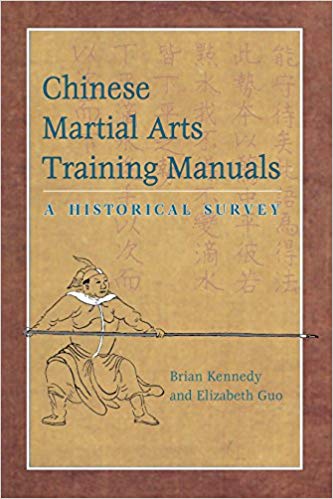
I conversed with Brian a few times and always found him to be an interesting and respectful person. Here’s an article he wrote on the Da Dao “Big Knife”, for those not familiar with his work.
“I first grew interested in martial arts history back in the ‘Bruce Lee-Kwai Chang Caine days’. My parents got me a copy of Robert Smith’s Asian Martial Arts and one of my high school history teachers let me do a semester of independent study on Chinese martial arts history. That independent study project, back in 1975, got me started on a lifelong interest in Chinese martial arts history. The field of Chinese martial arts history has progressed so much in those 40 years—but, many of the same challenges remain. “
Brain was 61 and had just got his brown belt in Briazilian Jiujitsu in January of this year and his first stripe in May. What an inspiration.
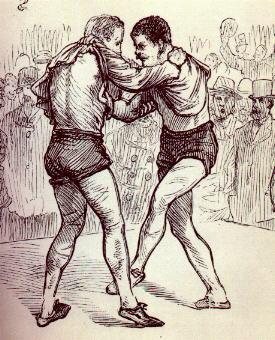
The first episode is devoted to the now lost wrestling style called simply, Irish Collar and Elbow.
What’s fascinating about this style is that it used to be huge. Thousands of people would turn up to watch a high profile match up over a century ago. It also spread to America where it became equally popular. Even George Washington was a practitioner!
However, it was superceeded by other styles of wrestling, and cultural and societal changes in its birthplace involving the industrial revolution (if I remember correctly) and the rise in popularity of boxing that resulted in its decline and eventual demise.
Ruadhán MacFadden, who runs the podcast, however, has been trying to recreate what it must have looked like based on his research into accounts of Collar and Elbow matches and his knowledge of contemporary grappling styles (he’s a brown belt in BJJ).
At a recent BJJ Globetrotters Summer Camp, he conducted a seminar showing what he’s discovered about this lost art. BJJ Globetrotters have now put the seminar online, so you can glimpse through a window into the past and see what this style of European martial art would have looked like:



 The Tai Chi Notebook