How to use the mind in Tai Chi

art beautiful bloom blooming

Photo by Magda Ehlers on Pexels.com

All movements are motivated by Yi, not external form”,

I’ve talked a lot on this blog about things to do with the body in Tai Chi, but I’ve not really said much about the mind before. That’s because it’s a lot harder to talk about, since, as you’ll discover, the requirement for correct use of the mind in Tai Chi has nothing to do with “thinking”, which makes it especially hard to talk about because as soon as you verbalize or write down your thoughts you are, in effect, thinking about it. See the problem?

The classics use three words to describe the mind in Tai Chi:  Shen, Xin and Yi.

We’ll leave Shen and Xin off the table for now, but the important point is that different words are being used to describe different aspects of the mind.

Let’s look at the big one: Yi.  The Tai Chi classics are pretty unequivocal about the importance of Yi to Tai Chi:

All movements are motivated by Yi,

not external form.”

But what is meant by Yi? The English translation given is usually “intention”. However, I think this is cause of more confusion about Tai Chi than anything else. People take it literally and think it’s the intention you have when performing the movements of Tai Chi – like the intention to grab and arm, or the intention to fight, or the intention to break a wrist, etc..

When people try to demonstrate this correct intention they simply pull a mean face and try to look a bit stern and aggressive while punching or doing something dramatic. That’s not it.

The word “intention” is definitely related to what Yi really is, but it’s not what is meant by Yi, not by a long way.

If you look at the face of somebody good performing Tai Chi they never look like they’re straining, aggressive or mean. Instead, they look like they are full of awareness, absorbed in what they’re doing, but open to their environment at the same time.

Yi has nothing to do with thinking, in the conventional sense at all. If you look at somebody doing Tai Chi who is thinking at the same time their movements look a bit empty, their eyes fidget all over the place, they are absorbed in themselves but not really ‘in’ their bodies. The mind and body have become separated.

In Tai Chi you want to achieve a unity of mind and body, so that there’s effectively no difference. You are just one unit doing the work, or rather, letting the work be done through you. You are present, but simultaneously aware.

I like to call Yi “directed mind”. It’s all about directions. When I’m performing the opening movement of Tai Chi for example, I am performing an opening of the body as the hands raise and a closing of the body as the hands fall. My mind is performing the directions up, in, down and forward in that order.  I am directing where the body is going with my mind and eyes. Your eyes have to be working in harmony with the whole process, not distracted, or looking in the wrong direction for the movement you’re doing. Don’t look at your hands, look through them. When you do press for example you are pressing towards the horizon, not just at your imagined opponent.

All of this direction thinking – the quality of using the mind this way – is impossible if you are thinking thoughts. As soon as you notice you are thinking thoughts you’ve lost it.

When attempting this type of training my Tai Chi teacher would advise me to stop the form altogether if I noticed my mind had wandered off and go back to the start. After repeatedly doing this, your mind kind of gets the message that you’re not kidding. You really want it to stay with the body and what you’re doing for the next 5 minutes, and it quietens down and takes a back seat, allowing your awareness to come to the fore.

“Focussed awareness” is another good phrase to use to describe Yi.

Hopefully this post has helped you understand what is meant by the phrase, All movements are motivated by Yi, not external form”, a little better. As you can see, it’s tricky to talk about. The only way to ‘get it’ is by practice. What I’m describing is a quality that isn’t a physical object or movement, so it’s hard to grasp, but with repeated practice over time it will become as real as the very device you’re reading this on.

The Jing Cheng Wushu archives

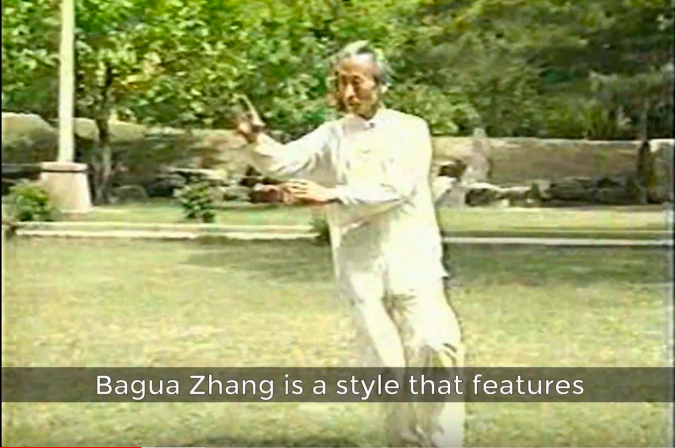
Screen Shot 2019-12-30 at 9.22.07 AM.pngI just wanted to give a quick shout out to the work Byron Jacobs is doing preserving old Chinese TV performances of Chinese martial art from the 1980s.

“Jing Cheng Wushu” (京城武术) is a series that ran on Beijing TV in the 80’s. The title “Jing Cheng Wushu” means ‘The Wushu of Beijing’. Each episode focused on a Chinese martial art style popular in Beijing at the time and featured many prominent older generation practitioners, many of whom have passed away since.

He’s done three episodes so far, digitising and adding English subtitles. They are:

XingYi Quan


Bagua Zhang


Taiji Quan


The punch you didn’t see coming

action adult athlete athletes

Photo by Coco Championship on Pexels.com

I’ve already talked about how we use jin (planet force) all the time. I think there’s a good example from MMA and boxing that sheds some more light on this.

When boxers or MMA practitioners get knocked out by a punch it’s usually from one they didn’t see coming. The counterpunch is a deadly strike in combat because at the very moment you think you are punching them, they’re hitting you. Its effectiveness is partly down to surprise, and often you get a double impact because the attacker is moving forward into the punch of the counter attacker – a perfect example of ‘using their own force against them’.

But the surprise factor and force on force don’t explain why a punch that the guy doesn’t see coming is often twice as effective as a punch he is mentally prepared for.

I believe the answer is to do with jin and the subconscious mind. When you can see a punch coming, your brain can – in the fractions of a second you have available, – make subtle postural adjustments so that the force is absorbed by your body better against the ground. This is similar to the idea of a jin path to the ground we’ve already talked about. I believe we automatically and subconsciously do this in response to any impact we can see coming.

When we can’t see that punch coming it’s more damaging because we are not ‘in position’ to receive it as well.

The next time you watch a boxing match or an MMA match, think about this idea and see if it looks true on the slow-motion replay.

The upsidedown world of Tai Chi

man performing handstand

Photo by Yogendra Singh on Pexels.com

I’d like to give a quick shout out to Cook Ding’s Kitchen who reposted one of my blog posts “Don’t Try“, which gave me the chance to read it again. It was about using less effort and not forcing things. Difficult words to live up to.

This started me thinking about one of the things that can help in using less effort in Tai Chi. A good trick is to turn our normal perspective on the human body upside down. We normally think of doing things with our arms and hands and don’t think much about the legs at all. In Tai Chi we want to reverse that.

If we watch a boxing match, for example, we tend to look at what’s going on with the hands a lot, since that’s where all the action is, and generally miss the subtle changes of the legs.

low angle photo of two men fighting in boxing ring

Photo by Sides Imagery on Pexels.com

Tai Chi is boxing with the legs: You use your legs like arms, and your arms like legs. When you’re doing the Tai Chi form, stop using your arms to ‘do’ things and put all your focus into using your legs to do it. It’s a bit like walking on your hands: your arms and legs swap their normal functions over.

When doing the form or applications, your toes grip the ground, your weight moves fully forward or backward on the feet (no wishy-washy stances floating about in the middle ground, please), you are sunk and slightly low in your stance so you can get fully into your legs. In contrast, the upper body should be empty. Relax. Let the arms go where they need to go, but don’t move them there deliberately. Let your legs, directed by your middle, do the work. Think them into position with a directed focus (yi).

The Press posture is a good example of what I’m talking about:

ycf2

Yang Cheng Fu – Press

You put your inside hand on the outside arm wrist and push towards the opponent in a linear direction. Because you’re forming a particular shape with your hands in Press, it’s tempting to do this move with your arms cut off from the body. Instead, the power needs to come from the ground via the legs. Drop down and release from the dantien area to the ground and let the power of the ground rise up to the hands. Done right, you’re hitting the opponent with the force of the planet (jin), not just the force of your body.

As it says in the classics:

“The jin should be
rooted in the feet,
generated from the legs,
controlled by the waist, and
manifested through the fingers.”

and

“The whole body should be threaded together
through every joint
without the slightest break.”

and

“All movements are motivated by yi,
not external form.”


Happy Christmas!

A very merry a Christmas to all my readers! 2019 has been a terrible year in many ways – not personally, but for the state of the world – but this blog has kept me on my toes, forcing me to think and rethink my ideas, and distracting me from world events.

Thanks to everybody who has inspired me – you know who you are.

Here’s a book I got for Christmas that I’ll hopefully make time to read. It’s time we all started to turn our heads back towards nature.

Tai Chi Notebook, the book, will be coming in 2020, so look out for it!

Have a happy New Year!

Graham

Elite Sports Ultra Light Preshrunk Adult Gi Review

Screen Shot 2019-12-18 at 4.02.21 PM.png

So far I’ve mainly reviewed martial arts books, but I’d also like to branch out into reviewing other martial arts products, so, being a BJJ enthusiast, I jumped at the chance to review the Elite Sports Ultralight Preshrunk Adult Gi when they offered to send me a review sample. Here’s my review.

Elite Sports Ultra Light Preshrunk Adult Gi review

Price: £59.99

Web: Elite Sports (UK)

Direct link to product

Verdict: Great value!

What is it? The Elite Sports Ultra Light Gi is a kimono for wearing in Jiujitsu classes. Jiujitsu gis differ a little in style and shape from Judo gis, and they also need to take a lot of wear and tear. They need to be tough, yet light enough that you don’t end up drowning in your own sweat.

How did it look? See for yourself. Here’s a video:

The video is also on our new Instagram account.

IMG_1291

There’s a nice range of colour options available. I went for the navy colour, which I really like. If I was being picky I’d say there was about a 10% difference in colour shade between the trousers and the top. That’s not a big problem for me though.

Is it tough enough? Yes, there were no signs that it was going to rip any time soon, and at under 3kg in weight, it was also light and didn’t feel cumbersome. The Elite Sports Gi manages to hit a great balance between toughness and lightness. The stitching looks solid and there were no problems with the tailoring at all.

Screen Shot 2019-12-18 at 4.31.20 PM.png

Did it fit? I went for the A2 size and it fitted me perfectly. The cut is great – called “fitted” – and being preshrunk it fits nicely as soon as you put it on. Flowing through jiujitsu movements the gi felt great – it’s been tailored so that there’s enough room for your arms and legs to move freely. It’s got a nice balance between stiffness and softness so that it keeps its shape as you roll. It’s not going to end up wrapped around your head like really soft gis can, but it also doesn’t feel too stiff.

The trousers are tied with a chunky cord, which looks like this:

Screen Shot 2019-12-18 at 4.31.30 PM.png

The cord might feel a bit odd to start with compared to other gis, but they didn’t untie once for the duration of a whole class.

The material of the gi itself is really smooth – this had the advantage that it’s easier to flow around people, and makes your jiujitsu feel really silky because there’s slightly less traction against the other person, but equally, it could make it slightly harder to hold people in positions.

What do you get in the box? Along with the gi you also get a free white belt. Like the gi, it’s good quality, and thick.

Did it shrink in the wash? No. I washed it at 30 degrees (which the label recommends)  and there was no shrinkage at all. There was also no colour loss.

How did it smell? Some cheaper gis can have a nasty smell when you first open them, but it’s important to note that when I first got the Elite Sports Gi, the gi smelt great – apparently there’s an “Antimicrobial Inner Lining” to this gi which has the effect of reducing sweat odour over time as well, which is a nice feature. I’d say it works too – even after a heavy rolling session, the gi didn’t smell that sweaty.

Would you recommend it? Yes. At just £60 this is a great value product: recommended!


Stand still, breathe better

underwater photography of woman

Photo by Engin Akyurt on Pexels.com

Have you noticed that some people always seem a little bit out of breath? Especially when they talk. I think it’s a problem of posture. Not a huge posture discrepancy, like bending over or tilting to the side, perhaps not even anything visible, but just a slight incline here or slump there that has become ingrained, causing the body to work harder than it needs to draw in oxygen.

I just read a great article that talks about the correct mechanics of breathing, which I’ll quote:

Here’s how breathing is supposed to work, according to the National Heart, Lung and Blood Institute:
  • The abdominal muscles relax while your diaphragm contracts downward, pushing all your guts out of the way.
  • Your intercostal muscles contract to expand your rib cage, lowering the air pressure in your lungs and creating a vacuum in the chest cavity.
  • Air flows through your nose and mouth in response to the vacuum.
  • The intercostal muscles and diaphragm relax while the abdominal muscles contract, pushing air out of the lungs.


Breathing is an automatic process that should be happening effortlessly, yet we mess about with it far too much.

So what does this have to do with Tai Chi you might be asking? Well the posture requirements needed to achieve the optimum style of breathing are provided by correct application of Tai Chi principles. I find standing upright with the head ‘as if suspended from above’, as it says in the Tai Chi classics and a relaxed upper body is the key. When we slump in even a minor way we impinge the correct functioning of the breathing process.

One of the best ways to train this is in Zhan Zhuang, “stake standing” postures, because it takes the complexity of movement out of the equation. With regular practice your general sense of being upright tends to improve.

One of the best free sources of information on Zhan Zhuang is the Channel 4 TV series Stand Still, Be Fit! that breaks it down into easy 10 minute lessons.

Notice that there’s no specific advice on breathing, but a lot of attention is paid on alignment and posture. The idea is that with correct posture, the breathing becomes natural again and follows what the Taoists called ‘the way’.

Clear as a glass of water. Do you have the patience to wait
till your mud settles and the water is clear?
Can you remain unmoving
till the right action arises by itself? The Master doesn’t seek fulfillment.
Not seeking, not expecting,
she is present, and can welcome all things.”

Tao Te Ching – chapter 15


Update: New URL = no more ads!

two persons holding drinking glasses filled with beer

Photo by Tembela Bohle on Pexels.com

Just a quick site update – I’ve opened up the purse strings, watched the moths fly out and blown away the dust, put my hand in my pocket and upgraded the site to a proper URL – www.thetaichinotebook.com

That means there will be no more adverts spoiling your viewing pleasure (hurrah!),  and maybe I’ll get a few more visitors.

If you like the sort of content I’m producing feel free to donate to keep the site going Disclaimer: nobody has ever donated 🙂

That’s it, no other news, except that I’ve updated my post on my History of XingYi podcast series to include all episodes. We’re now up to part 9 and we’re not even out of the Song Dynasty!

Oh, and the latest episode of my Heretics podcast showcases a really rare Japanese religion called Pana-Wave. Check it out.


The King (Netflix 2019), a short review

Screen Shot 2019-11-03 at 12.15.04 AM.png

The King (Netflix 2019) is (Shakespeare’s version) of the story of the rise of King Henry V and the battle of Agincourt against the French (1415).

Prince Henry is portrayed as a wayward teenager, who dislikes authority and has no desire for the throne or the complications of court politics and international diplomacy. Suddenly this emo teenager has the full weight of the English crown thrust on his shoulders, and pretty soon, against his will, he is at war with France and the famous field in Agincourt is calling.

There are virtually no women in this film. It’s as study of men. How men rule, how men lead and how men fight. And ultimately, how they lie.

The fight scenes are not bloody. They’re muddy. Smack, bang, wallop in the mud. But they feel realistic. I think the makers of The King have spent a lot of time talking to medieval armor experts and thinking about how fights in armor, between armored knights, would actually have played out.

While Agincourt is remembered for the English archers securing victory with their longbows, their effect in the battle, while important, is not portrayed as the decisive factor by a long way. It’s the use of the terrain, strategy and hand to hand combat that secures victory.

And the grappling. There is so much grappling. Specifically, grappling with weapons and armour. Forcing the opponent to the ground and working a blade in or bashing their head with a hammer.

The key factors seem to be, wrestling, impact from momentum (blunt or sharp edged weapons), and finally the environment – the mud.

Xing Yi, a Chinese martial art which I talk about a lot on this blog, has battlefield origins and seems equally obsessed with weapons, armour and the environment. The strikes in Xing Yi’s 12 animals all target weak points in armor. The bits where the joints in the human body are and the armor is, by necessity, weak to allow the limbs to move – up under the armpit, the inner thigh and the neck are obvious examples.

Another thing that Xing Yi emphasis is the stepping. So much emphasis is placed on making sure you don’t slip or trip in Xing Yi training. My XingYi teacher would insist on us stepping with the whole foot landing flat, never the normal heel toe action of walking.

Back when I was learning from him regularly we used to train outside (whatever the weather), so often this was on wet grass. Trust me – you don’t appreciate that heel toe stepping is vulnerable to slipping until you try it at speed on wet grass.

Over time we seem to forget these little things in our training, because in our modern life they are rather unimportant. People don’t wear armor these days and we usually train martial arts on flat wooden floored gymnasiums or village halls, in the dry. Watching The King was a good reminder of their importance. It’s the simple things like this that make the difference between living and dying on a battlefield.

When it comes to grappling in armor, The King suggests that tripping or simply unbalancing the opponent is the decisive factor. Forget the big hip and shoulder throws of judo, and think more about the little leg hooks and sweeps you find in folk style wrestling. It makes me think of those jacketed styles of folk wrestling which have survived today in isolated corners of the world, or the descriptions you read of Irish collar and elbow wrestling (sadly now lost), which start from a position of already being in a clinch with the upper body and the leg tricks where the art is found. Suddenly the reasons for training wrestling like that makes much more sense.

I enjoyed The King for all these reasons. Perhaps the closest we’ll ever get to a battlefield type situation in modern civilian life is a game of rugby. Either being in one or watching one.

In short, The King is great, war is a muddy business, and I need to start thinking about my stepping again.

Tai and Tuo Xing videos (part 1 and 2)

As I was reading Glen Board’s excellent new book Xing Yi: A study of Tai and Tuo Xing I thought there really needs to be a video of these linking sequences he’s presenting in the book so people can see how the moves work and get a flavour of it. So I made one myself in a bit of free time instead of my usual morning practice.

During filming I got a visit from a local village Peacock (we call him Peter) who decided to bless my video with his presence. Tai is the flycatcher, a small to medium bird with a long tail. Now, while Peter may also have a long tale, he’s a very large bird. Also, he’d be more like Chicken Xing (Ji Xing), so he’s a not a perfect fit with Tai, but you have to use what you’ve got.

IMG_1154.jpg

Peter, standing proud.

Here’s the first video:

The problem is, (as I discovered) if you want make a video of animals Xings that if useful for people to follow along you have to take a lot of the character of each animal out, and it becomes a bit bland and (dare I say it….?) more like Tai Chi…

So I did another video that had less emphasis on relaxed movement and accuracy and more on expressing the Xing of each animal. Glen described the Xing well in his book, but in short, I’m trying to generate more torsion through the dragon body in Tuo and more agility, abrupt change of direction and surprising strikes in Tai.

My Xing Yi is always a work in progress, and I’ve been out of the loop with it for a few years, but Glen’s book has inspired me to pick it up again, so I’m not presenting myself as a “Laoshi” or expert here or anything, just a glimpse into my personal training. Anyway, here it is and hopefully people who buy the book will find it helpful in some way: