One of the first things I talk about when it comes to alignment is:
Head over shoulders Shoulders over hips Hips over ankles
These three are the basic alignments for standing upright at the beginning of almost all Tai Chi forms and looks something like this (ignore the arm positions):
If one of these things is out of alignment then you are leaning forward or backwards, or your posture is out of whack.
It’s easy enough to keep these three alignments in a standing stance, but things can get more complicated in movement, and when you introduce forward and back-weighted stances. At that point I try and keep the following two alignments:
Head over shoulders Shoulders over hips
The ankles can now be in different places, as reacquired by the stance.
It depends on the style of Tai Chi you do, but if you do a style that advocates a forward lean then you need to make sure that there’s a straight-ish line between your back foot and your head. If you do a style that doesn’t advocate a lean, then your back knee must be bent and you want to keep your body upright with your shoulders vertically over the top of your hips.
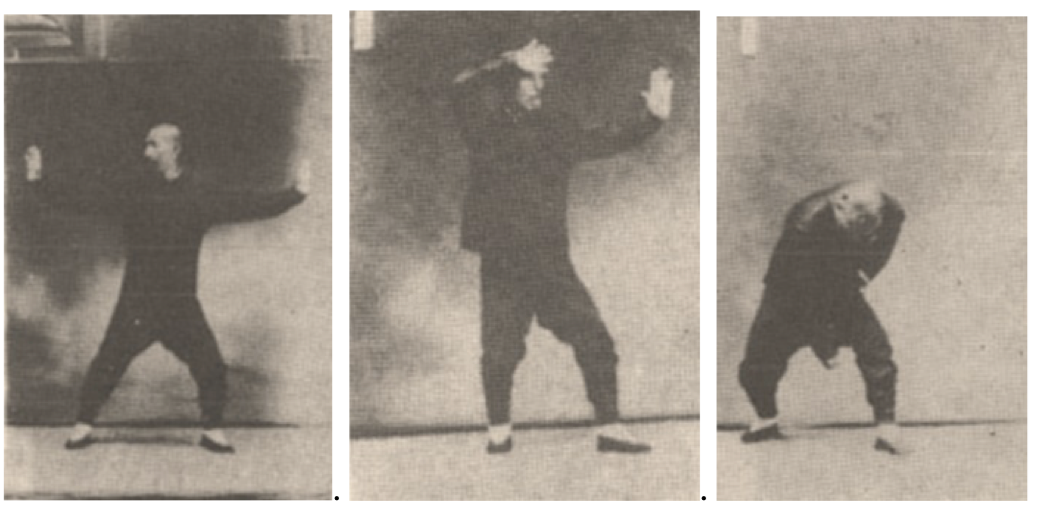
But the real answer is that no one style of Tai Chi only does things one way. Most styles contain some moves that lean and some that don’t. Wu style, for example:
If you compare late Yang Cheng Fu to early Chen Man Ching postures, you can see that they are very similar, and are both trying to keep the head over the shoulders, over the hips:
While doing the tai chi form, take a moment to think: ‘where is my head in relation to my hips?’ You don’t want to be sticking your bottom out and destroying your alignment, which often happens in transition movements between postures:
A picture paints a thousand words, especially in Tai Chi. I recently found an incredible source of Tai Chi images drawn (I think) by Anthony of Brisbane Tai Chi.
Just scroll down the main page and look at the images – they’re great! Full of tips on alignment and posture for Tai Chi and Zhan Zhuang (standing practice).
One of Anthony’s best images for thinking about how alignment relates to the tai chi form is this one:
Anthony/Brisbane Tai Chi
I think that image very clearly shows head over shoulder over hip over ankle, and how easy it is to mess that alignment up once you start moving in Tai Chi. You basically want to keep the blocks aligned over each other.
Why?
As it says in the picture, if you align yourself correctly with gravity then your legs become the primary weight holders in the body. That means you can be more relaxed (Sung) in the upper body, so that you can use it to transfer force, instead of tensing up to hold weight that is misaligned. Plus, it just feels better.
This post is going to start somewhere you don’t expect – over 1,000 years ago in Song Dynasty China during which we find the legendary founder of Xing Yi, Yue Fei, a general in the Song Dynasty army, mulling over the advancing (heavily armoured) Jin cavalry, and wondering how his foot soldiers are going to fair against the crushing advance of an army that had destroyed the Liao Dynasty troops, scattering them to the Western regions.
The Jin/Song wars would last a century, starting in 1125, when the Jin attacked the Song after a series of negotiations between the previous allies failed. During this period North and Southern China was effectively separated between Jin and Song, with the Song retreating into the south of China. The Jin advance into southern China in 1130 was stymied by Song generals like Yue Fei and Han Shzhong. Eventually the Song allied with the Mongols in 1233 to defeat the Jin, but the Mongols then went on to defeat their previous allies, the Song, and thus the Yuan Dynasty was born.
But why this history lesson? Well, one weapon that was popular during the Song/Jin wars was the ‘sword breaker’ called a bian, which translates as ‘whip’. But it was a very solid short stick made of iron, not a flexible whip. It was often used on horseback because it was effective against heavily armoured warriors, and the Jin cavalry was very heavily armoured.
The Tai Chi move “Single Whip” (Dan Bian), has the same character for whip as the one used for the ‘sword breaker’. It’s also similar to the characters for ‘shoulder pole’, which I’d previously speculated was a possible origin for the name. But people who are better at Chinese than me have cast doubt on this theory. It seems much more likely that it’s the ‘sword breaker’ weapon that is being referred to, not a shoulder pole.
“Recently I’ve been made aware of some theories about the meaning behind “Single Whip” 單鞭 (dān biān)
Basically the claim is that the posture resembles a farmer carrying something on a pole or yoke and that the name refers to this yoke.
This yoke or shoulder pole is called 扁擔 (biǎndan)
So right away, simply linguistically, this claim is a little bit problematic.
English Character Pinyin Romanization. Single Whip 單 鞭 dān biān Shoulder Pole 扁 擔 biǎndan
We’re dealing with four completely different characters with completely different meanings. The dan in biandan is POLE not single.
To a native Chinese speaker this is like comparing apples to tennis balls. It’s just a ridiculous claim.”
The post goes on to look at the historical record, which is fairly interesting, and makes the case for the bian being the ‘sword breaker’.
Fair enough, the shoulder pole idea was just a theory of mine based on the similar name, and the way it looks. As with all good theories, it can be disproved with evidence. But as I also said in that original post of mine:
“The ‘whip’ could also be used as a weapon in Chinese Marital Arts. Again, it was usually referring to a short stick, not a flexible whip. In the excellent “Chinese Martial Arts Training Manuals” by Brian Kennedy and Elizabeth Guo you’ll find a description of a book called “Tiger Tail Whip” by Jiang Rong Qiao published in 1930. It features a “long routine for the metal tiger tail ‘whip’, which is rigid and actually amounts to a type of cane.””
“Chinese Martial Arts Training Manuals”, by Brian Kennedy and Elizabeth Guo
The ‘sword breaker’ or ‘bar mace’ was certainly more substantial than a cane. As the name implies, it could break swords, but it was also good for attacking heavily armoured soldiers as it could impact the person under the armour. Check out what it could do in this excellent video:
What’s in a name?
But it’s still hard to work out why the Single Whip posture would be named after the ‘sword breaker’ in the first place. I mean, the posture doesn’t resemble the weapon at all… But then I saw something very interesting recently:
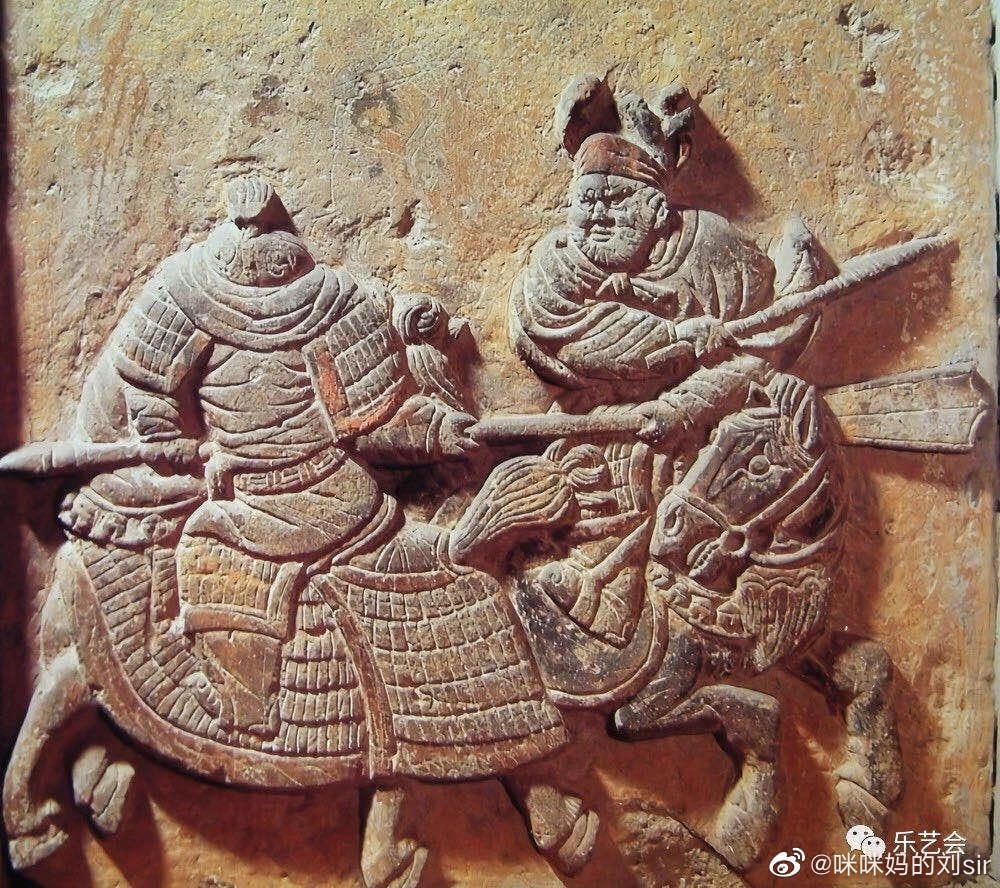
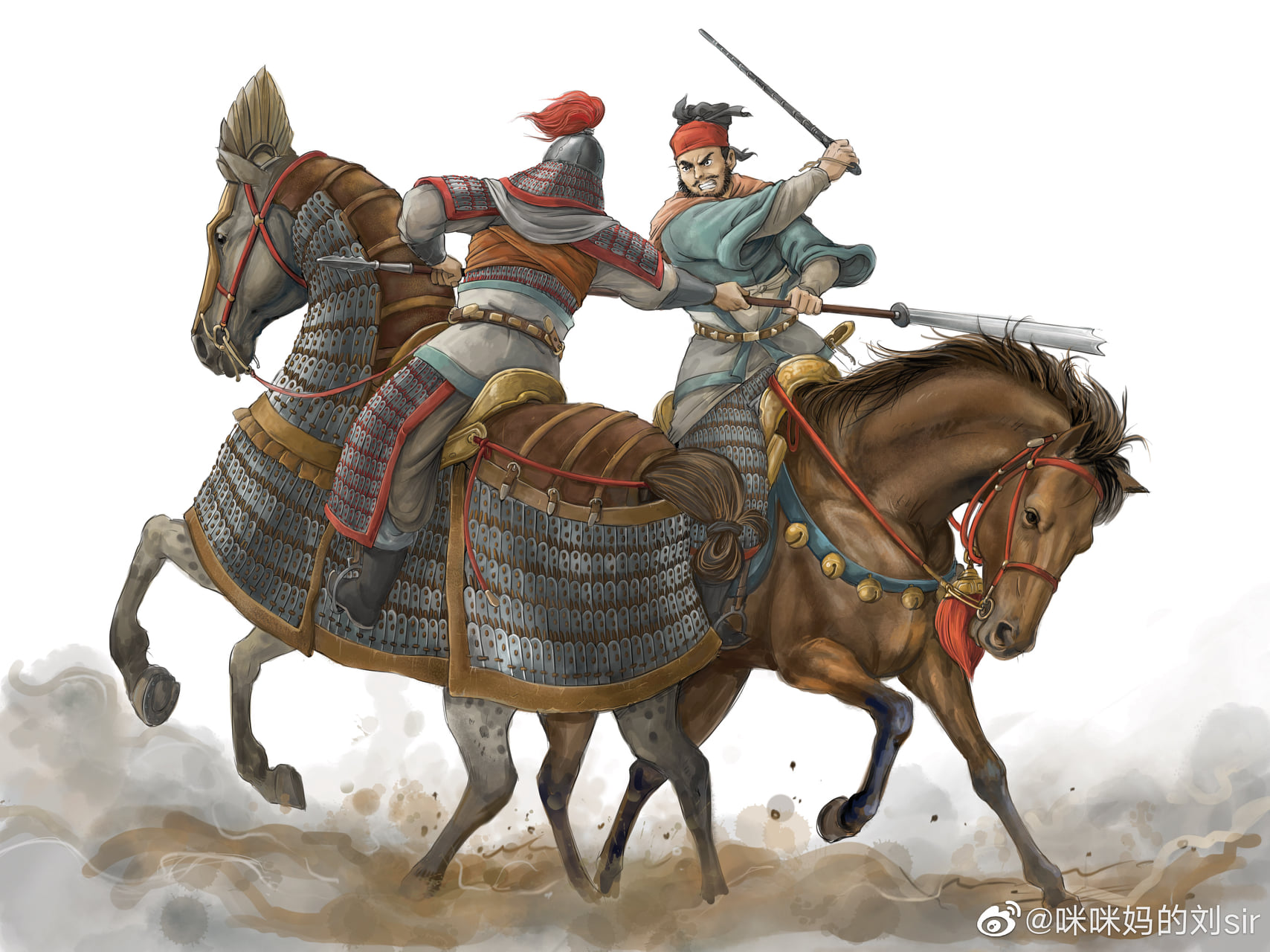
“This brick carving is from a tomb of Jurchen Jin (1125–1234), describing a battle between Song and Jin cavalries. The one who faced to us with a sword breaker 锏 might be Jin cavalry, who snatched the pole weapon (三尖两刃刀, lit. ‘Three points double edged blade’ fig. 3) away from Song cavalry and swung his sword breaker 锏 to attack his head from right to left. Song cavalry’s head and helmet were totally whacked. Well, pole weapon user should always keep distance with enemy and, such blunt weapons like mace, sword breaker etc. are really excellent weapon against heavy armor. Picture 2 was drawn by 咪咪妈的刘sir.”
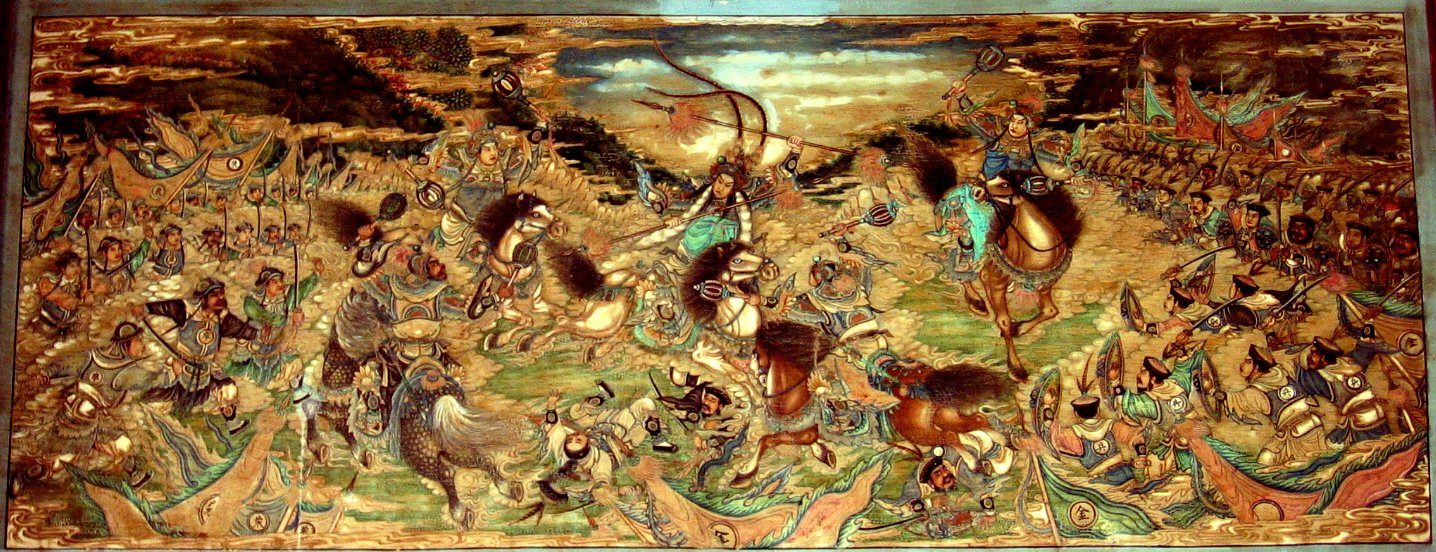
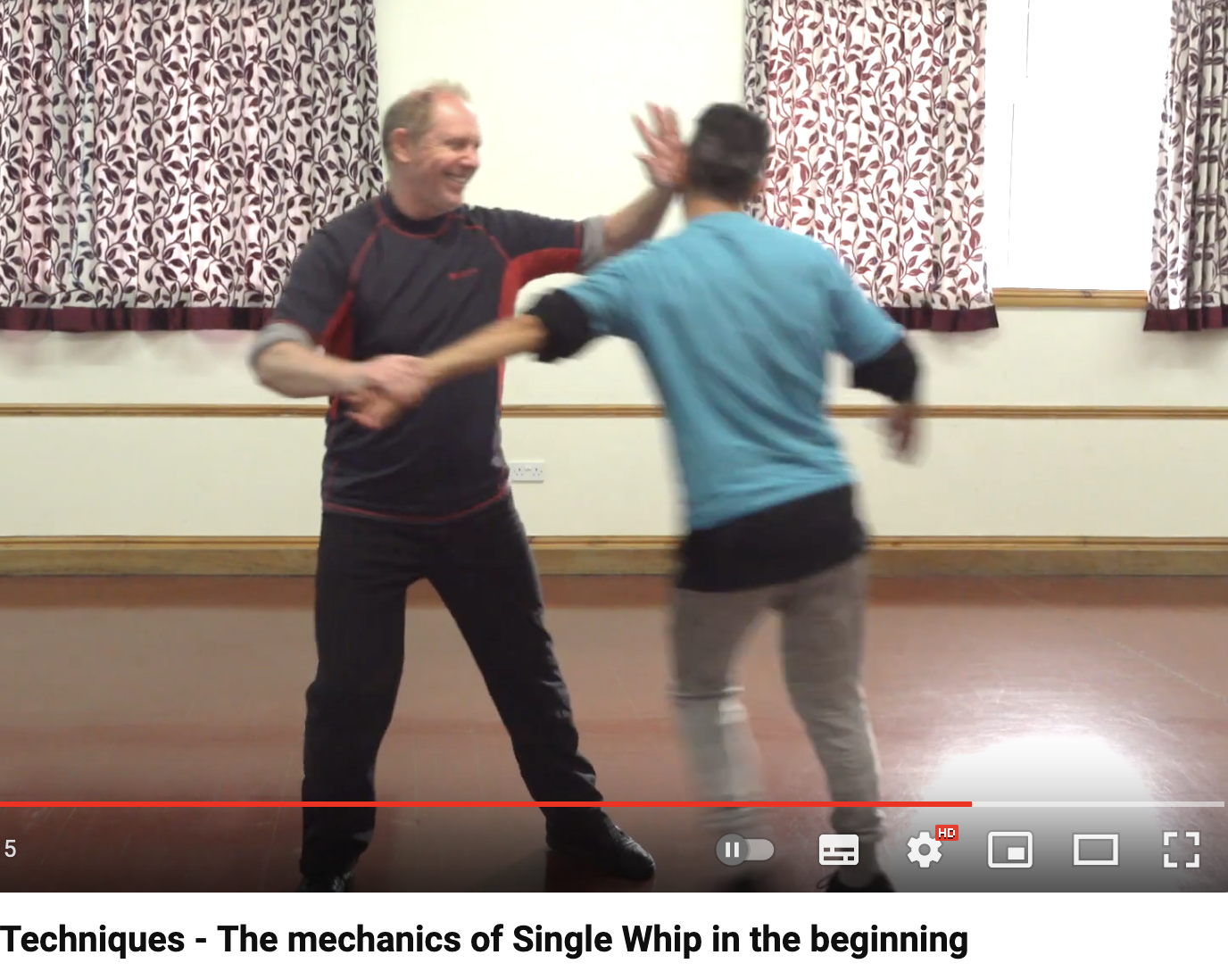
Now, what I notice about this carving, and the painting, is that it isn’t a million miles away from the application of single whip that we practice in our Tai Chi. Check it out:
Maybe that’s where the name “Single Whip” comes from? The application of the move is certainly similar to the way you’d use a ‘sword breaker’ way back in the Jin/Song wars to grab the opponent’s long pole weapon and bash them on the head with your ‘whip’.
But why “single”? Well, it turns out that the ‘sword breaker’ was often a two handed weapon. You had one in each hand, as this carving of the Jin cavalry shows:
You can also see double maces being used by cavalry in the painting that opens this article.
It’s as good an explanation for “single whip” as I’ve read anywhere else. And at least this reasoning makes some sense. At the end of the day, it’s just another theory, ready for some eager beaver to disprove.
It’s 2024, if you’ve ever commented, read or shared a post of mine, then a big thank you for contributing to the story of The Tai Chi Notebook. I feel privileged that I get such good comments here, and quite often they inspire new blog posts, so we all play a part. Let’s see where it goes in 2024.
I’ve already done one post of a training idea for the New Year, however, for New Year’s resolutions I thought I might introduce you to the more professional side of my writing – here’s an article I’ve written for the iMore website on iPhone apps that will help you stick to your New Year’s resolutions. Since most of us have smart phones these days I think it’s widely applicable to my readers here (I’m sure Android versions of most of the apps also exist). I hope you enjoy it! I’m certainly going to be using some of those apps this year.
2024 will be the Year of the Wood Dragon, (which starts on 10th February). Japan Times says “In a dragon year, people are said to be able to harness the creature’s intelligence, leadership and abilities to pursue their dreams with creativity, passion, courage and confidence.”
So, here’s a bit of Xing Yi Dragon I recorded in 5 spare minutes I had between opening presents and eating another round of Christmas dinner/left overs/chocolates – it’s out of focus, but not out of mind 🙂
I had the good fortune to guide a group of people through some Xing Yi Monkey recently, which made me focus on it more and practice it a bit harder in the run up, which was a good thing. (I’m also available for children’s parties and Hen parties too, btw). Anyway, I wrote some notes about it, which I’ve typed up below.
A unique animal
When it comes to the animals in the natural world that we can look at for inspiration for martial methods the most obvious place to start is with one of our closes cousins, the primates. Like us, monkeys can stand upright, if only for short periods in some cases, they have hands that can grip and even a bit of limited tool usage. However, monkey is not a good place to start your journey into the 12 animals of Xing Yi.
The first thing to realise about monkey is that it breaks a lot of the ‘rules’ of Xing Yi Quan, which is one of the reason why it’s often taught last amongst the 12 animals. My teacher taught the animals as almost self-contained mini martial arts – each one had a different strategy and techniques, but Monkey wins the award for being the most unique amongst them. It really does stand up on its own as a complete martial art.
Almost all of the rest of Xing Yi Quan can be performed in formation, standing in a line with other people, since you generally move forward and backwards along a straight line (except for the turns, obviously). Whether this really harks back to an ancient heritage of soldiers moving in formation is speculation of course, but it should be noted that a row of people holding a spear and standing side by side can perform the 5 elements and most of the first 11 animal links while all facing in the same direction without impending each other, provided they all turn at the same time. That’s possibly one reason why Xing Yi is so obsessed with keeping the elbows near the ribs.
But Monkey doesn’t follow these rules – it’s breaks the line. Or more accurately, it’s what you do when the line has been broken. Attacks in monkey are reacted to and defended at diagonal angles – there’s footwork you don’t find in the rest of Xing Yi and there are changes in tempo, bursts of speed and jumping. It’s as if your nice orderly line of soldiers has been broken up and the battle has become more of a melee situation.
All the different types of monkey have similar movement, but the monkey native to China that Xing Yi is probably using for inspiration is the Golden Monkey. And thanks to the BBC there are plenty of Golden Monkey clips available to watch – this one of two tribes coming together and fighting over resources is particularly good:
And here’s an interesting clip of a group of wild monkeys who have learned to trust humans for food:
Both clips are a gold mine of information about how these animals move.
Monkey Pi
Pi (splitting) is the main energy from the 5 elements that is used in monkey, but while in Pi Quan the arm uses the elbow joint as a pivot point for delivering the downward chopping strike (a bit like the swing of an axe), in monkey it’s the wrist that is the pivot point. The monkey Pi is more like a slap, but don’t think that makes it ineffectual. A relaxed and loose slap delivered using good body mechanics to the head can easily result in concussions.
Monkey also tends to eschew single strikes – everything is done in quick flurries of 3. This is called a triple palm. Often the first strike is to open up their guard, or intercept a strike, the second is to hit the head, and the third can be done as a grab and pull on their limb or head, leading to your own head butt or knee strike – an action called ‘wrapping’. The back of the hand can also be used as an upward deflection to the opponents arms, for when the monkey wants to enter deep.
Range
Talking of entering deep, Monkey wants to either be too far away for you to hit (beyond kicking range), or right in at what would normally be called grappling range, (i.e. too close for what is generally called striking range) but the use of close body palm strikes delivered by turning the body sharply and the cross stepping opens it up as a striking range too.
Take a look at this video of a monkey antagonising a Tiger cub (I don’t think he’d be brave enough to try this on a fully grown tiger!) to get the idea of range:
As you can see, monkey is something of a trickster engaged in a war of attrition. A tiger generally wants to finish the prey in one big action, monkey will keep attacking, wearing it down over time. Often the monkey’s goal is simply to drive the opponent away out of its territory.
Agility, but with stability
Obviously to close the distance from outside kicking range to inside punching range you need tremendous agility to play monkey, however, agility without stability is a recipe for disaster, which is another reason for teaching monkey last – it requires a very solid understanding of the footwork methods of Xing Yi Quan. It uses a cross step frequently, and also spins and jumps.
Monkey requires you to be agile, but rooted when you step. Without that combination the movements of monkey can become just a dance. The stability also relates to being relaxed in your movements. Because monkey movements tend to be done fast the tendency is to get tighter and more tense as you do them. I find consciously trying to relax while doing monkey is required more so than in other Xing Yi animals.
Tea cups exercise
The arm methods of money require more utilisation of the joints of the wrist, elbow and shoulder than the other methods of Xing Yi. Techniques like “Reach around the back of the helmet” require significant mobility of the arm joints. The best way to achieve this is to become adept at the famous tea cups exercise. You should practice this is with actual tea cups full of tea (or water) and try not to spill any. This is incredibly difficult!
Here’s a basic instructional on the tea cups exercise:
Yin and Yang
Finally, we do a Yin and a Yang monkey in our Xing Yi – the Yang monkey is the bright, lively, younger monkey, while the Yin monkey is the more older experienced monkey who uses heavier techniques. Almost all the video you see of Xing Yi money on the Internet are showing the Yang version. The most famous move from Yang monkey is the upward ‘flying’ knee strike. Here’s a good example:
To be honest, I haven’t seen any other Xing Yi group do a Yin monkey like we do, but here’s a little clip of me doing some Yin monkey so you can see what I mean:
“The, at first sight, seemingly humorous Chenjiagou saying to “always keep an egg under your armpit” reflects the importance of not allowing the upper arms to become stuck to the side of the body.
This idea of always keeping a space under the armpit is something I’ve heard said in other styles of Tai Chi as well, and it fits in very well with the idea of “Peng all over the body” that you’re aiming for in Taijiquan, that kind of “inflated like a balloon, but also soft, springy and heavy” feeling.
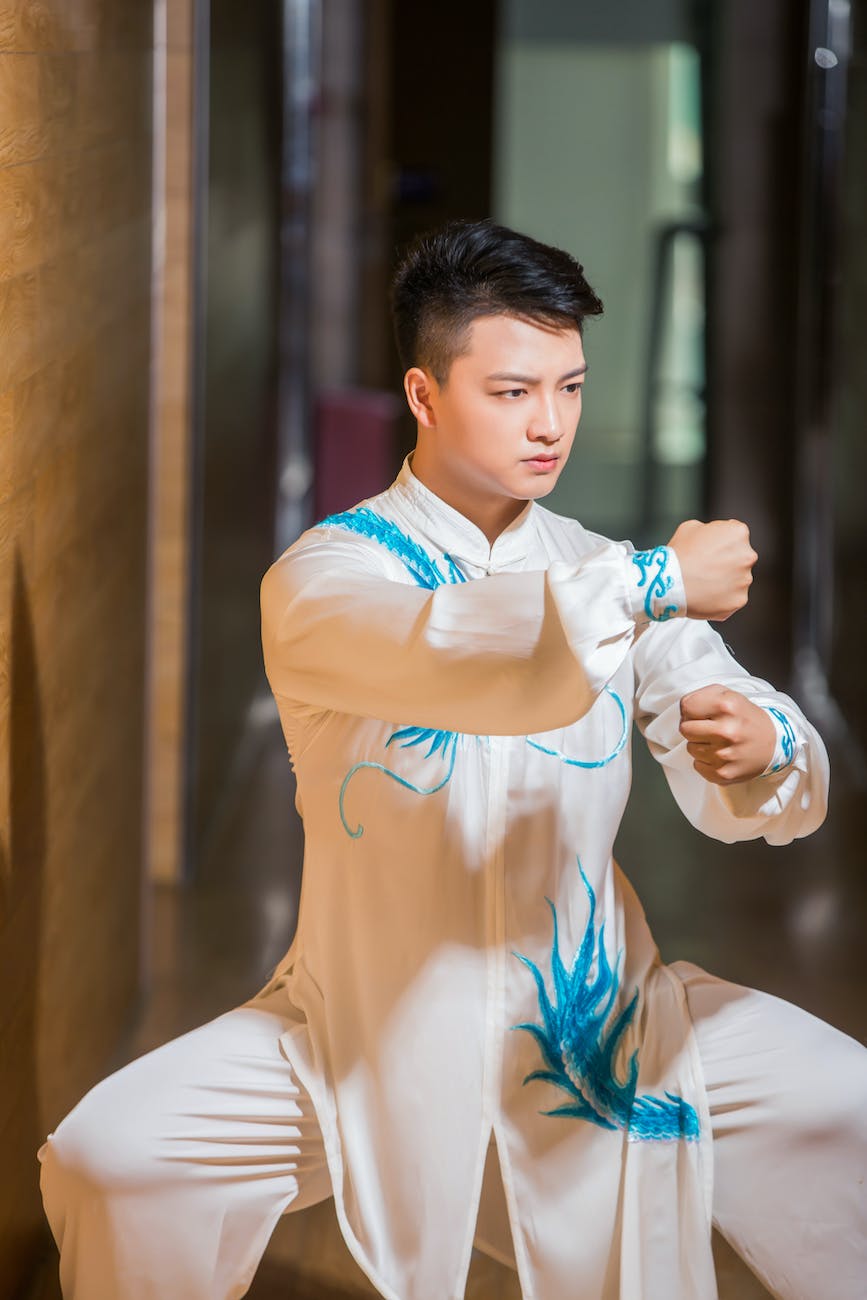
Taijiquan, with armpit gaps. Photo by Stephen on Pexels.com
But how does that relate to the question I was looking at recently about the issue of where the elbows should be in Xing Yi? “The elbows never leave the ribs” is a line from the Xing Yi classics* (more of that later) that has caused a lot of arguments between practitioners on its interpretation and meaning.
And when you compare it to the previous saying about the armpit from Chen Village, it’s basically the complete opposite advice! And yet, both Taijiquan and Xingyiquan are said to be internal arts, and part of the same family. So, is the advice about the elbow a crucial element, as fundamental as, say, aligning the Bai Hui point (the crown) with the spine? Or is this more of a piece of strategic advice to do with the fighting style of Xingyiquan, and not anything to do with its fundamental body method?
Let me throw in a curve ball here and switch arts to BJJ. “Glue your elbows to your ribs” is something I say to my students in BJJ all the time when they are on the bottom defending a position like side control, knee on belly or mount.
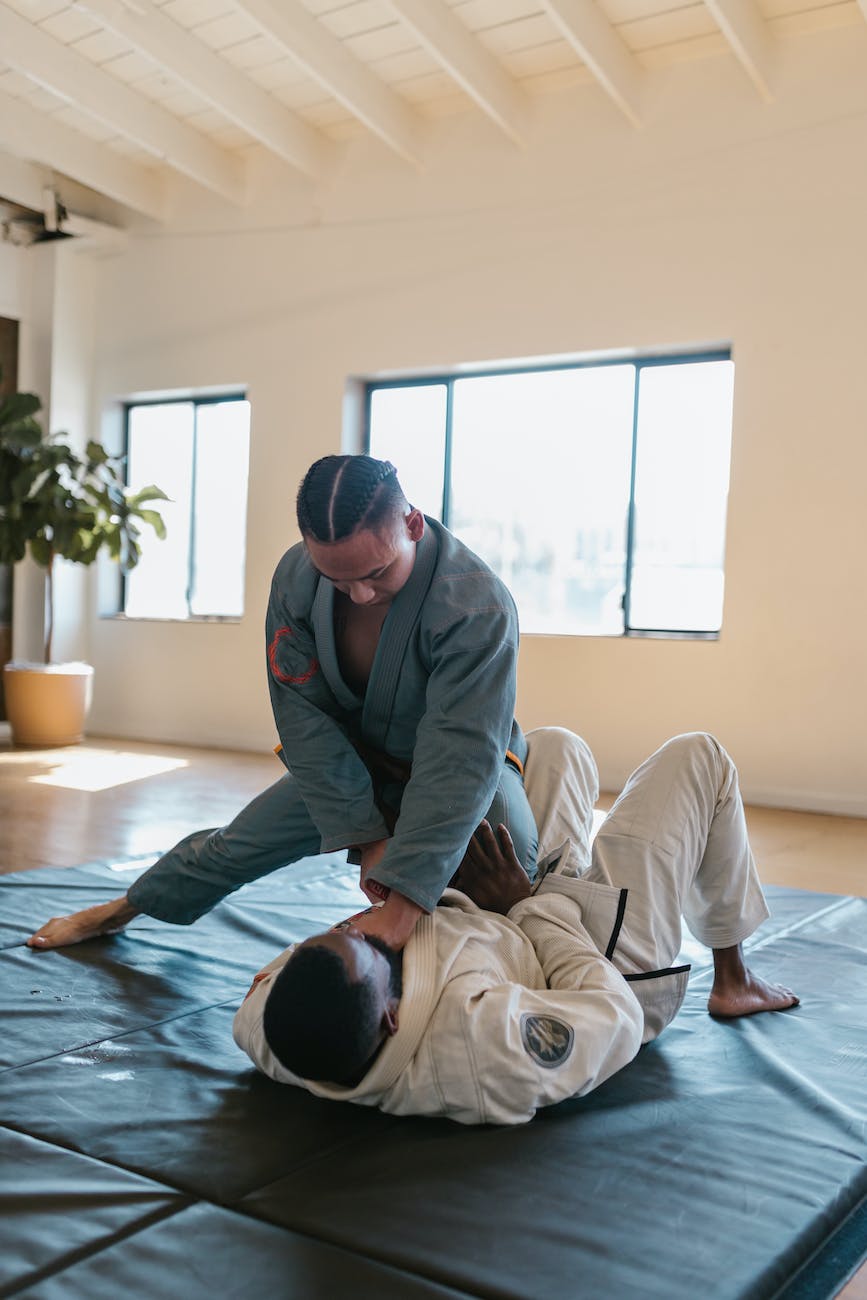
Knee on Belly in BJJ. Photo by RDNE Stock project on Pexels.com
If you let your opponent separate your elbows from your ribs in that position then only bad things can happen, so it’s great advice. Normally after I submit somebody new in BJJ I stop to explain to them how I did it, so we can turn it into a learning moment. 9 times out of 10 my explanation starts with “it started when you let me into the space under your armpit”. However, it would be ludicrous to make it into a hard and fast rule, to suggest that you should never let the ribs leave the armpit at any moment in BJJ. There are plenty of other times in BJJ where you need to pull with your arm, and you can’t do that fully without separating your elbow from your ribs.
In the preface to his manual Sun says (Translation by Brennan), “While once at Bai Xiyuan’s home in Beijing, I got to see one of the Yue Fei manuals, not an original copy of course, but a handwritten copy made by someone in a later generation. It was not very detailed and unfortunately contained no explanations of its terminology, only the barest of text from beginning to end. I was suddenly inspired by this, immediately wishing to provide more complete information, even though I was fully aware that my level of learning and skill was superficial, and without being tempted to make anything up [in order to fill information gaps]. I secretly made my own copy and then deeply studied it, going through it posture by posture until bit by bit I had built up the material to make this book. There is no decorative language in it at all, for in my studies I have not dared to hold on to even the slightest exaggerations. Wherever flaws are found within my work, I hope my comrades will correct me, for which I would be very appreciative.
– sincerely written by Sun Fuquan [Lutang] of Wan County, Baoding, 1915, 1st month, 15th day”
In his manual Sun has a chapter called “The Essentials of Practice” in which we find the advice about elbows and ribs. (Translation by Brennan)
“ESSENTIALS OF PRACTICE The essentials of practice in Xingyi Boxing: 1. Sink your waist. 2. Shrink your shoulders. 3. Hollow your chest. 4. Press. 5. Lift. 6. Horizontal and vertical should be clearly understood. 7. Lifting, drilling, dropping, and overturning should be clearly distinguished. … Your head presses up during drilling, then shrinks back during overturning. Your hands lift during drilling, then drop during overturning. Your foot lifts during drilling, then drops during overturning. Your waist lifts during drilling, then drops during overturning. [from the Xingyi Boxing Classics:] “In lifting there is a horizontal aspect, but it is invisible [because it appears to be only upward]. In dropping there is a vertical aspect, but it is invisible [because it appears to be only forward].” Lifting is going out and dropping is striking, but when lifting is also striking, dropping is still striking. Strike with lifting and dropping, like the overturning waves of water, which are lifting and dropping. Regardless of lifting and dropping, drilling and overturning, going and coming, it should always be that your elbow does not leave your ribs and your hand does not veer off from your centerline. These are considered to be the essentials in Xingyi Boxing. Knowing these, the right path in the art will be obtained.“
But you can see that even in this passage, Sun is quoting the older “Xing Yi Boxing Classics”. So, you have to start to wonder, how old is the advice that the elbows do not leave the ribs, really? I know some styles maintain that their “quan pu”, ancient collection of classic handwritten writings their family possesses has this advice in. At least with Sun’s work we have a published date we can be sure of.
But this also brings up the question of how much we dedicate ourselves to following the literal words of “the classics” to the letter. How much freedom are we allowed in our martial art? Were the classics intended to be a kind of set in stone, unwavering, set of rules to be followed on pain of death? The ancient writings of the founders always tend to take on this weight that gets heavier over time. If they’d been written a year ago, would we treat them with the same reverence? There are hard line Christians who treat every word of the Bible as the word of God, never to be questioned, and there are more modern progressive Christians who interpret the words in the Bible into a modern context, or see them as simply stories designed to teach an idea, and not to be taken literally.
Today’s blog is about a weird quirk of the Xing Yi world. There’s a surprisingly large amount of online debate in Xing Yi circles about where the elbow should be when performing Xing Yi. I mean, a surprisingly large amount of debate. Especially for a matter that might, forgive me for saying this, be seen as trivial by people actively engaged in combat sports that actually spar with resistance.
Obviously, if you have some sort of two person free practice in your Xing Yi system that you actually engage in regularly, I’m not talking to you. I think the real reason why all these debates happen is simple – too much forms and not enough fighting.
But, ok, there are other reasons. For example, details do matter in internal arts. Quite often we’re being asked to look in detail at our movements and micro movements to get the most perfectly coordinated and natural human movement possible. But without keeping one foot on the ground, (and grounded in the reality that sparring provides), the theoretical arguments start taking over and the art disappears up its own bum. A martial art that is predominantly forms-first is always going to be theoretical at best. To take the well worn analogy – you don’t learn to swim by practicing on dry land.
The problem stems from the fact that there’s a line in the Xing Yi classics that translates as:
“The hands do not leave the heart and the elbows do not leave the ribs”.
But it’s how literally you take these words seems to be the crux of the matter. Now, I’ve seen videos of respected Xing Yi masters quoting this passage while demonstrating and their elbows are clearly leaving the ribs, if not in the horizontal axis, at least in the vertical axis.
The reasoning behind keeping the elbows tight is sound – in boxing, kickboxing and MMA it’s generally considered best practice to keep your shoulders high and elbows tucked in close to the body to help protect the ribs. But boxers don’t tend to get hung up on this – as their individual style develops they don’t feel like they have to conform to the same ‘rules’ that the novice has to. They are free to develop their own personal style through experimentation and testing in the ring. I’m sure Prince Naseem was taught the same basics as Mike Tyson, but look how differently their boxing styles turned out in the end.
So, (and I know, dear reader, that you are just dying the hear this), what’s my take on where the elbow should be in Xing Yi?
Well, I’m glad you asked. Rather than getting hung up on words in an old writing (that may or may not be old at all) I prefer to get hung up on history. I mean, you have to get hung up on something, right?
Xing Yi is generally considered to be descended from military spear fighting. If you hold a heavy spear it becomes readily apparent that your best chance of wielding it with power is to keep it in front of the body, not out to the sides. It’s the same when you hold any heavy object – you are stronger when your arms are in front of you holding it than when they are at your side holding it. This is the truth I feel these words are aiming towards, and generally the postures and techniques of Xing Yi all comply with this idea of keeping the elbows in and the arms in front of the body, not to the sides. There are exceptions though. For example, Xing Yi Bear has a much rounder posture, with gaps under the elbows, more like the Yi Quan standing postures.
Some postures in our Xing Yi dragon and chicken links are for hitting with the elbows and we hold them out to the side when doing so, but in these cases you are normally (but not always) standing side-on to the opponent, so the elbow tip is pointing at the opponent, so in that sense it is not ‘out to the side’.
A good example is this famous Liang Yi Zhuang posture from Baji, which is similar to the chicken posture I was talking about. (Baji is another Northern Chinese martial arts, that is a bit similar to Xing Yi).
I mean, we could decide that viewed from the opponent’s position the elbow is in line with the body, therefore it is not leaving the ribs, but the hands are not in front of the heart. No way. Are we therefore going to decide that this posture, taken out of context on its own, is wrong because it doesn’t correspond literally to some ancient writing that may, or may not, have been referring to a specific context?
Here’s another theory: I think what the whole thing is quite possibly about how soldiers work in formation on a battlefield. If Xing Yi does have military roots then a line of soldiers on a battlefield would all be orientated towards the enemy, standing side by side in a line. That’s another good reason to stick the elbows to the ribs. Any bladed weapons going towards your sides would definitely not be welcomed by your brothers in arms.
Ultimately, I don’t expect this post to have really made a difference to the debate. I feel like this one is just going to run and run forever. So long as there are mainly theoretical practitioners of the art there will be always be many theoretical debates about how what somebody is doing is right or wrong in relation to some ancient writing.
I just think people’s efforts would be better put to trying moves out on other people and getting feedback that way. As one of my teachers used to say often:
“There is no such thing as correct technique, there is only appropriate technique.”
There’s a lot of great martial stuff in Xing Yi Quan, which is feeling more and more like an untapped resource these days. With that in mind I interviewed one of my old training partners, Mike Ash, for the latest episode of my podcast. Mike has always been interested in training Xing Yi Quan as a martial art, and that’s what we talk about. He’s also practiced plenty of other martial arts and has recently started a new study into Taijiquan.
We talk about all of that, plus the spiritual side of martial arts. Here’s the podcast:
Compared to solo forms in Chinese martial arts, a lot of questions you might have about why we do this, or don’t do that, are immediately obvious in application on a living, moving human being. And if they don’t make sense in that context, then you have to start asking yourself if what you’re practicing really has any point at all?
Switching the emphasis away from solo form doesn’t mean you have to be doing a sort of life and death battlefield combat every time you practice, it just means you need to be thinking about the other person, not yourself, so much.
Here’s one drill we practice in our Xing Yi system, called “5 Elements Fighting” – in its most basic form (shown here) it’s two people following the creative/destructive sequence of the 5 elements, so for example, your partner attacks with metal, you respond with fire, he responds with water, and so on. Later on you can improvise and vary the elements more so that you respond to metal with wood, or earth, for example. You can also add methods in from the 12 animals. But the idea is to keep a spontaneous feel, even if you’re following a set pattern, as we are here.
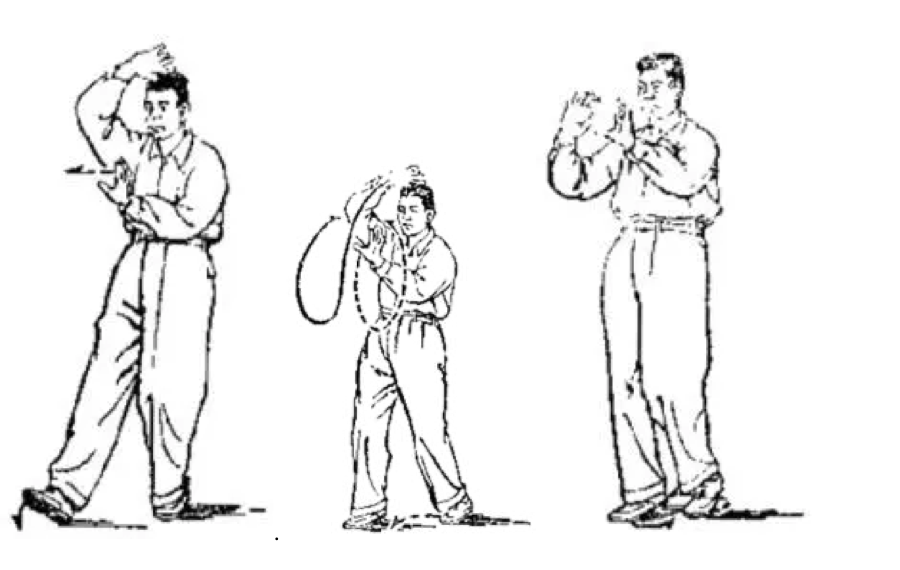
I’ve always been curious about the postures in martial arts forms where both feet are together, because these postures don’t look very martial at all. In fact, it’s hard to imagine why you would want to use a stance like that in a fight, and yet we find them in a lot of Tai Chi forms:
Here’s an example of the posture in application in Taiji performed by my teacher Sifu Raymond Rand:
Sifu Rang, Brush Knee, Twist Step.
It seems to be mainly Taiji lineages that have some influence from Sun Lu Tang that do this the most. A lot of people attribute the distinctive ‘feet together’ postures he used to his prior training in Xing Yi, and there could be some truth to this. Xing Yi does have ‘feet together’ postures quite a lot.
Of course, the root of Xing Yi is spear fighting, but the modern interpretation of the art is heavily biased towards bare hand training, and this creates a misleading impression. Think about it – if you were at at least one spear length away from your opponent the risk of being tackled to the ground because your feet are together would be greatly reduced. You’re now free to use the power generation advantages that can be gained by letting both feet come together, which is handy when you are holding a heavy object, like a spear.
If you watch this excellent video of Xing Yi spear technique by Byron Jacobs you’ll see that he doesn’t hang out with his feet together all the time, but occasionally he uses the feet together moments for power generation (and of course, also standing on one leg for range advantage and manoeuvrability in a way that makes sense with weapons).
In Xing Yi the most famous example of the ‘feet together’ posture is the Half-Step Beng Quan. Here the back foot stepping up to meet the front foot in place creates a powerful closing action of the body, kind of like a door slamming.
So, is this the origin of ‘feet together’ postures in Taiji forms? Quite possibly. However, there is one more thing to consider. After first learning Xing Yi, Sun Lu Tang learned his Taiji from Hao Weizhen 1849–1920, who learned from Li Yiyu 1832–1892, who learned from one of the Wu brothers, Wu Yuxiang 1812–1880 who had learned directly from Yang Luchan 1799–1872 and also sought out Chen Qingping 1795–1868 who he learned from in Zhaoboa village.
It’s often thought that the distinctive stepping seen in Sun style Taiji, where the back foot is often lifted and brought up close to the front foot, is a consequence of Sun’s prior Xing Yi training. This makes sense as part of the narrative created as part of the Sun Style Taiji brand, which is that he incorporated his earlier Xing Yi and Bagua training into his Taiji style. However, if you look at the Wu (Hou) style he learned, it already had this distinctive stepping in it.
While the feet don’t go completely together as much, if at all, in Wu(Hao) style, they are very close together for a lot of the time. Watch this video for an example of the form in action:
I think you can see that influence extending into Sun Lu Tang’s Taiji, which makes sense since he learned from this lineage.
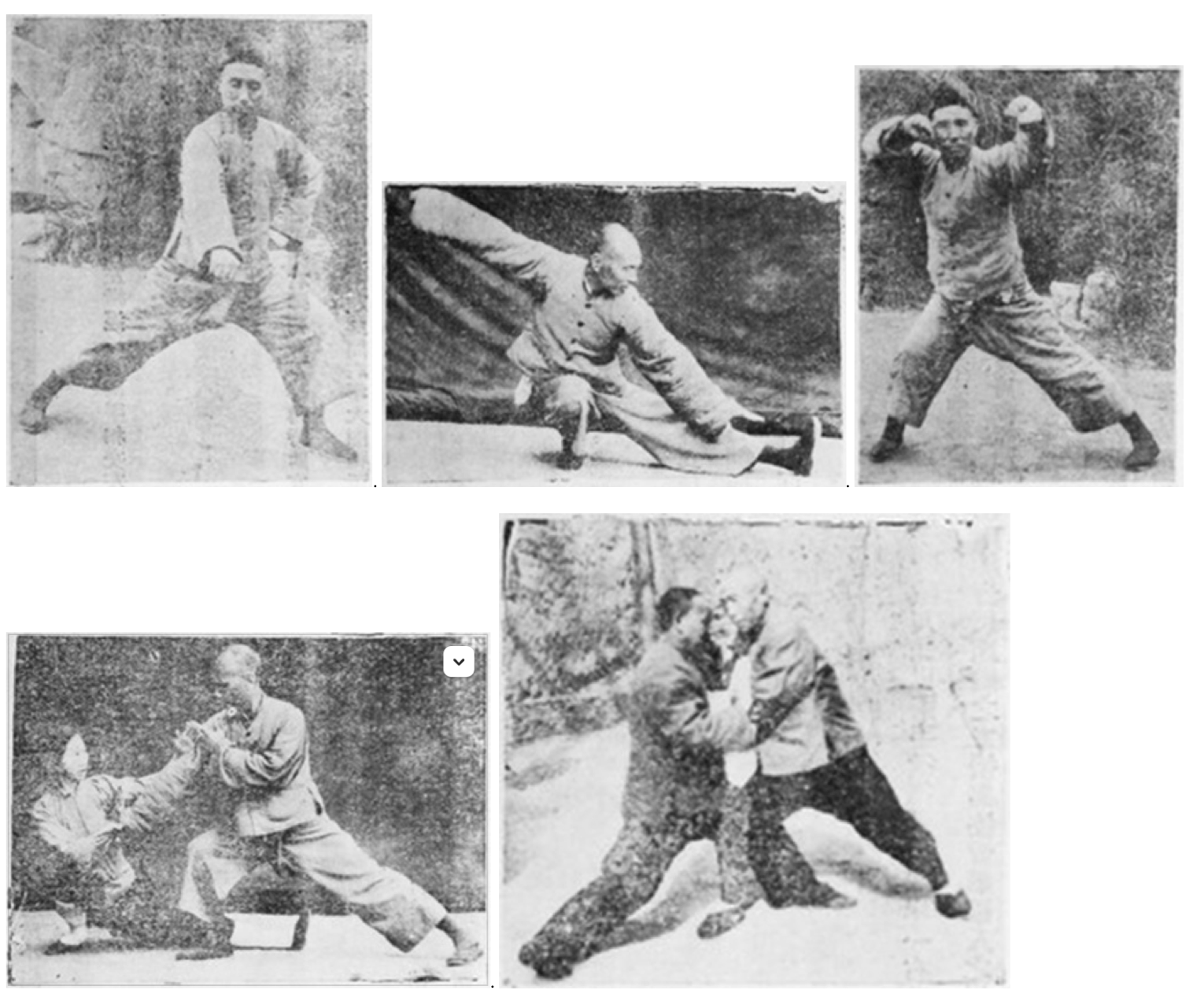
Finally, I should note that thought this post I don’t want to create the impression that all the steps in either Xing Yi or Taiji performed by Sun Lu Tang are small or restricted. He also had plenty of wider postures in his arts too, for example.
Xing Yi:
Taiji:
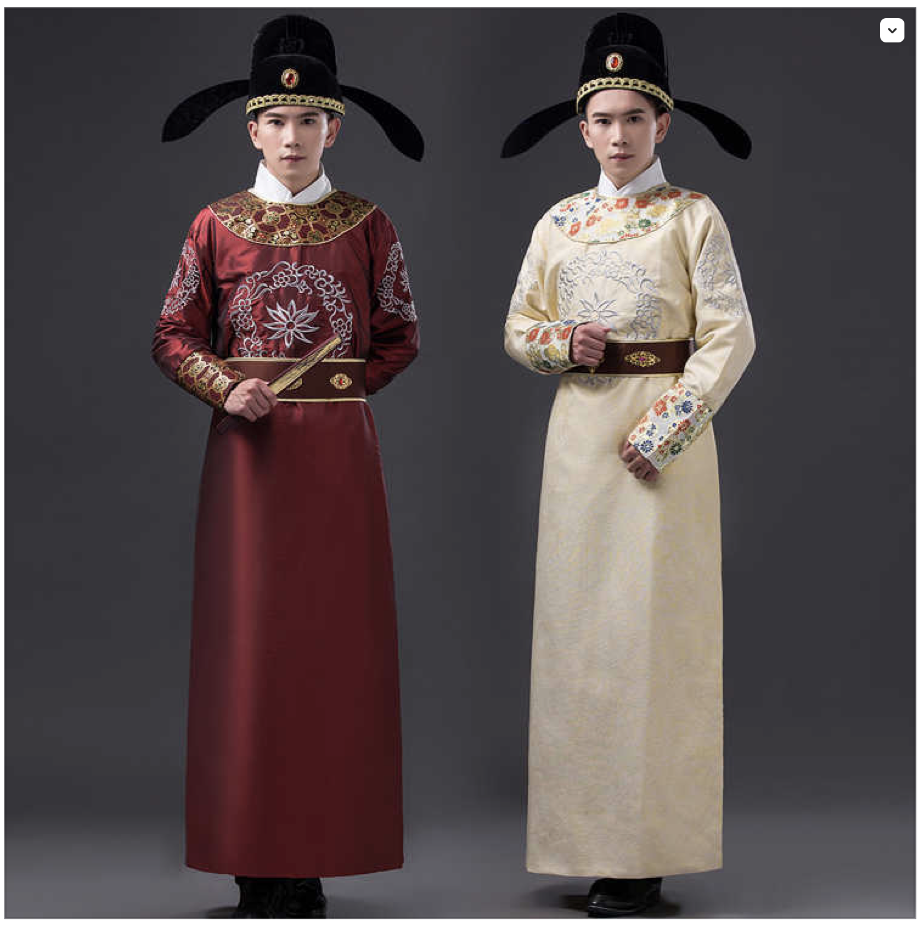
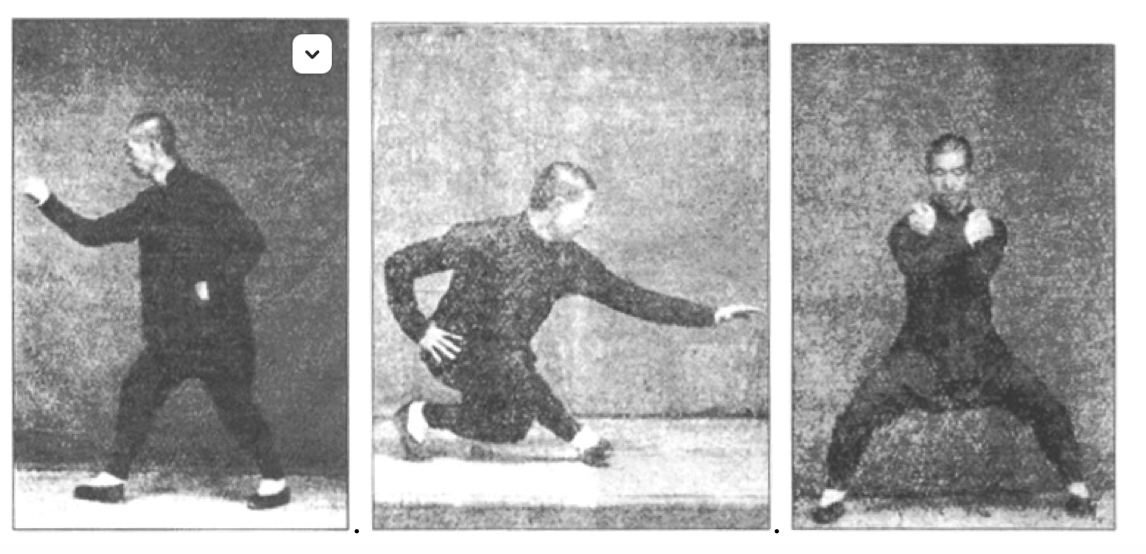
However, compare it to postures found in other styles of Taiji whose practitioners didn’t have to wear court dress:
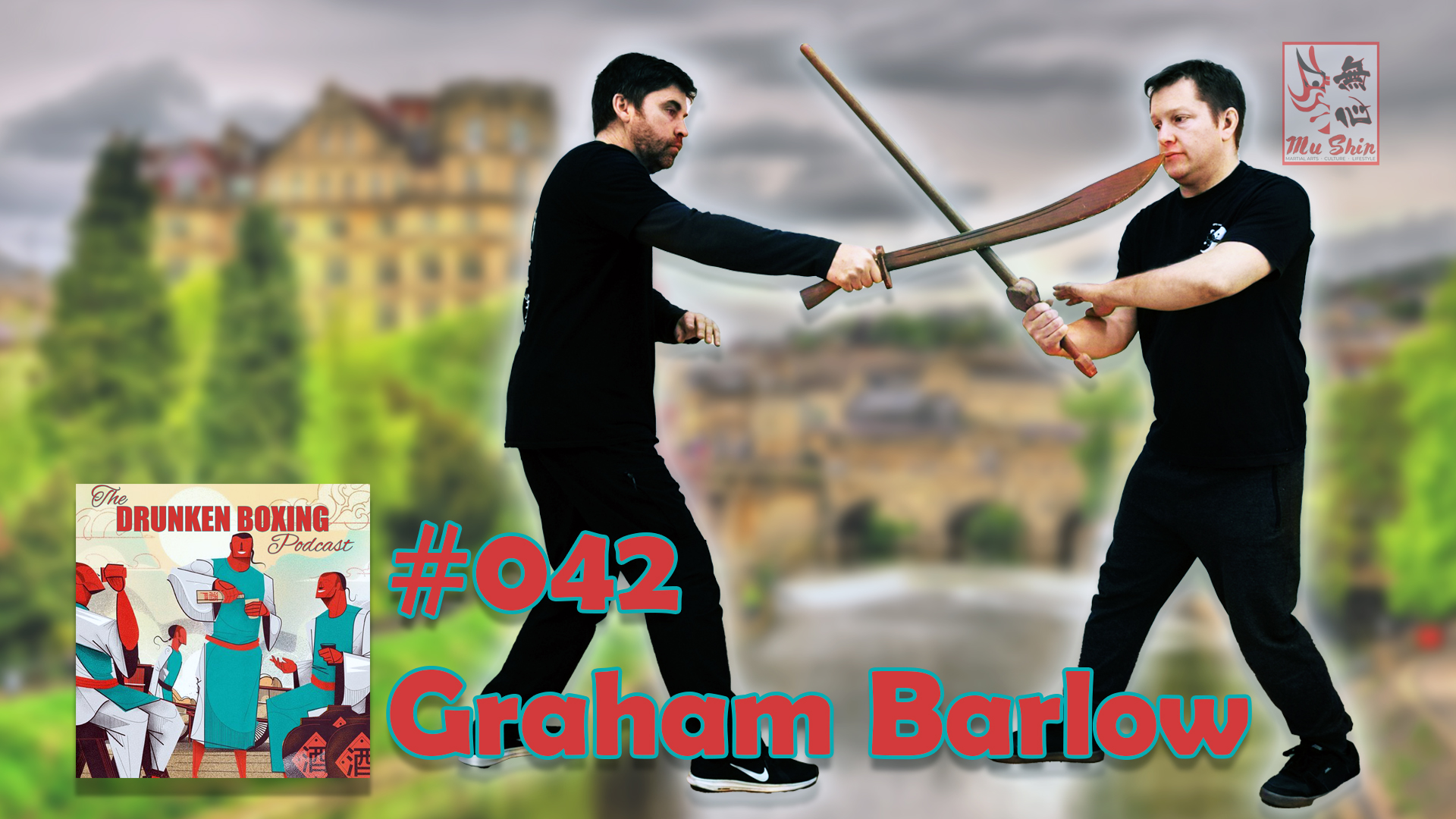
I appeared on the Drunken Boxing podcast run by my friend Byron Jacobs yesterday where we dived into the story behind all the martial arts I practice, who my teachers are and how I discovered them.
I’m usually the one interviewing other people on my podcast (I interviewed Byron back in episode 2) so this was a bit different. To be honest it feels a bit cringe listening to yourself talk about yourself, but hopefully there’s some interesting stories here to entertain people.
Drunken Boxing #042 Graham Barlow
Here’s a few links to some of the many and varied things I talk about:
Master Lam and Sifu Raymond Rand on the cover of Fighters magazine 1983:
Sifu Raymond Rand, Tai Chi Chuan applications 2022:
Stand Still Be Fit, Day 1: Master Lam Kam Chuen’s original Channel 4 TV series.
Graham in a BJJ sub-only competition 2013, blue belt








 The Tai Chi Notebook