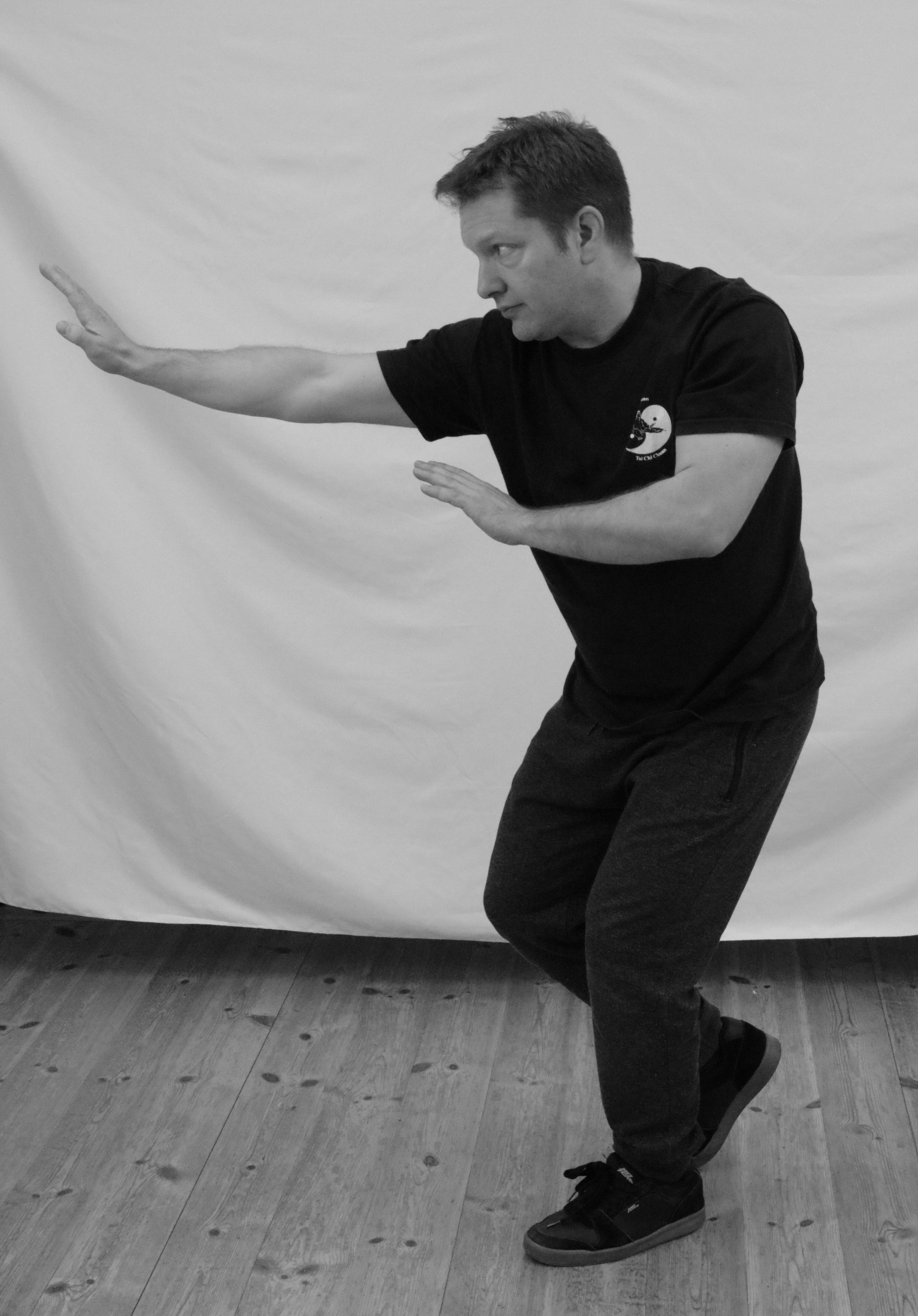
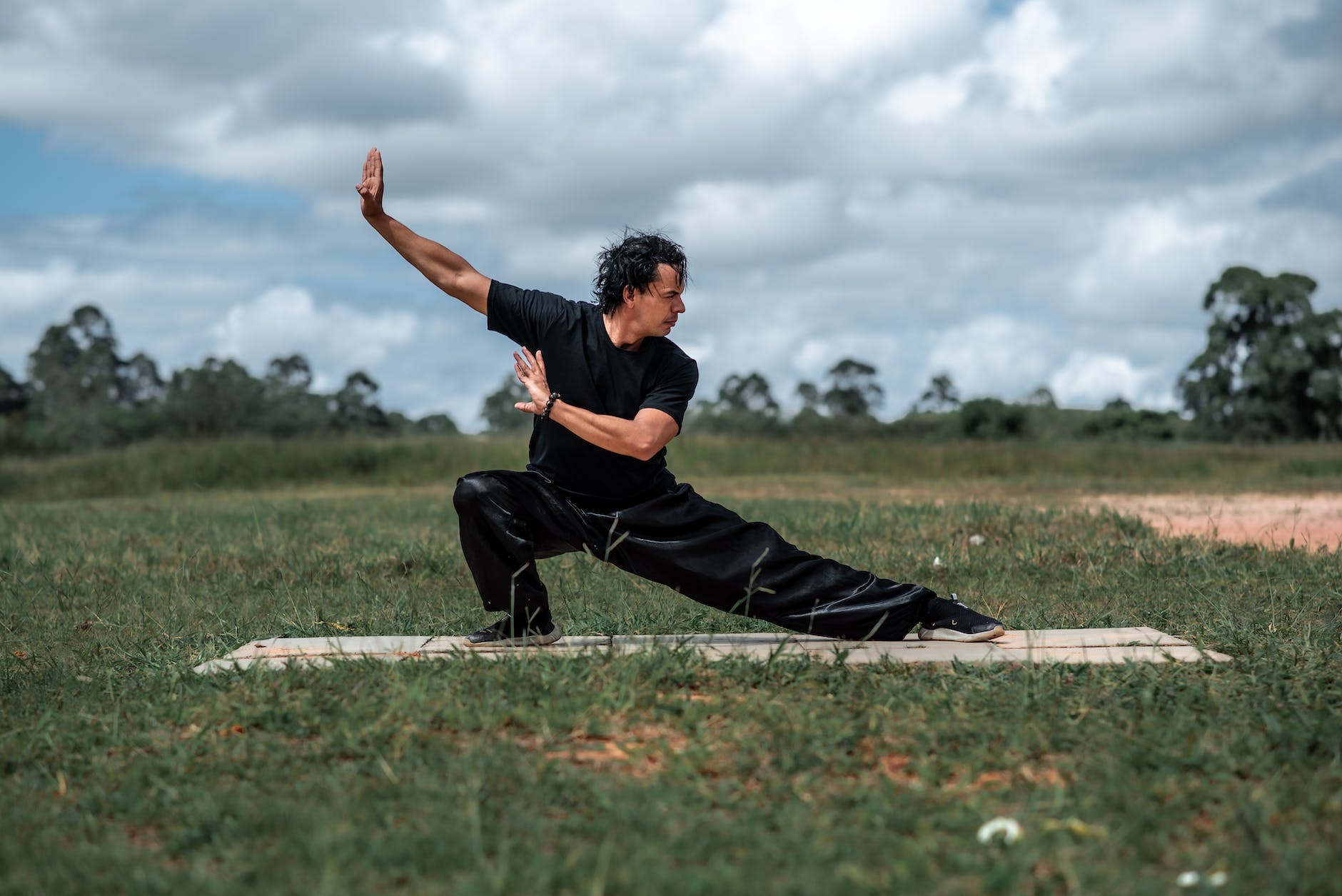
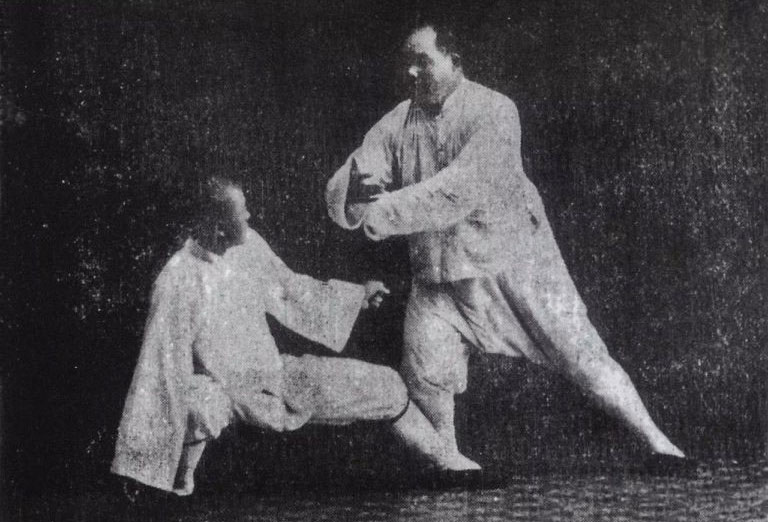
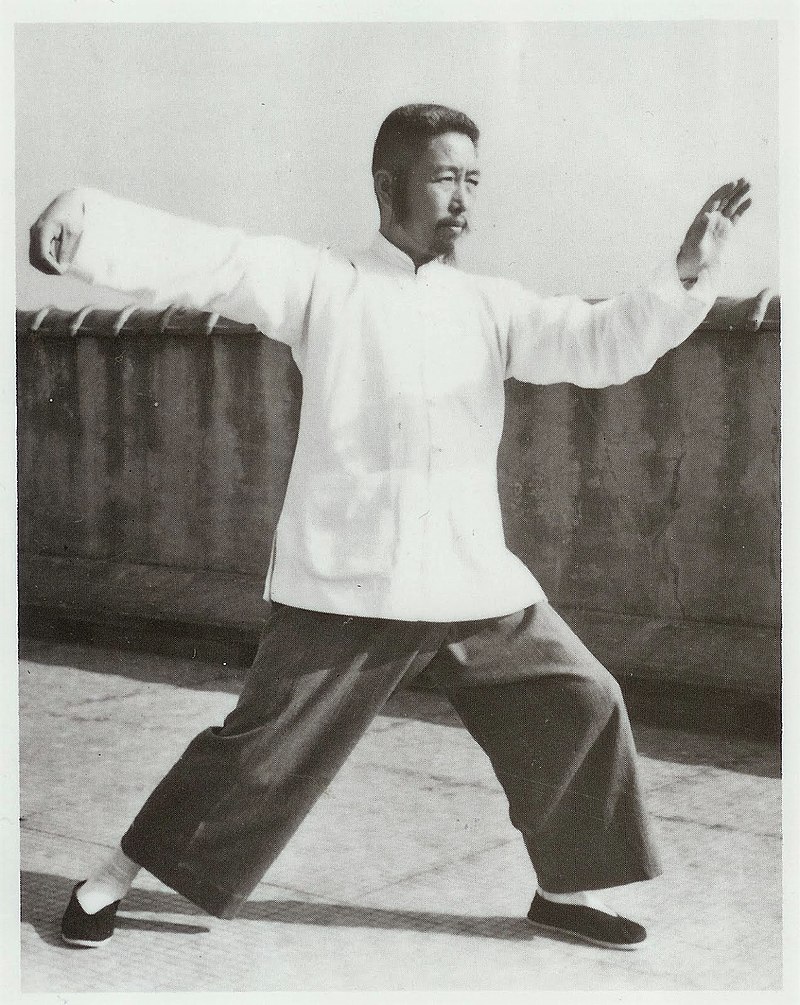
Key details for a good riding horse stance by connecting the upper and lower

Chen Man Ching once famously said that he only understood Tai Chi after having a dream in which he had no arms.

It’s a good indication of what you’re looking for in Tai Chi  – which is to “do” everything with the actions of the legs and waist, not the arms. The idea of moving the arms without moving the arms is, of course, contradictory, but that’s the challenge you undertake when you practice Tai Chi.

I found that I didn’t “get” this concept of “no arms” until I really relaxed my lower back and learned to sit correctly in the form. The lower back is the bridge between the upper body and the lower body. If that bridge is not open then goods and services cannot flow between the two different countries.

So, how do we do this in the correct way? I think the key is to be found in how you get into a riding horse posture properly. 

We’re all familiar with the wide-legged riding horse posture. When you start a Tai Chi form you are essentially sitting down into a narrower version of it, but it’s the same kind of stance. 

Let’s formalise what I mean by Riding Horse stance a bit more.

1. Toes point forward. 

2. Knees bent, but not further forward than the toes. 

3. Feet two shoulder widths apart. 

As aways we make sure that our upper body is relaxed (not collapsed) and upright. Just take a moment to focus not he AO joint that I mentioned in my last post, to ensure that your head is in the correct position. Your neck should feel long at the back and the chin slightly tucked at the front, crown going in the upward direction.

Now straighten your legs. This brings you out of a riding horse stance and into a leg triangle stance with straight legs.

We’re going to lower back down into a riding horse, but rather than doing what you normally do, I want you to focus on two things.

1. The knees go forward as they bend.

2. The butt does not move backward as it would if you were going to sit in a chair, but instead you open/relax your lower back so that it sinks downward.

There you go. This should feel like a different sort of riding horse stance to what you’ve normally experienced. That elongated and open feeling in the lower back is what you need to maintain during your Tai Chi form. Without that feeling you cannot connect the upper and lower parts of the body.

Play with it, experiment with it a bit, and then when you’re ready, start your Tai Chi form and as the hands come down and you sink, try and achieve the same feeling.

Then try and keep it for the whole form. If you can do that, then you’ll start to notice that Tai Chi is all about the leg movements, not the arm movements. Your arm movements can start to be directed by the leg and waist movements. 

As it says in the classics:

It is “rooted in the feet,

generated from the legs,

controlled by the waist, and

expressed through the fingers. “

The crucial detail of using the kua and hips in Needle at Sea Bottom

There’s a lot of talk in the internal arts about the “kua”, and how using the kua (as opposed to the hip joints) is central to getting the idea of internal movement in Tai Chi.

So, what is the kua?

A definition from Crane Tiger Tai Chi reads:

Kua refers to the area that extends from the inguinal folds (front of the hip where the leg and body meet) to the crest of the pelvis. It includes the hip joints, the iliopsoas, and adductor muscles as well as the sacrum and the perineum.

I’ve written about the kua several times myself, but I think Ken Gullette’s book (my review is here) does a great job of describing it. To me, moving the kua is about opening and closing the body in the space inside the hip joints. Integrating the opening and closing of the kua into your movement facilitates power moving smoothly from the legs and feet up through the body, or receiving force in the opposite direction and directing it down towards the ground.

Moving “inside” the hip joints allows for very detailed movement and enables you to create and remove space when interacting with an opponent, which has martial application.

However, I think that the focus on the kua in internal arts often risks people ignoring the pivotal (ha!) role of the hip joints. I think the hip joints are actually more important to get right – if you focus on the kua but never think about your hip joints it’s a bit like building the walls of your house without a firm foundation.

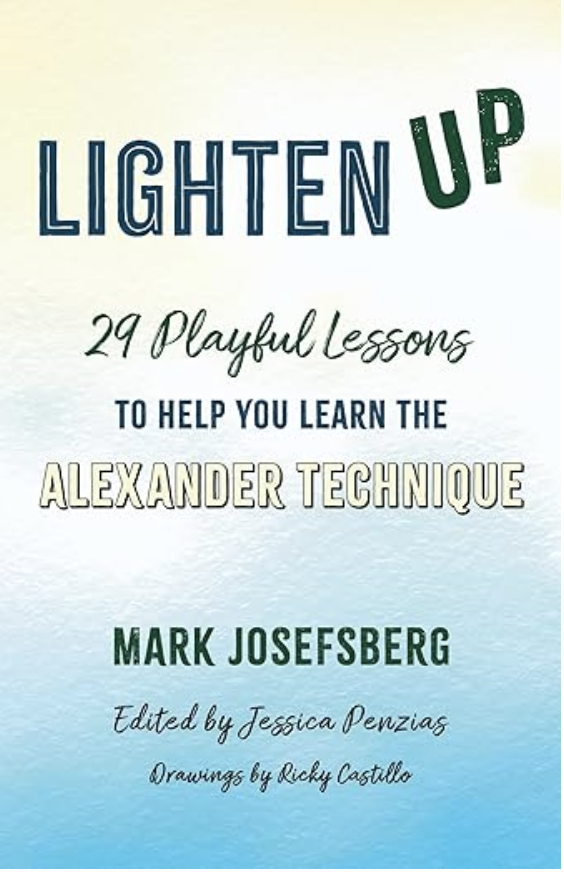
I’ve been reading a great little book called Lighten Up by Mark Josefsberg, which is a humorous description of the Alexander Technique, and only costs £2.50 for the Kindle edition.

It starts off making the great point about the pivotal (ha!) role the hip joint play in actions like sitting, standing, running, walking, bending, etc.. A good point it makes about your hip joints is that they probably aren’t where you think they are. People tend to think that you put your ‘hands on your hips’ that’s where you bend from, when in fact, your hips attach to your legs via a ball and socket joint that is much lower down.

This has real consequences for Tai Chi postures such as “Needle at Sea Bottom”, where you bend forward. If you bend from too high up then you are compromising your spine, and bending from your hip joints is always a bit lower down than you think it is.

Wu Jianquan, Needle at sea bottom

The way I do Need at Sea Bottom is to try and keep my head going “up” away from the spine and bend from the hip joints (where the legs attach to the body) keeping my spine in a straight line. In theory, at least.

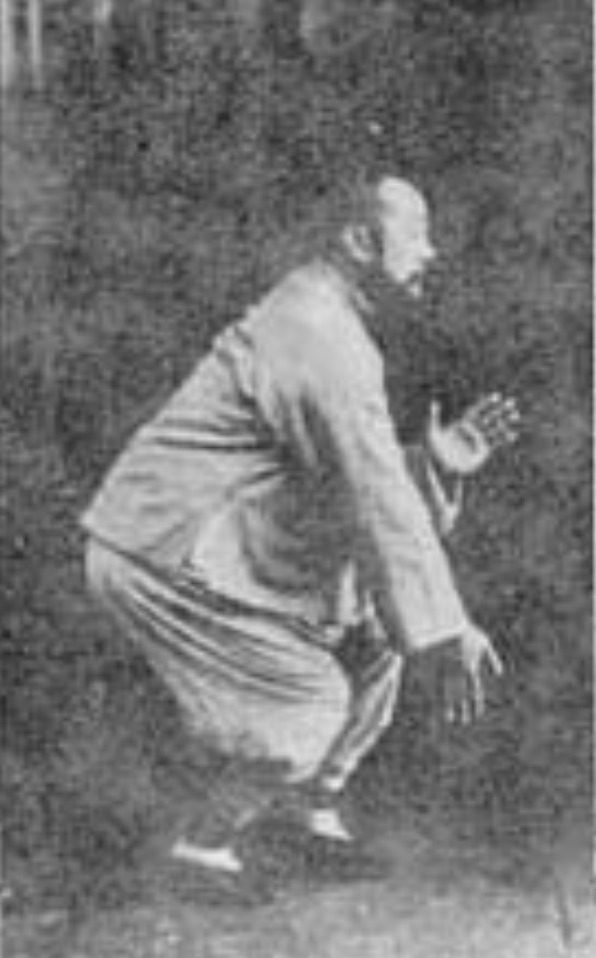
I don’t know who this is, but look at this guy doing it:

To me there are all sorts of problems here – he’s rounding his spine, and the head is kinked at an unnatural angle that isn’t an extension of the spine, in an effort to go too low. I’d rather not go as low as he is, and not compromise my spine like that.

The other point that Mark continually makes in the Lighten Up book I mentioned is to be aware of the AO joint – the atlanto-occipital joint. This is where the head meets the neck, and again, it’s not exactly where you think it will be. Put your fingers in your ears and imagine they are touching. Rotate the head up and down from something on a level with that point – that’s roughly where it is. What you’ll find is that you can look up and down without your fingers moving up or down because you are rotating the head around this point. Now apply that principle to Needle at Sea Bottom and you can see how your head position is meant to be.

Here’s a video of my Sifu Raymond Rand doing the movement correctly, with martial application:

Small circles and loops

I read something interesting in this interview with Chen Xiaowang, originally published in the October 1996 (vol 20 no. 5) issue of T’ai Chi Magazine.

He’s talking about silk reeling and he says:

Chen commented that many people practice the Chen style in an overly exaggerated fashion making very big movements. He said these kinds of excessively large movements lead to a separation of one part of the body from other parts of the body and is incorrect. A common mistake, he said, especially among those who do the Xin-jia or new frame is to do movements in an exaggerated manner and make a lot of small circles and loops. “That shows that they don’t understand the principles of chan si jing.”

Tai Chi Magazine


I’m not sure what to think about that. It’s pretty well understood in Chinese martial arts that you often practice big and use small. The best way to practice a movement is to start with it in a large, exaggerated way, but then over time you do it in a more refined way and it becomes smaller.

A quote from my teacher I’ve always remembered is:

“In the beginning my circles encompass the whole universe but at the end I roll them up and put them in my sleeves.”

However I think perhaps Chen is not talking about this. I’ve seen a lot of people who do Tai Chi (and particularly Chen style) in a very bendy, rubbery, gyrating way. I think he’s saying that too much of that can often lead people onto the wrong track. And more specifically, he’s saying that if they’re doing this then it’s because they don’t understand the basics of silk reeling.

Now silk reeling is quite a Chen style-specific practice. I don’t think you even need to do it to practice Yang or Wu style, but if you are doing it, I bet it’s very easy to get sidetracked into doing lots of small loops and circles. But really the process should be about being minimalist. Cutting out the inessentials until the movement is pure and simple, while still being effective.

Sinking the Qi and rooting in the foot

How does rooting work in Tai Chi?

In the Tai Chi Classic it says:

The jin should be
rooted in the feet,
generated from the legs,
controlled by the waist,
and expressed through the fingers. 


This does present something of a dilemma – how can we both be rooted in the feet but also controlled by the waist, let alone also generated by the legs?

In the Treatise on Tai Chi Chuan, the classic says “Sink the chi to the dantien.”

This sinking is related to the pulling in action of the muscle tendon channels that are usually associated with the contraction (closing) phase of opening and closing – usually while breathing in. The breath sinks to the dantien area, and combined with correct mental focus, this should make the dantien area feel full as you breathe in.

This pressurised feeling in the dantien is also the pressurised feeling at soul of the foot. You could think of it as squeezing the pressure from the dantien down to the foot, but you really don’t need to do that, as it should be instantaneous, since they are the same thing.

With the exhale, the pressure pushes up, through the legs, up the back and out to the extremities including the head. It’s a continual cycle of store and release.

You could call this the internal side of Tai Chi, but really, it’s just the way Tai Chi works, rather than a particular side of it.

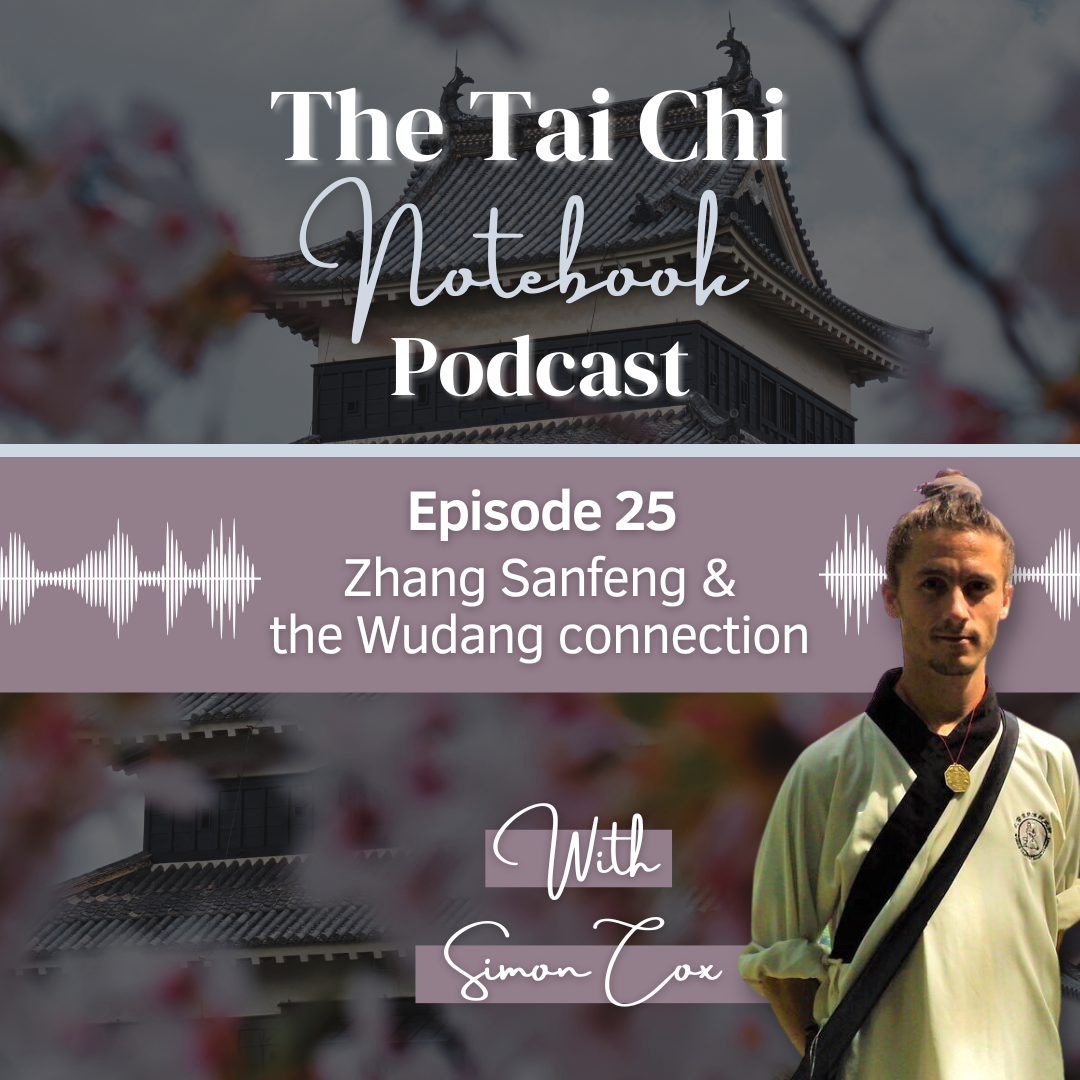
NEW PODCAST Simon Cox on Zhang Sanfeng and the Wudang connection to Tai Chi

New podcast! My guest today is Simon Cox, who co runs the Okanagan Valley Wudang with his wife Brandi in Penticton, British Columbia.

Simon and Brandi spent six years living and training in China under master Yuan Xiu Gang at the Wudang Daoist Traditional Kung Fu Academy. While there they studied Kung Fu, Tai Chi, Qi Gong, meditation, herbal medicine, Daoist music, and ancient and modern Chinese language.

After returning to the West, they started a Kung Fu school and community group in Houston Texas, where Simon was working on his PhD in Chinese and Tibetan mysticism at Rice University. At the end of 2019, they moved up to the Okanagan Valley and began sharing Wudang teachings with the local community.

What I really wanted to get at with Simon was an elucidation on his article about Zhang Sanfeng – exactly who was this mysterious Taoist immortal who is often credited as the founder of Tai Chi Chuan? I also wanted to find out more about Wudang mountain, and where its martial arts really come from. I hope you enjoy are conversation!

Is Tai Chi really about relaxation (fangsong)?

I noticed a person on Facebook recently who was trying to make the point that the term Fangsong (放松 relax, unwind, loosen, ease, release, slacken) doesn’t appear in writings about Tai Chi until about 1930, and is therefore a modern idea that we are retrofitting to suit our modern ideas of Tai Chi being all about relaxing. That’s not his argument word for word, but that was the gist of it, anyway.

I’ve heard similar things from other people about how ‘back in the day’ Tai Chi was practiced hard, like a real marital art, until you were exhausted, and that modern training has gone soft in comparison. To those people I would point out that intensity and duration of practice have nothing to do with how you practice. Ask anybody who has practiced ‘standing still and relaxing’ for half a hour in a Zhan Zhuang posture and you’ll find out that practicing relaxing for half an hour in a stressful position is an exhausting, sweaty, business.

But to return to the original point, I would point out that even if you look at one of the oldest writings we have on Tai Chi – the handwritten manuscript of Li Yiyu from 1881 (which is available to read on Brennan Translation) you’ll find the word “relax” appears in the English translation 9 times. That’s not an insignificant amount. (I’ll leave it to the Chinese language experts to search the original Chinese).

You find it in phrases like:

I relax my power, but I do not allow it to collapse. (This has to do with “calm”.)

and

Every movement is a technique of first putting forth strength and then immediately relaxing, yet always there must be continuity from one to other, and there is never to be a departure from the four stages of “begin, develop, transmit, and finish”.

However, if you check out the even earlier 1875 text Explaining Tai Chi Principles, written by Yang BanHou, son of the famous Yang LuChan, you’ll find that he’s right – the phrase “relax” doesn’t appear, even once!

However, just look at one of the things written in the text:

“Power comes from the sinews. Strength comes from the bones. Looking at it purely physically, one who has great strength is able to carry many hundreds of pounds, but this is an externally showy action of bones and joints, a stiff strength. If on the other hand the power of your whole body is used, it may appear you are unable to lift hardly any weight at all, yet there is an internal robustness of essence and energy, and once you have achieved skill, you will seem to have something more wonderful than one who has the stiff sort of strength. Thus runs the method of physical training for self-cultivation.”

It seems pretty clear that he’s talking about relaxation being required for whole body strength.

But getting away from the nitpicking about facts (sorry!) I do think he has a point – there has been a modern re-framing of everything to do with Taoist arts as a kind of therapy for stress and dealing with the pressures of modern living that wasn’t necessarily there in the original arts – especially with Tai Chi.

Tai Chi was created in pretty stressful times, when wars were being fought, the concepts of law and order and justice were malleable depending on how important you were and life could be brutal and short. Taoism emerged at a time that was probably even more dangerous to be alive in! Frankly, I don’t think you expected to live long enough to have to worry about getting stressed! You were probably too busy trying to stay alive and earn a living. Being stressed is something of a modern disease because we live lives of relative comfort and we’ve got nothing truly life threatening to worry about on a daily basis.

The same thing has already happened to yoga.

But, I think we’ll have to live with it, because the hippies who have taken over Tai Chi Chuan do have a very good point – the first step in Tai Chi is to relax, whether you like it or not! You cannot move your body as a unit if parts of it are tense.

In Tai Chi Chuan the body is required to move as a whole unit, connected by fascia, tendons, muscles, etc, with all the joints allowed to move freely during exercise. All the joints are involved to some degree in all movement, so need to be relaxed. The ball-and-socket joints of the shoulders and hips are allowed to move freely. The gliding joints of the ankles and wrists move freely, and the hinge joints at elbows and knees are all allowed to move freely. Finally, the dantian moves freely and controls everything. Tensing the muscles around a joint separates it off from the rest of the organism, meaning that whole body movement is not possible.

And being mentally ‘tense’ is just as much of a problem as being physically tense, since the mind and the body are intimately connected.

Perhaps the emphasis in the original writings on Tai Chi was focused on more lofty philosophical principles, yes, but you will find plenty of admonitions to relax in there, and for good reason. That’s just how Tai Chi works.

REVIEW: Yang Short form: A beginners guide to Taiji Chuan by Leo Ming and Caroline Addenbrooke

Yang Short Form: A beginners guide to Taiji Chuan, is a beautifully made, hardback coffee-table Tai Chi book, containing a brief section on history and principles of the art, over 200 colour photos mainly for showing you the form, a few verses from the Tao Te Ching to act as inspirational quotes and more.

There’s no denying that at an RRP of £49, it’s expensive. For people wondering why this book costs that much on Amazon (although you could pick it up for 18% less at time of writing), the high production values and hard cover explain the price. Printing in colour is expensive these days.

Sifu Leo Ming is the teacher who appears in the photos, and his student Caroline Addenbrooke is the author.

The main point of the book is to teach you the Cheng Man Ching short form, and if you view the book through the lens of ‘Can I learn a Tai Chi from this book?‘, it succeeds, I just have a few issues with some of the information presented here.

Consider the title

My problems start with the title, “Yang Short Form: A beginners guide to Taiji Chuan“. The Tai Chi form presented in this book is the Cheng Man Ching short form, which is certainly a Yang short form, but it’s a bit of a stretch to call it the Yang short form. People generally call it the Cheng Man Ching Short Form or the Chen Man Ching 37 form, which would have been a more accurate name, since Cheng’s form varies quite significantly from the official Yang form that belongs to the actual Yang family.

Secondly, the use of “Taiji Chuan” awkwardly mixes two different romanisation styles together in a way I’ve never seen done before, making it something of an outlier in the Tai Chi world. Tai Chi is usually either written Taijiquan/Tàijíquán (pinyin) or Tai Chi Chuan/Tai chi ch’üan (Wade-Giles), or shortened to simply “Tai Chi“. I find the decision making process of mixing the two systems together used here to come up with “Taiji Chuan” a bit baffling. Why do that?

Similarly, inside the book there’s a mix of different romanisation styles. Shaolin appears as “Shao-lin”, while changquan appears as “Changquan”, (so they’re happy to use pinyin there…) Dantien appears as “Tan Tien”. But Qi is “Qi”, not “Chi”, and Xingyi is “hsing-i”! I can’t work out the logic. In a way, so long as the system used is internally consistent it doesn’t matter, but it is a bit frustrating.

Finally, “beginners guide” is used in the title without an apostrophe! Well, that is just… wrong.

But, let’s move on from the title of the book and look at what we’ve got here. 

All the history all at once

The history section starts with a pretty safe phrase, “The history of Taiji Chuan is unknown”, and if it had stopped there I think I would have been happy, but it then goes on to tell a version of Tai Chi history anyway that includes every folk tale in the Tai Chi master’s repertoire! It talks about the classic Chan Sanfeng origin story, but also has the Chen village origin story straight afterwards before giving a brief rundown of the current styles of Tai Chi, before then pivoting back further into time and linking Tai Chi to the Shaolin Temple because that’s where “qigong theory” started… If you know anything about the history of Tai Chi you’ll know that these kind of myths are probably just that, myths, but they help the marketing of the art.

There are other problems with the accuracy of information, too – there’s a picture of a statue of Chang Sanfeng in the history section which is captioned “A statue in Chenjiagou depicting the legendary Chang San-Feng”. I thought that didn’t sound right. A quick 5 minutes on Google confirmed that his statue is of Chang, but it’s found (not surprisingly) in the Wudang mountains, not Chen village, as stated. Unless I’m wrong and there are two identical statues, but I don’t think so. The most famous statues in Chen village are the statues of Chen Chanxing and Yang Luchan.

The rundown of the different styles of Tai Chi in existence today is accurate, but if you want a proper investigation of the history of Tai Chi, I’d suggest looking elsewhere.

The section on principles of Tai Chi is also very brief. It’s all the usual advice you find in Tai Chi books about relaxing, centering, evenness and slowness, etc. There’s nothing wrong here, but it’s very surface level.

Teaching forms is where Yang Short Form gets it right. The book uses the method of breaking down each move into tiny fragments and showing them next to each other, conveying the sense of movement through the form nicely. As such you can definitely use the book as an aid to memory of this form, or even teach yourself the form from it. Take a look at this example of Single Whip:

Diagonal Flying:

Of course, Tai Chi purists will say that the choreography of the form is not the important part, and that the body method is vastly more important, however, for better or for worse, the vast majority of Tai Chi practitioners in the world are not looking for a book on that. They are simply trying to learn some movements as a form of exercise for health, and this book will serve them very well.

I don’t do the Cheng Man Ching short form myself, but I have learned it in the past, and as I was looking through the movements it struck me that there were one or two idiosyncrasies presented by Sifu Leo that I hadn’t seen before. I noticed three things in particular:

1) A low squat Sifu Leo does as a transition between each ‘Fair Lady Works at the Shuttles’ move: 

2) A front kick/leg raise, he puts into Repulse Monkey.

3) In Golden Pheasant Stands on one leg – he again squats all the way down to the floor between the knee raises.

This struck me as peculiar, so I checked the form against a video of Chen Man Ching, mapping the movements in his video to the ones in the book, and while the forms match (all the movements are here and none have been added), the above curiosities are not performed by Professor Chen Man Ching. 

Also, there are 43 moves in the form shown here, and Chen Man Ching’s form was said to be 37, but I suppose it depends how you count the moves. 

I don’t think these three variations to the Cheng Man Ching form matter that much, but I think it’s safe to say that they are not standard, so I should point them out. It’s also important to note that there are no marital applications or discussion of push hands in the book at all.

Overall, if you practice the Cheng Man Ching short form for health and you want a visual reference to remind you of the moves then this book will fit the bill – it’s beautifully designed and the form is clearly presented. If you’re looking for a scholarly discussion of the history of Tai Chi, or an in-depth dive into the body mechanics, then other books are available.

REVIEW: Chen Taijiquan Illustrated, by David Gaffney & Davidine Siaw-Voon Sim


Chen Taijiquan Illustrated is an exploration of pretty much everything that makes up Chen Taijiquan, from principles, and body methods to practical usage and philosophy. But the most notable thing about this Taijiquan book, and the place where we should probably start, are the illustrations, because they are what really separates this book from others of its ilk.

Almost every page here (and there are over 200) has some sort of detailed drawing on it that adds context to the text surrounding it. In fact, the whole book takes the form of a visual notebook, as if you are discovering a secret copy of the best-looking training notes you’ve ever seen. Surrounding the drawings are quotes from the most iconic practitioners in the Chen lineage, past and present, as well as explanations of principles, concepts and requirements of Taijiquan. Take a look and you’ll get the idea:

As you can see, the drawings are mainly done in a stylised cartoon way, which is actually very effective, and it’s pretty clear that these are photographs that have been traced over digitally, to produce the illustration, rather than drawn from scratch. The overall effect is really nice, and refreshingly modern and accessible. 

Because a Taiji master’s posture takes years to develop and is a reflection of their skill, you can learn quite a lot from just looking at it. So, having a drawing based on a real photo gives you the best of both worlds – you get to see the genuine skill of the practitioner on show mixed with the accessibility and visual appeal of an illustration. 

In fact, in a lot of cases you can guess the famous master that the drawing is based on. For example, the book cover shows, I believe, a digital tracing of a photo of Chen Xiaoxing, brother of Chen Xiaowang.

It should be pointed out that not all the illustrations in the book are done to the same high standard, but there are only a few where the quality dips significantly.

Chen Taijiquan Illustrated is split into three sections – Section 1, Body Rules (Shape and energy), Section 2, Practical use/Application and Section 3, Philosophical Roots. Section 3 on philosophy is tiny compared to the massive section two, which consists of a catalogue of pretty much all the practical methods found in Taijiquan – peng, lu, ji, an, listening, sticking, neutralising, push hands, hand methods, leg methods, stepping, chin na, etc. Pretty much everything to do with the Chen style is here!

The initial section on body requirements is very good, and something you can keep coming back to and the book goes into much more detail than you’d expect to find in a basic beginner’s book, which makes me happy. The explanations of the concepts and techniques in the second section can sometimes err towards being more of a catalogue of techniques than an in-depth ‘how to’ of each one, but there is always going to be a limit on how much can be achieved in print, and the illustration of various masters doing the method being discussed speaks volumes in itself, and adds a lot of depth. It’s also nice to see the martial methods of Taijiquan being discussed in detail, something that is also rare to find in a Taijiquan book.

Let’s talk for a moment about what the book doesn‘t include. For a start, there is no attempt to teach a form in this book, which is probably a good thing, as Chen style in particular would be hard to teach in a printed book due to its intricate nature and complex, spiraling movements. Also, there is no history section – personally I’m glad about that, as it’s a massive subject and would require too much space to do it justice, and frankly, it’s been done to death elsewhere, and matters not a jot to your actual practice of the art. If you want to discover the key to “internal movement” then you’ll find good pointers here, but if you really want to delve deeply into subjects like peng, groundpath and internal body mechanics then I’d say you should check out Ken Gullette’s book on the subject. Finally, there’s no mention of weapons here, which are obviously a huge part of the Chen art. The emphasis here is on body methods and bare hand methods only.

Taijiquan is a practical, doing art, not the sort of practice that benefits from too much intellectualism, and the visual nature of the book is great at reminding you of that fact, grounding the concepts and principles in practical reality.

Overall, I think this has to be one of my favourite books on Taijiquan ever produced. This is really one of the most comprehensive collection of training notes you’ll ever come across. And because everything is fitted around pictures, there are no long, boring, passages of text, meaning you can dip in and out at any point. In fact, just picking it up, flicking to a random page and starting to read for a few minutes can easily give you inspiration for your practice that day.

Highly recommended, and while obviously best suited to Chen style practitioners (there’s a lot of discussion of silk reeling), I think a Taijiquan practitioner of any style would get a lot out of it. I certainly did.

More thoughts on elbows and the classics of Tai Chi and Xing Yi

From  http://chentaijiquanworld.blogspot.com/ we find this nice quote about Chen Taijiquan:

“The, at first sight, seemingly humorous Chenjiagou saying to “always keep an egg under your armpit” reflects the importance of not allowing the upper arms to become stuck to the side of the body.

This idea of always keeping a space under the armpit is something I’ve heard said in other styles of Tai Chi as well, and it fits in very well with the idea of “Peng all over the body” that you’re aiming for in Taijiquan, that kind of “inflated like a balloon, but also soft, springy and heavy” feeling. 

Taijiquan, with armpit gaps. Photo by Stephen on Pexels.com

But how does that relate to the question I was looking at recently about the issue of where the elbows should be in Xing Yi? “The elbows never leave the ribs” is a line from the Xing Yi classics* (more of that later) that has caused a lot of arguments between practitioners on its interpretation and meaning. 

And when you compare it to the previous saying about the armpit from Chen Village, it’s basically the complete opposite advice! And yet, both Taijiquan and Xingyiquan are said to be internal arts, and part of the same family. So, is the advice about the elbow a crucial element, as fundamental as, say, aligning the Bai Hui point (the crown) with the spine? Or is this more of a piece of strategic advice to do with the fighting style of Xingyiquan, and not anything to do with its fundamental body method?

Let me throw in a curve ball here and switch arts to BJJ. “Glue your elbows to your ribs” is something I say to my students in BJJ all the time when they are on the bottom defending a position like side control, knee on belly or mount.

Knee on Belly in BJJ. Photo by RDNE Stock project on Pexels.com

If you let your opponent separate your elbows from your ribs in that position then only bad things can happen, so it’s great advice. Normally after I submit somebody new in BJJ I stop to explain to them how I did it, so we can turn it into a learning moment. 9 times out of 10 my explanation starts with “it started when you let me into the space under your armpit”. However, it would be ludicrous to make it into a hard and fast rule, to suggest that you should never let the ribs leave the armpit at any moment in BJJ. There are plenty of other times in BJJ where you need to pull with your arm, and you can’t do that fully without separating your elbow from your ribs.

* And let’s also decide on what constitutes a “classic” in Xing Yi. My own teacher only considered the 10 Thesis of Yue Fei  to be the classic writings in Xing Yi. Most of what people call the Xing Yi classics today are, in fact, writings created in the early 20th century when there was a publishing boom in martial arts manuals (See Chinese Martial Arts Training Manuals: A Historical Survey by Kennedy and Gau), and are based on the original Yue Fei writings anyway. For Xing Yi it started with Sun Lu Tang’s 1915 A Study of Xing Yi Boxing.

In the preface to his manual Sun says (Translation by Brennan), “While once at Bai Xiyuan’s home in Beijing, I got to see one of the Yue Fei manuals, not an original copy of course, but a handwritten copy made by someone in a later generation. It was not very detailed and unfortunately contained no explanations of its terminology, only the barest of text from beginning to end. I was suddenly inspired by this, immediately wishing to provide more complete information, even though I was fully aware that my level of learning and skill was superficial, and without being tempted to make anything up [in order to fill information gaps]. I secretly made my own copy and then deeply studied it, going through it posture by posture until bit by bit I had built up the material to make this book. There is no decorative language in it at all, for in my studies I have not dared to hold on to even the slightest exaggerations. Wherever flaws are found within my work, I hope my comrades will correct me, for which I would be very appreciative.

  – sincerely written by Sun Fuquan [Lutang] of Wan County, Baoding, 1915, 1st month, 15th day”

In his manual Sun has a chapter called “The Essentials of Practice” in which we find the advice about elbows and ribs. (Translation by Brennan)

“ESSENTIALS OF PRACTICE
The essentials of practice in Xingyi Boxing: 1. Sink your waist. 2. Shrink your shoulders. 3. Hollow your chest. 4. Press. 5. Lift. 6. Horizontal and vertical should be clearly understood. 7. Lifting, drilling, dropping, and overturning should be clearly distinguished.
  …
  Your head presses up during drilling, then shrinks back during overturning. Your hands lift during drilling, then drop during overturning. Your foot lifts during drilling, then drops during overturning. Your waist lifts during drilling, then drops during overturning. [from the Xingyi Boxing Classics:] “In lifting there is a horizontal aspect, but it is invisible [because it appears to be only upward]. In dropping there is a vertical aspect, but it is invisible [because it appears to be only forward].”
  Lifting is going out and dropping is striking, but when lifting is also striking, dropping is still striking. Strike with lifting and dropping, like the overturning waves of water, which are lifting and dropping. Regardless of lifting and dropping, drilling and overturning, going and coming, it should always be that your elbow does not leave your ribs and your hand does not veer off from your centerline.
  These are considered to be the essentials in Xingyi Boxing. Knowing these, the right path in the art will be obtained.“

But you can see that even in this passage, Sun is quoting the older “Xing Yi Boxing Classics”. So, you have to start to wonder, how old is the advice that the elbows do not leave the ribs, really? I know some styles maintain that their “quan pu”, ancient collection of classic handwritten writings their family possesses has this advice in. At least with Sun’s work we have a published date we can be sure of. 

Photo by George Sharvashidze on Pexels.com

But this also brings up the question of how much we dedicate ourselves to following the literal words of “the classics” to the letter. How much freedom are we allowed in our martial art? Were the classics intended to be a kind of set in stone, unwavering, set of rules to be followed on pain of death? The ancient writings of the founders always tend to take on this weight that gets heavier over time. If they’d been written a year ago, would we treat them with the same reverence? There are hard line Christians who treat every word of the Bible as the word of God, never to be questioned, and there are more modern progressive Christians who interpret the words in the Bible into a modern context, or see them as simply stories designed to teach an idea, and not to be taken literally.

So, the question still lingers, like a bad smell. 

Where do you put your elbows in Xing Yi? 

I think the best answer I’ve found so far is…..

“in between your shoulders and your wrists”.

Tai Chi Notebook News, May 25th 2023

So, a heads up about a couple of new books on the way, a robot teaching Tai Chi and a seminar write up that’s worth a mention. This post actually makes me think, should I be doing a newsletter? What do you think? Do you want one? Would you read it? Let me know!


XING YI NEWS

Dragon Body, Tiger Spirit

Byron Jacob has a new translation of the Xing Yi Classics, Dragon Body, Tiger Spirit, coming out, which looks like it will include a chapter on the history of Xing Yi written by Jarek Szymanski who you may know from his popular website China from inside.

Image Credit: Mushin Martial Culture

This is looking like it’s going to be good. The title is a nice play on “Crouching Tiger, Hidden Dragon” and it refers to things mentioned in the Xing Yi Classics. The cover also features a nicely-colourised version of the only photo we have of the famous Xing Yi master Guo Yun Shen, which has been very nicely done. (Master Guo is the guy seated centre right, and wearing the light blue tunic, next to Master Che.)

There have been many books that contain the Xing Yi classics translated, of course, but I’m hoping that Byron’s commentary will be the thing that makes this one different.

Byron says: “Dragon Body, Tiger Spirit will be available in hardcover, softcover as well as digital versions. To be notified of release visit mushinmartialculture.com and sign up to the newsletter.”

I’ll do a review once I get my hands on a copy.


TAI CHI NEWS

Yang Style Short Form

Another nicely presented book on my horizon is Yang Style Short Form by Sifu Leo Ming and Caroline Addenbrooke. The short form in question is the Cheng Man-Ching Tai Chi form, and calling it the “Yang Short Form” is a bit of a liberty, since it is not the official Yang Short Form. But names aside, it looks like it’s going to be interesting.

Here’s the description:

“A beginners guide to Taiji Chuan is a comprehensive training guide for all students of Taiji who are serious about mastering the art of Taiji. It is unique in that it details each of the forty four postures that make up the complete Yang Style Short Form, and it does so in a way that the student can experience the smallest nuance of each movement, from the opening sequence to the closing posture.”

It sounds interesting, especially since it goes on to say it will teach you how to breathe correctly during your practice and how the “Tan Tien drives all movement, opening the meridians so that the universal llife [sic] force can flow through you. “

A spelling mistake in the description of the book on the website (“llife”) is a bit of a red flag, but that could be Barnes & Nobles fault, and nothing to do with the book. However, I’m curious about the use of “Taiji Chuan” as a Romanisation on the cover though, since it seems to mix both Pinyin and Wade-Giles Romanisation systems. I have genuinely never seen anybody mix the two quite like this before. It’s usually either “Tai Chi Chuan” or “Taijiquan”. This will upset some people, I’m sure, but I don’t mind.

I’ll be reviewing the book soon.


Robot Tai Chi

I guess it was inevitable, but somebody has made a life-size robot that teaches Tai Chi.

Image Credit: Credit: Rochester Institute of Technology

Depending on how it works (there’s no video!) this looks quite impressive, however, I’m left with one burning question – why? I don’t know how many thousands or millions of dollars it took to create this robot, but economically I’m pretty sure that paying Bob, your local Tai Chi teacher $50 to teach Tai Chi to the people in the old folks home once a week is a business model that is going to be hard for a multi-million dollar robot to beat. This looks like a solution in search of a problem to me.


Chen style seminar write up

Let me give a shout out to my friend Ken Gullette of Internal Fighting Arts for his write up of a recent seminar with Chen Tai Chi mastermind Nabil Ranne in Philadelphia. Here’s a quote:

“What impressed me most about Nabil’s teaching was the level of detail. And there were differences — in the shorter stances where feet are parallel most of the time, in the shifting of weight, in the awareness of different jin in each movement, the fullness of the dan t’ien and the coordination of the mingmen, the opening and closing of the chest and back, the folding of the chest and stomach, the closing power in the legs, the grounding from the heels, the stability of the knees and the spiraling through the feet, and connecting it all in each movement; and peng — always maintaining peng, which I have worked on for over two decades but still learn new aspects.”

Image Credit: Ken Gullette

Nabil teaches Tai Chi in the Chen Yu lineage, and to my eye seems by far the best of the teachers available if you want to follow that particular line of Chen style. Plus, you can learn with him online at the Chen Style Taijiquan Network

If you want to get a quick glimpse of his style of Tai Chi then check out this Instagram page.


MORE LINKS

Recent Tai Chi Notebook posts

Here are 3 things I wrote this week that you should read:

1. The power of connection with Henry Akins:

I came across this video recently of Henry Akins explaining the concept of connection in BJJ, as taught to him by Rickson Gracie, and it doesn’t half remind me of Tai Chi…

2. Way of the Warrior episode: Shorinji Kempo

The classic BBC TV series, Way of the Warrior’s episode on Shorinji Kempo just appeared online, and it still holds up today.

3. Where should the elbows be in Xing Yi?

This blog is about a weird quirk of the Xing Yi world. There’s a surprisingly large amount of online debate in Xing Yi circles about where the elbow should be when performing Xing Yi.


If you haven’t checked The Tai Chi Notebook out on Facebook then please do, and why not give our Instagram page a look too, and our YouTube channel?