This video has been doing the rounds online, showing some tai chi (taijiquan) fighting applications.
I don’t think there’s much to say about it, but it does perhaps prove useful for answering that question you get a lot: “can tai chi be used for fighting?”.
Let’s just try to say a few things about it though:
Firstly, he’s clearly just taking a tai chi posture (‘Play Guitar’) that looks very like that an ‘on guard’ position and using it in the same way a boxer does to parry and block punches. The hand he has by his chin he’s using in just the same way a boxer does their back hand to parry a jab. Is there anything wrong with that? Maybe not. You could use the posture like that, but is that its purpose?
Is that what that posture is designed to be used for? At this point, who knows. Usually you see ‘play guitar’ used as an arm locking posture, or combined with a foot sweep into a shuai jiao-style throw.
On the positive side, he’s actually getting the guy to throw the attacks properly, which is nice to see. Maybe they could be a smidgen closer together, so the punch would actually land, but compared to most applications you see from non-committal attacks, it’s not bad.
No, it’s not sparring, but not everything has to be. I don’t think it would look quite as much like ‘tai chi’ if it was sparring.
Finally, is there much ‘tai chi’ going on here? I’d be looking for smoothly flowing into sticking, yielding, and neutralising. He follows up a couple of times, but I don’t see much in the way of controlling the opponent here. The opponent is more often than not just blocked, and not controlled.
The bar for tai chi applications is pretty low. There are too many videos of people bouncing away at the slightest touch to muddy the water, so I think we have to say that this is at least a step in the right direction.
Let’s see if we can explain this without getting lost in too much theory…
(N.B. I’m writing this, to help my own thought process, rather than producing a tidy finished article, so let’s see where we go.)
Yi is one of those confusing terms in taijiquan. I don’t think you can talk about it without reference to jin and fangsong (probably qi too, but let’s try to leave that for now).
Amongst the taijiquan community there are a lot of varied ideas about jin, the “refined strength” or “trained strength” that you find mentioned in the Chinese marital arts, particularly taijiquan.
Many people seem to think that jin is about generating force maximally for whatever movement you’re doing, so a swimmer has ’swimmer jin’ or a weightlifter has ‘weightlifting jin‘.
It’s a tempting idea – after all who wouldn’t want to move with the grace, power and agility of an athlete, but I don’t think that practicing taijiquan should be looked at as some sort of shortcut to those abilities.
Athletic abilities are hard won, don’t last forever and require an awful lot of maintenance to keep a hold of. You can’t just short-cut them.
In taijiquan that is not what’s really meant by the word jin anyway, or there wouldn’t be anything different, at a fundamental level, between the training a boxer does and the training a taijiquan player does (and at this point you may actually be standing on the sidelines shouting, “No, there isn’t and difference!”, however, that’s your choice, but let me try and change your mind…)
In taijiquan we are specifically talking about ground force when we talk about jin. By ground force I mean the solidity of the ground manifested to our fingers. As the saying in the taiji classic says
The jin should be rooted in the feet, generated from the legs, controlled by the waist, and expressed through the fingers.
This is achieved by letting whatever forces we’re working with find their way to your foot to rest on the ground. This ground force can be bounced back from where it comes, turning it into something that can be used actively as well as passively.
When people talk about jin the next word out of their mouth is usual fangsong, to relax. There’s a reason for this.
The only way to let the forces you’re working with rest on the ground as directly as possible is by relaxing your upper body. (Relaxing your legs doesn’t really help much, since the weight of the body is sinking down into them). It’s getting the tension out of your upper body, by letting it dissolve down, that works the magic.
So what does it mean to ‘let forces rest on the ground’, and how do you do it?
Let’s make this a practical example.
If you’re sitting at a desk right now reading this on a laptop, I want you to pick up your laptop with your hands.
Got it? Good. (If you haven’t got a laptop, grab something of equal weight)
Now, you might think you’re fairly relaxed as you sit there holding your laptop off the desk, but what happens if you say to yourself “let the weight of this laptop go to the ground, through my chair”.
Now, if you’re anything like me you’ll notice that something invisible subtly changes inside yourself when you do this. There’s a noticeable switch of the internal musculature of your body (the qi) that is rearranging things for the weight you are holding to be supported by the ground.
I don’t know what exactly changes, because subconsciously your body just does it, and that subconscious switching is a function of your yi, which is usually translated as “intent”.
You can put your laptop back down now.
What I notice when I do this is that when direct forces to the ground my neck feels freer, my shoulders looser and space seems to open up. Mentally I also feel clearer. These are a lot of the benefits that you get from practicing taijiquan.
Your yi is activated when you imagine a direction that you want to send a force into. It does all the hard work of plotting the path through your body on a subconscious level that you aren’t usually aware of. In fact, trying to work out how it’s doing it is a sure way to mess up actually doing it.
If you see people practicing taijiquan, or other internal arts, with that kind of faraway focus that’s about halfway between open awareness and fixed attention, that’s what they’re doing. They’re not communing with the angles, they’re imagining directions for the jin to ‘flow’ in. They are using their yi while doing the form.
Now that was quite a lot of concepts to throw at you in a short while, and probably enough for now, so let’s stop there.
Mike Sigman’s post on qi has made me want to think more about jin and qi again. I realise I haven’t been posting about it very much recently – partly because I’ve been distracted by writing a book about BJJ – but now the book is finished it’s time I came back to the subject. I read another post Mike made recently on his 6H group about pushing against a wall, which I think is a brilliant idea, because it’s so simple.
In a way this post is just me writing it out in my own words as an exercise, so I can understand it, and contextualise it a little more in terms of my tai chi practice.
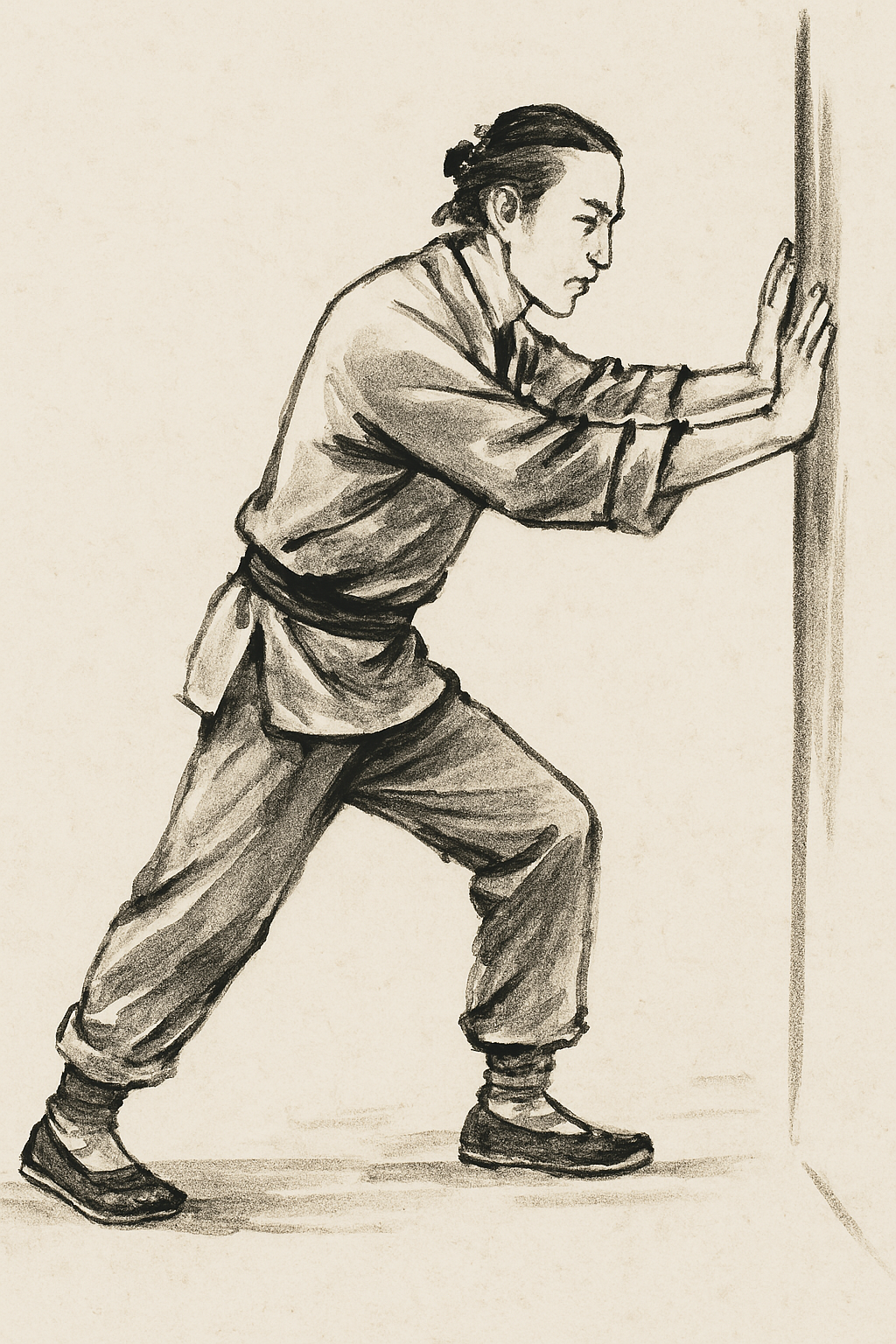
Pushing is a big deal in tai chi because it features so prominent in the form – one of the four ‘energies’ of tai chi is called push in English, which (as I discussed with Ethan Murchie in my last podcast) is confusing since the translation of “an” into English is more accurately to “press down”, which isn’t what the push posture in tai chi looks like, or how you’d push a wall.
An AI-generated tai chi ‘push’against a wall
Pushing is also part of tai chi’s two person exercise, tui shou – “push hands”. So most tai chi people are pretty familiar with the concept of pushing.
Now imagine you are pushing against a wall and somebody asked you to push harder. Most people would simply push harder with their arms and lean harder into the wall. What you’ll feel when you do this (try it) is that it pushes your upper body backwards and away from the wall quite a bit because it’s impossible to push hard with your arms without introducing excess tension into the system.
This is the “you’re using your shoulder too much!” criticism that a lot of tai chi teachers sling at their students, without really explaining how not to push using the shoulder.
So, let’s look at exactly how you could push harder without using the shoulder.
The only another way to increase the power of your push is to increase the downwards power through your legs. Now, it’s pretty hard to push downwards with your legs, since we have nothing above us to push off from if we want to push downwards. Instead, all we have in a downwards direction is gravity, so how do we use that gravity power? The answer is to relax and sink down into your legs harder.
Put your hands on a wall and try it.
As you sink and relax more through the legs you should feel the power in your arms increasing.
What you’ll notice is that you have to internally align your body correctly for this power to reach your hands. The good news is that you don’t need to think very hard to do this, you can just feel how you need to arrange yourself and your subconscious will do the rest. But you need to properly relax. If you tense up parts of your body – your shoulder being the main culprit – the power won’t slow smoothly and uninterruptedly through the body to reach its destination.
At this point you should start to realize why the word relax (or “sung” in Chinese) is said so often in tai chi practice.
That path from floor to hands is what you’d call a ground path, or a jin path. And the force you are channeling into your hands is known as jin in Chinese. The usual English translation of jin that you see used is “refined strength”.
Again, don’t get hung up with where the path goes through the body, just where you want the force to go.
You should also notice that as the jin force in your arms increases, you don’t get knocked or pushed backwards as easily as you did when you were using brute strength, because there is less tension in your upper body.
Obviously you are not going to push a wall over! But you can now feel the forces in your body that we should be dealing with when doing the tai chi form, and hopefully when you do “push” in the form, your push will now be a little bit different, more refined, a little less clumsy and a lot more tai chi-like.
My latest podcast with Alan Wychereley, who was as student of the late UK tai chi legend Dan Docherty inspired my listener/reader Steffan Stringer to track down Dan’s autobiography “Wild Colonial Boy” (I have to admit, I’d heard of this book before, but never read it, and in my mind it was always called “Wild Caledonia Boy”, which, I think, given the Scottish-centric design of the cover would have been a far better title!)
“In 1975, Dan Docherty, a young Scots law graduate and karate black belt, left Glasgow to spend nine years as a Hong Kong police inspector.
As well as serving as a detective and vice squad commander, he also took up Tai Chi and won the 5th Southeast Asian Chinese Full Contact Championships in Malaysia in 1980.
In 1985, he was awarded a postgraduate diploma in Chinese from Ealing College.
He travels extensively teaching Tai Chi and has written four books on the subject.”
When I started Tai Chi in the early 90s everybody had heard of Dan Docherty, and he was something of a big name, not only because of his competition success, but also because of his reputation for unmasking frauds. I remember him gaining a lot of notoriety for pouring a bottle of water over the head of an ethnically Chinese Qigong teacher who was doing seminars on Ling Kong Jin or “Empty force”. Dan’s reasoning was that if he could move people without touching them then he should be able to deflect the bottle without the need for physical contact. It didn’t work. He was also famous for “getting into it” with one of the Yang family representatives in the UK, who ended up leaving the UK after their encounter.
Sadly Dan Docherty died of complications from Parkinson’s disease in 2021. I never met Dan in real life, but his impact on the UK tai chi community continues to be felt long after his death. That’s probably the best legacy a tai chi teacher could hope for.
I had a chat with Alan Wycherley from the In Defence of the Traditional Martial Arts YouTube channel for my podcast and the episode is now live. We talk about how Tai Chi can be used as a realistic self-defence system and Alan’s encounters with traditional martial artists from different kung fu systems.
One of the first things I talk about when it comes to alignment is:
Head over shoulders Shoulders over hips Hips over ankles
These three are the basic alignments for standing upright at the beginning of almost all Tai Chi forms and looks something like this (ignore the arm positions):
If one of these things is out of alignment then you are leaning forward or backwards, or your posture is out of whack.
It’s easy enough to keep these three alignments in a standing stance, but things can get more complicated in movement, and when you introduce forward and back-weighted stances. At that point I try and keep the following two alignments:
Head over shoulders Shoulders over hips
The ankles can now be in different places, as reacquired by the stance.
It depends on the style of Tai Chi you do, but if you do a style that advocates a forward lean then you need to make sure that there’s a straight-ish line between your back foot and your head. If you do a style that doesn’t advocate a lean, then your back knee must be bent and you want to keep your body upright with your shoulders vertically over the top of your hips.
But the real answer is that no one style of Tai Chi only does things one way. Most styles contain some moves that lean and some that don’t. Wu style, for example:
If you compare late Yang Cheng Fu to early Chen Man Ching postures, you can see that they are very similar, and are both trying to keep the head over the shoulders, over the hips:
While doing the tai chi form, take a moment to think: ‘where is my head in relation to my hips?’ You don’t want to be sticking your bottom out and destroying your alignment, which often happens in transition movements between postures:
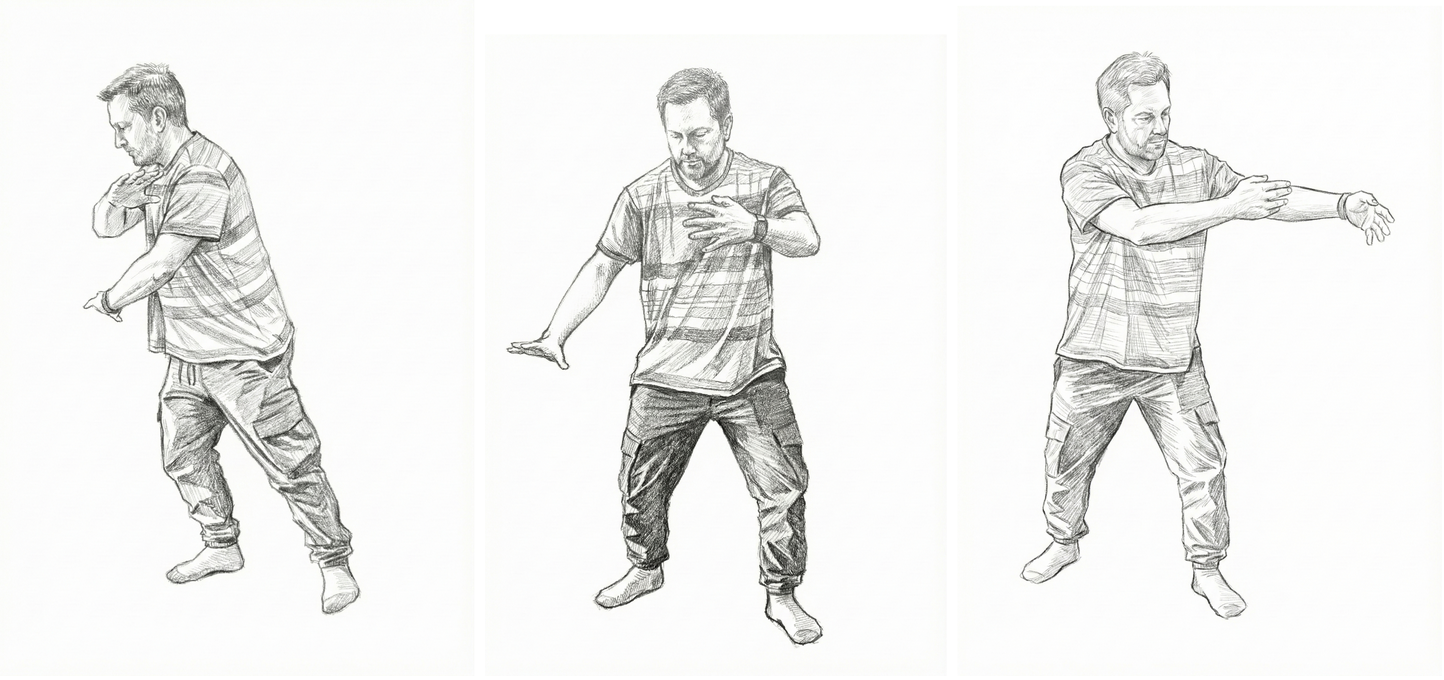
A picture paints a thousand words, especially in Tai Chi. I recently found an incredible source of Tai Chi images drawn (I think) by Anthony of Brisbane Tai Chi.
Just scroll down the main page and look at the images – they’re great! Full of tips on alignment and posture for Tai Chi and Zhan Zhuang (standing practice).
One of Anthony’s best images for thinking about how alignment relates to the tai chi form is this one:
Anthony/Brisbane Tai Chi
I think that image very clearly shows head over shoulder over hip over ankle, and how easy it is to mess that alignment up once you start moving in Tai Chi. You basically want to keep the blocks aligned over each other.
Why?
As it says in the picture, if you align yourself correctly with gravity then your legs become the primary weight holders in the body. That means you can be more relaxed (Sung) in the upper body, so that you can use it to transfer force, instead of tensing up to hold weight that is misaligned. Plus, it just feels better.
You can think of the Tai Chi form as an exercise in claiming your space. We rarely think of the space we occupy or move around in as part of ourselves, but it is. We often let others take our space, or give it away needlessly. We move out of the way when people walk towards us in the street. Rarely do we stand our ground and own the part of the earth that is directly underneath us.
In tai chi push hands we learn to claim our space, to gently redirect people that want to come into it and also to take away other people’s space if we need to, and not let them get it back. In the tai chi form we learn to round out our movements, so that (as the classics say) there are “no hollows or projections” in tai chi. Your goal is to create a kind of sphere with your body, as if you were inside a giant beach ball. Your hands extend to the limits of the ball, and no further.
Finding your centre
In tai chi there is ‘finding your centre’ within yourself, but there is also ‘finding your centre’ when in contact with another person. When two people are in contact, especially if engaged in some form of conflict, they are rarely both in balance, usually the advantage lies with one person or the other. The one in control is usually the person who has made both people part of their ‘centre’. Viewed from above, they become the centre of the circle, around which the other person is orbiting.
In class today I was working on the ward-off posture. I think by far the best way to think about ward off, as a martial posture, is to think about having just slipped a straight punch over your right shoulder by moving your head and turning your body to your left, you then step diagonally into the space occupied by the other person, right under their armpit using the familiar ‘ward off’ posture to keep them off balance. You need to keep that full, rounded, ‘peng’ aspect to your arms here, and once you have them off balance, you never retreat or give up the ground you’ve taken. If you do then you’re simply giving them their balance back. You need to keep them off balance continually, so that they can’t recover and they end up open to strikes or to being knocked over.
That ability is one reason why, while strikes exist in Tai Chi, they’re not really emphasised in the form. Instead, in the form you’re continually learning how to take ground from the opponent and occupying it while remaining in balance. As a means of self defence, it is highly effective, but not easy to understand without feeling it, which is another reason why so many people are confused about how Tai Chi works as a martial art.
Thank you for supporting The Tai Chi Notebook. If you are reading this on a website that isn’t thetaichinotebook.com, then it’s highly likely it’s been stolen. Please let me know so I can issue their webhost a DMCA takedown notice for copyright breach. Thanks.And if you have the great idea of starting a tai chi website by stealing other people’s work to fill it with content for clicks then take a good hard look at yourself, and do better.
My guest for the latest episode of The Tai Chi Notebook Podcast is Tina Faulkner Elders, chief instructor of the RuYi School of Taijiquan and Qigong in Aberdeenshire. We talk about Tina’s training in qigong, first with her father, then in Beijing, China, and then on Wudang mountain itself, the legendary home of Taoism.
“The origin of internal arts” is probably what I’d have called this really interesting podcast with Peter Lorge about the history of internal martial arts, however Kung Fu Genius decided to name it “Chinese Martial Arts History is Mostly FAKE” because, well, it probably generates more clicks, or something. Anyway, Lorge turns over a few sacred cows here, and I also liked what he had to say about BJJ.
Have a listen:
I think Peter makes a great point about all these different ‘internal’ things throughout Chinese history all definitely existing, but all being completely separate and unconnected until the 1920s Guoshu Institute needed to create the category of “internal” to exist in opposition to shaolin and external, so it brought them all together. (The gentleman whose name he forgets when talking about this is obviously Sun Lu Tang.)
I do wonder if instead of looking back for mentions of “internal” throughout Chinese history a look back for the phrase Liu He “six harmonies” would make a better connection between the dots of Chinese martial arts history. While the term “Neijia” may not appear very often pre-1920s, Liu He definitely did. If we’re looking at how we got where we are today, then that’s probably a better bet.
What’s in a name? When it comes to tai chi chuan (taijiquan), then the answer is… quite a lot.
Firstly, there’s the issue of how you write it. Occasionally, you will see an attempt to guess at the spelling of the name that makes the mind boggle, such as an email asking if somebody can come to your “thai chee” class, but usually it’s some variation of “tai chi” or “taiji”.
Tai chi was first romaised into English using the Wade–Giles system as “tʻai chi chʻüan”. But English speakers soon abbreviated it to “tʻai chi” and dropped the mark of aspiration. Nowadays, in the UK at least, we tend to use “tai chi” and forget about the “chuan”. Perhaps a better translation would be “tai chi boxing”, but this goes against the image of the art, which is usually practiced as a health exercise, so that’s never going to catch on. There really isn’t much “boxing” going on in most tai chi classes.
Then there’s he newer pinyin romanisation system, which has replaced Wade–Giles as the most popular system for romanizing Chinese. In pinyin, tai chi is written taijiquan. It’s popular to use taiji or taijiquan in English now to also remove any colonialist connotations of the term from a bygone era.
I get that, but I think the written phrase tai chi has slipped so far into the general populations consciousness that a lot of people have no idea what you’re talking about if you write taijiquan. I use tai chi myself.
Step back into the Qing dynasty
Then there’s the issue of when the art was given the name tai chi boxing. Tai chi emerged into public life in the royal court during the Qing dynasty, yet it wasn’t freely called tai chi until after the dynasty ended. If you try and find a written occurrence of the name published before 1912 you’ll draw a blank. There are certainly written documents that claim to be from years earlier that contain the name “tai chi boxing” yet not a single one of them was made public or published before 1912. What happened in 1912? The Qing dynasty collapsed and the new Republican era began.
My best guess as for the reason that this is the case is that Hong Taiji (1592 – 1643), the founding emperor of the Qing dynasty had adopted the name “Taiji”. It’s unclear if this was his personal name or a title, but there was certainly a taboo around using that name because it belonged to an emperor. It therefore became impossible for a marital art to be called “tai chi boxing” without breaking that taboo and suffering the (presumably harsh) consequences. However, once the Qing dynasty fell, the name was back on the market. (Credit to my friend Daniel Mroz for bringing this to my attention).
The taiji symbol
Then there’s the meaning of the name. The name taiji has obvious connections to the philosophical concept of the taiji symbol – the circle with the two fishes representing yin and yang and their constant interchangeable position. One state increase till it exhausts itself leading to the other in an infinite loop.
In Yang style tai chi lineages, the art has long been associated with Taoist ideas, which the taiji symbol is representative of. Chen style seems less Taoist in origin, however, the concept of taiji is a universal symbol, and used throughout all of Chinese thought.
The name taiji can be translated as “supreme ultimate”, which has lead many to conclude that tai chi boxing must have got the name because it was the boxing system par excellence of the Chinese martial arts scene. It is literally, the best! If only!
I wish that was true, but I think it’s just a common misunderstanding, which is perhaps played on as a marketing device in modern times. I mean, who wouldn’t want to be learning the supreme ultimate boxing system, right?
The concept of being a supreme ultimate is more to do with supremely different positions being harmonised. Extreme yang and extreme yin. Polar opposites that work together and find harmony. That’s the real meaning.
In Tai Chi your body moves through position after position – we call these ‘postures’ usually – in the transition between them the body will open and close in a repetitious cycle. Once yang (open) is exhausted the body will move to yin (close) once you’ve reached the extreme position of yin, you move back to yang again, and so on.
The opening and closing is a whole body action. So, you are literally enacting the taiji diagram with your body.
That’s the general idea. Of course, you can break down your body into sections and look at how each one of those opens and closes, there is seemingly no end to the level of detail you can drill down to, but on a basic level your body is always moving from yin to yang and back again, which is the reason for the name of the art – tai chi chuan.