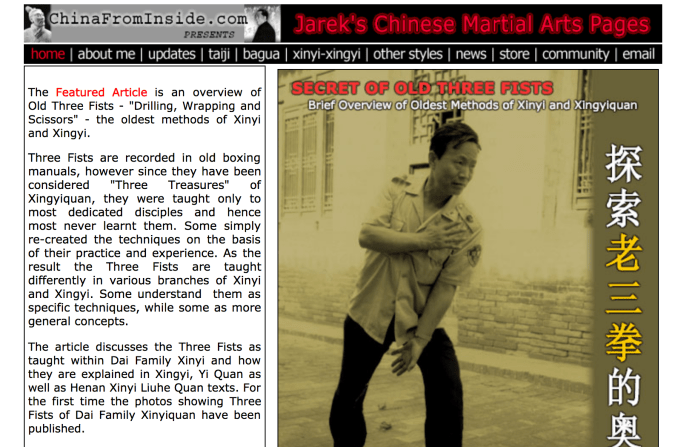
Jarek Szymanski’s website, China from Inside was one of the first and best resources on the web for the history and practice of Chinese Martial Arts, written by a European living and working inside China. It was particularly good for finding out how internal martial arts, like XinYi, XingYi, Bagua and Taijiquan were actually practiced in their native environement.
I remember reading his website back in the 1990s, and it’s still there!
Nick at Masters of the IMA has been working together with Jarek over the last few months on recording some of his experiences in China back in the 90s – how he came to end up living in China, his experiences investigating the history of various CMA, etc.
He’s posted the first parts of the interviews on his website, and it’s well worth a read. You can find out all about his experiences on Mount Wudang and Beijing, and get his opinions on how modern Chinese martial arts related to the older traditions, and how they differ. I really liked his insights into places like the Shaolin temple and Mount Wudang (see part 5) and how they’ve changed over the years compared to his visits there in the 90s.
“When we got there, we saw some Shaolin monks (wuseng) giving performances not in a stadium, but just in an open space outside the temple. As far as I can tell they were demonstrating some forms and hard qigong, iron shirt (tie bu shan), etc. My Polish friend and I had great fun ‘testing out’ the iron shirt guy – when he invited members of the audience out to test his iron shirt, I don’t think he was expecting to be punched full force in the stomach by two 6-foot Polish guys (laughter). It was at that point that I realised so-called iron shirt is not that special, most demonstrations of iron shirt are just a combination of timed breathing and muscle contraction, similar to what I had practiced in my early karate years.”
In the last post I was talking about how, if you let the power of the movements naturally arise, it just works, as opposed to trying too hard to put power in them, which always leads to you screwing it up. But that doesn’t mean that if you just sink your weight and relax that your Tai Chi will become naturally powerful all on it’s own. If you want to send force outwards using Jin you need to be consciously aware you’re doing it.
I was reminded of this recently by a post by Robert Van Valkenburgh:
Jin, by definition, requires intent. If you don’t know you’re doing it, how can you be doing it?
As I explained in the last post, using Jin (ground-based force) as opposed to Li (muscle-based force) requires a relaxed body with the ability to sink the weight down to the ground, so it can rebound into the hands.
What I neglected to mention was that if you just sink the weight downwards, then that’s the direction it will go. It’s not going to magically just appear in the hands. So how do you get it there? The answer is, using the Yi.
The Yi is one of those hard-to-define Chinese terms we so often come across in Tai Chi. The most general ‘catch all’ translation you find is “intent”. But you can also think of it as “the mind directed to do something” or “the mind directed in a direction”.
So how do you get the force of the ground into the hands? By using the mind to direct it there. In fact, you want to direct it outwards and past your hands and into your opponent. I like to think of directing it from my foot (the part of me that is nearest to the ground) all the way to the horizon, through my hands, when I do an outward expressive movement, and down and in towards my foot when I do an inwards movement.
Don’t think of the path of power ( a Jin path) as going up the leg, through the torso and then down the arm and out – trapping the mind inside your body like that will not help the energy go outside it, which is what you want.
So, don’t worry about the path it takes, just ‘think’ in a straight line from your foot to your hand and out. The Jin path you create with your mind usually goes from your foot, through the air (at some point) and to your hands and in a straight line, since that’s the quickest route.
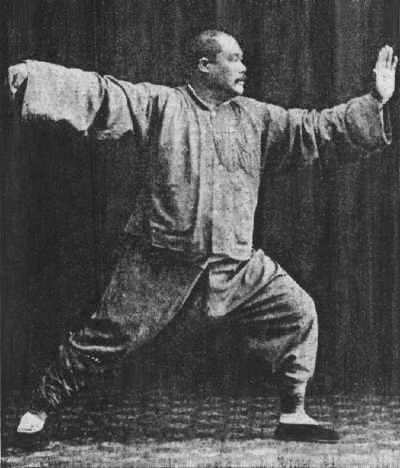
In the picture of Yang Cheng Fu below you can imagine that the Jin path goes from his back foot to this hand like this:
Jin path
So when you run through the form, your mind needs to be creating these jin paths as you practice. As well as you doing everything I said in the last post – relaxing, sinking the chi and coordinating the body so all the separate parts arrive together. That’s the Tai Chi form in action.
Of course, that’s a tall order, and I’d suggest that beginners who are interested in this type of training pick a favourite move (a simple Push movement is a good one) and just practice it over and over, paying particular attention to mentally directing the path of forces in the body.
Without a teacher who can show you what it feels like it will be a bit like fumbling for something in the dark when you don’t know what it is or looks like. So get out there, try and get ‘hands on’ with a good teacher and you’ll get a better idea of what it feels like. If you find somebody who can do this then you can recognise it. It doesn’t feel like normal strength.
Ken Gullette, whose book I recently reviewed, has a good video that I hadn’t seen before which I think can give you a sense of what you’re looking for – the feeling of the ball under the water. That’s the main thing to focus on in this video.
Once you understand this concept then some of the lines in the Tai Chi classics will start to make more sense. Like, for example:
“The jin should be rooted in the feet, generated from the legs, controlled by the waist, and manifested through the fingers.”
“All movements are motivated by Yi, not external form.”
“6.) Use the mind instead of force. The T’ai Chi Ch’uan Classics say, “all of this means use yi and not li.” In practicing T’ai Chi Ch’uan the whole body relaxes. Don’t let one ounce of force remain in the blood vessels, bones, and ligaments to tie yourself up. Then you can be agile and able to change. You will be able to turn freely and easily. Doubting this, how can you increase your power?”
“The yi and ch’i must interchange agilely, then there is an excellence of roundness and smoothness. This is called “the interplay of insubstantial and substantial.”
“Don’t put power into the form let it naturally arise from the form.”
A guy on a discussion forum called Wayne Hansen uses that quote in his signature. I don’t know if this is a famous quote from an old master, or if it’s just something that Wayne thought of himself, but it’s such a great quote, because it’s absolutely true!
I was reviewing somebody’s form recently and the big thing I noticed was that they were trying to put power into the movements, rather than just accepting that the movements on their own are powerful, and don’t need anything extra to make them work. In fact, when you try and make Tai Chi movements powerful, it just messes them up, because you inevitably revert to tense, upper body muscle use, instead of a smooth flow of connected power, talked about in the Tai Chi classics.
(I think I should mention here that I’m not talking about the explosive bursts of power you typically see in Chen style forms. These are different. Instead, I’m talking about the general movements found in Tai Chi, typified by Yang style and it’s variations, which opt for a smooth form with an even pace throughout).
What that quote doesn’t do however is explain how Tai Chi is done, which is pretty standard in Chinese martial arts. Tai Chi is full of these mysterious sayings, which have very little explanation, and are only useful for people who already understand what they mean. So let’s break this one down and see where we get, starting with:
1. Fang song
In Tai Chi we are frequently admonished to fang song or “relax” as we would say in English. We all instinctively know that a relaxed body can be a powerful body. Think of how heavy a small child can make themselves if they don’t want to be picked up by going all floppy. Similarly, a baby’s grip is surprisingly powerful, but not tense.
Being too tense results in a kind of rigid and brittle strength. It’s strong, but it sacrifices flexibility. This sort of force tends to lie on the surface, like ice on a lake, but break through the surface and it’s nothing but water underneath. In contrast, relaxation can be more like thick sea ice – strong and solid all the way down.
But to be both powerful and relaxed a body also needs to be:
2. Coordinated
On a purely mechanical level that means moving so that the coordinated power of the body arrives together at the same place at the same time. If you can coordinate your body so the legs, hips, torso, and arm are all arriving together in a unified purpose then you can use relaxation to create a kind whole body power that doesn’t rely much on tension at all. But that’s still not the whole story. You also need:
3. Sinking
The next stage is to get used to sinking into the movements. This sinking, which can be described as dropping the weight of the body down into the ground through relaxing, enables power from the ground to rebound up into the hands. It generally moves in an upward and outwards manner, which is the Peng Jin that Tai Chi is famous for. All the movements of Tai Chi need to contain this Peng Jin.
I often read people who criticise sinking as merely “pushing from the legs”. They say that this will just be too slow. To that I’d say, go and ask a boxer if his punches are too slow, because that’s what a boxer does. But more importantly, that’s not what I’m talking about.
It’s true, the legs are very much involved in generating power from the ground, but when you can effectively drop your weight down it’s not a physical movement of pushing from the legs that matters. It’s the internal movement of power that is important, the jin. And the power of the ground arrives in your hands instantaneously, so there’s no delay. It’s not going to be too slow to use.
Once you get used to doing this sinking you can feel it in your form. It requires practice, probably daily practice to get it. But that’s why you do the form every day, right? Every day you are practicing movements where you drop the weight and put the power of the ground in your hands.
Remember, the movements themselves are powerful – you don’t need to add power in. Instead you need to learn to relax, coordinate and sink your ‘energy’.
Just look at that picture of the famous Yang style Tai Chi teacher, Yang Cheng Fu. You can see how relaxed he looks and how his weight is sinking down.
Born in 1990, Wang Yan became head coach of Cheng village training centre in 2013 and is as a Taiji fighter as well as a coach, not to mention an expert in forms. He was one of the “nine tigers” – the best nine students of Chen ZiQiang. There’s an interview with him in English on Chen Taijiquan blog, with some great pictures from his private collection. The interview is pretty long, but there are lots of really interesting insights into his daily training, San Da competitions training and how exhausting it all was!
“Our daily routine started in the morning with running and warming-up excercises. In the first morning class we studied forms, in the second class we did strength excercices, in the third class we did push hands exercises, kicks, punches and other self defense techniques, and during the last evening class we were again doing push hands exercises, and sometimes weight lifting.”
“When a student grows a little older, reaching his late teens and early twenties, then the school starts putting much more attention to learning taolu (forms).”
“When I was a young student, the training was more strenous then now. The approach has changed nowadays towards a somewhat softer way. Students now come from more comfortable backgrounds and are, generally speaking, often more interested in computer games than in serious training.”
“Some of us developed more in the direction of Taiji fighting, while the others became the very best in various Taiji forms.”
Competition training:
“To develop stamina we would practice frog jumps, running in a crouched position, running while carrying someone on our shoulders etc., until the point where I would be absolutely exhausted.
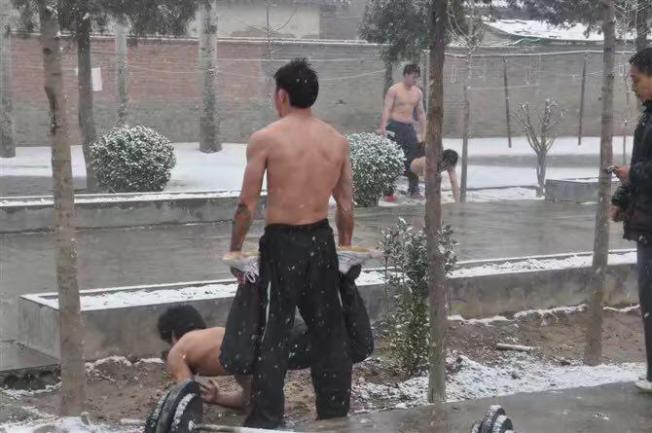
One method of practicing tuishou was, for example, being in a circle of about twenty students, who would challenge you one after another. When I knock the first one down, the next one would attack, and so on till the last one, after which the circle repeats itself. I also practiced the same circle exercise blindfolded in order to sharpen body sensations. Sometimes during wintertime, shifu would take us outside, dressed just in trousers, to train in the snow. One of exercises was to hold each other by the legs while ‘hand walking’ on the cold or frozen ground.
Before tuishou competitions I always have to control my weight, so during preparation time I would eat less and avoid spicy and very greasy food. Finally, after hard training, it is also important to have a proper rest.”
Training:
“There is a saying: “By missing one day of practice, your skill regresses for three days”. So, I make sure that I practice every day.That means that I go at least through forms. And when I have some more time, I do also some fitness exercises like running and weight lifting.”
It really does sounds beyond what most people could have physically and mentally endured at a young age, and more extreme than the training is in Chen Village these days.
There’s a lot of controversy in Tai Chi circles about the role of weight training in internal arts. It’s often dismissed as either unnecessary or worse, damaging to progress. It sounds like the antithesis of the frequently heard advice to relax more. Yang Cheng Fu’s “10 important points” essay is often read as a warning of the dangers of following an “external” path. (I think people often miss the meaning of that text though, so I’ll return to it at a later date.)
When the Chen Tai Chi masters teach seminars to Westerners they keep the focus on traditional conditioning exercises, like silk reeling, or zhan zhuang and forms, which do not involve weights, and emphasize things like relaxation and internal conditioning. Traditionally of course, training with heavy weapons would have been a form of weight training, and village farmers would have naturally been very strong people from all the physical labour, but there still seems to be a contradiction between the methods espoused to Western students in seminars and the content of the syllabus for training young fighters in Chen village itself.
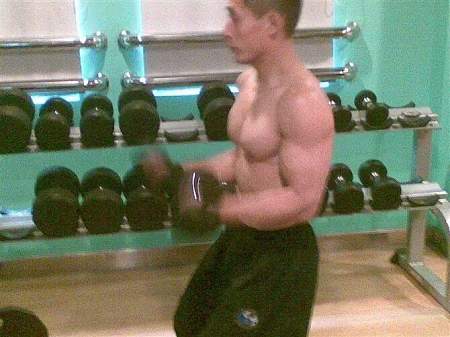
There are also the ‘internet famous’ pictures of Chen ZiQiang doing weight training, and looking very ‘cut’ that spark off these debates, for example:
So, it’s interesting to read the above interview, where Wang Yan makes clear the role that weight training played in training his generation of Chen village teachers, especially when preparing for San Da competition. It’s also interesting to note that they may be the last generation to be trained like that, as “Students now come from more comfortable backgrounds and are, generally speaking, often more interested in computer games than in serious training.”
That’s an interesting point in itself, that makes me wonder if that generation was a kind of high point for martially trained Tai Chi fighters from Chen village. “May the children of your enemies live in luxury!”, as the famous Cynic philosopher Antisthenes said; a quote that echoes the famous poem/meme:
Of course, it’s all a matter of perspective. The people Wang Yan is training now are probably working a lot harder than most people could tolerate, even if they’re not doing wheelbarrows in the snow in winter wearing only their trousers 🙂
Full-time training
If I was training full time to be a fighter and I had a fight coming up in which somebody was going to try their best (under the rules) to hurt/beat me, then you can bet I’d be weight training too! You can’t fake fitness. And no matter how good your Tai Chi skills, if you get out of breath in a fight and your conditioning fails then you can’t fight back. Also, extra muscle mass doesn’t stop you from doing internal movement, although speaking realistically I don’t think that would have been the focus of training going into a fight.
Wang Yan was training as a full-time athlete. As well as doing all the hard physical training he would have been training in traditional Chen family methods at the same time. One does not preclude the other. While some might look down on all that physical training, it appears that the Chen village plan is to develop physical attributes first in its young people, including fighting skills, and later the more subtle Tai Chi skill is focussed on.
Here’s a video of Wang Yan doing some traditional Chen forms:
And here he is looking pretty good in a San Da match from 2013:
He’s a great inspiration for all Tai Chi practioners everywhere.
Here’s part 4 of the course. This week we focus on breathing. I cover the topics of normal and reverse breathing, then show a couple of different exercises that will get you on the right track for applying the breathing methods to the movement we are working on. Finally, we integrate the breathing into the movement, preserving all the progress we have made so far. Once you get the hang of it those breathing exercises I show are not required anymore, as you should be integrating it into your main exercise.
This week is more subtle than work showed previously. An inner focus will be required. Good luck! I’m happy to answer any questions you have.
I found an interesting post on Slantedflying.com about Chen village and how it’s grown. There’s a video in it that shows an aerial view of the village and the massive training hall. It’s more like a small city than a “village” now!
It’s incredible how the popularity of Tai Chi has transformed this “rural backwater” (as I’ve often heard it described) into a bustling, modern, mini-city.
Here’s part 3 of my 8-week course on mindful movements with Tai Chi. Last week we looked at the lower body, this week it’s the turn of the upper body and I throw in a bit of zen wisdom at the end for good measure. Enjoy!
Here’s the second episode of my Tai Chi course on mindful Tai Chi movements. This week we take a look at where you power you movements from in the body. Enjoy!
My Facebook friend Byron Jacobs is the Technical & Events Manager and Technical Committee Member at International Wushu Federation in China. That’s a pretty high up in Chinese Martial Arts for a guy from South Africa 🙂
This is a YouTube video about him:
As you can see from the video, he’s fluent in Chinese and lives in China. He trains Xingyiquan under his Sifu, Di Guoyong.
Recently Byron appeared in an episode of the Chinese TV documentary “Da Dao Taiji” in which he was interviewed about traditional Chinese martial arts, its utility in the modern age and the problems it is facing both in the mentality of practitioners and their methods today. I don’t think they were quite expecting such a frank interview!
Unsurprisingly, it was edited quite heavily, and they only kept some of these “inconvenient truths” in the documentary.
The good news is that here on Tai Chi Notebook you can view his whole interview, complete with subtitles. It may have been too hot for Chinese TV, but nothing is too hot for you, my dear readers!
(As an interesting sidenote, the new laws in China were passed last year prohibiting people with tattoos from being shown on TV, so they had to smudge out his tattoo for the aired version of this!)
Enjoy the inconvenient truths video:
And here is the entire episode 2, as it appeared on Chinese TV:
Great video by Chen Zhaosen on putting the internal into your Taijiquan practice so that it becomes Taijiquan not Taiji Gymnastics. Of course, it should already have been there, but we all know that already, right? 🙂 The secrets are all here, hidden in plain sight. Chen Zhaosen on breathing:




 The Tai Chi Notebook