Byron Jacobs, who produced the excellent XingYi San Ti Shi primer I posted recently, has launched a new podcast that’s well worth checking out.
In the first episode, Byron talks to Marin Spivak, Chen Tai Chi disciple of Chen Yu, about what it’s like going to live and train gung fu in Beijing as a Westerner back in the 1990s and 2000s. Both Byron and Marvin made the jump to live and train in Beijing, so they have a good insight into Chinese culture, and particular gong fu culture.
I really liked the discussion of the tangled network of gong fu culture a prospective student has to find their way through in China, and which the average western student has no idea exists at all.
He’s the ‘Marmite‘ of the Tai Chi world (well, one of the Marmites anyway, you could argue the Tai Chi world is made up of Marmite personalities all the way down 🙂 ), but this free article is a nice neat summation of Scott Phillips’s theory of Taijiquan as dramatic storytelling.
It’s easy to dismiss Scott as “he’s just a dancer”, but to me those Chen style movements he’s talking about look so stylistic and deliberate that they’re clearly not just martial movements. If you’re arguing that Tai Chi is just a martial art and nothing else then I think you’ve got a lot of explaining to do. It’s pretty easy to see what fighting looks like these days, since sport fighting is on TV every weekend.
I think the idea that ‘Ok, this might be true, but does this matter?’ has much more validity. If Scott is right and he’s tracked down the origins of Tai Chi, then it clearly been forgotten over time, and Tai Chi these days has become something else.
In fact, it had become something else over a hundred years ago. China has gone through several major political and cultural shifts over that time that changed their society completely (often resulting in the deaths of millions of people and associated trauma). The Boxer Rebellion, the 1912 Chinese Revolution, the Communist rise to power, the Cultural revolution and the current rise of nationalism under the guise of Communism, etc…
Anyway, the article is in-depth and it’s worth a read if you have an interest in the possible origins of Tai Chi:
I don’t really enjoy push hands. I used to, I used to enjoy it much more when I saw it as a medium for exploring arm locks, takedowns, wrist locks, throws. In short, when I saw it as a way to practice techniques. I used to love it.
In more recent years I’ve reframed my view of what push hands is. Partly this is because I took up BJJ, and found I got more than enough scrapping in my diet to satisfy my craving to try out locks, throws and sweeps. That’s essentially what we do in BJJ, we practice locks, throws and sweeps over and over until we get very good at them and can do them under full resistance.
Inevitably the BJJ player ends up going one of two ways over the years. Either he (or she) gets softer and more flowing. So, when the other person is pushing you should be pulling, and when they’re pulling you should be pushing. By learning to flow with the dynamic movement between two people you learn to blend, yield and overcome. Or they end up getting very good at smashing people. Whatever is in front of them they can just smash through it using precise, accurate bursts of speed and power.
Inevitably all BJJ players tend towards the first approach as they age, if they want to keep training, that is. Or they give up either through injury or changing life circumstances.
But back to push hands. Once I had found a way to get my regular fix of fighty, I found I could step back and view push hands as something else. Perhaps what it was originally intended for.
Now when somebody pushes on my arm I don’t immediately think “how can I lock this arm?”, I am thinking, “where is his force going?”. Is it going to my feet? If not, I try and send it there, turn and yield. When it’s my turn to push back I ask myself where I’m pushing from. Is it the ground? If not, why not? What am I doing that’s stopping that? Where am I tense?
Pushing hands like this might not be as much fun, but I think overall, it’s more satisfying.
Proper push hands lacks the thrills of the fighty approach, but it instils qualities in you that make your fighty better.
That’s a difficult concept to really understand, and even harder to do when the other person just wants to fight. If the other person wants to fight then I sometimes just fight back. Inevitably I slip into BJJ mode and we end up in some armlock on the ground, and it’s fun…
Tai Chi Chuan has the 13 postures as its basis, which consist of the 8 powers and 5 directions.
The first 4 powers are well known – peng, lu, ji and an – while the second 4 tend to not be so well known. Li (split), Tsai (Pull down/shock), Zhou (elbow) and Kou (shoulder).
These 8 ‘powers’ are the most common expressions of power in Tai Chi Chuan. No technique in Tai Chi Chuan is really purely a single power – they’re all combinations of all 8 of the powers.
It’s this pull down, or shocking, power I want to talk about today.
Shock is often called Pull down because that’s the direction it’s most often used in, however, it’s actually directionless. I prefer “shock” as a description as that’s what it feels like, rather than a pull. Even if performed while pulling, it’s a sudden burst of focussed energy rather than a long expression of energy over time, like say a push.
A lot of people practice Tai Chi with its soft flowing movements yet are unable to coordinate the body together to produce a single isolated burst of power that’s required in the application of many of the movements of Tai Chi Chuan. Depending on how a Tai Chi form is done it’s quite common to see all the shock power removed altogether in favour of soft, flowing, relaxed movement. Yet without it, something is lacking. You’ll never make your techniques effective.
Take an armlock that’s supposed to break a limb. There’s no way you’re going to get that to achieve the desired effect if you can only do the move slowly and softly.
I’m not talking about a sudden burst of tension there either. A good ‘shock’ is delivered by coordinating the body movements together and generating power from the dantien, legs and waist.
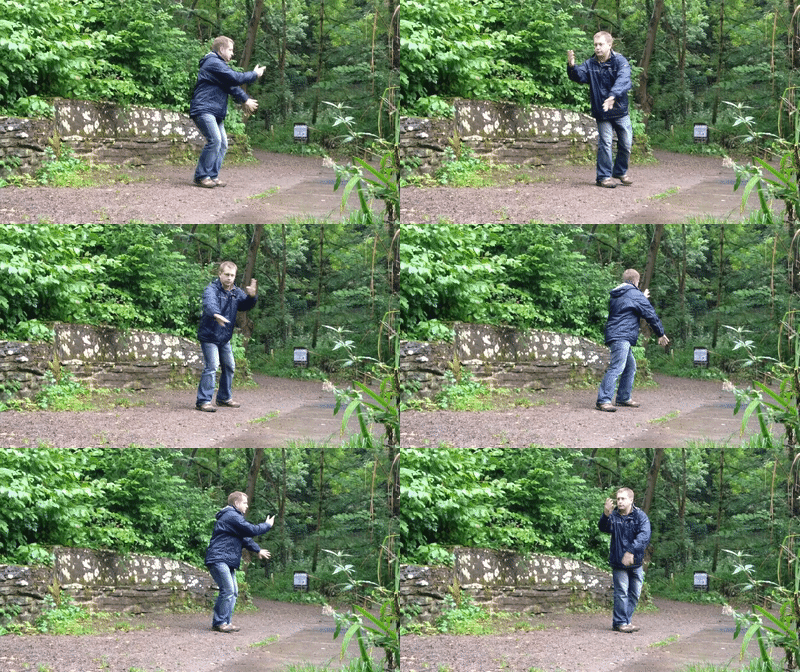
Here’s a video I made whilst working on some Tai Chi – see if you can spot where the shock energy is.
There’s an old adage that the Tai Chi practitioners of Chen village used to “tear up the sandbanks” of the river bank when they practiced their form there. This indicates how much force was being produced by the legs twisting.
It’s often said in Tai Chi that your feet want to grip the ground. This is achieved by slightly raising the arch of the foot so the toes perform a clawing action that affords you improved stability, balance and grip.
The question is, how do you do it? It doesn’t sound very relaxed to ‘grip’ the ground with your toes,and we all know that in Tai Chi we need to be Song (‘relaxed’).
In fact, the arch of the foot and the grip of the toes is achieved through softness, rather than hardness. The answer is found in the wrapping of the legs we mentioned earlier.
If you point your knees outwards slightly you create a kind of gentle wrapping in the legs as you move, and, if you let it, this wrapping will encourage the toes to grip the ground and the foot arch to form. Of course, it should be emphasised that the action of the knee pointing outwards is achieved not by pointing the knee itself, but by rounding the inner thigh area – the Dang, in Chinese. We covered this in that last post.
The gripping action of the toes gives you better than normal balance, especially in one legged postures. If you’ve ever looked at a Tai Chi practitioner stand on one leg without wobbling and wondered how they do it, then look at their knee and see if it’s being gently pointed outwards. That’s usually the key.
There’s not really any point in seeking the extra stability this leg posture affords if you’re only practicing Tai Chi for health reasons, which is why “rounding the crotch” or gripping with the toes isn’t talked about much in styles that predominantly focus on health matters, but it should form part of martial Tai Chi Chuan. And indeed, if you are making this all happen using too much tension, then you might end up causing more harm than good, so buyer beware.
None of the postural considerations of Tai Chi should be achieved through tensing parts of the body. That’s the key. You need to walk the middle way between trying to make something happen too hard and not trying hard enough. That’s the enigma of Tai Chi.
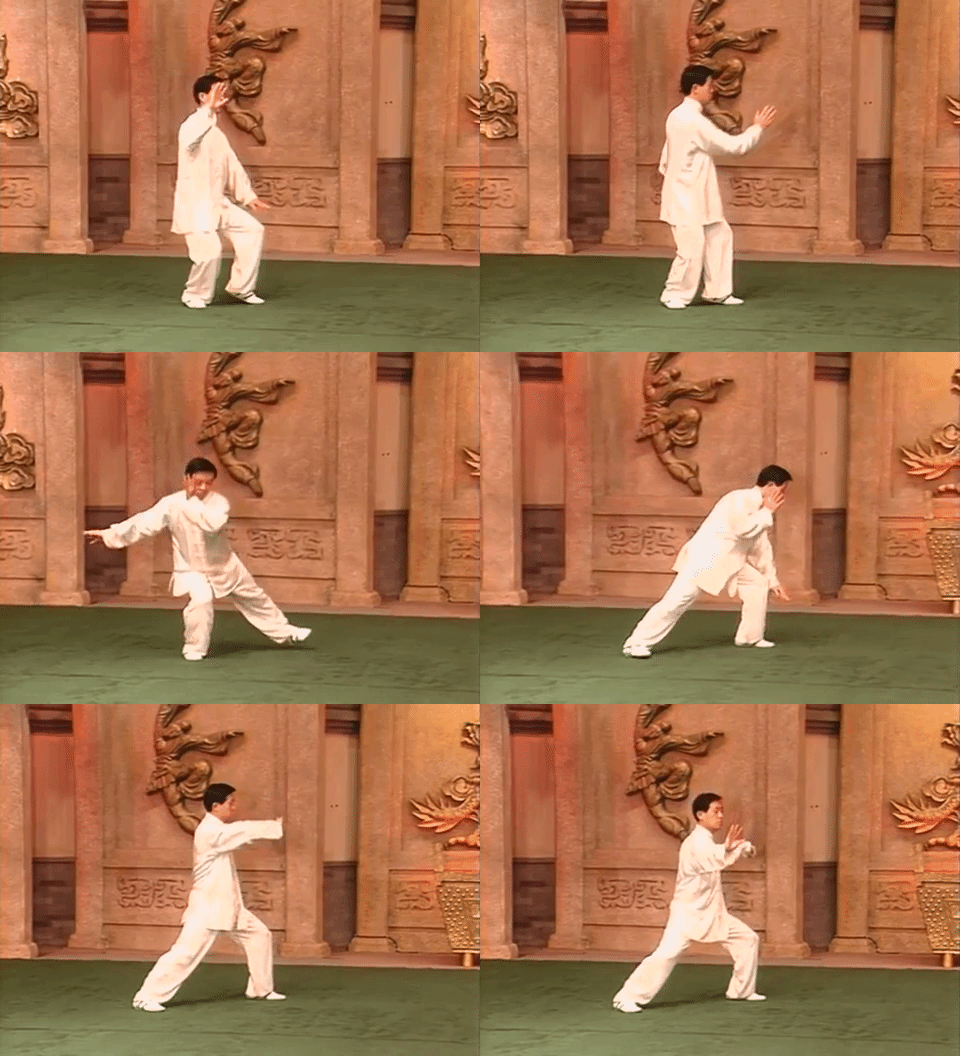
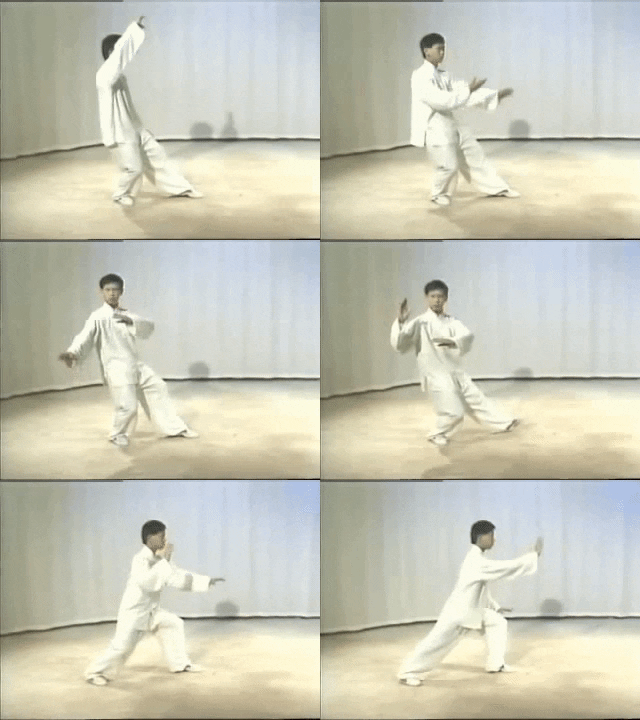
Brush Knee Twist Step (called “Walk obliquely with twist step”, which was probably its original name) is a fundamental movement in all Tai Chi styles.
Chen Zheng Lei performing “Walk obliquely with twist step”:
The Yang style Brush Knee looks like a slightly simplified version of this. Here performed by Yang Jun, grandson of Yang Cheng-Fu :
And Sun Style looks like the Yang style, but with added steps. Here performed by Sun Peng who is Sun Lu Tang’s grandson :
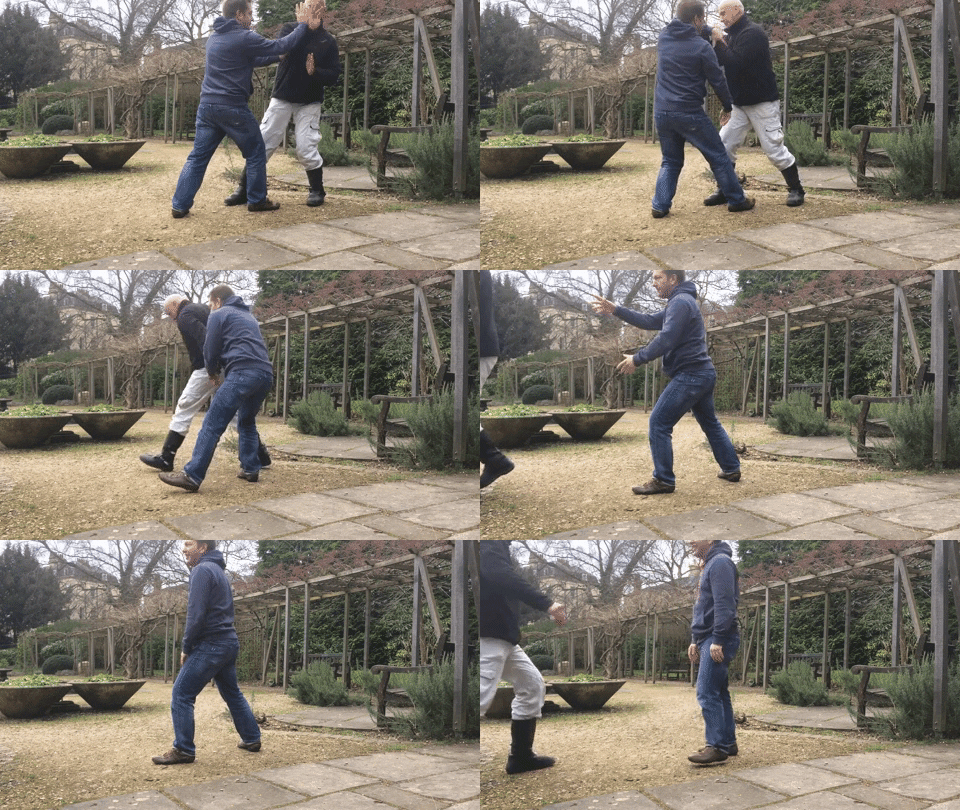
The version I personally do is somewhere between the traditional Sun and Yang styles. It’s got a step, but it’s most like Yang. Here’s a little GIF showing me doing an application of Brush Knee Twist Step in push hands from the Tai Chi style I practice.
Here’s how it looks in my form (a Yang style variant from the Gu Ru Zhang lineage that had input from Sun Lu Tang).
Of course, there are many possible applications of this movement, and I’m just showing one, but hopefully, that gives some indication of the usage.
In Tai Chi we all know we are told we should “round the crotch area” – sometimes called “Kua”, but more accurately called “Dang” in Chinese – but why? What does that mean anyway? I’m going to try and point you in the right direction with this post.
The three dantiens
There are three main dantiens in the body that Tai Chi is concerned with. Firstly there’s the main one in the lower belly, which acts as a nexus, or control point for the whole body, but slaved to it are two other dantiens – the chest dantien and the crotch dantien.
There are clear parallels here to the idea of chakras in Yogic folklore, and indeed there are more “dantiens” in the Chinese system that relate to the other chakra locations in the body too, but for the purposes of internal martial arts, it’s the crotch and chest dantiens that are most important.
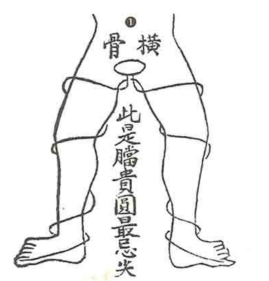
The crotch dantien is located at the Hui Yin point, and shown in the drawings from Chen Xin’s book:
These dantiens are points where you can use to store force that can be used in the release of power in the way that the internal martial arts express it – i.e. from the ground to the point of application.
It’s often said that Tai Chi is “boxing with the legs”, and this relates to the use of the crotch dantien. The knees are also in the domain of the crotch dantian, so, you need to think of the legs, hips and crotch all working together.
So what is that supposed to feel like? Well, It’s a bit like sitting on a space hopper – that feeling of grasping something with the inside of your legs, but not too forcefully.
When you take up your stance in Tai Chi you should feel this ‘energy’ inside that leg arch, as if you are sitting on a space hopper. That’s not exactly a scientific way to describe it, but hopefully, you get the idea.
So your knees are involved too: when you rotate one leg forward, the other leg must rotate backwards to keep the grip on the ball. This forms the action of opening and closing, and is part of the overall action of opening and closing that is going on all over the body.
Squeezing the ball
As you move through the Tai Chi form you ‘squeeze’ this ball between your legs (just as you do a space hopper). So the crotch (the part of the body where the legs join the torso) can close on one side of the body and open on the other, but the feeling of there being something there is maintained throughout.
In Zhan Zhuang practice you get a lot of people describing holding a balloon between the legs, or a ballon supporting your limbs – that’s the same idea, and with enough practice it can actually start to feel like this.
While the space hopper or balloon may be imaginary, the feeling isn’t. It reminds me a lot of the verse in the Tao Te Ching about the value of what’s not there:
“Thirty spokes share the hub of a wheel; yet it is its center that makes it useful. You can mould clay into a vessel; yet, it is its emptiness that makes it useful. Cut doors and windows from the walls of a house; but the ultimate use of the house will depend on that part where nothing exists. Therefore, something is shaped into what is; but its usefulness comes from what is not.”
This feeling of buoyancy in the crotch dantien forms part of the way the power is transferred from the legs to the torso, and ultimately out to the fingers.
Store and release
In terms of training this power, traditionally it’s common to stand in a low horse riding stance for a long period of time. I think this is more about building leg strength than the sort of power I’m talking about though, so while there’s nothing wrong with it, I think you need a moving exercise to practice what I’m talking about.
Trying to focus on just developing this power while doing the whole Tai Chi form isn’t optimal, as there are too many other things going on at once.
It’s important to stress again that there is no actual ball of energy between your legs – it’s just a useful metaphor for helping you get the right feeling for the particular winding in the legs and hips that helps produce power through the store and release mechanism in the horizontal plane.
As you turn one way then the other, the windings of the legs results in opening and closing actions which store power, that can be released into movement.
This is another reason why you really need to turn the waist a lot in side-to-side motions in Tai Chi Chuan (usually a lot more than you think). Without sufficient turning of the waist, you’re just not getting the hips and legs involved enough and activating their store and release potential for power.
The Tai Chi move ‘Wave hands like clouds’ is a good example of this. Notice that I’m turning all the way through to the sides to get the most store and release out of the legs:
My teacher always admonishes me to ‘relax the waist’ when he’s critiquing my form. Over the years I’ve learned that what he’s really asking me to do is increase the range of movement that my waist goes through. Obviously, stiffness inhibits the range of motion of the waist, but just realising that you need to turn more than you are currently doing is a valuable insight in itself. And now hopefully you can understand the reasons why.
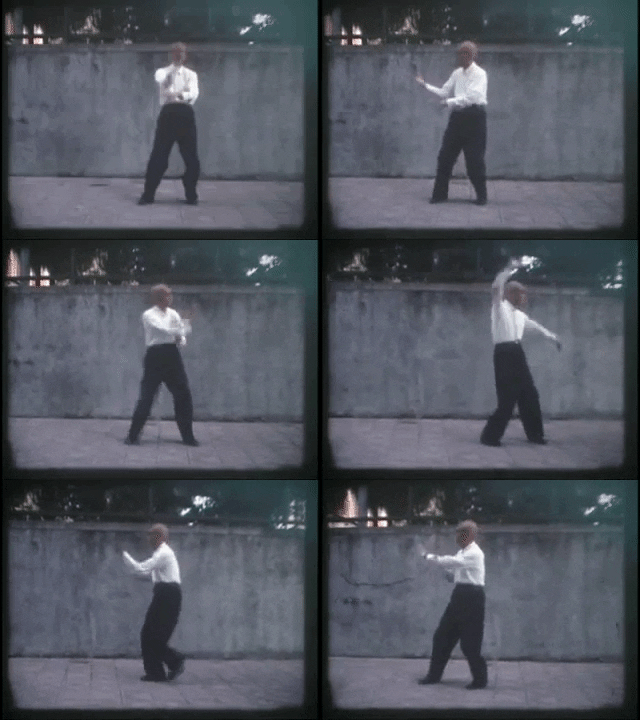
Below is a video, shot in 1977, of the Tai Chi form of Xiong Yangho who was a student of Yang Shau-Hou, the (much) older brother of Yang Cheng Fu. Born in 1862 he was effectively of a different generation than his brother Yang Cheng-Fu who was born in 1883, which is 21 years later.
You can see that the form follows the same pattern as the Yang Cheng-Fu version but has a few unique characteristics. Again, this hints that there were different ways of doing the form before Yang Cheng-Fu standardised it into “Yang style”.
These different interpretations are a bit like the Gnostic Christian gospels – they’ve been rejected from the main orthodox canon, but they have just as much validity as any ‘official’ version of the form.
The description reads:
“Taiji Grand Master Xiong Yang He (1889-1981) The Interpretation of Taiji Quan The Teaching Frame of Hundred & Eleven Styles in Taiji Quan Video & voice edited by Li Ri Xing 28th September 1977”
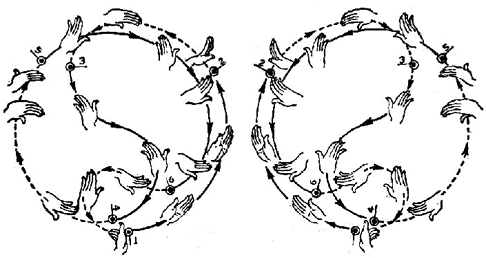
What’s particularly interesting is the second video, at 7.51 onwards, after the form has finished, he does what looks like a couple of silk reeling exercises in which he traces a Yin Yang symbol in a manner described in Shen Jiazhen’s book.
In the video Xiong Yangho then does some fast moves that look a lot like Southern Kung Fu – Pake Mei or Wing Chun, that sort of thing:
Edit: A comment on this post from Bai Yiming reveals that these are from another martial art called “Xiyangzhang”
“What Xiong Yanghe shows in the later vids has nothing to do with TJQ; those “5 little hands”, as they are called, originate form Xiyangzhang, another style. Xiong has cross-trained a lot and taught a huge curriculum. There is no Taiji symbol traced, it is purely an application. I know as I’m training in the Xiongmen, the Xiong system, do the Xiyangzhang and also those hand moves!”
Here’s a video of Xinog Yanghe doing some more Xiyangzhang:
Here’s another video of Xiong Yangho doing Tai Chi:
Originally from the mainland, Xiong Yangho was a military man who escaped to Taiwan with the nationalists once the Communists took over in China. There’s a short biography of him here.
Today’s Tai Chi tip is all about how to get better at push hands simply by adjusting your posture.
Push hands should really be an exercise in which we get to test our ability to absorb Jin from an opponent and project it into an opponent as required, to uproot them.
It shouldn’t devolve into a pushing and shoving match to see who can ‘win’. Once it turns into that then I don’t think anybody is learning anything anymore. There are far superior methods of grappling and I think you’d be better off spending your time learning those if your goal is simply to win a grappling exchange.
But before we can focus on using Jin we have to get our body in a position where it conforms to the Tai Chi principles of posture, where we’re not fighting it all the time, and it’s working to our advantage instead.
It is said, “Jin does not flow through tense muscles”
So, we need to get our body into a structural position where we can be as relaxed as possible, without collapsing, yet still maintain our connection to the ground. In Chinese terms you would call this a posture where your “qi is strong”, but you are not tensing muscles more than they need to be.
Of course, this optimum qi structure is one of the first things to go out of the window once we start push hands. In push hands we get to test our Tai Chi under a limited amount of pressure. Faults that lie dormant in the form rise to the surface like bubbles.
Here we’re going to go over a few.
1. Head position and leaning
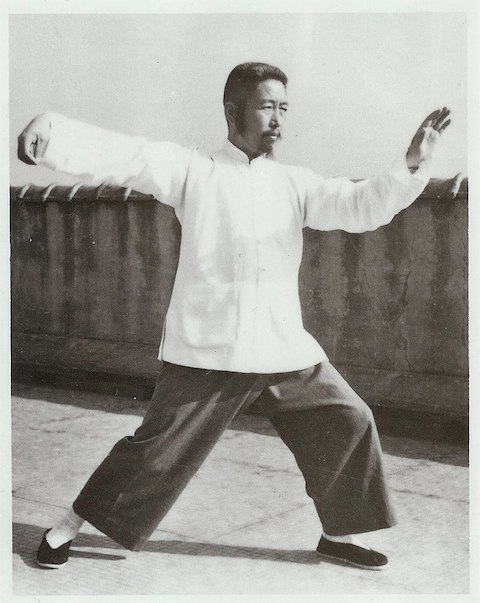
Head position in the form goes hand in hand with the issue of leaning. Some styles of Tai Chi, like Wu style and Yang Cheng-Fu’s Yang style, opt for a slight angling forward of the torso in forward-weighted bow stances. Other styles like Sun style, Chen style and Cheng Man-Ching style all keep an upright posture as often as they can, even in front-weighted stances. (See pictures below)
But the thing is, all styles are upright in their back stances (or should be). And even styles that maintain an upright stance, have to lean forward to do throwing techniques that take the person to the ground like Needle at Sea Bottom or Punch to the ground, for example.
Here are some examples of different Tai Chi practitioners:
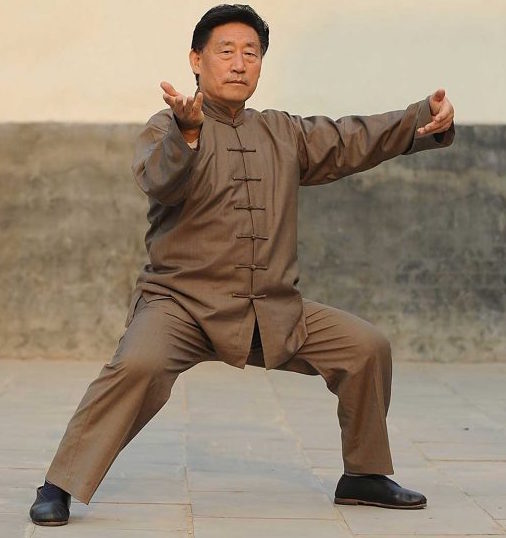
Chen Xiaowang, upright and stable.
Cheng Man-Ching, very upright.
Sun Lu Tang, no leaning.
A variety of postures from Wu Jian Quan, showing sometimes leaning, sometimes not.
Yang Cheng-Fu showing sometimes a slight leaning, sometimes not.
I think it’s time to get to the point of all this:
It’s not the lean itself that matters.
It’s maintaining an unbroken spinal alignment that is the key issue!
All these practitioners have one thing in common, they are not letting their heads droop, and they are not looking at the floor when they don’t need to.
For example, when even a practitioner who is famous for his upright posture does Needle at Sea Bottom, he or she bends forward, she just doesn’t break the alignment of the spine.
Needle at Sea Bottom
The Tai Chi classics talk a lot of carrying the head as if “suspended from above”. If you let your head droop you break the spinal alignment. You are easy to off-balance in push hands because your posture is broken. But if you hinge properly from the hips then you can still keep this spinal alignment even when you bend forward.
Think of the spine as including the neck (which anatomically, it does of course). If the neck goes offline in relation to the spine then the weight of the head has to be compensated by muscles elsewhere in the body. And this extra tensing of muscles results in a less efficient transfer of Jin from (or too) the ground.
Because we are quite used to this happening while standing or sitting, we don’t really feel our head being off centre so much. Switch to working on the ground, in a yoga posture for example, and you can instantly feel the difference your head position makes.
On a technical level, if you are using Jin you should be able to let the solidity of the ground be apparent at the point of contact with the opponent. If you have to use too much muscle then your pure Jin starts to turn into “Muscle Jin”. Muscle jin, isn’t as adaptable to change as pure jin. You can’t easily change direction, for instance. It also just doesn’t feel as it should. It might help you win a push hands competition, but you’ll find it lacking when it comes to martial technique.
And when it comes to the thorny issue of leaning, I’d recommend trying to stay upright in push hands. As I said before, the leans you tend to see in Tai Chi forms are to do with the application of a technique. Sure, you can lean to apply power according to a technique (just make sure you keep your spine aligned) but for the usual back and forth of push hands I’d recommend trying to keep as upright as possible. You’ll find it gives you more freedom of movement in the horizontal axis.
If you watch this clip of Wang Hai Jun doing some push hands with applications in it, you’ll notice that he’s staying upright during the push hands, but he’ll lean to apply a technique:
2. Shoulder usage
I posted before about learning how to sink in Tai Chi Chuan. One of the benefits of sinking is that you can be powerful yet relaxed at the same time. Again, this is a body requirement for the use of Jin. I don’t really care about relaxing the legs so much (although see point 3 later on) they key thing is making sure that all the tension of the upper body is dissolved down into the lower body.
You want to feel like your upper body is empty, while your lower body is full. “Hands like clouds, legs like mountains”, is a phrase that springs to mind.
The big stumbling block here is always the shoulder. Either we use our shoulder too much, and the movement becomes local and isolated from the rest of the body, or we don’t relax it sufficiently, and it becomes a blockage to the smooth flow of power from the ground that you’re looking for.
One really effective way of bypassing the shoulder in push hands, and relying more on sinking and the power of the ground, is to imagine a tube that runs from your hand, all the way up your arm, and down your back to the foot and the ground. Imagine another tube for the other side of the body. Now, when you want to move your arm, you have to move the whole tube. Start your power at the foot.
Over time, once you get the hang of it, it will become intuitive to start to direct your ‘tube movement’ from the waist area, and ‘moving from the dantien’ starts to become your preferred method of movement.
3. Using the back leg as a brace
Another trap people fall into is using the back leg like a brace, held stiff against the ground. Again, this leads to muscle Jin, not the relaxed release of power we are looking for. If you engage in the push and shove type of push hands you typically see at push hands tournaments then this is a great way to win. Unfortunately, ‘winning’ makes no difference if your goal is to get better at Tai Chi Chuan.
Don’t get me wrong, a little physical scrap like this is good for you now and again, and it’s good fun to push yourself physically! But these days I tend to let BJJ rolling get that all out of my system, so I can focus more on developing push hands skill in the right way when I’m engaged in push hands practice. .
So that’s a bunch of stuff you shouldn’t be doing. But what should you be doing?
I’d put forward the following 3 suggestions. This is just my personal opinion, of course.
1. Posture, posture, posture.
As you push hands keep your focus on your posture. Mentally note when you lean forward, note when you feel unbalanced sideways. Stop looking at the floor. Look at the horizon, through your opponent. Note when your feet aren’t flat on the ground. Where is your breathing? Low down or up in the chest? I count breathing as a posture consideration since it will affect your posture.
2. Sink.
I’ve said it before and I’ll say it again. Sinking is the key to changing from using Li to learning to use Jin. Learn to relax the upper body completely and drop your weight into your lower body, then use that to power your movements.
3. Listen.
Once you are relaxed and able to sink your weight (Sung in Chinese) you should start to ‘listen’ – Ting Jin in Chinese. This enables you to detect where your partner is weak in their structure. How just a little push here or there will send them off balance. That’s where you need to start experimenting in your attacks.
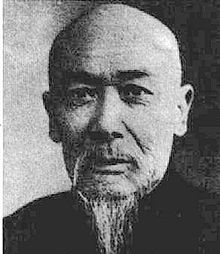
I found this video recently of an old gentleman called Mr Han practicing his Tai Chi form in the courtyard in front of the old house of Yang Lu Chan (the founder of the Yang style, pictured top left) in Yongnian County, Hebei province.
The video says he’s practicing Wu Yu Xiang’s (1818-1880, pictured top right) varient of Tai Chi, but I don’t find his performance particularly typical of that style as it is usually presented with much smaller stances than he’s using. It’s possible of course that this is what an ‘older’ version of the style looked like. It’s more similar to what we know as Yang style today.
The Wikipedia take on Wu Yu Xiang was that he was a “scholar from a wealthy and influential family who became a senior student (along with his two older brothers Wu Chengqing 武澄清 and Wu Ruqing 武汝清) of Yang Luchan. Wu also studied for a brief time with a teacher from the Chen family, Chen Qingping, to whom he was introduced by Yang.”, which I think is accurate.
It’s interesting that he learned from Yang LuChan, but also went back to try and find the teacher that Yang learned from, presumably, to find out details he was missing, or simply out of curiosity. It turned out that Chen Changxing (Yang’s teacher) said he was too sick to teach and instead referred Wu to Chen Qingping who was living in Zhaobao (赵堡) village, just down the road. He studied with him for a few months. The whole thing does sound a bit like a brush off to me.
Also, I think we can assume that Wu financially supported the teachers he learned from, since he was wealthy. Here we can see the birth of the Ching Dynasty idea that a martial artist could earn a living purely from teaching these arts.
Wu, and his brothers, allegedly found the documents we now call the Tai Chi Classics in a salt cellar, however, I’d say it’s much more likely that they are the authors of these documents (which are really just a collection of old martial arts sayings), given that they were wealthy scholars. Especially since they definitely did author some other writings on Tai Chi themselves.
Wu taught his nephew Li Yi-Yu, who in turn taught Hao Weizhen (郝為真; 1842–1920) who was the person who made the style popular, so it is often called Hao Style.
The video above is the sort of Tai Chi form I associate with Wu Yu Xiang’s style today, but if we go back to the video taken outside Yang’s house in Yongnian, the Tai Chi starts at 54 seconds. If you notice Mr Han’s performance looks a lot more like Yang style.
If anything I think this just shows that the further you go away from the source of something, the more it inevitably changes. Tiny little changes, amplified by time, end up with big differences in the end results.














 The Tai Chi Notebook