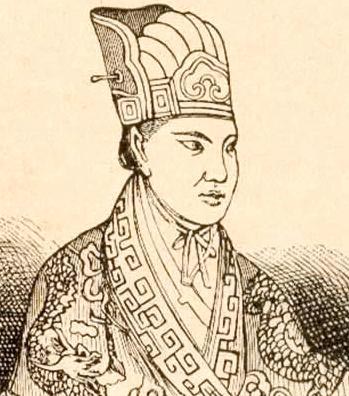
This is Hong Xiuquan, the extremist Christian who orchestrated the biggest and most bloody civil war in history, the Taiping rebellion. It happened around the same time as the American civil war, and shared a lot of similarities.
Hong Xiuquan
The Taiping’s had some previously unimaginable beliefs in China, like equality for men and women (women fought in their army, which reached a million people) and no private ownership of land.
From the Encyclopaedia Britannica:
Taiping Christianity placed little emphasis on New Testament ideas of kindness, forgiveness, and redemption. Rather, it emphasized the wrathful Old Testament God who demanded worship and obedience. Prostitution, foot-binding, and slavery were prohibited, as well as opium smoking, adultery, gambling, and use of tobacco and alcohol. Organization of the army was elaborate, with strict rules governing soldiers in camp and on the march. For those who followed these rules, an ultimate reward was promised. Zeng Guofan was astonished when, after the capture of Nanjing, almost 100,000 of the Taiping followers preferred death to capture.
Under the Taipings, the Chinese language was simplified, and equality between men and women was decreed. All property was to be held in common, and equal distribution of the land according to a primitive form of communism was planned. Some Western-educated Taiping leaders even proposed the development of industry and the building of a Taiping democracy. The Qing dynasty was so weakened by the rebellion that it never again was able to establish an effective hold over the country. Both the Chinese communists and the Chinese Nationalists trace their origin to the Taipings.
We believe these historical events contributed directly to the creation of Taijiquan. Without the Ching court being rocked to its core respected Confucian court officials like Wu Yuxiang and his brother would not have even interacted with a low-level martial artist like Yang Luchan. But the Taiping rebellion was not the only crises happening in China at the same time. A dynasty can survive one crisis, but several at once? No chance. The Yangtze river flooded leading to a catastrophic famine and loss of life and the British and the French started the second Opium war. There was also the Nian rebellion in the North.
The Taiping’s were eventually defeated with help from the Mongols and British. (The British wanted to sell opium, to sustain their empire and the Taiping’s were against that). If the rebellion had suceeded, just imagine the different China that would have emerged.
We cover all this in the 3rd part of your history of Taijiquan, and the crucial moment when the Wus first meet the Chens:
In this episode we look at how the effects of the Taiping Northern Expedition and the Nian Rebellion of the mid Nineteenth Century drew the confucian Wu brothers and the fighters of Chen Village towards each other for the first time.
Ok, here it is, part 2 of our history of Tai Chi Chuan. In this episode we examine the context in which the relationship between Yang Luchan, Wu Chengqing and Wu Yuxiang developed during the years of the Taiping Rebellion and the new regime of Emperor Xianfeng.
Looking back over the last few blog posts I’ve written it occurs to me that a reader might think that I don’t actually like Tai Chi Chuan. I do. I practice it pretty much every day. There’s something in it that is just very good for you. Before practice I feel a bit unfocussed, and uncoordinated. After practice I feel like I’m back “in the zone”, and that’s a rare thing for any practice to deliver as consistently as Tai Chi does. And it always does.
If I contrast that with Jiujitsu (something I also love, or at least used to before this lockdown started), after that I’m an exhausted, sweaty mess in need of water and recovery. Jiujitsu is a lot of fun, but it breaks you down. In contrast, Tai Chi builds you up. You need both together. I’ve always practiced my Tai Chi with other more physical arts anyway. More dynamic things, like Choy Lee Fut or Xing Yi are great compliments to the relaxed, slow Tai Chi movements.
One of the reasons I criticise Tai Chi a lot is that it does have the most abysmally low standards amongst its practitioners of any martial art you’ll ever see. In fact, it’s a martial art that most people don’t actually practice as a martial art!
Regular readers to the blog, or regular listeners to the Heretics Podcast, will know that we recently started a series on “The Myth of Tai Chi“. Again, it sounds like it’s a bit of a negative attack on Tai Chi, but anybody with even a cursory understanding of Tai Chi history will realise that a lot of it is vague, unknown and contradictory, especially for a period of time (1850s onwards) in which other martial arts (like Xing Yi) have no confusion over their history and lineage.
Episode 1 of the podcast takes into account all the other things that were happening in China in 1850, and there was a lot! It was a period of turmoil that was about to become even worse with the most bloody civil war in world history – the Taiping Rebellion – which left an estimate 20 million dead. (If you’d like to know more about this and the various martial arts that were created around the same time period, like Wing Chun and Choy Li Fut, then I’d recommend Benjamin Judkin’s excellent book Creation of Wing Chun, The: A Social History of the Southern Chinese Martial Arts – it’s by far the best Chinese martial arts history book I’ve read).
The best Chinese martial arts history book you’ll ever read!
Now the scene is set, episode 2 (coming soon) will offer more definite conclusions on the origins of Tai Chi Chuan, but there’s still so much left to talk about that this will soon become a mult-part story. You might want to empty your cup before you listen though: Damon’s conclusions on what Tai Chi really is are not particularly favourable for any group trying to claim ownership of the Tai Chi brand – the Chens, the Yangs, the Wus the Taoists or anybody else. You’ll have to wait until episode 2 is released in the next few days to find out what the big reveal is!
But until then, just a little reminder that I do actually like Tai Chi Chuan (honest!), despite appearances. And regardless of its origins what matters is its actual practice. Learning about history won’t make you any more or less skilful, only practice will do that.
The 98th Regiment of Foot at the attack on Chin-Kiang-Foo (Zhenjiang), 21 July 1842, effecting the defeat of the Manchu government. Watercolour by military illustrator Richard Simkin (1840–1926).
The history of Tai Chi Chuan (Taijiquan), rather than its actual practice, is one of the most controversial subjects to do with the art. Various different groups have tried to claim Tai Chi as their own, and considering the amount of money involved in the art it’s very hard to know who to trust in this matter.
In this podcast we’ve tried to look objectively at the facts, and the result is that it doesn’t look good for anybody, especially the British 🙂
The history of Tai Chi Chuan is a subject I’ve wanted to tackle on our podcast for a while, but now (thanks to one of our patreons, Gabriel) it’s finally a reality.
In this episode we begin a new series of episodes on this subject by setting the scene and historical background to the mythmaking around the origins of Tai Chi that occurred starting from the middle of the Nineteenth Century in response to social turmoil and unrest exemplified by the Taiping Rebellion and Opium Wars.
We all have blind spots. If you went outside and did your Tai Chi form right now I can guarantee you there’s a bit of it that you’ve never really paid attention to. I don’t mean something big, like a whole movement, but there will be lots of little spots which you’re glossing over your form without full awareness.
Try this as an exercise: Go through your Tai Chi form right now, but as you do each posture pay attention only to the way the joints of the body open and close. But here’s the thing – I’m not saying, make them open and close.
This is a crucial difference. If you try and make them open and close you just end up ruining your form, or being “too physical” as my teacher likes to say. Just use your awareness to be the silent observer of yourself as you do the form. And try and focus that awareness on the way your joints are opening and closing. Pick the easy ones to start with – the shoulder/hip, elbow/knee and ankle/wrist relationships. Try and see if you can maintain awareness of all 3 pairs and how they open and close as you move through the postures. The postures, done correctly, are designed to allow them to open and close – there’s nothing extra you need to add. If that’s too much too mentally juggle at once then just pick one pair to be aware of for the entire length of the form. Shoulders and hips is a good one. There are many more ‘joints’ to be aware of, of course, but that will do for now.
I don’t want to spoil the experience for you, so if you’d like to discover what this training method can do for yourself, then stop reading here and come back when you’ve done it.
Remember that joke – ‘Don’t think of an elephant’? This picture reminds me of that. 🙂 Photo by Pixabay on Pexels.com
Still with me? Ok, let’s go on…
What I find when I do this is that the simple act of being aware of something changes it, without me having to do anything. For me, this exercise highlights the areas of the form that I’ve been glossing over, and from that awareness, a new form begins, one that is more complete and better.
As the great Taoist sage Lao Tse wrote:
10
Can you coax your mind from its wandering
and keep to the original oneness?
Can you let your body become
supple as a newborn child’s?
Can you cleanse your inner vision
until you see nothing but the light?
Can you love people and lead them
without imposing your will?
Can you deal with the most vital matters
by letting events take their course?
Can you step back from you own mind
and thus understand all things? Giving birth and nourishing,
having without possessing,
acting with no expectations,
leading and not trying to control:
this is the supreme virtue.
In fact, that’s just one example, the whole Tao Te Ching is full of the benefits of this sort of Wu-Wei “non-action”.
These blind spots in your Tai Chi are usually found in the transitions between what we think of as “postures”. The in-between bits. The space between the notes, as the great French composer Claude Debussy famously said, was where the music is found.
This discovery poses an interesting question not only for your Tai Chi, but for your life too. Where are your blind spots? What are you not really paying attention to? I think you know what to do now.
This podcast interview of Mark Chen by Ken Gullette is a real gem. If you haven’t listened to it before I’d really recommend it. It starts with a basic run-through of who taught who and in what order, and who all these people are, but then gets really interesting about halfway through when it talks of some of the more heretical things, like what happened during the utter insanity and madness of the Cultural Revolution in the 1960s. A period which is ignored by almost all Chinese martial artists. It’s just something that is not talked about these days – almost a non-subject, and those non-subjects always fascinate me.
There is also a section on the famous “Peng Lu Ji An” list used to describe the “powers” of Taijiquan, and the characters used. There are also some good thoughts about Taijiquan training and what Taijiquan is really all about. Overall this is an excellent podcast and shouldn’t be missed by anybody.
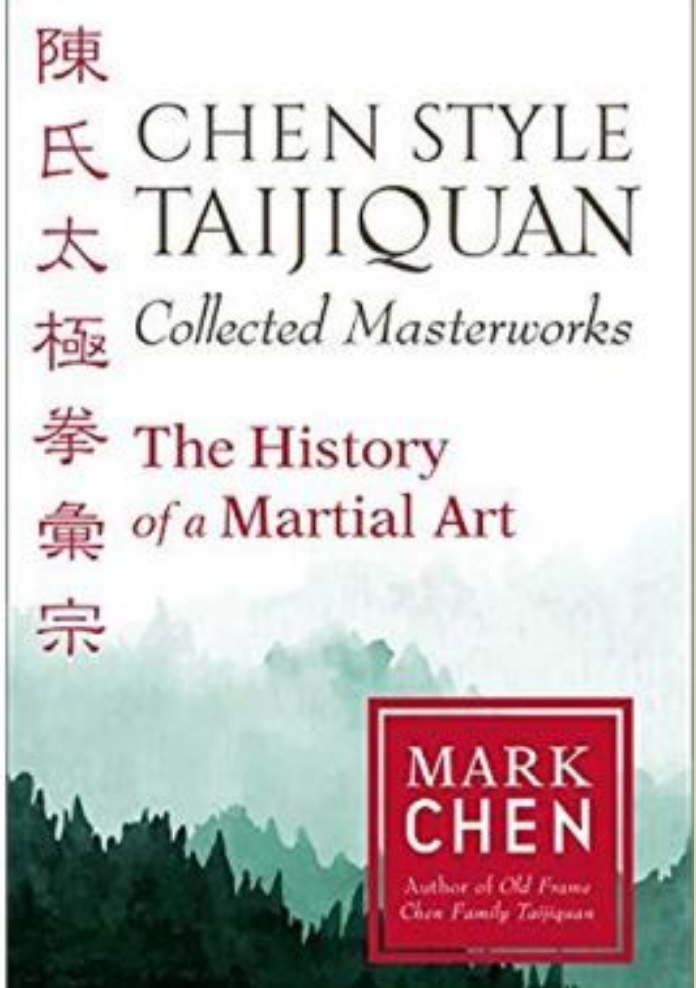
Mark’s book is a translation of most of the book by Chen Zhaopi’s book, published in 1935 and is available on Amazon in print and digital formats.
I’d like to point you to an excellent article by Sascha Matuszak on the Ming Dynasty General Qi Jiguang. In his 1560 book Jixiao Xinshu (“New treatise on disciplined service”), which contains a chapter called “Quanjing Jieyao Pian” (“Chapter on the fist cannon and the essentials of nimbleness”). This chapter is famous because it contains the first written reference to Kung Fu written by a military person.
“There is a lot of speculation as to why Qi Jiguang included martial arts in his military treatise, but it is most likely that several trends converged to make including martial training a sensible thing to do. A few of them would be the rise of taijiquan during the late Ming Dynasty, the superior close combat skills of Japanese pirates, an incredible lack of disciplined, trained Chinese troops, and Qi Jiguang’s own experience training martial arts and developing farmers into soldiers.” – Sascha Matuszak
While I love the article, I’m puzzled by the inclusion of the rise of Taijiquan as a reasoning device for the inclusion of the chapter on kung fu, since 1560 was three hundred years before anybody had even heard of Taijiquan. The great populariser of Taijiquan, Yang LuChan died in 1872.
Interestingly, the chapter written by General Qi does contain references to some things that crop up in Taijiquan centuries later… Does this sound familiar to Yang stylists?
“The Golden Rooster: stand on one leg and cock the head askew.”
“Golden Rooster stands on one leg” is a well known Taijiquan posture.
“The Ambush Crouch posture: it is like using the hunting bow to lie in wait for a tiger;”
I’m thinking of the posture known as “Bend the bow to shoot the tiger”, also found in Yang style Taijiquan.
“Change to a lower position and momentarily take the single whip stance”.
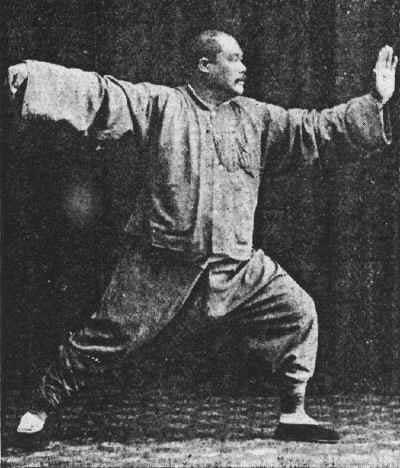
Yang Cheng Fu showing Yang style Taijiquan “Single whip”.
While Qi seems to have a love/hate relationship with Kung Fu, it’s interesting to note that Qi incorporated “Chinese individuals capable of acrobatic performance including boxing instructors and Buddhist monks” into his army to meet the challenge of fighting Japanese pirates, who were much better versed in close-quarter combat skills than uniformed Chinese soldiers.
In chapter 14, he makes criticisms of the existing martial arts of the time as being too specialised, and that by combining them you can cover all bases better. My feeling is that although he does say he engaged in training at Liu Caotang’s Striking Fists school, he’s a military man, an outsider looking at civilian arts he isn’t involved with personally or practices, so you get an interesting perspective.
He’s continually judging what is credible and what is not – something that continues to this day on martial arts forums on the Internet!
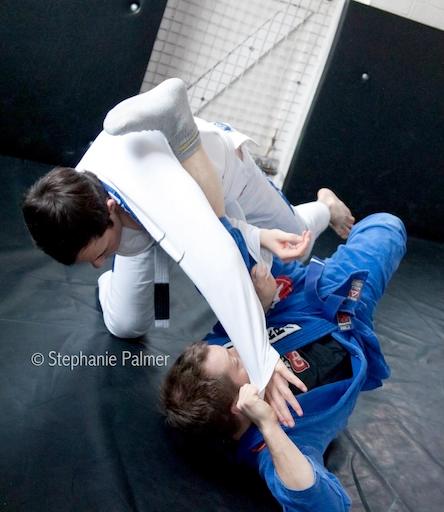
I was reminded recently of a blog post I wrote for Cook Ding’s Kitchen a few years ago about starting BJJ after years of doing Tai Chi. I just re-read it and decided it was ‘not too bad’, so I’m sharing it again here.
Here’s a quote about my first time sparring in BJJ.
We fist-bumped again and went for round 2. He then proceeded to act out a BJJ clinic on me. He was tapping me out using every sort of conceivable lock or choke hold I could think of at a rate of one tap every 2 minutes. And worse, he wasn’t even trying. I quickly realised he’d let me tap him the first time just to see what I could do. This went on for the full 30 minutes. It wasn’t a matter of being out-muscled – it was clear that he possessed a knowledge that I didn’t. I wanted to lie down, curl up and die after about 10 minutes, but something in me refused to give up and I lasted until the end of the class. The black belt running the class was keeping an eye on me, and expressed some concern about the curious wheezing noises my breathing was making and asked if I’d like to sit out, but my pride wouldn’t let me. I kept going until the end. It took me about 2 days to recover fully. My next class was the same, but this time the blue belt I fought was a smaller female, who repeatedly jumped on my back and tapped me out with chokes until time was up.
That was it, I was hooked.
There was a type of knowledge here I could learn, and it worked in a fight, and it didn’t matter if the other person was stronger than you. There were no forms, deadly techniques or imagining ‘what if’ scenarios. You were hit by reality from the first fist bump.
A new video in the long line running ‘Tai Chi master vs MMA guy’ series got posted the other day. Rather than talk about it here straight away I wanted to see what the reaction was from the martial arts community, and boy, it didn’t disappoint!
This whole MMA vs Tai Chi genre was started by the now-infamous Xu Xiaodong who posted the first video showing what happens when a delusional Tai Chi “master” gets in a fight with an MMA guy.
The qualifications for being a “Tai Chi master” these days seem to be that you have:
1) The backing of Chinese state TV, who will post lots of faked videos of you performing magical martial skills.
2) You have a sufficient number of minions and followers to do you bidding.
3) You look the part (silk pyjamas) and have can talk a good talk about your abilities.
Of course, none of these martial abilities are grounded in reality, so when you get in a challenge match with an MMA guy it usually ends quickly and badly for you. Chinese martial arts, particularly Tai Chi, is the focus of the soft power emanated by Beijing and the hyper-nationalistic Chinese government on the global stage. Therefore, publicly humiliating a Tai Chi “master” doesn’t make the MMA guy very popular in China, and Xu Xiaodong has been badly persecuted – his social credit score is now so low that he can’t even travel on trains and his social media accounts keep being deleted.
After the initial video of Xu Xiaodong surfaced he didn’t let the persecution put him off and he kept calling out the masters boasting of their skills on state TV. Challenge after challenge followed. One involved self-proclaimed Tai Chi/Xing Yi Master Ma Bao Guo who had previously paid a retired cage fighter Peter Irving in the UK to perform in a demo video that made him look good, and was boasting that this video was proof he was the real thing.
In this excellent article, Peter recounts the story behind the video.
Here’s the video:
To anybody that knows anything about fighting it’s obvious that Peter is just feeding attacks to Ma who reacts with some twitching responses. The fact that some people thought this was real says a lot about the mentality of minions and followers.
Xu and Ma’s challenge match was all set to go ahead (and would have ended the same way as all the others) but Ma actually called the police on his own challenge match and it was called off!
But Ma Bao Guo wasn’t giving up. At 69 he recently got in a challenge match with a San Da (Chinese kickboxing) guy who was 20 years younger than him. Here’s the video of Ma Bao Guo vs the San Da guy
As expected, it was a shocking display of ineptitude, and as I said, the reactions of the martial arts community have been interesting. Here are a few of the common responses I noticed:
The rebranding of this as MMA vs Tai Chi to fit the narrative.
The fight is actually between two practitioners of Chinese styles – one is Tai Chi/Xing Yi and the other is San Da, which is a homegrown Chinese kickboxing style. But it instantly becomes “MMA” because it fits the story created so far.
“The Chinese have absolutely ruined kungfu.” Hard to argue with this really.
Concern for Ma’s safety.
This was my first thought – getting knocked out like that at 69 could have been fatal, and will likely have long-term effects.
He needs to be sued for fraud.
I wonder how many minions and followers he convinced of his nonsense over the years? I wonder what they think of his teachings now? If they gained health benefits are they now invalid?
Why don’t those Kungfu guys that angrily complain about the fraudulent masters’ performance themselves step up to make Kungfu great again?
It seems like a bit of false reasoning to me. I think the point is that if you are going to claim abilities then you need somebody to test them. Perhaps you need to be more realistic about what you claim? The reason Xu is not challenging 20-year-old kickboxers, is that they’re not claiming magical abilities on state-run TV. And also, it’s usually the old masters doing the challenging!
“I look at someone getting beaten and it has little to do with me or my training.”
True – exposing the delusional Tai Chi masters doesn’t mean that Tai Chi itself is delusional. If you are honest about what you can and can’t do, then that’s a good thing.
But then we get to number 7, and this is the one that really gets my goat…..
7. “It says a lot about those that post these clips.”
What???
Aiming your ire at the guy lifting the curtain to show a little old man, not a wizard, behind it is something you’d attribute more to the mad emperor Nero, (who had a habit of shooting dead the bearers of bad news) than the sane and balanced mind of Marcus Aurelius, one of the last ‘good’ emperors of Rome.
The event was done publicly. There were press there with cameras. Ma had clearly arranged for this to be broadcast. And I can bet if (by some miracle) Ma had actually defeated the San Da guy, then heralds of his victory would be celebrated far and wide by everybody who purports to be a Chinese martial artist.
Stop trying to shame people for exposing the bullshit.
You can’t have it both ways. If you do something sportive and public then it remains pubic, regardless of whether you like the outcome. The point of challenge matches is to see what works. Part of the appeal of MMA for me is that it’s on one hand sport, but on the other a long-running public education project about what works in fighting.
I can already feel the voices of those “MMA is not for the street!” guys building as I write this, but you know – screw them. A good answer to that is that if you can’t make your art work with a limited rule set that simulates a real fight as closely as we can make it, how are you supposed to make it work when the other guy isn’t even restricted by those few rules?
San Da, boxing or MMA is a young man’s game. Old masters of whatever martial art it is should really stop trying to engage in it altogether. Putting yourself in a position where you can get knocked out cold at 69 years old is just a terribly bad idea. The implications for what remains of your life are serious. There’s a reason that Muay Thai fighters’ careers usually end in the 20s.
The whole thing was folly.
Ma was delusional for
Thinking that whatever martial skills he had gained from a lifetime of pushing minions, followers, and paid performers, around while wearing silk pyjamas could actually translate into real fighting skills.
Thinking that you could do this at 69 years old.
But human beings are delusional. And in normal life, we can get away with it up to a point because there are no serious consequences. I talked about this in my recent interview on the Martial Arts Studies podcast. My point was that nature is not delusional, which is why the Song Dynasty had such success economically and military thanks to the Li Movement, which aimed to get back to looking at nature for what it is, not what we think it is. That was the point I was making about studying animal methods (that I don’t think my interviewer quite picked up on) that a snake does what a snake does regardless of what human beings think about it, or even better, with no human beings around at all.
Similarly, MMA or San Da or challenge matches bring martial artists into direct contact with nature, or reality, if you like. And sometimes that can be a painful act of recognition.
It should be celebrated, not turned away from. Look it full in the face and learn. As the old martial arts saying goes:
“In martial arts you either win or you learn.”
It’s probably not a good idea to wait until you’re 69 to start learning.