When it comes to tai chi, buyer beware

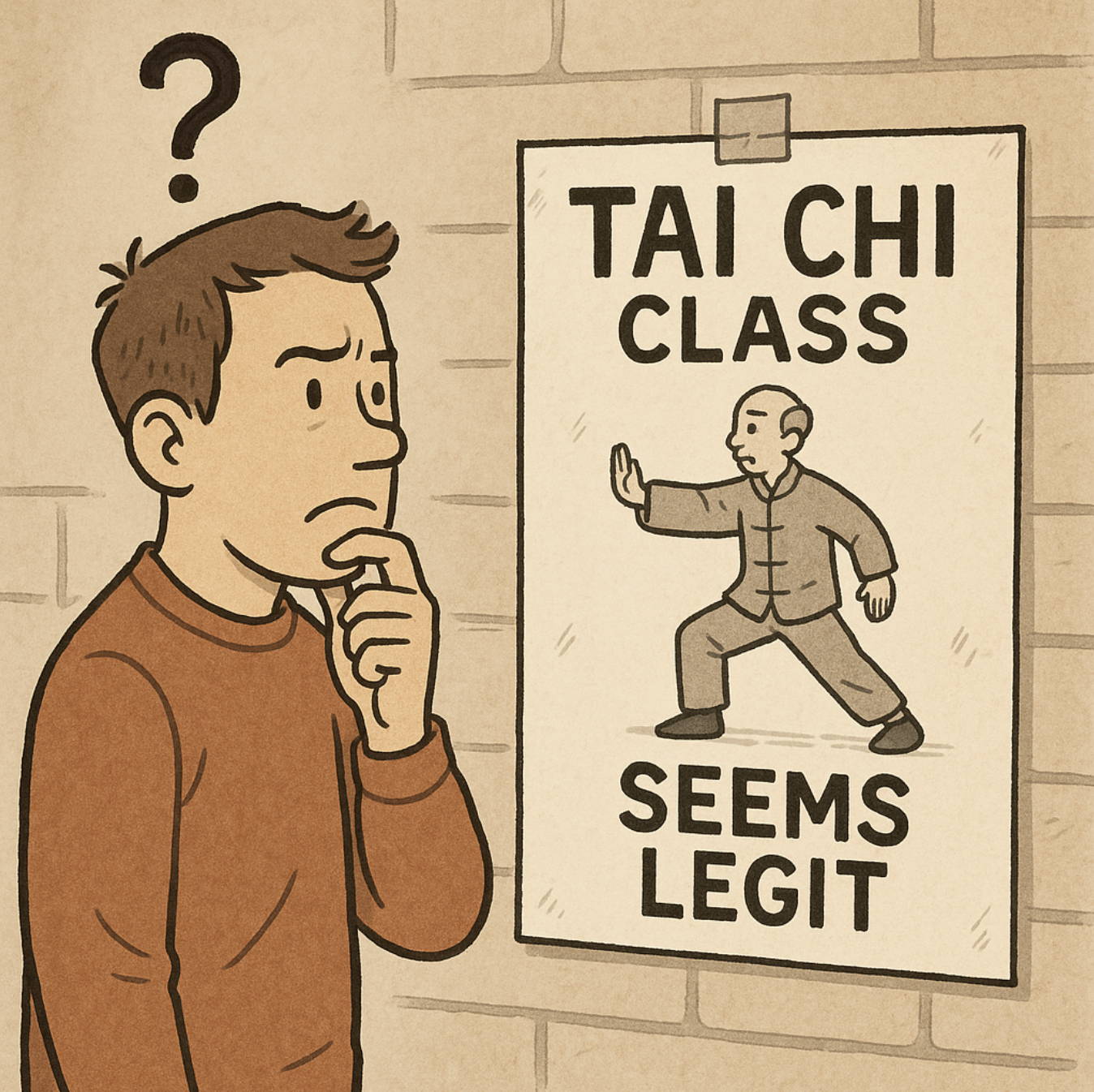
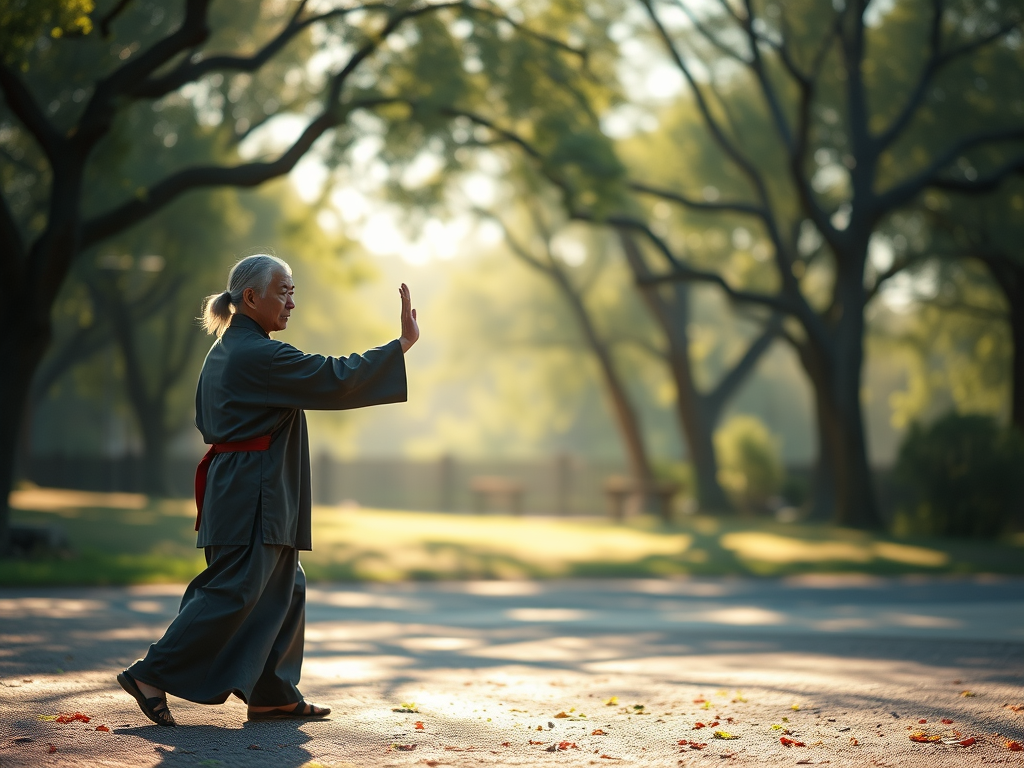
(FYI: Image made with ChatGPT)

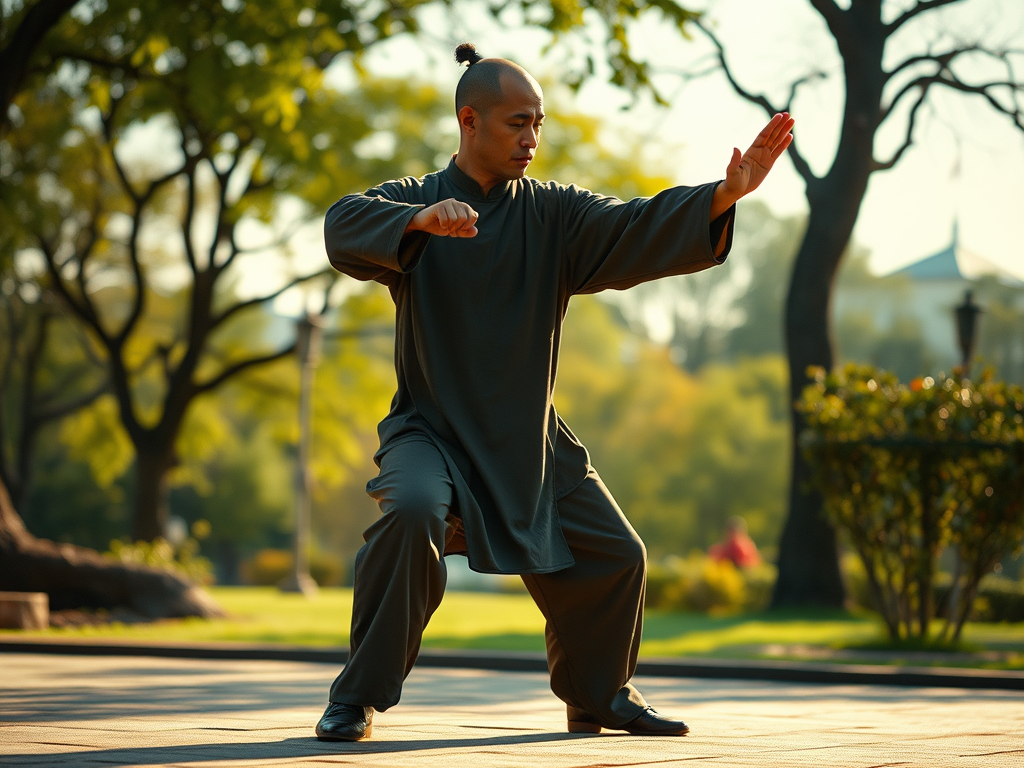
I just saw an advert for a week long “Tai Chi for beginners” intensive with the teacher in question demonstrating a tai chi posture with the head thrust forward, so the chin juts out, the hips and pelvis thrust forward so it looks like he’s doing a bad Elvis impression, the arms awkwardly twisted so the shoulders lock up and the souls of the feet rolling to the sides and coming off the floor, so the ankle joint is not stable.

And yes, he was calling himself “Master”.

I think “buyer beware” is good advice in the tai chi market.

One thing I’ve observed in so many tai chi teachers is this desire to be the teacher way before they are ready. People don’t want to be the student – that’s boring! – they want the glory of leading something, of creating something, of being the person at the front of the class sharing their vast wisdom with their adoring students…

Why is this? I think it’s just ego. I’ve definitely felt it’s twinges in me. It’s a subtle trap that you need to avoid. And one I try actively to avoid all the time when I teach.

It is undoubtedly a nice feeling when people ask you for advice, and look up to you. However, I think it’s nearly always a mistake to want to be that person. People are rarely ever ready to teach tai chi when they start. You could say it’s the curse of tai chi in the western world. That’s why we have people called “master somebody” who can’t do basic tai chi postures or understand tai chi movement leading week-long intensives.

But what do we do about this? After all, somebody has to teach something or there would be no tai chi for anyone!

Perhaps some guidelines if you are teaching:

1. Think of yourself as a coach, or a guide, not ‘a teacher ‘master’. After all, people need to do the work themselves, you can’t do it for them.

2. Don’t let people start to treat you like some guru or master – if they do instantly stop that behaviour developing. You’ll be surprised, a lot of people want a guru to take away all their self responsibility.

3. Self reflect. Are you constantly talking about things you can’t actually do? If so, just stop. There’s never any need for that.

4. The most important thing: Be honest. Tell people what you know, how long you’ve been training, where you got it from. Don’t make yourself into something you’re not in other people’s eyes.

5. Finally, you also need a teacher. Find people you can learn from and don’t stop learning.
Tai Chi and the art of occupying the other’s space

You can think of the Tai Chi form as an exercise in claiming your space. We rarely think of the space we occupy or move around in as part of ourselves, but it is. We often let others take our space, or give it away needlessly. We move out of the way when people walk towards us in the street. Rarely do we stand our ground and own the part of the earth that is directly underneath us.

In tai chi push hands we learn to claim our space, to gently redirect people that want to come into it and also to take away other people’s space if we need to, and not let them get it back. In the tai chi form we learn to round out our movements, so that (as the classics say) there are “no hollows or projections” in tai chi. Your goal is to create a kind of sphere with your body, as if you were inside a giant beach ball. Your hands extend to the limits of the ball, and no further.

Finding your centre

In tai chi there is ‘finding your centre’ within yourself, but there is also ‘finding your centre’ when in contact with another person. When two people are in contact, especially if engaged in some form of conflict, they are rarely both in balance, usually the advantage lies with one person or the other. The one in control is usually the person who has made both people part of their ‘centre’. Viewed from above, they become the centre of the circle, around which the other person is orbiting.

In class today I was working on the ward-off posture. I think by far the best way to think about ward off, as a martial posture, is to think about having just slipped a straight punch over your right shoulder by moving your head and turning your body to your left, you then step diagonally into the space occupied by the other person, right under their armpit using the familiar ‘ward off’ posture to keep them off balance. You need to keep that full, rounded, ‘peng’ aspect to your arms here, and once you have them off balance, you never retreat or give up the ground you’ve taken. If you do then you’re simply giving them their balance back. You need to keep them off balance continually, so that they can’t recover and they end up open to strikes or to being knocked over.

That ability is one reason why, while strikes exist in Tai Chi, they’re not really emphasised in the form. Instead, in the form you’re continually learning how to take ground from the opponent and occupying it while remaining in balance. As a means of self defence, it is highly effective, but not easy to understand without feeling it, which is another reason why so many people are confused about how Tai Chi works as a martial art.


You can train Tai Chi with me in Bath/Bristol, and get better at standing on one leg, twice a week.


Listen to a podcast about this blog post.


Thank you for supporting The Tai Chi Notebook. If you are reading this on a website that isn’t thetaichinotebook.com, then it’s highly likely it’s been stolen. Please let me know so I can issue their webhost a DMCA takedown notice for copyright breach. Thanks. And if you have the great idea of starting a tai chi website by stealing other people’s work to fill it with content for clicks then take a good hard look at yourself, and do better.


How most people get Tai Chi breathing wrong

“Stop doing the wrong thing and the right thing does itself.”

– F. Mathias Alexander.

Breathing has become a hot topic these days. There’s Wimm Hoff with his patented breathing methods for overcoming extreme cold all over TV and YouTube, breathing classes have sprung up in every town where you can go to where you spend an hour focusing on your breath (just type in the town you live in an ‘breathing classes’ into Google and I bet you find something), and of course, there still are all sorts breathing methods you can find out there in yoga, tai chi and qigong classes.

Often in Tai Chi we’re told that we should be performing abdominal breathing, or ‘Taoist breathing‘ – so, as you breathe-in the abdomen should expand and as you breathe out, the abdomen should contract*. We equate this abdominal breathing with deep breathing – almost as if the more we can ‘fill’ our abdomen with air, the deeper and better the breathing will be – and think that it therefore must be healthy. (* there is also reverse breathing, but that’s another topic).

Just breathe! (Photo by Spencer Selover on Pexels.com)

How to breathe

I recently started reading the excellent book ‘How to breathe’ by Richard Bennan, which has made me reconsider the way I’ve been approaching breathing in Tai Chi.

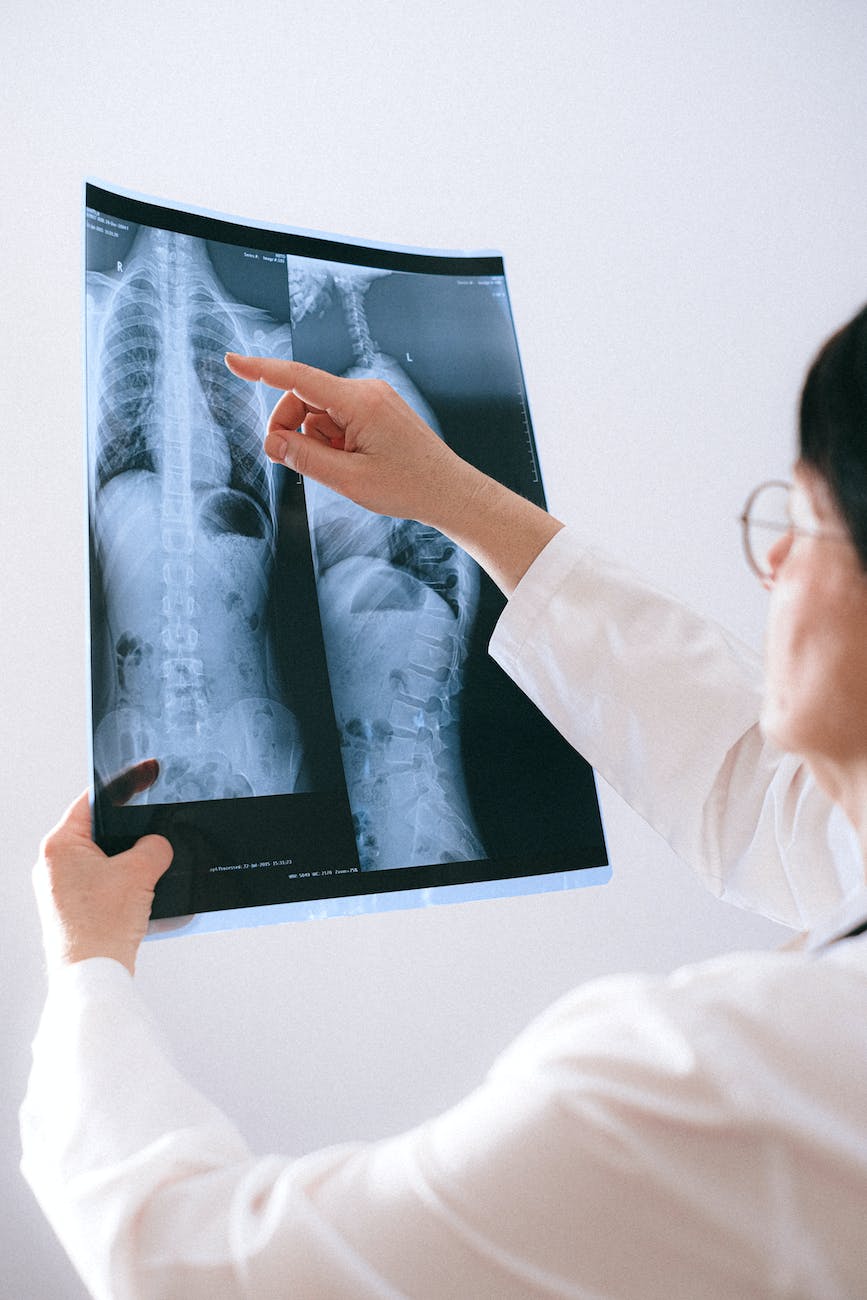
Firstly, let’s start with the basics. It’s worth remembering where your lungs are. They are behind the ribs and reach up higher than the collar bones on each side. Look at the picture below and you’ll be surprised by how far up the lungs go. So, when you expand your belly on an in-breath the air isn’t going down into your belly – it all stays in your upper torso. Of course, that might already be obvious to you, but you’d be surprised how many people think their belly is filling with air when they breathe in! It’s not.

Photo by Anna Shvets on Pexels.com

When you practice ‘belly breathing’ what you should be doing is expanding the whole torso on an in-breath, and it’s this expansion of the lungs and the dropping of the diaphragm that pushes the abdomen down and outwards (on all sides, not just the front). If you start to try to use your abdomen muscles to lead the process, or force-ably expand or contract the belly as you breathe in and out then you are just adding tension to the whole process, which is the exact opposite of what you want. There should be as little tension as possible for efficient breathing. Trust the process – it will work on its own.

So, with me now, try an in-breath and focus on the lungs themselves filling up and expanding and this wave of expansion being the motivating force for expanding the belly. It doesn’t really happen in a step by step way either – everything expands at once. So, don’t try to fill one section of the torso, then another, that is also just adding tension. Equally, don’t try and keep the ribs still. They are designed to expand and contract with the lungs. If you try and keep them still, then, you guessed it… You’re just adding more tension.

Once you can visualise where your lungs are, (and how far up they go above the collar bones), then just focus on letting them expand freely, and stop interfering with the breathing process. Less is often more.

You might also like to think about the posture requirements of Tai Chi and what effect these might be having on your breathing. We often hear words like “round the shoulders”, “lift the back” and “hollow the chest” in Tai Chi. Think for a minute about what effect those directions, if followed literally, might be having on your breathing. Do you think they are beneficial or harmful? It’s something to consider anyway.

Breathing should feel amazing. It should feel smooth, natural and healing. And it will, if you stop interfering with it.

* I think reverse breathing is a deliberate hack to the body’s natural way of breathing, but I don’t think people should be attempting it before they’ve got better at breathing in a natural way first. If you are already breathing in an unnatural way, and then you try and add on something else, well, it doesn’t take a genius to realise that you’re headed for long term problems.

Rewire your brain in six weeks – the benefits of meditation

There’s an interesting article on the BBC website about how a six week mediation programme (that you can access free online) can produce measurable changes in the human brain. It’s interesting, but does end with the disclaimer that “A final note of caution – it is important to acknowledge that any brain changes we had seen could also be random“.

Photo by Mike Bird on Pexels.com

Tai Chi beneath the surface

As we approach the holiday season, stress starts to enter the body and mind, family dramas intensify and it’s easy to forget the simple things in life. That’s where Tai Chi can help.

The question of what use Tai Chi or martial arts are to modern life comes up frequently. Unless you’re in a job that requires frequent encounters with violence most of us will live our whole life with minimal exposure to violence.

So what else can martial arts offer? This short film by Pamela Hiley shows some of the meditative sides to life that Tai Chi can reveal, where questions resolve to silence and are answered by nature.

“True to Life’ is a cinematic essay portraying the spiritual ideas of Pamela Hiley, a Welsh born Taiji master living in Norway. This is an exploration of Taoist philosophy, seen through her eyes, with very little factual information apart from ideas on the transcendent mind: breathing, balance, defence, neutralisation of conflict and moving beyond polarity. We follow Pamela on a trip to China where she meets with masters and students of these ancient arts – they love and share a deep respect for the mysteries of their common practice. But this film is not about a journey in the physical world, but rather trip into the the inner landscape of the mind.”


My FREE 8-week Tai Chi Notebook course has launched!

Good news! I’ve started filming a short 8-week Tai Chi Notebook course, and you can get it here, for free.

As usual things come together by chance (or maybe a it’s fate) but either way, a friend asked me to show them how to do “this internal stuff“, so I was about to shoot them a simple video on the basics, then I realised that there’s too much to cover in just one video, so I planned out 8. Then I started to get creative and made it look a little bit professional, and the end result is what  you’ve got here – a short YouTube course called Pulling earth, pushing heaven.

In week 1 of the course we cover the concept of “maintain and extend”. Each week will focus on a different aspect until we get to the point where you’ve got the basic idea of “Tai Chi movement”. Of course, this is just ‘foot in the door’ stuff, but I’d like to think that after following along for 8 weeks, and doing it every day, you’d at least have the correct foot inside the correct door. Look out for part 2 next week.

How to use Taijiquan to heal anxiety

meditation-2214532-1140x641

Writing for Jetli.com is taking up more of my free time, so I haven’t posted too much original content here, but I guess I’m waiting for the muse to find me before I do.

In the meantime, here’s my latest article for Jetli.com

How Wushu and TaiJi Serve As a Path to Mindfulness to Heal Anxiety and Stress

There are so many technical aspects to Taijiquan, that it’s easy to forget to simply breathe and enjoy the practice, keeping that awareness of the breath as you go.

“If you are depressed you are living in the past.

If you are anxious you are living in the future.

And if you are at peace you are living in the present.”

– Lao Tzu.