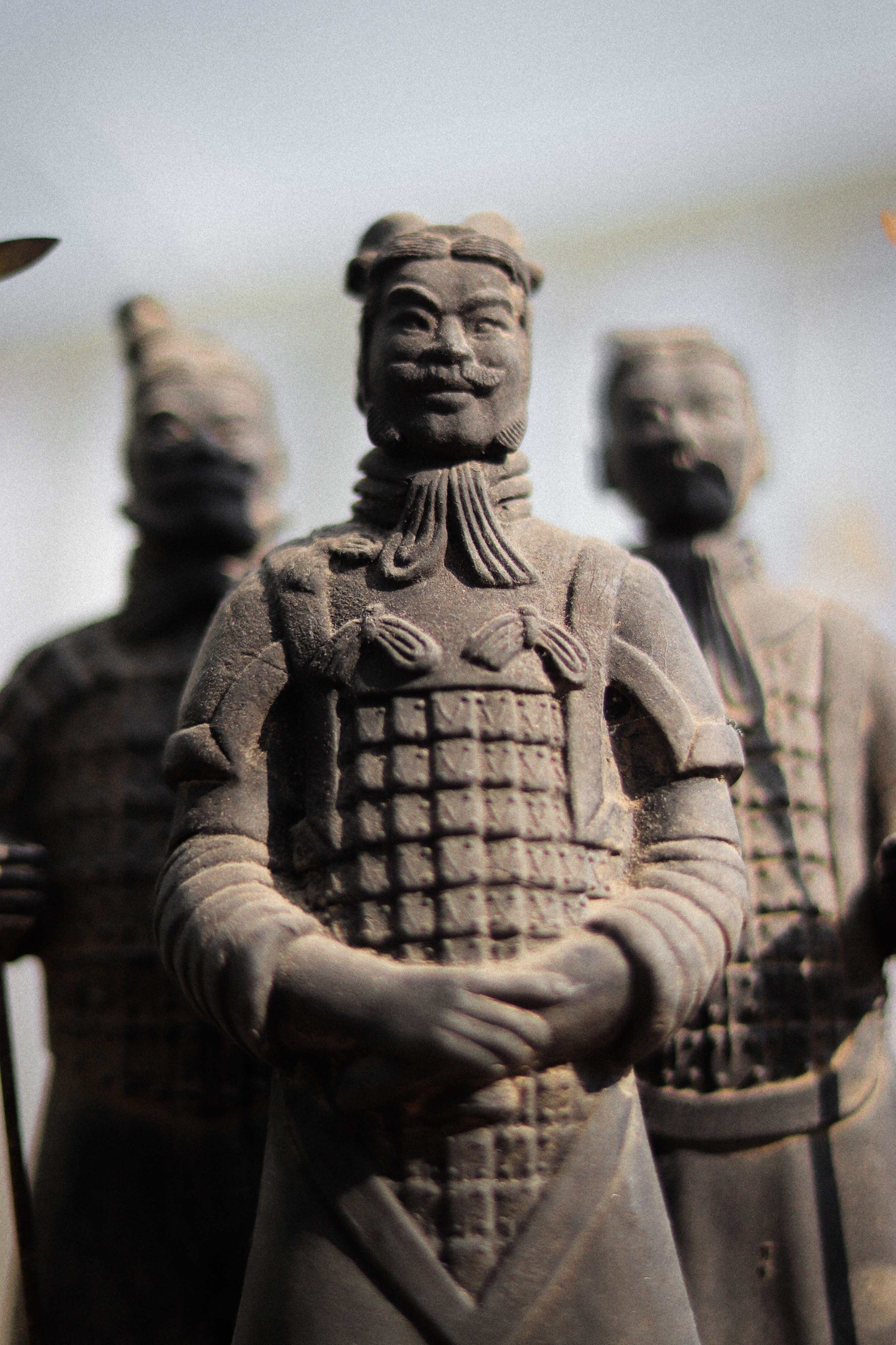
The classic BBC TV series, Way of the Warrior’s episode on Shorinji Kempo just appeared online, and it still holds up today.
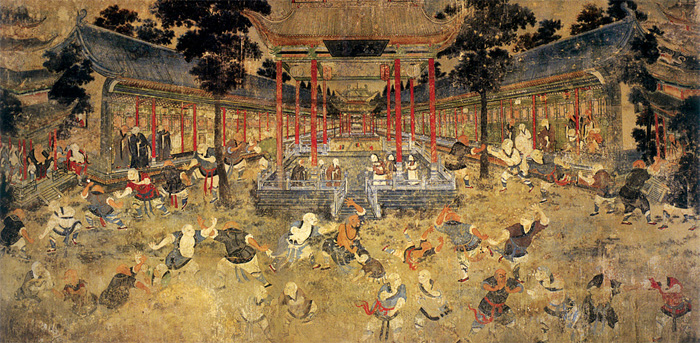
The BBC seem to have complete access to the style to film this, which at the time they say had a million followers and was floating on that ‘cult’ borderline, and it’s a fascinating glimpse into the past. Shōrin-ji kempō means something like Shaolin Temple Fist Way, and was established in 1947 by Doshin So after his time as a spy in China, where he supposedly trained at the Shaolin Temple. I think, as the documentary makes out, that his main form of training at the Shaolin Temple consisted of looking at the famous painting (which is not that old at all) of Chinese and Indian monks fighting. Like all Kempo styles his art is probably an eclectic mix of all sorts of different martial arts he trained in. However, he appears to have used that painting as the inspiration for his whole martial art! The Shaolin origins made a great backstory, anyway.
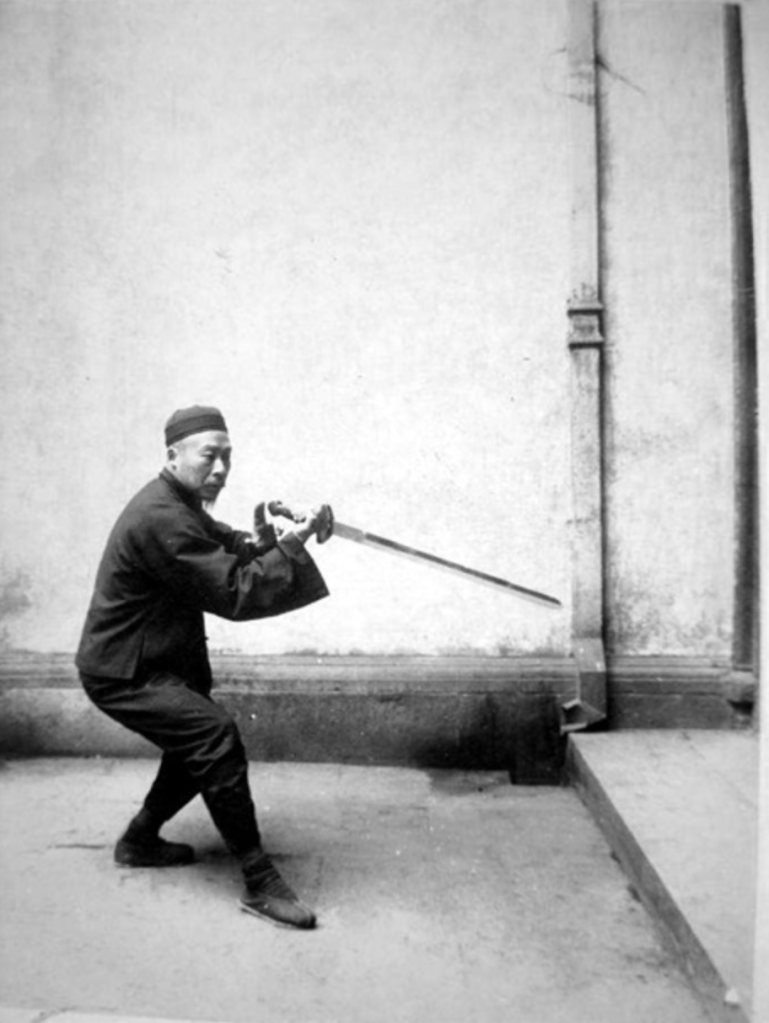
The mural painting from the Shaolin Temple.
While this is only one type of Kempo from Japan, you can see a lot of the elements we talked about in our Heretics Podcast, History of Kempo and Jiujitsu episodes, that seem to be recurring themes:
The blending of marital arts and religion (in this case Buddhism)
Far right political views
A sense of freedom in where you get techniques from (absorb what is useful)
Helping fight crime as a kind of unofficial police force
A lot of sparring!
What is also interesting is that the film shows the widespread use of the original Shorinji Kempo logo – the Swastica – that they replaced for all branches in 2005 with the so-en (double circle).
Today’s blog is about a weird quirk of the Xing Yi world. There’s a surprisingly large amount of online debate in Xing Yi circles about where the elbow should be when performing Xing Yi. I mean, a surprisingly large amount of debate. Especially for a matter that might, forgive me for saying this, be seen as trivial by people actively engaged in combat sports that actually spar with resistance.
Obviously, if you have some sort of two person free practice in your Xing Yi system that you actually engage in regularly, I’m not talking to you. I think the real reason why all these debates happen is simple – too much forms and not enough fighting.
But, ok, there are other reasons. For example, details do matter in internal arts. Quite often we’re being asked to look in detail at our movements and micro movements to get the most perfectly coordinated and natural human movement possible. But without keeping one foot on the ground, (and grounded in the reality that sparring provides), the theoretical arguments start taking over and the art disappears up its own bum. A martial art that is predominantly forms-first is always going to be theoretical at best. To take the well worn analogy – you don’t learn to swim by practicing on dry land.
The problem stems from the fact that there’s a line in the Xing Yi classics that translates as:
“The hands do not leave the heart and the elbows do not leave the ribs”.
But it’s how literally you take these words seems to be the crux of the matter. Now, I’ve seen videos of respected Xing Yi masters quoting this passage while demonstrating and their elbows are clearly leaving the ribs, if not in the horizontal axis, at least in the vertical axis.
The reasoning behind keeping the elbows tight is sound – in boxing, kickboxing and MMA it’s generally considered best practice to keep your shoulders high and elbows tucked in close to the body to help protect the ribs. But boxers don’t tend to get hung up on this – as their individual style develops they don’t feel like they have to conform to the same ‘rules’ that the novice has to. They are free to develop their own personal style through experimentation and testing in the ring. I’m sure Prince Naseem was taught the same basics as Mike Tyson, but look how differently their boxing styles turned out in the end.
So, (and I know, dear reader, that you are just dying the hear this), what’s my take on where the elbow should be in Xing Yi?
Well, I’m glad you asked. Rather than getting hung up on words in an old writing (that may or may not be old at all) I prefer to get hung up on history. I mean, you have to get hung up on something, right?
Xing Yi is generally considered to be descended from military spear fighting. If you hold a heavy spear it becomes readily apparent that your best chance of wielding it with power is to keep it in front of the body, not out to the sides. It’s the same when you hold any heavy object – you are stronger when your arms are in front of you holding it than when they are at your side holding it. This is the truth I feel these words are aiming towards, and generally the postures and techniques of Xing Yi all comply with this idea of keeping the elbows in and the arms in front of the body, not to the sides. There are exceptions though. For example, Xing Yi Bear has a much rounder posture, with gaps under the elbows, more like the Yi Quan standing postures.
Some postures in our Xing Yi dragon and chicken links are for hitting with the elbows and we hold them out to the side when doing so, but in these cases you are normally (but not always) standing side-on to the opponent, so the elbow tip is pointing at the opponent, so in that sense it is not ‘out to the side’.
A good example is this famous Liang Yi Zhuang posture from Baji, which is similar to the chicken posture I was talking about. (Baji is another Northern Chinese martial arts, that is a bit similar to Xing Yi).
I mean, we could decide that viewed from the opponent’s position the elbow is in line with the body, therefore it is not leaving the ribs, but the hands are not in front of the heart. No way. Are we therefore going to decide that this posture, taken out of context on its own, is wrong because it doesn’t correspond literally to some ancient writing that may, or may not, have been referring to a specific context?
Here’s another theory: I think what the whole thing is quite possibly about how soldiers work in formation on a battlefield. If Xing Yi does have military roots then a line of soldiers on a battlefield would all be orientated towards the enemy, standing side by side in a line. That’s another good reason to stick the elbows to the ribs. Any bladed weapons going towards your sides would definitely not be welcomed by your brothers in arms.
Ultimately, I don’t expect this post to have really made a difference to the debate. I feel like this one is just going to run and run forever. So long as there are mainly theoretical practitioners of the art there will be always be many theoretical debates about how what somebody is doing is right or wrong in relation to some ancient writing.
I just think people’s efforts would be better put to trying moves out on other people and getting feedback that way. As one of my teachers used to say often:
“There is no such thing as correct technique, there is only appropriate technique.”
“If correct timing and position are not achieved, the body will become disordered and will not move as an integrated whole; the correction for this defect must be sought in the legs and waist.“
When you’ve been practicing Tai Chi for a while – a few years maybe – you’ll get to the stage where you start to think about making your own form. Something that puts all the bits you really like together, and is either shorter than what you usually do, or longer, or uses less space, or fits into your garden better, or… something.
It’s potentially driven out of a need to make your own mark on the world; perhaps a sense of ego. You want something that is yours! Or maybe it’s just that you are a creative person and you have a need to continually create. Or perhaps it’s just to bring a sense of aliveness and play back into your Tai Chi…
What will then happen is you’ll start making a form, and then you fiddle with it, and fiddle with it and fiddle with it… and years pass and you’re still fiddling with it.
Ultimately, you’ll realise that this process never ends, and that your form will never be “finished”. Just when you think you’ll got it finished, you’ll notice a part of it isn’t quite right.
Whenever I mentioned to my teacher, over the years, that I’d made my own little form he was usually completely nonplussed. I mean, he asked to see it, but I could tell it wasn’t setting his world on fire 🙂
As I was pondering on my millionth version of my form this morning, another thought occurred to me. An obsession with creating your own form is probably an indication that you are getting a little too concerned with the external aspects of Tai Chi.
Switch your focus in Tai Chi back to the ‘internal’ elements – your perception of your body in space. Slow down, put your mind on what you are doing, notice your breathing, feel the (for want of a better word) energy inside the movements, notice where your weight is on your feet, push up from the ground, etc…
Now you’ll find that it doesn’t really matter to you what form you are doing – it’s all the same. If you are focused on the inside, your concern for what order movements come in and how many times you repeat something isn’t what matters anymore.
Suddenly, the idea of creating your own sequence of moves seems a bit, well, meaningless. Instead, you create your own form every time you practice, with every movement you do.
A deep dive into Matt Thornton, Sam Harris and Mr Inbetween
One of the most interesting things I listened to this week was Matt Thornton’s interview with Sam Harris on his Making Sense podcast. Matt Thornton is the founder of the Straight Blast MMA gym network and an early advocate of Jeet June Do, and cross-training in multiple martial arts. He moved quite strongly into practicing Brazilian Jiujitsu after encountering the genius of Rickson Gracie. He was an early advocate of the concept of ‘aliveness’ in training, as well as his uncompromising attitude to martial arts, which is probably what he’s most famous for.
He’s got a new book out called The Gift of Violence, and is promoting it via the Sam Harris podcast. It’s an hour long podcast that you can listen to for free. It goes on longer, but that requires a subscription to the Making Sense podcast. (To be honest, Thornton has done lots of other interviews before, which can be found on YouTube, so you can probably get the info from the bits we are missing by listening to a selection of those.)
Here’s the book cover:
(That’s a terrible, terrible cover, design btw. Using “Full Justify” on text on a cover is a true crime against humanity, not to mention design. Plus, the gorilla looks like it’s yawning, and is badly cut out. However, since Matt’s picture on the BJJ Heroes website is of him in non-matching blue Gi top and white Gi pants, I don’t think fashion sense, design or style is really on his radar, and that has its own attraction)
Check out the podcast on YouTube:
Thornton is quite blunt about stating his belief that most martial arts simply don’t work and are therefore silly or a waste of time. I noticed that his comments seemed to annoy quite a few of the more serious Chinese marital arts practitioners that I follow online.
I’m somehow stuck in the middle on this. I find Thornton’s views on practicality quite compelling – the martial arts are full of stuff that is hardly what I’d call best practice for actually protecting yourself, and if I was being less generous, downright bad advice, however I can’t get onboard with his eagerness to throw every martial art that isn’t 100% dedicated to practical, alive, self defence training 100% of the time, under the bus.
As I’ve talked about before, I believe Chinese martial arts were never ‘just’ marital arts. They are part of a complex web that linked all sorts of aspect of life in ancient China together – religion, ritual, festival, theatre, healing, medicine and of course, self defence. And while several attempts were made throughout history to isolate just the self defence aspect of Chinese marital arts and separate is out from the rest (particularly after the disastrous Boxer Rebellion in 1900, and then again much later by the Communists in the 70s and their attempts to stamp out individuality and ‘rotten old traditions’ ) much of the previous branches remain – their roots go deep. But is that really a bad thing? People are multifaceted beings too. We don’t only do martial arts for one thing either. I know in my own training for instance, I don’t only train just for self-defence. I train because I enjoy it and it is good for me! I enjoy the puzzle-solving challenge that is Brazilian Jiujitsu, I enjoy the workout of forms in Chinese marital arts and the sense of mental balance and peace it gives me. I enjoy the ritual of having a little morning routine that I practice by myself and the quiet time it gives me. I enjoy the friends I make doing martial arts and the discussions we have, etc.
But I think Thornton’s opinions on martial arts are a side issue here to the most valuable insights you can get from him. What I’m most interested in from Thornton are his insights into violence. I haven’t read his book yet, but I’m going to. The book blurb makes some great points about violence
“In today’s modern world, we are largely isolated from the kind of savagery our ancestors faced on a daily basis. Although violence was as natural to our evolutionary development as sex and food, it has become foreign to most of us: at once demonized and glamorized, but almost always deeply misunderstood.”
Matt Thornton
That sounds exactly right to me – our approach to violence in the modern world have become very unnatural. We glamorise it in almost every TV show we watch, yet we’ve lost connection to it in daily life.
One TV show I’ve been rewatching recently (for the third time I think!) makes very much the same points about violence and its role in society is the the award-wining Australian series, Mr Inbetween created by the brilliant Scott Ryan. I don’t think any other show since The Sopranos has really tried to peel the lid on violence quite so effectively.
Scott Ryan as Ray Shoesmith. A man who knows a thing or two about violence.
As it says in this interview, Ryan’s character represents consequences. The show also deals with another factor that the modern day martial arts are often called in to deal with – bullying. Whether its children or adults being bullied, this is perhaps the one area of modern life that we as a society struggle to deal with the most, and it’s perhaps one area where violence really is the answer. Or is it?
In the UK, Mr Inbetween is on Disney+. I’d recommend it.
Seeing these old masters from Taiwan looking so good while practicing their external arts has made me wonder about switching my priorities.
I’ve been enjoying the recent series of videos from Will on his Monkey Steals Peach YouTube Channel of his tour of Taiwan Kung Fu schools. The latest one features Long Fist. It’s been great to see so much good technique demonstrated and also a few of the younger students, proving the arts have a future.
But of course, a lot of the practitioners Will has featured are older, but that doesn’t stop them being proficient in dealing out the ass whoppings. This has made me reflect on my own training priorities. A lot of these fit-looking older men are training in arts that would be classified as ‘external’ like Long Fist and Mantis, rather than the so-called ‘internal’ arts like Tai Chi or Xing Yi, which are more normally associated with older people.
Perhaps shifting focus to these external arts, which have longer postures with more twisting and stretching, and are practiced more vigorously is a good idea as you get older?
I’ve got to admit, that while I do feel good after a few run throughs of the Tai Chi form, I probably feel more energised and exercised after a few runs through of a Choy Li Fut form. My cardiovascular system is placed under more stressed for one thing, and my joints get moved through a larger range of motion.
“When you practice the form, the slower the better!” – Yang Cheng-Fu
Of course, Yang Cheng-Fu in his 10 Important Points, famously used this distinction between internal and external to explain that external arts were “harmful” for you, and the fact that you don’t get out of breath doing Tai Chi proved its superiority! He wrote (recorded by Chen Weiming, and translated by Jerry Karrin):
“External martial artists prize leaping and stomping, and they do this until breath (chi) and strength are exhausted, so that after practicing they are all out of breath. In Tai Chi Chuan we use quiescence to overcome movement, and even in movement, still have quiescence. So when you practice the form, the slower the better! When you do it slowly your breath becomes deep and long, the chi sinks to the dantian, and naturally there is no harmful constriction or enlargement of the blood vessels. If the student tries carefully they may be able to comprehend the meaning behind these words.”
Yang Cheng Fu
Now, it doesn’t take a genius to make an observation that Yang Cheng-Fu could have done with losing a few pounds himself, and that since he died relatively young his thoughts on longevity should be taken with a pinch of salt. Frankly, I think he could have done with getting a bit out of breath now and again!
It’s also fairly obvious to anybody who has seen Chen style Taijiquan that ‘leaping and stomping’ can be a part of Taijiquan too.
However, I do think there’s something to what he’s saying. When moving slowly and achieving a mediative state of mind you can experience profound levels of relaxation that do feel different to other types of exercise. When you “slow your breath” and it becomes “deep and long” it can feel wonderful. However, is that enough? I think it’s a mistake to use this type of exercise to replace more traditional cardiovascular exercise, and your body will not thank you in the long run.
Why not do both? Tai Chi has its place, but so do external arts of the Shaolin variety. Perhaps the best approach is to not skew too heavily in favour of either, but to adopt a balanced approach where you train both equally? Let me know what you think.
In the latest episode of the Tai Chi Notebook podcast host Graham is left all on his own without a guest, so he’s decided to pick up a book and read it to you! He’s gone for The Tai Chi Classic, one of the core works which make up a collection known as The Tai Chi Classics. Graham goes through the text a paragraph at a time and gives his interpretation of what the classic is saying. We hope you enjoy!
The Tai Chi Classic
In motion, the whole body should be light and agile,
with all parts linked as if threaded together.
The chi should be activated,
The mind should be internally gathered.
The postures should be rounded and without defect,
without deviations from the proper alignment;
in motion, your form should be continuous, without stops and starts.
The jin should be
rooted in the feet,
generated from the legs,
controlled by the waist, and
expressed through the fingers.
The feet, legs, and waist should act together
as an integrated whole,
so that while advancing or withdrawing
one can take the opportunity for favorable timing
and good position.
If correct timing and position are not achieved,
the body will become disordered
and will not move as an integrated whole;
the correction for this defect
must be sought in the legs and waist.
The principle of adjusting the legs and waist
applies for moving in all directions;
upward or downward,
advancing or withdrawing,
left or right.
All movements are motivated by Yi,
not external form.
If there is up, there is down;
when advancing, have regard for withdrawing;
when striking left, pay attention to the right.
If the yi wants to move upward,
it must simultaneously have intent downward.
Alternating the force of pulling and pushing
severs an opponent’s root
so that he can be defeated
quickly and certainly.
Full and empty
should be clearly differentiated.
At any place where there is emptiness,
there must be fullness;
Every place has both emptiness and fullness.
The whole body should be threaded together through every joint
without the slightest break.
Long Boxing is like a great river
rolling on unceasingly.
Peng, Lu, Ji, An,
Tsai, Lieh, Zhou, and Kao
are equated to the Eight Trigrams.
The first four are the cardinal directions;
South; Heaven, North; Earth, West; Water, and East; Fire.
The second four are the four corners:
Southwest; Wind, Northeast; Thunder,
Southeast; Lake, and Northwest; Mountain.
Advance, Withdraw,
Look Left, Look Right, and
Central Equilibrium
are equated to the five elements:
Metal,
Wood,
Water,
Fire, and
Earth
Taken together, these are termed the Thirteen Postures
So, as a kind of counterpoint to my previous post questioning whether all Chinese martial arts come from military methods, I’d like to focus on one that definitely does – Xing Yi. Although, this really just emphasises my previous point because Xing Yi looks very different to most other Chinese martial arts and the reason it looks different is because it comes from weapons-based military methods and is therefore more concerened with military engagements than civilian. As our podcast series is showing, there is a verifiable historical connection between Xing Yi and soldiers – for example, the oldest historically verifiable practitioner linked to Xing Yi – Ji Long Feng, was a real life soldier in the Ming Dynasty army.
But the real reason you can tell Xing Yi descends from military methods is that you can simply look at it. The arms and legs are generally close together and close to the body, the posture is narrow and the direction of techniques is straight in front of you. Everything is done within the profile of the body. There are two main reasons for this 1) you were wearing armor and had to accommodate for the weight of it, and 2) you were using weapons, which were probably quite heavy, since they had to penetrate armor.
The Xing Yi we have today is what military arts would look like if you did them without wearing armor and using hand techniques instead of weapons. Of course, many people still do Xing Yi with a spear, but it’s rare to see anybody wearing armor doing it these days, which I think leads people to get the wrong idea about it.
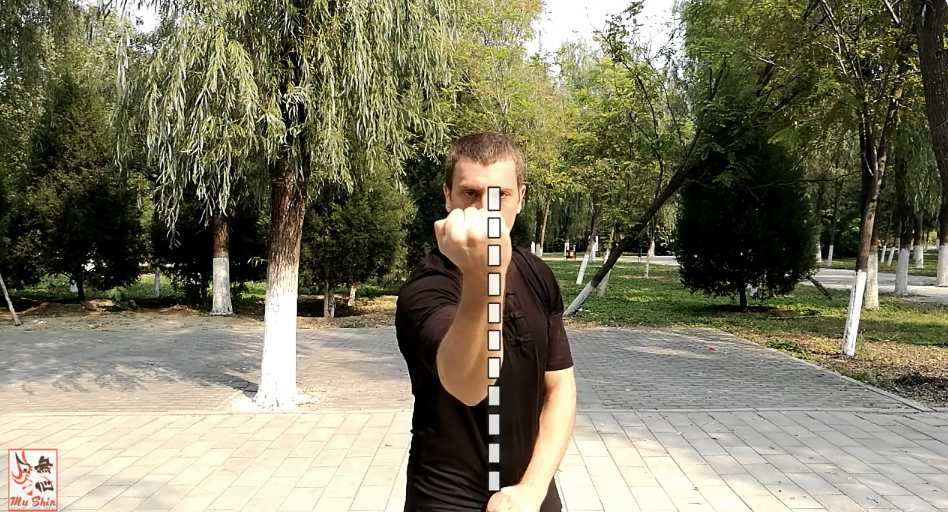
Take a look at this video of my friend Byron Jacobs from Beijing doing Xing Yi Zuan Quan (Drilling fist). Look how tight everything is to the body and how the hands are kept within the profile of the body:
Here’s an example:
All this leads me to this excellent new video by Karate Nerd, Jessie Enkamp called “I trained like a Samurai for a day”. Here he gets Dr. Kacem Zoughari, a Japanese martial arts expert to take him around the Samurai Museum Berlin. It’s pretty interesting then half way through, it gets super interesting because he gets to wear old Samurai armor and have a go with a few authentic weapons. Now this is really valuable because he tries to do Karate movements in the armor and very quickly realises that it’s completely inefficient and exposes all the vital parts of the body to strikes from the opponent. The expert, Dr. Kacem Zoughari, gets him to change his movements so that everything happens within the profile of the body and makes him use the footwork, momentum and body to power the arm movements. The strikes become hidden, and tight to the body rather than telegraphed and open… and bingo! It starts to look just like Xing Yi! He suggests a cross step at one point and it looks a lot like Xing Yi Dragon step. The strikes he has to do start to look like parts of the 5 Elements – Pi, Beng, Tzuan.
Take a look:
Now you may be thinking Japanese armor isn’t the same as Chinese armor and therefore none of this is relevant, but you would be wrong. That armor at the top of this post is not Samurai armor, (although I bet if you took the average person off the street and asked them what it was they would think it was Samurai armor). It’s based on Chinese armor from the Song Dynasty. This would have been officer armor, not what your average soldier was wearing, but the same principles would apply – you want your movements to protect your vulnerable areas – the neck and joints in particular.
Xing Yi is based on these principles – minimal movement, a tight profile, using the body, momentum and the step to power the arms, strikes based on timing rather than speed, etc. And that’s why it looks so different to something like Karate or Norther Shaolin or Long Fist, etc.
I think this post is perhaps a little half formed, but I want to get on to writing up my last lesson with Bear, so I’m going to put it out as is. Let the pieces fall where they may…
An interesting new video has been released by Will (a recent guest on my Tai Chi Notebook podcast) about his recent visit to Taiwan where he got to talk to various Taiwanese martial arts masters. It’s the start of a series and it looks like it’s going to be great – Will gets to walk down the smokey back alleys of Taiwan to find the martial artists and martial arts schools in Taiwan you wish you could. What’s not to like? Watch it here:
The blurb reads: “In the first episode, I meet up with my friend John Eusebio @longfistmantis to visit the bookstore of Liu Kang Yi. Mr Liu’s bookstore, Wuxue Shuguan has a huge collection of martial arts books, in both Chinese and English, and he has also spent decades collecting old and rare manuscripts. In this video he shares his insights on the development of martial arts from a military combat art, to an integrated system of both combat and health practice, as we see it today. He also shows us a copy of the Bubishi, the foundational manual of Okinawan Karate.”
Mr Liu talks about internal training, and how it relates to strengthening the tendons and fascia of the body, so that it can toughen and that can lead to more strength “qi” in the body. This all seems fairly accurate to me. (There’s discussion to be had about whether these methods were always a part of Chinese marital arts, or added in later from a different tradition, but that’s by the by). Then he talks about the 3 phases of development of Chinese martial arts, which is the part I wanted to pick up on.
To paraphrase, he says, the first is only martial training and not cultivating: it’s pure combat. No focus on health. This is the military period. The second is once it entered the civilian population. They train both combat and cultivate health, but separately, developing things like Yijinjing and Baduanjing. The third evolution was to combine combat and health, to bring both aspects together. Taijiquan is a good example of this.
Now, this is not a bad way of looking at the evolution of Chinese martial arts, but I think it’s a bit reductive, and crucially, it misses out a lot of other influences.
It’s a view that is not dissimilar to Peter Lorge’s in the book Chinese Martial Arts: From Antiquity to the Twenty-First Century which is that marital arts were all originally military arts and over time were simply dispersed from the army into civilian life.
Lorge’s position is laid out clearly in the introduction to his book starts with this:

I actually really enjoyed Peter’s lecture about the history of Chinese martial arts at the Martial Arts Studies conference 2017, but it seems that both Mr Lorge and Mr Liu both view Chinese martial arts as a kind of offshoot of military training, and nothing more, and in both cases the subject doesn’t even seem to be up for debate, it’s just presented as self obvious. The parallel between both of them is that they are relying only on written sources as their research into the matter. In fact, a lot of the cultural traditions of ‘common folk’ were not recorded, since writing belonged to the upper classes.
Now, I’ll admit, there can be no doubt that the intermingling of civilian and military life had a massive influence on martial arts practiced by people in villages, particularly after the Ming Dynasty army was disbanded and returned to civilian life after its defeat by the invading Manchu’s, who seized control of Beijing in 1644. Xing Yi in particular is one of the martial arts that traces its origins to that event, to military methods kept alive by ex soldiers who were now civilians who had had their weapons taken away. A review of Xing Yi’s existing methods and techniques today reveals a clear bias towards methods that work with a spear, which would have been the dominant weapon in the military for soldiers, and also a concern for facing an attacker who is in front of you, not to the side, which is another feature of military arts. However, most other Chinese marital arts are more biased towards barehand actions than weapons, contain sometimes elaborate sequences that would appear to be more at home on a stage than in a street fight, or involve making specific hand gestures or actions that hint at a ritual quality, that it’s clear, to me at least, that something more is going on here. Rather than just military methods being translated into personal self-protection methods, we are seeing other influences.
In China, there is a long history of martial arts being used in religious ritual, festival culture, spirit possession, street entertainment, Xiqu (Chinese theatre) and Wuxia (which literally means “martial heroes”, a genre of Chinese fiction concerning the adventures of martial artists in ancient China). I think those traditions have as much influence on the martial arts passed down to us today as the military does, and in a lot of cases, more. But, if you mention this to proponents of the “pure pugilism” brand of martial artist, they usually try and explain to you that all these things came out of marital arts. i.e. martial arts came first, and the dance/performance/theatre/ritual, etc came second. In fact, Lorge argues exactly this at 43.00 minutes in his lecture (which I still enjoyed!), despite cataloging wrestling going back centuries as pure entertainment for the Royal Court. This attempt to explain away the obvious flaw reminds me of when people present funky martial applications to form movements that clearly don’t look like marital movements. There are some frankly ridiculous martial application out there from well know teachers who, rather than just admitting that there’s no real martial application of this move that makes any sense, come up with something that just looks silly.
I’ve talked to a lot of martial artists on my podcast (20 episodes so far!) and I quite often broach this subject to see what kind of reaction I get, and I’ve found that the martial artists who live in Asia, or have lived there for some time, tend to have no problem with the idea that Chinese martial arts is a broad church of methods derived from various traditions. It tends to be the people outside of that culture who have a problem with what they’re learning not being a super-deadly killing art created for one purpose only – to be the best fighter! I suppose it’s because so many of these cultural traditions are still alive and well in Asia today that it’s hard to deny their existence. Just look around you. Martial arts training halls tend to have shrines in them where incense is burned as part of a religious ritual. Or the martial arts school participates in local religious festivals by enacting Lion and Dragon Dance routines, or giving a demonstration of martial arts. Or there is a semi-religious ceremony involved in becoming an indoor disciple, etc.
I think two things are going on here. First there’s a reaction against the modern Chinese trend of turning marital arts into a gymnastic demonstrations instead of fighting arts, and secondly there’s a reaction against the modern trend for making Chinese martial arts appear as spiritual and mystical in the same way Yoga is.
As Charles Holcomb wrote in 1990 , “Everywhere in China the martial arts either present themselves in the guise of simple exercises or are shrouded in arcane religious mysteries. Western enthusiasts often feel impelled to strip away these religious trappings and construct a version of the martial arts that is neither simple gymnastics nor religion, but emphasizes true hand-to-hand combat skills. The question remains, is this an authentic understanding of the martial arts?” [1]
I think that process of trying to present the martial arts as true hand-to-hand combat skills is very much alive and well today, I mean, its probably what most people are looking for when they start Kung Fu. I certainly was. But I think it’s also something of a reaction to the introduction of Chinese martial arts to the West, which came off the back of the Kung Fu TV series (which presented martial arts as mystical from Shaolin monks) and followed off the back of mystics like Alan Watts who presented a very counter culture sort of take on Eastern religion.
While there’s nothing wrong with that, my feeling is that it misses out on the wider, and weirder, historical context of the arts we practice today. They’re a rich blend of various traditions, and we should treat them as such.
[1] Theater of combat: A critical look at the Chinese martial arts by Charles Holcombe, Historian. Vol. 52 No. 3 May.1990. Pp. 411-431 Copyright by Michigan State University Press
Due to a series of fortuitous events, this week I ended up learning Wing Chun for a couple of hours from a teacher from Hong Kong in a cold, damp, lockup somewhere off the beaten track in an industrial estate. As we ran through the opening sequence of the “little idea” form, (Siu Lim Tao), the glare of the electric light bulb cast our stationary shadows out through the open door into the dark, rainy yard outside and I remember thinking that this really felt like the real thing. I could feel the magic of Kung Fu here.
We are learning from “Bear”, a nickname we have created from his family name (Xiong). Bear has long hair and glasses and has a kind of laid back vibe. He seems more interested in being friendly and making friends than fighting. He speaks very little English, but YaYa his girlfriend does and acts as his translator. I’d say about 60% of it gets through, the rest I can hopefully work out thanks to my previous martial training.
He’s built a bit like a bear too – he takes his top off so we can see his arms – his tendons and muscles are clearly very conditioned and big, yet his arms feel soft to the touch. He used to train “5 hours a day when I was reading”, which I think means when he was a student.
He doesn’t have an ego at all. He demonstrates his speed all the time, but without hitting us, just stopping short – but at the same time his instruction is incredibly precise and demanding. Parts of the body have to move and other parts must stay still. He touches my arm and says “Ooooh! Very sung”, which I’ll take as a compliment 🙂
The concrete floor is damp and slippy, but luckily we are not doing footwork yet. We have to bend our legs all the time, as if sitting on a stool and grip with our inner thighs as if riding a horse. The night air is cool and the breeze blows in through the open door as we go through the opening movements of Siu Lim Tao, over and over.
I’m used to bending my wrist back so the fingers are vertical to form “praying hand”, and sitting down into my stance as if riding a horse, thanks to years of training other styles, but my companions are not, so there is a lot of stretching out aching legs and talk about how to condition tendons so wrists can be bent back further.
The three of us have ended up here after a chance meeting, and a lot of mistranslation. I was initially told that my friend had met Bruce Lee’s nephew who was going to teach us Wing Chun. OK, I thought, it was unlikely but theoretically possible that he could be Bruce Lee’s nephew, but the “nephew” bit turned out to be a mistranslation based on the word “Sifu” meaning both father and teacher. So, he’s a “marital nephew”, but not a family nephew. But who cares, we are all here now learning together and we’re having a great time, so I’m going with it. You can learn from any good teacher, and the chance to learn a new martial art is always a great opportunity.
Bear pulls out a book, which looks like a hand-written training notes, and starts to tell us the story of the creation of Wing Chun, which YaYa translates. It was, we are told, created from “the observation of a snake and a goose fighting”. (I suspect he really means crane). The goose(!) uses its wings in a kind of sideways swiping action, like Wing Chun’s Bong Sau. The key feature of the snake, Bear emphasises, is that it doesn’t retreat to strike, it just strikes from where it’s at. Bear pulls out his phone and shows us this clip from ‘Enter the Dragon’ where Bruce fights O’Hara to demonstrate:
I’d thought of Wing Chun as being more based on lots of relaxed arm trapping, but Bear seems much more interested in striking as quickly and explosively as he can, with minimal movement, which I think he was trying to tell us was the point of training the “little idea” form, very much like Bruce in this clip. Not big movement – minimal movement. There seems to be a snap on the end of everything, too, and he says the words “fa jin”, which Tai Chi people should be familiar with, quite often.
Having read all these snake and crane origin stories for years, not to mention hearing stories of many of my own British teachers having to work out what their Chinese teacher was actually saying through the limitations of translation, I’m finding this experience of living the tradition quite magical.
Towards the end he starts showing us some kicks and these are fast, low and look very cool. He wants us to fix some tires on the wall to practice kicks on. He seems to pendulum his upper body backwards as his legs flash forward, as if avoiding a head strike and countering low. The impression I get is that whatever we are learning it’s not designed for a long protracted engagement. It’s quick, to the point and you get it over with then move on. I’m looking forward to learning more next week.
Compared to solo forms in Chinese martial arts, a lot of questions you might have about why we do this, or don’t do that, are immediately obvious in application on a living, moving human being. And if they don’t make sense in that context, then you have to start asking yourself if what you’re practicing really has any point at all?
Switching the emphasis away from solo form doesn’t mean you have to be doing a sort of life and death battlefield combat every time you practice, it just means you need to be thinking about the other person, not yourself, so much.
Here’s one drill we practice in our Xing Yi system, called “5 Elements Fighting” – in its most basic form (shown here) it’s two people following the creative/destructive sequence of the 5 elements, so for example, your partner attacks with metal, you respond with fire, he responds with water, and so on. Later on you can improvise and vary the elements more so that you respond to metal with wood, or earth, for example. You can also add methods in from the 12 animals. But the idea is to keep a spontaneous feel, even if you’re following a set pattern, as we are here.