One of the most frequent things you hear in BJJ is “move your hips“.
Brazilian teachers tend to say “escape your hips“. Which is an odd-sounding translation of presumably something that sounds better in Portuguese. In American and English it usually gets turned into “hip escape“, as in, “do a hip escape here“, “it’s not working because you need to hip escape more“.
We hip escape up and down the gym as a warm up (also known as “shrimping”) because it’s a fundamental movement you need to have in your tool box that you can pull out without having to think about it.
But why? What is it? Simply put: It’s designed to create more space between you and your opponent on the ground.
You can use hip escapes for escaping bad positions like side control and mount. But it also has benefits for attacks too. Basically a good rule of thumb is that if what you’re doing isn’t working try doing a hip escape and doing it again. The change of angle and leverage will probably fix it.
Now we know what a hip escape is, let’s get to the point of all this.
When we say “move your hips” that’s not the part of the body that you need to move from. If you just moved from your hips you’d never go anywhere. You’d just spasm on the floor like a dying fly having its last buzz. What you actually need to do is push with your toes and feet on the ground so that your hips move.
Your hips moving is the result of the action, not the action itself.
Which brings me onto Tai Chi Chuan and the dantien (the lower abdomen area of the body).
All wise and knowledgeable Internet-enabled Tai Chi practitioners know that we need to “move from the dantien” in Tai Chi Chuan. (This is the supposed secret to Tai Chi that you get told by your wise master only after you have paid the required tuition fees for a number of years. 🙂 )
Cheng Man Ching, Single Whip posture.
But again, where does the action originate? I would say that, just as in JiuJitsu, you don’t actually “move from the dantien” by originating action there. Your dantien moves, but it’s your foot that provides the impetus. Your foot pushing against the ground is where the ‘power’ comes from in Tai Chi Chuan.
(A side note here for the Order of Advanced Tai Chi Wizards of the Internet: When you get this concept of the power from the ground you will find that you can actually originate the movement in the dantien as a kind of dropping force that is then rebounded from the ground, so it’s less of a push with the legs. File this under “advanced” if it makes no sense right now and come back to it later).
What Tai Chi Chuan specialises in is transmitting this power to the extremities without interfering with it as much as is humanly possible. We know that in Tai Chi we need to be relaxed (song), which seems like the last thing you’d want to be if you have to hit something hard, but there is a method in the madness.
In Tai Chi Chuan you are trying to transfer that power – the ground reaction force – from your foot all the way to your fingers as smoothly as possible and directing it with the dantien. This is called ‘threading a pearl through the 9 crooked gates‘ in the Tai Chi classics. The gates here are the joints of the body. All the breaks in connection between your foot and fingers are the points where power leaks out. Usually we cover these things up by using muscular strength to get by – you can spend years fooling yourself with this, and it’s a very hard habit to stop.
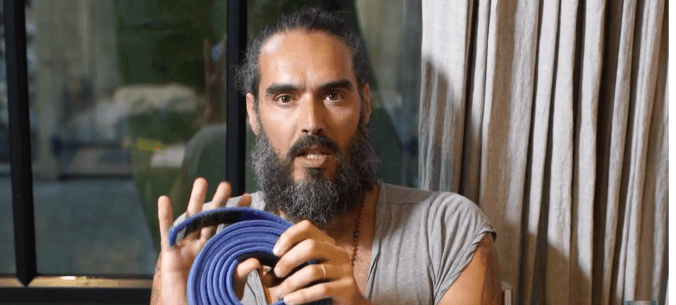
Here’s a very nice video from actor, comedian and all-round philosopher guru person, Russell Brand, about getting his blue belt in Brazilian Jiujitsu from the Roger Gracie school. There are no shortcuts for celebrities in BJJ (or at least there shouldn’t be), so just like everybody else he’s had to work hard for this. This is a great example of hard work paying off. Well done Russell!
In the video, he talks a lot about the community feel of BJJ.
What he’s talking about in the video (I believe) is the gap in modern society that used to be filled by either religion or secret societies and mystery religions – the idea of a brotherhood (and sisters too) that is created in a group where people are no longer viewed by the labels that society creates for us – father, doctor, immigrant, lawyer, builder, student, etc… but by what we have achieved on the matt.
“We all come through the door for different reasons, but we are all the same once we’re inside”.
It’s a very valuable thing to be viewed without societies cultural baggage weighing us down.
BJJ especially seems to fill that void in modern life. Other martial arts do too, but I don’t think they create quite the same sense of brotherhood as BJJ for a variety of reasons – perhaps it’s the close physical contact, where we’re constantly almost killing each other but paradoxically helping each other succeed.
In BJJ you see the huge changes in people’s personality happen before your eyes, they become more humble, warmer, and you feel it happen to yourself too.
Whatever this process is I just think BJJ does it better than other martial arts, and is more accessible than the old fashioned secret societies which don’t really exist in the same way in our more secular society where mainstream religion is a lot more tolerant than it used to be.
I’ve written a guest blog post about my Heretics podcast and our history of Japanese martial arts series for Holistic Budo, a blog run by my friend Robert Van Valkenburgh.
Here’s a quote:
After the Tokugawa-era ended with the bloody Boshin war followed by the Meiji Restoration (1868), Japan slowly opened up to the outside world. In fact, it was forced open by the British and Americans using violent gunboat diplomacy, but eventually the new era was embraced by the new rulers and also reflected in a new spirit of openness within the martial arts. Aliveness was back in fashion and innovators like Jigoro Kano breathed new life into the martial arts they inherited using the practice of randori (free sparring). His approach was so effective that Kano went from never having trained martial arts at all, to founding his own style in less than 6 years. Ultimately Kano’s Judo would outshine all the other styles of Jiujitsu and change the course of martial arts in Japan entirely, not to mention the rest of the world.
Just to let readers of Tai Chi Notebook know, this site also has a sister site dedicated to BJJ. It’s more technique and breakdown orientated than this site, but you might enjoy it too, especially if you practice the Arte Suave.
I’ve given it a little New Year’s refresh too, so check it out!
In part 4 we examine the time period between 1960 and 1980 in Japan, and discuss topics such as martial arts marketing and the different ways in which the Japanese created and promoted a wide range of new martial arts.
Here are a few links to videos of the things we talk about this time:
Gracie vs. Kimura – October 23, 1951 (Maracanã Stadium – Rio de Janeiro, Brasil)
Gracies vs bullies on beach:
Rikidozan vs Masahiko Kimura (1954 – Part 2/2)
PRIDE 25: Kazushi Sakuraba vs Antonio “Elvis” Schembri
Muhammed Ali vs Antonio Inoki Boxer vs MMA Fighter 1976
And part 3 of our History of Jiujitsu and Kempo is out! This time we have Bartitsu, the truth about Ninjas, the British connection, the controversial origins of the BJJ belt system and the birth of pro wrestling in Japan.
Episode 2 of the history of Kempo and Jiujitsu is out!
Starts in 1850. Extensive discussion of Kano Jigoro, the evolution of Judo and beyond. Plus a lot on the political-cultural situation of Japan at the time. Plenty of martial arts Heresy as always 😉
If you found the first episode too history-heavy this one, while still having a bucket-load of history in it, is more conversational and has some lighter-weight elements, talking about BJJ, Chuck Lidell and other things. We take a slightly controversial listener question at the end.
In the first episode we explore the development of the concept of heresy by two early christian teachers, Valentinus and Irenaeus. We then begin a multi-part series on the origins of Jiu Jitsu and Kempo, addressing some of the myths surrounding the samurai class in the process, as well as talking about some of the other, less famous, inhabitants of feudal Japan.
We had BJJ world champion Victor Estima at our BJJ school recently for a seminar. There was a guy there who I think is trying to make a life for himself as a YouTube Vlogger (although he only appears to have 1 video on YouTube!)
Anyway, he made this video about the event and it’s very funny because he challenges Victor to a match. He’s just a white belt. Hilarity ensues…