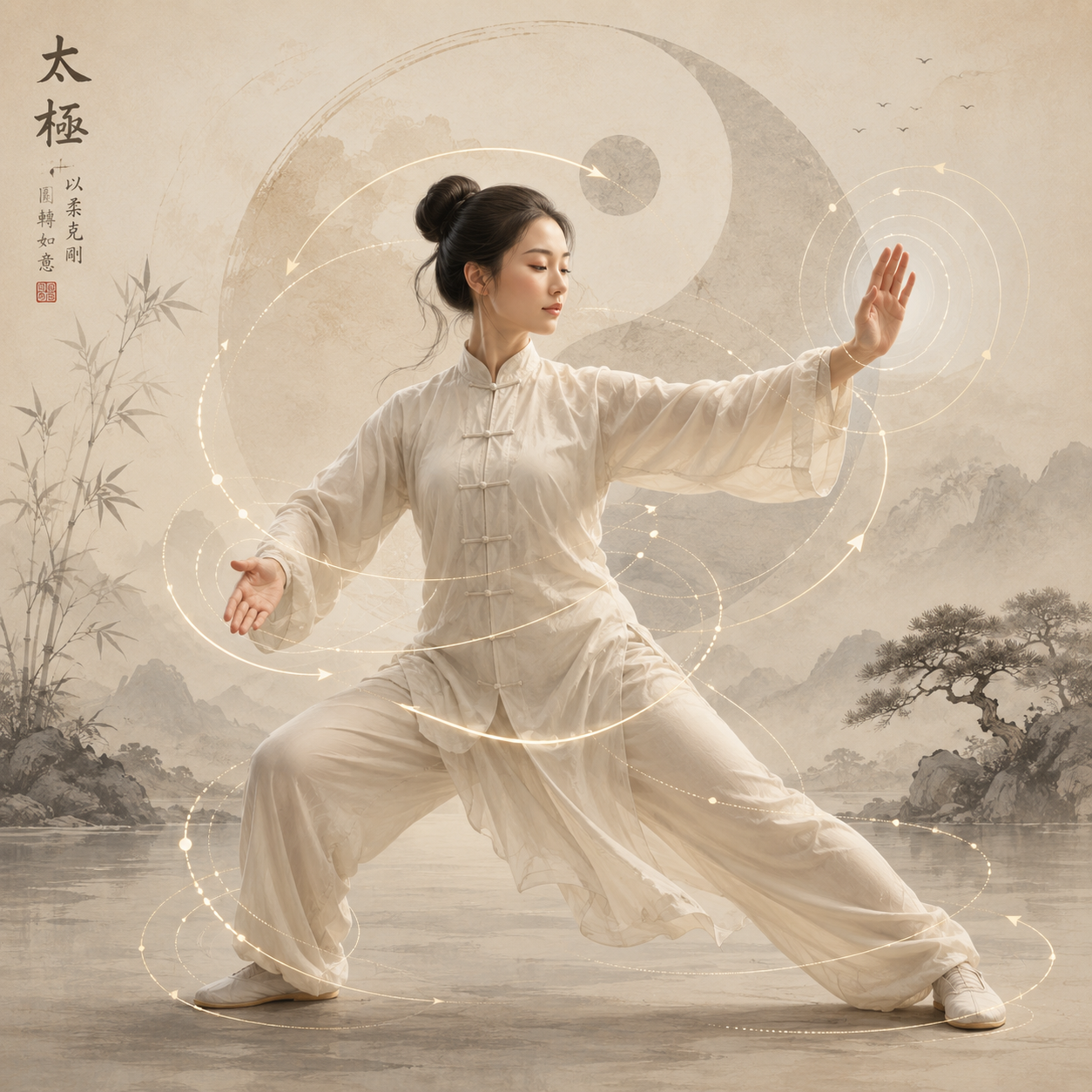
Here’s the thing: Every movement in Tai Chi is part of a circle, either clockwise or anti-clockwise, and sometimes parts of the Tai Chi yin/yang diagram (like a figure eight infinity symbol), but they are always circular, even the moves that look linear on the surface. If it looks linear it’s because the circle has become so small as to be invisible (or at least that should be the reason).
I find that to really understand this you need to go through the whole form until you understand how each movement is circular, and how to generate that circle from your feet, legs and middle, not the arms. Of course, that’s easier said than done!
Go through each movement of the form and break down how it is composed of circles and learn how to generate them from the turn of the middle of the body, using the legs to help, and not from the shoulders.
Where the circle begins
The important thing is not to draw imaginary circles with your hands. That is just arm waving.
The real work is to feel where the circle begins. Does it start in the shoulder, or does it come up from the foot, through the leg, into the middle of the body, and only then express itself through the arm?
That is the difference between making a circular shape and moving in a circular way.
So, when you practice, pick one movement and ask yourself: where is the circle? Is it turning horizontally, vertically, diagonally, or through the body like a spiral? Can you make it bigger? Can you make it smaller? Can you still feel it when it becomes almost invisible?
Over time, this changes how the form feels. The postures stop being separate positions joined together by transitions. They become circles turning into circles, opening and closing, rising and sinking, appearing and disappearing.
And that, really, is Tai Chi: not a sequence of poses, but a body learning how to move without corners.


Another article, elegant in its simplicity and profound in its implications. What I like most is that you highlight an essential point:
That really resonated. The visible circle is an expression of rotational organization throughout the body, from which circular and helical paths emerge naturally.
LikeLike
This is the essence of why I prefer Tai Chi to other MA’s. The circular flow harmonizes the body with itself and nature. Although I had not prior considered the physical geometry of every move👊🙏☯️
LikeLiked by 1 person