Martial Art Essays from Beijing, 1760, presents 64 essays written by Yang Mingbin, a painter in the Royal court of the Ching dynasty. Or does it? As well as being a painter, Yang was also a martial artist and the papers are his thoughts on his martial practice, except that Yang Mingbin never actually existed, and the work is entirely a fictional piece of writing by the modern author, Michael A. DeMarco. DeMarco is a Tai Chi practitioner who used to publish the peer-reviewed quarterly Journal of Asian Martial Arts.
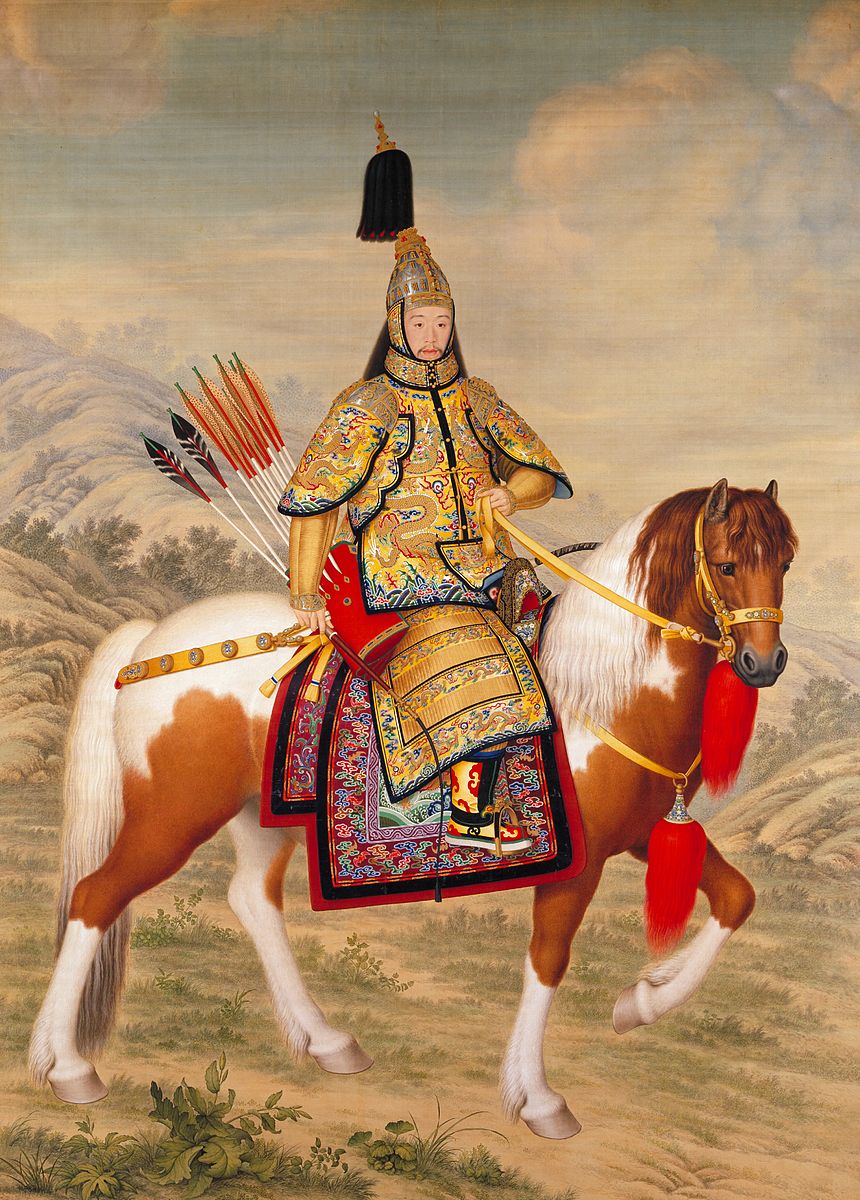
Yang Mingbin’s place in history is well researched, and surrounded by genuine historical figures such as Giuseppe Castiglione (1688-1766), a real Jesuit priest who was a painter in the Royal court in Beijing, and was responsible for influencing the Chinese style of painting of the era with western Renaissance ideas. You’ve likely seen some of his paintings before, such as the famous one of the Emperor Qianlong in ceremonial armour.
The Qianlong Emperor in Ceremonial Armour on HorsebackGiuseppe Castiglione (1688–1766)
So, the conceit here, then, is that you’re being asked to imagine what it would have been like if Giuseppe had had a friend in the court – another painter – who was also a martial artist, and what would happen if we had recently found a copy of his notes on martial arts. It’s a thought experiment, that the author begs your indulgence in as you read along.
Initially it works, because the historical setting feels authentic, but once we get into the actual meat of the book (Minben’s 64 martial arts essays), we find that Yang Minben writes exactly like a 21st century American who practices Tai Chi would write, rather than like somebody actually living in 1760 in China would!
Actual martial arts writings from that period in history tend to be functional, pithy and less verbose. Worse, Mingben’s text often uses modern conventions, for example, (p63),
“Dive into a swift flowing river and swim against the current. Keep swimming, but gradually change the direction – 0 to 45 degrees, to 90 to 135, then to 180 – finally swimming directly with the current.”
Would a Chinese person writing in 1760 have described this using degrees?
And things get very odd when, on p97, Minben writes, “between 1775 and 1779, Qing troops stabalized the northern and western boundary of Xingjang province, harshly squelching the rebellion in the area occupied by the Mongolic Zunghar tribe.”
How is Minben writing about events that happened in 1779 when the current date is supposed to be 1760?
That’s not to say there aren’t interesting things to learn here. I enjoyed the discussion of the Neo-Confucian scholar Zhu Xi and the concept of Li, the calligraphy analogies and the references to Lao Tze and Chuang Tzu. But if the author wants us to enter into his historical conceit, then I think it helps if the writing is consistent with the time period. I would have also liked to have heard more accounts of what Beijing was like in 1760. That would have helped build the illusion – city life, how business was done, what the pervading political climate was like, what the fashions were, what the gossip was – what was happening in Royal Court?
You could argue that since all of this is imaginary anyway, perhaps we do not need to make a big deal out of it? DeMarco’s writings are a collection of modern philosophical musings designed to be easily read and understood by the modern Tai Chi crowd and that draw in frequent references to the Daodejing and analogies with calligraphy and painting. I quite enjoyed them, but if you are looking for something that reads like the real classic writings on martial arts, you’ll be disappointed. However, if you’re after something a little easier to read and that inspires you to practice Tai Chi more, then you’ll find it here.
I had the good fortune to guide a group of people through some Xing Yi Monkey recently, which made me focus on it more and practice it a bit harder in the run up, which was a good thing. (I’m also available for children’s parties and Hen parties too, btw). Anyway, I wrote some notes about it, which I’ve typed up below.
A unique animal
When it comes to the animals in the natural world that we can look at for inspiration for martial methods the most obvious place to start is with one of our closes cousins, the primates. Like us, monkeys can stand upright, if only for short periods in some cases, they have hands that can grip and even a bit of limited tool usage. However, monkey is not a good place to start your journey into the 12 animals of Xing Yi.
The first thing to realise about monkey is that it breaks a lot of the ‘rules’ of Xing Yi Quan, which is one of the reason why it’s often taught last amongst the 12 animals. My teacher taught the animals as almost self-contained mini martial arts – each one had a different strategy and techniques, but Monkey wins the award for being the most unique amongst them. It really does stand up on its own as a complete martial art.
Almost all of the rest of Xing Yi Quan can be performed in formation, standing in a line with other people, since you generally move forward and backwards along a straight line (except for the turns, obviously). Whether this really harks back to an ancient heritage of soldiers moving in formation is speculation of course, but it should be noted that a row of people holding a spear and standing side by side can perform the 5 elements and most of the first 11 animal links while all facing in the same direction without impending each other, provided they all turn at the same time. That’s possibly one reason why Xing Yi is so obsessed with keeping the elbows near the ribs.
But Monkey doesn’t follow these rules – it’s breaks the line. Or more accurately, it’s what you do when the line has been broken. Attacks in monkey are reacted to and defended at diagonal angles – there’s footwork you don’t find in the rest of Xing Yi and there are changes in tempo, bursts of speed and jumping. It’s as if your nice orderly line of soldiers has been broken up and the battle has become more of a melee situation.
All the different types of monkey have similar movement, but the monkey native to China that Xing Yi is probably using for inspiration is the Golden Monkey. And thanks to the BBC there are plenty of Golden Monkey clips available to watch – this one of two tribes coming together and fighting over resources is particularly good:
And here’s an interesting clip of a group of wild monkeys who have learned to trust humans for food:
Both clips are a gold mine of information about how these animals move.
Monkey Pi
Pi (splitting) is the main energy from the 5 elements that is used in monkey, but while in Pi Quan the arm uses the elbow joint as a pivot point for delivering the downward chopping strike (a bit like the swing of an axe), in monkey it’s the wrist that is the pivot point. The monkey Pi is more like a slap, but don’t think that makes it ineffectual. A relaxed and loose slap delivered using good body mechanics to the head can easily result in concussions.
Monkey also tends to eschew single strikes – everything is done in quick flurries of 3. This is called a triple palm. Often the first strike is to open up their guard, or intercept a strike, the second is to hit the head, and the third can be done as a grab and pull on their limb or head, leading to your own head butt or knee strike – an action called ‘wrapping’. The back of the hand can also be used as an upward deflection to the opponents arms, for when the monkey wants to enter deep.
Range
Talking of entering deep, Monkey wants to either be too far away for you to hit (beyond kicking range), or right in at what would normally be called grappling range, (i.e. too close for what is generally called striking range) but the use of close body palm strikes delivered by turning the body sharply and the cross stepping opens it up as a striking range too.
Take a look at this video of a monkey antagonising a Tiger cub (I don’t think he’d be brave enough to try this on a fully grown tiger!) to get the idea of range:
As you can see, monkey is something of a trickster engaged in a war of attrition. A tiger generally wants to finish the prey in one big action, monkey will keep attacking, wearing it down over time. Often the monkey’s goal is simply to drive the opponent away out of its territory.
Agility, but with stability
Obviously to close the distance from outside kicking range to inside punching range you need tremendous agility to play monkey, however, agility without stability is a recipe for disaster, which is another reason for teaching monkey last – it requires a very solid understanding of the footwork methods of Xing Yi Quan. It uses a cross step frequently, and also spins and jumps.
Monkey requires you to be agile, but rooted when you step. Without that combination the movements of monkey can become just a dance. The stability also relates to being relaxed in your movements. Because monkey movements tend to be done fast the tendency is to get tighter and more tense as you do them. I find consciously trying to relax while doing monkey is required more so than in other Xing Yi animals.
Tea cups exercise
The arm methods of money require more utilisation of the joints of the wrist, elbow and shoulder than the other methods of Xing Yi. Techniques like “Reach around the back of the helmet” require significant mobility of the arm joints. The best way to achieve this is to become adept at the famous tea cups exercise. You should practice this is with actual tea cups full of tea (or water) and try not to spill any. This is incredibly difficult!
Here’s a basic instructional on the tea cups exercise:
Yin and Yang
Finally, we do a Yin and a Yang monkey in our Xing Yi – the Yang monkey is the bright, lively, younger monkey, while the Yin monkey is the more older experienced monkey who uses heavier techniques. Almost all the video you see of Xing Yi money on the Internet are showing the Yang version. The most famous move from Yang monkey is the upward ‘flying’ knee strike. Here’s a good example:
To be honest, I haven’t seen any other Xing Yi group do a Yin monkey like we do, but here’s a little clip of me doing some Yin monkey so you can see what I mean:
I’ve been meaning to read the story of Matthew Polly’s time spent training at the famous Shaolin monastery for years, but I finally got around to it recently thanks to my Audible.co.uk subscription*. And what a great read it is! I’m sure we can all identify with the teenage Polly, unsure of himself and his place in the world, who falls under the spell of Kung Fu and decides to dedicate his life to the pursuit of it as some kind of escapism from the pressures and fakeness of the modern world. To Polly, Kung Fu represented something sublime, pure and otherworldly that actually meant something. But unlike most of us, he did more than just dream about it, he actually went to Shaolin and lived there for almost a year, at a time when there was no Internet, no easy way to get there and China had only recently opened up to foreigners, so most Chinese people had never even seen a Laowai in the flesh before.
Polly’s story could best be summed up as a sequence of misadventures punctuated by moments of sublime martial arts inspiration. He manages to get into all sorts of scrapes involving accidentally offending senior party officials, being entered into a tournament against a San Da champion and hilarious misadventures with the opposite sex. Part Bill Bryson-style travelogue, and part kung fu geek-out, this is a rewarding, even emotional, look into what the Shaolin monks were really like in the 1990s, just as their international fame as stage performers was starting to spread and take over from the mystical image everybody had of them from the Kung Fu TV show. (Interestingly, at one point Polly watches the Kung Fu TV show with the monks who laughed their heads off at the idea of burning a dragon and tiger into your arms by lifting a hot anvil and dropping it into the snow – “why would you do that???”)
What you really get from this book is a sense of what the Shaolin monks are really like back then, and how much more human, relatable and down to earth they are compared to the lofty ideas we all have of them. It answers all the big questions like, how good are they at actually fighting, how seriously they take the “monk” side of their lives and how they train iron first, arm, head and even iron crotch.
The little snatches of Chinese you pick up by reading the book are also a hidden bonus and bring the characters to life marvellously. By the end of the book you feel like they are your friends and you know them just as well as Polly did. Anybody who likes this blog would love this book. Recommended.
N.B. The cover with a monk holding a Burger King bag is representative of the idea of American values seeping into China, but a little misleading as there were no Burger Kings in China then, and certainly nothing like that in the rural backwater of the Shaolin village.
*Like a number of other books, American Shaolin is included in the cost of an Audible subscription, so if you are a subscriber you get it free.
I don’t normally do a preview of my podcasts guests before the podcast comes out, but in the case of George Thompson I think it’s worth doing one because not only is he a fellow Bristolian, but he has so much great media out there for you to view that it’s worth watching some of it before the next podcast drops (which will be episode 24, due in a few weeks).
George has a great YouTube channel that has lots of Tai Chi and Taoism videos. He spent time in the Wudang mountains learning in a small Tai Chi school and there are lots of great videos shot in China that just look amazing.
He also makes hour-long films and I’d recommend giving Journey to the East a go, it’s a documentary of his last trip to Wudang and his adventures getting there because he was attempting to travel by train across Europe to China just at the same time as the pandemic was breaking in 2020. Check it out!
So, as a kind of counterpoint to my previous post questioning whether all Chinese martial arts come from military methods, I’d like to focus on one that definitely does – Xing Yi. Although, this really just emphasises my previous point because Xing Yi looks very different to most other Chinese martial arts and the reason it looks different is because it comes from weapons-based military methods and is therefore more concerened with military engagements than civilian. As our podcast series is showing, there is a verifiable historical connection between Xing Yi and soldiers – for example, the oldest historically verifiable practitioner linked to Xing Yi – Ji Long Feng, was a real life soldier in the Ming Dynasty army.
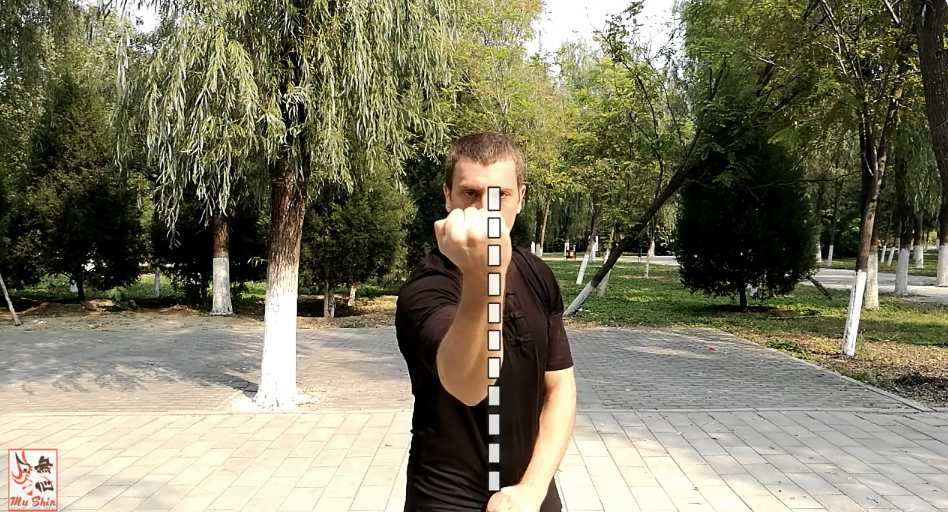
But the real reason you can tell Xing Yi descends from military methods is that you can simply look at it. The arms and legs are generally close together and close to the body, the posture is narrow and the direction of techniques is straight in front of you. Everything is done within the profile of the body. There are two main reasons for this 1) you were wearing armor and had to accommodate for the weight of it, and 2) you were using weapons, which were probably quite heavy, since they had to penetrate armor.
The Xing Yi we have today is what military arts would look like if you did them without wearing armor and using hand techniques instead of weapons. Of course, many people still do Xing Yi with a spear, but it’s rare to see anybody wearing armor doing it these days, which I think leads people to get the wrong idea about it.
Take a look at this video of my friend Byron Jacobs from Beijing doing Xing Yi Zuan Quan (Drilling fist). Look how tight everything is to the body and how the hands are kept within the profile of the body:
Here’s an example:
All this leads me to this excellent new video by Karate Nerd, Jessie Enkamp called “I trained like a Samurai for a day”. Here he gets Dr. Kacem Zoughari, a Japanese martial arts expert to take him around the Samurai Museum Berlin. It’s pretty interesting then half way through, it gets super interesting because he gets to wear old Samurai armor and have a go with a few authentic weapons. Now this is really valuable because he tries to do Karate movements in the armor and very quickly realises that it’s completely inefficient and exposes all the vital parts of the body to strikes from the opponent. The expert, Dr. Kacem Zoughari, gets him to change his movements so that everything happens within the profile of the body and makes him use the footwork, momentum and body to power the arm movements. The strikes become hidden, and tight to the body rather than telegraphed and open… and bingo! It starts to look just like Xing Yi! He suggests a cross step at one point and it looks a lot like Xing Yi Dragon step. The strikes he has to do start to look like parts of the 5 Elements – Pi, Beng, Tzuan.
Take a look:
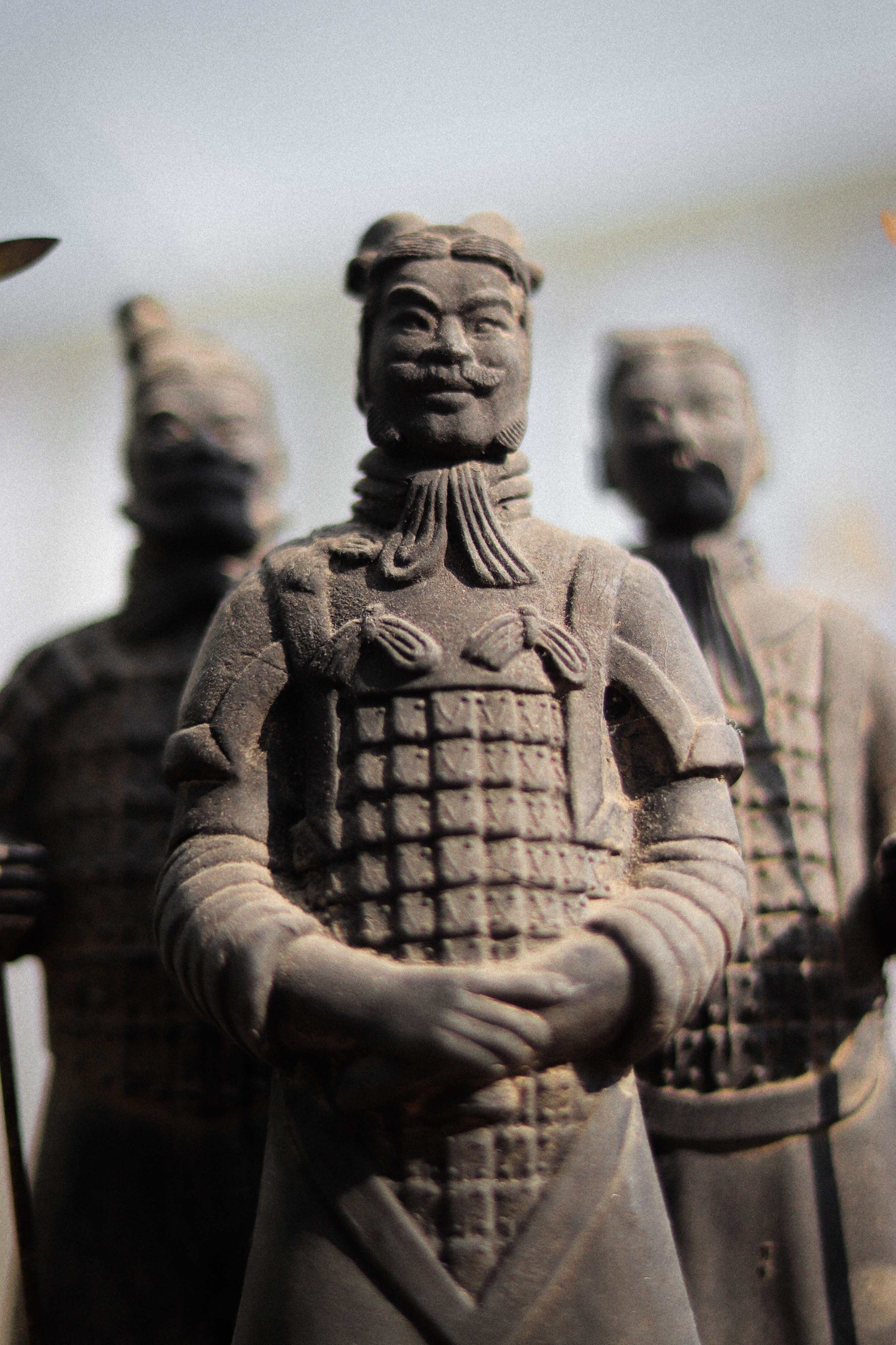
Now you may be thinking Japanese armor isn’t the same as Chinese armor and therefore none of this is relevant, but you would be wrong. That armor at the top of this post is not Samurai armor, (although I bet if you took the average person off the street and asked them what it was they would think it was Samurai armor). It’s based on Chinese armor from the Song Dynasty. This would have been officer armor, not what your average soldier was wearing, but the same principles would apply – you want your movements to protect your vulnerable areas – the neck and joints in particular.
Xing Yi is based on these principles – minimal movement, a tight profile, using the body, momentum and the step to power the arms, strikes based on timing rather than speed, etc. And that’s why it looks so different to something like Karate or Norther Shaolin or Long Fist, etc.
I think this post is perhaps a little half formed, but I want to get on to writing up my last lesson with Bear, so I’m going to put it out as is. Let the pieces fall where they may…
An interesting new video has been released by Will (a recent guest on my Tai Chi Notebook podcast) about his recent visit to Taiwan where he got to talk to various Taiwanese martial arts masters. It’s the start of a series and it looks like it’s going to be great – Will gets to walk down the smokey back alleys of Taiwan to find the martial artists and martial arts schools in Taiwan you wish you could. What’s not to like? Watch it here:
The blurb reads: “In the first episode, I meet up with my friend John Eusebio @longfistmantis to visit the bookstore of Liu Kang Yi. Mr Liu’s bookstore, Wuxue Shuguan has a huge collection of martial arts books, in both Chinese and English, and he has also spent decades collecting old and rare manuscripts. In this video he shares his insights on the development of martial arts from a military combat art, to an integrated system of both combat and health practice, as we see it today. He also shows us a copy of the Bubishi, the foundational manual of Okinawan Karate.”
Mr Liu talks about internal training, and how it relates to strengthening the tendons and fascia of the body, so that it can toughen and that can lead to more strength “qi” in the body. This all seems fairly accurate to me. (There’s discussion to be had about whether these methods were always a part of Chinese marital arts, or added in later from a different tradition, but that’s by the by). Then he talks about the 3 phases of development of Chinese martial arts, which is the part I wanted to pick up on.
To paraphrase, he says, the first is only martial training and not cultivating: it’s pure combat. No focus on health. This is the military period. The second is once it entered the civilian population. They train both combat and cultivate health, but separately, developing things like Yijinjing and Baduanjing. The third evolution was to combine combat and health, to bring both aspects together. Taijiquan is a good example of this.
Now, this is not a bad way of looking at the evolution of Chinese martial arts, but I think it’s a bit reductive, and crucially, it misses out a lot of other influences.
It’s a view that is not dissimilar to Peter Lorge’s in the book Chinese Martial Arts: From Antiquity to the Twenty-First Century which is that marital arts were all originally military arts and over time were simply dispersed from the army into civilian life.
Lorge’s position is laid out clearly in the introduction to his book starts with this:

I actually really enjoyed Peter’s lecture about the history of Chinese martial arts at the Martial Arts Studies conference 2017, but it seems that both Mr Lorge and Mr Liu both view Chinese martial arts as a kind of offshoot of military training, and nothing more, and in both cases the subject doesn’t even seem to be up for debate, it’s just presented as self obvious. The parallel between both of them is that they are relying only on written sources as their research into the matter. In fact, a lot of the cultural traditions of ‘common folk’ were not recorded, since writing belonged to the upper classes.
Now, I’ll admit, there can be no doubt that the intermingling of civilian and military life had a massive influence on martial arts practiced by people in villages, particularly after the Ming Dynasty army was disbanded and returned to civilian life after its defeat by the invading Manchu’s, who seized control of Beijing in 1644. Xing Yi in particular is one of the martial arts that traces its origins to that event, to military methods kept alive by ex soldiers who were now civilians who had had their weapons taken away. A review of Xing Yi’s existing methods and techniques today reveals a clear bias towards methods that work with a spear, which would have been the dominant weapon in the military for soldiers, and also a concern for facing an attacker who is in front of you, not to the side, which is another feature of military arts. However, most other Chinese marital arts are more biased towards barehand actions than weapons, contain sometimes elaborate sequences that would appear to be more at home on a stage than in a street fight, or involve making specific hand gestures or actions that hint at a ritual quality, that it’s clear, to me at least, that something more is going on here. Rather than just military methods being translated into personal self-protection methods, we are seeing other influences.
In China, there is a long history of martial arts being used in religious ritual, festival culture, spirit possession, street entertainment, Xiqu (Chinese theatre) and Wuxia (which literally means “martial heroes”, a genre of Chinese fiction concerning the adventures of martial artists in ancient China). I think those traditions have as much influence on the martial arts passed down to us today as the military does, and in a lot of cases, more. But, if you mention this to proponents of the “pure pugilism” brand of martial artist, they usually try and explain to you that all these things came out of marital arts. i.e. martial arts came first, and the dance/performance/theatre/ritual, etc came second. In fact, Lorge argues exactly this at 43.00 minutes in his lecture (which I still enjoyed!), despite cataloging wrestling going back centuries as pure entertainment for the Royal Court. This attempt to explain away the obvious flaw reminds me of when people present funky martial applications to form movements that clearly don’t look like marital movements. There are some frankly ridiculous martial application out there from well know teachers who, rather than just admitting that there’s no real martial application of this move that makes any sense, come up with something that just looks silly.
I’ve talked to a lot of martial artists on my podcast (20 episodes so far!) and I quite often broach this subject to see what kind of reaction I get, and I’ve found that the martial artists who live in Asia, or have lived there for some time, tend to have no problem with the idea that Chinese martial arts is a broad church of methods derived from various traditions. It tends to be the people outside of that culture who have a problem with what they’re learning not being a super-deadly killing art created for one purpose only – to be the best fighter! I suppose it’s because so many of these cultural traditions are still alive and well in Asia today that it’s hard to deny their existence. Just look around you. Martial arts training halls tend to have shrines in them where incense is burned as part of a religious ritual. Or the martial arts school participates in local religious festivals by enacting Lion and Dragon Dance routines, or giving a demonstration of martial arts. Or there is a semi-religious ceremony involved in becoming an indoor disciple, etc.
I think two things are going on here. First there’s a reaction against the modern Chinese trend of turning marital arts into a gymnastic demonstrations instead of fighting arts, and secondly there’s a reaction against the modern trend for making Chinese martial arts appear as spiritual and mystical in the same way Yoga is.
As Charles Holcomb wrote in 1990 , “Everywhere in China the martial arts either present themselves in the guise of simple exercises or are shrouded in arcane religious mysteries. Western enthusiasts often feel impelled to strip away these religious trappings and construct a version of the martial arts that is neither simple gymnastics nor religion, but emphasizes true hand-to-hand combat skills. The question remains, is this an authentic understanding of the martial arts?” [1]
I think that process of trying to present the martial arts as true hand-to-hand combat skills is very much alive and well today, I mean, its probably what most people are looking for when they start Kung Fu. I certainly was. But I think it’s also something of a reaction to the introduction of Chinese martial arts to the West, which came off the back of the Kung Fu TV series (which presented martial arts as mystical from Shaolin monks) and followed off the back of mystics like Alan Watts who presented a very counter culture sort of take on Eastern religion.
While there’s nothing wrong with that, my feeling is that it misses out on the wider, and weirder, historical context of the arts we practice today. They’re a rich blend of various traditions, and we should treat them as such.
[1] Theater of combat: A critical look at the Chinese martial arts by Charles Holcombe, Historian. Vol. 52 No. 3 May.1990. Pp. 411-431 Copyright by Michigan State University Press
My guest for this episode is Will Wain Williams. Will has a background in Taiji Mantis Kung Fu, which he trained in China, where he also lived for 13 years. He’s traveled around Asia documenting ancient Kung Fu systems for his YouTube Channel Monkey Steals Peach ( https://www.youtube.com/@MonkeyStealsPeach ).
I talk to Will’s about his travels documenting kung fu styles, as well as his upcoming trip to Taiwan and how he’s recently started Brazilian Jiujitsu.
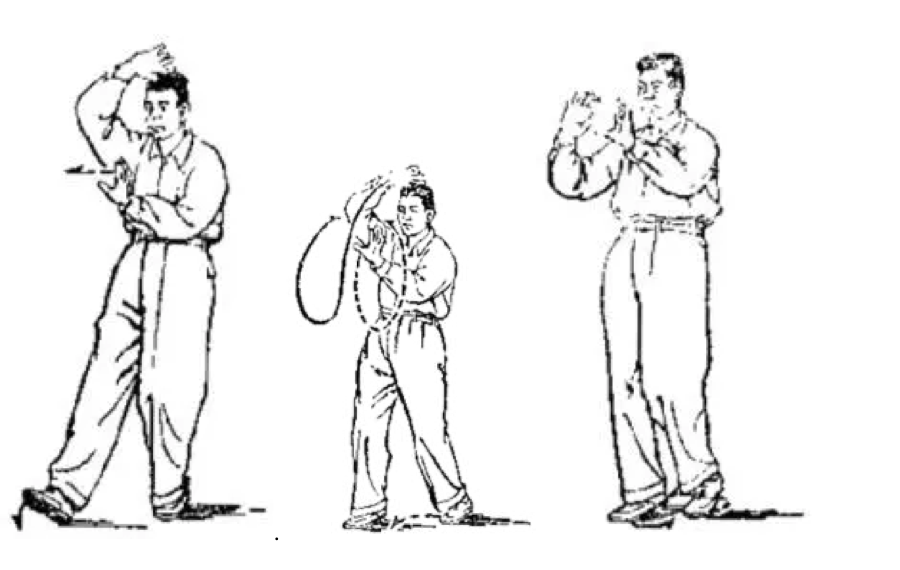
I’ve always been curious about the postures in martial arts forms where both feet are together, because these postures don’t look very martial at all. In fact, it’s hard to imagine why you would want to use a stance like that in a fight, and yet we find them in a lot of Tai Chi forms:
Here’s an example of the posture in application in Taiji performed by my teacher Sifu Raymond Rand:
Sifu Rang, Brush Knee, Twist Step.
It seems to be mainly Taiji lineages that have some influence from Sun Lu Tang that do this the most. A lot of people attribute the distinctive ‘feet together’ postures he used to his prior training in Xing Yi, and there could be some truth to this. Xing Yi does have ‘feet together’ postures quite a lot.
Of course, the root of Xing Yi is spear fighting, but the modern interpretation of the art is heavily biased towards bare hand training, and this creates a misleading impression. Think about it – if you were at at least one spear length away from your opponent the risk of being tackled to the ground because your feet are together would be greatly reduced. You’re now free to use the power generation advantages that can be gained by letting both feet come together, which is handy when you are holding a heavy object, like a spear.
If you watch this excellent video of Xing Yi spear technique by Byron Jacobs you’ll see that he doesn’t hang out with his feet together all the time, but occasionally he uses the feet together moments for power generation (and of course, also standing on one leg for range advantage and manoeuvrability in a way that makes sense with weapons).
In Xing Yi the most famous example of the ‘feet together’ posture is the Half-Step Beng Quan. Here the back foot stepping up to meet the front foot in place creates a powerful closing action of the body, kind of like a door slamming.
So, is this the origin of ‘feet together’ postures in Taiji forms? Quite possibly. However, there is one more thing to consider. After first learning Xing Yi, Sun Lu Tang learned his Taiji from Hao Weizhen 1849–1920, who learned from Li Yiyu 1832–1892, who learned from one of the Wu brothers, Wu Yuxiang 1812–1880 who had learned directly from Yang Luchan 1799–1872 and also sought out Chen Qingping 1795–1868 who he learned from in Zhaoboa village.
It’s often thought that the distinctive stepping seen in Sun style Taiji, where the back foot is often lifted and brought up close to the front foot, is a consequence of Sun’s prior Xing Yi training. This makes sense as part of the narrative created as part of the Sun Style Taiji brand, which is that he incorporated his earlier Xing Yi and Bagua training into his Taiji style. However, if you look at the Wu (Hou) style he learned, it already had this distinctive stepping in it.
While the feet don’t go completely together as much, if at all, in Wu(Hao) style, they are very close together for a lot of the time. Watch this video for an example of the form in action:
I think you can see that influence extending into Sun Lu Tang’s Taiji, which makes sense since he learned from this lineage.
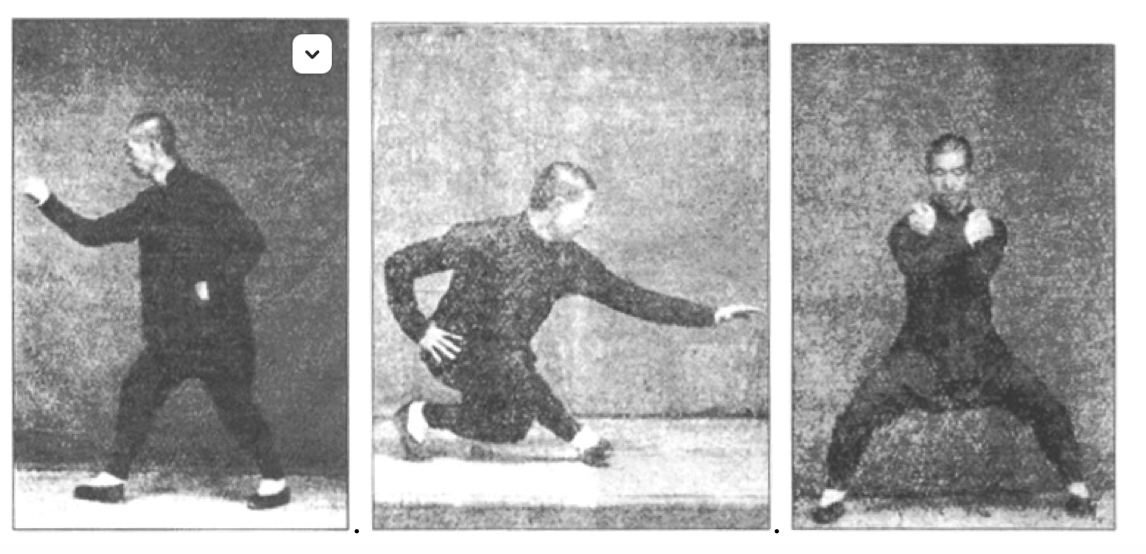
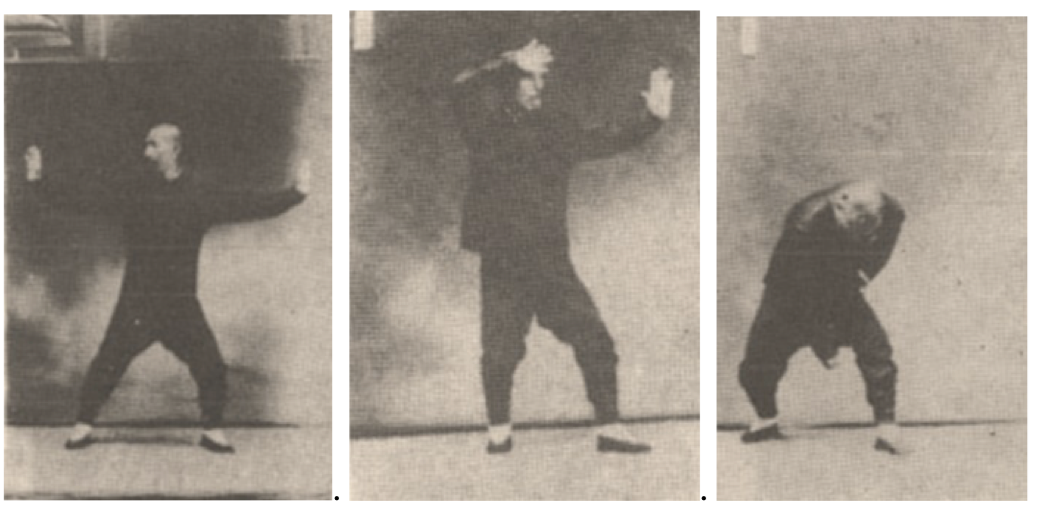
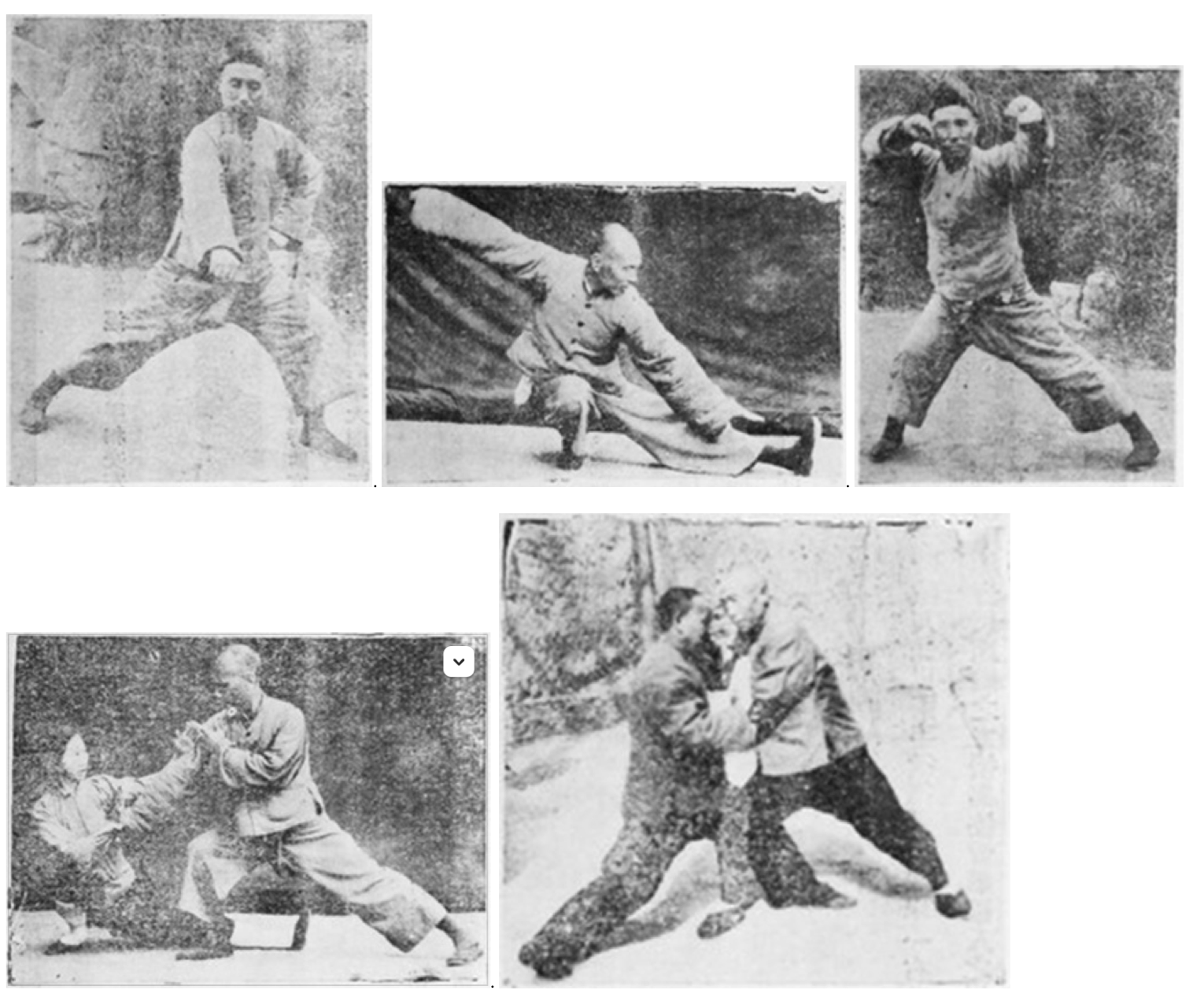
Finally, I should note that thought this post I don’t want to create the impression that all the steps in either Xing Yi or Taiji performed by Sun Lu Tang are small or restricted. He also had plenty of wider postures in his arts too, for example.
Xing Yi:
Taiji:
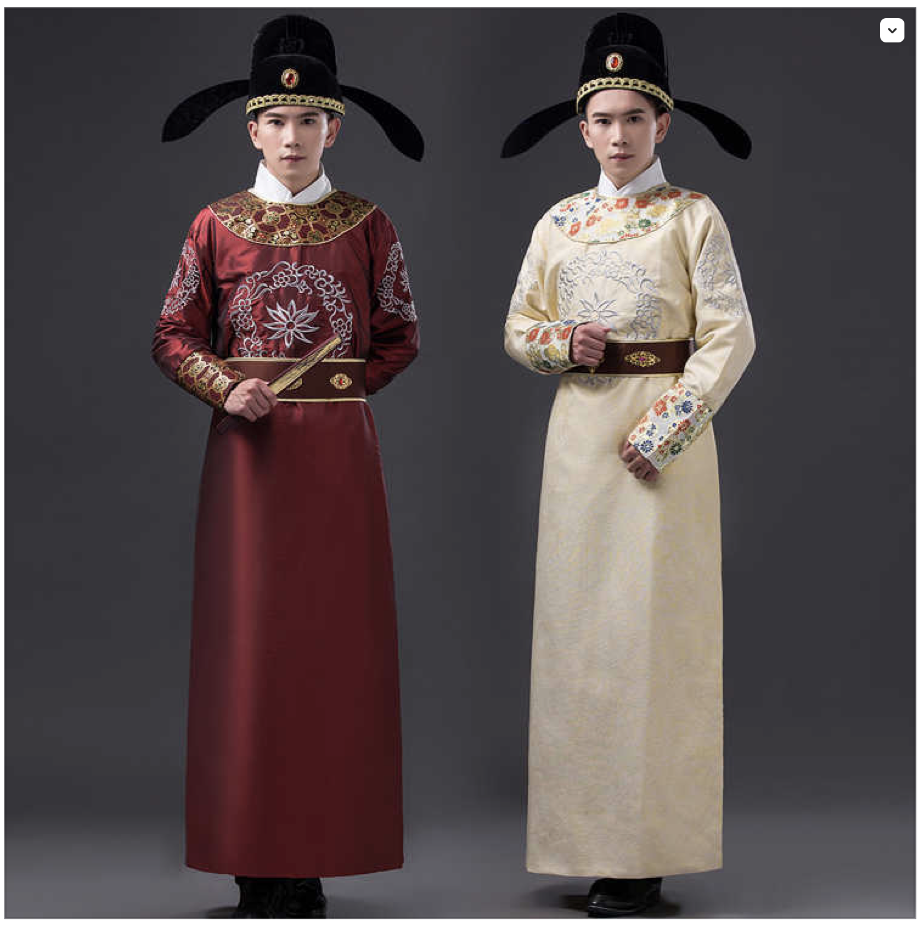
However, compare it to postures found in other styles of Taiji whose practitioners didn’t have to wear court dress:
This is a very interesting interview with scholar and practitioner Simon Cox, PhD, whose book on the history of the concept of the subtle body is available on Amazon. Simon lived and trained full time in the Wudang mountains for over five years and has lots to tell…
I’m hoping to have Simon as an upcoming guest on my podcast, so if you can think of any questions you’d like me to ask him about what it’s like training Taoist martial arts in an actual Taoist monastery then put them in the comments. Thanks.
If you’d like to learn more about Simon, see amazing photos from his time in China, and join his mailing list to hear about all the cool stuff he’s offering, check out okanaganvalleywudang.com.
I find I’m getting increasingly fascinated by the concept of ritual, magic, and how it relates to Chinese martial arts. I think I’ve just never been satisfied with the explanation that forms in Chinese martial arts are there for cataloguing techniques. There are many martial arts in the world that do not require forms to catalogue either their techniques or body methods (Shen fa). When something like that so obviously doesn’t add up, I think there has to be something else going on. But what?
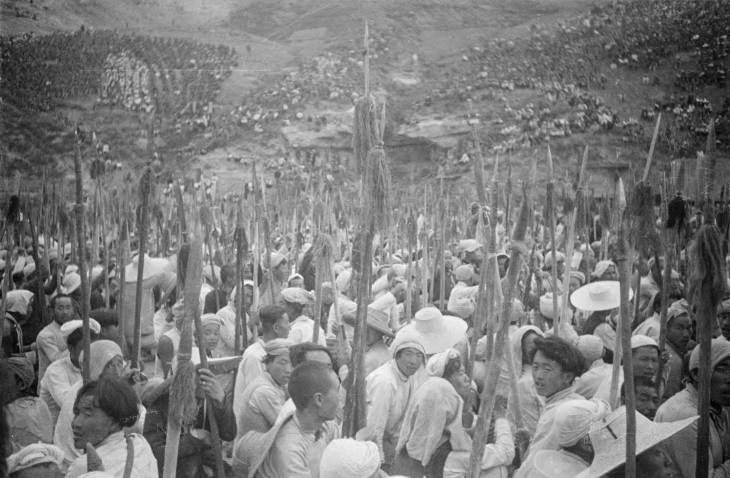
It’s been a long time since I’ve linked to Ben Judkins excellent website Kung Fu Tea, but I’m going to recommend that you give this article a read. It’s about the biggest group of 20th century Chinese ‘martial artists’ that you’ve probably never heard of. They were called The Red Spears. And despite having a membership in the millions (millions!) they tend to get wiped from modern historical accounts of Chinese martial arts. Made up of poor, usually illiterate members, they existed away from the cities and the urban areas, where all the well known marital arts groups like the Jingwu Association and the Koushu Association existed. Urban association tended to write books and leave more newspaper articles as evidence for historians. The Red Spears had the numbers, but they were out in the sticks, and out there, less ‘scientific’, ‘outsider’ and ‘western’ ideas pervaded. There we find war magic, rituals and mystical arts.
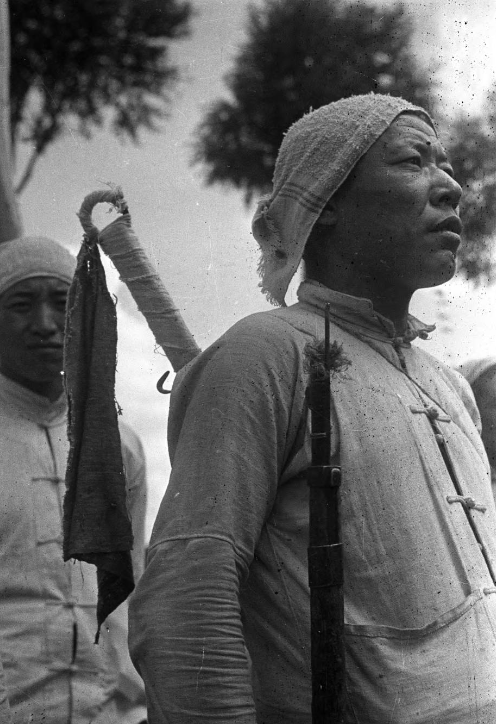
Yanan China Peoples’ Militia member.
The Red Spears, as effective grassroots organisers in local areas seemed to perform something of the same function as elements of the historical Yakuza in Japan, stepping in when local authorities overstep their mark and being effective at “getting things done”.
And despite the name Red Spears, let’s not forget that these militia groups, like all militia groups, carried rifles. Performing magic rituals and being in a secret society did not mean they rejected all modern technology.
The article contains a report called “Background and Doings of China’s Red Spears By Norman D. Hanwell (Asia Magazine), The China Weekly Review, August 19, 1939. Page 381” which talks about practices that don’t seem a million miles away from what we would call chi kung these days, if you made it more secular and removed the practices we would call superstitious.
“Through the customs of the Red School probably differ from locality to locality and naturally the secret part of their program is difficult to confirm, since no outsider is permitted to attend, there are descriptions by Chinese in print. In some sectors members of the Red School “got to school” in a temple each evening. Arriving with their red-tasseled spears. Reaching the School Hall they come before the incense altar common to all Chinese Temples, bare their backs and kneel to listen to one their leaders lecture. Following this, each one breaths deeply and beats his breast, ending with the shouting of the slogan “Chi Kung lai yeh!”—a phrase difficult to translate. Perhaps it might be compared to “The gods be with us!” a short incantation from which strength may be obtained. Out of this process some of the Red Spears are convinced of their invincibility in battle and immunity to death therein.
The Type of Training
Certain persons profess to find in this type of training some scientific basis. For example, the regular evening attendance, the listening to lectures and the sitting in meditation are good training, they claim, for the development of the quality of serenity or tranquility. The practice of holding the breath and beating the breast is excellent for developing the lungs. The crying out of the slogans is declared to be good training for breath control. Whether we accept any of these “scientific” values or not, we must admit that there are psychological advantages to be obtained from these practices. The peasant convinces himself of his own ability to undertake certain tasks, and his conviction inevitably increases his effectiveness.
A recently made investigation of the White Spear Society of Anhwei Province, an area now under Japanese occupation, reports that the superstitious “Chu kung lai yeh!” has been replaced by slogans more appropriate to present activities. Among these are “Kill the Eastern Sea Devils”—that is, the Japanese—and “Kill the Traitors”—that is, those Chinese cooperating with the Japanese.”
As you can see, the report talks about breath control, tranquility training, hitting the body to strengthen it and gain invincibility (The shouting of the slogan “Chi Kung Lai yeh!” may have some relevance, but who knows…? That may simply have been the historical equivalent of “Let’s do this!”)
I’m increasingly wondering how much of modern Chinese martial arts is built on all this long forgotten training from a different time and setting. It’s interesting to ponder.
I wrote about cults in marital arts yesterday. I think its pretty clear that The Red Spears would fit the definition of a cult, but by modern standards they are way more extreme than anything the Tai Chi world can conjure up today. Forget expensive training camps. They actually led their members into armed conflicts, battles and more! That’s also an interesting topic to consider.






 The Tai Chi Notebook