Martial arts as theatre, theatre as martial arts – meeting Scott P. Phillips

A new theory on the origins of Tai Chi

pulteney-bridge-bath

One of the benefits of posting on the Rum Soaked Fist internal martial arts discussion forum for so long now, and also working in the beautiful city of Bath, is that I’ve met up with various US Chinese internal martial artists on their travels through this fair isle. Bath is lovely and deservedly on the tourist trail for travellers from across the pond. They come to Bath and we meet up and talk through our favourite subject – martial arts – usually over lunch, then potter off to a local park to exchange techniques. It works out perfectly because they get to see some touristy culture as well as geek-out about their favourite subject – martial arts – with me. I’ve also been across to the US on a few occasions too, and managed to fit in meet ups with various people I’ve known from RSF. Meetups are usually fun and interesting because people always have different perspectives from my own, and I like that. I enjoy seeing the world from a different point of view. How else are you going to expand your horizons if you don’t meet new people?

Last year I met up with the notable Tai Chi practitioner Scott Meredith, or “Tabby Cat” as he’s known on his semi-famous Tai Chi/Astral Animal blog. We had a great time. Scott’s forte is fixed-step push hands from the Cheng Man Ching lineage via his teacher Ben Lo. Scott showed me some of his method and I shared a bit of my XingYi in return. He mentions meeting me in a post here. Scott is a great guy and very skilled at his style of push hands, and I’d really recommend hooking up with him if you get the chance. This week I met up with another Scott, who’s also a big personality on the Tai Chi scene – namely Scott P. Phillips of North Star Martial Arts in Boulder, Colorado. Scott was over here in the UK for the first ever Martial Arts Studies conference at Cardiff University, run by my good friend and erstwhile martial arts student Dr. Paul Bowman. Scott has practiced many different martial arts, including Chen style Tai Chi and XinYi Liu He Quan with George Xu (I really liked the look of his Xin Yi)and has recently become involved in teaching seminars with the Li Shi organisation on Taoist movement.
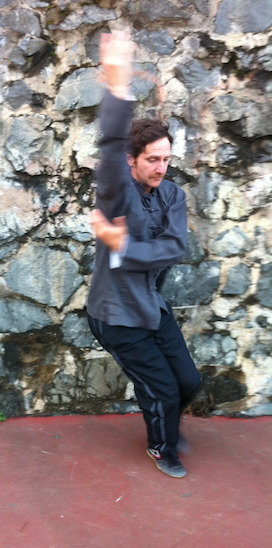
Scott Phillips performing Ba Ga Zhang.

Scott Phillips performing Ba Ga Zhang.

My experience with martial artists is that each person has their ‘thing’ – whatever that may be – that is their individual take on the whole martial arts shaboodle; its point. Why you should practice it. Or a particular method. With Scott I’d say that thing is ‘martial arts as theatre’. He’s theatrical in nature, and boy, does he love to perform! Over a local stout (which turned out to be delicious, despite the waitress describing it as ‘like Guinness, but not as good’) we discussed many martial subject – too many in fact – and while I can’t say that all of the mud he flung at my wall stuck (he blasted me with probably two decades worth of research material into martial arts, theatre and traditional dance over the course of a single hour!) the one idea of his that really struck home for me was the under-appreciated role of traditional Chinese theatre and folk religion ritual in forming today’s martial arts. Scott’s argument is that Chinese Opera needs much more credit for its role in creating and shaping Chinese martial arts styles than we give it. Much more. For an example of what he’s talking about watch this old video he made on the role of established characters in Chinese Opera, and their relation to the typical warm ups you find in a Tai Chi or Kung Fu class:

https://www.youtube.com/watch?v=gyms4lomW50

But his theory goes much deeper than this, way beyond mere warm-ups and further down the rabbit hole. You really need to see him jump up out of his seat and perform his guided walkthrough of the opening of the Chen Tai Chi form to ‘grok’ what he’s talking about. With spunk and vigour he relates each posture to a part of the story of Chang Seng Feng (Zhang Sanfeng), the legendary founder of Tai Chi. He’ll show you how some of the hand positions from Tai Chi have well-established operatic meanings – for example, the hands with the wrists crossed – a position found near the start of the Chen form – means “awaking from a dream”. His theory is that the Tai Chi form tells the story of Chang Seng Feng, and as you move through it you are performing the ritual of his canonisation. The Chen form (and hence, its derivatives like Yang, Sun and Wu) therefore is a canonisation ritual immortalised in a set of martial arts movements. Let’s take Crane Spreads Wings as an example. As the story of the form unfolds Chang Seng Feng journeys to the capital, and sees a fight between a snake and a crane on the way, which inspires him to create Tai Chi Chuan. In the form, this is the point where you do White Crane Spreads Wings, and so on and on it goes, with each posture representing another part in the story.

Zhan Sanfeng, shown in a posture that’s rather similar to Buddah’s Warrior Attendant Pounds Mortar from the Chen Tai Chi form.

This theory explains the long established, yet sometimes baffling, connection between Tai Chi and Chang Seng Feng. It sounds ridiculous, but when you see him perform it (and I really mean to use the word “perform” here, with facial gestures, and dramatic pauses to boot), it’s a strangely compelling argument. Or maybe it was the stout talking, but I don’t think so – there’s definitely something to the unappreciated role of theatre and ritual in all martial arts.

Take Tai Chi Chuan, for example. People often need to be told that it’s a martial art, because it doesn’t look like one. How did we get to this place where we have a martial art that doesn’t even look like a martial art? People always point to the more fighty and vigorous Chen style (there are fast punches and kicks that make it look like a proper martial art) compared to slow, graceful pace of Yang style, yet it’s pretty obvious from watching the opening of the form that most of the movements are floaty and obscure and don’t even look martial in nature at all. Take postures like Buddha’s Warrior Attendant Pounds Mortar, where you stamp your foot and strike your own palm with your fist, then make a circular, rotational motion with the hands and belly as an example. The stamp looks martial, and makes a nice noise, but what are you doing? As a martial arts technique it looks utterly unpractical. Sure I’ve seen people demonstrate a supposed martial application for the movement, but it never looks convincing. If your aim is to learn to fight, then there must be a quicker way than this… But, what if the move is really just the acting out of part of a ritual – the metaphorical mixing of two elements in a mortar and pestle? That explanation suddenly sounds a lot more feasible than this being a deadly martial arts technique!

Even the traditional start to all Tai Chi forms – the raising and lowering of the hands had a meaning related to theatre – it signalled the start of a performance in Chinese Opera.

The idea that all Chinese martial arts are based, in part at least, on theatre and ritual, also opens up new explanations for why we do things the way we do them. For example, why do we practice long solo forms, unless they are designed to be seen and performed? Why have (even secretive) Chinese martial artists always done public demonstrations of their skills? What’s all that breaking of boards and bricks really about? Why are there so many videos of ‘Chi tricks’ out there showing Tai Chi masters moving their students using nothing but the power of their Chi? Perhaps, we’re all just performers, who have forgotten we’re part of a very,very old play? What if it’s all just a variation of a magic trick? You’re not supposed to get upset that all these chi masters are not teaching real-world self defence – it’s just a magic trick after all, and you’re supposed to just enjoy it as theatre, and nothing more. And everybody knows, you’re not supposed to ask the magician how he does it, as that would spoil the magic!

It’s a fascinating idea, and an awakening from a dream, of sorts.

As I said, you need to see and hear Scott explain things himself to really do his theories justice. At best I’m probably misrepresenting them horrendously, but all I’ve got to go on are my memories from one meeting, slightly clouded by excellent stout. Scott tells me that a professionally made video of his guided Chen Tai Chi walkthrough (complete with Chinese subtitles) is on the way. Plus, Three Pines Press is expected to publish an extended academic essay about his theory with pictures in December, in a book called Daoism and the Military.

Look out for both. And do get out there and meet people – you’ll always learn something.

#RealXingYi

Exciting new website

realxingyi

I want to give a ‘shout out’ here to my friend Paul and his amazing new venture, the XingYi Academy website, and Facebook page.

In his own words:

“There is not much there now but that will change very soon, regular blog updates and later a full members area with loads of content and instructional videos.

Just a few of the things we have planned:

I am already embarking on a project with one of my students who is fluent in Chinese to make a translation of Yue Fei’s Theses and interpret them from a martial context to show their relevance to Xing Yi practice. This will be added to the members area when we’re done and we hope to also publish our translation academically and in a simplified form as a paperback.

I’ve just bought an antique Chinese spearhead and hope to restore it and show some xing yi spear with a real spear with a real historical spear head. (I’ve also got a live spear head and hope to put up some video of test cutting with a live spear too). We might even film some Xing Yi Archery at some point ;)

We’re big on full contact fighting and we’ll definitely be showing how Xing Yi can be used for real, hence our tag line “Real Xing Yi”.

I’m hoping we’re going to raise the bar and set a new standard for Xing Yi online, in terms of depth and amount of content (we seem to have sheds of stuff and from experience I’ve not found any other school with the sheer amount of material I’ve managed to learn or discover especially in 12 animals xing yi), but also in terms of quality of the media, we’re looking to really up the game and make everything to the highest standard we can. As we grow we’ll even go over the older material and update it and increase the quality when we have new camera equipment or space to film in etc.

And at the end of the day we’re just going to put all our stuff out there, whether people are beginners, experienced, whether they like what we do or not I guarantee we’ll be presenting things that will be new to a lot of people and I’m sure all Xing Yi practitioners will find something to take away. And we’ll happily engage in debate and discussion, we hope to be able to provide members forum and some kind of Q&A/two way feedback discussion with members and with me and the other XYA guys once we get going down the line.

We hope to have a mailing list up and running by the end of next week, maybe even by Monday but for now if anyone would like to take a look please do so. Support and feedback is much appreciated.”

The best way to stay on a sinking ship

Alignment matters, but not that much

We talk a lot about alignment in Tai Chi, but often this is done by looking at a static posture. The hip is aligned with the shoulder here, the elbow aligns with the knee here, etc… We do this because it’s easier to do it this way, but we should never forget that alignment is something that happens as you move.

Biomechanist Katy Bowman discusses this often ignored movement aspect of alignment in the first episode of the Katy Says podcast.

Give it a listen. I particularly like the analogy that ergonomics is the best way to stay on a sinking ship.

Tai Chi lacks ground fighting

It’s true – it does

A recent Internet clip https://www.youtube.com/watch?v=fs_kdGe8Ljc showed what was supposed to be a random attack on a subway somewhere that looks a lot like China or Japan. Two men get onto the subway, involved in some sort of disagreement, one pushes on the shoulder of the other who applies a swift wrist lock, throwing him to the floor, then acts like he’s about to help the attacker up, then the clips ends.

Firstly, it may or may not be a real clip. There’s something about the whole confrontation, and the technique used that looks a bit staged. The technique is too clean, the attacker looks like he’s acting, etc. It could all be being played out for the camera, to make it look real, or not.

Either way, there’s something you can learn from this – mainly that the defender has no idea what to do with a person on the floor that he’s just put there. Standing back to let them get up is a really bad idea. Think about it – you’ve just hurt them, humiliated them by throwing them on the floor and now you’re going to let them get up? Odds are that you’re really going to be in trouble now, because they’re really mad.

It’s a tactical error to let them get up, but one that probably happens because the defender is afraid of going to the ground. 6 months work in some sort of grappling art would sort this right out. I’d say restrain the person on the floor until you can safely get away, or they have stopped being a threat, or law enforcement arrives. Anything else is a big risk.

But why not just kick them in the head, you might ask? Well, in a court of law I think you might end up in trouble for doing that. Laws vary between countries, but I think it’s safe to say that your level of response has to be appropriate to the level of aggression.

So, yes, it’s probably a good idea to incorporate what to do to a downed opponent into your martial art studies.

Redefine your idea of exercise

Katy says

I hadn’t been aware of Katy Bowman, and her blog Katy Says, until I happened across this episode of the Joe Rogan Experience podcast:

It’s about how we aren’t designed to live the way we live in the modern world, and how that should change your approach to exercise. It starts getting interesting at 17 minutes, and again at 55 when she talks about the importance of walking more.

There are some great insights here, particularly the idea that:

1. We put our eyes into a cast by not looking at things far away often enough.

2. Everything we walk on is flat – this is really unnatural and we should have more regular access to uneven terrain.

3. Sitting down for long periods is very bad for you

4. Go barefoot – you get more aware of your feet because you have to protect them, plus your toes get to move sideways, which rarely happens in shoes.

5. You need to walk more than you do.

There’s a lot more here – it’s well worth a listen.

Become a Stoic for a week

You know you want to

stoic1

A lot of people are attracted to Tai Chi because of the associated Taoist philosophy. It turns out that there’s perhaps less historical proof of a link between Tai Chi and Taoism than some people would like. You can think of Taoism more as an intellectual ‘bolt on’ addition to an existing martial art, or perhaps as a reimagining of Taoism In Action in the 1900s, a bit like when somebody remixes the classic Beatles albums with a modern house groove. But anyway, for whatever valid (or invalid), historical reasons, Taoism and Tai Chi are now part and parcel of the same package.

I think a lot of Westerners are attracted to Taoism (and Buddhism) because it represents something that has been lost in our culture. (Ironically it’s probably even harder to find in modern, face-obsessed, materialistic 20th Century Chinese culture, but that’s another story). But it wasn’t always like this. Ancient Greece and Rome had some of the same ideas represented in their various schools of philosophy. Philosophy to them wasn’t the dead, academic, historical subject that we know today. It was a living breathing thing that hadn’t been pummelled to death by religion yet.

Stoicism is one of the philosophical schools of ancient Greece and Rome that appeals to me – it tends towards the practical, the ‘how to live your life well’, of Taoism, with probably a bit more real-world applicability and more obvious steps to get somewhere. It was followed by slaves and emperors, so it must have been useful for all walks of life. Thanks to the Stoicism Today page you can become a Stoic for a week – give the philosophy a spin, and let it marinate in your brain for a while.

Go on, it’s free – try the one week course – your slaves will thank you for it:

http://blogs.exeter.ac.uk/stoicismtoday/files/2013/11/Stoic_Week_2013_Handbook.pdf

Using your opponent’s force against them

A neat twist on an old idea…

From the Treaste on Tai Chi Chuan 

“When the opponent is hard and I am soft,
it is called tsou [yielding].”

The idea of yielding to overcome is the main combat strategy of Tai Chi Chuan, but there are various ways of thinking about this idea. It’s another way of saying to use your opponent’s strength against them. Recently I found another way of thinking about this that you might find useful.

From Buckling the Crippler 

“In the martial arts, there is often talk of taking the opponent’s strength and using it against him, but normally this is illustrated in books and films with a woman performing a judo throw on a male aggressor. But I contend that there is no better example of using and opponent’s strength against him than drawing him onto your blows and having him double the force for you.”

The value of An “Push” in Tai Chi

Don’t push me!

One of the things that get belittled about Tai Chi Chuan so much is the amount of pushing that goes on. From the point of view of other martial arts it’s impossible to look at people struggling for years to effectively push somebody away in the most relaxed way possible and not wonder if they’ve missed the point of martial arts entirely.

Tai Chi push

Of course, the standard answers to this type of criticism are that “if you can push, you can hit!”, “it’s just a training tool”, “it’s so nobody gets hurt”. This may all be true, but there never seems to be any hitting going on, long after the ability to push has been acquired.

Perhaps another way to look at it is that pushing, far from being an ineffectual tool in the fighters arsenal, is actually a very valuable skill to acquire. Read this article  about the famous kick-boxer, Giorgio Petrosyan. The summary is, he uses the push technique effectively to counter pretty much all offense that’s thrown his way.

Pushing the opponent away.

Perhaps Tai Chi needs to reclaim its “push” as just what it says on the tin – a push – and stop trying to pretend it’s for something else. Because, frankly, it’s pretty damn useful.

It’s interesting that a lot of Tai Chi people have Push “An” as a downward push – almost like a takedown done from a push, but without the leg trip. I’m dubious about this – I don’t think it works well beyond the Master’s doe-eyed students. Looking at the motion of any Tai Chi form, you can see that the motion of An is up, up, up and away. I’d suggest that’s how it’s meant to be used. I think some of the ‘push down’ is to crowbar Tai Chi into a philosophy.

The absurdity of Single Whip

Yes, it’s pretty absurd

/home/wpcom/public_html/wp-content/blogs.dir/a6c/3733799/files/2014/12/img_0635.jpg

This is the ‘end point’ of the Single Whip posture. Like many, if not all, the postures in a Taichi form, it doesn’t look much like something you’d see in a fight. Why is this?

Even when demonstrated by the practical, hardcore, or no-nonsense tribe of Tai Chi practitioners, it’s a pretty absurd fighting application. That’s just my opinion, so feel free to reject it, but to be honest, a lot of Chinese martial art is pretty absurd, when it comes to fighting applications (“Monkey steals the peach!”, anyone?) Even the ruthlessly practical styles have a few applications that are aways on the edge, but anyway…

I was picking up on this old post from internal strength adept Mike Sigman:

“Silk-Reeling and the Taiji of Yin-Yang

There are two basic martial-arts postures in Asian martial-arts: Open and Close. In “Close” there is stress inward along the front of the body and the inward parts of the limbs; the knees and elbows and the joints bend and are generally under contractile forces of the front. Wing Chun’s basic stance, Uechi Ryu karate’s basic stance, “Play PiPa” (in Taiji), the closed aspect of “Squatting Monkey” (in Dai Family Xinyi), and in many other martial arts can be found variations of the Closed position of stances.

In “Open” the expansive forces from the back of the body and the outsides of the limbs pull the knees and elbows outward and the body lengthens, joints opening. Postures like “Single Whip” exemplify Open. In classically correct postures there is always a balance of the forces of Close and Open or Yin and Yang.”

So, if the point of practicing a Tai Chi form is to get used to going from open to closed in a sequence of postures, perhaps it becomes less relevant what those postures are. Of course, this implies that the form isn’t really for fighting, and that it’s for teaching a body method, which you then use in fighting… which means that the “fighting” probably doesn’t look any different to regular “fighting”, whatever that may be….

If you want to go from close to open then why not create a nice series of postures rather than simply repeat the same movement over and over. That way you get used to doing it in a good variety of positions.

Anyway, food for thought.