Lo and behold! Leandro Lo – the master of the BJJ guard pass


Breaking down the floating guard pass game

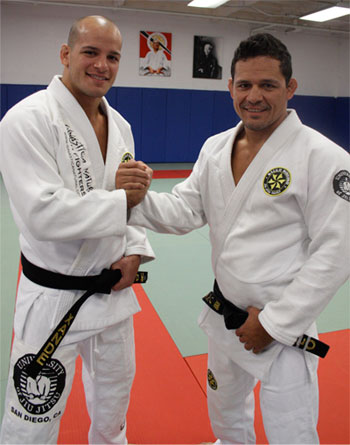
Despite being young, Leandro Lo is already a legend in the sport of BJJ, and he’s only just getting started. Training out of the same gym as the Myao brothers in Brazil, Lo has been winning major comps for a few years now, moving up in weight while doing so. He won this year’s Pan Ams against Romulo at medium heavy. His matches are always exciting to watch, as his style is characterised by frenetic guard passing and what appear to be plenty of mad scrambles.


Read the rest of this post at my new blog… BJJ Notebook


Power your Tai Chi from the inside

How to put the juice into Rollback and Press 

comet-now-343175

Tai Chi contains advancing and retreating movements, combined with circling left and circling right. Of course, in Tai Chi all movements need to be powered by the dantien. That’s easy to say, but on a practical level, how does this work?

One way I like to think about this is that as you retreat you can think about the arm movements being pulled by the dantien and as you advance they are pushed by the dantien. You can think of ‘rollback’ and ‘press’ from the Yang Tai Chi form as being a good example of this. As you shift the weight backwards in rollback you can imagine ropes attached from your dantien to your hands that are gently pulling them as the dantien moves. Rollback is usually performed with a turn of the waist to the side as you do it, so rather than being pulled completely in towards you, the pulling makes the hands go past you and ready to circle into the next movement… which is ‘press’. At this point you can imagine the ropes snap hard and become ‘rods’, which push the hands away, so the ‘press’ is powered by a pushing from the dantien into the hands. It looks like this:


lnbetw

In all of this your shoulder joint is moving, and power is going through it, but the key thing is that it is not the source of the power. The power source is the triangle formed by the two feet, legs, kua and dantien. The power goes through the shoulder to get to the hands, and if you tense the shoulders then you stop the flow.

Of course, these ropes and rods I’m talking about don’t actually exist, but they do give you the idea of a kind of pressure that is either pulling or pushing your arms and hands, which I think is useful. Once you use reverse breathing to pressurise your body you can start to feel this push and pull in the arms and hands. This isn’t imaginary, it’s a genuine feeling.

If you stand in a relaxed stance you can feel the pressurisation that reverse breathing gives you. Pick the classic ‘hold the ball’ Zhuan Zhang position, then stand for a few minutes while doing reverse breathing*.

You need to feel a connection all the way to the fingers and toes that’s connected to the breathing. It should feel like a slight pressure. Then try to get the feeling of pulling that connection in towards the dantien on an in breath and pushing out towards the fingers on an out breath.

The usual disclaimers apply to any type of work with pressure in the body – don’t do anything crazy with the pressure – you don’t want to tear anything in the body, and don’t direct it into your head. That way lies madness, or at least a pretty decent headache 🙂

(* All breathing in Tai Chi is done lower in the body than normal, so that the diaphragm extends downwards when you breath in, as opposed to the chest expanding. In ‘normal’ Tai Chi breathing the abdomen expands as you breathe in, in reverse breathing you change this around so that you contract your abdomen as you breathe in – this creates a kind of pressure in the body, that you can then use to power movement.)

Once you have a handle on the feeling of being pushed and pulled you might like to experiment with a basic arm wave silk reeling exercise – as the arm moves away from you it’s the ‘push’ from the dantien, and as the arm circles back towards you, you are looking for a basic ‘pull’ from the dantien. You need to maintain the pressurised connection at all times.

Here’s Chen Xiao Wang showing some silk reeling exercises – he starts with the basic single arm wave. Unlike me, he’s an actual expert, so pay close attention.


Of course, there’s more going on than this in Tai Chi, but as a basic fundamental it’s a good place to get started. Going back to the example of rollback and press – it’s a good section of the form to work with as both hands move in the same direction. Other Tai Chi movements, like Repulse Monkey for example, are more complex, with one hand going towards you, – a ‘pull’ – and the other going away from you – a ‘push’. Of course, it’s easy to mimic the movement on a surface level, but you need to be doing it from the inside. For now I’ll leave it up to you to think about how Repulse Monkey might work when it’s powered from the dantien.

irp0nt

Find your primal posture – Gokhale method

This could change the way you do martial arts forever

Now, this is interesting. Esther Gokhale has created a method of sitting and walking that she claims will restore your “primal posture”. As you’d expect there’s a book, a DVD, a six-lesson course you can go on, and associated paraphernalia (like cushions) that you can spend more money on, etc, but you can actually get the core of the information for free by watching talks she’s given, like this one at TEDx. If you watch the following video you’ll get the background to what she’s talking about, plus she shows you how to sit in a chair using the method.


I’ve tried it, and I have to say, it makes sitting in a chair way more comfortable than usual for me. I find I can also stay there. Using her ‘sitstretch’ method I lose the urge to fidget around that I normally get when correcting my posture. The slight stretch on your lower back that the method gives you is actually kind of like having a hot bath – very relaxing and restorative.

There are lots of other videos on YouTube for different aspects of the method – like lying and walking. The method is based on observation of tribal people and how they don’t tend to have back pain, and move with a natural grace that we lose as soon as we become ‘civilised’ and live in larger groups in cities.

One idea is the ‘J spine’ – that the spine should be relatively straight, without a large lumbar curve that was associate with an ‘S’ shape.


greekstatues_sq-a539142bad77e190c92e643365afb3fd2a0ccdda-s400-c85

The J spine in ancient Greek statue.


One tip she gives for keeping this spinal alignement throughout activities is to imagine you have a tail behind you, and you want to keep it behind you and pointing ‘up’. From an evolutionary point of view, this makes sense. Human foetuses actually have a tail, until at some point in our development in the womb it shrinks back into the body.


monkey


It’s interesting to apply this idea to Tai Chi, which has long been associated with ‘tucking the tailbone’. I’ve always thought of it as ‘centre’ the tailbone myself, which means that you basically relax the lower back. In fact, the Internet is full of people who have suffered health problems due to excess tucking of the tailbone in Tai Chi practice. There are a lot of people who seem to think that ideally you should form some sort of ‘c’ shape with your spine when doing Tai Chi. I’m of the opinion this is a misunderstanding.

From the classics:

When the tailbone is centered and straight,
the shen [spirit of vitality] goes through to the headtop.

back-pain-promo2_custom-f0b45c9971709faff894cfbc6ee8afdac7c7b7d5-s900-c85

The spine on the right is from an older medical textbook, before the idea of the ‘S’ shape.

Stretching – you’re doing it wrong

Static stretching vs dynamic stretching – which is best?

Young woman seated hamstring stretch

I’ll be the first to admit that stretching isn’t the most exciting topic for most people, but it’s kind of important, so I should cover it. Plus, I’ve recently found a video by Ryan Hall that gives some extra insights into common stretches we do before BJJ:

Ryan gives some really valuable little tips on how to do each stretch correctly. Since you generally learn these stretches by just following along in class, with little to no additional information, it’s all too easy to miss the little details. For example, the first stretches he shows are the shoulder stretches you do by pulling the arm across the body (see 9.08 in the video). These are really common stretches used in all sorts of sports, yet the little detail he gives that you should be taking the shoulder down and back while pushing the chest out as you do them makes all the difference. Now you’re actually working the shoulder joint, which is the point of the stretch. Just yanking the arm across the body on its own won’t do squat.

Look at the ‘sprinters stretch’ at 24.26 – everybody I know will reach for that foot (including myself) but as Ryan points out, the point of the stretch is to get really comfortable getting your head to your leg – that’s where the focus needs to be.

What’s also nice about the video, is that Ryan puts each stretch in context – so you can see where it fits into BJJ as a whole. So, he’ll show you why it’s useful to be flexible.

And yet, he’s doing it all wrong. We all are. Or are we? You need to decide this for yourself after reading the latest research into dynamic vs static stretching, which I’ll point you towards here.

Ryan is showing what are called ‘static’ stretches, where you move into position then hold for 10 seconds. The current thinking is that ‘dynamic stretches’ are a better way to warm up. Dynamic stretches don’t involve holding the position at all, you simply take the joint through a range of motion, without holding the position at any point.

The reason of why dynamic stretching is better for you as a warm-up (than static stretching) seems to come down to two things. Firstly, the purpose of a warm-up is to warm the muscles and tendons, ready for the work that’s about to be done. In martial arts the work that is about to be done doesn’t usually involve holding stretched positions in extended periods (although if you’re getting stacked in your guard in BJJ, then it might!) Generally though, we’re about to use our muscles in an explosive way while putting our joints through their full range of motion. This is very different to the experience of a static stretch.

The second part is to do with the Golgi tendon receptor. This is a nerve which is found inside every tendon, and tells the muscle to relax and switch off to avoid it getting injured. So, if your bicep is under load and at full contraction for more than 5 seconds, the Golgi tendon receptor will make it relax, so you don’t tear anything. It’s this nerve which gets activated in a static stretch lasting more than, say, 5 seconds, essentially tricking it into relaxed the muscle further than normal, which means you can stretch further, but it also means the muscle can lack up to 20% of the power it had before it did the extra stretch (because you need tension to create power).

There have also been various studies performed which show that static stretching as a warm-up does nothing to help athletic performance, and in some cases actually diminishes it.

I think it all comes down to how you view the warm-up. If it’s simply to prepare your body for the work to be done, then dynamic stretching makes sense. However, you’re not going to dramatically increase your flexibility with dynamic stretching. So, in an ideal world you’d have both – the dynamic stretch before the activity, as a warm-up, then the static stretch as a cool-down afterwards.

A good source of information on stretching for athletic performance is sports coach Brian Mac, who has a website packed full of articles, like these ones, which contain the following quotes:

Muscle movement

“Contained in the tendon of each muscle is the Golgi tendon receptor. This receptor is sensitive to the build up of tension when a muscle is either stretched or contracted. The receptor has a tension threshold that causes the tension to be released when it gets to high. As the Biceps contracts and the threshold is exceeded then a signal is sent to the Biceps causing it to relax. This mechanism prevents damage being done to the Biceps should the weight be to heavy or the movement is to fast.”

Conditioning: How does static stretching affect an athletes performance?

“In conclusion, in most cases static stretching before exercise reduces an athlete’s power and strength. If the athlete participates in power or strength exercises acute stretching may not be recommended. “

Flexibility: Dynamic versus passive stretches

“This suggests that dynamic stretches, slow controlled movements through the full range of motion are the most appropriate exercises for warming up. By contrast, static stretches are more appropriate at the end of a workout to help relax the muscles and facilitate an improvement in maximum range of motion.”

Finally, here’s a few stretches to try:
Dynamic Stretching Exercises

Static Stretching Exercises


Obama Tai Chi

The POTUS and FLOTUS know their Single Whip…

3333

The Obamas have a bit of history with Tai Chi. Here’s Michelle Obama giving Tai Chi a try at a high school Tai Chi class as she visited in the Chinese city of Chengdu back in March 2014:


“It is a really stunning type of exercise, and I loved giving it a try,” the first lady wrote in a travel journal posted on the White House website. Press report here.
Well, it seems a bit of this might have rubbed off on her husband, judging from today’s picture of his awkward, misjudged handshake with Cuban President Raul Castro. Just as Obama reached in to shake his hand, Raul lifted Obama’s arm upwards, resulting in what can only be described as a picture-perfect Cheng-Man Ching-style Single Whip. Here’s the video:


My critical analysis would be that there’s a bit of residual tension in his left shoulder, but he deals with his attacker well. 🙂

Rory Miller interview, on violence

Somebody worth listening to…

Screen Shot 2016-03-17 at 11.27.50 AM

Rory Miller is a name that will be familiar to many people involved with martial arts. He wrote the seminal book Meditations on Violence about his experiences facing violence on a daily basis. It’s often described as one of the best books on self defence ever written. He also runs a website that has lots of great articles on it.

A new interview with him by Rafe Kelley of Evolve, Move Play just appear that’s an hour long and well worth your time watching. He tackles some very interesting subjects, particularly his take on violence.

I’ve been watching Rafe’s work on YouTube for a while now with interest – he’s got some great ideas on rough housing and using martial arts as play. Check out the following video:

Beating the bigger man – AJ Sousa and the Lasso Guard

A different approach to overcoming strength and size in JiuJitsu

xande_saulo_ribeiro1

Last year BJJ world champions Saulo and Xande Ribeiro released 5 episodes of a YouTube-only JiuJitsu Reality TV show under the banner of their online instructional website, BJJ Library, called The BJJ Library Challenge. BJJLibrary.com is actually one of the best resources for online BJJ instruction you’ll find on the net – on the one had you’ve got lots of video lessons from Xande and Saulo, who both specialise in a “strong on the basics” approach to BJJ, and you’ve also got plenty of video instructional from the leading lights in the BJJ universe, like Leandro Lo, Clark Gracie, Eduardo Telles and JT Torres, all showing the techniques they have become famous for.

Read the rest of this post at my new blog… BJJ Notebook

Your kung fu demo doesn’t look like fighting, and I don’t care

Very rarely does a kung fu demo look like real fighting, but so what?

kung-fu-77875413538

Chinese martial arts have a strong connection to what we (by which I mean people in Europe and America) would call ‘theatre’. All kung fu styles have some sort of performance element built into them. Historically a lot of kung fu styles were practiced by Chinese Opera performers, or have links to religious rituals, which became hidden inside Kung Fu styles. I’ve written about this before with respect to Tai Chi and its strange preoccupation with the Taoist Chang Sang Feng.

From the modern view point it’s easy to laugh at this idea, sine we tend to think that martial arts have one purpose – for kicking butt! But I think it’s valid to ask why do almost all Chinese Martial Arts contain so many solo forms if they’re not meant to be performed and appreciated as a performance? Compare it to something like Brazilian JiuJitsu or Wrestling – these arts don’t contain any solo kata or forms anymore, because they’re really just focussed on fighting techniques and conditioning. Sure, forms build up stamina, which is conditioning, and train techniques, and the flow of movements, but a lot of this could easily be done more effectively by repeating individual techniques over and over. Instead, in Chinese Marital Arts, they get put together into a (often highly stylised) form.

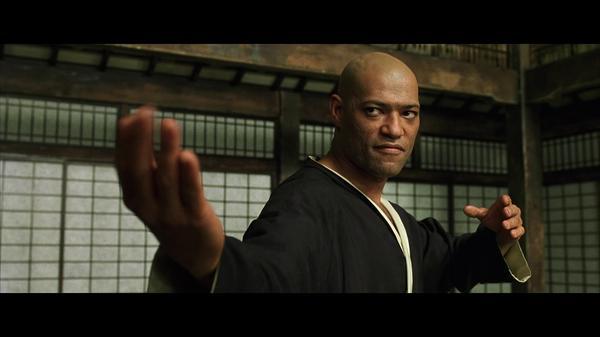
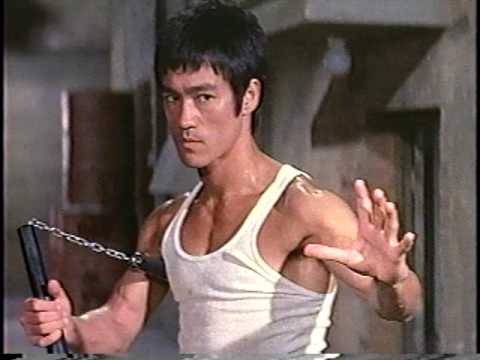
It’s no surprise to me that the kung fu film industry is so big, and has also crossed over into Western cinema, first with Bruce Lee and Enter the Dragon, and recently with Crouching Tiger, Hidden Dragon and The Matrix. It’s because kung fu has always been designed to be performed partly as theatre, making cinema its natural medium.

hqdefault1

Kung Fu teachers back in the 1970s when kung fu started to take-off were well aware of this ‘for show’ element to the arts, and didn’t think it was anything to be concerned about.  Some techniques were ‘good for show’ and some were ‘good for real use’, and your teacher knew the difference. Of course these days we’re in the era of the YouTube generation, so when a Kung Fu demonstration, with its flashy techniques done against minimal resistance, crops up for discussion there’s an immediate cry of ‘foul!’.

Take this video of a Choy Lee Fut demonstration, which got posted on RSF recently:

The teacher moves well, and clearly has a grasp of using the big swinging techniques of Choy Lee Fut, and demonstrates them with speed and efficiency, which is presumably the point of the demo, but it was instantly greeted with cries of “That was awful”, and “I liked how the camera shakes at some points. Real dragonball effect. Only one question …. why is it none of the “attackers” have their hands covering their heads? Ok one more. Why can they throw 2+ punches or kicks like he does?”

Because of the huge interest in MMA, which is probably as close to actual fighting for entertainment as we can get and still be relatively safe for the participants, everybody has at least some idea of what a fight actually looks like, so we’ve now got people looking at Kung Fu demonstrations questioning why it looks nothing like a fight. This is a good thing, because I get the impression that back in the 1970s and 1980s people thought this was what real fighting should look like. Then the UFC came along in 1993 with a healthy dose of reality that blew everybody’s perceptions out of the water. Sure there’s the usual ‘but that’s not the reality of the street’ and ‘but what about knives?’ objections, but I think they’re missing the point. Fighting looks like fighting. It’s scrappy and messy, and always will be.

These days I’m finding it harder to care that the polished, perfect kung fu demos we’re used to seeing don’t look like real fighting, and I’m just happier to accept them for what they are. Kung fu has evolved over many generations into an art that contains performance related elements, and that’s just the way it is. I’d rather just enjoy the performance and not worry about it being too ‘real’, because that’s what you’re meant to do.

I’m writing this on International Women’s day, so I’m going to end this post with a clip demonstrating that women have a long history in kung fu films, and were violently kicking mens’ butts years before things like ‘trigger warnings’ existed. Let’s not forget that. Here’s to the ladies of kung fu!


Omoplata obsession

Is the shoulder lock done with the legs the most “BJJ” of all BJJ techniques?

hqdefault

Everyone who starts BJJ eventually goes through a bit of an omoplata obsession, I think it’s because it’s one of those techniques that is unique to BJJ. Triangles, armbars and cross chokes can all be found in Judo, and while it’s probably possible to dig up a Jiujitsu demo from the 1920s that features an omoplata (take that as a challenge dear reader!), the technique has really found its mark in the world of BJJ.

Read the rest of this blog post at my new blog… BJJ Notebook


The Iceman cometh

Ancient Yogic breathing techniques make a return to the UFC

wimhof-face

You might not have heard of Wim Hof, but he’s been creating a big buzz in certain circles and has gained the name “The Iceman” for his incredible acts of endurance and ability to withstand extreme cold using a breathing technique he calls Innerfire. He even climbed Everest in a pair of shorts.  Watch this video to get an idea of what he’s about:

With the MMA world latching on to the new trend in ‘movement‘, it wasn’t going to be long before somebody noticed that Wim’s breathing methods and extraordinary abilities might be quite useful for fighting as well. I just wasn’t expecting it to be UFC title contender Alister Overeem that lead the way.

Overeem has had a chequered history since joining the UFC. There are allegations of juicing in his past, and he failed to live up to his potential in a number of fights. But then I remember being really impressed by his last performance in UFC on FOX 17 in December 2015 when he completely destroyed the always dangerous Junior Dos Santos, ending a dominant fight with a 2nd round KO. I remember thinking at the time that something had changed about Overeem. The arrogance that lost him his bout against Bigfoot Silva in 2014 was gone. Instead he seemed calm, composed and very focussed. Something had changed, and now I know why. He was training Wim Hof’s breathing methods, as this video shows. You can see Overeem doing push ups with breath control and even submerging himself in some very cold water for over 2 minutes.

Highlights from Overeem vs Dos Santos:

Here’s Wim explaining his method himself:

And here he is explaining it to Joe Rogan:

You can’t argue with Overeem’s impressive results, and as he says, breathing is one of the most important things to any fighter, regardless of the sport they’re in. I can see immediately how this level of breathing control and the improved cardio it promises could improve my BJJ, since once you gas, that’s it, you’re done, no matter how much skill you have.

I think I’m going to do more research into Wim and maybe try his methods. There’s even an iPhone app for Innerfire. I’ll keep you updated.