Gong Li Quan, “power-building boxing”, and the truth about Ching dynasty martial arts

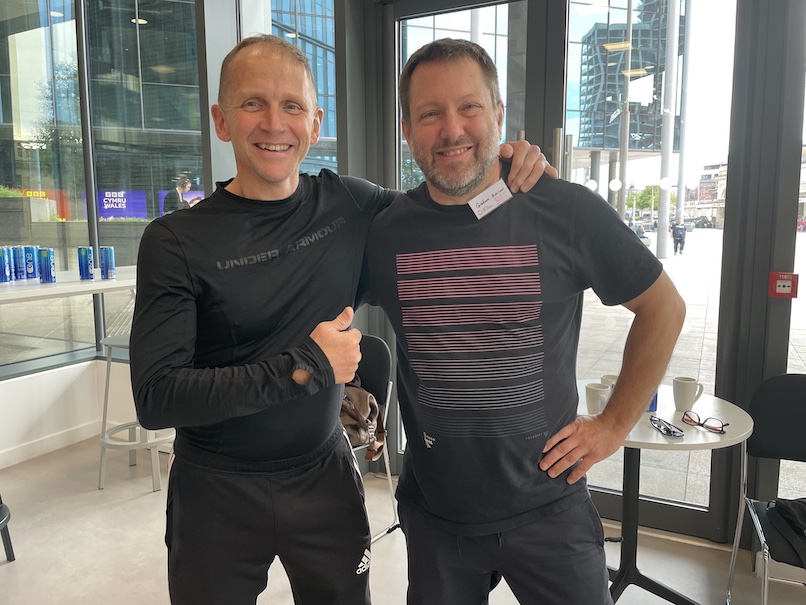
Randy and Graham in Cardiff, 2024

At the recent 2024 Martial Arts Studies conference in Wales I had the good fortune to meet Randy Brown of Mantis Boxing and Brazilian JiuJitsu in Massachusetts, USA. We had a blast at the conference discussing martial history, theory and even demonstrating a few techniques on each other into the small hours in a pub in Cardiff city center! Not only is Randy highly skilled in mantis boxing, but he’s also a black belt in Brazilian Jiujitsu, so we had a lot in common.

When I was exchanging techniques with Randy he noticed that the Choy Li Fut I was showing was identical to moves from a form he knew called gong li quan, which translates as “power-building boxing”. It was a form he had learned that was used as foundational training for various Ching dynasty martial arts, like long fist, eagle claw boxing and praying mantis boxing.

On gong li quan, Randy writes:

Gōng Lì Quán, or Power Building Boxing, is a unique boxing set from northern China, and is included as a training routine amongst a variety of boxing styles in the north to include: long fist, eagle claw boxing, and praying mantis boxing. This form likely intermixed with the latter two styles when it was included as part of the Jīngwǔ Athletic Association’s fundamental wu shu curriculum. At Jīngwǔ, gōng lì quán was one of the mandatory six empty hand and four weapons sets taught to kung fu practitioners. These ten sets were required as a prerequisite to the study of: xingyiquan, bagua, taijiquan, eagle claw, or mantis boxing; considered by Jīngwǔ founders to be more ‘advanced’ styles.

Our meeting seems to have sparked a desire in Randy to delve further into gong li quan and resurrect this old form he’d forgotten about and try to bring the movement to life with grappling applications. He’s been kind enough to share video of his research.

3 Rings Trap the Moon

This was the original move we discussed in Cardiff, 3 Rings Trap the Moon, which in Choy Li Fut would be a gwa choy (back fist) followed by a sau choy (sweeping fist) followed by a biu choy (an outward forearm strike). Randy shows the original move from gong li quan, then his grappling applications. It’s pretty cool!

Twining Silk Legs

Randy has been updating his blog post with new applications as he goes, so keep checking back. One of his latest is the move Twining Silk Legs:

Twining Silk Legs is two upper cuts followed by two kicks. Again, Randy shows the move and then his grappling interpretation of the applications. What’s really interesting to me is that, once again, there’s a parallel in Choy Li Fut with this move. If you look at the move starting at 1.22 in the following Choy Li Fut video you’ll see what is essentially the same move as Twining Silk Legs – two upwards strikes followed by a kick. (Ok, just the one kick here, not two, but still…)

You could look at this as further proof that gong li quan and Choy Li Fut share a common ancestor back in the mists of time, but since I’d be willing to bet that other Chinese martial arts practitioners would also recognise these moves from their own systems, I’d venture to say that is is further evidence for Randy’s theory that the explosion of different martial styles during the end of the Ching dynasty (which is where we get Choy Li Fut, mantis, Wing Chun and the other well-known styles) was more about branding the martial arts, for commercial reasons, and that they actually shared a common pool of knowledge.

An extract from the abstract of Randy’s excellent presentation reads:

“A question needs to be asked, did ‘Chinese boxing’ of the era, have a similar common pool of knowledge? Qī Jì guāng’s manual would hint at such. Within ‘Chinese Boxing’, attributes, feats, or skills defining one fighter over another became definitive styles of their own right due to events of the time”.

(The Qi Ji Guang he’s referring to is the Ming dynasty general who fought off Japanese pirates and because a hero to the people. He wrote a famous manual which documented the martial arts of the time. The techniques in the manual seem to crop up in all sorts of Ching dynasty martial arts.)

You can learn more about the the tumultuous events of the Ching dynasty and the explosion of martial arts styles that happened during it in Randy’s video of his presentation from the 2019 Martial Arts Studies Conference:

2025 Martial Arts Studies Conference

Today I heard the exciting news that next year’s 2025 Martial Arts Studies Conference will also be held in Cardiff, Wales. This will be the 10th anniversary of the original 2015 conference, which was held on the 10th-12th June in Cardiff, and will be held on exactly the same dates. It’s almost too perfect. See you there?

The Martial Arts Studies Network has also released a new (and free as always) issue 15 – check it out, it’s full of top-quality articles on martial arts. Oh, and don’t forget, I also recorded a podcast with Randy while we were at the conference – here it is:

The origin of internal arts, with Peter Lorge

“The origin of internal arts” is probably what I’d have called this really interesting podcast with Peter Lorge about the history of internal martial arts, however Kung Fu Genius decided to name it “Chinese Martial Arts History is Mostly FAKE” because, well, it probably generates more clicks, or something. Anyway, Lorge turns over a few sacred cows here, and I also liked what he had to say about BJJ.

Have a listen:

I think Peter makes a great point about all these different ‘internal’ things throughout Chinese history all definitely existing, but all being completely separate and unconnected until the 1920s Guoshu Institute needed to create the category of “internal” to exist in opposition to shaolin and external, so it brought them all together. (The gentleman whose name he forgets when talking about this is obviously Sun Lu Tang.)

I do wonder if instead of looking back for mentions of “internal” throughout Chinese history a look back for the phrase Liu He “six harmonies” would make a better connection between the dots of Chinese martial arts history. While the term “Neijia” may not appear very often pre-1920s, Liu He definitely did. If we’re looking at how we got where we are today, then that’s probably a better bet.

Self-healing disasters

“According to Chinese medicine, all diseases are caused by blocked meridians (energy channels in the body). Hence, disease prevention and healing can be as simple as clearing meridians and expelling toxins and waste in the body.”

The above quote is from the Amazon description of the book PaidaLajin Self-Healing by Hongchi Xiao. If you’re a Tai Chi practitioner, have had acupuncture or are “into” Chinese medicine then you’re probably thinking, hmm that sounds quite reasonable, right? Wrong…

Well, the reason I’m not linking to that book on Amazon (which you can still buy for £5.20, btw) is that Hongchi Xiao, 61, of Cloudbreak, California, is currently on trial for manslaughter by gross negligence at Winchester Crown Court, in the UK.

“Danielle Carr-Gomm, 71, died in October 2016 while taking part in a workshop in Wiltshire which promoted Paida Lajin therapy, which sees patients being slapped or slapping themselves repeatedly.

Prosecutor Duncan Atkinson told Winchester Crown Court Mrs Carr-Gomm had been seen to be “vomiting, tired and weak” and had been “howling in pain”.

The article about the case is available to read on the BBC website. The details are chilling.

Mrs Carr-Gomm had Type 1 diabetes, meaning she had to take insulin every day to keep her blood glucose levels under control. 

But Mr Atkinson told the court that she announced on the first day of the workshop that she had stopped taking her insulin, which Mr Xiao “congratulated” her on.

“He did nothing to alert others to the risk. He simply congratulated her and allowed a Type 1 diabetic to commence fasting without insulin,” he added.

There’s a strong crossover between Chinese martial arts and Chinese healing systems. In fact, it’s the link between the two that is often quoted as one of the strengths of the Chinese systems – that the practitioner learns how to heal the body as well as destroy it. And yet, these things keep happening.

One of Cheng Man Ching’s close western students died of a burst appendix that was left untreated because of a distrust of western medicine. I can think of at least one Qigong master who died from a hernia caused by their practice, or the Qigong student who died after not eating for 54 days. I was shocked to learn recently that the Wim Hof Method has a surprisingly high body count.

Let’s see this as a teaching moment. Qigong, massage, Tai Chi, breathing therapy, etc, can all be useful complementary practices to help the healing process, but no matter how wise, guru-like or charismatic your Qigong teacher, Kung Fu master, or alternative-healing therapist appears, you should not hand over your brains at the studio door along with the class fee. Remain skeptical, and trust only qualified medical practitioners if you have serious issues with your health.

What the name tai chi chuan means

What’s in a name? When it comes to tai chi chuan (taijiquan), then the answer is… quite a lot.

Firstly, there’s the issue of how you write it. Occasionally, you will see an attempt to guess at the spelling of the name that makes the mind boggle, such as an email asking if somebody can come to your “thai chee” class, but usually it’s some variation of “tai chi” or “taiji”.

Photo by Klub Boks on Pexels.com

Tai chi was first romaised into English using the Wade–Giles system as “tʻai chi chʻüan”. But English speakers soon abbreviated it to “tʻai chi” and dropped the mark of aspiration. Nowadays, in the UK at least, we tend to use “tai chi” and forget about the “chuan”. Perhaps a better translation would be “tai chi boxing”, but this goes against the image of the art, which is usually practiced as a health exercise, so that’s never going to catch on. There really isn’t much “boxing” going on in most tai chi classes.

Then there’s he newer pinyin romanisation system, which has replaced Wade–Giles as the most popular system for romanizing Chinese. In pinyin, tai chi is written taijiquan. It’s popular to use taiji or taijiquan in English now to also remove any colonialist connotations of the term from a bygone era.

I get that, but I think the written phrase tai chi has slipped so far into the general populations consciousness that a lot of people have no idea what you’re talking about if you write taijiquan. I use tai chi myself.

Step back into the Qing dynasty

Then there’s the issue of when the art was given the name tai chi boxing. Tai chi emerged into public life in the royal court during the Qing dynasty, yet it wasn’t freely called tai chi until after the dynasty ended. If you try and find a written occurrence of the name published before 1912 you’ll draw a blank. There are certainly written documents that claim to be from years earlier that contain the name “tai chi boxing” yet not a single one of them was made public or published before 1912. What happened in 1912? The Qing dynasty collapsed and the new Republican era began.

My best guess as for the reason that this is the case is that Hong Taiji (1592 – 1643), the founding emperor of the Qing dynasty had adopted the name “Taiji”. It’s unclear if this was his personal name or a title, but there was certainly a taboo around using that name because it belonged to an emperor. It therefore became impossible for a marital art to be called “tai chi boxing” without breaking that taboo and suffering the (presumably harsh) consequences. However, once the Qing dynasty fell, the name was back on the market. (Credit to my friend Daniel Mroz for bringing this to my attention).

The taiji symbol

Then there’s the meaning of the name. The name taiji has obvious connections to the philosophical concept of the taiji symbol – the circle with the two fishes representing yin and yang and their constant interchangeable position. One state increase till it exhausts itself leading to the other in an infinite loop.

In Yang style tai chi lineages, the art has long been associated with Taoist ideas, which the taiji symbol is representative of. Chen style seems less Taoist in origin, however, the concept of taiji is a universal symbol, and used throughout all of Chinese thought.

The name taiji can be translated as “supreme ultimate”, which has lead many to conclude that tai chi boxing must have got the name because it was the boxing system par excellence of the Chinese martial arts scene. It is literally, the best! If only!

I wish that was true, but I think it’s just a common misunderstanding, which is perhaps played on as a marketing device in modern times. I mean, who wouldn’t want to be learning the supreme ultimate boxing system, right?

The concept of being a supreme ultimate is more to do with supremely different positions being harmonised. Extreme yang and extreme yin. Polar opposites that work together and find harmony. That’s the real meaning.

In Tai Chi your body moves through position after position – we call these ‘postures’ usually – in the transition between them the body will open and close in a repetitious cycle. Once yang (open) is exhausted the body will move to yin (close) once you’ve reached the extreme position of yin, you move back to yang again, and so on.

The opening and closing is a whole body action. So, you are literally enacting the taiji diagram with your body.

That’s the general idea. Of course, you can break down your body into sections and look at how each one of those opens and closes, there is seemingly no end to the level of detail you can drill down to, but on a basic level your body is always moving from yin to yang and back again, which is the reason for the name of the art – tai chi chuan.

Photo by Murillo Molissani on Pexels.com

Making an easier Tai Chi form

I’ve returned to teaching beginners recently and that’s left me with a problem: I need a simpler Tai Chi form to teach.

The main problem with beginners learning Tai Chi is remembering the movements. While this is all a distant memory for me, lost behind 30 years of practice, I can see that the struggle is real for them – where does this arm go? Where are my feet? What move is next?

Also, the complexity of movements is an issue. Moves involving kicks where you have to stand are a lot harder for people without any background in a sport or a martial art to do.

I also need a Tai Chi form that’s short enough that the end of it isn’t so far away as to be unattainable to beginners, but has enough content in it that there’s something of a work out going on.

So I came up with doing some modifications to the first section of our long form and running with that. Here it is:

I think this form has a good balance of everything – it’s long enough that there’s enough to learn and practice, plus the movements are relatively simple for beginners, with no complicated kicking or turning manoevers. But it’s not so long that it’s going to take months to get to the end of.

Once the form has been learned and the first 6 posture principles of Tai Chi adhered to:

  1. Suspend the head
  2. Centre the coccyx
  3. Round the shoulders
  4. Bend the elbows
  5. Hollow the chest/raise the back
  6. Bend the knees

…and a reasonable level of relaxation achieved, then they can work on principles, like arms following the body, not moving independently. A good way to work on this is through silk reeling exercise.

Of course, after beginners have reached a reasonable standard in this form, they can move on to the full Lam short form, which is more of a challenge. But I suspect that for a lot of people, this little form will be enough.

I also updated my Tai Chi teaching website with a new name Slouching Tiger. Check it out.

Image credit: eberhard grossgasteiger

What is Kempo?

Early Kempo.

My friend Brett teaches Mishima Kempo in Cornwall, and has just updated his webpage with a really good page that answers some questions about what Kempo is and he also has a more detailed page on its history. It’s well worth a read if you want some good information about Kempo.

So what is Kempo? Well the short answer is, to quote from Brett’s page:

Kempo is not a martial art, but rather “Japanese martial arts of Chinese origin or association”.

So, check out his web page for more information, especially if you live in Cornwall and are interested in training Kempo. If you want to dig a little deeper, we started the Heretics Podcast off with a series on the intertwined origins of JuJitsu and Kempo, and that’s still available to listen to.

The King’s longsword duel, revisited

Happy Father’s Day, UK! There are three Euros matches on today, including England, so you’re probably not looking for a film to watch tonight, but if you do then I’d recommend The King (2019) on Netfix.

The King trailer.

I loved this film, which I reviewed when it came out. It’s the story of Henry the fifth, not the historically accurate story, the Shakespeare version, but presented as if it was the historical version, which is a bit confusing, but that didn’t bother me. The acting is great (it stars the unfairly good-looking Timothée Chalamet), the story is top notch (er, thanks, Shakespeare) and the battle scenes are really well done.

But it was the solo duels in particular caught my attention for having a realistic quality, which is why I greeted this video breaking down the first longsword duel in the film between Harry ‘Hotspur’ and Hal with interest.

When you’ve been doing Asian martial arts for a while you have to remind yourself that the term “martial arts” also applies to European martial arts too, the sort of thing that HEMA is busy reviving, and Longsword is one of the things they practice. I really like the discussion of longsword technique in the analysis of the video, and the reference to historical fencing manuals (fight books), and how it gives you more insight into what’s going on in the fight.

My one criticism of the breakdown is that it completely ignores the excellent little ankle trip takedown right at the end that gives Hal the win. That deserves more credit! Anyway, here’s the video:

A rare picture of Yang Cheng-Fu surfaces

Is this Yang Cheng Fu, or just a clever AI fake?

Yang Cheng Fu, grandson of the Yang style Tai Chi founder, Yang Lu Chan, is probably the most photographed of all the famous early Yang style practitioners, thanks to the publication of his 1930s books on Tai Chi that showed him performing his Tai Chi form as a series of fixed poses.

Of course, we all know that Tai Chi has no fixed positions, but if you are going to present a series of movements in a book then you either need a series of drawings or a series of photos showing poses. Film was rare and video recorders hadn’t been invented when Yang Cheng Fu published Methods of Applying Boxing (1931) and the Essence and Applications of Tai Chi (1934), which was translated into English in 2005 and published in print.

Yang Cheng Fu posing in Single Whip, from his Methods of Applying Boxing, 1931

Because of books like these we are used to seeing Yang Cheng-Fu in perfectly poised shots for the camera, which was why it was so surprising to discover this week that somebody had an ‘action shot’ of Yang Cheng-Fu taken while he was doing a form demonstration at a martial arts event.

So, full credit to the person who posted this: The photo was posted to Facebook by Wong Yuen-Ming in the Internal Arts Institute group with the message “Today I am making public one such a photo, possibly the only photo that shows Yang Chengfu demonstrating his Taijiquan in public that was shot by a photographer in action. It was taken on October 15, 1928 when Yang was demonstrating at the Chinese National Guoshu championship.” There is no name of the photographer mentioned.

It’s hard to know whether the photo is genuine, especially in the age of AI where it’s very easy to fake photos in a convincing way, but it does at least look like Yang Cheng-Fu. The posture shown also looks like Yang Cheng-Fu’s frame and style.

As for the location and date, that also checks out: The Central Goushu Institute held two events in 1928, the first in Beijing was a highly competitive lei tai tournament and the second was in Nanjing From Wikipedia: “This event came to be regarded as one of the most significant historic gatherings of Chinese martial arts masters. The tournament was presided by generals Zhang Zhijiang, Li Liejun, and Li Jinglin, who separated the 600 participants into two categories: Shaolin and Wudang.[2] After the first several days of competition, the fighting competitions had to be halted because many participants were severely injured. The final 12 contestants were not permitted to continue, with the public excuse being the fear more injury or a death. The winner was determined by a vote by the participants.”

It’s not clear which of these two events the alleged photo of Yang Cheng-Fu was taken at.

Is it genuine? I don’t know, but it’s very convincing. I initially thought he was performing in front of a mirror but the arms are not a mirror image, so there are two performers on the stage.

Episode 31: Mantis boxing, BJJ, self defence and heresy in martial arts

Here’s my latest podcast! Mantis boxing, BJJ, Self Defence and heresy in martial arts with Randy Brown.

Randy Brown is a Mantis Boxing and BJJ black belt coach teaching in the USA. In this podcast we explore how Randy has reworked his Mantis Boxing to explore the grappling potential hidden in its forms and how they can interact with his Brazilian Jiujitsu. We talk about a range of subjects including self defence vs sport, weapons vs barehand and how to turn dead systems into living arts again.

Links:
https://randybrownmantisboxing.com/

Martial Arts Studies Conference, Cardiff June 2024, write up

It’s really hard to do the 2024 Martial Arts Studies Conference justice in a write up. It’s an intense 3 days of thought-provoking lectures on all aspects of martial arts research that can open up huge vistas of unexplored subjects, ripe with possibilities for further study, or make you reevaluate what you think you already know about subjects you maybe thought were common knowledge. It’s attended by academics and researchers from all over the world and a few ‘civilians’, like myself, who are more populist writers or practitioners.

Maybe I could just recap a few of the things I learned after three days in Cardiff of having my preconceptions about martial subject gently poked, enlightened and challenged.

Firstly, I’m now much more informed on the subject of trauma-informed martial arts practice thanks to the excellent work of Georgia Verry who runs the Conscious Combat Club project and podcast who, as well as delivering a paper, ran a workshop on trauma-informed kickboxing. There’s also Dr Alex Channon and his work with the Love Fighting Hate Violence project on the same subject. I now have a new appreciation of the brilliance of 80s martial arts hero Cynthia Rothrock thanks to a paper delivered by Prof Meaghan Morris of the University of Sydney, and I have new ways to think about questions that used to fox me, like “why do you still do martial arts?”, thanks to a thought-provoking paper delivered by Wayne Wong. Daniel Mroz delivered new perspectives on martial arts history and Adam Frank gave me new ideas on how to think about qi. Scott MacMillan gave me some ideas about why Brazilian Jiujitsu answers life’s existential questions. And Tran Khải Hoài gave me insights into how Communist revolutionary Ho Chi Min may have influenced Taijiquan practice in ways we haven’t thought about. Yes, really!

But that’s just scratching the surface. The full schedule is here. I didn’t get to listen to all the talks as they were usually happening in parallel, so you had to choose which one to go to. However, I’m hoping they were all recorded and all appear on the martial arts studies YouTube channel soon so I can pick up the ones I missed.

But really it’s the meeting of such a great bunch of people and the social elements that really make the event special. From an impromptu push hands session opposite the Millennium Stadium with Ian Sinclair from Canada to little demonstrations of martial technique here and there in pubs and restaurants in the evening (thanks Randy Brown!), it’s an invaluable opportunity to meet with really experienced practitioners of martial arts from all over the world. I got to talk at length with practitioners about Okinawan Karate, French Boxing Savate, Vietnamese martial arts, Capoeira, Mantis Boxing, Taijiquan, Ninjitsu, Aikido, Brazilian Jiujitsu, MMA and probably many more that I’ve forgotten, and regardless of the martial art, the positive conference vibe remained strong.

And let’s not forget the brilliant Capoeira demonstration that sought to teach us the difference between the Regional and Angola styles.

I didn’t want the conference to end, it was great to meet old friends and make new ones, and as one participant said “end of the MAS Conference Blues are a real thing”.

I’ve made lots of contacts so hopefully there will be more new faces appearing on my podcast in the weeks and months to come. Thanks to Paul Bowman for doing a great job organising it. Here’s to the next one.