My old XingYi teacher’s Shamanism podcast is producing more material than I can actually keep up with, however a recent email pointed to three episodes that contain practical exercises that I though I’d share:
So…
Ep 16 lays down the foundation for what stage 2 is. The Amsgar, which literally means The breath. This is a deep look at the biology and science behind what it is we are doing here.
This is not to be missed. Its a fascinating foundation for whats about to come up.
Episode 17 introduces… wait for it… the Shamans Drum. Now this is like nothing you will have heard before. Its not about banging it and entering a so called trance. There is so much more to it.
Does the drum need to have a smell?
Listen to the episode to find out all about authentic and traditional shaman drums as well as a step by step look at this practical exercise called Boekhgeen Khengreg.
Here I want to discuss what a natural posture means in Tai Chi Chuan. I was working on the posture we call ‘Fist under elbow’ with a student today. The posture looks like this:
Fist under elbow – Yang Cheng-Fu
The word translated as ‘fist’ could also mean ‘punch’, so you could equally call the posture, ‘Punch under elbow’. It looks a bit like the Judo Chop I talked about recently, but it’s not done like that at all in application. Instead of a chopping, downward, movement it’s a forward and outwards,palm strike done with the left hand. You can see this immediately when you see it done in motion. Here’s Yang Jun, the grandson of Yang Cheng-Fu who is pictured above, teaching the movement in his family’s style of Tai Chi.
You might ask why your other hand is punching under the elbow. I was always taught this was a hidden technique, where you’d turn the left hand into a deflection of the opponent’s attack and punch them with your right, but in the Tai Chi form it wasn’t show explicitly, and the punch was hidden away under the elbow… In application, it looked a lot like a little bit of Wing Chun Kung Fu.
I always have doubts about the validity of these sorts of explanations though. Firstly, I don’t know why you’d want to hide a technique like this? Who are you hiding it from, and why? And it’s not an especially deadly technique, so it’s not like it is dangerous for people to see it. There are much more dangerous techniques shown openly in the form. And secondly, if you don’t actually practice it then you’ll never actually be able to do it under pressure, so hiding things away is not an ideal practice method.
I think it’s much more likely that the posture itself has special cultural significance (as say, part of a religious ritual, or maybe it relates to Chinese cosmology), so was included in the Tai Chi form sequence, or perhaps it’s something of a signature move that was handed down over the generations from an older martial art, and has lost its original meaning, but remained as a kind of nod of respect to the forefathers.
Either way, it’s in the Tai Chi form now, and shows no sign of being removed, so we might as well get on with learning it properly.
My point in writing this article was that I find students generally don’t perform this posture particularly well. Perhaps it’s something to do with the arm position being slightly uncomfortable unless you can relax sufficiently, but it seems particularly suited to making mistakes. Maybe it’s because it looks a bit like an “on guard!” posture, but if you ask a student to take up this posture they will invariably hunch the shoulders, or make their leading arm too stiff and aggressive, or get the angle of the hand and fingers all wrong.
Here’s an example of what I mean. Look at how tense this guy’s arms are:
He’s holding up his right elbow instead of letting it drop. His left arm is almost locked straight and both arms are too high: Instead of ‘sinking the chi’ he’s letting it rise up, which makes him unsteady.
In Tai Chi the shoulders should naturally round and the elbows should drop – this makes your posture softer and more relaxed – ‘sung‘, as we say in Tai Chi.
If I was to walk up to the person above practicing on the beach and at the moment they formed their Fist Under Elbow I was to slap their arm away at the elbow then the chances are that I’d severely compromise their structure and balance, possibly knocking them over, giving me ample room to attack.
In comparison, if you look at the picture of Yang Cheng-Fu above again, then you can see he is much more relaxed and comfortable in his stance. You get the feeling that if you tried to slap his arm away he’d be able to just let his arm go with your motion, and let it swing back around and slap you in the face! (This was exactly what happened to me the first time I got hands-on with my Tai Chi teacher, so I can talk from experience!)
Yang Cheng-Fu’s more natural posture means that his centre of gravity is within himself in the area of the dantien. And because mind and body are linked, it’s more likely that his mind is focussed and aware of what’s happening. Once your physical centre of gravity starts to shift out of your base, so too does your mental focus. And equally, if your mind is all over the place when you’re doing your Tai Chi form then, more than likely, your physical balance will suffer for it.
In an ‘internal’ martial art we try to harmonise what’s happening between the external and the internal parts of the body. That’s what I’m trying to do in each posture of the Tai Chi form – become more centred,both mentally and physically. I want to have a more natural body that is free from artificial posturing. Postures that look ‘held up’, as if from invisible wires from the ceiling, are not as useful for combat as natural, rooted, aware postures that can meet the demands of the moment.
(A quick tip for getting a more natural posture is to take up a posture from the Tai Chi form, put your arms in what you think is the correct position, then take a big breath in, all the way up to your shoulders then let it all out in one big gasp. Let your arms settle to where they need to be, rather than holding them up. That relaxed, sunk, posture you now have is what you should be looking for in Tai Chi Chuan.)
A Tai Chi Chuan performer dong a form, as viewed by an observer, is not in a binary right/wrong state. If it were then everyone would be ‘wrong’ because Tai Chi is that point of perfection that everybody is striving towards. I’m not talking about superficial things that form competitions are judged on, like the wrong height for an arm, or the wrong length of stance. I’m talking about maintaining a perfect state of equilibrium (yin/yang balance) throughout the movement. Constantly going from open to close in perfect harmony. Even the best experts are making little errors constantly as they perform a Tai Chi Chuan form, they’re just so much better than the average person that we can’t see or appreciate them.
But equally, all roads to not lead to Rome. Not everyone doing Tai Chi is on the right track. There are so many side roads you can wander off on, especially with so many other tempting martial arts available on the high street that are a bit like it, but not the thing itself.
There’s one particular side road I want to discuss here that is so close to Tai Chi, but also, so far from it, that you’ll never get there if you go too far down it.
“a hair’s breath and heaven and earth are set apart.”
One thing you’ll find a lot of people, particularly instructors who are into the martial side of Tai Chi, doing is putting their weight into things, rather than moving from the dantien.
So what do I mean? Well, think of it like this: if somebody is doing a Tai Chi form and each time they lift and arm they keep their body relaxed and let their body weight fall into the arm they can generate a significant amount of power, while appearing to remain relaxed – all the things Tai Chi is supposed to be.
It’s impressive, and will convince a lot of people of your awesome martial prowess, but it’s not really how Tai Chi is supposed to work. If you’re committing your weight into a technique then you get a lot of power, but you also get a lot of commitment. As an analogy, it’s rather like swinging a lead pipe to hit somebody. If you make contact then fine, you’ll do a lot of damage, but if you swing and miss then you can’t change and adapt quickly enough to deal with the opponent’s counter.
In contrast Tai Chi is supposed to work like a sharp knife – you can generate power without committing your weight into the technique, so you can change and adapt, just as if you were switching cuts with a blade. The knife is so sharp it doesn’t need a lot of weight behind it.
To get this curious mix of non-committed movement and power you need to move from the dantien. This requires a co-ordinated, relaxed body, that’s driven from the central point. This type of movement really does involve re-learning how to move and is developed in things like silk reeling exercises and form practice.
Learning to put your body weight into techniques is comparatively much easier to grasp, and may even be a useful first step, but it should never become the goal of your practice. It’s only when you come up against somebody well trained in dantien usage that you realise the inferiority of other methods.
So, a while back I mentioned that I’d been contacted by a major martial arts website about writing some articles for its launch. Well, today that website launched!
Yes, that’s the famous martial artists and film star Jet Li!
At Jetli.com we strive to bring you content that is exciting and inspiring. We are drawn to stories that highlight people all over the world that chase their dreams no matter what. From the boxing gyms of London to the favelas of Brazil, we have found heroes who live with the values of martial arts at the center of their lifestyle. You’ll see dedication, courage, humility, and generosity. Amazing stories await you at Jetli.com!
I’ve written quite a few articles for Jet already – it looks like two have been published, so here they are:
The act of taking your hand and making a chop motion on a persons shoulder near the neck area while saying in a loud manner, “Judo chop-HAI!”
1. Find a victim.
2. Creep up behind them.
3. Make sure palm/hand is flat and straight.
4 Raise your hand and chop the victim’s shoulder, making sure it is close enough to the neck.
5. Say the phrase, “Judo Chop HAI!” While doing so.
6. Walk away.
Following on from my last post about Internal Judo, I’ve been thinking about the (stupid) “knife hand” attack you commonly see in Aikido, Jiujitsu and Judo – “Shomen uchi”
I say “stupid” because , well, it is. Nobody is ever going to attack you like this in reality. You even see it done with bottles and knives, but it’s pretty obvious that this technique is derived from a much more practical origins – an overhead strike from a katana:
One of my friends does Judo. He loves it, except for the time when the teacher says they’re going to do “self defence” and the class has to learn how to defend against an overhead strike using a knife, or defend a haymaker by turning their back on the attacker and doing a hip throw. The first situation is ridiculous, the second, possible, but unlikely.
It’s hangovers like this, relics of the weapons-focus of the past that are left behind in martial arts, that provide more weight to the theory one of my old teachers used to have that what we recognise as “martial arts” didn’t used to exist a few hundred years ago when people could freely carry weapons, and soldiers were trained in how to use them. The invention and evolution of the firearm changed things a lot, and then once it was no longer considered civilised to carry a bladed weapon in normal daily life, things changed again. If it was acceptable to carry a sword nowadays, you can bet the local Tae Kwon Do class would be changing its syllabus.
If you think about it, the idea of defending yourself against somebody with a weapon, when you don’t have one, is a pretty hopeless task. Especially if they’ve got a knife. The only thing you can say about knife fighting for sure, is that they’re definitely not going to attack you with a big overhand strike to the temple. So why keep training it?
There is an interesting theory about martial arts that I want to talk about today. Let’s call it the Golden Age theory, as it posits that at one time there was a Golden Age of martial arts, probably in China. Now, ok, you might not buy into that theory, but please bear with me. Drop your natural cynicism for a moment and allow the idea to percolate in your mind a little as we take a trip back to ancient China…
The knowledge the ancients had in this golden age about how the body functioned was complete, detailed and comprehensive, producing something more than normal strength. It was an overarching understanding, so it covered all sorts of skills, not just martial arts, but as time went on, and social, political, economic and geographical environments changed this knowledge slowly degraded and fewer and fewer of these old skills survived intact. Today we are left with remnants of them passed down in different traditions, most notably Tai Chi, XingYi and Bagua, and clues left in the historical record.
That body of knowledge consisted of what is known today as the Internal skills of the martial arts. Most Chinese marital arts still contain some internal skills, what you might call “basic Jin”. We can tell that all martial arts descended from this skill set as you see the remains in today’s marital arts and you can still see clues everywhere, including the names of old martial arts like ‘Six harmony spear’ or ‘Six harmonies, eight methods’. This “six harmony” nomenclature refers to a way of moving the body in a connected fashion from the toes to the finger tips.
This way of moving existed in all martial arts once, and survived amongst a special few even into the modern age. For example, Morihei Ueshiba of Aikido had it, and he died in 1969. Some people have it today, to various degrees. Usually you find these people in the Chinese Internal arts, but there are glimpses of it everywhere, even in the Japanese maritial art of Judo.
If you’ve seen Olympic Judo matches you can see it’s an incredibly athletic sport that requires supreme physical conditioning and strength mixed with a high level of technique. But is today’s Judo really where the art originally started out?
There is an old kata in Judo called Gu No Kata, which consists of a number of movements performed with a partner. It’s pretty safe to say that these days the meaning of the movements has been lost, as it’s performed with raw physical stength, not what the Chinese would call Jin, but dig under the surface and you’ll find that it’s a series of Judo techniques which serve as internal strength testing exercises, linked together.
This article provides a description of Go No Kata.
And here’s what it looks like done in modern times:
It doesn’t look very “internal”, but watch this informative video by Mike Sigman in which he explains and demonstrates how the various postures of Go No Kata are done with Jin – i.e with strength from the ground through a relaxed (‘song’) body.
In Mike’s own words:
“The “tests” in Go-no-kata resolve into Up, Down, Back, Forward, and sideways. You need to develop your qi/frame and you need to work with jin forces until you’re comfortable with them because not only can you resist forces (they’re doing it for development purposes, not as a basic strategy for good Judo), but you can learn to take kuzushi using only the mind-directed forces of jin.
Here’s the video. It’s fairly short. If you haven’t played much with jin forces, it may not be obvious what is going on, so please try to meet up with someone that has some jin skills.”
Here are the different pictures he’s referring to:
Finally, watch this comparison video between Kanō Jigorō the founder of Judo and a modern practitioner, and ask yourself, what has been lost?
Kung Hei Fat Choy! Welcome to the year of the Fire Rooster. If you’re looking for some tips to survive in this alternative reality we seem to have entered, then Scott P Phillips has a Fire Rooster survival guide. In short: get organised.
I’d also like to kick off the Chinese new year by directing you to this excellent interview ‘It’s not what you think: what serious martial artists want you to know about tai chi‘,with Chen Huixian,a Chen villiage Taiji practitioner who has moved to the US and is teaching there. It’s good to see Taiji from the source reaching a wider audience.
Also make sure you take the opportunity to read the excellent talk by Paul Bowman on ‘Taoism in bits‘ about the transplanting of ideas around Taoism and martial arts from East to West.
I often wonder to myself if the concept of ‘styles’ in Taiji has reached a kind of end point. These days, with the floodgates to information wide open, thanks to the Internet, everybody has access to everything. Silk reeling exercises are no longer the secret teachings belonging to the Chen family. Zhan Zhuang standing meditation is no longer the preserve of Yi Quan practitioners. Fast stepping patterns are no longer the speciality of XingYi and Bagua, and slow movement no longer belongs to the Yang family. These days you’re as likely to see a Yang style practitioner doing silk reeling exercises as a Chen practitioner standing in Yi Quan postures for extended periods.
It’s like it has come full circle, and there is just Taijiquan again.
I just learned that Scott P Philips recently created a new Facebook page, and as I browsed it I ended up on his Books page, which is like leafing through the most comprehensive Tai Chi/Chinese Martial arts section of Waterstones that will ever exist, but never will.
He’s linked reviews in the descriptions of several of them, too, which is a nice touch.I’ve got a lot of these books, but there are way more here than I’ll ever have time to read.
If you’re after some reading material on Taijiquan or the martial arts culture from which is arose, then there are some great ideas here.
The Tai Chi Notebook has made it into Feedly’s top 20 martial arts blogs on the planet. Woot! I get a medal and everything. Look!
So, if you’re looking for more martial arts blogs give their list a look-over. Nice to see Slideyfoot in there. Can Sonmez refereed at a BJJ competition I was in many moons ago, so at least that’s somebody I’ve met. His blog is great – if you’re into BJJ. (I also run a BJJ blog, so check that out if it’s your cup of tea). I was a blue belt back then – here’s my best match from that day.
Anyway, I’ve also been recommended by Qialance in their top 15 Tai Chi blogs if you want even more blogs to read. They also did an interview with me.
Just browsing through the Internet on a lazy New Year day’s morning I noticed once again how my feeds tend to bring together the old and the new in one continuous stream of “Internet”, showing me videos and writing that are almost 100 years apart, yet seem to be talking the same language.
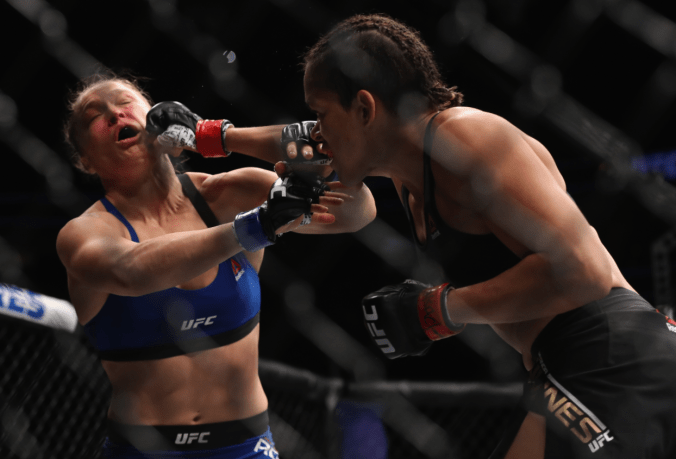
For example, we’ve just had UFC 207 in which (warning, SPOILERS) Ronda Rousey made her come back for a not-so-glorious 48 seconds, and was hit with 27 punches from Amanda Nunes (that connected) without landing a single blow back and was saved by the referee from further damage. She looked totally outclassed in the striking department. This was further highlighted by the previous championship bout between Cody Garbrant and Dominic Cruz, which was like an exhibition match, showing incredible timing, footwork and striking ability over 5 truly glorious rounds. The belt went to Cody via decision in the end, but Cruz fought like a warrior and his footwork was as outstanding as ever even if it occasionally left him open.
The two matches couldn’t have been more different; one a display of how bad footwork and poor defence meeting strong striking results in total domination, the other a display of perfect timing and offence mixed with defensive footwork on both sides resulting in a game of inches.
I don’t know how long these links will last but here are the full fights:
Brennan translations are free translations of old Tai Chi manuals. This is one from a Yang Cheng-Fu student published in the 1940s. I’ve skim read a few parts now of this new one, and I really like it, and the translation is done in a way that you can read it without being perplexed at obscure phrases.
For example, here’s a good quote:
“Every movement in Taiji Boxing is always half empty and half full, and is like a round sphere. This is not only the case for large movements, but also for the smallest movement of any part of the body. From beginning to end, movement is continuous, like the ceaseless movement of the universe through the sky. Taiji Boxing uses the abdomen as the axis of the whole body, so that whatever way your are moving – forward and back, side to side, up and down, or reversing direction – the limbs and trunk are all being moved from the abdomen, going along with its movement like the stars following the setting sun. Therefore Taiji Boxing is an exercise that conforms very much to naturalness.”
Ok, stars don’t strictly “follow” the setting sun, but I think it gives a nice poetic metaphor.
In particular, I like chapter 7, in the manual “SEVEN: METHODS OF PRACTICING EMPTINESS & FULLNESS” Personally, I think getting an understanding of empty and full, as a strategy, is key to applying all martial arts in a live situation.
In chapter 7, it says:
“Empty to defend, then fill to attack. This is the key to the art.
If you spot the moment to become full and yet do not issue, the art will be difficult to master.
There is emptiness and fullness within emptiness and fullness.
When your “fullness” is really full and your “emptiness” is really empty, you will attack without missing.”
And right away I’m reminded of the fights this weekend at UFC 207. Dominic Cruz is a master of this principle. He creates a fullness, enticing the opponent to strike him, then as the strikes come, takes that fullness away and gives them only emptiness to hit – usually thin air, but at the same time (and this is the key to making it really successful) hitting them with a ‘full’ strike from somewhere else. To be fair, Cody Garbrant displayed some equally good demonstrations of this concept, but he did it more by bobbing and weaving on the spot, while Cruz displayed his rare talent for doing it while moving in and out, which makes it even more exciting to watch.
In contrast, Ronda had none of this. Her footwork was plodding, her body movement stiff and she continually met the fullness of Amanda Nunes’ punches with the fullness of her own face, with predictable results.
As Wu’s book goes on to say:
“Practitioners of martial arts have to study the principle of emptiness and fullness. It is not only a feature of Taiji Boxing, all other martial arts have it too.”
Indeed – it’s not really a Tai Chi-specific concept I’m talking about there, but it is part of Tai Chi Chun as a martial art. Indeed, the concept of emptiness and fullness forms the title and theme of chapter 6 in the classic military text, Art of War, by Sun Tzu.
Wu goes on to explain the two key phrases:
“Empty to defend, then fill to attack. This is the key to the art.
If you spot the moment to become full and yet do not issue, the art will be difficult to master.”
As:
“These two phrases form the theory of how to apply emptiness and fullness. When it is time for emptiness, defend, and when it is time for fullness, attack. “Empty to defend. Fill to attack.” This is an unchanging rule of attack and defense in martial arts, the highest skill. If the opponent attacks with fierce power (i.e. fullness), I do not resist him directly, instead I avoid his main force to let it dissipate. Once he has missed and switches his fullness to emptiness, I immediately enter while he is empty. To “spot the moment to become full” means that when he empties, I fill. But if I do not attack at that moment, the result will be that I have let opportunity pass me by. To “not issue” in such a moment indicates that you are unable to determine emptiness and fullness, and the techniques will naturally be difficult for you to master.”
It seems to me that a lot of what has been preserved in the Tai Chi classics is a distillation of many popular martial arts sayings, and not phrases created specifically for Tai Chi Chuan. In this case they come from Sun Tzu in the 5th century BC. And, as the fights from UFC207 at the end of 2016 prove, they’re as relevant today as they were thousands of years ago.


 From the ever-enlightening