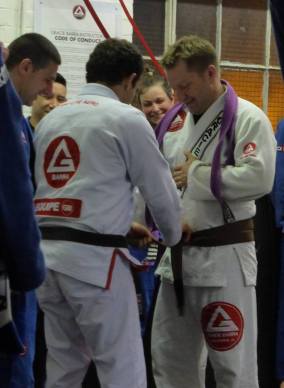
Rick Matz of Cook Ding’s Kitchen blog asked me to write a little thing about my story and how my Tai Chi and BJJ fit together, so I did! Unfortunately, it turned out to be quite a big thing. In fact, it’s a bit of an essay.
Have I summed up all the ways that Tai Chi and BJJ fit together? Not at all. There’s still much more to tell, but I hoped I’ve shined a light on to a part of it for you.
Here’s a quote:
“Learning Tai Chi is a constant process of having your mistakes pointed out to you, trying to correct them, then moving on to the next thing. The key to getting good at BJJ is similar – you don’t want to focus on winning, since you end up muscling things instead of being technical and correct. But just like in Tai Chi, it’s learning from your mistakes that matters.”
New footage of Bruce Lee sparring his students Ted Wong and Taky Kimura at the Long Beach Karate Championship in 1967 has recently emerged, and it’s a joy to watch.
The clip was billed on Facebook and even in the national press like the Daily Mail and Mirror as footage of Bruce Lee’s only “real fight caught on camera”, but that’s just nonsense, obviously, as it’s just a sparring session. True, it’s not a choreographed demonstration, but it’s also a long way from being a “fight”. The sparring partner is also frequently, incorrectly, named as Bruce’s other famous student, Dan Inosanto.
I actually trained Jeet Kune Do for a good couple of years, so I can see what Bruce is doing in the clip as it’s pretty much what we trained every class: a strong lead forward fighting stance with the back heel up, the front fist pointing at the opponent, the use of hand trapping, the footwork, the lead leg attacks, but most of all the idea of intercepting the opponent’s attack using superior timing. This is the “Jeet” part of Jeet Kune Do, which translates as the “Way of the intercepting fist”. (Interestingly, I found later on that the Chinese martial art of Xingyiquan is also very big on this idea).
Bruce really was ahead of the game here. His quality of his movement has the same sort of fluidity that you see in modern high level fighters like Connor McGregor, and his timing is excellent. As Connor McGregor says often “Precision beats power, timing beats speed”.
What’s also interesting is the gear they are wearing. When I was training Jeet Kune Do we wore almost identical gear for sparring. I still have it all somewhere in my loft! The lineage of Jeet Kune Do I trained in came down from Tommy Caruthers, who was based in Glasgow, UK, and was influenced by all of Bruce’s students (including Jesse Glover), but at the time I was training it, Ted Wong was a probably the biggest influence.
If you want to get a better idea of what’s going on in the clip then there are videos out there that break down the technique he shows, like this one:
And this one:
Being able to see such good quality clips of Bruce Lee sparring from 1967 is a treat. He was one of the great innovators in martial arts and rightly deserves his place amongst the greats of the art. What would he be doing now if he hadn’t died such an untimely death? We can only wonder.
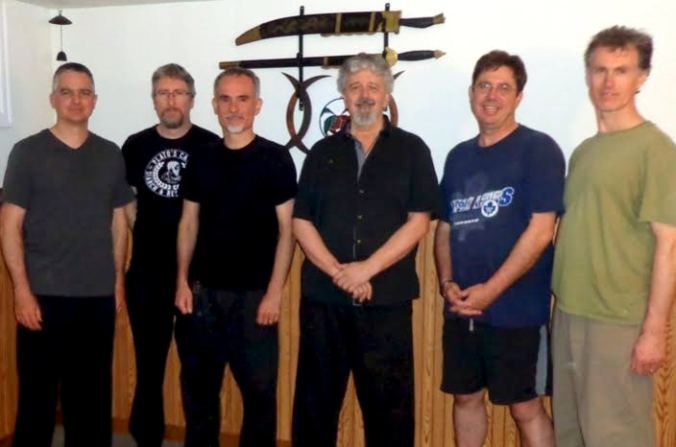
After 32+ years teaching (and 40+ in the art) my online friend, the always insightful, polite and charming, Michael Babin of Ottawa, Canada, has hung up his double-edge jian and taught his last Tai Chi class.
This is a pic of his last class. Michael is in the centre with the beard. Note: the five students in his class all look in good shape, which is the sign of a good teacher, and sadly in contrast to what you’ll find in many Tai Chi classes(!).
Teaching mainly Yang style barehand and sword (and some Sun style Tai Chi), Michael has trained with a who’s-who of the Tai Chi scene in North America, including notables such as: Sam Masich, Dr. Yang Jwing-ming, Liang Shou-yu, Eric Chew, William C.C. Chen, Carol Mancuso, Erle Montaigue and Tim Cartmell, among others.
When Tai Chi first arrived in the West information about it was scarce – there was no Internet, there were very few teachers and it was hard to tell the real from the fake, because there was literally nothing to compare it against. As it is for any pioneer, times were exciting – you were amongst the first wave of Western people to experience a martial art from a different culture on your own soil – but life was also tough, and only the strong survived. Your main sources of information back then were magazines like Inside Kung Fu and T’ai Chi Magazine, in fact Michael contributed articles to both.
Michael wasn’t one of the ‘New age’ style of Tai Chi teachers, either – always looking to keep his art martially effective. But now it seems that old age has caught up to him and he’s shuttering his Tai Chi classes. In his own words, ‘I don’t want to be one of that legion of sad old farts you see on youtube relying on “tricks” to look as if they are still the “bee’s knees“.’
You have to admire the man’s candour.
I wish Michael good luck as he enters this new stage of his life. (But I bet his old students manage to drag him back to teach a workshop or two!) As we practice this art we all add to it, and his contributions have become part of its history on the American continent.
If you peruse his website you’ll see there are all sorts of Tai Chi-related articles, but one thing caught my eye in particular – his PDF anthology of blog posts from over a decade of writing on the Yang-style and swordsmanship. It’s effectively a great free book on Tai Chi. Here you’ll find informative, funny and down-to-earth accounts of the ups and downs of being a Tai Chi teacher. Enjoy.
I’ll leave Michael with the last word:
“Good luck with your journey. Mine has lasted 40+ years and I am still both delighted and frustrated by the depths of this discipline and art. Studying it seriously is like having children and getting older — rewarding but not for the feint of heart!”
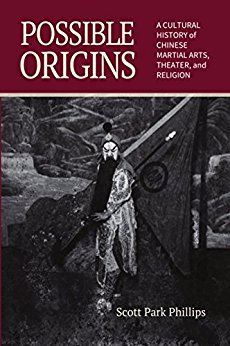
I’ve been meaning to review Scott Phillips’ book on the origins of Chinese Martial Arts for some time now, but there always seemed to be something else for me to read, or to do… Ok, I admit it, I’m just a terribly slow reader. However, the recent uproar over the fight between Tai Chi “Master” Wei Lei and MMA coach Xu Xiaodong that has dominated the Chinese Martial Arts scene has made me pick up Possible Origins, A Cultural History of Chinese Martial Arts, Theatre and Religion, and give it the attention it deserves.
A bit of background to the current situation: Xu (who had to go into hiding after the fight once the government got involved) had started to make a name for himself as the debunker of Kung Fu masters who he claimed lacked the skills required for actually fighting while charging students large sums of money to learn these (nonexistent) skills. He wasn’t particularly respectful in his debunking either – in fact, his profanity filled rants were uncomfortable to watch and hard to follow, but his point was simple.
Wei, the subject of a documentary on Chinese television about his Tai Chi powers, took umbrage to the implied insult and challenged Xu in an effort to defend the honour of traditional martial arts. It sounds like the plot of every kung fu movie, but it actually happened. Anybody who has seen the fight (which lasts about 10 seconds ending with Wei’s face being ruthlessly pummeled on the ground by Xu) will have realised that Wei was utterly delusional about his fighting abilities. Even after his beating, in his post fight interview, Wei still seemed to be delusional about his fighting ability, proclaiming that he was only hit after he “tripped’ and fell”. In reality he was knocked to the ground by a punch which revealed him to be a bumbling amateur in the realms of pugilism.
You can easily make the argument that Wei was never a proper Tai Chi Master anyway, so his poor performance is irrelevant, but a lot of people obviously did think he was a legit martial artists. What’s interesting to me is how we got here. How did we end up with a generation of Kung Fu (especially Tai Chi) masters who think they can fight, but can’t? If you went to a boxing coach in Glasgow to learn how to box, he’d teach you how to box, and regardless of how good or bad you were, you’ll at least end up with some fighting skills. But if you go to a Tai Chi master in Taiwan, asking to learn to fight, he’ll teach you a lot of fancy arm-waving stuff, mystical qigong and forms, but after several years you might actually be no different from an untrained person in your fighting ability. In fact, you’ll probably be worse.
Nothing ushers in a period of self reflection like a catastrophic failure, so it’s at this point that we should turn to Possible Origins to see how we got here.
Scott’s book at least proposes some answers to this curious situation that Chinese Martial Arts finds itself in – which is to embrace it. His basic premise is that once upon a time in China, martial arts, theatre and religion were all one thing. Over time, and due to various political and cultural shifts they became separated out, but never truly lost their connection to each other, even if the arts lived on as a pale reflection. The book examines how that process happened, why it happened and what we can do about it. In a way it’s a call to arms for the reader to embrace parts of their practice that have hitherto remained untapped and to restore these connections.
I know plenty of people amongst the martial arts that I know who just laugh at Scott’s theories. (“Oh, no, not that guy…”)*. They tend to be practical people who are more interested in how something works than why it is the way it is in the first place. That’s fine, and there’s no reason to go ‘backwards’ in martial arts. I think it’s equally valid to not worry about any of this, and just focus on what you can do with what we’ve had handed down to us. But the book does open a door to a fascinating world of demons, spirits and ancestors that we’ve left behind. You’d also be surprised by how much evidence there is for his interpretations. He can’t be conclusive about anything (hence the title) but I’ll be damned if he doesn’t present a wealth of information to support his case.
Martial arts originated so long ago that almost everything about that time is lost to us, and survives only in fragments. I think the strongest ‘evidence’ Scott has for his theories is the Boxer Rebellion of 1899, which happened relatively recently, and was a kind of a last gasp of the old world where martial arts, religion, theatre and ritual were all tied up together. There are documented cases in the Boxer Rebellion of martial arts practitioners combining martial arts techniques with spirit possession and mediumship to help overthrow foreign powers. Unfortunately it turns out that invoking the spirits of demons to give you fighting ability doesn’t, in fact, stop bullets and the Boxers were wiped out, and many of the ‘old ways’ and knowledge with them. Further cultural, political, and repressive regimes buried them deeper and deeper until today we’ve lost all concept of why we do what we do in Chinese Martial Arts.
Besides all this, Possible Origins is a damn good read, and an entertaining, book in its own right. It’s not an academic tomb, it’s an easy to devour. I’m halfway through and loving it. Even if you don’t agree with Scott’s theories, you’ll learn a lot about things you never even knew existed from Possible Origins.
Everybody who practices a Chinese Martial Art should read it. I’ll post a ‘part 2’ follow up when I’m finished. Links: Scott’s blog. Scott’s video. Buy the book on Amazon.
* In case you were wondering, Scott’s martial arts lineage is actually legit, and explained in the book.
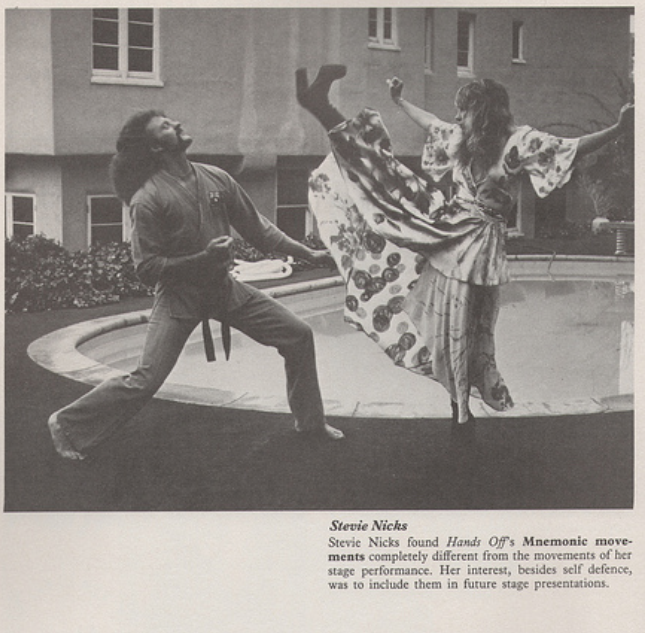
“The book itself was written by Bob Jones, an Australian martial arts instructor who doubled as a security guard for Fleetwood Mac, The Beatles, The Rolling Stones, David Bowie, Joe Cocker and other stars. And it featured what Jones called “mnemonic movements”–essentially a series of nine subconscious/reflexive self-defense moves (like a swift knee to the groin). See Jones’ website for a more complete explanation of the exercise routine that also provided, he notes, a great cardio workout.”
Check out the heels – no can defend!
Fleetwood Mac’s classic track, The Chain, was featured heavily in Guardians of the Galaxy 2, a reminder that they really don’t make ’em like they used to:
All martial arts tend to be big on repeating movements over and over – BJJ-ers practice hip escapes and triangles, Wing Chun-ers practice Su Lim Tao, Tai Chi-ers practice form movements over and over. We intuitively recognise the benefits that repeating a sequence of movements gives us – we become more fluid and after a while it feel like these moves could be something we could actually pull-off under pressure. Well, it turns out there is a science behind repetition, and this TED video explains what it is:
This video is a blast from the past (for me, at least). It was filmed in 2003 and I’m in it!
It’s the film of a demonstration the Yongquan Chinese Martial Arts group did in London. There are lots of the arts I was training at the time shown off here – Choy Lee Fut, Northern Shaolin, Tai Chi, Push Hands, then some breaking demonstrations. I’m doing a broadsword form in the demo that I can’t even remember anymore! There’s some Iron palm (a granite pebble broken with a chop) from Donald and a kerb stone gets broken over Doug’s head with a sledge hammer!
Since I was actually in this demo I know that none of these materials are faked – they’re all the genuine article. Real bricks, etc..
At the end of the demonstration there are some clips of us practicing for the demo. These are more enjoyable for me to watch as they bring back some good memories of training with my teacher and the rest of the guys back in the day.
What I like most in the video is the very last clip, where Doug is practising the Press (Ji) technique from Tai Chi on a line of people. Done right it’s meant to be very minimal physical effort with a big results (using Jin not Li) – the power should penetrate through the line of people so that the people at the back of the line fly away first. He does a ‘not very good’ version of it (too much Li – physical force) so it all looks very physical. Donald comes over to tell him off and show him how it should be done, and without any set up does a perfect Ji – really minimal effort and the guy at the end of the line flies off – then Doug has another go and gets it right. I’m glad that got captured on video.