BBC self defence clip: “I was nearly raped”

An interesting clip popped up on the BBC website today about self defence for women by a woman. Here it is:

Here’s my potentially mansplaining view: She makes 3 quick points at the end – I really agree with her first two, (don’t be afraid to offend and use your voice) but her last one – “widen your stance” – I don’t get. I’d say the opposite – get ready to move! Get up on your toes (mentally, if not always physically) and get ready for movement. If you make a sitting duck of yourself against a man whose’s first move is probably going to be to try and grab you then that’s not good. Equally, if he’s going to strike you then adopting a firm, wide stance is not going to help either.

Watch my previous post about movement for self defence from Rob Poynton to see what I’m talking about.

Either way, I’m glad she made the point that despite all the martial arts techniques on show, the first two points can be done by anyone and are the most effective.

The comments section on that video is interesting too:

“I want to see that viral video of men teaching boys how to fight off the urge to be predatory.”

“But god forbid she be allowed carry a firearm to more effectively defend herself”

“Give her a gun and she’ll be unbeatble”

Learning to hate men!

“Unrealistic sweep, and sloppy arm bar. Train Jiu Jitsu, that will give you more realistic techniques that actually work. The clinch was also poorly done, with no control.”

” I remember reading somewhere that a man was jumped by 2 women. They we’re basically groping him & trying to take his trousers off. They wouldn’t stop & he slapped them. Next day, he had police at his door for common assault.”

There you have it – the great unwashed of the world live in every comments section. Never look below the line 🙂


Rickson Gracie using concepts found in Chinese martial arts – notably, jin

Here’s a seminar clip I came across recently of the legendary Rickson Gracie teaching in Tokyo, Japan this year. He’s going over concepts that should be familiar to Tai Chi people, or in fact anybody who has a deep understanding of Chinese martial arts. It’s the concept called “jin” – often translated as refined force. It’s using the power of the ground, transmitted through a relaxed (“sung”) body to produce an unusual strength that isn’t reliant on excessive muscle use (“li”).

Jin is talked about all the time in the Tai Chi Classics, most notably on the issuing of force with the famous phrase:

The jin should be
rooted in the feet,
generated from the legs,
controlled by the waist,
and expressed through the fingers. 

What’s interesting to me is why it’s only really Rickson Gracie (and his students) who talks about and demonstrates this stuff in BJJ? Did he find it elsewhere and integrate it, or was it always there if you had eyes to see it?

Anyway, here’s his workshop:

Using movement for self defence, not blocks

I really liked the above clip by Rob Poynton of Cutting Edge Systema. It’s about the idea of using movement, rather than a fixed, rooted stance or hand blocks, to defend yourself.

To break down the message:

  • Your first reaction should be to move.
  • Use the legs for defence (stepping) and not the arms to block.
  • With your arms free you can use them for other things – like takedowns or strikes.

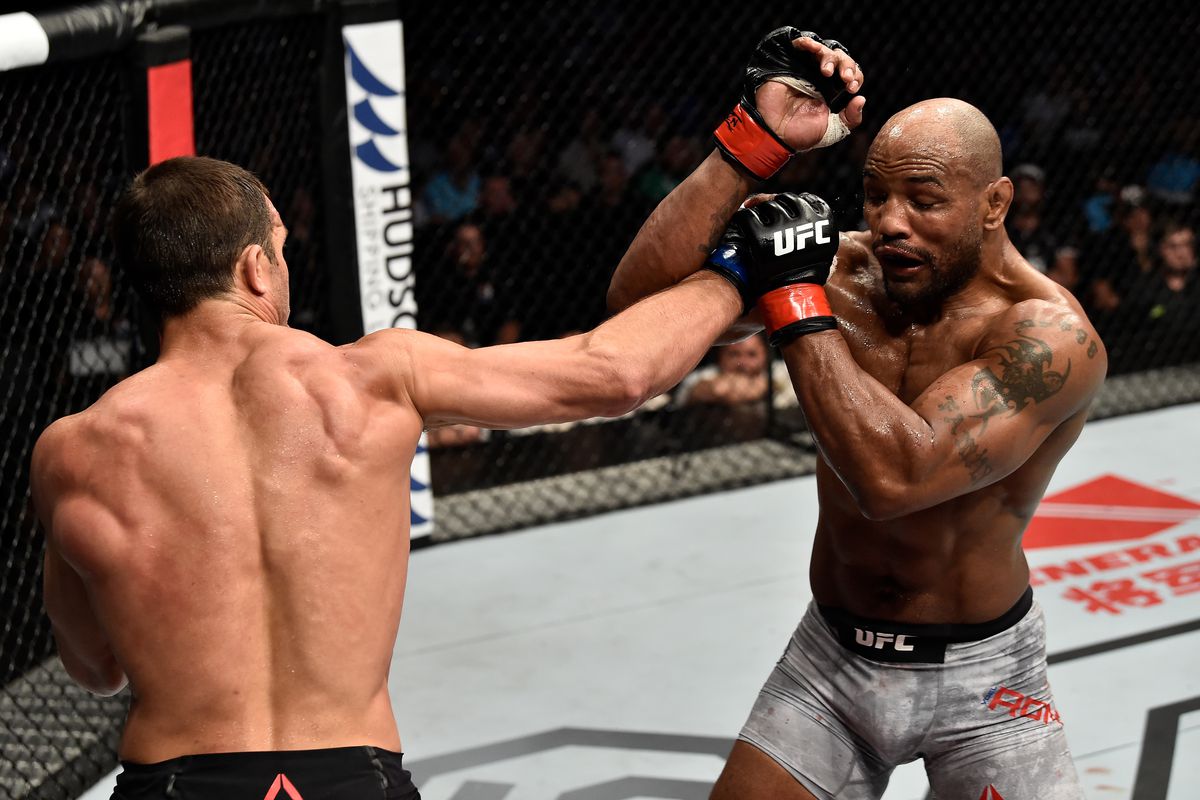
It’s simple, common sense advice when it comes to martial arts. The XingYi I learned was based around exactly the same concepts, incidentally. If you look at a lot of MMA fighters you see the same set of principles in action. If you think about it, you generally don’t see them doing a lot of blocking with their hands. Instead, they are moving and slipping punches. Obviously, there are exceptions – for example, the last MMA fight I watched was Yoel Romero vs Luke Rockhold, at UFC 221 in which Romero did a series of bizarre-looking arm blocks throughout the fight, yet came out on top.

916785142-0

To be fair though, it wasn’t getting him anywhere – he was getting him picked apart by Rockhold until Romero finally broke through and delivered a knockout blow, possibly by virtue of being one of the toughest human beings alive at the moment.

I think Rob’s right in saying that the traditional arts are slow to teach this concept of movement, though. Generally, you hear things said like “if you don’t spar you’ll never be able to use it”, which is true, of course, but how about actually breaking down and analysing what you learn in sparring, and bringing it back into training to refine it? I think that’s what Rob is showing here.

The point about a fear-based response vs a confidence-based response is also very interesting.

Of course, the counter-argument is ‘where are all the great Systema fighters, then?’ But it’s pretty clear that Systema isn’t really designed primarily for being used in a cage. It seems like a pretty useful life skill though, full of concepts you can more easily transfer to your day to day existence.

Labels like ‘internal’ do matter in martial arts

pexels-photo-312839.jpeg

It’s quite ‘Zen’ and deconstructionist to talk about labels not mattering. But over long years I’ve come to the conclusion that labels (for martial arts) exist in the world because they do matter. If they didn’t matter (to whatever extent) then they wouldn’t exist.

I was reading recently (an idea from Mike Sigman) that the best way to view a martial art with regard to the question of “How internal is this?” is as a sliding scale of 1 through 10 from just using local muscle on the left (0-1), through to external martial arts in the middle (5) that use Jin (ground force) to some extent, on to internal martial arts at the end (10 being the highest) that use full dantien control of movement.

I’d put things like Wing Chun or Karate that go beyond just using basic movement in the middle of the scale. These things often get called the true ‘internal’ versions of the arts, but they don’t really use the dantien. The official version of Yang style Tai Chi that you see done by Yang Jun I don’t think is a full 10 either – it just doesn’t use the datien for full control all the time. I think Chen style Tai Chi would be a 10 – of course, that’s the theory. Most practitioners would be bottom to middle of the scale at best.

There was some talk recently on internal aspects in arts like BJJ. I think BJJ and Judo have the potential for being in the middle of the scale – some Jin usage. Often this is what you see termed as ‘invisible jiujitsu’. I think that’s exactly what you need for groundwork (and for fighting generally) – beyond that it’s a case of returns vs time spent. If you want to make your living as a pianist you don’t need to become a master of the very hardest pieces of classical music. It’s almost irrelevant. Of course, if you want to devote your life to it then, it’s your life and it’s a world of discovery.

All’s Well that Ends Well

The NHS is broken – part 2. One thing that should change.

Lots of great reactions to my post yesterday about my experiences with the NHS.

I contacted a nurse who works at the BRI, but will remain anonymous, and got them to read it. They were just as nice as all the staff I’ve talked to before, and very sorry about my situation. It was interesting that the thing that really got them about my post was how a patient has to put their life on hold before going in, and the stress and frustration it causes when the operation is cancelled through no fault of their own. I guess when you see 10, 20, 50 people a day you just don’t have time to consider their lives outside of the immediate medical problem.

They did say one thing that was interesting – “we’re always open to ways to doing things differently”. That got me thinking about ways they could do things differently.

Ok, here’s one very simple thing:

How about you pre-warn the patient that their operation *might* be cancelled. Or, even that there’s a high probability that it *will* be cancelled?

That way we can plan better, and we won’t feel as crushed as we do when the rug is once again pulled from under our feet. I naively had no idea it was even a possibility when I rocked up for my first cancelled surgery.

Take a look at this photo – it’s all the info I’ve been sent about my operation.


IMG_3740

Here are the headings on the pamphlets: Requirements for admission, Moving to the discharge lounge, Hospital acquired thrombosis, Pressure ulcers – everyone’s business, Your visit to the Pre-operative Department (POD), Keeping patients warm, The management of pain after surgery, Keeping an eye on your alcohol use, You and your anaesthetic.

It’s all about what *you* need to do to make this happen.

Not once, in any of the literature is there a single mention that your operation might be cancelled.

Not once in my surgical consultations was it ever mentioned to me that the operation being cancelled was even a possibility.

Being given hope, only that have it taken away, is a kind of psychological torture, and it needs to be recognised more openly by the NHS.


The NHS is broken, and so am I

IMG_3739

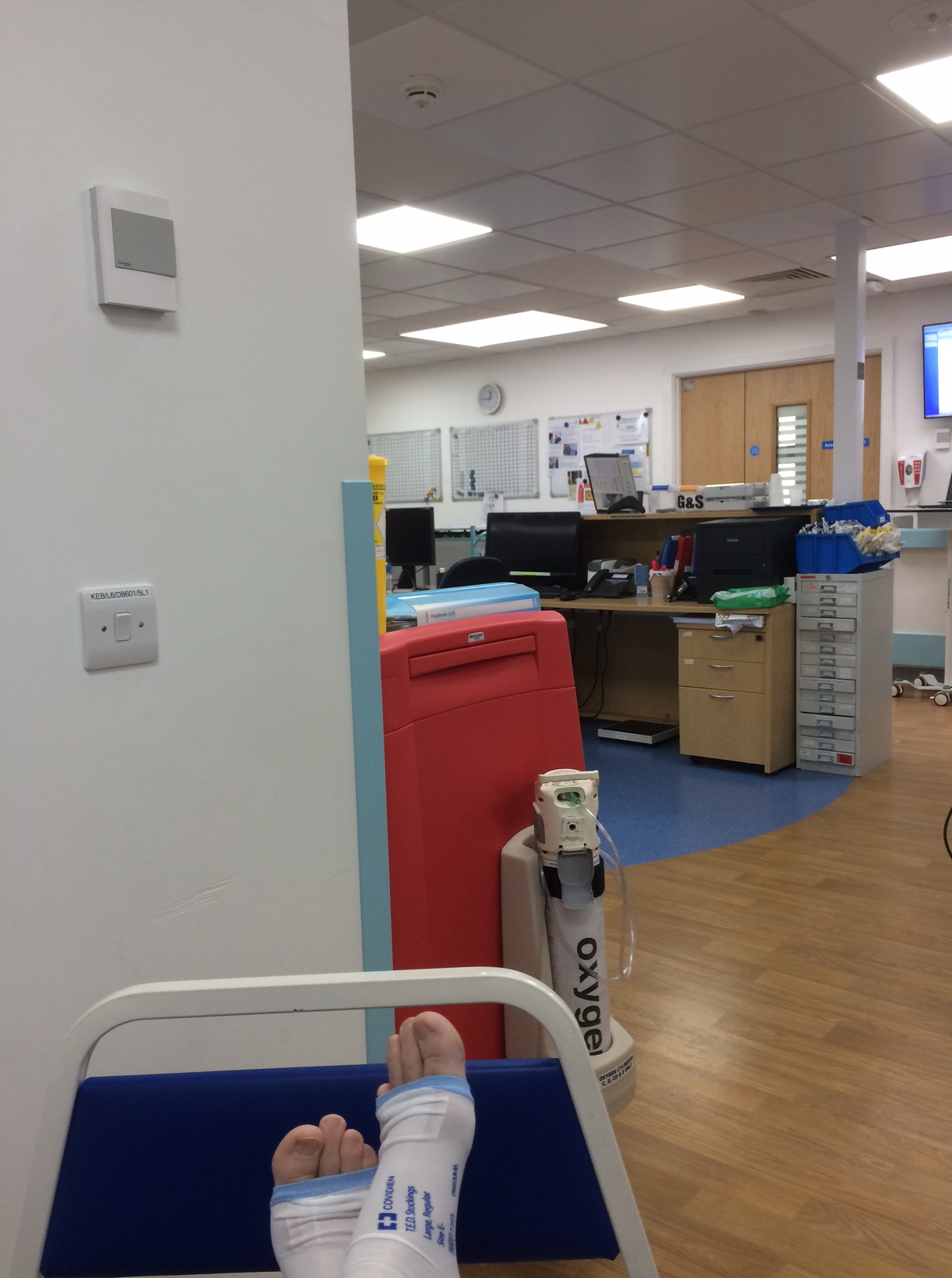
Sexy surgical socks

Just before Christmas, I accidentally clashed heads with somebody while doing sports so hard that I broke the orbital bone underneath my right eye. This is called a “blowout fracture”. He effectively headbutted my eye. Yes, it hurt. A lot. And bled from my nose. I didn’t know anything was broken at the time, I just thought I’d had a bad knock. But more worrying was the instant double vision, which seemed to return back to normal(ish) very quickly. Even though it was getting better I still had it, so I phoned 111 the next day. Head injury with double vision? “Stay there, we’re sending a paramedic over”.
 
They took me to A&E since my symptoms were an indicator of bleeding on the brain, which is obviously a serious business. The doctor gave me an X-Ray, looked in my eyes and said I was fine. Go home. I had a bit of a black eye, but it didn’t look particularly bad. After Christmas I got a call from the hospital saying they were going over the X-Rays and found something they missed. Could I come in for a CT scan straight away? This sounded serious so I did. The CT scan indicated a fracture under the eye. I was referred to the Maxillo Fascial Unit at the Bristol Eye Hospital. After waiting a bit I went for my appointment with a surgeon who started talking about volumes of liquid in a glass and how mine was now a bigger glass, but the only words I was really taking in were “over time your eye will recede into your head”. So there’s nothing you can do?, I managed to blurt out at one point. “Oh yes, there’s surgery to correct it. We’ll put a metal plate in your head”.
 
Faced with that or my *eye receding into my head* I went with the latter option. I did the pre-op visit the same day and after a few days, I received an appointment at the BRI to have the operation done in a couple of weeks. That seemed a reasonable time to me as it was classed as a non-emergency but “needed doing”.
 
Here’s what happens when you are admitted. First, you have to rearrange your life around the fact that you have to stay in hospital overnight. So you’ve moved things around at work, cancelled things you were going to do, booked time off and generally written off the week for getting over the general anesthetic and pain. You can’t eat or drink anything 7 hours before the op, which is inconvenient. Then you need to get to hospital at 7.15am. The BRI is right in the centre of Bristol so you get dropped off by a helpful friend (thank you, Jonathan).
 
So you do all that. From 6.30am onwards you and your little group of today’s patents gather in the waiting room, with a sense of too early morning doom hanging over you all. You’re all going through your own different personal hells as you wait. Then you are called in.
 
A nurse calls you to a room, does some blood pressure checks and makes sure you haven’t got MRSA or any other major health problems. Once that’s done the anesthetist rolls in. They are full of optimism and joy. They talk you through the anesthetic procedure and how it’s all good to go from their end and there won’t be any problems. Now your spirits are lifted and you’re feeling positive everything is going ahead. Then the surgeon comes in and tells you there’s a 50% chance it won’t happen because there’s no bed for you currently. And since you were last here (yes, this is your *second* attempt at an operation after the first was cancelled because there wasn’t an anesthetist available), “50% of all patients have been sent home without their operation”, so your chances really aren’t good. But wait until the 11 o’clock bed meeting and hopefully one will free up, but it doesn’t usually because you are a lower priority to people having a genuine medical emergency, and your procedure “doesn’t need to be done today”.
 
But after waiting 2 hours there’s some good news! There’s a bed! After another wait, you see the surgeon again and he looks positively relieved “Good news!”, he says, but there are people due to be operated on before you so it won’t be until after 3.30. That’s ok, I’ve got a book and a comfy seat. I can wait.
 
To be fair, the constant state of anxiety about whether it will or won’t happen does take your mind off the fact that a surgeon is going to open up your face with a sharp knife and mess around with your eyeball before putting a metal plate underneath it and screwing it in.
 
You relax and settle down to read. 2 hours later a very nice woman you haven’t seen before turns up and tells you that she’s very sorry but your operation is canceled because they’ve “run out of time”. That’s it. Go home, wait for another appointment in the post. “But this is the second time this has happened!”, you say. “I know, sorry…”, she says. Apparently, the woman due to go before me has only just gone in and hers is a long operation, meaning they won’t be finished before 5.
 
At this point you say FML and look into private health care, wishing you’d done that a month ago. At least they wiped the arrow they’d drawn on my head off this time before they sent me home, unlike last time.
 
I’m lucky that my job comes with private health care (BUPA). I’ve never used it. My NHS surgeon was at great pains to say that if I went private then he couldn’t recommend one hospital over another, but I got some options out of him. I eventually wrestled a ‘consultation authorisation number’ out of BUPA’s corporate team (There’s a £100 excess I need to pay, or something) over the phone and contact a private hospital. They gave me a consultation date of the next day at 9.30am in the morning. “We have our own car park, which you can use”. (Words you will never hear in the NHS.)
 
I still don’t know if my insurance covers me for the op – I have to get a procedure code at the consultation, then phone up and find out if I’m covered for that procedure, or something. I still might not actually be covered. I’ve yet to find out.
 
I’ve used NHS local doctors and dentists all my life. I hadn’t felt the need to go through the hassle of enacting private health insurance because everything seemed to be going smoothly on the NHS. Until it wasn’t. Twice, now. And with no guarantee it will be any different the third time.
 
I love the idea of the NHS. I’ve been paying for it all my working life. I tried to use it, but it’s broken. All the doctors and nurses I met were lovely, but if the system is broken how does that help?
 
If there’s a motto then just don’t get any sort of non-emergency injury in Britain in 2018. Or be rich. I guess that’s the message.
 
Oh and if you live in Britain, then please vote anything other than Conservative at the next election. That would help, thanks.

The problem with push hands challenges

black-and-white-people-bar-men.jpg

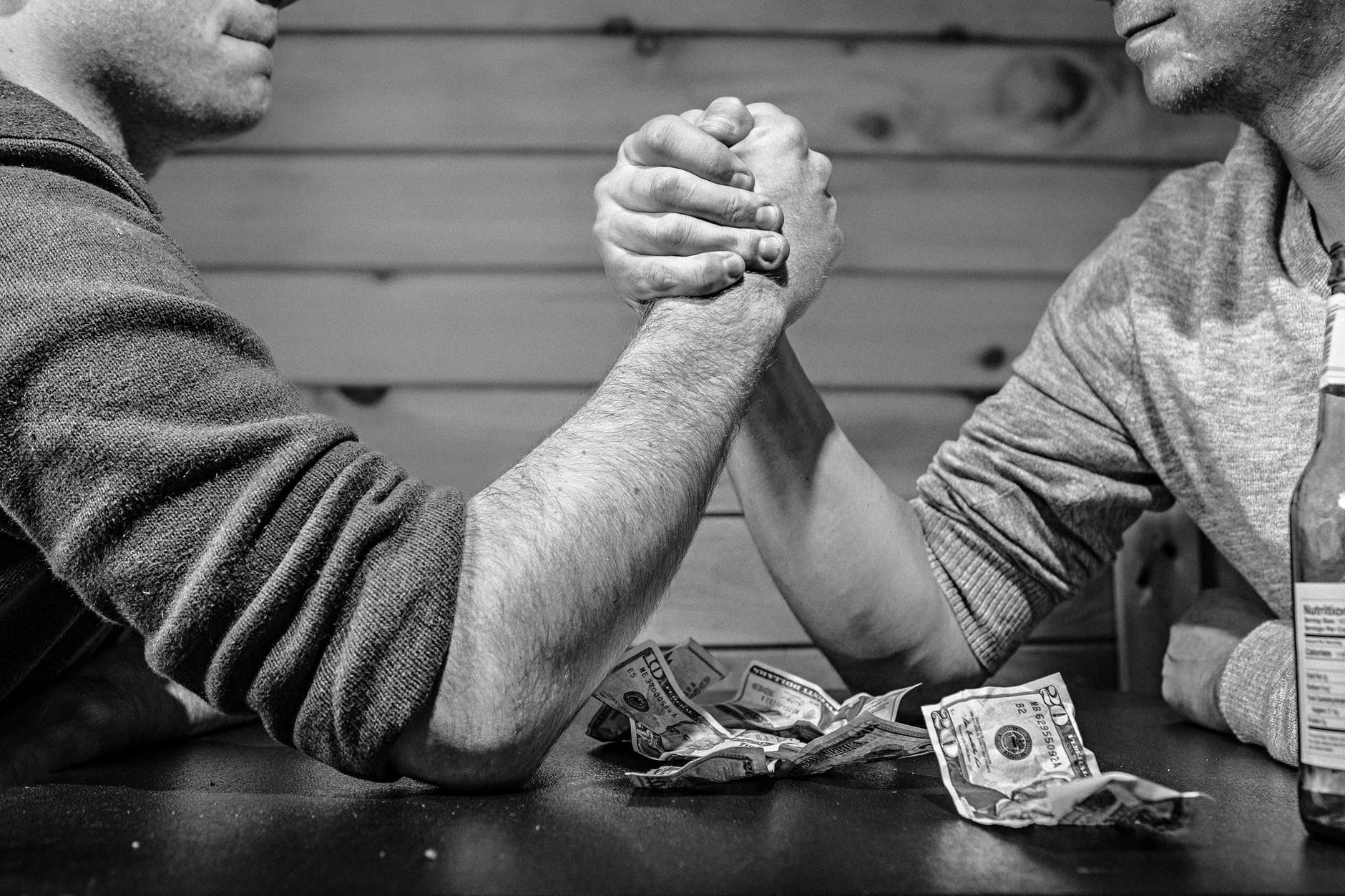
This is a really interesting article from Practical Method Tai Chi about the passive-aggressive world of Tai Chi push hands challenges in China – I really try to avoid pushing hands with people I don’t know for many of the reasons described here.

I think the best use of push hands is as a teaching tool, where it is invaluable. Used as a method to compare skills it inevitably turns into ‘Wrestling Lite’, and the best wrestler wins.

Check out the article here.

You might also like: Thoughts on Push hands by Mike Sigman


Martial arts in video games: New Batman fight choreography

Things have been getting a bit ‘academic’ lately on the blog, so let’s just have some fun. I just saw this fight choreography for Batman vs Bane in an upcoming computer game called Batman the Enemy Within. Check it out:

It’s interesting for a number of reasons – firstly, it’s really good! People putting this much work into fight sequences for a game surprised me. This isn’t motion capture – the sequence is a “visual reference for animators”. It would be really interesting to see how the final sequence looks when fully animated. You can see some examples of their animated work below:

Secondly, they’re using a woman as the Batman character. Partly I think this is to create a size difference between the two characters. Bane is meant to be bigger, and he can inject venom to “Hulk up” a bit when he needs to.

Finally, the fighting style used looks very jiu jitsu-based, of the “flying armbar” variety. At one stage in the movie franchise Batman moved towards a fighting style that was based more around Filipino arts.

Great work.