He’s the ‘Marmite‘ of the Tai Chi world (well, one of the Marmites anyway, you could argue the Tai Chi world is made up of Marmite personalities all the way down 🙂 ), but this free article is a nice neat summation of Scott Phillips’s theory of Taijiquan as dramatic storytelling.
It’s easy to dismiss Scott as “he’s just a dancer”, but to me those Chen style movements he’s talking about look so stylistic and deliberate that they’re clearly not just martial movements. If you’re arguing that Tai Chi is just a martial art and nothing else then I think you’ve got a lot of explaining to do. It’s pretty easy to see what fighting looks like these days, since sport fighting is on TV every weekend.
I think the idea that ‘Ok, this might be true, but does this matter?’ has much more validity. If Scott is right and he’s tracked down the origins of Tai Chi, then it clearly been forgotten over time, and Tai Chi these days has become something else.
In fact, it had become something else over a hundred years ago. China has gone through several major political and cultural shifts over that time that changed their society completely (often resulting in the deaths of millions of people and associated trauma). The Boxer Rebellion, the 1912 Chinese Revolution, the Communist rise to power, the Cultural revolution and the current rise of nationalism under the guise of Communism, etc…
Anyway, the article is in-depth and it’s worth a read if you have an interest in the possible origins of Tai Chi:
Is there a secret to Tai Chi? To martial arts? To life? If there is I think it might be encapsulated in the two words, “Don’t try”.
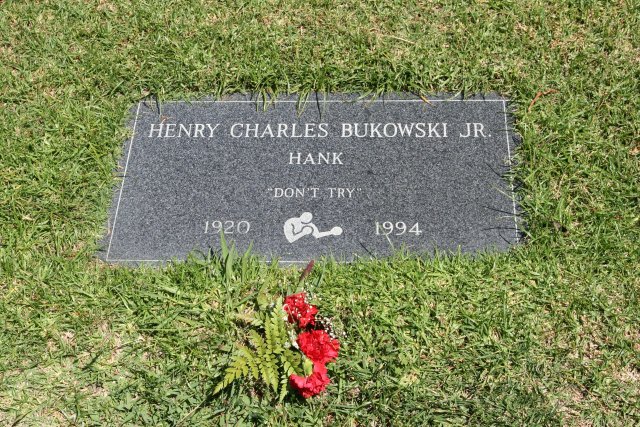
Famously offensive American poet and author Charles Bukowski had “Don’t try” written on his gravestone:
It makes you wonder what he meant. Did he mean just give up? I don’t think so. Underneath “don’t try” is a picture of a boxer, indicating a struggle.
Mike Watt in the San Pedro zine The Rise and the Fall of the Harbor Areainterviewed his wife Linda about, “Don’t try”:
Watt: What’s the story: “Don’t Try”? Is it from that piece he wrote?
Linda: See those big volumes of books? [Points to bookshelf] They’re called Who’s Who In America. It’s everybody, artists, scientists, whatever. So he was in there and they asked him to do a little thing about the books he’s written and duh, duh, duh. At the very end they say, ‘Is there anything you want to say?’, you know, ‘What is your philosophy of life?’, and some people would write a huge long thing. A dissertation, and some people would just go on and on. And Hank just put, “Don’t Try.”
As for what it means, it’s probably best to let Bukowski tell us:
“Somebody asked me: “What do you do? How do you write, create?” You don’t, I told them. You don’t try. That’s very important: not to try, either for Cadillacs, creation or immortality. You wait, and if nothing happens, you wait some more. It’s like a bug high on the wall. You wait for it to come to you. When it gets close enough you reach out, slap out and kill it. Or if you like its looks, you make a pet out of it.”
– Charles Bukowski
Now that’s starting to sound like Tai Chi to me…
I was working on an application of diagonal flying yesterday. The one where you get underneath their shoulder, arm across their body and lift them up and away. There’s a sweet spot as your shoulder goes under their armpit where you have leverage. Where they move easily. You go an inch or so in the wrong direction and you lose it. The technique doesn’t work.
Compared to wrestling and judo I think there are different factors to consider in making a Tai Chi throw work.
You have to think more about your posture. Say, your chest position (is it sheltered? Are the shoulders rounded?) and if you are sunk and in contact with the ground correctly. Is your butt sticking out? Are your legs bent enough?
All these factors matter more in Tai Chi than in Judo and wrestling because Tai Chi is a less physical art. (Whether that’s a good thing or bad thing is debatable, but it either way, it just is.)
With a less-physical art it’s much easier to notice when you’re having to “try” more to make a throw work. Having to “try” too much is a sign you’re muscling it, not letting posture, correct position, leverage and Jin (power from the ground) do the work. Judo and wrestling incorporate these elements too, but Tai Chi relies on them. And without them it just falls apart.
In BJJ I also really like the philosophy of “don’t try”.
For example, if I’ve got the knee on belly position on my opponent I love to go for the baseball bat choke:
The problem is that once you set your grips up on the classic baseball bat your opponent doesn’t just lie there – he defends. He grabs your arms, shifts his hips and generally does everything he can to prevent you from getting the finish.
Now the video shows you three ways to do this – they’re clever little counters to his counters. (I really like the last one actually – I’m going to try that).
But I tend to prefer a slightly different approach. Rather than think of each technique in isolation I like to think of them as being paired. Quite often when I go for a baseball bat choke I set up my grips and immediately my partner has cast iron grips on both my hands. Now sure, I could fight through this – ie. “try” to make the choke work – or I could just go, “you know what? The way he’s defending this means he’s lifting his far elbow – I’ll use that instead”. I give up the baseball choke entirely, but before you know it I’ve spun around and I’ve got a successful kimura grip. He defends the kimura and guess what? It leaves his neck open, and I go back to the baseball choke, so on.
I’m not trying to make anything work, I’m just going with what he gives me. And eventually all the pieces fit together like a jigsaw and it’s done.
I don’t always get it right. More often than not I get it wrong, but that’s what I’m aiming for. If you’re going to adopt this attitude you have to have a really flexible mind. You can’t get fixated on one thing. In fact, you can’t think too much. Just go with what you feel is available.
What I’m talking about is getting off the baseline and onto the middle and top lines. For a full explanation of what this means you’d need to listen to the Woven Energy podcast, but in a nutshell, it means you stop using the thinking, rational part of your brain and just use direct feedback from nature (your partner in this case, who is as much a part of nature as you are) and that gives you access to the midline (body) and topline (spirit).
In Chinese culture the topline, midline and baseline form a trigram, which can have broken or unbroken lines, as so:
And since we’ve returned to China we should note that the Taoists were all about this “Don’t try” philosophy. They called it Wu Wei – to do by not doing.
From the Tao Te Ching chapter 2:
Therefore the Master
acts without doing anything
and teaches without saying anything.
Things arise and she lets them come;
things disappear and she lets them go.
She has but doesn’t possess,
acts but doesn’t expect.
When her work is done, she forgets it.
That is why it lasts forever.
Or as Yoda put it, “Do or do not, there is no try”.
And to return to the topic of Tai Chi, it is also exemplified in the short but concise classic on push hands:
Song of Push Hands (by unknown)
Be conscientious in Peng, Lu, Chi, and An.
Upper and lower coordinate,
and the opponent finds it difficult to penetrate.
Let the opponent attack with great force;
use four ounces to deflect a thousand pounds.
Attract to emptiness and discharge; Zhan, Lian, Nian, Sui,
no resisting no letting go.
And to finally return to Bukowski, he might be a strange role model, but I kind of like the old guy. His poems aren’t beautiful, but at least they are honest. He was always, exactly himself. He didn’t need to try.
I don’t really enjoy push hands. I used to, I used to enjoy it much more when I saw it as a medium for exploring arm locks, takedowns, wrist locks, throws. In short, when I saw it as a way to practice techniques. I used to love it.
In more recent years I’ve reframed my view of what push hands is. Partly this is because I took up BJJ, and found I got more than enough scrapping in my diet to satisfy my craving to try out locks, throws and sweeps. That’s essentially what we do in BJJ, we practice locks, throws and sweeps over and over until we get very good at them and can do them under full resistance.
Inevitably the BJJ player ends up going one of two ways over the years. Either he (or she) gets softer and more flowing. So, when the other person is pushing you should be pulling, and when they’re pulling you should be pushing. By learning to flow with the dynamic movement between two people you learn to blend, yield and overcome. Or they end up getting very good at smashing people. Whatever is in front of them they can just smash through it using precise, accurate bursts of speed and power.
Inevitably all BJJ players tend towards the first approach as they age, if they want to keep training, that is. Or they give up either through injury or changing life circumstances.
But back to push hands. Once I had found a way to get my regular fix of fighty, I found I could step back and view push hands as something else. Perhaps what it was originally intended for.
Now when somebody pushes on my arm I don’t immediately think “how can I lock this arm?”, I am thinking, “where is his force going?”. Is it going to my feet? If not, I try and send it there, turn and yield. When it’s my turn to push back I ask myself where I’m pushing from. Is it the ground? If not, why not? What am I doing that’s stopping that? Where am I tense?
Pushing hands like this might not be as much fun, but I think overall, it’s more satisfying.
Proper push hands lacks the thrills of the fighty approach, but it instils qualities in you that make your fighty better.
That’s a difficult concept to really understand, and even harder to do when the other person just wants to fight. If the other person wants to fight then I sometimes just fight back. Inevitably I slip into BJJ mode and we end up in some armlock on the ground, and it’s fun…
San Ti Shi is the basic stance used in Xing Yi. This helpful new video by Byron Jacobs takes you through the stance, the positioning of arms and legs and what to do as you stand.
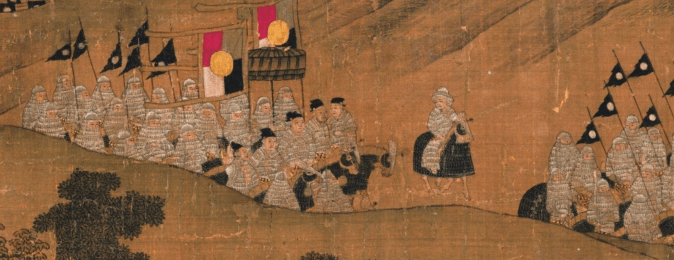
Jurchen Jin Cavalry. Illustrations of Auspicious Omens [Public domain]
After looking at the rise of the Mongol Empire for a few episodes my Heretics podcast has come back around to looking at Xing Yi and in particular the use of weapons, military strategy and armour in the Song Dynasty armies.
Part 7 starts with a rebuke to the criticism “You haven’t even got to talking about Xing Yi yet!” then looks at some animal-based military strategy. These are the same strategies that are used in the Xing Yi animals today.
In particular, we look at Ma Xing – Horse strategy – but also look at Snake (She Xing) and Eagle (Ying Xing).
Part 8 looks at Chinese armour in more detail, but also talks about Xing Yi fighting tactics in relation to armour and how the armour influences the way the art works – stepping, continuous movement, minimal movement, twisting the fist in Tzuann, etc…
There are two versions of part 8, the first is for public consumption, available here:
and we got into some controversial topics at the end of the episode, so the full version is reserved for our Heretics/Woven Energy Patrons ($5 and up):
If you practice Chinese martial arts then you need to know your history, and especially what happened in the early 20th century with the Kuo Shu (Guo Shu) movement.
This was before the Wu Shu movement, which came later.
This excellent video by Will from Monkey Steals Peach explains what happened and why, and why Sun Lu Tang became such an important figure in Tai Chi history.
There’s a lot of debate about “tucking the tailbone” in Tai Chi. Some people are big exponents of ‘tucking’ or centring the pelvis, which removes the curve of the lumbar spine. Other people prefer a more ‘natural’ lower back which has more of an inward arc.
For me, it’s not that either of these positions are wrong in Tai Chi, it’s that the idea of holding your spine in a fixed position that is wrong.
If I see anybody practising Tai Chi with a fixed, ‘held’, lower back shape I think it’s just time to sigh and move on.
The lower back is part of the dantien area. This area must be relaxed and free to move.
By far the most common way people hold the spine in this position with tension is with an inward curve. If you see a curved-in back then this area is not relaxed. It might be more aesthetically pleasing but there is no way to connect the power of the ground and legs through the dantien area like this – it’s essentially cut off from that power.
Sure, you can generate power in other ways, but unless you relax the lower back power can’t be transferred from the ground.
Xing Yi is the oldest of the ‘internal’ martial arts. If you look at videos of a precursor art to Xing Yi, called Dai family Xin Yi Lie He, you can see their art has an exercise called squatting monkey as its foundation practice. Look at how it bows and unbows the spine. There’s a lot of flexibility being trained here.
These exercises are like basic, large frame, training exercises for conditioning the muscles and tendons of that area, and the movement can become a lot smaller in usage.
If you’re a Tai Chi practitioner you don’t need to start doing Squatting Monkey practice. I’m not saying that, but you do need to start paying attention to your lower back as you do whatever exercises you are doing – form, Pa Tuan Chin, Silk Reeling, Chi Kung, etc…
Ask yourself what your lower back is doing. Am I holding tension in it? (Here’s a big clue – you are!) and how should I release it? How about when walking around town, or pushing a trolley in Sainsbury’s? You’ll be surprised by how often we hold tension in this area.
Next think about the role of breathing and how it relates to the lower back. If we are doing deep diaphragmatic breathing (which makes the abdomen swell) then it should also be expanding at the back of the abdomen too. Ask yourself, do you have any flexibility here when you breathe in?
As somebody said: “From the sample pages it looks as bonkers and brilliant and polarising as the last one. Better than being boring!”
I’m really looking forward to seeing how he supports his theory (from the back cover) that Baguazhang was created after the failings of the Boxer Rebellion (1900) when the founder of the art, Dong Hai Chuan, died in 1882. I’ve been assured he tackles this point in the book…
If you click the Amazon link above you can click “Look Inside” to read a bit.
Tai Chi Chuan has the 13 postures as its basis, which consist of the 8 powers and 5 directions.
The first 4 powers are well known – peng, lu, ji and an – while the second 4 tend to not be so well known. Li (split), Tsai (Pull down/shock), Zhou (elbow) and Kou (shoulder).
These 8 ‘powers’ are the most common expressions of power in Tai Chi Chuan. No technique in Tai Chi Chuan is really purely a single power – they’re all combinations of all 8 of the powers.
It’s this pull down, or shocking, power I want to talk about today.
Shock is often called Pull down because that’s the direction it’s most often used in, however, it’s actually directionless. I prefer “shock” as a description as that’s what it feels like, rather than a pull. Even if performed while pulling, it’s a sudden burst of focussed energy rather than a long expression of energy over time, like say a push.
A lot of people practice Tai Chi with its soft flowing movements yet are unable to coordinate the body together to produce a single isolated burst of power that’s required in the application of many of the movements of Tai Chi Chuan. Depending on how a Tai Chi form is done it’s quite common to see all the shock power removed altogether in favour of soft, flowing, relaxed movement. Yet without it, something is lacking. You’ll never make your techniques effective.
Take an armlock that’s supposed to break a limb. There’s no way you’re going to get that to achieve the desired effect if you can only do the move slowly and softly.
I’m not talking about a sudden burst of tension there either. A good ‘shock’ is delivered by coordinating the body movements together and generating power from the dantien, legs and waist.
Here’s a video I made whilst working on some Tai Chi – see if you can spot where the shock energy is.
There’s an old adage that the Tai Chi practitioners of Chen village used to “tear up the sandbanks” of the river bank when they practiced their form there. This indicates how much force was being produced by the legs twisting.
It’s often said in Tai Chi that your feet want to grip the ground. This is achieved by slightly raising the arch of the foot so the toes perform a clawing action that affords you improved stability, balance and grip.
The question is, how do you do it? It doesn’t sound very relaxed to ‘grip’ the ground with your toes,and we all know that in Tai Chi we need to be Song (‘relaxed’).
In fact, the arch of the foot and the grip of the toes is achieved through softness, rather than hardness. The answer is found in the wrapping of the legs we mentioned earlier.
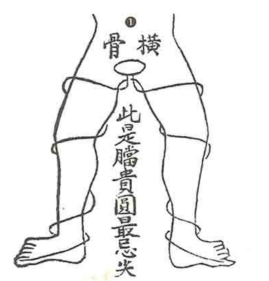
If you point your knees outwards slightly you create a kind of gentle wrapping in the legs as you move, and, if you let it, this wrapping will encourage the toes to grip the ground and the foot arch to form. Of course, it should be emphasised that the action of the knee pointing outwards is achieved not by pointing the knee itself, but by rounding the inner thigh area – the Dang, in Chinese. We covered this in that last post.
The gripping action of the toes gives you better than normal balance, especially in one legged postures. If you’ve ever looked at a Tai Chi practitioner stand on one leg without wobbling and wondered how they do it, then look at their knee and see if it’s being gently pointed outwards. That’s usually the key.
There’s not really any point in seeking the extra stability this leg posture affords if you’re only practicing Tai Chi for health reasons, which is why “rounding the crotch” or gripping with the toes isn’t talked about much in styles that predominantly focus on health matters, but it should form part of martial Tai Chi Chuan. And indeed, if you are making this all happen using too much tension, then you might end up causing more harm than good, so buyer beware.
None of the postural considerations of Tai Chi should be achieved through tensing parts of the body. That’s the key. You need to walk the middle way between trying to make something happen too hard and not trying hard enough. That’s the enigma of Tai Chi.