This is a very informative interview with Ma Yue who is a Mashi Tongbei master. He talks about (amongst other things) what it was like growing up in a traditional martial arts family when the Cultural Revolution happened in China, and he had to be taught in secret. He also talks about the making of the first Shaolin Temple film, which is father was involved in, and what he sees as the many problems with Wu Shu today.
The article has some great ideas, especially about forms being memory holders for principles, rather than catalogues techniques.
“you need to use the forms, or techniques not as platonic ideals to be chased forever, but as examples from a broad set of ‘what is possible’. It is possible to hit this way, that way and another way. It is possible to unbalance this way, that way and another way. And so on. No perfect techniques, just the capacity to recognise possibilities”
With the explosion on the Internet of videos of MMA fighters knocking out traditional martial artists I think that internal martial arts are feeling (rightly) like they’ve become the undeserved butt of a joke, while at the same time the older generation of teachers is passing away without enough new students to carry on their arts to the same standards. The modern generation don’t want to practice as hard and have other things to be interested in.
Noble institutions like Xing Yi, Baguazhang and Taijiquan, which developed a reputation for being effective, fighty, martial arts during the 1920s and 1930s in China are now starting to be thought of as ‘for health’ only, or useless for fighting with, while MMA is seen as the barometer of effectiveness. Or at least that’s the narrative I see being played out. But I’m just not convinced that this narrative is actually true
Firstly, I don’t think these videos of Xu Xiaodong beating up Kung Fu masters are necessarily about saying MMA is better than internal arts – they’re more about one man’s fight against the Chinese system. One man’s “rage against the machine”, which is the government’s control over the martial arts scene in China. It’s a battle for personal freedom that Kung Fu just happens to have got caught up in. The China state Wu Shu machine is relentless in imposing the “official” version of traditional Chinese martial arts on the population, and that often it has little to do with actual fighting (which gets sidelined into Sanda – Chinese Kickboxing – , which is often divorced from traditional Wu Shu). So-called masters were encouraged to start making outrageous claims about their kung fu abilities on Chinese TV in staged demonstrations that were presented as being real. For pointing out the flaws in this heavily state-promoted view of Wu Shu with his fists, Xu Xiaodong is paying a heavy price of social restrictions and persecution. His travel is limited and his freedoms are curtailed.
Over here in the West I often hear serious Kung Fu practitioners worry that if MMA is seen as the be-all and end-all of fighting then traditional styles will eventually fade away, and the evolution of martial arts will go down a sports-based cul-de-sac, in which you “aren’t even allowed to kick somebody in the head when they’re on the ground!”
I see things differently. MMA training is really rough (or at least, it is in most places). In terms of what the vast majority of martial arts practitioners want, it’s a fringe element. Your average office worker has no interest in turning up to work on Monday with a black eye and busted nose. The vast majority of martial arts practitioners are still in traditional arts, which might be more ‘street’ orientated, but tend to be less rough in their practice. They’re filling village halls with karate and tae kwon do classes, or doing judo at university, or BJJ at their local academy and Tai Chi in the park. Or at least they used to be before COVID hit. The percentage of these people that want to push their bodies to the limit and be beaten up on a regular basis is vanishingly small.
MMA is also a form of entertainment designed for television. When the big MMA stars compete at UFC on a Saturday and the crowd goes “Whoo!”, when a spinning head kick finds its target, I bet the numbers at local Tae Kwon Do clubs go up the next week, not down. I see MMA as a great promoter of all martial arts. It’s quite possible Conor McGregor has done more to promote traditional karate than anybody else in history!
I agree there’s a real risk that if MMA is seen as the only arbiter of ‘what works’ in combat then martial arts could evolve down a sports cul-de-sac, but I’d argue that MMA is pretty damn close to ‘real’, and the gains made by seeing what works in the cage compared to what passed as ‘real’ in martial arts before the UFC is like night and day.
People are not so stupid that they can’t understand the difference between a sport with rules and a martial art for self defence. And anyway, sure it’s against the rules to kick an opponent in the head when their knee is touching the ground, but who the hell is getting kicked full power in the head when they’re on the ground in a martial arts class anyway?
What we’re actually seeing is the end of the era of the ‘death touch’ and ‘ling kong jin’ no-touch nonsense that found a fertile environment to grow in a martial arts world that had lost touch with reality. An MMA guy in China beating up fake kung fu masters could just be part of the course correction that is required in the path of martial arts needs to walk right now.
It’s easy to laugh at the QAnon followers who stormed the capitol in the belief that Donald Trump would pardon them of their crimes and there was a secret revolution about to happen, but there are plenty of equally delusional beliefs in martial arts.
I found an article on the Martial History Team blog recently that quotes from a longer article by Paul Bowman about why martial arts history seems to matter so much to some people.
There are plenty of gems here, but I like this quote:
“Unsurprisingly, in much scholarship on Asian martial arts, the matter of history remains freighted and weighted down by the same popular myths; so much so that even much that passes for scholarship seems to refuse to face up to the evidence that suggests that, quite frequently, martial arts that present themselves as ancient are hardly even old.[11]
So many massive social mutations occurred through the nineteenth and twentieth centuries that most ‘traditional’ martial arts effectively have at best little more than a century of continuous history to them, rather than the vast eons of allochronic time that so many seem to want them to have spanned.[12]
I emphasize the word ‘want’, here. This is because wanting appears to be a key issue to consider when approaching questions of martial arts history and culture. For instance, it seems that the perpetuation of fantasy histories and the fetishistic fabrication of lineages in ‘traditional’ martial arts evidently have everything to do with wanting.
Practitioners want taiji to be ancient. Many want there to have been a Southern Shaolin Temple which was burned down, scattering the few surviving kung fu monks to the different corners of China.[13] We want Okinawan farmers to have fought samurai with rice flails. We want Yim Wing Chun to have been a real proto-feminist warrior.[14] We want the skill that wielded the weapon that killed Magellan to remain alive today.[15] And we want ancient warrior armies to have flown at each other through the air, kicking each other off horses with flying sidekicks and jumping spinning back kicks.
Just because you want something, it doesn’t make it true.
As lockdown lingers around the world martial arts classes are facing a tough time, however, there are plenty of stimulating online discussions on martial arts to listen to. Here are three discussions I’ve listened to recently that have tickled my cerebral tentacles. Maybe they’ll do the same thing for yours?
This discussion between Paul Bowman and Qaus Stetkevych on so-called “Viking martial arts” is really interesting. It’s a world I know nothing about (although I did write an essay once on the connection between Xing Yi and old shield work )
It’s very interesting to listen to the criticisms that Qays makes in the above discussion then watch this clip I found of “Viking martial arts/Glima” – (which was litterally the first clip that came up when I searched for Glima). This martial art looks exactly like No Gi Brazilian Jiujitsu to me…
Xing Yi and Yi Quan
Next is Byron Jacobs excellent Drunken Boxing Podcast in which he interviews Yi Quan practitioner James Carss. What I like about this discussion is that it’s very down to earth and real about what it’s like training martial arts in China and Hong Kong. It’s not all smiles and rainbows and it was interesting hearing about the animosity between different groups of the same martial art that naturally spring up. Plus you get to find out more about the connections between Yi Quan and Xing Yi Quan, and how they are a lot closer than a lot of people think.
Finally, here’s a bit of an older discussion, but fascinating if you are interested in the connection between Chinese theatre and martial arts. Scott Park Philips is in conversation with Daniel Mroz about all the subjects you find in his latest book. Scott never gives the same answer twice, but it’s an interesting slice into his mind. In particular he answers the question “What is the Golden Elixir?” at 41.44.
Jack Slack was the first person to draw my attention to the parallel between rioters storming government buildings that happened in China’s Boxer Rebellion around 1900, and the storming of the Capitol Building by Trump Supporters in 2021. Both involve a kind of “spirit possession”.
Of course, America, along with many European nations, was involved in the Boxer Rebellion:
“In 1898 the Yellow River burst its banks and destroyed the harvest in much of Northern China, but this misfortune was followed by an agonizing drought which dried out the land and hardened the dirt. As young men went hungry and without work, some Chinese noted the connection between the anger of nature and the construction of train tracks, telegraph lines and churches since the arrival of foreigners in the Qing Empire. Anti-foreign sentiment brought together groups of peasants practicing martial artists and calling themselves the Righteous Society of the Harmonious Fists—though the West came to know them as “The Boxers”. The Boxers attacked and murdered missionaries across the Empire and in the summer of 1900, Tianjin and Beijing were plunged into chaos as the Boxers received the blessing of Empress Dowager Cixi and the Imperial army. 400 foreigners and 3000 Chinese Christians endured a two month siege in Beijing’s legation quarter—a stone’s throw from the Imperial Palace but completely helpless. The Boxer Rebellion is a story about agriculture and diplomacy, magic and court intrigue, and it stands as both the last great event of the Victorian Era and the beginning of the end for the Qing Dynasty. ” – Jack Slack
Of course, I’d contest that the events that lead to the end of the Qing Dynasty had started much earlier, back in 1860s. It was these conflicts with foreign powers and internal rebellions which lead directly to the creation of Tai Chi Chuan, as we discussed on our History of Tai Chi podcast series. Yes, I’m sorry, the myth of a Taoist inventing Taijiquan after a dream about a snake and a crane, is just a fairytale. The real reason is much more pragmatic.
Jack has done an excellent podcast episode on the Boxer Rebellion, which he’s just released to the public, instead of being behind his Patreon paywall. If you want to find out more, have a listen:
Michael Rook posted about an online course in Hap Gar that’s starting in January, so I thought I’d check it out and had a go with one of the free videos as my morning workout. The teacher is David Rogers of Rising Crane, and the workout is a nice, not too heavy, way to start your day while learning some Kung Fu. Plus it’s free, so give it a go! I really enjoyed it. After a warm up you’ll work on the first 5 basic punches of Hop Gar and some stances.
Richard is a teacher of Tai Chi and Hap Gar Kung Fu through the Rising Crane. David only takes one or two student groups a year for online learning, and it’s a very interactive, personalised training session so a whole group can move through it together, getting feedback as they go.
I haven’t done Hap Gar before, but I’ve done a lot of Choy Lee Fut, and to my eyes there appears to be very little difference between the two. Hap Gar looks like a version of Choy Lee Fut to me, even the same names are used for the moves, so it was great to experience a Kung Fu style I was already familiar with, but from a slightly different perspective. I also liked his thoughts on fighting strategy for these long range styles that he gives at the end, around the 35 minute mark, plus I liked his thoughts on MMA.
That is one mean looking crane. Photo by Pixabay on Pexels.com
Today I want to talk about a very useful martial arts teaching called the 3 timings. In many ways, these teachings are the secret to all martial arts, so you’re getting some pretty good value out of this free blog post! 🙂
The three timings have been handed down in many different martial arts lineages under different guises, but it’s all the same teaching. I suspect the 3 timings are as old as time itself.
Personally, I’ve found the three timings most applicable to weapons work, but they are obviously important for barehand too.
The version of the 3 timings handed down in my Chinese lineage was called “Yi timing, Chi timing and Xing timing”, but in English you’ll find them explained perfectly well by Paul Vunak here as simply, before, during and after:
Paul Vunak is a Jeet Kune Do teacher. Bruce thought the concept of “Jeet” was so important he named his martial art after it. The “Jeet” in Jeet June Do means to intercept, and intercepting is what the 3 timings are all about.
The 3 timings is a pretty simple concept. You can hit somebody:
“After” they have completed their technique (xing timing), for which you obviously have to move out of the way before you respond. This is the slowest timing and easiest to perform.
“During” their attack (chi timing). This is a much shorter timing, and it could end up in a simultaneous strike where you both hit each other, but ideally you would just sneak in first and beat them to the punch.
And finally, “before” they strike you (yi timing). This is the hardest timing to achieve, because it’s very easy to get wrong. For true Yi timing you need to hit them before they launch their attack, but equally, their attack does need to be a genuine attack. If you fire on Yi timing (”intention” timing), and they are faking, or not attacking, you’ll end up out of position and vulnerable. Yi timing therefore requires immense practice and sensitivity so that you can accurately read the whole situation in the blink of an eye.
Timing is the ultimate skill in martial arts. If you are a master of timing, then you almost don’t need any technique. If we are both holding swords and I can always time my attack to hit you anytime you come towards me then I can forget about “Green Dragon Scoops the water” or whatever fancy technique I know. It all becomes irrelevant.
So how do you practice the 3 timings? Well, I’d suggest that the first stage would involve getting a partner, like Mr Vunak has done in that video, and practicing responding to set attacks, so you can develop a feel for each timing. Obviously this would need to be done predictably at the start then slowly more variation can be introduced and the sparring can become freer. Instead of the other person just feeding attacks, they can try to start to make their own attacks and counters.
If you practice barehand and with weapons then you’ll notice how much quicker the timing needs to be with weapons. You have so much less time to react. In fact, going back to barehand after using weapons you will almost feel like you are moving in slow motion, which is a handy skill to have for obvious reasons.
With the timings at the heart of your practice you might also change the way you think about moving in martial arts. Ways of moving that require a unity of body and mind become much more important. You need to move everything together, and as one, to hit your timings.
The words of the Xing Yi Classic of Unification become more important:
“When the upper and lower move, the centre will attack. When the centre moves, the upper and lower support, Internal and external, front and rear are combined, This is called “Threading into one”, This cannot be achieved through force or mimicry.”
Hundreds of years after these words were written, Bruce Lee came to the same conclusions, and based his new martial art around the concept of timing, naming it Jeet Kune Do, the way of the intercepting fist.
As 2020 falls into a slow-motion death spiral, like a bad cinematic supervillain delivering his final monologue before reaching for the detonator, it’s time to reflect back on the highs and lows of the year… and then the really low bits, and then the bits that were lower than those. Yes, 2020 sucked. Martial arts practice with other people became one of those things we all used to do, everybody stayed in their home and talked to each other on Zoom and our physical and metal health suffered. And whatever happens with the new vaccines on the way, the world will never be the same again.
One of the things that kept me going in 2020 were the podcasts. Trapped at home in various flavour of lockdown meant people had more time than ever to record podcasts and we all had more time to listen to them as we waited in the food queues, enjoyed our regulatory 1 hour walk in the fresh air or silently screamed under the blankets.
Here, in no particular order, are some of the shows that deserve my thanks for making 2020 slightly less awful than it could have been.
Martial Arts Studies
It’s like martial arts, but for people who want to think and talk as well as punch people in the head. Crazy, right? The ever-insightful Professor Paul Bowman is your host and he introduces a different guest each episode who has been doing research into an area of the martial arts you probably didn’t even know existed. This is a high-brow listen, so expect to have your horizons expanded and your tolerance for deconstructionism tested. At some point in the year I was on this podcast, so there’s that, too. Martial Arts Studies.
OH GOD, WHAT NOW?
Brexit, brexit, brexit. Not only did we have to suffer the ravages of the COVID 19 pandemic in the UK, but we had to suffer an equally pernicious virus called Brexit simultaneously. A handful of super hard-right millionaires and billionaires had hoodwinked a statistically significant percentage of the population into believing it was in their interests that they should be able to keep on avoiding paying any tax in the UK. It turns out that while they were very good at winning referendums and putting the blame on foreigners for all the aweful things that they had in fact helped create, they were just not that particularly competent at negotiating trade agreements. We narrowly avoided a hard brexit by accident, but are left with a trade agreement that puts us in a far worse position than we have been when we were still a member of the EU and that also removes the right of UK people to live and work in 22 European countries. It’s been an unmitigated disaster, but the sane and rational voices on this podcast have enabled me be clearer about some of the frustrations I have with the government. OH GOD, WHAT NOW?
Fights gone by w/ Jack Slack
While most sports ground to halt in 2020, MMA continued by, well, by not really caring too much about fighter health and safety in much the same way that MMA has always not cared too much about fighter health and safety (hey, they’re all going to end up with brain damage, anyway, right?) To beat COVID restrictions the UFC upped sticks and moved to a “fight island” in Abu Dahbi, where events could be staged with a higher degree of COVID safety and we had some fantastic matches, title defences, knockouts and submissions throughout the year. 2020 fights from Khabib Nurmagomedov, Justin Gaethje and Tony Ferguson, were particularly memorable. Should MMA really have continued in 2020? It’s hard to say, but plenty of fighters contracted COVID 19, and at least 2 now have long-term complications that have delayed their next appearances. Jack Slack has continually been the most insightful commentator on MMA, in fact, without his Fights gone by podcast I wonder if I’d watch anywhere near as much MMA at all. The level of detail he provides on the fight game can really change your appreciation of the job fighters are doing, and improve your own martial arts. What’s more, he’s British. Fights gone by
Robby The Robot’s Waiting: The Sci-Fi Podcast
As well as podcasts and MMA, another thing that has kept me going in 2020 is sci-fi. I’m currently enjoying the latest series of The Expanse on Amazon Prime, for example. As cinema releases have stalled, streaming services have really come into their own, but they have so much content its easy to miss something you would like, which is why I’ve found the Robby The Robot’s Waiting podcast so valuable – it keeps you abreast of what’s happening in the world of sci-fi, what you should be watching now and what’s coming soon. The hosts all have a connection with SFX magazine, and I know quite a few of them personally from the publishing industry. It’s a perfect fix of weekly Sci-Fi goodness.
Special mention:
I’m going to give a special mention to Stephan Kesting for his Strenuous Life podcast. Stephan is a BJJ guy, but also enjoys things like Kayaking around the Candian wilderness on his own. (I think we can all see the attraction of that right now!) And while I don’t like every episode of his show (it depends on the guest very much) Stephan has been a consistent voice of reason in the BJJ community during the global pandemic, which has seen a lot of prominent BJJ personalities slip into the netherworld of conspiracy theories and casual racism. For some reason, BJJ people seem attracted to conspiracy theories, and it’s very frustrating to have to deal with them, along with everything else.
Also check out:
The Drunken Boxing Podcast, Byron Jacobs delivers the low-down on martial arts in China, from inside China itself.
Systema for Life. If you’re into the philosophical side of the martial arts then this is a good listen.
Heretics by Woven Energy – my own podcast! We shine a light on esoteric subjects and their place in history, martial arts and religion.
A rare and welcome return to dead tree media for Brazilian Jiu-Jitsu fans everywhere.
Since the advent of DVD, and easily downloadable video tutorials from the likes of Kesting’s own Grapple Arts website and sites like BJJ Fanatics, new books that teach you BJJ techniques in a step-by-step manner have dwindled to the point of non-existence. Back in the day we had masterworks in print, like Jiu-Jitsu University by Saulo Ribeiro and Kevin Howell, and Advanced Brazilian Jiujitsu Techniques by Marcelo Garcia and Marshal D Carper* to guide us. But VHS and then DVD took over, which is why I’m so pleased to see this new release from Brandon Mullins and Stephan Kesting. Nonstop Jiu-Jitsu is the first new book about Brazilian Jiu-Jitsu to buck the trend and feature photos and step-by-step techniques, released in years.
You might be wondering what the point of a printed book teaching you BJJ is in the modern age of YouTube and steaming video, so let me offer you some reasons for its existence:
1) You don’t need a phone, app, computer or VR headset to enjoy a book. You can take it wherever you go and dive into any page anytime, anywhere. Talk about “instant access”!
2) Some people learn better from printed material – reading puts you in a different headspace. There’s also just something nice about a real, physical book that you can hold in your hands.
3) A DVD of this material (“Nonstop Jiu-Jitsu”) already existsfrom Grapple Arts, so this book acts as an additional resource.
4) Goddamn it, I’m just tired of all BJJ instructionals being in video format these days! It’s so nice to go back to something more old school.
So, as you can probably tell, I really wanted to like this book. I work in print magazines as my day job, so I love print with the sort of passion that Gordan Ryan normally reserves for protein shakes. I want to see the printed medium continue for as long as possible. So, as a fan of the original Nonstop Jiu-jitsu video instructional from Grapple Arts, I was beyond excited to hear that a print version was now available. And at 260 pages, with literally hundreds of full colour photos it is clearly a labour of love for the authors Kesting and Mullins. Yet alas, (alas!), it is not without its problems, of which there are many, but more of that later.
First though, who are Kesting and Mullins, and why should you care what they have to say about BJJ? As mentioned, Kesting runs the Grapple Arts business of BJJ instructional videos. I’ve been a fan of his work for a long time, and purchased many of his products. They’re all good, high-quality productions and usually done in conjunction with another teacher, who has a unique or valuable insight into the world of BJJ. Kesting usually takes the role of uke in the videos, while the featured instructor takes you through his techniques, or concepts. The featured instructor here is Brandon “Wolverine” Mullins, a BJJ world champion who is known for his clear instructional style and showing you complete gameplans, rather than isolated techniques, so he will show you a guard sweep, followed by a guard pass and then a submission, rather than techniques that leave you hanging and not knowing quite what comes next. Mullins isn’t one of the really famous BJJ guys out there, but he’s no stranger to competition and is a very competent teacher.
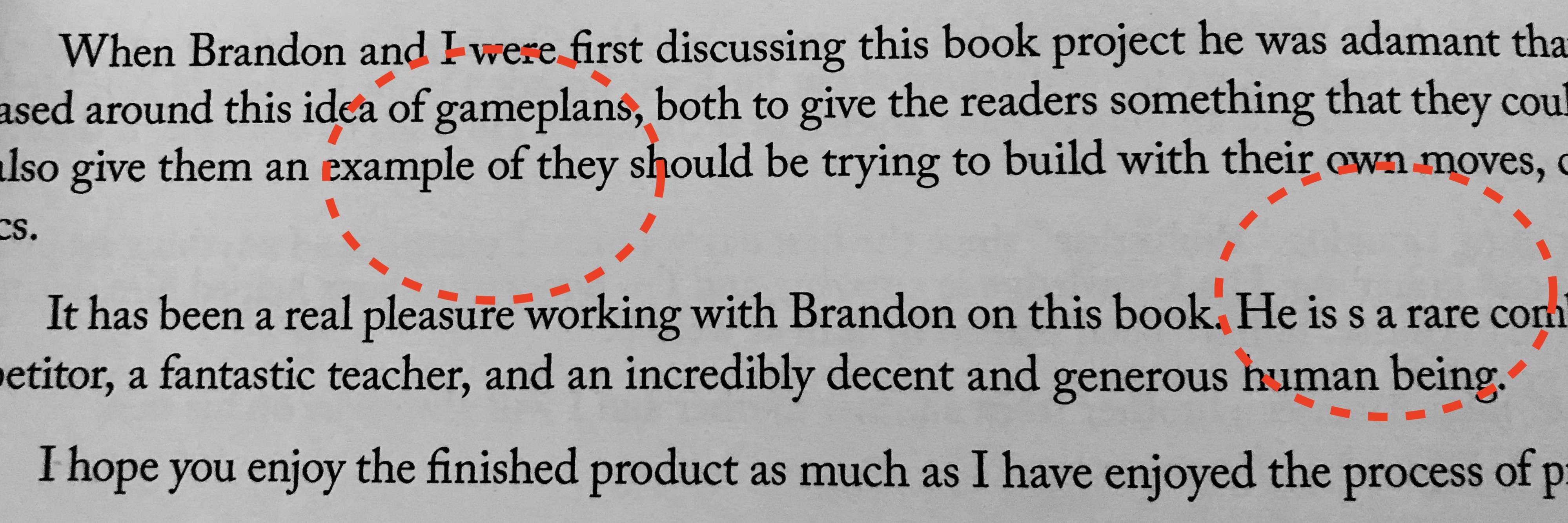
So what’s my beef? Well, the problem is that the book smacks of self publishing. A quick scan of the credits page reveals they didn’t employ an editor or a sub editor, and it really shows. Not only could almost all the text in the book do with a good edit to make it punchier, tighter and more interesting to read, there are a lot of unforgivable grammatical errors that have crept in, mainly in the introduction text admittedly, but that’s the thing you read first, so it creates a very bad first impression. But while things improve in later sections, typos are prevalent throughout the work, and if like me you can’t stand seeing obvious mistakes in a finished book, you’ll be tearing your hair out. I have a lot of sympathy for the authors here – working in print I know how hard it is to spot your own mistakes. You go “word blind” to your own writing. There are probably typos in this review that I’ve missed, but I can easily go back and fix them because it’s a blog post. In contrast, once something has been published in print it can’t be changed without issuing an expensive reprint – it’s really a very unforgiving medium, and not getting another pair of eyes to look at every single page before you send it to the printers is always fatal. Heck, I’d have done it for free myself if only they’d asked me!**
Some examples of typos from the introduction:
Maybe you’re not be the sort of person who cares about dotting the i’s and crossing the t’s. You just want to get to the great content, right? Well, I have some issues there as well.
I can’t fault the quality of the instruction presented. Like I said before, I was a fan of the original video series. But the way it’s presented here could be improved. For a start, the book is an odd shape (21.5cm across and 21.5cm high). There’s a reason why most books generally aren’t square – they’re really awkward to design for and you can see how this has created problems. When they have a full page of text, they’ve used only 1-column, so a line is uncomfortably long. The margin on the outside edge of the page is very tight too, and it all makes reading difficult, as you have to track your eye back a long way to the left to find the start of the next line. A 2-column grid would have made scanning text much easier.
(Very long lines of text to digest here. And a double exclamation mark at the end? What were they thinking”!!”)
The pages of photos have a different problem. Following from one step to the next is difficult, as they often have alternative shots of the same technique on the page. They’ve put numbers on photos so you can see where to move your eye to next, but knowing where to go next is not intuitive. They also expect you to read the explanation in the text box at the top of the page, then move your eye back to the correct picture to see what is meant, then move your eye back to the text box at the top to read the next step, and so on. It’s all a bit awkward.
(The two white lines indicate an alternative view, in case you were wondering.)
All credit to Kesting and Mullins for spending the time to re-shoot every single technique in detail and presenting colour photos of each step (that’s not cheap to do in print). The photos are clear and accurately show the techniques. They avoid the classic mistake of both weaing the same colour gi, but the printing is a bit too dark, meaning there are some shadows and dark patches on Kesting’s blue gi that are hard to make out, as you can see in my photos. (This probably looked fine on screen when they were creating the book, but the printed version can differ).
(That’s a lot of very small photos to try and fit on one page).
The design has competing systems of classification too, which makes it even more confusing. Sometimes a “what not to do” type photo has a red thumbs down icon on it, at other times it is crossed out with a big red “x”. Why not just pick one system and stick with it?
In their enthusiasm the authors have tried to squeeze too much into this book, both in terms of the number of photos on each page, and the amount of material covered. There are 3 big sections – 1. Fundamental movements, 2. Butterfly guard, 3. De La Riva guard – and to fit it all in, something important has been lost, which is context. In the video version of Nonstop Jiu-Jitsu, Mullins explains why he’s doing each technique, usually in response to the opponent defending his previous effort. Here you don’t know when or why you would use the techniques shown. For instance, when you have butterfly guard, what makes you choose either the hook flip to x guard or the hook flip to phantom choke? It’s not entirely clear. A short piece of text explaining the context before diving into the steps would have made all the difference.
To give you an idea of how much content there is here, the table of contents alone runs to 6 pages! Complaining there’s too much value in a book sounds like an odd gripe, but this book could easily have been split into 3 different books, with more room to really let each subject breathe, and it would have been all the better for it.
The first section (which seems unsure if it’s called Fundamental Movements, or Advanced Fundamentals) is based around the fundamental movements of Jiu-Jitsu, like the technical stand up, sit through, hip escape, butt double and rolling forward and backwards, and then shows you how these movements can be applied in techniques. In a section aimed at beginners the applications are actually quite involved and ramp the difficulty level up very quickly – for example, a rolling omoplata from the armbar position in side control, anybody? As a more experienced Jiu-jitsu player I personally loved the high-level technical content here, but a real beginner might be a bit out of their comfort zone. My only criticism is that they show plenty of applications for all the movements except the hip escape (or shrimp) and bridge, which only get one application each – regaining closed guard from half guard for the shrimp and bridging from mount. I would have liked to have seen a shrimping escape from side control here, and another mount escape added for completeness sake.
The second section goes on to cover butterfly guard. Butterfly is a really good guard to use against an opponent who is trying to pass your guard from his knees. The standard butterfly sweep is shown, plus a plethora of options for when they post a hand or leg. Quite naturally this leads into all sorts of x guard material, back takes and shin sweeps. The section starts with Mullins’ trademark aggressive butt double attack from butterfly, which is a very proactive way to get the action going against a stalling opponent, and as such is nicely suited to competition. Because Mullins teaches in a game plan-based system, a lot of this chapter is devoted to guard passing after you’ve swept them from butterfly guard.
The final section covers the De La Riva guard, which shows you what to do against a standing opponent. The majority of the section is on how to attack with the ball and chain sweep, and follow ups depending on how the opponent defends. Again, the jiu-jitsu shown is attacking and aggressively non-stop, in the sense that he links together guard sweeps, passes and submissions.
Throughout all of the book’s sections, Mullins drops in some tips on motivation, competition strategy and his general thoughts on BJJ. It’s welcome advice, but I think it could have done with an editor to make it more concise.
After all this moaning you probably think I’m going to recommend staying well clear of Nonstop Jiu-Jitsu (or is it “Non-stop Jiu-Jitsu“? Even the name of the book is editorially styled in two different ways, one on the cover without a hyphen and another on the footers of each page with a hyphen – argh! Just choose one way and stick with it), because of all the editorial problems, but I’m not. I’m recommending it because this book is actually glorious!
I love seeing BJJ back in print, and despite the issues I’ve mentioned**, it didn’t stop me from loving this book. If you’re looking for some new ideas for a game to play from butterfly or de la Riva, then you’ll find inspiration here that will last a lifetime, and you can easily add to your game. And, godamn it, it’s a real book about BJJ and we should celebrate that fact.
(* If you’re interested, I consider Marcelo Garcia’s book to be the gold standard in terms of these types of instructional BJJ manuals. Its production standards are first rate, from the quality text and explanations to the brilliant photos. Sadly it went out of print a long time ago.)
(** Lads, if you are reading this and want to do an updated version 2 of this book without all the typos, then please do, but please, please hire an editor this time!)