I’ve just finished listening to an interesting podcast where Dr. Rangan Chatterjee talks about about how to form daily habits in a way that actually works. The takeaway is that you need to make the habit as easy as possible and also tack it onto something you already do every day if you want it to stick. Dr Chatterjee makes the good point that we don’t have to force ourselves to brush our teeth in the morning and at night – we just do it. We don’t decide, oh, I’m a bit tired tonight or I’ve got a lot of work on, so I’ll just skip it for a couple of days. No, we just do it, and it’s easy.
Doing Tai Chi could be as easy as brushing your teeth. Photo by Andrea Piacquadio on Pexels.com
Forming a regular practice Tai Chi habit however can be hard. It’s very easy to convince yourself to not practice because you’re tired or just not feeling like it.
Tai Chi, Qigong or stretching is also a bit like brushing your teeth, because you don’t get much benefit from not brushing your teeth for a week, and then doing a massive 1 hour deep clean on a Sunday. No, brushing your teeth needs to be done a little every day if it’s going to work, and so does Tai Chi, Qigong and stretching.
Which brings us to the question of how we actually develop a strong practice habit like this for Tai Chi, and that takes me back to Dr. Rangan Chatterjee. Most of us make a pot of coffee, or cup of tea in the morning. It’s a ritual we’re already doing and nobody needs to force us to start doing. (If you don’t do this, I bet there is something similar you do in the morning?) What we need to do is start hacking that existing habit with the new habit we want to instill, in this case Tai Chi, stretching, standing, meditation, or whatever it is.
It’s all about maximising those moments of dead time. Photo by Rachel Claire on Pexels.com
While your coffee is brewing, stop looking at your phone and spend those minutes doing the thing you want to do. One thing I’ve started to do is pour the water on my tea bag, then do a stretching routine while it is brewing. This way I don’t need to rely on motivation to do the routine each morning, because motivation is great when it’s high, but a rubbish thing to rely on when you are feeling tired, rushed or grumpy.
Even a few minutes of whatever it is will make a difference. I already feel like I’m more flexible in my hips because of these few minutes. And doing those few minutes might make me feel like doing more immediately afterwards. Other ideas for things to do while the coffee is brewing would be some single arm silk reeling circles, some standing Qigong, or repeat small sections of the form, like Grasp Birds Tail. The choice is yours. Try it!
N.B. This does NOT look like a very well applied choke at all, but it’s the only free photo I could find! (Photo by Kampus Production on Pexels.com)
Disclaimer: Please only take medical advice from a qualified doctor. I am not a qualified doctor!
One of the things I find quite astonishing amongst ‘martial artists’ is the generally low level of understanding of the theory of choking people.
Choking is the process of stopping or reducing blood flow to the brain until the person loses consciousness (cerebral hypoxia). It usually requires a bit of squeezing force, but can be effortless and painless if applied with high levels of accuracy, and the person will just go to sleep. It’s one of the most powerful techniques in the self defence arsenal, since chokes generally work on everyone. It doesn’t’ matter if you’re big, small, strong, super strong or even Herculean, everybody goes to sleep. In Judo and BJJ done in a Gi, chokes are often done with a collar and are commonly taught.
Chokes have nothing to do with airflow. Again, I just did a quick google search and the amount of seemingly legitimate websites talking about ‘restricting airflow’ and ‘windpipe’ is insane. There is a lot of bad information out there. Chokes are about restricting the blood flow in the two jugular veins and cartoid arteries on either side of the windpipe. For a detailed analysis of what happens, check here. Being aware of exactly where you should be applying pressure when choking somebody will increase the effectiveness of your chokes massively.
Rendering somebody unconscious by stopping their airflow is also possible, and called smothering in BJJ. Smothering is usually a pretty nasty, violent thing to have done to you. Look up the Mothers Milk submission if you are curious! And a choke that involves crushing/compressing your windpipe to make it happen could also have dire consequences. Similarly, pressure on the chest can also stop you breathing and lead to unconsciousness. That’s particularly unpleasant, too.
But a good old fashioned blood choke is the safest method of rendering somebody who is aggressive instantly harmless. Quite often when they wake up the fight has gone out of them.
Chokes can be trained and practiced safely but become incredibly dangerous in the hands of the inexperienced, as we have tragically seen in many police killings of people already restrained, so only practice them under expert guidance. And if the person has gone unconscious – LET GO! Very often it is hard to tell, so check on them, get verbal feedback, don’t just keep squeezing!
In training, the idea is that before you go unconscious you can feel the effects (a build up of pressure in the head, the world going black around the edges, etc) and tap before it happens, so that the person lets go.
If you are training with somebody that didn’t tap in time and went unconscious then don’t do the commonly seen thing of raising their legs to ‘get the blood flow back to the brain’ – you’re much better off putting them in the recovery position and waiting for them to wake up, which should happen fairly quickly. If they don’t seem ok in anyway, especially if their speech is slurred, call an ambulance.
Nothing in martial arts is ever risk free and there is some evidence of poorly applied chokes, or people struggling too hard to get out of them, causing damage to blood vessels, leading to blood clots, leading to (in rare cases) risk of stroke.
My advice is always tap early and tap often, especially if you feel like you’re going to sleep.
Understanding choke theory is important for all martial artists. If you feel like you need a primer on choke theory, then I’d recommend this new video by Chris Paines. See below.
Martial Art Essays from Beijing, 1760, presents 64 essays written by Yang Mingbin, a painter in the Royal court of the Ching dynasty. Or does it? As well as being a painter, Yang was also a martial artist and the papers are his thoughts on his martial practice, except that Yang Mingbin never actually existed, and the work is entirely a fictional piece of writing by the modern author, Michael A. DeMarco. DeMarco is a Tai Chi practitioner who used to publish the peer-reviewed quarterly Journal of Asian Martial Arts.
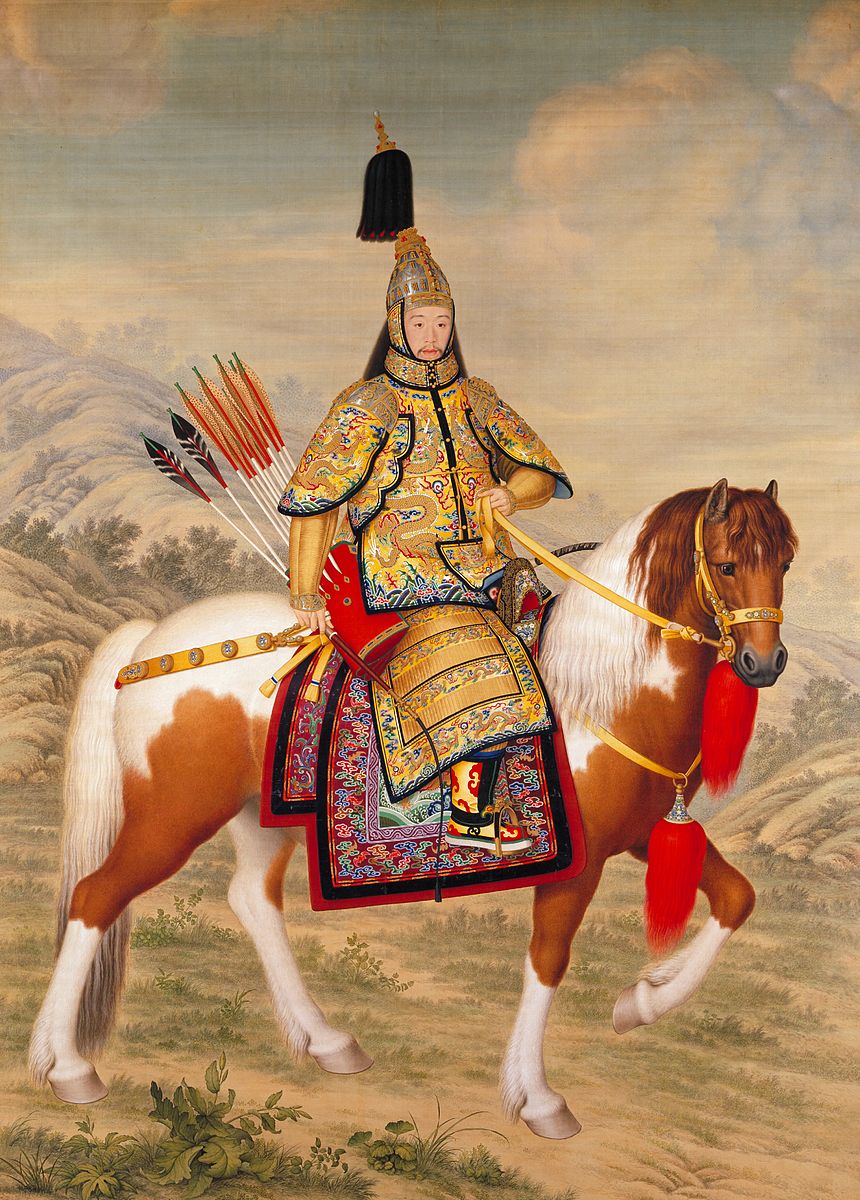
Yang Mingbin’s place in history is well researched, and surrounded by genuine historical figures such as Giuseppe Castiglione (1688-1766), a real Jesuit priest who was a painter in the Royal court in Beijing, and was responsible for influencing the Chinese style of painting of the era with western Renaissance ideas. You’ve likely seen some of his paintings before, such as the famous one of the Emperor Qianlong in ceremonial armour.
The Qianlong Emperor in Ceremonial Armour on HorsebackGiuseppe Castiglione (1688–1766)
So, the conceit here, then, is that you’re being asked to imagine what it would have been like if Giuseppe had had a friend in the court – another painter – who was also a martial artist, and what would happen if we had recently found a copy of his notes on martial arts. It’s a thought experiment, that the author begs your indulgence in as you read along.
Initially it works, because the historical setting feels authentic, but once we get into the actual meat of the book (Minben’s 64 martial arts essays), we find that Yang Minben writes exactly like a 21st century American who practices Tai Chi would write, rather than like somebody actually living in 1760 in China would!
Actual martial arts writings from that period in history tend to be functional, pithy and less verbose. Worse, Mingben’s text often uses modern conventions, for example, (p63),
“Dive into a swift flowing river and swim against the current. Keep swimming, but gradually change the direction – 0 to 45 degrees, to 90 to 135, then to 180 – finally swimming directly with the current.”
Would a Chinese person writing in 1760 have described this using degrees?
And things get very odd when, on p97, Minben writes, “between 1775 and 1779, Qing troops stabalized the northern and western boundary of Xingjang province, harshly squelching the rebellion in the area occupied by the Mongolic Zunghar tribe.”
How is Minben writing about events that happened in 1779 when the current date is supposed to be 1760?
That’s not to say there aren’t interesting things to learn here. I enjoyed the discussion of the Neo-Confucian scholar Zhu Xi and the concept of Li, the calligraphy analogies and the references to Lao Tze and Chuang Tzu. But if the author wants us to enter into his historical conceit, then I think it helps if the writing is consistent with the time period. I would have also liked to have heard more accounts of what Beijing was like in 1760. That would have helped build the illusion – city life, how business was done, what the pervading political climate was like, what the fashions were, what the gossip was – what was happening in Royal Court?
You could argue that since all of this is imaginary anyway, perhaps we do not need to make a big deal out of it? DeMarco’s writings are a collection of modern philosophical musings designed to be easily read and understood by the modern Tai Chi crowd and that draw in frequent references to the Daodejing and analogies with calligraphy and painting. I quite enjoyed them, but if you are looking for something that reads like the real classic writings on martial arts, you’ll be disappointed. However, if you’re after something a little easier to read and that inspires you to practice Tai Chi more, then you’ll find it here.
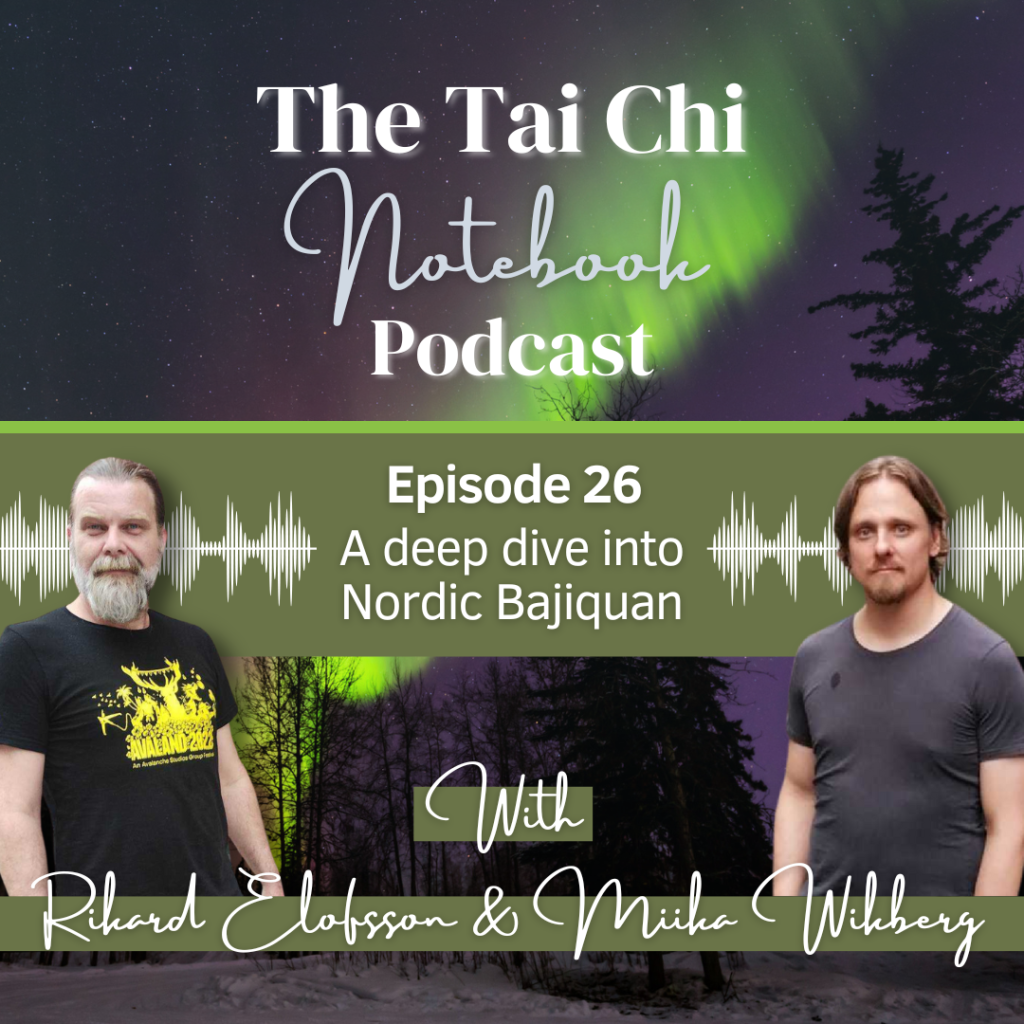
Bājíquán (八極拳) or shorter just Baji, is commonly known as “the martial art of bodyguards”. It emphasises the use of attacks that close down the distance as well as explosive close combat techniques such as combinations of elbow, knee and takedown techniques.
Both Rikard Elofsson and Miika Wikberg are senior Baji students of Lü Baochun, based in Finland who has over 40 years’ experience in the training and practice of baji. He has trained under many of the famous martial artists who used the style, such as Han Longquan and Zhang Xuchun.
Timestsamps:
0.40: – Rikard – Introduce yourself/how did you meet your teacher Master Lü Baochun?
3.15: – Miika – Introduce yourself/how did you meet your teacher Master Lü Baochun?
7.15: What makes Baji different to other martial arts?
8.30: Old Baji and new Baji
9.20: Trademark techniques of Baji
10.15: How is Baji power different? Training methods and the 3 stepping methods –
The jin should be rooted in the feet, generated from the legs, controlled by the waist, and expressed through the fingers.
This does present something of a dilemma – how can we both be rooted in the feet but also controlled by the waist, let alone also generated by the legs?
In the Treatise on Tai Chi Chuan, the classic says “Sink the chi to the dantien.”
This sinking is related to the pulling in action of the muscle tendon channels that are usually associated with the contraction (closing) phase of opening and closing – usually while breathing in. The breath sinks to the dantien area, and combined with correct mental focus, this should make the dantien area feel full as you breathe in.
This pressurised feeling in the dantien is also the pressurised feeling at soul of the foot. You could think of it as squeezing the pressure from the dantien down to the foot, but you really don’t need to do that, as it should be instantaneous, since they are the same thing.
With the exhale, the pressure pushes up, through the legs, up the back and out to the extremities including the head. It’s a continual cycle of store and release.
You could call this the internal side of Tai Chi, but really, it’s just the way Tai Chi works, rather than a particular side of it.
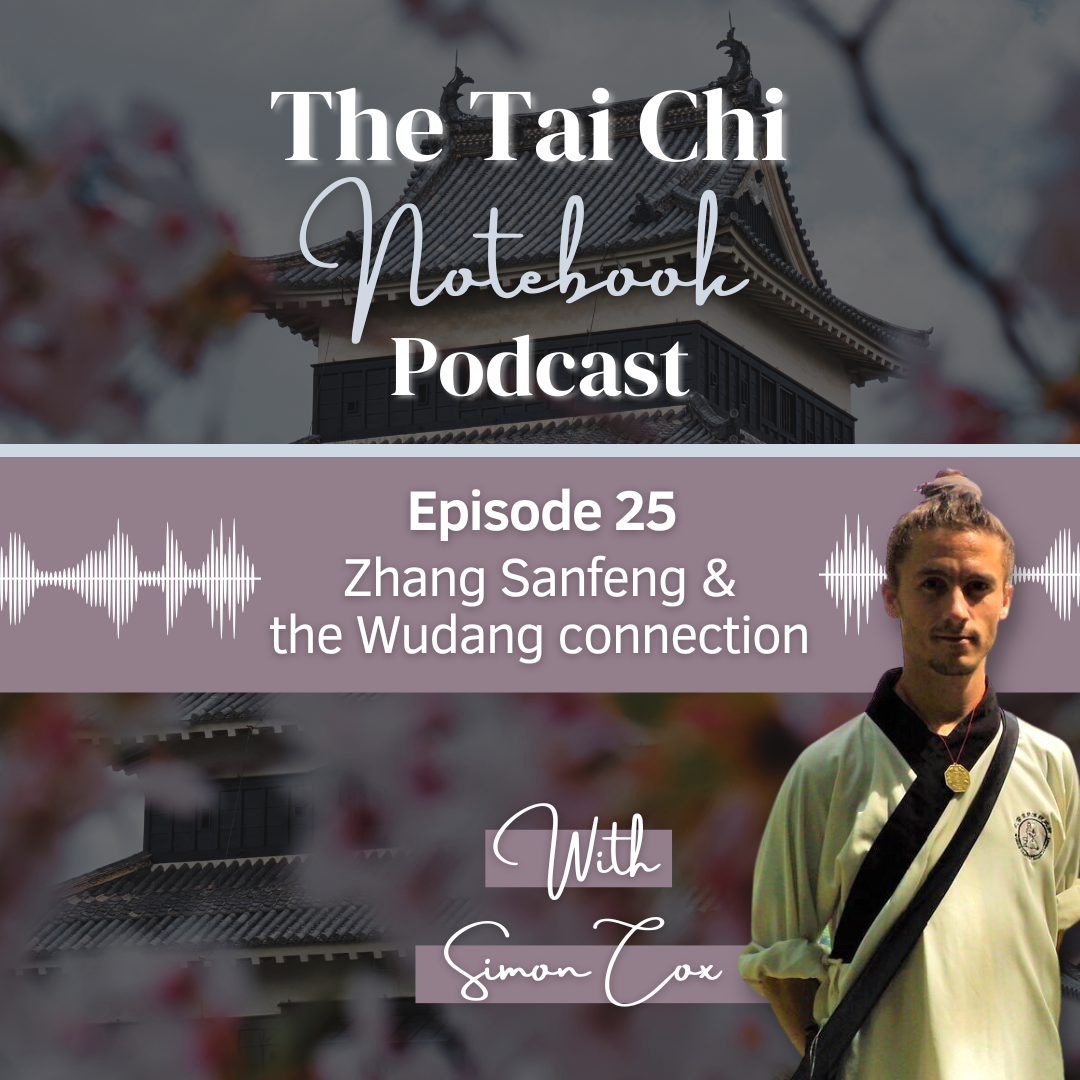
Simon and Brandi spent six years living and training in China under master Yuan Xiu Gang at the Wudang Daoist Traditional Kung Fu Academy. While there they studied Kung Fu, Tai Chi, Qi Gong, meditation, herbal medicine, Daoist music, and ancient and modern Chinese language.
After returning to the West, they started a Kung Fu school and community group in Houston Texas, where Simon was working on his PhD in Chinese and Tibetan mysticism at Rice University. At the end of 2019, they moved up to the Okanagan Valley and began sharing Wudang teachings with the local community.
What I really wanted to get at with Simon was an elucidation on his article about Zhang Sanfeng – exactly who was this mysterious Taoist immortal who is often credited as the founder of Tai Chi Chuan? I also wanted to find out more about Wudang mountain, and where its martial arts really come from. I hope you enjoy are conversation!
I had the good fortune to guide a group of people through some Xing Yi Monkey recently, which made me focus on it more and practice it a bit harder in the run up, which was a good thing. (I’m also available for children’s parties and Hen parties too, btw). Anyway, I wrote some notes about it, which I’ve typed up below.
A unique animal
When it comes to the animals in the natural world that we can look at for inspiration for martial methods the most obvious place to start is with one of our closes cousins, the primates. Like us, monkeys can stand upright, if only for short periods in some cases, they have hands that can grip and even a bit of limited tool usage. However, monkey is not a good place to start your journey into the 12 animals of Xing Yi.
The first thing to realise about monkey is that it breaks a lot of the ‘rules’ of Xing Yi Quan, which is one of the reason why it’s often taught last amongst the 12 animals. My teacher taught the animals as almost self-contained mini martial arts – each one had a different strategy and techniques, but Monkey wins the award for being the most unique amongst them. It really does stand up on its own as a complete martial art.
Almost all of the rest of Xing Yi Quan can be performed in formation, standing in a line with other people, since you generally move forward and backwards along a straight line (except for the turns, obviously). Whether this really harks back to an ancient heritage of soldiers moving in formation is speculation of course, but it should be noted that a row of people holding a spear and standing side by side can perform the 5 elements and most of the first 11 animal links while all facing in the same direction without impending each other, provided they all turn at the same time. That’s possibly one reason why Xing Yi is so obsessed with keeping the elbows near the ribs.
But Monkey doesn’t follow these rules – it’s breaks the line. Or more accurately, it’s what you do when the line has been broken. Attacks in monkey are reacted to and defended at diagonal angles – there’s footwork you don’t find in the rest of Xing Yi and there are changes in tempo, bursts of speed and jumping. It’s as if your nice orderly line of soldiers has been broken up and the battle has become more of a melee situation.
All the different types of monkey have similar movement, but the monkey native to China that Xing Yi is probably using for inspiration is the Golden Monkey. And thanks to the BBC there are plenty of Golden Monkey clips available to watch – this one of two tribes coming together and fighting over resources is particularly good:
And here’s an interesting clip of a group of wild monkeys who have learned to trust humans for food:
Both clips are a gold mine of information about how these animals move.
Monkey Pi
Pi (splitting) is the main energy from the 5 elements that is used in monkey, but while in Pi Quan the arm uses the elbow joint as a pivot point for delivering the downward chopping strike (a bit like the swing of an axe), in monkey it’s the wrist that is the pivot point. The monkey Pi is more like a slap, but don’t think that makes it ineffectual. A relaxed and loose slap delivered using good body mechanics to the head can easily result in concussions.
Monkey also tends to eschew single strikes – everything is done in quick flurries of 3. This is called a triple palm. Often the first strike is to open up their guard, or intercept a strike, the second is to hit the head, and the third can be done as a grab and pull on their limb or head, leading to your own head butt or knee strike – an action called ‘wrapping’. The back of the hand can also be used as an upward deflection to the opponents arms, for when the monkey wants to enter deep.
Range
Talking of entering deep, Monkey wants to either be too far away for you to hit (beyond kicking range), or right in at what would normally be called grappling range, (i.e. too close for what is generally called striking range) but the use of close body palm strikes delivered by turning the body sharply and the cross stepping opens it up as a striking range too.
Take a look at this video of a monkey antagonising a Tiger cub (I don’t think he’d be brave enough to try this on a fully grown tiger!) to get the idea of range:
As you can see, monkey is something of a trickster engaged in a war of attrition. A tiger generally wants to finish the prey in one big action, monkey will keep attacking, wearing it down over time. Often the monkey’s goal is simply to drive the opponent away out of its territory.
Agility, but with stability
Obviously to close the distance from outside kicking range to inside punching range you need tremendous agility to play monkey, however, agility without stability is a recipe for disaster, which is another reason for teaching monkey last – it requires a very solid understanding of the footwork methods of Xing Yi Quan. It uses a cross step frequently, and also spins and jumps.
Monkey requires you to be agile, but rooted when you step. Without that combination the movements of monkey can become just a dance. The stability also relates to being relaxed in your movements. Because monkey movements tend to be done fast the tendency is to get tighter and more tense as you do them. I find consciously trying to relax while doing monkey is required more so than in other Xing Yi animals.
Tea cups exercise
The arm methods of money require more utilisation of the joints of the wrist, elbow and shoulder than the other methods of Xing Yi. Techniques like “Reach around the back of the helmet” require significant mobility of the arm joints. The best way to achieve this is to become adept at the famous tea cups exercise. You should practice this is with actual tea cups full of tea (or water) and try not to spill any. This is incredibly difficult!
Here’s a basic instructional on the tea cups exercise:
Yin and Yang
Finally, we do a Yin and a Yang monkey in our Xing Yi – the Yang monkey is the bright, lively, younger monkey, while the Yin monkey is the more older experienced monkey who uses heavier techniques. Almost all the video you see of Xing Yi money on the Internet are showing the Yang version. The most famous move from Yang monkey is the upward ‘flying’ knee strike. Here’s a good example:
To be honest, I haven’t seen any other Xing Yi group do a Yin monkey like we do, but here’s a little clip of me doing some Yin monkey so you can see what I mean:
I noticed a person on Facebook recently who was trying to make the point that the term Fangsong (放松 relax, unwind, loosen, ease, release, slacken) doesn’t appear in writings about Tai Chi until about 1930, and is therefore a modern idea that we are retrofitting to suit our modern ideas of Tai Chi being all about relaxing. That’s not his argument word for word, but that was the gist of it, anyway.
I’ve heard similar things from other people about how ‘back in the day’ Tai Chi was practiced hard, like a real marital art, until you were exhausted, and that modern training has gone soft in comparison. To those people I would point out that intensity and duration of practice have nothing to do with how you practice. Ask anybody who has practiced ‘standing still and relaxing’ for half a hour in a Zhan Zhuang posture and you’ll find out that practicing relaxing for half an hour in a stressful position is an exhausting, sweaty, business.
But to return to the original point, I would point out that even if you look at one of the oldest writings we have on Tai Chi – the handwritten manuscript of Li Yiyu from 1881 (which is available to read on Brennan Translation) you’ll find the word “relax” appears in the English translation 9 times. That’s not an insignificant amount. (I’ll leave it to the Chinese language experts to search the original Chinese).
You find it in phrases like:
I relax my power, but I do not allow it to collapse. (This has to do with “calm”.)
and
Every movement is a technique of first putting forth strength and then immediately relaxing, yet always there must be continuity from one to other, and there is never to be a departure from the four stages of “begin, develop, transmit, and finish”.
However, if you check out the even earlier 1875 text Explaining Tai Chi Principles, written by Yang BanHou, son of the famous Yang LuChan, you’ll find that he’s right – the phrase “relax” doesn’t appear, even once!
However, just look at one of the things written in the text:
“Power comes from the sinews. Strength comes from the bones. Looking at it purely physically, one who has great strength is able to carry many hundreds of pounds, but this is an externally showy action of bones and joints, a stiff strength. If on the other hand the power of your whole body is used, it may appear you are unable to lift hardly any weight at all, yet there is an internal robustness of essence and energy, and once you have achieved skill, you will seem to have something more wonderful than one who has the stiff sort of strength. Thus runs the method of physical training for self-cultivation.”
It seems pretty clear that he’s talking about relaxation being required for whole body strength.
But getting away from the nitpicking about facts (sorry!) I do think he has a point – there has been a modern re-framing of everything to do with Taoist arts as a kind of therapy for stress and dealing with the pressures of modern living that wasn’t necessarily there in the original arts – especially with Tai Chi.
Tai Chi was created in pretty stressful times, when wars were being fought, the concepts of law and order and justice were malleable depending on how important you were and life could be brutal and short. Taoism emerged at a time that was probably even more dangerous to be alive in! Frankly, I don’t think you expected to live long enough to have to worry about getting stressed! You were probably too busy trying to stay alive and earn a living. Being stressed is something of a modern disease because we live lives of relative comfort and we’ve got nothing truly life threatening to worry about on a daily basis.
But, I think we’ll have to live with it, because the hippies who have taken over Tai Chi Chuan do have a very good point – the first step in Tai Chi is to relax, whether you like it or not! You cannot move your body as a unit if parts of it are tense.
In Tai Chi Chuan the body is required to move as a whole unit, connected by fascia, tendons, muscles, etc, with all the joints allowed to move freely during exercise. All the joints are involved to some degree in all movement, so need to be relaxed. The ball-and-socket joints of the shoulders and hips are allowed to move freely. The gliding joints of the ankles and wrists move freely, and the hinge joints at elbows and knees are all allowed to move freely. Finally, the dantian moves freely and controls everything. Tensing the muscles around a joint separates it off from the rest of the organism, meaning that whole body movement is not possible.
And being mentally ‘tense’ is just as much of a problem as being physically tense, since the mind and the body are intimately connected.
Perhaps the emphasis in the original writings on Tai Chi was focused on more lofty philosophical principles, yes, but you will find plenty of admonitions to relax in there, and for good reason. That’s just how Tai Chi works.
You can see the little wobble of the knee he does before he does a fajin in the form. This knee wobble has been the source of seemingly endless debate. Some lineages of Chen style do it, some don’t. Some do it but it’s very minimal, some do it and it’s quite exaggerated. It doesn’t even seem to be a village vs Beijing style thing either.
So, why do it? It’s a way to involve the knee in the generation of power. The best analogy I can think of is that it’s like retracting your fist before you punch, but instead of having to move your fist back (which has certain obvious martial disadvantages), you store power by moving the knee back instead. This obviously requires a conditioned body, where the hand to foot is all connected, so that when one part moves, all parts move. If you just took your average Joe off the street and they did a knee wobble, I don’t think it would do anything for their punching power. In fact, it would probably decrease it. But for somebody who has built that connection over time throughout the body, it has advantages.
Lots of people are convinced that the knee wobble is the route to ruin for your body, that it’s bio-mechanically inefficient and potentially injurious over time with hard training. I can see where they are coming from since you are using the knee as part of a whip-like kinetic chain for which the hinge joint is not well evolved.
But personally I’m not so convinced that, done properly as part of an overall training system, it is bad for the knee, necessarily. I think if you were holding your weight for a long time on a misaligned knee joint then that would be a bigger problem. But the quick flick of a fajin isn’t like that. There are also plenty of things athletes do all the time that I’d say are potentially much more dangerous. It also depends on the person. The knee is a particular weak point in the evolution of the human beings into an upright posture, and being severely overweight is very dangerous to your knee joints. And if I was severely overweight there is no way I’d be flicking my knee joints about like this, so it very much depends on the overall health of the person doing it.
Disclaimer! I’m not an orthopedic surgeon, or a physiotherapist, so I’d suggest getting your medical advice from somebody who is actually medically qualified.
The article On the Historical Mystery of Zhang Sanfeng by Simon Cox, on the history of Tai Chi Chuan and its connection to Zhang Sanfeng is great. I’ll just quote a couple of paragraphs from near the end, but recommend you read the whole thing for context:
It seems like Tai Chi was really a Republican era (1912-1949) category that became a sort of umbrella term for various Chinese martial arts that are practiced slowly, containing such multitudes as the ancient martial arts of Chen village, the later arts of the Yang family, and the weird things people were doing at Wudang, in Zhaobao village, and even the government-created variations on these styles. From this view, asking which style started it all is rather meaningless. The historical connections simply aren’t there. From the densest of historical positions, there is no evidence anyone practiced anything called Tai Chi Fist before the 20th century. It arises as a high prestige category in the context of post-Qing Chinese nationalism. Every slow-ish martial art in China seems to have been automatically re-branded as a form of Tai Chi.
According to the Yang Family oral tradition, Yang Luchan 杨露禅 (1799-1872), the founder of the style, called his art variously Cotton Fist 綿拳 or Transforming Fist 化拳, and it was only during his time in Beijing that a Confucian scholar Weng Tonghe 翁同龢 (1830-1904) witnessed him demonstrating his style and wrote a poem about how it embodied the principles of Tai Chi. According to this oral tradition it was after this event that the art came to be known as Tai Chi Fist. This story was first published in the 1930’s and is almost certainly apocryphal. But even if we take it at face value, we arrive at the inevitable conclusion that Tai Chi Fist was an appellation applied first to Yang family martial arts and then later, during the first decades of the 20th century, expanded to include Wudang and Chen styles.
Simon Cox – On the Historical Mystery of Zhang Sanfeng




 The Tai Chi Notebook