Thoughts on an interview with Wang Yan, head coach of the Chenjiagou Taijiquan School

Born in 1990, Wang Yan became head coach of Cheng village training centre in 2013 and is as a Taiji fighter as well as a coach, not to mention an expert in forms. He was one of the “nine tigers” – the best nine students of Chen ZiQiang. There’s an interview with him in English on Chen Taijiquan blog, with some great pictures from his private collection. The interview is pretty long, but there are lots of really interesting insights into his daily training, San Da competitions training and how exhausting it all was!

I’ve cherry-picked a few quotes below:

from:

https://chentaijisi.wordpress.com/2018/03/07/if-you-give-more-you-receive-more-an-interview-with-wang-yan-head-coach-of-the-chenjiagou-taijiquan-school/

On his own training:

“Our daily routine started in the morning with running and warming-up excercises. In the first morning class we studied forms, in the second class we did strength excercices, in the third class we did push hands exercises, kicks, punches and other self defense techniques, and during the last evening class we were again doing push hands exercises, and sometimes weight lifting.”

“When a student grows a little older, reaching his late teens and early twenties, then the school starts putting much more attention to learning taolu (forms).”

“When I was a young student, the training was more strenous then now. The approach has changed nowadays towards a somewhat softer way. Students now come from more comfortable backgrounds and are, generally speaking, often more interested in computer games than in serious training.”


“Some of us developed more in the direction of Taiji fighting, while the others became the very best in various Taiji forms.”
wang-yan-6

Competition training:

“To develop stamina we would practice frog jumps, running in a crouched position, running while carrying someone on our shoulders etc., until the point where I would be absolutely exhausted.

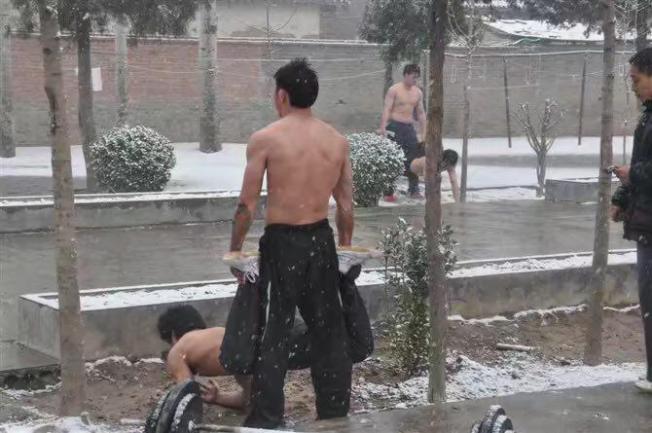
One method of practicing tuishou was, for example, being in a circle of about twenty students, who would challenge you one after another. When I knock the first one down, the next one would attack, and so on till the last one, after which the circle repeats itself. I also practiced the same circle exercise blindfolded in order to sharpen body sensations. Sometimes during wintertime, shifu would take us outside, dressed just in trousers, to train in the snow. One of exercises was to hold each other by the legs while ‘hand walking’ on the cold or frozen ground.

Before tuishou competitions I always have to control my weight, so during preparation time I would eat less and avoid spicy and very greasy food. Finally, after hard training, it is also important to have a proper rest.”


Training:

“There is a saying: “By missing one day of practice, your skill regresses for three days”. So, I make sure that I practice every day.That means that I go at least through forms. And when I have some more time, I do also some fitness exercises like running and weight lifting.”

It really does sounds beyond what most people could have physically and mentally endured at a young age, and more extreme than the training is in Chen Village these days.

There’s a lot of controversy in Tai Chi circles about the role of weight training in internal arts. It’s often dismissed as either unnecessary or worse, damaging to progress. It sounds like the antithesis of the frequently heard advice to relax more. Yang Cheng Fu’s “10 important points” essay is often read as a warning of the dangers of following an “external” path. (I think people often miss the meaning of that text though, so I’ll return to it at a later date.)

When the Chen Tai Chi masters teach seminars to Westerners they keep the focus on traditional conditioning exercises, like silk reeling, or zhan zhuang and forms, which do not involve weights, and emphasize things like relaxation and internal conditioning. Traditionally of course, training with heavy weapons would have been a form of weight training, and village farmers would have naturally been very strong people from all the physical labour, but there still seems to be a contradiction between the methods espoused to Western students in seminars and the content of the syllabus for training young fighters in Chen village itself.

There are also the ‘internet famous’ pictures of Chen ZiQiang doing weight training, and looking very ‘cut’ that spark off these debates, for example:

czq1

So, it’s interesting to read the above interview, where Wang Yan makes clear the role that weight training played in training his generation of Chen village teachers, especially when preparing for San Da competition. It’s also interesting to note that they may be the last generation to be trained like that, as “Students now come from more comfortable backgrounds and are, generally speaking, often more interested in computer games than in serious training.

That’s an interesting point in itself, that makes me wonder if that generation was a kind of high point for martially trained Tai Chi fighters from Chen village. “May the children of your enemies live in luxury!”, as the famous Cynic philosopher Antisthenes said; a quote that echoes the famous poem/meme:

thumbnail_img_7571

Of course, it’s all a matter of perspective. The people Wang Yan is training now are probably working a lot harder than most people could tolerate, even if they’re not doing wheelbarrows in the snow in winter wearing only their trousers 🙂

Full-time training

If I was training full time to be a fighter and I had a fight coming up in which somebody was going to try their best (under the rules) to hurt/beat me, then you can bet I’d be weight training too! You can’t fake fitness. And no matter how good your Tai Chi skills, if you get out of breath in a fight and your conditioning fails then you can’t fight back. Also, extra muscle mass doesn’t stop you from doing internal movement, although speaking realistically I don’t think that would have been the focus of training going into a fight.

Wang Yan was training as a full-time athlete. As well as doing all the hard physical training he would have been training in traditional Chen family methods at the same time. One does not preclude the other. While some might look down on all that physical training, it appears that the Chen village plan is to develop physical attributes first in its young people, including fighting skills, and later the more subtle Tai Chi skill is focussed on.

Here’s a video of Wang Yan doing some traditional Chen forms:

And here he is looking pretty good in a San Da match from 2013:

He’s a great inspiration for all Tai Chi practioners everywhere.

Week 4 – breathing. Half way through my 8-week Tai Chi course.

Here’s part 4 of the course. This week we focus on breathing. I cover the topics of normal and reverse breathing, then show a couple of different exercises that will get you on the right track for applying the breathing methods to the movement we are working on. Finally, we integrate the breathing into the movement, preserving all the progress we have made so far. Once you get the hang of it those breathing exercises I show are not required anymore, as you should be integrating it into your main exercise.

This week is more subtle than work showed previously. An inner focus will be required. Good luck! I’m happy to answer any questions you have.

Tai Chi vs BJJ in China

It’s all in Chinese, but I believe this video is a Tai Chi guy entering a BJJ competition in China… or maybe it’s a challenge match. From the way everybody is watching this one match, in particular, I get the feeling this is a special challenge.

Here’s the video. The match starts at around 8.30.


I can’t understand what is being said, but based on what I can see the “Tai Chi” guy showing a terrible lack of respect – he keeps hitting the BJJ guy, which is against the rules, then saying sorry to the audience, apologising profusely, then just doing it again. There’s lots of drama. The “Tai Chi” guy tries to walk off at one point when he realises the way things are going. Well done to the BJJ guy for keeping his cool.

When the  “Tai Chi” guy inevitably gets submitted the ref separates them and then he tries to attack the BJJ guy after the match has ended, at which point the ref restrains him with a choke hold and chaos ensues.

Only in China 🙂

In a world where you can self-identify as anything, anybody can claim to be a “Tai Chi guy”, but apparently the guy is Zheng Jiakuan, known as the apprentice of Ma Baoguo, and the BJJ guy is a blue-belt player Zhang Long from Alliance.

Ma Baoguo produced this famous video which he claims showed the effectiveness of his techniques… while the MMA fighter claims otherwise.


Anyway, I think that says it all.

I don’t really know what the Tai Chi guy expected to achieve by entering a BJJ tournament, but by behaving so badly he’s ended up looking even worse than you’d expect. All the traditional Chinese values of respect are all displayed by the BJJ guy.

A better video for “Tai Chi vs BJJ” is the video of Marcelo Garcia against a Taiwanese push hands champion. Of course, lots of people don’t think these push hands champions are doing Tai Chi either, but at least respect was shown:


My FREE 8-week Tai Chi Notebook course has launched!

Good news! I’ve started filming a short 8-week Tai Chi Notebook course, and you can get it here, for free.

As usual things come together by chance (or maybe a it’s fate) but either way, a friend asked me to show them how to do “this internal stuff“, so I was about to shoot them a simple video on the basics, then I realised that there’s too much to cover in just one video, so I planned out 8. Then I started to get creative and made it look a little bit professional, and the end result is what  you’ve got here – a short YouTube course called Pulling earth, pushing heaven.

In week 1 of the course we cover the concept of “maintain and extend”. Each week will focus on a different aspect until we get to the point where you’ve got the basic idea of “Tai Chi movement”. Of course, this is just ‘foot in the door’ stuff, but I’d like to think that after following along for 8 weeks, and doing it every day, you’d at least have the correct foot inside the correct door. Look out for part 2 next week.

The most perfect BJJ match ever?

In terms of the matra of: takedown, pass guard, submit, Jeff Lawson’s performance at Polaris 6 is possibly the most perfect BJJ match ever. Completely flawless and so quick! We were drilling this exact Seoi Nage (shoulder throw) this week. Great to see it used exactly as we drilled it in competition against a resisting opponent.

Forrest Chang’s “Stupid Jin Tricks” video

This is a great video from Forrest Chang showing what Jin is in Chinese Martial Arts and how it can be used.

As he explains in the video, he calls these “stupid jin tricks” because they’re the sort of thing a teacher would look at you like you’re stupid if you asked him to do them. Somebody trained in internal martial arts should just be able to do these.

There is another thing that’s worth pointing out that he doesn’t explicitly state, but which should be obvious – there’s one jin.

All the early books on Tai Chi that came out in the 80s started listing all these different Jins, and I think that’s lead to a lot of misunderstanding that they are all separate things – when in reality there is one Jin in Chinese martial arts, and lots of ways of using it.

Once you’ve got a handle on what he’s doing it’s worth watching videos of famous teachers of Chinese Martial Arts and trying to analyse what they’re doing from a Jin perspective. I find their own explanations are often not very clear, so it’s better just to watch what they’re actually doing:

Chu Shong Tun (Wing Chun)


Sam Chin (Zhong Xu I LIq Chuan)


Adam Mizner (Tai Chi)

Henan Village Chang family Xiao Luohan

I was reading through this excellent interview with Matthew Polly, author of American Shaolin, (a book which has somehow has escaped my bookshelf – a situation I should rectify promptly), when I came across this video of a man performing Chang family Xiao Luohan in a rural village in Henan.

It’s a great little video for a number of reasons. The first is that this is something old and precious that is in danger of dying out as people lose interest in WuShu in modern life. The second is the authenticity of the presentation – it really does look like a rural villiage where he has lived all his life. The third is – it’s a really good performance!

These are the sorts of “old school” martial arts skills that are in danger of dying out in China. To quote from the Matthew Polly interview above:

“As I mentioned in American Shaolin, the idea of chī kǔ (吃苦 ), eating bitterness, is central to the Chinese understanding of learning martial arts, and the value of suffering. And the way in which that contrasts with the western idea of trying to avoid pain in any way. We have an entire society built around the idea of alleviation of pain. We have an opioid crisis because we’re trying to avoid all sorts of pain. I admire progress and evolution in the way mixed martial artists do, but I have a nostalgia and sentimentality for tradition and the way that old man practised the same form for 60 years. There’s something beautiful about that and a sadness in seeing that wiped away as MMA goes like a bulldozer through the traditional kung fu and karate world.”

Chang family boxing is one of the precursors to Taijiquan, at least in terms of martial arts theory, although there are several similar postures to Chen Taijiquan found in its boxing sets, so the connection may be more literal than just in terms of theory.

I think research into Chang family boxing would reveal more about the origins of Taijiquan than wondering if it was Taoist. Luckily this research has already been done by Marnix Wells in his book ‘Scholar Boxer: Cháng Nâizhou’s Theory of Internal Martial Arts and the Evolution of Taijiquan‘. Again, another shocking omission from my bookshelf, but by all accounts, this is a very deep piece of research. According to Jess O’Brian (author of Nei Jia Quan: Internal Martial Arts) – “For those interested in the theory, history and practice of the internal martial arts, this book is going to blow your mind.”

51bn6f9hnwl-_sx334_bo1204203200_

Is Taijiquan Taoist?

I wrote a blog post the other day in which I mentioned that the Taoist origins of Tai Chi are historically unproven, yet the similarity in ideas is obviously there.

I got an interesting comment back on Facebook from somebody linking to a book I wasn’t aware of:

“Roel Jansen: Your information on the origins of Tai Chi is outdated. Please read ‘Tai Chi – the true history & principles’ by Lars Bo Christiansen to get up to date with the latest findings on the daoist origins of Tai Chi.”

So I looked the book up and it exists – it’s on Amazon.

41iqbv8rcol-_sx348_bo1204203200_

You can read a lot of the book on Amazon’s “look inside” feature. It’s about the newly found Li family manuscripts from which the author draws some pretty wild conclusions, one of which is that the Taoist link to Tai Chi has now been proved beyond doubt.

The book author has a website too, which contains his main arguments in the QnA:

I thought something seemed a bit ‘off’ with the whole thing, so I looked around and found the eminent Douglas Wile, who wrote two books on the Tai Chi Classics that are very good, and that classic essay on Chan Sang Feng, had written a massive article on these Li manuscripts, (and Lars’ book) which is here:

https://mas.cardiffuniversitypress.org/ … /download/

It’s a mammoth read, but looks at the whole thing from a more balanced perspective, including all the political leanings.

The TL;DR version is: It’s complicated. The verdict is still out :)

Here’s a pertinent quote:

The question of whether taijiquan is the product of Daoism creating a martial art or a martial art absorbing Daoism is a critical issue in Chinese martial arts historiography. If anything, Daoism is an even more slippery term than taijiquan itself, but the issue has become highly politicized, which is understandable in the context of Chinese history and culture. However, for a Western scholar to stumble into this minefield bespeaks a certain naiveté. The assertion of Daoist origins has become associated with cultural nationalism and the search for Chinese identity, often called ‘Chineseness’. Chinese scholars have built entire careers out of championing either Zhang Sanfeng or Chen Wangting, but it is very unseemly for Western scholars to insert themselves in this politicized process of roots-seeking and competing attempts to identify origin, creator, or birthplace as ‘transient points of stabilization’
[Laclau 2000: 53].

I think there are other questions that need to be asked about the whole question of “Is Tai Chi Taoist?”

For instance how many of the concepts we associate with Taoism, like the Tai Chi symbol, the I-Ching, Wu Xing and Bagua are actually Taoist in origin? Chinese Folk Religion, is actually the largest religion in China, and makes use of many things that we in the West think are “Taoist”.

As HotSoup on the RSF forum posted recently:

“There is an opinion that asking a CIMA practitioner from the beginning of the nineteenth century whether his art was “Buddhist” or “Taoist” would make as much sense, as asking a medieval fence teacher whether his fencing was “Catholic” or, say, “Juwish”.