Paul Brennan of Brennan Translation has completed a new work, that’s worth a look if you’re a XingYi practitioner. It’s called “The teachings of Li CunYi on XingYi’s 5 Elements“, which are said to be the oral teachings of the famous XingYi boxer, Li CunYi as recorded by Du Zhitang of Guangzong [in Xingtai, Hebei]. There’s no date on the manual, but 1916 is a good guess.
The manual covers the 5 Elements of XingYi (Pi, Zuan, Beng, Pao and Heng) together with a “continuous boxing set”, which is a linking form, where the techniques are linked together in one continuous flow.
The linking form presented in the book is very close to this one:
“Simply going through the motions is not enough. One must be self-aware, actively choose goals when practicing, and strive to improve those one or two things until you could do them “perfectly.” In a moment of frustration Nihilus called on a student not to “be perfect,” but to make a conscious choice to put himself on a path to mastery. At its best, this is what the challenge of “perfect practice” can be.”
If you liked this article then you might also like:
This is a follow up post to yesterdays post about Tai Chi vs MMA. As I said in the last post, I thought the Tai Chi guy took way too much damage if the point of it was to discover if Tai Chi worked in an MMA environment. Obviously, it was more of a challenge match involving a clash of egos, so it didn’t go down like that, but there are better and friendlier ways to test your traditional martial arts in a more challenging environment.
That’s why I really like this clip of a 13-year Aikido guy trying his stuff on an MMA fighter in a ring. Nobody gets hurt and the Aikido guy has the chance to let the scales fall from his eyes without suffering brain trauma in the process.
It’s a great video and well worth watching. Well done to both of them – and let’s see more of this please!
A video clip has been doing the rounds on the Internet recently about a “Tai Chi master” called Lei Gong who accepted the challenge of a Chinese MMA fighter/coach called Xu Xiaodong to an actual fight. Here’s what happened:
As you can see the Tai Chi master had his bell rung very quickly and very convincingly. The whole video lasts 47 seconds. It’s clear from the first few seconds of the actual fight that Lei Gong is way out of his depth and shouldn’t be in there with Xu. He had no idea how to deal with an opponent who was actually attacking him, not just dancing around making strange shapes in the air, like his student presumably do for him.
(The stoppage by the ref was a bit late for me, and Lei Gong ended up taking more punishment than he should have. The effects of head trauma are all too real, but it seems that this is the price he had to pay to be woken from his dream of magic fighting ability).
Generally, I think that this fight was a good thing for Tai Chi as a whole. Let me explain.
The challenge arose after Lei Gong appeared on a Chinese Television programme called “Experiencing Real Kung Fu” claiming to have sparring and fighting ability with Tai Chi. He spared one of the hosts of the show in the programme. See below at 9.30:
Xu’s beef with the show was that people claiming these sorts of abilities better be able to back it up.
The sad truth is that most things in China are fake, including their TV shows! I’ve seen so many of these types of shows now where Tai Chi masters go up against Muay Thai or Karate people, or wrestlers. They’re all fake. Does that mean Tai Chi is fake too? I don’t think so, but I think it exposes the complete lack of realism that is prevalent in the Tai Chi culture. It’s not rocket science: if you want to be able to actually fight with any art, then you have to practice actually fighting with it.
Xu seems to have a particular problem with the big dogs of Chen village who charge a lot of money for people to become disciples to learn their special skills. I can see where he’s coming from – if you look at what you learn in a typical seminar from a big name in the Chen style, then none of this is going to prepare you for an encounter like the one Lei Gong was in.
Xu’s argument, which I think is logically valid, is that if you’re going to charge all that money for something you better be able to prove it works. He’s now challenged the son of Wang Xi’an, one of the “4 tigers of Chen village”, but Wang’s son will only send his student, who has also been trained in SanDa (Chinese kickboxing with throws as well) to fight Xu. Xu, understandably says this will not do, because he wants to test Chen style Tai Chi. This will probably rumble on a bit and lead nowhere.
I was chatting with a friend about the whole thing and he said something like “I think that all martial arts, once they actually spar end up looking like some version of MMA”.
I think he’s probably right. I’ve written before about the delusion of grace under pressure and how so many people’s idea of what Tai Chi should look like in a fight is so way off.
MMA is what martial arts look like when stripped down to pure functionality. When all the cultural trappings have been removed. Chinese Martial Arts does contain its own bad-ass martial artists, but still, those arts contain things that are not purely about fighting. And for a good reason – they perform a useful social function. MMA also performs a useful social function, but more in the same way that Western boxing does, not in the way that Chinese Martial Art does.
Perhaps we’re all missing something. There are special skills you can only get from Tai Chi, and I think people have a right to teach these things without having to fight MMA to prove it works. I also don’t believe that all the people who are paying lots of money to become indoor disciples of Chen style masters think they are being given a kind of ‘master-key’ to martial arts that will mean they will be able to fight 21-year old athletes without ever having to spar first. It’s more like they are buying into a tradition. Once they buy in they’ll (hopefully) get the skills the tradition is famous for*, and be able to set themselves up as teachers. The problem comes when they get delusional and start to see themselves as bad-ass fighters when they don’t have a right to. This situation is made worse by the acceptance of fakeness, or cheating, in Chinese culture and TV shows.
It’s a messy situation, but it is what it is. Welcome to the world of Tai Chi. What matters is you and your training. Use your own reasoning to asses what you’re doing and what skills it is actually giving you, and don’t start to claim you can do things you can’t, otherwise you might suffer a painful wake-up call, like Lei Gong did.
*Of course, whether somebody who is not Chinese and not even from Chen village would ever really be taught the real skills of the family is open for debate anyway.
One MMA fighter I haven’t paid much attention to is Michelle Waterson, “the Karate Hottie”, who fights “Thug” Rose Namajunas in UFC211 tonight. The winner of which will presumably challenge the formidable Joanna Jędrzejczyk, who I have written about before, for the Women’s Strawweight title.
In her last outing with the UFC Michelle made short work of the UFC’s golden girl, Page VanZant, winning by rear naked choke in the first round:
What’s interesting about Michelle is that she comes from a traditional Karate background, although to look at her fight these days she looks more like a Muay Thai/Jiujitsu fighter, but in the Page fight she made frequent use of the sidekick, a staple from Karate.
In the following video she talks about the problems of adapting traditional Karate kicking techniques to the MMA world. It’s interesting on a technical level and very refreshing in its honesty about what happens when ideas meet reality:
In the brash, trash-talking, world of MMA Waterson, with her traditional ideas of martial arts respect and humility, seems like a breath of fresh air. She’s down-to-earth, possessing a natural charm.
Her journey from Karate fighter, to MMA fighter, to world Champion with Invicita then moving to the UFC, having a daughter and her supportive husband, who gave up his boxing career for her are all documented in the brilliant film Fight Mom, which you can watch in full here:
Win or lose tonight, Michelle has had a hell of a ride to get to where she is today, and I look forward to every chance I get to see what she can do in the UFC.
We brush our teeth twice a day, morning and night. It’s a ritual that we don’t really think about, we just do it. But how about this for a little life hack? Stand in a Horse stance while you brush your teeth.
If you brush your teeth for 2 minutes a session, then switching to a Horse Stance will mean that’s 4 minutes of Horse Stance a day you’re now doing. That’s 28 minutes a week, 112 minutes a month and 1,460 minutes (or over a whole day) of standing in Horse stance a year.
So, why do this?
Firstly, why not? It’s dead time that you aren’t doing anything else, so you might as well get a bit of training in.
Secondly, training a Horse stance is really good for your health. It makes your legs stronger. I’ve heard it said that the Chinese believe we die from the ground up. If you look at old men they generally have skinny legs. By working the muscles in your legs in a Horse stance you stop them withering away. It’s a bit like the benefits you get from squats, but more evenly distributed over all of the muscles in the legs, not just the big ones in your thighs. Having well muscles legs helps your heart pump blood around your body – the calf muscle (specifically the Gastrocnemius/Soleus) is often described as a ‘second heart‘ because it helps to return blood from the lower leg.
And for the more superficial amongst us, you’re also working your butt muscles 😉
Thirdly, as your muscles complain and tighten you need to consciously relax them, smile through the pain and after a while it starts to feel enjoyable. You might not be able to do a full 2 minutes to start with, but after a few days, you will. You can feel the gains you make very quickly.
This ability to relax through the tension is essential for any sport or martial activity. You’re programming your responses to change from their habitual reaction of tensing to relaxing.
How to do a Horse Stance
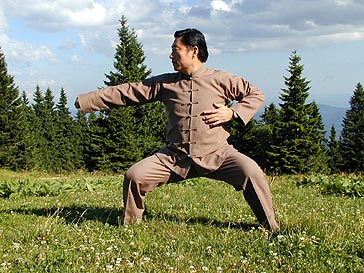
A typical horse stance.
There are many varied and contrasting opinions on what a Horse Stance is, but I’m going to show you how to do the one I do, which I feel is the most doable, and has the added bonus of being mechanically sound.
Stand with your feet one and a half times your shoulder width distance apart.
Keep the outside edges of your feet parallel with each other.
Sink down until your thighs are at 45 degrees.
The weight is evenly distributed between right and left feet.
That’s it! If you look down you should see your big toe on the inside of your knee. If you can’t then you might be letting your knees collapse inwards, so just gently push them out a bit.
To stand in this position you keep your lower back relaxed (watch out for tension here) and keep your shoulders aligned vertically over the top of your hips (no leaning forward!) Keep your head aligned as if pulled up by a thread from the crown point (your neck should lengthen at the back and your chin tucks in slightly). The spine is lengthening upwards. Remember, don’t lean forwards. Stay upright so you can work with gravity, not against it.
If you do need to bend forward to pick up your toothbrush, etc, then try and hinge your body from your hips. Keep your spine lengthened and your head in the same alignment with your neck and shoulders. N.B. Don’t curve your spine to reach forward – keep it extended.
There are more extreme versions of the horse stance with the thighs parallel with the ground. Leave that for the young and foolish for now.
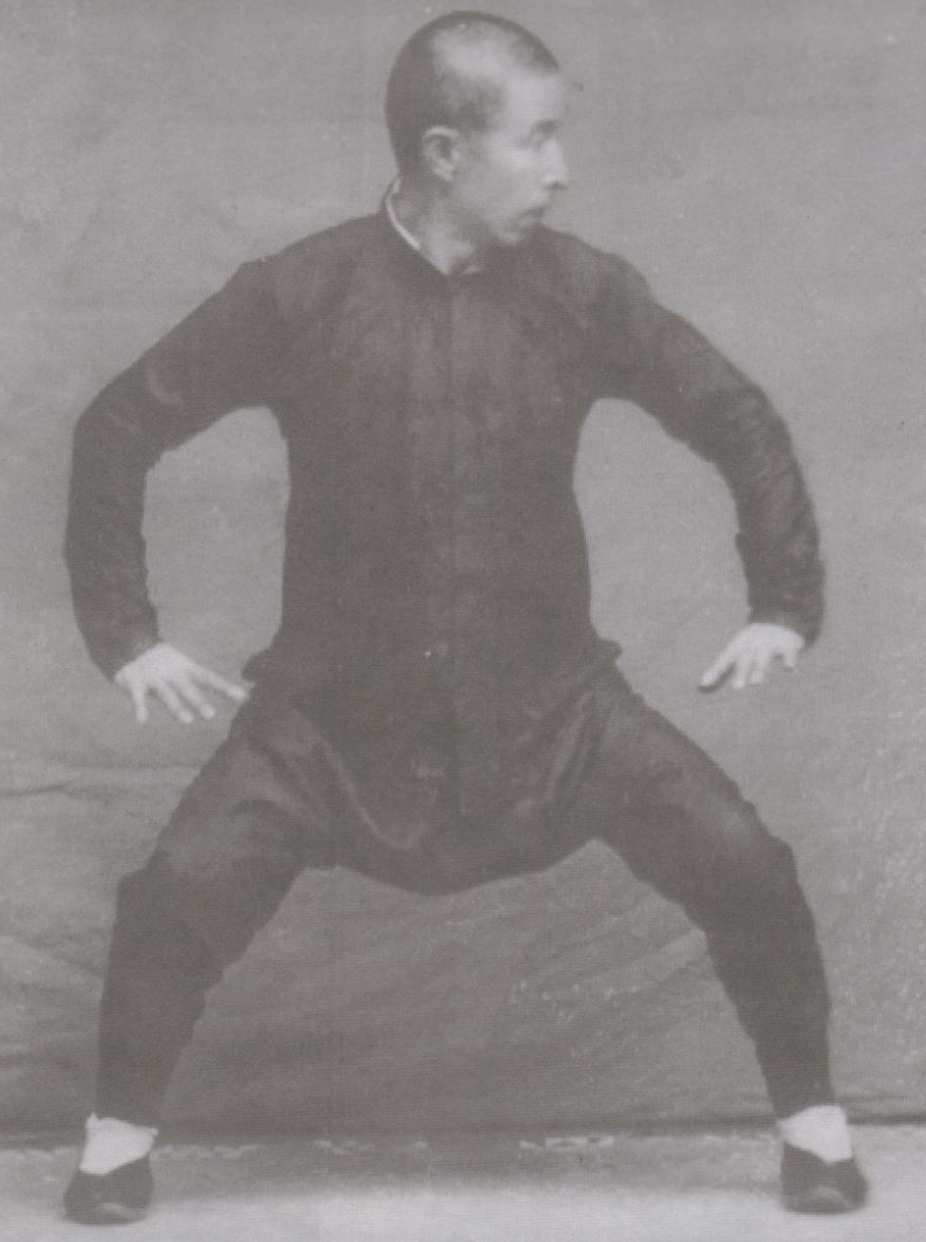
Here are some pictures of tai chi masters showing the type of Horse Stance I’m talking about:
Sun Lu Tang in a horse stance.
Chen Xiaowang
Taking it further
You don’t have to stop at just brushing your teeth in a Horse Stance. I like to also wash my face in the stance as well. I would shave there too, but I can’t see myself in my bathroom mirror when I sink down into a Horse stance, so that’s currently a no go for me. Perhaps I’ll get myself a second shaving mirror…
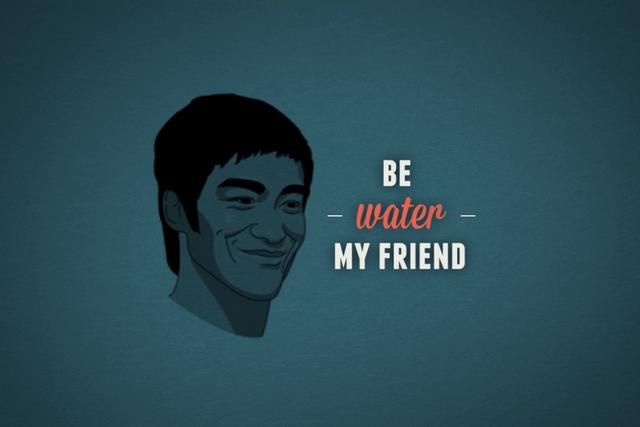
Bruce Lee was onto something with his water analogies…
I recently read the phrase, “Don’t push the river, listen to it instead”, and it resonated deeply with me because it’s a great way of summing up my approach to jiujitsu’s rolling and tai chi’s push hands. The water analogy was famously used by Bruce Lee and also crops up a lot in the Tai Chi classics, for example “Chang Ch’uan [Long Boxing] is like a great river rolling on unceasingly.”
The flow of water is analogous to the flow of energy, or movement, when performing a Tai Chi form, or between two people engaged in a martial activity . In both jiujitsu and tai chi your ultimate goal is to ‘go with’ this flow in such a way that you come out on top. You want the opponent to be undone by their own actions.
In jiujitsu that might mean not using excessive strength to press home a collar choke from mount if your partner is defending it well, and switching to an armbar instead, then switching back to the collar choke (and hopefully getting it) when they defend the armbar.
In push hands it could mean not resisting your partner’s push and using Lu to let it pass you by, then switching to an armbar to capitalise on their over extension.
Of course, this is for when you’re engaged in the ‘play’ mode of both these arts, which is the mental space you need to occupy if you want to get better at either of them. This is the relaxed practice that nourishes the soul. It kind of goes without saying that in competition or in a self defence situation you’d be better off in Smash Mode. But when winning isn’t the only thing that’s important you need to open up your game a little and keep it playful. Or ‘listen to the river’ as the phrase has it. It takes a lot of expertise to be able to be that relaxed in a real situation, but as your experience in the art increase so too should your ability to remain relaxed under increasing amounts of pressure.
Rickson Gracie said, ‘you can’t control the ocean but you can learn to surf’ and that’s the heart of what I’m talking about.
To be aware of the way the river is flowing, and not waste futile energy pushing it in a direction it doesn’t want to go you need a degree of self awareness, and the ability to be aware of the situation you are in. And to get that you need to slow down and stay calm. Or, as the ancient Taoists said:
“Do you have the patience to wait
Till your mind settles and the water is clear?
Can you remain unmoving
Till the right action arises by itself?”
Lau Tzu, Tao-te-Ching
Here’s the best thing to do after you’ve applied Tai Chi’s rollback.
One of the things that comes up a lot in Tai Chi push hands training that’s geared towards the martial side of Tai Chi is what to do with the opponent after you’ve done Rollback. Rollback uses Lu energy to lead the opponent in and control them, with their arm kind of locked, but not to the point where they’d tap. In the Yang form there’s no ‘finish’ from this position – after controlling them you strike with Press (Ji). This is ok, but to me it seems like you’re giving up the advantage you have over them because of the control that rollback affords in exchange for a quick strike. It looks like this:
There are several alternative things you can do – turn it into a push away (into a wall?), turn it into a takedown where you keep the pressure on the arm and shoulder, forcing them into the ground, or you can go for my preferred answer, which is to turn it into a standing arm bar as shown in this video:
Key things to note:
1. He puts his elbow over the top of their arm and makes sure the locked arm is snug in his armpit.
2. On the locked arm the little finger edge is pointing to the sky.
3. In the finish position he rotates his wrists around the opponent’s wrist so that both his thumbs point upwards – this gives you maximum leverage on the arm.
4. Once the opponent is controlled you can look around and watch out for further danger from somebody else.
I like this solution because it’s a really powerful arm lock and you can move into it from the end of the Tai Chi rollback posture fairly easily. You can feel it would be easy to break the arm from here, and the opponent is pretty much helpless. Obviously, in a self defence situation the level of force you exert needs to match the severity of the threat you feel you are under, so don’t go breaking the arm of people who have innocently patted you on the back, and also take care of your training partners. Don’t break your toys!
A quick shout out to my friend Rob Poyton of Cutting Edge Systema, who has started a new blog, which hopefully he’ll update regularly.
Starting with a background in various martial arts Rob moved into Tai Chi, then later discovered Systema, the Russian system, and quickly converted. I’ve always been impressed with the practical and down to earth way he approaches training. He’s also very generous with his information and produces lots of videos showing the sort of work he gets up to. Whatever they do, it always looks like they’re having fun, which is a lot more important that you’d imagine in martial arts!
Anyway, his most recent post is about reality in training and contains this great quote:
“Ultimately though, if you want your training to be “real” I suggest you work on a behavioural level. Rather than learning some techniques, or even working on the principles behind the techniques, you train in such a way to make your work something you are rather than something you do. Under any kind of stress, your breathing works as it needs to – rather than you going into a breathing pattern. Your body responds to hostile contact as it would a hot object. No thought required. No plan or technique, just appropriate action. Freedom of thought and freedom of movement go hand in hand. Not clouded by assumptions, fear or agression, just doing what needs to be done. Training in this (Systema) way develops faith in the body, leaving your mind free for other things. Not blind faith, but faith developed over a wide and deep range of training which challenges us on all levels.
It’s difficult to overstate the benefits this has on our overall life. Whether applied tactically, combatively, sporting, or just everyday living, your training becomes reality and reality becomes your training. The world is your gym. No constructs, no wishful thinking, no fooling ourselves, but a powerful way of dealing with life as it unfolds before us.”
Forget the snake and the crane, Tai Chi is stuck between a rock and a hard place in the modern martial arts world, and it’s hard to see how it’s going to get out
Tai Chi, it is said, was created by the immortal Taoist Chang Sanfeng after watching a fight between a snake and a crane. Seeing the way the snake coiled and retreated to avoid the strikes of the bird’s beak he invented a martial art that relied on the ancient Taoist idea of softness overcoming hardness, and thus Tai Chi Chuan (‘Supreme Ultimate Boxing’) was born. Or so the story goes…
Obviously, you need to take all these origin stories with a hefty pinch of salt. I’ve talked about Chang Sanfeng before, and I’d like to do again at some point, because I think there’s more to say on the subject, but for now let me just point you to a couple of ideas that show the Yin and the Yang extremes of people’s views about him.
On the one hand there the pragmatic, logical, view, that Chang Sanfeng was a sort of Robin Hood-style character and his whole mythology was just a nice little story that people made up as a “made-to-order counterpoint to Bodhidharma” as the founder of Chinese martial arts, and later to hide and ostracise the true creators of Tai Chi, the Chen family of Chenjiagou village. This view is best expressed by Stanley Henning in his classic essay Ignorance, Legend and Taijiquan.
In these more enlightened times, the people who actually believe in the whole Chang Sangfeng story seem to be few and far between, but on the flip side of the coin you’ve got this intriguing point of view from Scott Park Phillips, expressed in his blog post on, Channelling Zhang Sanfeng. Phillips offers a fresh (or should that be old?) perspective on what the Chang Sang Feng connection with Tai Chi was really all about:
“Zhang Sanfeng was a ubiquitous figure in the late 1800s, not just because he was a popular trickster of the theater but because he was the subject of widespread spirit writing cults. Groups of literati would gather together and do a kind of ritual séance, in which they would write in the voice of Zhang Sanfeng.”
Sanfeng therefore becomes a part of the richer cultural world view you need to adopt to understand Tai Chi’s place in history.
Whatever the motives for bringing Chang Sanfeng’s name into the story of Tai Chi Chuan – whether to hide its humble origins amongst simple peasant folk, or as an esoteric way of connecting to a spirit cult, it’s pretty clear that he didn’t exist as a real person, all of which doesn’t bode well for selling Tai Chi as a serious marital art. To make matters worse, the Tai Chi world is full of lunatics and fakes. I’ve written about Tai Chi fakery before, and on the cult of the Tai Chi Magician who can fling his followers around with magic Qi blasts. Sadly, this is all par for the course for the Tai Chi world, and sadly for martial arts in general. It seems that the environment of the martial arts class is the perfect breeding ground for cult masters to recruit their willing followers. They’re everywhere in marital arts, and frequently exposed on YouTube.
I’m not going to talk about these sort of fringe behaviours this time. Instead I’m addressing the meat and potatoes of the Tai Chi world – those teachers who do their best to present an old martial tradition as a living, breathing martial art, and the problems that inevitably throws up in a world where MMA is starting to supplant boxing as the most exciting contact sport in the mainstream’s consciousness.
Where martial Tai Chi now stands
The dominant format for expressing martial arts in modern times, MMA, is generally composed of striking, grappling (with throws and takedowns) and ground work. If you want to look at where Karate fits into this then it’s easy – it occupies the striking segment of the venn diagram of MMA. Similarly, JiuJitsu can be found in both the grappling and ground work section. Tai Chi? It’s not so easy. It doesn’t fit neatly into the formulae. Tai Chi is a mix of standing grappling, locking, throwing and striking. The techniques flow interchangeably between the different stand-up mediums, but never in a way that makes sense to MMA.
As a training device Tai Chi uses Push Hands – a kind of limited rules stand-up grappling that is either done fixed step, or free step within an area. The rules for competition push hands are very, very restrictive. For fixed step, if you move your foot you’re ‘out’, and in free step, you just need to push your opponent out of the area. No strikes or locks are allowed, and there are various other rules restricting grabbing.
This is a typical example of a push hands competition. I’ve got to be honest, if an outsider saw that they’d wonder what on earth it was all about. To somebody with experienced of typical grappling competitions it also looks bizarre. The phrase “Well if you’re going to that then why not just learn proper BJJ/Judo/Wresting (delete as appropriate) instead?” springs to mind…
The problem is that compared to a grappling tournament under Judo, BJJ or Shuai Jiao (Chinese Wrestling) rules the whole thing is slightly on the ludicrous side, but the real problem is that this competition push hands doesn’t really have anything to do with what real Tai Chi push hands, and Tai Chi itself, is supposed to be about.
It’s contentious to say what is ‘real’ and what is not when it comes to Tai Chi, so I’m just going to go with my gut. There are basically two types of training in Tai Chi – training for self defence and training for developing the sorts of skills you need for Tai Chi. Let’s call these “Jin skills”. It turns out that ‘real’ push hands is supposed to be an exercise in learning Jin skills and not a sort of contest to find out who is the best at pushing somebody over (which is on the self defence side). Jin skills involve learning how to deal with an opponent’s incoming force using your Qi and Jin (I’ve blogged about what these terms means in martial arts before). To do this in a Tai Chi way requires you to repattern your body’s habitual way of moving, and not fall back on the way you usually move. The problem is that once you try to push somebody over and they resist, or you add a bit of competitiveness into the mix, that’s invariably what’s going to happen.
One notable teacher of internal arts once remarked to me in conversation that “So far I have never seen a video in which the westerner had even a remote clue how to do push-hands”… which brings me onto this video of Chen Ziqiang, which I think exemplifies the problem that Tai Chi is going to have if it’s going to make any impact on the modern martial arts scene.
Chen Ziqiang is the oldest son of Chen style master Chen Xiaoxing, and he is the nephew of Grandmaster Chen Xiaowang – therefore I think it’s safe to say that he knows what he’s doing. I’m not sure if the video is meant to be push hands, wrestling, or just freestyle playing around, but either way, he’s at a considerable size and weight disadvantage to his opponent, and suffers for it. So, does this mean that Tai Chi doesn’t work? Hardly.
The Chen-style of Tai Chi is famous for its ability to do damage by releasing power suddenly and for its joint-locks … but in a ‘push hands’ format where he can’t use either of his main weapons, Chen is going to be at a big disadvantage. I’m sort of surprised that he keeps allowing people to video his “push hands” matches, which always turns out to be some westerner trying his grappling skills against him. And I’m not sure how this format is going to persuade others that there is some martial skill that is worth perusing Tai Chi for? Why not just do western wrestling?
In short, I’m glad that Chen Ziquang isn’t adopting the usual unassailable mantle of a Tai Chi master who won’t actually get hands-on with students, but the downside of that is he’s going to be made to look very human against bigger people who have wrestling skills. If it is to convince people of the value of its Jin skills,and their use in martial arts, then I don’t know what the answer is, but this isn’t it. Tai Chi remains stuck between a rock and a hard place.







 The Tai Chi Notebook